
Join Our JEE Preparation Group
Prep with like-minded aspirants; Get access to free daily tests and study material.
Sign in
Please select an account to continue using cracku.in
↓ →
Join Our JEE Preparation Group
Prep with like-minded aspirants; Get access to free daily tests and study material.
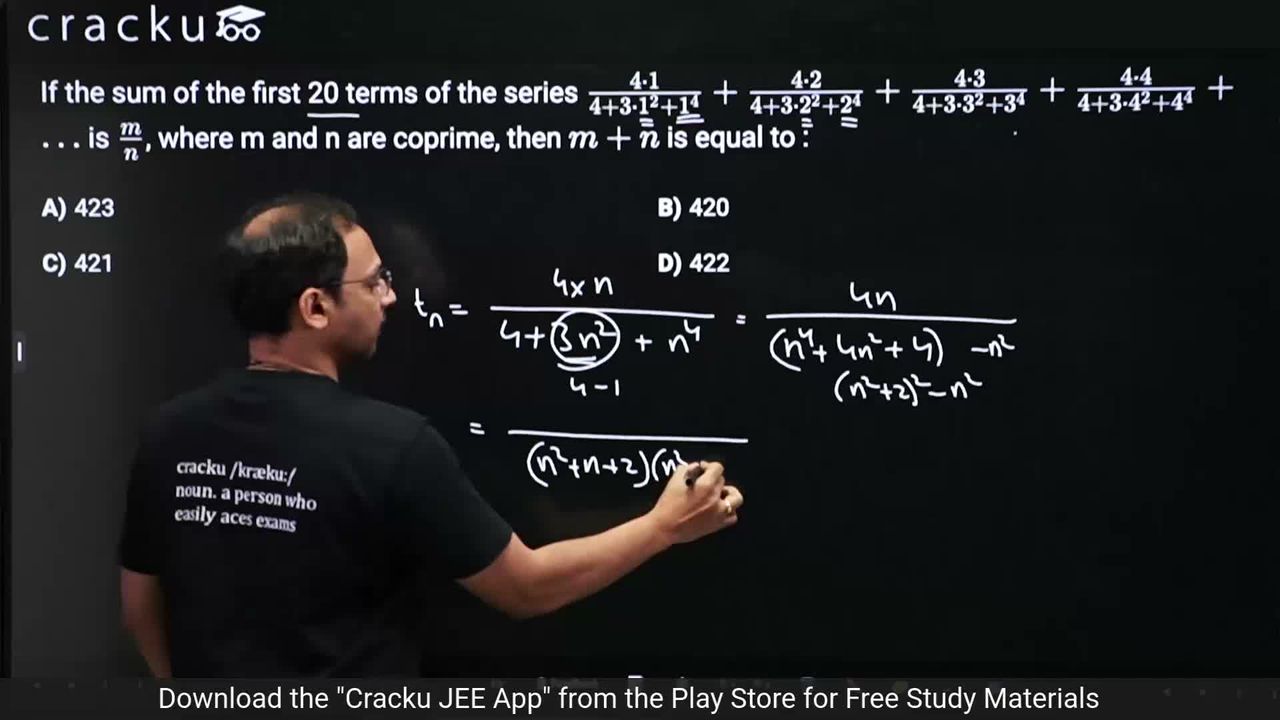
If the sum of the first 20 terms of the series $$\frac{4 \cdot 1}{4 + 3 \cdot 1^2 + 1^4} + \frac{4 \cdot 2}{4 + 3 \cdot 2^2 + 2^4} + \frac{4 \cdot 3}{4 + 3 \cdot 3^2 + 3^4} + \frac{4 \cdot 4}{4 + 3 \cdot 4^2 + 4^4} + \ldots$$ is $$\frac{m}{n}$$, where m and n are coprime, then $$m + n$$ is equal to :
Let the general term of the given series be $$T_r$$:
$$T_r = \frac{4r}{4 + 3r^2 + r^4}$$
The denominator can be factorized by completing the square:
$$r^4 + 3r^2 + 4 = (r^4 + 4r^2 + 4) - r^2 = (r^2 + 2)^2 - r^2$$
Using the difference of squares identity $$A^2 - B^2 = (A - B)(A + B)$$:
$$r^4 + 3r^2 + 4 = (r^2 - r + 2)(r^2 + r + 2)$$
---
Now, we rewrite the numerator $$4r$$ in terms of these two factors:
$$4r = 2 \left[ (r^2 + r + 2) - (r^2 - r + 2) \right]$$
Substituting this back into the expression for $$T_r$$:
$$T_r = \frac{2 \left[ (r^2 + r + 2) - (r^2 - r + 2) \right]}{(r^2 - r + 2)(r^2 + r + 2)}$$
$$T_r = \frac{2}{r^2 - r + 2} - \frac{2}{r^2 + r + 2}$$
This can be written in telescoping form as $$T_r = V_r - V_{r+1}$$, where $$V_r = \frac{2}{r^2 - r + 2}$$.
---
The sum of the first 20 terms is given by:
$$S_{20} = \sum_{r=1}^{20} T_r = \sum_{r=1}^{20} (V_r - V_{r+1})$$
$$S_{20} = (V_1 - V_2) + (V_2 - V_3) + \dots + (V_{20} - V_{21})$$
$$S_{20} = V_1 - V_{21}$$
---
Calculating the values of $$V_1$$ and $$V_{21}$$:
$$V_1 = \frac{2}{1^2 - 1 + 2} = \frac{2}{2} = 1$$
$$V_{21} = \frac{2}{21^2 - 21 + 2} = \frac{2}{441 - 21 + 2} = \frac{2}{422} = \frac{1}{211}$$
Substituting these back into the sum:
$$S_{20} = 1 - \frac{1}{211} = \frac{210}{211}$$
---
Comparing this with $$\frac{m}{n}$$, where $$m$$ and $$n$$ are coprime:
$$m = 210, \quad n = 211$$
The required value is:
$$m + n = 210 + 211 = 421$$
Therefore, the value of $$m + n$$ is equal to 421.
Click on the Email ☝️ to Watch the Video Solution
Create a FREE account and get:
_1.webp)

Educational materials for JEE preparation

Ask our AI anything

AI can make mistakes. Please verify important information.
AI can make mistakes. Please verify important information.


