
Join Our JEE Preparation Group
Prep with like-minded aspirants; Get access to free daily tests and study material.
Sign in
Please select an account to continue using cracku.in
↓ →
Join Our JEE Preparation Group
Prep with like-minded aspirants; Get access to free daily tests and study material.
A solid sphere of radius $$R$$ carries a charge $$Q + q$$ distributed uniformly over its volume. A very small point like piece of it of mass $$m$$ gets detached from the bottom of the sphere and falls down vertically under gravity. This piece carries charge $$q$$. If it acquires a speed $$v$$ when it has fallen through a vertical height $$y$$ (see figure), then (assume the remaining portion to be spherical)
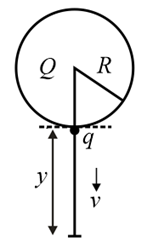
$$\Delta K + \Delta U_g + \Delta U_e = 0$$
$$\left(\frac{1}{2}mv^2 - 0\right) + (-mgy) + \left(\frac{qQ}{4\pi\varepsilon_0(R+y)} - \frac{qQ}{4\pi\varepsilon_0 R}\right) = 0$$
$$\frac{1}{2}mv^2 = mgy + \frac{qQ}{4\pi\varepsilon_0}\left(\frac{1}{R} - \frac{1}{R+y}\right)$$
$$\frac{1}{2}mv^2 = mgy + \frac{qQ}{4\pi\varepsilon_0}\left(\frac{y}{R(R+y)}\right)$$
$$v^2 = 2gy + \frac{2qQy}{4\pi\varepsilon_0 R(R+y)m}$$
$$v^2 = 2y\left[\frac{qQ}{4\pi\varepsilon_0 R(R+y)m} + g\right]$$
Was this solution helpful?
Create a FREE account and get:
_1.webp)

Educational materials for JEE preparation

Ask our AI anything

AI can make mistakes. Please verify important information.
AI can make mistakes. Please verify important information.


