
Join Our JEE Preparation Group
Prep with like-minded aspirants; Get access to free daily tests and study material.
Sign in
Please select an account to continue using cracku.in
↓ →
Join Our JEE Preparation Group
Prep with like-minded aspirants; Get access to free daily tests and study material.
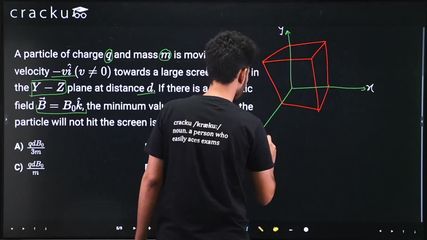
A particle of charge $$q$$ and mass $$m$$ is moving with a velocity $$-v\hat{i}$$ $$(v \neq 0)$$ towards a large screen placed in the $$Y-Z$$ plane at distance $$d$$. If there is a magnetic field $$\vec{B} = B_0\hat{k}$$, the minimum value of $$v$$ for which the particle will not hit the screen is:
We first write the Lorentz-force law for a charged particle moving in a magnetic field:
$$\vec F = q\,\vec v \times \vec B.$$
The magnetic field is along the positive $$z$$-axis,
$$\vec B = B_0 \hat k,$$
while the particle is shot towards the screen with velocity
$$\vec v = -\,v\hat i \qquad (v \neq 0).$$
Taking the cross-product we get
$$\vec v \times \vec B \;=\; (-\,v\hat i)\times(B_0\hat k) = -\,vB_0\;(\hat i \times \hat k) = -\,vB_0\,(-\hat j) = +\,vB_0\,\hat j,$$
so
$$\vec F = q\,vB_0\,\hat j.$$
The force (and therefore the acceleration) is along $$+y$$, perpendicular to the initial velocity. A constant force perpendicular to the velocity produces uniform circular motion in the plane perpendicular to $$\vec B$$ (the $$x\!-\!y$$ plane).
For such motion the magnetic force supplies the necessary centripetal force. Stating the formula,
$$\text{Centripetal force} = \frac{mv^{2}}{r}, \qquad \text{Magnetic force} = qvB_0,$$
and equating them gives
$$qvB_0 = \frac{mv^{2}}{r}.$$
Solving for the radius $$r$$ of the circular path,
$$r = \frac{mv}{qB_0}.$$
Let the screen be the plane $$x = 0$$. The particle starts from the point $$P(d,0)$$ and its initial velocity is towards $$-x$$. Because the acceleration is along $$+y$$, the centre of the circle lies a distance $$r$$ above the starting point, i.e. at $$C(d,\,r)$$. Hence the circle has centre abscissa $$x = d$$ and radius $$r$$. The left-most point of this circle (the point of smallest $$x$$) is therefore at
$$x_{\min} = d - r.$$
If the particle is to miss the screen, this left-most point must stay to the right of the screen, i.e.
$$x_{\min} > 0 \;\;\Longrightarrow\;\; d - r > 0 \;\;\Longrightarrow\;\; r < d.$$
The borderline (minimum) speed that just manages to avoid the screen occurs when the trajectory merely grazes it, i.e. when
$$r = d.$$
Substituting $$r = d$$ in the expression $$r = \dfrac{mv}{qB_0}$$, we obtain
$$d = \frac{mv_{\min}}{qB_0} \;\;\Longrightarrow\;\; v_{\min} = \frac{qB_0\,d}{m}.$$
Thus the least speed required so that the particle never reaches the screen is
$$v_{\min} = \frac{q\,d\,B_0}{m}.$$
Comparing with the given options, this corresponds to Option C.
Hence, the correct answer is Option C.
Was this solution helpful?
Click on the Email ☝️ to Watch the Video Solution
Create a FREE account and get:
_1.webp)

Educational materials for JEE preparation

Ask our AI anything

AI can make mistakes. Please verify important information.
AI can make mistakes. Please verify important information.
