
Join Our JEE Preparation Group
Prep with like-minded aspirants; Get access to free daily tests and study material.
Sign in
Please select an account to continue using cracku.in
↓ →
Join Our JEE Preparation Group
Prep with like-minded aspirants; Get access to free daily tests and study material.
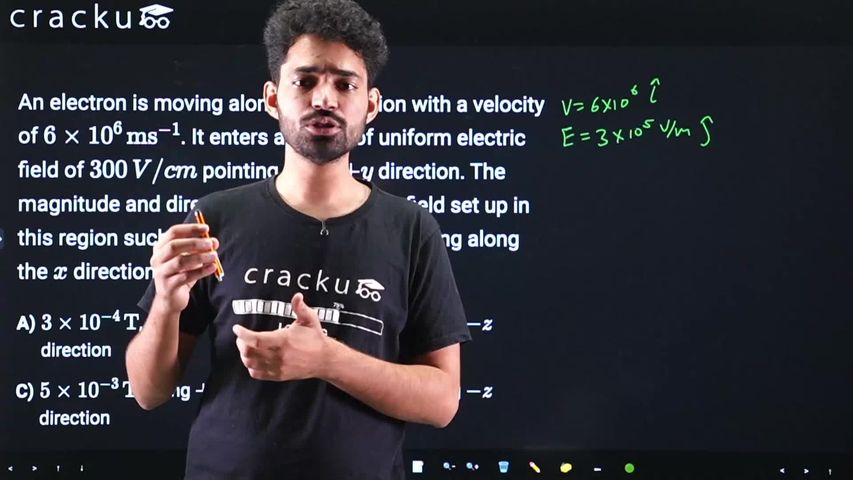
An electron is moving along $$+x$$ direction with a velocity of $$6 \times 10^6\,\text{ms}^{-1}$$. It enters a region of uniform electric field of $$300\,V/cm$$ pointing along $$+y$$ direction. The magnitude and direction of the magnetic field set up in this region such that the electron keeps moving along the $$x$$ direction will be:
We have an electron whose velocity is strictly along the $$+x$$-axis, so we write
$$\vec v = 6 \times 10^{6}\,\text{m s}^{-1}\,\hat i.$$
The region also possesses a uniform electric field pointing along $$+y$$, that is
$$\vec E = 300\,\text{V cm}^{-1}\,\hat j.$$
First, we convert this electric field into SI units. Since $$1\,\text{cm}=10^{-2}\,\text{m},$$ we obtain
$$300\,\text{V cm}^{-1}=300 \times 10^{2}\,\text{V m}^{-1}=3.0 \times 10^{4}\,\text{V m}^{-1}.$$
For a charge $$q$$ moving in simultaneous electric and magnetic fields, the Lorentz force formula is stated as
$$\vec F = q\bigl(\vec E + \vec v \times \vec B\bigr).$$
We want the electron to continue moving only along the $$x$$-direction, which means the net transverse force must vanish. Hence we require
$$\vec F = \vec 0 \Longrightarrow \vec E + \vec v \times \vec B = \vec 0.$$
Re-arranging gives
$$\vec v \times \vec B = -\vec E.$$
Because the electron carries charge $$q=-e,$$ its electric force is $$\vec F_E = -e\vec E.$$ Since $$\vec E$$ is along $$+y,$$ $$\vec F_E$$ is along $$-y.$$ Therefore the magnetic force $$\vec F_B = q(\vec v \times \vec B)$$ must point along $$+y$$ in order to exactly cancel $$\vec F_E.$$ To secure that direction we inspect the cross-product:
$$\vec v = v\,\hat i, \qquad \vec B = B\,\hat k \;(\text{assume}).$$
Using the right-hand rule,
$$\hat i \times \hat k = -\hat j,$$
so
$$\vec v \times \vec B = vB(-\hat j).$$
Multiplying by the electron’s charge $$q=-e$$ gives
$$q(\vec v \times \vec B) = (-e)\bigl(vB(-\hat j)\bigr)=+e vB\,\hat j,$$
which indeed points along $$+y$$ as required. Hence our initial assumption that $$\vec B$$ is along $$+z$$ ($$\hat k$$) is correct. The magnetic field must therefore be directed along $$+z$$.
To find its magnitude, we equate the magnitudes of the electric and magnetic forces:
$$eE = e v B \quad\Longrightarrow\quad B = \frac{E}{v}.$$
Substituting $$E = 3.0 \times 10^{4}\,\text{V m}^{-1}$$ and $$v = 6 \times 10^{6}\,\text{m s}^{-1},$$ we obtain
$$B = \frac{3.0 \times 10^{4}}{6 \times 10^{6}}\,\text{T} = 0.5 \times 10^{-2}\,\text{T} = 5 \times 10^{-3}\,\text{T}.$$
Thus, a magnetic field of magnitude $$5 \times 10^{-3}\,\text{T}$$ directed along $$+z$$ will ensure the electron continues straight along the $$x$$-axis.
Hence, the correct answer is Option C.
Was this solution helpful?
Click on the Email ☝️ to Watch the Video Solution
Create a FREE account and get:
_1.webp)

Educational materials for JEE preparation

Ask our AI anything

AI can make mistakes. Please verify important information.
AI can make mistakes. Please verify important information.
