
Join Our JEE Preparation Group
Prep with like-minded aspirants; Get access to free daily tests and study material.
Sign in
Please select an account to continue using cracku.in
↓ →
Join Our JEE Preparation Group
Prep with like-minded aspirants; Get access to free daily tests and study material.
A parallel-plate capacitor with plate area $$A$$ has separation $$d$$ between the plates. Two dielectric slabs of dielectric constant $$K_1$$ and $$K_2$$ of same area $$\frac{A}{2}$$ and thickness $$\frac{d}{2}$$ are inserted in the space between the plates. The capacitance of the capacitor will be given by:
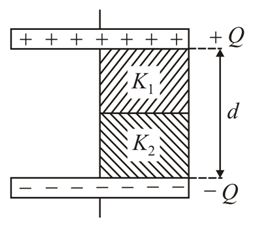
We need to find the total capacitance of a parallel-plate capacitor when it is partially filled with two different dielectric slabs of dielectric constants $$K_1$$ and $$K_2$$.
Let's break the setup down into individual capacitor components by analyzing how the space is filled:
The standard formula for the capacitance of a parallel-plate capacitor with area $$A'$$, plate separation $$d'$$, and filled with a dielectric constant $$K$$ is given by:
$$C = \frac{K \varepsilon_0 A'}{d'}$$
Both capacitors share a reduced plate area of $$A' = \frac{A}{2}$$ and a halved thickness of $$d' = \frac{d}{2}$$.
$$C_1 = \frac{K_1 \varepsilon_0 \left(\frac{A}{2}\right)}{\frac{d}{2}} = \frac{K_1 \varepsilon_0 A}{d}$$
$$C_2 = \frac{K_2 \varepsilon_0 \left(\frac{A}{2}\right)}{\frac{d}{2}} = \frac{K_2 \varepsilon_0 A}{d}$$
This section contains air ($$K = 1$$), has an area of $$A' = \frac{A}{2}$$, and spans the full distance $$d' = d$$.
$$C_3 = \frac{1 \cdot \varepsilon_0 \left(\frac{A}{2}\right)}{d} = \frac{\varepsilon_0 A}{2d}$$
Since $$C_1$$ and $$C_2$$ are connected back-to-back in series across the vertical voltage drop, their equivalent capacitance is calculated as:
$$\frac{1}{C_{\text{series}}} = \frac{1}{C_1} + \frac{1}{C_2} = \frac{d}{K_1 \varepsilon_0 A} + \frac{d}{K_2 \varepsilon_0 A}$$
$$\frac{1}{C_{\text{series}}} = \frac{d}{\varepsilon_0 A} \left( \frac{1}{K_1} + \frac{1}{K_2} \right) = \frac{d}{\varepsilon_0 A} \left( \frac{K_1 + K_2}{K_1 K_2} \right)$$
$$C_{\text{series}} = \frac{\varepsilon_0 A}{d} \left( \frac{K_1 K_2}{K_1 + K_2} \right)$$
The empty air branch ($$C_3$$) and the dielectric-filled branch ($$C_{\text{series}}$$) sit side-by-side, sharing the same top and bottom plates. Therefore, they are arranged in a parallel configuration:
$$C_{\text{total}} = C_3 + C_{\text{series}}$$
$$C_{\text{total}} = \frac{\varepsilon_0 A}{2d} + \frac{\varepsilon_0 A}{d} \left( \frac{K_1 K_2}{K_1 + K_2} \right)$$
Factoring out the common term $$\frac{\varepsilon_0 A}{d}$$ gives the final expressions:
$$C_{\text{total}} = \frac{\varepsilon_0 A}{d} \left( \frac{1}{2} + \frac{K_1 K_2}{K_1 + K_2} \right)$$
Final Answer: Option A $$\left[ \frac{\varepsilon_0 A}{d} \left( \frac{1}{2} + \frac{K_1 K_2}{K_1 + K_2} \right) \right]$$
Was this solution helpful?
Create a FREE account and get:
_1.webp)

Educational materials for JEE preparation

Ask our AI anything

AI can make mistakes. Please verify important information.
AI can make mistakes. Please verify important information.
