
Join Our JEE Preparation Group
Prep with like-minded aspirants; Get access to free daily tests and study material.
Sign in
Please select an account to continue using cracku.in
↓ →
Join Our JEE Preparation Group
Prep with like-minded aspirants; Get access to free daily tests and study material.
A capacitor is made of two square plates each of side 'a' making a very small angle $$\alpha$$ between them, as shown in figure. The capacitance will be close to:
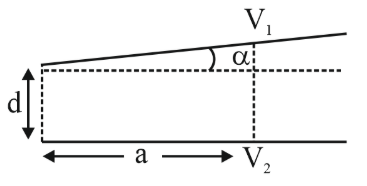
Separation distance between plates at distance $$x$$ from the left end: $$y(x) = d + x\tan\alpha \approx d + x\alpha$$
Capacitance of a differential strip of width $$dx$$ and length $$a$$: $$dC = \frac{\varepsilon_0 a \, dx}{y(x)} = \frac{\varepsilon_0 a \, dx}{d + \alpha x}$$
Since elemental strips are connected in parallel across the common plates:
$$C = \int_{0}^{a} dC = \int_{0}^{a} \frac{\varepsilon_0 a \, dx}{d + \alpha x}$$
$$C = \frac{\varepsilon_0 a}{\alpha} \left[ \ln(d + \alpha x) \right]_0^a = \frac{\varepsilon_0 a}{\alpha} \ln\left(1 + \frac{\alpha a}{d}\right)$$
Using the Taylor expansion $$\ln(1 + z) \approx z - \frac{z^2}{2}$$ since $$\alpha \ll 1$$:
$$C \approx \frac{\varepsilon_0 a}{\alpha} \left( \frac{\alpha a}{d} - \frac{\alpha^2 a^2}{2d^2} \right) = \frac{\varepsilon_0 a^2}{d} \left( 1 - \frac{\alpha a}{2d} \right)$$
Was this solution helpful?
Create a FREE account and get:
_1.webp)

Educational materials for JEE preparation

Ask our AI anything

AI can make mistakes. Please verify important information.
AI can make mistakes. Please verify important information.


