
Join Our JEE Preparation Group
Prep with like-minded aspirants; Get access to free daily tests and study material.
Sign in
Please select an account to continue using cracku.in
↓ →
Join Our JEE Preparation Group
Prep with like-minded aspirants; Get access to free daily tests and study material.
Two particles $$A$$ and $$B$$ having charges 20 $$\mu$$C and $$-5$$ $$\mu$$C respectively are held fixed with a separation of 5 cm. At what position a third charged particle should be placed so that it does not experience a net electric force?
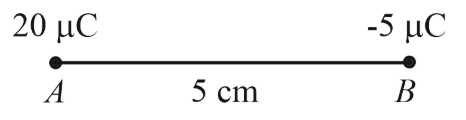
We need to find the position where a third charged particle should be placed along the line connecting two fixed charges, $$A$$ and $$B$$, such that it experiences a net electric force of zero (electrostatic equilibrium).
Let's write down the properties of the two fixed charges:
Since the two charges have opposite signs (one is positive and the other is negative), the net electric force can never be zero at any point between them. In the region between them, the forces exerted by both charges on a third test charge would point in the same direction.
Therefore, the equilibrium position must lie outside the two charges, specifically on the side of the smaller magnitude charge to balance out the stronger push/pull from the larger charge. This means the third charge must be placed to the right of charge $$B$$ ($$-5\ \mu\text{C}$$).
Let the third charge $$q_3$$ be placed at a distance $$x$$ to the right of charge $$B$$.
For the net force on $$q_3$$ to be zero, the magnitude of the electrostatic force exerted by charge $$A$$ must equal the magnitude of the force exerted by charge $$B$$:
$$\frac{1}{4\pi\varepsilon_0} \frac{|q_A| \cdot |q_3|}{(5 + x)^2} = \frac{1}{4\pi\varepsilon_0} \frac{|q_B| \cdot |q_3|}{x^2}$$
We can simplify the equation by cancelling out the common constants ($$\frac{1}{4\pi\varepsilon_0}$$ and $$|q_3|$$):
$$\frac{20}{(5 + x)^2} = \frac{5}{x^2}$$
Dividing both sides by 5:
$$\frac{4}{(5 + x)^2} = \frac{1}{x^2}$$
Taking the square root on both sides to solve cleanly:
$$\frac{2}{5 + x} = \frac{1}{x}$$
Cross-multiplying the terms:
$$2x = 5 + x$$
$$2x - x = 5$$
$$x = 5\text{ cm}$$
The calculation shows that the third charge should be placed at a distance of $$5\text{ cm}$$ from the $$-5\ \mu\text{C}$$ charge on the outer right side of the line connecting the system.
Correct Option: A (At 5 cm from $$-5\ \mu\text{C}$$ on the right side)
Was this solution helpful?
Create a FREE account and get:
_1.webp)

Educational materials for JEE preparation

Ask our AI anything

AI can make mistakes. Please verify important information.
AI can make mistakes. Please verify important information.
