
Join Our JEE Preparation Group
Prep with like-minded aspirants; Get access to free daily tests and study material.
Sign in
Please select an account to continue using cracku.in
↓ →
Join Our JEE Preparation Group
Prep with like-minded aspirants; Get access to free daily tests and study material.
The velocity-displacement graph of a particle is shown in the figure.
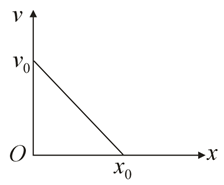
The acceleration-displacement graph of the same particle is represented by :
We need to find the correct acceleration-displacement ($$a-x$$) graph corresponding to the given velocity-displacement ($$v-x$$) graph of a particle.
From the problem statement, the velocity decreases linearly with displacement $$x$$. This straight line has a positive vertical intercept and a negative slope.
We can write the equation of this line using the slope-intercept form ($$y = mx + c$$):
$$v = -mx + v_0 \quad \text{--- (Equation 1)}$$
Where:
Acceleration $$a$$ is defined as the rate of change of velocity with respect to time ($$\frac{dv}{dt}$$). Using the chain rule, we can express it in terms of displacement $$x$$:
$$a = \frac{dv}{dt} = \frac{dv}{dx} \cdot \frac{dx}{dt}$$
Since $$\frac{dx}{dt} = v$$, the relationship simplifies to:
$$a = v \cdot \frac{dv}{dx}$$
Now, let's find the components from Equation 1:
$$\frac{dv}{dx} = -m$$
$$a = (-mx + v_0) \cdot (-m)$$
$$a = m^2x - mv_0 \quad \text{--- (Equation 2)}$$
Equation 2 ($$a = m^2x - mv_0$$) is also a linear equation representing a straight line on an $$a \text{ vs } x$$ coordinate plane:
Looking at the options, the graph that features a straight line starting from a negative vertical intercept and sloping upwards to cross the $$x$$-axis is Option C.
The correct acceleration-displacement graph is represented by Option C.
Was this solution helpful?
Click on the Email ☝️ to Watch the Video Solution
Create a FREE account and get:
_1.webp)

Educational materials for JEE preparation

Ask our AI anything

AI can make mistakes. Please verify important information.
AI can make mistakes. Please verify important information.
