
Join Our JEE Preparation Group
Prep with like-minded aspirants; Get access to free daily tests and study material.
Sign in
Please select an account to continue using cracku.in
↓ →
Join Our JEE Preparation Group
Prep with like-minded aspirants; Get access to free daily tests and study material.
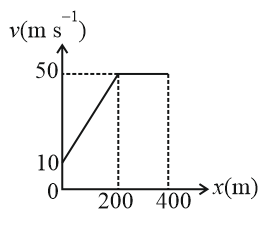
The velocity-displacement graph describing the motion of a bicycle is shown in the figure.
The acceleration-displacement graph of the bicycle's motion is best described by:
We need to determine the acceleration-displacement ($$a-x$$) graph from the given velocity-displacement ($$v-x$$) graph of the bicycle's motion.
The acceleration $$a$$ as a function of velocity $$v$$ and displacement $$x$$ is given by the relation: $$a = v \frac{dv}{dx}$$, where $$\frac{dv}{dx}$$ represents the slope of the $$v-x$$ graph.
Let's analyze the motion in two distinct regions based on the graph:
Region 1: From $$x = 0$$ to $$x = 200\text{ m}$$
The $$v-x$$ graph is a straight line starting from $$(0, 10)$$ and ending at $$(200, 50)$$. The equation of this straight line is of the form $$v = mx + c$$.
The slope of this line is: $$\frac{dv}{dx} = \frac{50 - 10}{200 - 0} = \frac{40}{200} = 0.2\text{ s}^{-1}$$.
The intercept on the vertical axis is $$c = 10$$, so the velocity equation is: $$v = 0.2x + 10$$.
Substituting $$v$$ and $$\frac{dv}{dx}$$ into the acceleration formula gives: $$a = (0.2x + 10) \times 0.2 = 0.04x + 2$$.
This is a straight-line equation for acceleration with a positive slope ($$0.04$$) and a vertical intercept of $$2\text{ m s}^{-2}$$.
• At $$x = 0\text{ m}$$, the acceleration is: $$a = 0.04(0) + 2 = 2\text{ m s}^{-2}$$.
• At $$x = 200\text{ m}$$, the acceleration is: $$a = 0.04(200) + 2 = 8 + 2 = 10\text{ m s}^{-2}$$.
Region 2: From $$x = 200\text{ m}$$ to $$x = 400\text{ m}$$
The velocity is constant at $$v = 50\text{ m s}^{-1}$$. Therefore, the slope of the graph is zero: $$\frac{dv}{dx} = 0$$.
Substituting this into the acceleration formula gives: $$a = 50 \times 0 = 0\text{ m s}^{-2}$$.
Combining both regions, the acceleration $$a$$ increases linearly from $$2\text{ m s}^{-2}$$ to $$10\text{ m s}^{-2}$$ in the first 200 meters, and then drops instantly and remains at $$0\text{ m s}^{-2}$$ from 200 meters to 400 meters.
Therefore, the correct description matches the graph where $$a$$ starts at 2, rises to 10 at $$x = 200\text{ m}$$, and becomes 0 thereafter.
Was this solution helpful?
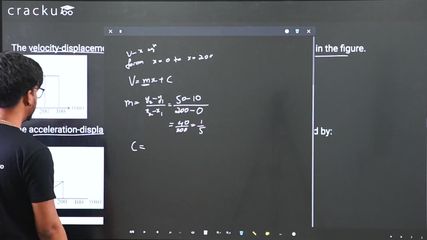
Click on the Email ☝️ to Watch the Video Solution
Create a FREE account and get:
_1.webp)

Educational materials for JEE preparation

Ask our AI anything

AI can make mistakes. Please verify important information.
AI can make mistakes. Please verify important information.
