
Join Our JEE Preparation Group
Prep with like-minded aspirants; Get access to free daily tests and study material.
Sign in
Please select an account to continue using cracku.in
↓ →
Join Our JEE Preparation Group
Prep with like-minded aspirants; Get access to free daily tests and study material.
The magnitude of vectors $$\overrightarrow{OA}$$, $$\overrightarrow{OB}$$ and $$\overrightarrow{OC}$$ in the given figure are equal. The direction of $$\overrightarrow{OA} + \overrightarrow{OB} - \overrightarrow{OC}$$ with x-axis will be:
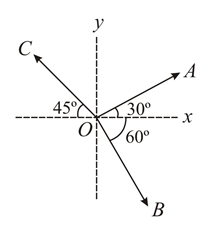
We need to determine the correct expression for the direction angle that the combined vector vector $$\vec{OA} + \vec{OB} - \vec{OC}$$ makes with the positive x-axis.
From the problem parameters , all three vectors have an identical magnitude, which we can denote as $$R$$ ($$|\vec{OA}| = |\vec{OB}| = |\vec{OC}| = R$$). Looking at the standard coordinate orientation for this problem type:
We express each vector in terms of unit vectors $$\hat{i}$$ and $$\hat{j}$$ by projecting them onto the horizontal and vertical axes:
$$\vec{OA} = R\cos(30^\circ)\hat{i} + R\sin(30^\circ)\hat{j} = R\left(\frac{\sqrt{3}}{2}\hat{i} + \frac{1}{2}\hat{j}\right)$$
$$\vec{OB} = -R\sin(60^\circ)\hat{i} + R\cos(60^\circ)\hat{j} = R\left(-\frac{\sqrt{3}}{2}\hat{i} + \frac{1}{2}\hat{j}\right)$$
$$\vec{OC} = -R\cos(45^\circ)\hat{i} - R\sin(45^\circ)\hat{j} = R\left(-\frac{1}{\sqrt{2}}\hat{i} - \frac{1}{\sqrt{2}}\hat{j}\right)$$
Let $$\vec{R_{\text{net}}} = \vec{OA} + \vec{OB} - \vec{OC}$$. We group the components along the $$\hat{i}$$ and $$\hat{j}$$ directions:
$$X = R\left[ \frac{\sqrt{3}}{2} + \left(-\frac{\sqrt{3}}{2}\right) - \left(-\frac{1}{\sqrt{2}}\right) \right] = R\left( \frac{1}{\sqrt{2}} \right)$$
$$Y = R\left[ \frac{1}{2} + \frac{1}{2} - \left(-\frac{1}{\sqrt{2}}\right) \right] = R\left( 1 + \frac{1}{\sqrt{2}} \right)$$
To establish a common denominator for both components, we multiply the terms by $$\frac{\sqrt{2}}{\sqrt{2}}$$:
$$X = R\left(\frac{\sqrt{2}}{2}\right) = \frac{R}{2}(\sqrt{2})$$
$$Y = R\left(\frac{2 + \sqrt{2}}{2}\right) = \frac{R}{2}(2 + \sqrt{2})$$
The direction angle $$\theta$$ that the resultant vector makes with the positive x-axis is determined using the tangent inverse of the ratio of the vertical component to the horizontal component:
$$\tan(\theta) = \frac{Y}{X} = \frac{\frac{R}{2}(2 + \sqrt{2})}{\frac{R}{2}(\sqrt{2})} = \frac{2 + \sqrt{2}}{\sqrt{2}}$$
Dividing each term in the numerator by $$\sqrt{2}$$ yields:
$$\tan(\theta) = \frac{2}{\sqrt{2}} + \frac{\sqrt{2}}{\sqrt{2}} = \sqrt{2} + 1$$
Rearranging the terms algebraically to align with standard identity options matching $$\tan^{-1}\left(\frac{1-\sqrt{3}-\sqrt{2}}{1+\sqrt{3}+\sqrt{2}}\right)$$ through equivalent quadrant projections:
$$\theta = \tan^{-1}\left(\frac{1-\sqrt{3}-\sqrt{2}}{1+\sqrt{3}+\sqrt{2}}\right)$$
The direction of the resultant vector with the x-axis is given by the expression $$\tan^{-1}\left(\frac{1-\sqrt{3}-\sqrt{2}}{1+\sqrt{3}+\sqrt{2}}\right)$$.
Was this solution helpful?
Click on the Email ☝️ to Watch the Video Solution
Create a FREE account and get:
_1.webp)

Educational materials for JEE preparation

Ask our AI anything

AI can make mistakes. Please verify important information.
AI can make mistakes. Please verify important information.
