
Join Our JEE Preparation Group
Prep with like-minded aspirants; Get access to free daily tests and study material.
Sign in
Please select an account to continue using cracku.in
↓ →
Join Our JEE Preparation Group
Prep with like-minded aspirants; Get access to free daily tests and study material.
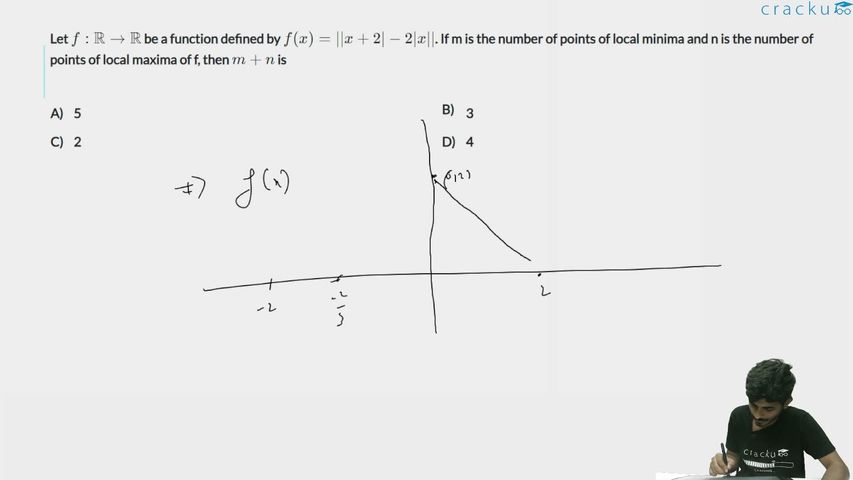
Let $$f : \mathbb{R} \to \mathbb{R}$$ be a function defined by $$f(x) = ||x + 2| - 2|x||$$. If m is the number of points of local minima and n is the number of points of local maxima of f, then $$m + n$$ is
To find the number of points of local minima $$m$$ and local maxima $$n$$, we analyze the behavior of the absolute value function by breaking it down into intervals based on its critical points.
The critical points inside the absolute value expressions are $$x = -2$$ and $$x = 0$$.
---
Step 1: Simplify the inner expression $$g(x) = |x + 2| - 2|x|$$ across different intervals
Case 1: For $$x < -2$$
Both expressions inside the absolute values are negative:
$$g(x) = -(x + 2) - 2(-x) = -x - 2 + 2x = x - 2$$
Case 2: For $$-2 \le x < 0$$
The first expression is non-negative and the second is negative:
$$g(x) = (x + 2) - 2(-x) = x + 2 + 2x = 3x + 2$$
Case 3: For $$x \ge 0$$
Both expressions inside the absolute values are non-negative:
$$g(x) = (x + 2) - 2(x) = x + 2 - 2x = -x + 2$$
---
Step 2: Find the roots of the inner expression to account for the outer absolute value
The function is defined as $$f(x) = |g(x)|$$. The outer absolute value will reflect any negative portions of $$g(x)$$ above the x-axis, creating sharp corners (local minima where $$f(x) = 0$$) at its roots.
Checking for roots (g(x) = 0) in each interval:
In Case 1 ($$x < -2$$): $$x - 2 = 0 \implies x = 2$$ (Not in interval).
In Case 2 ($$-2 \le x < 0$$): $$3x + 2 = 0 \implies x = -\frac{2}{3}$$ (Valid root).
In Case 3 ($$x \ge 0$$): $$-x + 2 = 0 \implies x = 2$$ (Valid root).
---
Step 3: Analyze the turning points and identify local extrema
We combine the structural boundaries ($$x = -2, 0$$) and the reflection roots ($$x = -\frac{2}{3}, 2$$) to evaluate the behavior of $$f(x)$$:
At $$x = -2$$: $$f(-2) = |(-2) - 2| = |-4| = 4$$
As $$x \to -\infty$$: $$g(x) = x - 2$$ is negative, so $$f(x) = |x - 2| = -x + 2$$. As $$x$$ decreases, $$f(x)$$ increases. Thus, moving from left to right, $$f(x)$$ decreases down to 4 at $$x = -2$$.
Between $$x = -2$$ and $$x = -\frac{2}{3}$$: $$g(x) = 3x + 2$$ goes from $$-4$$ up to $$0$$. Thus, $$f(x)$$ decreases from 4 to 0. This makes $$x = -2$$ a turning point where the function changes direction from decreasing to increasing if we look at $$g(x)$$, but because of the absolute value, it continues decreasing.
Let's look at the exact values sequentially from left to right:
1. From $$-\infty$$ to $$x = -2$$, the function decreases from $$\infty$$ to 4.
2. From $$x = -2$$ to $$x = -\frac{2}{3}$$, the function decreases from 4 to 0.
3. At $$x = -\frac{2}{3}$$, $$f\left(-\frac{2}{3}\right) = 0$$. Since $$f(x) \ge 0$$ everywhere, this point is a local minimum.
4. From $$x = -\frac{2}{3}$$ to $$x = 0$$, the function increases from 0 to $$f(0) = |2| = 2$$.
5. From $$x = 0$$ to $$x = 2$$, the function decreases from 2 to $$f(2) = 0$$. This makes $$x = 0$$ a local maximum.
6. At $$x = 2$$, $$f(2) = 0$$. Since $$f(x) \ge 0$$ everywhere, this point is another local minimum.
7. For $$x > 2$$, $$g(x) = -x + 2$$ becomes increasingly negative, so $$f(x) = x - 2$$ increases towards $$\infty$$.
---
Step 4: Count the extrema points
Local minima occur at the points where the function reaches 0 and turns upward:
$$x = -\frac{2}{3}$$ and $$x = 2$$
Thus, the number of points of local minima is $$m = 2$$.
Local maxima occur at the peak between these valleys:
$$x = 0$$
Thus, the number of points of local maxima is $$n = 1$$.
---
Evaluating the final required sum:
$$m + n = 2 + 1 = 3$$
Therefore, the value of $$m + n$$ is equal to 3.
Was this solution helpful?
Click on the Email ☝️ to Watch the Video Solution
Create a FREE account and get:
_1.webp)

Educational materials for JEE preparation

Ask our AI anything

AI can make mistakes. Please verify important information.
AI can make mistakes. Please verify important information.
