Please select an account to continue using cracku.in
↓→
SSC Geometry Questions
SSC Geometry Questions
Question 1
What is the total surface area of a cone whose radius is 15 cm and height is 8 cm?
Question 2
Find the area of the triangle whose height is 35.7 cm and the base is 1/7th of the height.
Question 3
Calculate the area of a right-angled triangle with a base of 22 cm and height corresponding to that base is 15 cm.
Question 4
How many spherical balls of radius 8 cm can be made by melting a hemisphere of radius 48 cm?
Question 5
The radius of a hemisphere is 3.5 cm. What will be its volume?
Question 6
Find the area of a triangle with a base of 12 cm and the height corresponding to that base is 1/3rd the length of the base.
Question 7
What is the curved surface area of a cylinder having radius of base as 70 cm and height as 14 cm?
Question 8
The radius of a circle is increased by 35 percent. What will be the percentage increase in its area?
Question 9
Parallel sides of a trapezium are 15 cm and 16 cm and its area is 961 $$cm^{2}$$. What is the distance between parallel sides?
Question 10
The radius of a hemisphere is 2.1 cm. What will be its volume?
Question 11
What is the total surface area of a cone whose radius is 24 cm and height is 10 cm?
Question 12
The diameter of a hemisphere is 21 cm. What is the total surface area of the hemisphere?
Question 13
Radius of a sphere is increased by 50 percent. What will be the percentage increase in its volume?
Question 14
The length of the side of a cube is 13 cm. What is the lateral surface area of the cube?
Question 15
What is the total surface area of a cylinder having radius of base as 4.2 cm and height as 8 cm?
Question 16
Find the area of die right angled triangle if the longest side of a right angled triangle is 17 cm and the height is 15 cm.
Question 17
Height of a cone is 24 cm and radius of its base is 10.5 cm. What is the volume of the cone?
Question 18
If the perimeter of a rhombus is 200 cm and one of its diagonal is 80 cm, then what ts the area of the rhombus?
Question 19
If total surface area of a cube is 600 cm$$^2$$, then what is the volume of cube?
Question 1
A pyramid has an equilateral triangle as its base, of which each side is 8 cm. Its slant edge is 24 cm. The whole surface area of the pyramid (in $$cm^{2}$$) is:
Question 2
A circle touches all four sides of a quadrilateral ABCD. If AB = 18 cm, BC = 21 cm and AD = 15 cm, then length CD is:
Question 3
What is the volume of a cylinder if the radius of the cylinder is 10 cm and height is 20 cm? (Take $$\pi = 3.14$$)
Question 4
The total surface area of a square-based right pyramid is 1536 $$m^{2}$$, of which 37.5% is the area of the base of the pyramid. What is the volume (in $$m^{3}$$) of this pyramid?
Question 5
If the diameter of a sphere is reduced to its half, then the volume would be:
Question 6
If the volume of a sphere is 38808 $$cm^{3}$$, then its surface area is:
Question 7
In a circle of radius 42 cm, an arc subtends an angle of 60° at the centre. Find the length of the arc.
(Take $$ \pi = \cfrac{22}{7}$$)
Question 8
The area of a rhombus having one side measuring 17 cm and one diagonal measuring 16 cm is:
Question 9
The radius of a circle is 1.75 cm. What is the circumference of the circle?
(Take $$ \pi = \frac{22}{7}$$)
Question 10
The radius of the base of a right circular cone is 5 cm. Its slant height is 13 cm. What is its volume (in $$cm^{3}$$ , rounded off to 1 decimal place)? (Take $$ \pi = \frac{22}{7}$$)
Question 11
A conical shape vessel has a radius of 21 cm and has a slant height of 25 cm. If the curved part of the vessel is to be painted white, find the cost (in ₹) of painting at the rate of ₹1.5 per $$cm^{2}$$.
Question 12
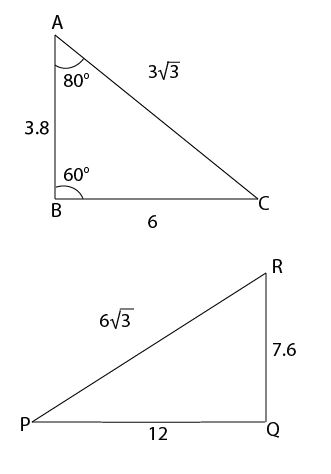
In a $$\triangle PQR$$ and $$\triangle ABC, \angle P = \angle A$$ and $$AC = PR$$. Which of the following conditions is true for triangle PQR and ABC to be congruent?
Question 13
The total surface area of a solid hemisphere is 4158 $$cm^{2}$$. Find its volume (in $$cm^{3}$$).
Question 14
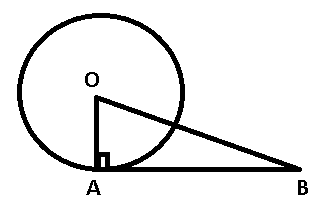
Let C be a circle with centre O and radius 5 cm. Let PQ be a tangent to the circle and A be the point of tangency. Let B be a point on PQ such that the length of AB is 12 cm. If the line joining O and B intersects the circle at R, find the length of BR (in cm).
Question 15
What is the volume of the largest sphere that can be carved out of a wooden cube of sides 21 cm? (Take $$ \pi = \frac{22}{7}$$)
Question 16
What will be the difference between the total surface area and the curved surface area of a hemisphere having 4 cm diameter?
Question 17
The area of an equilateral triangle is $$4\sqrt{3} cm^{2}$$. Find the side (in cm) of the triangle.
Question 18
Find the area of a triangle whose length of two sides are 4 cm and 5 cm and the angle between them is $$45^{\circ}$$.
Question 19
The cost of painting the total surface area of a 30 m high solid right circular cylinder at the rate of ₹25 per $$m^{2}$$ is ₹18,425. What is the volume (in $$m^{3}$$) of this cylinder [use $$ \pi \frac{22}{7}$$]?
Question 20
What is the length (in cm) of the transverse common tangent between two circles with radii 6 cm and 4 cm, given that the distance between their centres is 14 cm?
Question 21
The areas of the two triangles are in the ratio 4 : 3 and their heights are in the ratio 6 : 5. Find the ratio of their bases.
Question 22
The volume of a sphere is given by 130977 $$cm^{3}$$. Its surface area (in $$cm^{2}$$) is:
Question 23
ABCD is a cyclic quadrilateral and BC is a diameter of the related circle on which A and D also lie. $$\angle BCA = 19^{\circ}$$ and $$\angle CAD = 32^{\circ}$$. What is the measure of $$\angle ACD$$?
Question 24
Find the number of diagonals of a regular polygon, sum of whose interior angles is $$2700^{\circ}$$.
Question 25
PQR is an equilateral triangle inscribed in a circle. S is any point on the arc QR. Measure of $$\frac{1}{2} < PSQ$$ is:
Question 26
If the height of a cone is 7 cm and the diameter of the circular base is 12 cm, then its volume is (nearest to integer):
Question 27
The area of a rectangular field is 480 $$m^{2}$$. If the length is 20% more than the breadth, then the length of the rectangular field is:
Question 28
In a circle centred at O, PQ is a tangent at P. Furthermore, AB is the chord of the circle and is extended to Q. If PQ = 12 cm and QB = 8 cm, then the length of AB is equal to:
Question 29
The curved surface area of a cone whose base radius is 7 cm and slant height is 10 cm is:
Question 30
A sector of a circle has a central angle of $$45^{\circ}$$ and an arc length of 22 cm. Find the radius of the. circle. [Use $$\pi = \frac{22}{7}$$]
Question 31
Find the area of a rhombus if the perimeter of the rhombus is 52 cm, and one of its diagonals is 10 cm long.
Question 32
The diameter of a hemisphere is equal to the diagonal of a rectangle of length 4 cm and breadth 3 cm. Find the total surface area (in $$cm^{2}$$ ) of the hemisphere.
Question 33
A cylindrical metallic rod of diameter 2 cm and length 45 cm is melted and converted into wire of uniform thickness and length 5 m. The diameter of the wire is:
Question 34
Find the total surface area of a sphere whose volume is $$\cfrac{256}{3} \pi cm^{3}$$.
Question 35
If the base radius and the height of a right circular cone are increased by 10%, then the percentage increase in the volume is:
Question 36
If one of the interior angles of a regular polygon is $$\frac{15}{16}$$ times of one of the interior angles of a regular decagon, then find the number of diagonals of the polygon.
Question 37
Some medicine in liquid form is prepared in a hemispherical container of diameter 36 cm. When the container is full of medicine, the medicine is transferred to small cylindrical bottles of diameter 6 cm and height 6 cm. How many bottles are required to empty the container?
Question 38
The volume of a right circular cone having a base diameter of 14 cm is 196π $$cm^{3}$$. Find the perpendicular height of this cone
Question 39
A cylinder has some water in it at a height of 16 cm. If a sphere of radius 9 cm is put into it, then find the rise in the height of the water if the radius of the cylinder is 12 cm.
Question 40
If perimeter of the circle is 13.2 cm, then the radius of the circle is ____________.
(Take $$ \pi = \cfrac{22}{7}$$)
Question 41
If the radius of two circles be 6 cm and 9 cm and the length of the transverse common tangent be 20 cm, then find the distance between the two centres.
Question 42
The area of an equilateral triangle is 173.2 $$cm^{2}$$. Its side will be __________.
Question 43
The perimeter of a sector of a circle is 24 cm and the radius is 3 cm. Calculate the area (in $$cm^{2}$$) of the sector.
Question 44
In two circles centred at O and O’, the distance between the centres of both circles is 17 cm. The points of contact of a direct common tangent between the circles are P and Q. If the radii of both circles are 7 cm and 15 cm, respectively, then the length of PQ is equal to:
Question 45
In a triangle LMN, OP is a line segment drawn parallel to the side MN. OP intersects the sides LM and LN at O and P, respectively. If LM = 15 cm, OM = 4 cm, and PN = 5 cm, then what is the length (in cm) of the side LN?
Question 46
The sides of a triangle are in the ratio 5 : 12 : 13 and its perimeter is 90 cm. Find its area (in $$cm^{2}$$).
Question 47
In a $$\triangle ABC$$, the bisectors of angle ABC and angle ACB intersect each other at point O. If the angle BOC is $$125^{\circ}$$, then the angle BAC is equal to:
Question 48
In a $$\triangle PQR, \angle P : \angle Q : \angle R = 3 ∶ 4 ∶ 8$$. The shortest side and the longest side of the triangle, respectively, are:
Question 49
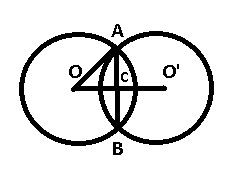
Two circles of radius 13 cm and 15 cm intersect each other at points A and B. If the length of the common chord is 12 cm, then what is the distance between their centres?
Question 50
In a triangle ABC, if $$\angle B = 90^{\circ}, \angle C = 45^{\circ}$$ and AC = 4 cm, then the value of BC is:
Question 51
A right square pyramid having lateral surface area is 624 $$cm^{2}$$ . If the length of the diagonal of the square is $$24\sqrt{2}$$, then the volume of the pyramid is:
Question 52
The area of a sector of a circle of radius 8 cm, formed by an arc of length 4.6 cm, is ___________.
Question 53
For a triangle ABC, D and E are two points on AB and AC such that $$AD = \frac{1}{6} AB, AE = \frac{1}{6} AC$$. If BC = 22 cm, then DE is __________. (Consider up to two decimals)
Question 54
The radii of the ends of a frustum of a solid right-circular cone 45 cm high are 28 cm and 7 cm. If this frustum is melted and reconstructed into a solid right circular cylinder whose radius of base and height are in the ratio 3 : 5, find the curved surface area (in $$cm^{2}$$) of this cylinder. [Use $$\pi = \frac{22}{7}$$]
Question 55
The sides of a rectangle are in the ratio of 3 : 8 and its area is 1944 $$cm^{2}$$. What is its perimeter?
Question 56
A solid sphere made of wax of radius 12 cm is melted and cast into solid hemispheres of radius 4 cm each. Find the number of such solid hemispheres.
Question 57
In a $$\triangle PQR, \angle P=90^{\circ}, \angle R=47^{\circ}$$ and $$PS \perp QR$$. Find the value of $$\angle QPS$$.
Question 58
Let ABC, PQR be two congruent triangles such that $$\angle A = \angle P = 90^{\circ}$$. If BC = 17 cm, PR = 8 cm, find AB (in cm).
Question 59
$$PQR$$ is a triangle. The bisectors of the internal angle $$\angle Q$$ and external angle $$\angle R$$ intersect at $$S$$. If $$\angle QSR = 40^{\circ}$$, then $$\angle P$$ is:
Question 60
The curved surface area (CSA) and the total surface area (TSA) of a hemisphere whose radius is 7 cm are:
Question 61
If the hypotenuse of a right-angled triangle is 29 cm and the sum of the other two sides is 41 cm, then the difference between the other two sides is:
Question 62
The height and the radius of the base of a right circular cone are in the ratio of 12 : 5. If its volume is 314 $$cm^{3}$$, then what is the slant height of the cone? (Use $$\pi = 3.14$$)
Question 63
If the radius of a sphere is doubled, then its surface area will be increased by:
Question 64
AB is a chord of a circle having radius 1.7 cm. If the distance of this chord AB from the centre of the circle is 0.8 cm, then what is the length (in cm) of the chord AB?
Question 65
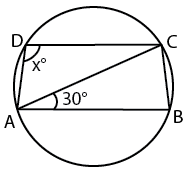
E, F, G, and H are four points lying on the circumference of a circle to make a cyclic quadrilateral. If $$\angle FGH = 57^{\circ}$$, then what will be the measure of the $$\angle HEF$$?
Question 66
If the radius of a hemispherical balloon increases from 4 cm to 7 cm as air is pumped into it, find the ratio of the surface area of the new balloon to its original.
Question 67
The heights of two cones are in the ratio 7.: 5 and their diameters are in the ratio 10:21. What is the ratio of their volumes? ($$Where $$ \pi = \frac{22}{7}$$)
Question 68
If radius of a sphere is decreased by 48%, then by what percent does its surface area decrease?
Question 69
The difference between the length of two parallel sides of a trapezium is 12 cm. The perpendicular distance between these two parallel sides is 60 cm. If the area of the trapezium is 1380 $$cm^{2}$$, then find the length of each of the parallel sides (in cm).
Question 70
In a circle, chords AB and CD intersect internally at E. If CD = 18 cm, DE = 5 cm, AE = 13 cm, then the length of BE is:
Question 71
What is the area of a triangle whose sides are of lengths 12 cm, 13 cm and 5 cm?
Question 72
If the external angle of a regular polygon is 18°, then the number of diagonals in this polygon is:
Question 73
PQRS is a cyclic quadrilateral. If $$\angle P$$ is three times of $$\angle R$$ and $$\angle S$$ is four times of $$\angle Q$$, then the sum of $$\angle S + \angle R$$ will be:
Question 74
The centroid of an equilateral triangle PQR is L. If PQ = 6 cm, the length of PL is:
Question 75
In $$\triangle PQR,PQ=QR$$ and O is an interior point of $$\triangle PQR$$ such that $$\angle OPR= \angle ORP$$. Consider the following statements: (i) $$\triangle POR$$ is an isosceles triangle. (ii) O is the centroid of $$\triangle PQR$$. (iii) $$\triangle PQO$$ is congruent to $$\triangle RQO$$. Which of the above statements are correct?
Question 76
A hemispherical bowl of internal radius 18 cm is full of liquid. This liquid is to be filled in cylindrical bottles each of radius 3 cm and height 6 cm. How many bottles are required to empty the bowl?
Question 77
It is given that $$\triangle ABC \cong \triangle PQR, AB = 5 cm, \angle B = 40^{\circ}$$, and $$\angle A = 80^{\circ}$$. Which of the following options is true?
Question 78
A rectangular park is 120 m long and 104 m wide. A 1-m wide path runs along the boundary of the park, remaining completely inside the park area. Thus, the outside edges of the path run along the boundary wall of the park. The inside edges of the path are marked with a white line of negligible thickness. If it costs ₹2.50 to mark each metre with the white line, then how much would it cost (in ₹) to fully mark the inside edges of the path?
Question 79
What is the total surface area of a pyramid whose base is a square with side 8 cm and height of the pyramid is 3 cm?
Question 80
The breadth ‘b’ of a room is twice its height and half of its length. Find the length of the longest diagonal of the room.
Question 81
If the areas of two similar triangles are in the ratio 196 : 625, what would be the ratio of the corresponding sides?
Question 82
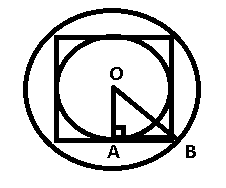
What is the perimeter of a square inscribed in a circle of radius 5 cm?
Question 83
If the surface area of a sphere is 30,184 $$cm^{2}$$ , then find its volume (Use $$\pi = \frac{22}{7}$$)
Question 84
A,B, C are three points such that AB = 9 cm, BC = 11 cm and AC = 20 cm. The number of circles passing through points A,B,C is:
Question 85
If the curved surface area of a cylinder is $$126 \pi cm^{2}$$ and its height is 14 cm, what is the volume of the cylinder?
Question 86
The length, breadth and the height of a cuboid are 24 cm, 18 cm and 12 cm respectively. It is melted to make smaller cubes. If the length of the side of the cube is 6 cm, then what is the number of cubes formed?
Question 87
A solid metallic sphere of radius 21 cm is melted and moulded into small right circular cones, each of radius 7 cm and height of 3 cm. The number of such cones is:
Question 88
In a trapezium ABCD, AB and DC are parallel to each other with a perpendicular distance of8 m between them. Also, (AD) = (BC) = 10 m, and (AB) = 15 m &lt; (DC). What is the perimeter (in m) of the trapezium ABCD?
Question 89
AB = 28 cm and CD = 22 cm are two parallel chords on the same side of the centre of a circle. The distance between them is 4 cm. The radius of the circle is ______ (Consider up to two decimals)
Question 90
The perimeter of an isosceles triangle is 100 cm. If the base is 36 cm, then find its semi perimeter (in centimetres).
Question 91
A prism and a pyramid have the same base and the same height. Find the ratio of the volumes of the prism and the pyramid.
Question 92
A hemispherical bowl has a radius of 7 cm. It is to be painted from inside as well as outside. Find the cost of painting it at the rate of Rs.40 per 20 $$cm^{2}$$ ? (Take thickness of the bowl as negligible).
Question 93
The sides of two similar triangles are in the ratio 5:7. The areas of these triangles are in the ratio:
Question 1
Points A and B are on a circle with centre O. PA and PB are tangents to the circle from an external point P. If PA and PB are inclined to each other at $$42^{\circ}$$, then find the measure of $$\angle$$ OAB.
Question 2
The diagonal of a rectangle is 12 cm long, and it is twice as long as one of the sides of the rectangle. What is the area of this rectangle?
Solution
The diagonal of a rectangle is 12 cm long, and it is twice as long as one of the sides of the rectangle.
diagonal of a rectangle = 12 cm
one of the sides of the rectangle = $$\frac{12}{2}$$ = 6 cm
$$144=\ 36\ +\left(another\ side\right)^2\ $$ $$144-36=\ \left(another\ side\right)^2\ $$ $$108=\ \left(another\ side\right)^2\ $$ $$\sqrt{108}=\ another\ side$$ $$6\sqrt{3}=\ another\ side$$ Area of this rectangle = product of both sides = $$6\times\ 6\sqrt{3}$$ = $$36\sqrt{3}$$ cm$$^2$$
Question 3
AB is the diameter of a circle with centre O. C and D are two points on the circumference of the circle on either side of AB. such that $$\angle CAB= 42^{\circ}$$ and $$\angle ABD = 57^{\circ}$$. What is difference (in degrees) between the measures of $$\angle CAD$$ and $$\angle CBD$$?
Question 4
A circle is inscribed in a ΔABC having sides AB = 16 cm, BC = 20 cm and AC = 24 cm, and side AB, BC and AC touches circle at D, E and F, respectively. The measure of AD is:
Question 5
The tops of two poles of heights 18 m and 30.5 meters connected by a wire. If the wire makes an angle of $$30^{\circ}$$ with the horizontal, what is the length (in m) of the wire?
Question 6
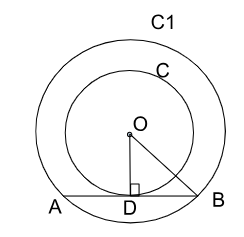
The inner circumference of a circular path enclosed between two concentric circles is 264 m. The uniform width of the circular path is 3 m. What is the area (in $$m^{2}$$, to the nearest whole number) of the path? (Taken $$\pi = \frac{22}{7}$$)
Question 1
The internal length, breadth and height of a cuboidal room are 12 m, 8 m and 10 m,respectively. The total cost (in ₹) of white washing only all four walls of the room at the cost of ₹25 per $$m^{2}$$ is:
Question 2
The base ofa triangle is equal to the perimeter of a square whose diagonalis $$6 \sqrt{2}$$ cm,and its height is equalto the side of a square whose areais 144 $$cm^{2} $$. Thearea ofthe triangle (in $$cm^{2} $$) is:
Question 3
The area of a square and rectangle are equal. The length of the rectangle is greater than the length of a side of the square by 10 cm and the breadth is less than 5 cm. The perimeter(in cm)of the rectangleis:
Question 4
A circle is inscribed in a triangle ABC. It touches side AB, BC and AC at points R, P and Q, respectively. If AQ = 2.6 cm, PC = 2.7 cm and BR = 3 cm, then the perimeter (in cm)of the triangle $$\triangle ABC$$ is:
Question 5
Chord AB of a circle is produced to a point P, and C is a point on the circle such that PC is a tangent to the circle. If PC = 12 cm, and BP = 10 cm, then the length of AB (in cm)is:
Question 6
The radius of the base of a cylinder is 14 cm andits volumeis 6160 $$cm^3$$, The curved surface area (in $$cm^2$$) is:
(Take $$\pi = \frac{22}{7}$$)
Question 7
If the volumeof a sphere is 4851 $$cm^{3}$$ then its surface area (in $$cm^{2}$$) is: (Take $$\pi = \frac{22}{7}$$)
Question 8
In $$\triangle ABC, \angle A = 68^\circ$$. If is the incentre of the triangle , then measure of $$\angle BIC$$ is:
Question 9
In a circle with centre O, AD is a diameter and AC is a chord. Point B is on AC such that OB = 7 cm and $$\angle OBA = 60^\circ$$. If $$\angle DOC = 60^\circ$$, then what is the length of BC?
Question 10
In a $$\triangle ABC$$, the bisector of $$\angle B$$ and $$\angle C$$ meet at O in the triangle. If $$\angle BOC = 134^\circ$$, then the measure of $$\angle A$$ is:
Question 11
Theratio of the total surface area and volumeof a sphereis 2 : 7. Its radiusis:
Question 12
In $$\triangle ABC, \angle A = 54^\circ$$. If I is the incenter of the triangle, then the measure of $$\angle BIC$$ is:
Question 13
The internal measures of a cuboidal room are with length as 12 m, breadth as 8 m and height as 10 m. The total cost (in ₹) of white washing all four walls of the room and also the ceiling of the room,if the cost of whitewashing is ₹25 per $$m^{2}$$ is :
Question 14
Let A and B be twocylinders such that the capacity ofA is the same as the capacity of B. Theratio of the diameters ofA and B is 1 : 4. Whatis the ratio of the heights ofA and B?
Question 15
$$PQRS$$ is a cyclic quadrilateral. If $$\angle P$$ is 4 times $$\angle R $$, and $$\angle S $$ is 3 times $$\angle Q$$, then the average of $$\angle Q$$ and $$\angle R $$ is:
Question 16
The sides of a triangle are 24 cm, 26 cm and 10 cm.At each of its vertex, circles of radius 4.2 cm are drawn. What is the area (in $$cm^$$) of the portion covered by the three sectors of the circle ? $$(\pi = \frac{22}{7})$$
Question 17
If each side of a square is decreased by 17%, then by what percentage does its area decrease?
Question 18
The sides PQ and PR of $$\triangle PQR $$ are produced to points S and T, respectively. The bisectors of $$\angle SQR$$ and $$\angle TRQ$$ meetat U. If $$\angle QUR = 59\circ$$, then the measure of $$\angle P$$ is:
Question 19
One side of a rhombus is 13 cm and one of its diagonals is 24 cm. What is the area (in $$cm^2$$) of rhombus?
Question 20
Thebaseof triangle is equal to the perimeter of a square whosediagonal is 9 $$\sqrt{2}$$ cm,andits height is equalto the side of a square whosearea is 144 $$cm^{2}$$. Thearea ofthe triangle (in $$cm^{2}$$) is:
Question 21
A ladder is resting against a wall, The angle between the foot of the ladder and the wall is $$45^\circ$$ and the foot of the ladder is 6.6 m away from the wall. The length of the ladder(in m)is:
Question 22
PA and PB are two tangents from a point P outside the circle with centre O. If A and are points on the circle such that $$\angle APB = 142^\circ$$, then $$\angle OAB$$ is equal to:
Question 23
The perimeter of a square is half the perimeter of a rectangle. The perimeter of the square is 40 m. If its breadth is two- thirds of its length, then what is the area (in $$m^2$$) of the rectangle?
Question 24
The perimeterof a right triangle is 60 cm and its hypotenuse is 26 cm. Whatis the area (in $$cm^{2}$$)ofthe triangle?
Question 25
In $$\triangle ABC, D$$ is the median from $$A$$ to $$BC, AB = 6 cm, AC = 8 cm$$ and $$BC = 10 cm$$ .The length of median $$AD$$(in cm)is
Question 26
Two circles of radii 15 cm and 10 cm intersect each other and the length of their common chord is 16 cm. What is the distance (in cm) between their centres?
Question 27
A 64 cm wide path is made arounda circular garden having a diameter of 10 metres. The area (in m?)ofthe path is closest to: $$(take \pi= \frac{22}{7})$$
Question 28
In $$\triangle ABC, BD \perp AC$$ at D. E is a point on BC such that $$\angle BEA = x^\circ$$. If $$\angle EAC = 62^\circ$$ and $$\angle EBD = 60^\circ$$,then the value of $$x$$ is:
Question 29
A solid metallic cylinder with a base radius of 3 cm and a height 120 of cm is melted and recast into a sphere of radius r cm. What is the value of r if there is a 10% metal loss in the conversion?
Question 30
AB is a chord of a circle with centre O and P is any point on the circle. If $$\angle APB = 122^\circ$$, then what is the measure of $$\angle OAB$$?
Question 31
If the radius of a circle is increased by 23%, then by what percentage will its area increase?
Question 32
If the radius of a sphere is increased by $$16\frac{2}{3}\%$$, then by what per cent would its surface area increase (correct to one decimal place)
Question 33
In circle with centre O and radius 13 cm, a chord AB is drawn. Tangentsat A and B intersect at P such that $$\angle APB = 60^\circ$$. If Distance of AB from the centre O is 5 cm, then what is the length (in cm) of AP?
Question 34
In $$\triangle ABC, D$$ and E are the points on sides AB and AC, respectively and $$DE \parallel BC$$. BC = 8 cm and DE = 5 cm. If the area of $$\triangle ADE = 45 cm^2$$, then what is the area (in cm$$^2$$) of $$\triangle ABC$$?
Question 35
Points P, Q, R, S and lie in this order on a circle with centre O. If chord TS is parallel to diameter PR and $$\angle RQT = 58^\circ$$ then find the measure (in degrees) of $$\angle RTS$$.
Question 36
The base of a triangle is increased by 30%. By what percentage (correct to two decimal places) can its height be increased so that the area increases by 50%?
Question 37
The radius of a cylinder is reduced to 50% of its actual radius. If its volume remains the same as before, then its height becomes k times the original height. The value of k is:
Question 38
$$\triangle ABC$$ is an equilateral triangle with side 18 cm. D is a point on BC such that $$BD = \frac{1}{3}BC$$ Then length(in cm) of AD is:
Question 39
A circle touches all the four sides of a quadrilateral ABCD whose sides are AB = 8.4 cm, BC = 9.8 cm and CD = 5.6 cm. The length of side AD, in cm, is:
Question 40
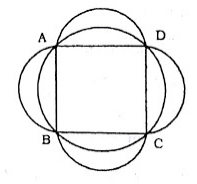
A rectangular plot is 420 m long and 84 m wide. lt is surrounded by semi-circular flower beds along all its sides. The area of the entire plot (in hectares) is $$x$$. The value of $$x$$ (correct to one decimal place) is (Taken $$\pi=\frac{22}{7}$$):
Question 41
A $$\triangle ABC$$ has sides 5 cm, 6 cm and 7 cm. AB extended touches a circle at P and AC extended touches the same circle at Q. Find the length (in cm) of AQ.
Question 42
A wooden piece in the shape of a cuboid is divided into five equal parts by cutting it with four cuts perpendicular to its length,and it turns out that each picece is a cube of volume 27 $$cm^{3}$$. That is the total surface area (in $$cm^{2}$$) of the cuboid?
Question 43
ABCD is a cyclic quadrilateral. Diagonals BD and AC intersect each other at E. If $$\angle BEC = 138^\circ$$ and $$\angle ECD = 35^\circ$$, then what is the measure of $$\angle BAC$$?
Question 44
If each side of a rectangle is increased by 12%, then by what percentage will its area increase?
Question 45
If the diameter of the base of a cone is 24 cm and its curved surface area is $$1395\frac{3}{7}$$ $$cm^{2}$$, then its height is: (Take $$\pi=\frac{22}{7}$$)
Question 46
If the length of a rectangle is increased by 80%, what would be the percentage decrease (correct to one place of decimal) in the width to maintain the same area?
Question 47
In $$\triangle ABC, AB$$ and AC produced to points D and E respectively. If the bisectors of angle CBD and angle BCE meet at point O, such that $$\angle BOC = 63^\circ$$, then $$\angle A = ?$$
Question 48
In $$\triangle ABC, \angle A= 90^\circ, AD \perp BC$$ at D. If AB = 12 cm and AC = 16 cm, then what is the length(in cm) of BD?
Question 49
In $$\triangle ABC, DE \parallel AB$$, where D and E are the points on sides AC and BC, respectively. If AD = x-3, AC = 2x, BE = x-2 and BC = 2x + 3, then what is the value of x?
Question 50
In triangle PQR, points E and F are on sides PQ and PR respectively such that EF is parallel to QR. If PE = 2 cm and EQ = 3 cm, then area($$\triangle$$ PQR) : area($$\triangle$$ PEF) is equal to:
Solution
$$\triangle$$PQR and $$\triangle$$PEF are similar triangles.
$$\Rightarrow$$ $$\frac{\text{Area of triangle PQR}}{\text{Area of triangle PEF}}$$ = $$\left(\frac{PQ}{PE}\right)^2$$
$$\Rightarrow$$ $$\frac{\text{Area of triangle PQR}}{\text{Area of triangle PEF}}$$ = $$\left(\frac{PE+EQ}{PE}\right)^2$$
$$\Rightarrow$$ $$\frac{\text{Area of triangle PQR}}{\text{Area of triangle PEF}}$$ = $$\left(\frac{2+3}{2}\right)^2$$
$$\Rightarrow$$ $$\frac{\text{Area of triangle PQR}}{\text{Area of triangle PEF}}$$ = $$\frac{25}{4}$$
$$\Rightarrow$$ Area of triangle PQR : Area of triangle PEF = 25:4
Hence, the correct answer is Option B
Question 51
Let $$\triangle ABC \sim \triangle PQR$$ and $$\frac{ar(\triangle ABC)}{ar(\triangle QPR)} = \frac{144}{49}$$. If AB = 12 cm, BC = 7 cm and AC = 9 cm, then PR(in cm) is equal to:
Question 52
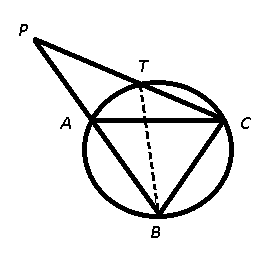
Tangent is drawn from a point P to a circle, which meets the circle at T such that PT = 8 cm. A secant PAB intersects the circle in points A and B. If PA= 5 cm, what is the length (in cm) of the chord AB?
Solution
$$\Rightarrow$$ PT$$^2$$ = PA. PB
$$\Rightarrow$$ 8$$^2$$ = 5 x (PA + AB)
$$\Rightarrow$$ 64 = 5 x (5 + AB)
$$\Rightarrow$$ 12.8 = 5 + AB
$$\Rightarrow$$ AB = 7.8 cm
Hence, the correct answer is Option D
Question 53
The capacity of a cuboidal tank is 12288 kilolitres. Its length is 32 m, and its breadth and height are in the ratio of 3: 2. What is the breadth (in m) of the tank?
Question 54
The lengih (in m, correct to one decimal place) of the longest pole that can be fitted in a room of dimensions 12 m $$\times$$ 6 m $$\times$$ 4 m is:
Question 55
The length and breadth of a rectangle are increased by 25% and 32%, respectively. The percentage increase in the area of the resulting rectangle will be:
Question 56
The total surface area of a solid right circular cylinder of height 13cm, is 880 $$cm^{2}$$. Its volume (in $$cm^{2}$$) is 11k. The value of k is: (Taken $$\pi=\frac{22}{7}$$)
Question 57
In a circle, chords AB and CD intersect internally, at E. If CD = 16 cm, DE = 6 cm, AE = 12 cm, and BE = X cm then the value of x is:
Question 58
In a circle with centre O, AD is a diameter and AC is a chord. Point B is on AC such that OB = 7 cm and $$\angle OBA = 60^\circ$$. If $$\angle DOC = 60^\circ$$, then what is the length of BC (in cm)?
Question 59
In a $$\triangle ABC, \angle BAC=90^{0},AD$$ is drawn perpendicular from A on BC. Which among the following is the mean proportional between BD and BC?
Question 60
In $$\triangle ABC, AD$$ is the bisector of $$\angle A$$ meeting BC at D. If AC = 21 cm, BC = 11 cm and the length of BD is 3 cm less than DC, then the length(in cm) of side AB is:
Question 61
Ina trapezium PQRS, PQ is parallel to RS and diagonals PR and QS intersect at O. If PQ= 4 cm. SR = 10 cm, then what is area($$\triangle POQ$$) : area($$\triangle SOR$$) ?
Question 62
Point P lies outside a circle with centre O. Tangents PA and PB are drawn to meetthe circle at A and respectively. If $$\angle APB = 80^\circ$$, then $$\angle OAB$$ is equal to:
Question 63
Points A and B are on a circle with centre O. PAM and PBN are tangentsto the circle at A and B respectively from a point P outside the circle. Point Q is on the major arc AB such that $$\angle QAM = 58^\circ$$ and $$\angle QBN = 50^\circ$$, then find the measure (in degrees) of $$\angle APB$$.
Question 64
Points P and Q are on the sides AB and BC respectively of a triangle ABC, right angled at B. If AQ = 11 cm, PC = 8 cm, and AC = 13 cm, then find the length (in cm) of PQ.
The area of a parallelogram ABCD is $$300 cm^{2}$$, The distance between AB and CD is 20cm, and the distance between BC and AD is 30cm. What is the perimeter (in cm) of the parallelogram ?
Question 66
The length and breadth of a rectangle are 35 cm and 11 cm, respectively. What will be the circumference of the circle that inscribes this rectangle? (Take $$\pi=\frac{22}{7}$$)
Question 67
A rectangular room has an area of 60 $$m^{2}$$ and a perimeter of 34 m. The length of the diagonal of the rectangular room is same as the side of a square. The perimeter of the square (in m) is:
Question 68
In $$\triangle ABC, AD \perp BC$$ at D and AE is the bisector of $$\angle A$$. If $$\angle B = 62^\circ$$ and $$\angle C = 36^\circ$$, then what is the measure of $$\angle DAE ?$$
Question 69
Ina triangle ABC,a point D lies on AB and points E andF lie on BC suchthat DF is parallel to AC and DE is parallel to AF. If BE = 4 cm, EF = 6cm, then find the length (in cm) of BC.
Question 70
Points A and B are on a circle with centre O. Point C is on the major are AB. If $$\angle OAC = 35^\circ$$ and $$\angle OBC = 45^\circ$$, then what is the measure (in degrees) of the angle subtended by the minor are AB at the centre?
Question 71
The area of a triangular plot having sides 12 m, 35 m and 37 m is equal to the area of a rectangular field whose sides are in the ratio 7 : 3. The perimeter (in m) of the field is:
Solution
Perimeter of triangular plot = 12 + 35 + 37 = 84 m
Half of the perimeter = s = 42 m
Area of the triangular plot = $$\sqrt{42\left(42-12\right)\left(42-35\right)\left(42-37\right)}$$
The area of a triangular plot is equal to the area of a rectangular field.
Area of a rectangular field = 210 cm$$^2$$
Sides of rectangular filed are in the ratio 7:3.
Let the sides of the rectangular field are 7p and 3p respectively.
7p x 3p = 210
p$$^2$$ = 10
p = $$\sqrt{10}$$
Perimeter of the rectangular field = 2(7p + 3p)
= 20p
= 20$$\sqrt{10}$$ cm
Hence, the correct answer is Option A
Question 72
The area of the curved surface of a right circular cylinder is 19.5 $$m^{2}$$ and its volume is 39 $$m^{3}$$. What is the radius (in m) of its base?
Question 73
The radius of a solid lead sphere is 2 cm. 2541 such spheres are melted and recast into a cube of edge $$x$$ cm. The value of $$x$$ is (take $$\pi=\frac{22}{7}$$):
Question 74
A solid metallic sphere of radius 8.4cm is melted and recast into a cone of height 18.9cm. What is the radius (in cm) of the base of the cone ?
Question 75
In a circle with centre O, points A, B, C and D in this order are concyclic such that BD is a diameter of the circle. If $$\angle$$BAC = 22$$^\circ$$, then find the measure (in degrees) of $$\angle$$COD.
Angle subtended by a chord at the center of the circle is twice the angle subtended by the chord on the point of a circle in the same segment.
$$\Rightarrow$$ $$\angle$$COD = 2$$\angle$$CAD
$$\Rightarrow$$ $$\angle$$COD = 136$$^\circ$$
Hence, the correct answer is Option B
Question 76
In triangle ABC, D is a point on BC such that BD : DC =3 : 4. E is a point on AD such that AE : ED = 2 : 3. Find the ratio area $$(\triangle ECD)$$ : area $$(\triangle AEB)$$.
Question 77
Let $$\triangle$$ABC $$\sim$$ $$\triangle$$RPQ and $$\frac{ar(\triangle \text{ABC})}{ar(\triangle \text{PQR})}=\frac{16}{25}$$. If PQ = 4 cm, QR = 6 cm and PR = 7 cm, then AC (in cm) is equal to:
The are of square is S, and that of the aquare formed by joining the mid-points of the given square is A. The value of $$\frac{A}{S}$$ is equal to:
Question 79
The area of a circular path enclosed by two concentric circles is 3080 m$$^2$$. If the difference between the radius of the outer edge and that of inner edge of the circular path is 10 m, what is the sum (in m) of the two radii? (Take $$\pi = \frac{22}{7}$$)
Solution
Let the radius of the outer circle and inner circle are $$r_o$$ and $$r_i$$ respectively.
The difference between the radius of the outer edge and that of inner edge of the circular path is 10 m.
$$r_o$$ - $$r_i$$ = 10........(1)
The area of a circular path enclosed by two concentric circles is 3080 m$$^2$$.
The area of the four walls of a room is 1152 $$m^{2}$$ and its length is $$\frac{5}{3}$$ times its breadth. If the height of the room is 12 m,then the area of its floor is:
Question 81
The internal and external diameters of a hollow hemispherical bowl are 18 cm and 22 cm, respectively. The total surface area (in $$cm^{2}$$) of the bowl is:
Question 82
The radii of the circular ends of a frustum of a cone are 20 cm and 13 cm and its height is 12 cm. What is the capacity (in litres) of the frustum (correct to one decimal place)? (Take $$\pi=\frac{22}{7}$$)
Question 83
The sides of a triangular field are 96 m, 110 m and 146 m. The cost of levelling the field at ₹5.60 per $$m^{2}$$ is:
Question 84
Two circles of radius 15 cm and 37 cm intersect each other at the points A and B. If the length of common chord is 24 cm, what is the distance (in cm) between the centres of the circles?
Solution
From triangle AHG,
AH$$^2$$ + GH$$^2$$ = AG$$^2$$
AH$$^2$$ + 12$$^2$$ = 15$$^2$$
AH$$^2$$ + 144 = 225
AH$$^2$$ = 81
AH = 9 cm
From triangle CHG,
CH$$^2$$ + GH$$^2$$ = CG$$^2$$
CH$$^2$$ + 12$$^2$$ = 37$$^2$$
CH$$^2$$ + 144 = 1369
CH$$^2$$ = 1225
CH = 35 cm
Distance between two circles = AC = AH + CH = 9 + 35 = 44 cm
Hence, the correct answer is Option A
Question 85
A cylindrical vessel of base radius 10.5 cm and height 30 cm is $$\frac{4}{5}$$ full of water. The entire water is poured into a rectangular tub of length 44 cm and breadth 36 cm. The height (in cm) to which the water level rises in the tub is: (Take $$\pi = \frac{22}{7}$$) (Assuming no overflow of water)
Question 86
A wire is in the form of a square of side 33 cm. If the wire is molded to form a circle, then what is the radius of the circle? (Use $$\pi=\frac{22}{7}$$)
Question 87
Angle between the internal bisectors of two angles $$\angle B$$ and $$\angle C$$ of a $$\triangle ABC$$, is $$132^\circ$$, then the value of $$\angle A$$ is:
Question 88
In $$\triangle ABC$$ and $$\triangle DEF$$ we have $$\frac{AB}{DF} = \frac{BC}{DE} = \frac{AC}{EF}$$, then which of the following is true?
Solution
Hence, the correct answer is Option A
Question 89
The area of a circular park is 12474 m$$^2$$ . There is 3.5 m wide path around the park. What is the area (in m$$^2$$) of the path?(Take $$\pi = \frac{22}{7}$$)
Solution
Let the radius of the circular park = r
Area of a circular park is 12474 m$$^2$$.
$$\frac{22}{7}r^2=12474$$
$$r^2=567\times7$$
$$r^2=81\times7\times7$$
$$r=63$$ m
Area of the circular width = Area of outer circle - Area of the inner circle
The diameter of an iron ball used for shot-put is 21 cm. It is melted and then a cylinder of height 3.5 cm is made. The curved surface area of the cylinder will be: (Take $$\pi=\frac{22}{7}$$)
Question 91
The perimeter of rectangular field is 386 m and the difference between its two adjacent sides is 95 m. The side of a square field, having the same area as that of the rectangle, is:
Question 92
$$\triangle ABC \sim \triangle PQR$$. The areas of $$\triangle ABC$$ and $$\triangle PQR$$ are 64 cm$$^2$$ and 81 cm$$^2$$, respectively and AD and PT are the medians of $$\triangle ABC$$ and $$\triangle PQR$$, respectively. If PT = 10.8 cm, then AD =?
Question 93
What is the volume(in cm$$^3$$a) ofa spherical shell whose inner and outerradii are respectively 2 cm and 3 cm ?
Question 94
A chord 21 cm long is drawn in a circle of diameter 25 cm. The perpendicular distance of the chord from the centre is:
Question 95
A radius of a circular park is 23 m. It has inside all around it, a 4 m wide path. Find the cost of paving the path at the rate ₹500/ $$m^{2}$$. (Take $$\pi=\frac{22}{7}$$)
Question 96
A solid cube of side 15 cm is dropped into a rectangular container of length 25 cm, breadth 20 cm and height 18 cm, which is partly filled with water. If the cube is completely submerged, then the rise of water level (in cm) is:
Question 97
Chord AB of circle of radius 10 cm is at a distance 8 cm from the centre O. If tangents drawn at A and B intersect at P, then the length of the tangent AP (in cm) is:
Question 98
From a wooden cubical block of side 10 cm, a sphere of radius 4.2 cm is carved out. How much wood is wasted in the process? (Use $$\pi=\frac{22}{7}$$)
Question 99
From each of the four corners of a rectangular sheet of dimensions 48 cm x 27 cm, a square of side 3.5 cm is cut off and a box is made. The volume of the box is:
Question 100
In a circle with centre O, AB is a chord of length 10 cm. Tangents at points A and B intersect outside the circle at P. If OP = 2 OA, then find the length (in cm) of AP.
Question 101
In $$\triangle ABC, AB = 20$$ cm, BC = 21 cm and AC = 29 cm. What is the value of $$\cot C + \cosec C - 2 \tan A$$?
Question 102
In $$\triangle$$ABC, $$\angle$$C = 90$$^\circ$$ and Q is the midpoint of BC. If AB = 10 cm and AC = $$2\sqrt{10}$$ cm, then the length of AQ is:
The total surface are of a hemisphere is very nearly equal to that of an equilateral triangle. The side of the triangle is how many times (approximately) of the radius of the hemisphere?
Question 104
Four solid cubes, each of volume 1728 $$cm^{3}$$, are kept in two rows having two cubes in each row. They form a rectangular solid with square base. The total surface area (in $$cm^{2}$$) of the resulting solid is:
Question 105
If the internal dimensions of a rectangular closed wooden box are 30 cm, 18 cm and 23 cm, what space (in $$cm^{2}$$) will it occupy, if the wood used is 1 cm thick?
Question 106
In a triangle ABC, point D lies on AB, and points E and F lie on BC suchthat DF is parallel to AC and DE is parallel to AF. If BE = 4 cm, CF = 3 cm, then find the length (in cm) of EF.
Question 107
In triangle ABC, P and Q are the mid points of AB and AC, respectively. R is a point on PQ such that PR : RQ = 3 : 5 and QR = 20 cm, then what is the length (in cm) of BC?
Question 108
Points A, D, C, B and E are concyclic. If $$\angle$$AEC = 50$$^\circ$$ and $$\angle$$ABD = 30$$^\circ$$, then what is the measure(in degrees) of $$\angle$$CBD?
Solution
ADCE is a cyclic quadrilateral, so opposite angles are supplementary.
$$\Rightarrow$$ x + 30$$^\circ$$ + 130$$^\circ$$ = 180$$^\circ$$
$$\Rightarrow$$ x = 20$$^\circ$$
$$\Rightarrow$$ $$\angle$$CBD = x = 20$$^\circ$$
Hence, the correct answer is Option A
Question 109
The area of a triangular field with sides 60 m, 175 m and 185 m is equal to that of a rectangular park whose sides are in the ratio of 21 : 10. The perimeter (in m) of the park is:
Question 110
The sum of the length, breadth and height of a cuboid is 28 cm. lf the total surface area of the cuboid is 558 $$cm^{2}$$ then its diagonal is:
Question 111
There is a rectangular plot, 120m long and 98m wide, with semi-circular flower beds along the breath on both sides of the plot. The cost of putting a fence all around the plot at ₹16.50 per m is: (Taken $$\pi=\frac{22}{7}$$)
Question 112
Two circles of radii 10 cm and 12 cm intersect each other and the length of their common chord is 16 cm. What is the distance (in cm) between their centres?
Question 113
The area of a trapezium, whose parallel sides are 25 cm and 19 cm long, is 330 $$cm^{2}$$. The distance between the sides (in cm) is:
Question 114
The material of a sphere of radius r is melted and recast into a hollow cylindrical sell of thickness a and outer radius b. What is its length asssuming that no material is lost in recasting?
Question 115
Two similar cylindrical jugs have heights 5 cm and 8 cm, respectively. If the capacity of the smaller jug is 64 $$cm^{3}$$, what is the capacity ( correct to 2 decimal places, in $$cm^{3}$$) of the larger jug?
Question 116
What is the length (in cm) of the smallest altitude of the triangle whose sides are 5 cm, 12 cm and 13 cm? (correct to one decimal place)
Question 117
ABCD is a cyclic quadrilateral such that when sides AB and DC are produced, they meet at E, and sides AD and BC meet at F, when produced. If $$\angle$$ADE = 80$$^\circ$$ and $$\angle$$AED = 50$$^\circ$$, then what is the measure of $$\angle$$AFB?
If one of the angles of a triangle is $$74^\circ$$, then the angle between the bisectors of the other two interior angles is:
Question 119
In a right angled triangle ABC, the lengths ofthe sides containing the right angle are 5 cm and 12 cm respectively. A circle is inscribed in the triangle ABC. Whatis the radius ofthe circle (in cm)?
Question 120
In $$\triangle ABC, D$$ and are the points on sides AB and AC,respectively such that $$\angle ADE = \angle B$$. If AD = 7 cm, BD = 5 cm and BC = 9 cm, then DE (in cm) is equal to:
Question 121
The area of the floor of a cubical room is 147 $$m^{2}$$. The length of the longest rod that can be kept in the room is:
Question 122
The base of a triangle is 8.5 cm and height is 14 cm. The height of another triangle, having base 14 cm and double the area of the first triangle, is:
Question 123
The bisector of $$\angle A$$ in $$\triangle ABC$$ meets side BC at D. If AB = 12 cm, AC = 15 cm and BC = 18 cm, then the length of DC is:
Question 124
The lengths of one side and a diagonal of a rectangle are 63 cm and 65 cm, respectively. What is the perimeter (in cm) of a square whose area is one-seventh of that of the rectangle?
Question 125
Triangle ABC is right angled at B and D is a point of BC such that BD = 5 cm, AD = 13 cm and AC = 37 cm. then find the length of DC in cm.
Solution
From right angled triangle ABD,
AD$$^2$$ = AB$$^2$$ + BD$$^2$$
13$$^2$$ = AB$$^2$$ + 5$$^2$$
169 = AB$$^2$$ + 25
AB$$^2$$ = 144
AB = 12 cm
From right angled triangle ABC,
AC$$^2$$ = AB$$^2$$ + BC$$^2$$
37$$^2$$ = 12$$^2$$ + BC$$^2$$
1369 = 144 + BC$$^2$$
BC$$^2$$ = 1225
BC = 35
BD + DC = 35
5 + DC = 35
DC = 30 cm
Hence, the correct answer is Option B
Question 126
$$\triangle$$ABC $$\sim$$ $$\triangle$$DEF and the area of $$\triangle$$ABC is 13.5 cm$$^2$$ and the area of $$\triangle$$DEF is 24 cm$$^2$$ . If BC = 3.15 cm, then the length (in cm) of EF is:
Solution
$$\triangle$$ABC $$\sim$$ $$\triangle$$DEF
$$\Rightarrow$$ $$\frac{\text{Area of triangle ABC}}{\text{Area of triangle DEF}}$$ = $$\left(\frac{BC}{EF}\right)^2$$
If the area of the base of a cylinder is $$346.5 cm^{2}$$ and the area of the curved smface is $$990 cm^{2}$$, then its height is: (Taken $$\pi=\frac{22}{7}$$)
Question 128
If the height of a cylinder is increased by 30%, and the radius of its base is decreased by 15% then by what percentage will its curved surface area change?
Question 129
If the side of a square is increased by 40%, then its area will be increased by:
Question 130
Ina circle with centre O, PAX and PBY are the tangents to the circle at points A and B, from an external point P. Q is any point on the circle such that $$\angle QAX = 59^\circ$$ and $$\angle QBY = 72^\circ$$. What is the measure of $$\angle AQB$$?
Question 131
The perimeter of a circular lawn is 1232 m. There is 7 m wide path around the lawn. The area (in m$$^2$$) of the path is:(Take $$\pi = \frac{22}{7}$$)
Solution
Let the radius of the circular lawn = r
The perimeter of a circular lawn is 1232 m.
$$2\times\frac{22}{7}\times r=1232$$
r = 196 m
Area of the path = $$\pi\left(r+7\right)^2-\pi\ r^2$$
The volume of a wall whose height is 10 times its width and whose length is 8 times its height is 51.2 m$$^3$$ . What is the cost(in ₹) of painting the wall on one side at the rate of ₹100/ m$$^2$$ ?
Solution
Let the width of the wall = b
Height of the wall = 10b
Length of the wall = 8 x Height = 8 x 10b = 80b
Volume of the wall = 51.2 m$$^3$$
length x width x height = 51.2
80b x b x 10b = 51.2
8000b$$^3$$ = 512
b = $$\frac{8}{20}$$
b = $$\frac{2}{5}$$ m
Area of one side of the wall = length x height = 80b x 10b = 800b$$^2$$ = 800 x $$\frac{4}{25}$$ = 128 m$$^2$$
The cost of painting the wall on one side at the rate of ₹100/ m$$^2$$ = 128 x 100 = ₹12800
Hence, the correct answer is Option A
Question 133
If the radius of a cylinder is decreased by 40% and the height is increased by 60% to form a new cylinder, then the volume will be decreased by:
Question 134
In triangle ABC, D and E are the mid points ofAB and BCrespectively. If area($$\triangle CED$$) = 8 cm$$^2$$, then what is the area(ADEC) in cm$$^2$$ ?
Question 135
In $$\triangle$$ABC, $$\angle$$A = 50$$^\circ$$. If the bisectors of the angle B and angle C, meet at a point O, then $$\angle$$BOC is equal to:
Kamala has three cylindrical containers, each with radius 20 cm that she wants to fill with grain. If her bag of grain contains 100 kg grain, and she fills all three containers to a height of 70 cm, how much grain will be left in the bag, if 1 kg grain occupies 3000 $$cm^{2}$$ space? (Use $$\pi=\frac{22}{7}$$)
Question 137
The area of a table top in the shape of an equilateral triangle is $$9\sqrt{3}$$ cm$$^2$$. What is the length (in cm) of each side of the table?
Solution
Let the length of each side of the table = a
The area of a table top in the shape of an equilateral triangle is $$9\sqrt{3}$$ cm$$^2$$.
$$\frac{\sqrt{3}}{4}$$a$$^2$$ = $$9\sqrt{3}$$
a$$^2$$ = 36
a = 6 cm
Length of each side of the table = 6 cm
Hence, the correct answer is Option A
Question 138
The cost of tiling the floor of a rectangular room is ₹9100 at ₹65 per m$$^2$$ . Theratio of the length and breadth of the floor is 7 : 5. The perimeter (in m ) of the floor of the room is:
Question 139
The radius of a cylinder is increased by 20% and its height is decreased by 45%. What is the percentage increase/decrease in the volume of the cylinder?
Question 140
The ratio of the curved surface area and total surface area of a cylinder is 4 : 7. If its volume is 4851 $$cm^{3}$$ , then its radius is: (Take $$\pi=\frac{22}{7}$$)
Question 141
Triangles ABC and DBCareright angled triangles with common hypotenuse BC. BD and ACintersect at P when produced. If PA= 8 cm, PC = 4 cm and PD = 3.2 cm, then the length of BD,in cm, is:
Question 142
A path 6 m wide runs around and outside of a rectangular plot of length 10 m and breadth 8 m. The area (in $$cm^{2}$$) of the path is:
Question 143
If the volume of a sphere is $$65\frac{10}{21} cm^{3}$$, then its surface area is: (Taken $$\pi=\frac{22}{7}$$)
Question 144
Length of eachside of a rhombusis 13 cm and oneof the diagonal is 24 cm. Whatis the area (in cm$$^2$$) of the rhombus?
Question 145
The radius of a metallic solid sphere is 21.6 cm. It is melted and drawn into a wire of uniform cross section. If the length of the wire is 259.2 m, then ihe radius of the wire is:
Question 146
The total surface area of a solid right circular cone is equal to that of a sphere of the same radius. The height of the cone is how many times the diameter of the sphere?
Question 147
What is the volume of the largest right circular cone that can be cut out of a cube of edge 12 cm (correct to two decimal places)?
Question 148
A container in the shape of a right circukar cone, whose radius and depth are equal, gets completely filled by 128000 sperical droplets, each of diameter 2mm. What is the radius (in cm) of the container?
Question 149
A metal cube of edge 18 cm is melted to form three smaller cubes, which are unequal in dimensions. If the edges of two smaller cubes are 9 cm and 15 cm, what is the surface area in (in $$cm^{2}$$) of the third smaller cube?
Question 150
ABCD is a cyclic quadrilateral. AB and DC meet at F, when produced. AD and BC meetat E, when produced. If $$\angle BAD = 68^\circ$$ and $$\angle AEB = 27^\circ$$, then whatis the measure of $$\angle BFC$$?
Question 151
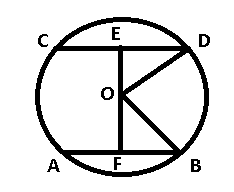
In a circle with centre O, AB and CDare twoparallel chords on the sameside of the diameter. If AB = 12 cm, CD = 18 cm and distance between the chords AB and CD is 3 cm, then find the radius of the circle (in cm).
Question 152
In $$\triangle ABC, D$$ is a point on side AB such that BD = 3 cm and DA = 4 cm. E is a point on BC such that DE $$\parallel$$ AC,. Then Area of $$\triangle BDE$$ : Area of trapezium ACED =
Question 153
The length of a rectangle is three- fifth of the radius of a circle. The radius of the circle is equal to the side of a square whose area is 6400 $$m^{2}$$. The area (in $$m^{2}$$) of rectangle, if the breadth is 20 m is:
Solution
Given,
Area of square = 6400 $$m^{2}$$ (given)
We know,
Area of square = $$\left(side\right)^2$$
$$\therefore\ side\ =\ \ \ \sqrt{\ 6400}=80\ m$$
Side of square = radius of circle (given)
radius = 80 cm
Now, Length of rectangle = three-fifth of radius of circle
l = $$\frac{3}{5}\times\ 80=48\ m$$
b = 20 m (given)
Area of rectangle = $$l\times\ b$$
= $$48\times\ 20=960\ m^2$$
Question 154
The radii of two concentric circles are 12 cm and 13 cm. AB is a diameter of the bigger circle. BD is a tangent to a smaller circle touchingit at D. Find the length (in cm) of AD? (correct to one decimal place)
Question 155
AB is a diameter of a circle. C and D are points on the opposite sides of the diameter AB, such that $$\angle ACD = 25^\circ$$. E is a point on the minor are BD. Find the measure of $$\angle BED$$ (in degrees).
Question 156
If the length of a rectangle is increased by 12% and the width is decreased by 10%, then the ratio of the areas of the original rectangle and the changed rectangle is:
Question 157
In the given figure, the area of the unshaded region is 35% of the area of the shaded region. What is the value of x?
Question 158
Sides AB and DCof a cyclic quadrilateral ABCD are produced to meetat E and sides AD and BC are produced to meet at F. If $$\angle ADC = 78^\circ$$ and $$\angle BEC = 52^\circ$$, then the measure of $$\angle AFB$$ is:
Question 159
The vertices of a $$\triangle ABC$$ lie on a circle with centre O. AO is produced to meetthe circle at the point P. D is a point on BC such that $$AD \perp BC$$. If $$\angle B = 68^\circ$$ and $$\angle C = 52^\circ$$, then the measure of $$\angle DAP$$ is:
Question 160
When a rectangle is divided into three equal parts, each of them turns out to be a square of area 16 $$cm^{2}$$. What is the perimeter (in cm) of the rectangle?
Question 161
A solid metal cube of edge 12 cm is immersed completely in water in a cylindrical vessel whose radius is 20 cm and height is 32 cm, and the water in the vessel is up to a height of 15 cm. The height (in cm) by which the water will rise in the vessel is (correct to one decimal place):
Question 162
A square park has area 4356 $$m^{2}$$. Taking its one round is same as taking one round of another circular park. Find the area of the circular park. (Use $$\pi=\frac{22}{7}$$)
Question 163
In a circle, a ten cm long chord is at a distance of 12 cm from the centre of the circle. Length of the diameter of the circle (in cm) is:
Question 164
In triangle ABC, AD is the bisector of $$\angle A$$. If AB = 5 cm, AC = 7.5 cm and BC = 10 cm, then whatis the distance of D from the mid-point of BC (in cm)?
Question 165
In $$\triangle$$ABC, D is a point on BC such that $$\angle$$BAD = $$\frac{1}{2} \angle$$ADC and $$\angle$$BAC = 77$$^\circ$$ and $$\angle$$C = 45$$^\circ$$. What is the measure of $$\angle$$ADB?
x + 45$$^\circ$$ + 77 - $$\frac{\text{x}}{2}$$ = 180$$^\circ$$
$$\frac{\text{x}}{2}$$ = 58$$^\circ$$
x = 116$$^\circ$$
$$\angle$$ADB = 180$$^\circ$$ - x
= 180$$^\circ$$ - 116$$^\circ$$
= 64$$^\circ$$
Hence, the correct answer is Option B
Question 166
Points A, B and C are on circle with centre O such that $$\angle$$BOC = 84$$^\circ$$. If AC is produced to a point D such that $$\angle$$BDC = 40$$^\circ$$, then find the measure of $$\angle$$ABD (in degrees).
Solution
Angle subtended by chord BC at the centre is twice the angle subtended by chord BC on the point A of the circle.
The difference between the areas of two concentric circles is $$88 cm^{2}$$. If the radius of the inner circle is 6 cm, then the area (in $$cm^{2}$$) of the larger circle is closest to: (Taken $$\pi=\frac{22}{7}$$)
Question 168
The dimensions of a solid metallic cuboid are 36 cm, 54 cm and 24 cm. It is melted and recast into 8 cubes of same volume. The sum of the surface areas (in $$cm^{2}$$) of these 8 cubes is:
Question 169
The radius of the base of a cone and also that of a hemisphere each is 4 cm. Also, the volumes of these two solids are equal. The curved surface area of the cone is: (Taken $$\pi=\frac{22}{7}$$)
Question 170
The sum of the radius of the base and slant height of a right circular cone is 49 cm. If the total surface area is 1848 $$cm^{2}$$, then its height is: (Take $$\pi=\frac{22}{7}$$)
Question 171
Triangle ABC is right angled at B. BDis an altitude intersecting AC at D. If AC = 9 cm and CD = 3 cm, then find the measure of AB (in cm).
Question 172
A man walking at a speed of 3 km/h crosses a square field diagonally in 5 minutes. What is the area of the field (in m$$^2$$)?
Solution
Let the side of the square field = a
Speed of the man = 3 km/h = 3 x $$\frac{1000}{60}$$ m/min = 50 m/min
Time taken to cross the field diagonally = 5 minutes
Length of the diagonal of the square field = 50 x 5 = 250 m
$$\sqrt{2}$$a = 250
a = $$\frac{250}{\sqrt{2}}$$ m
Area of the square field = a$$^2$$
= $$\left(\frac{250}{\sqrt{2}}\right)^2$$
= $$\frac{62500}{2}$$
= 31250 m$$^2$$
Hence, the correct answer is Option A
Question 173
A square has the perimeter equal to the circumference of a circle having radius 7 cm. What is the ratio of the area of the circle to area of the square?(Use $$\pi = \frac{22}{7}$$)
Solution
Radius of the circle = 7 cm
Circumference of the circle = $$2\times\frac{22}{7}\times7$$ = 44 cm
Perimeter of square is equal to the circumference of the circle.
Perimeter of the square = 44 cm
Let the side of the square = a
4a = 44
a = 11 cm
Ratio of the area of the circle to area of the square = $$\frac{22}{7}\times7^2\ :\ 11^2$$
= 14 : 11
Hence, the correct answer is Option C
Question 174
ABCD is cyclic quadrilateral in which $$\angle$$A = x$$^\circ$$, $$\angle$$B = 5y$$^\circ$$, $$\angle$$C = 2x$$^\circ$$ and $$\angle$$D = y$$^\circ$$. What is the value of (3x - y)?
Solution
ABCD is cyclic quadrilateral.
Opposite angles in a cyclic quadrilateral are supplementary.
$$\angle$$A + $$\angle$$C = 180$$^\circ$$
x + 2x = 180$$^\circ$$
3x = 180$$^\circ$$
x = 60$$^\circ$$
$$\angle$$B + $$\angle$$D = 180$$^\circ$$
5y + y = 180$$^\circ$$
6y = 180$$^\circ$$
y = 30$$^\circ$$
3x - y = 3(60) - 30 = 150
Hence, the correct answer is Option C
Question 175
If the radius of a circle is increased by 19%, then by what percentage will its area increase?
Question 176
In a circle with centre O, AB and CD are parallel chords on the opposite sides of a diameter. If AB = 12 cm, CD = 18 cm and the distance between the chords AB and CD is 15 cm, then find the radius of the circle (in cm).
In $$\triangle ABC, D$$ is the mid-point of side AC and E is a point on side AB such that EC bisects BD at F. If AE = 30 cm, then the length of EB is:
Question 178
The area of a triangular field whose sides are 96 m, 110 m and 146 m is equal to the area of a rectangular park whose sides are in the ratio 10 : 11. The length of the longer side of the park is:
Question 179
The area of a triangular park with sides 78 m, 160 m and 178 m is equal to the area of a rectangular garden whose sides are in the ratio of 13 : 12. The smaller side (in m) of the garden is:
Question 180
The curved surface area of a cylinder is 462 cm$$^2$$ and its base area is 346.5 cm$$^2$$ . What is the volume (in cm$$^3$$) of the cylinder? (Use $$\pi = \frac{22}{7}$$)
Question 181
The length of a rectangle is three-fifth of the radius of a circle. The radius of the circle is equal to the side of a square, whose area is 6400 $$m^{2}$$. The perimeter (in m) of the rectangle, if the breadth is 15 m, is:
Question 182
The slant height and the diameter of the base of a right circular cone are 34 cm, respectively.Its volume (in $$cm^{3}$$) is:
Question 183
Whatis the area of the square (in cm$$^2$$) whose vertices lie on a circle of radius 5 cm?
Question 184
A solid metallic toy has a hemispherical base with radius 3.5 cm surmounted by a cone. If the height of the cone is the same as the radius of its base, then the volume of metal used in $$cm^{3}$$ is: (Take $$\pi=\frac{22}{7}$$)
Question 185
From an external point A, two tangents AB and AC have been drawnto a circle touching the circle at B and C respectively. P and Q are points on AB and AC respectively such that PQ touchesthe circle at R. IfAB = 11 cm, AP=7 cm and AQ = 9 cm, then find the length of PQ (in cm).
Question 186
In a circle with center O, AB is a diameter and CD is a chord such that $$\angle ABC = 34^\circ$$ and CD = BD. What is the measure of $$\angle DBC$$?
Question 187
The cost of leveling a square field at the rate of ₹52/$$m^{2}$$ is ₹1,30,000. What will be the cost of fencing its boundary at the rate of ₹35/m?
Question 188
The curved surface area of a cone is $$\frac{3432}{7}$$ $$cm^{2}$$ and its radius is 12 cm. Wha t is the radius of a sphere whose volume is 1.2 times the volume of the cone? (Take $$\pi=\frac{22}{7}$$)
Question 189
The perimeter of a semi-circle is 25.7 cm. Whatis its diameter (in cm)? $$(\pi = 3.14)$$
Question 190
The radius of spherical balloon increases from 6 cm to 10 cm when more air is pumped into it. The ratio in the surface area of the original balloon and the inflated balloon is:
Question 191
The sum of the height and radius of the base of a solid right circular cylinder is 46 cm. If the total surface area of the solid cylinder is 6072 $$cm^{2}$$, what is the volume ( in $$cm^{3}$$) of the cylinder? (Use $$\pi=\frac{22}{7}$$)
Question 192
The volume of a metallic cylindrical pipe is 1232 $$cm^{2}$$. If its external radius is 7 cm and thickness is 2 cm, then the length of the pipe (correct to one decimal place) (in cm) is: (Take $$\pi=\frac{22}{7}$$)
Question 193
To circles touch each other externally;the distance between their centres is 12 cm and the sume of their areas (in $$cm^{2}$$) is $$74\pi$$. What is the radius of the smaller circle?
Question 194
$$\triangle ABC$$ is incribed in a circle with center O, such that $$\angle ACB = 115^\circ$$. O is joined to A. What is the measure of $$\angle OAB$$?
Question 195
$$\triangle ABC$$ s an equilateral triangle. D is a point on side BC such that BD : BC = 1 : 3. If $$AD = 5\sqrt{7}$$ cm, then the side of the triangle is:
Question 196
Vertices A, B, C and D of a quadrilateral ABCD lie on a circle. $$\angle$$A is three times $$\angle$$C and $$\angle$$D is two times $$\angle$$B. What is the difference between the measures of $$\angle$$D and $$\angle$$C?
Solution
Given,
$$\angle$$A is three times $$\angle$$C and $$\angle$$D is two times $$\angle$$B.
$$\angle$$A = 3$$\angle$$C.......(1)
$$\angle$$D = 2$$\angle$$B.......(2)
In a cyclic quadrilateral, opposite angles are supplementary.
Difference between the measures of $$\angle$$D and $$\angle$$C = 120$$^\circ$$ - 45$$^\circ$$
= 75$$^\circ$$
Hence, the correct answer is Option C
Question 197
What is the area (in $$cm^{2}$$) of a trapezium whose parallel sides are 25 cm and 19 cm long, and the distance between them is 15 cm?
Question 198
What is the radius (in cm) ofa circle whose area is $$2\frac{17}{30}$$ times the sum of the areas of two triangles whose sides are 20 cm, 21 cm and 29 cm, and 11 cm, 60 cm and 61 cm (take $$\pi=\frac{22}{7}$$).
Question 199
A right circular cone is inscribed in a cube of side 9 cm occupying the maximum space possible. What is the ratio of the volume of the cube to the volume of the cone? (Take $$\pi=\frac{22}{7}$$)
Question 200
AB is a chord of a circle in minor segment with center O.C is a point on the minorarc of the circle between the points A and B. The tangents to the circle at A and B meetat the point P. If $$\angle ACB = 102^\circ$$, then whatis the measure of $$\angle APB$$?
Question 201
If the value of a cube is $$375\sqrt{3}cm^{3}$$ , then its diagonal is:
Question 202
In a circle with center O and radius 5 cm, AB and CD are two parallel chords of lengths 6 cm and x cm, respectively and the chords are on the opposite side of the centre O . The distance between the chords is 7 cm. What is the value of x?
Question 203
In a triangle ABC, length of the side AC is 4 cm more than 2 times the length of the side AB. Length of the side BC is 4 cm less than the three times the length of the side AB. If the perimeter of $$\triangle$$ABC is 60 cm, then its area (in cm$$^2$$) is:
Solution
Length of the side AC is 4 cm more than 2 times the length of the side AB.
b = 2c + 4......(1)
Length of the side BC is 4 cm less than the three times the length of the side AB.
a = 3c - 4.......(2)
Perimeter of $$\triangle$$ABC is 60 cm.
a + b + c = 60
3c - 4 + 2c + 4 + c = 60
6c = 60
c = 10 cm
b = 2c + 4 = 24 cm
a = 3c - 4 = 26 cm
Half of the perimeter(s) = 30 cm
Area of the triangle = $$\sqrt{s\left(s-a\right)\left(s-b\right)\left(s-c\right)}$$
The least munber of square tiles required to pave the ceiling of a room, 12 m 95 cm long and 3 m 85 cm broad, is:
Question 205
The maximum length of a pencil that can be kept in a rectangular box of dimensions 13 cm $$\times$$ 8 cm $$\times$$ 3 cm is:
Question 206
The total surface area of a solid cube is 294 $$cm^{2}$$. It is melted and recast into a right circular cylinder of radius 7 cm. What is the height (in cm, correct io one decimal place) of the cylinder? (Taken $$\pi = \frac{22}{7}$$)
Question 207
A solid right circular cone is cut into two parts by a plane parallel to its base and at a point one-third vertically below its vertex. What is the ratio of the volume of the smaller cone to that of the whole cone?
Question 208
The angles of a triangle are in AP (arithmetic progression). If measure of the smallest angle is $$50^\circ$$ less than that of the largest angle, then find the largest angle (in degrees).
Solution
The angles of triangle are in AP (arithmetic progression).
Let the angles are a, a+r, a+2r.
Measure of the smallest angle is $$50^\circ$$ less than that of the largest angle.
a = a + 2r - $$50^\circ$$
2r = $$50^\circ$$
r = $$25^\circ$$
Sum of the angles of triangle = $$180^\circ$$
a + a + r + a + 2r = $$180^\circ$$
3a + 3r = $$180^\circ$$
3a + $$75^\circ$$ = $$180^\circ$$
3a = $$105^\circ$$
a = $$35^\circ$$
Largest angle of triangle = a + 2r = $$35^\circ$$ + $$50^\circ$$ = $$85^\circ$$
Hence, the correct answer is Option B
Question 209
The area of a square shaped field is 1764 m$$^2$$. The breadth of a rectangular park is $$\frac{1}{6}$$th of the side of the square field and the length is four times its breadth. What is the cost (in ₹) of levelling the park at ₹30 per m$$^2$$ ?
Solution
Let the side of the square shaped field = a
The area of square shaped field is 1764 m$$^2$$
a$$^2$$ = 1764
a = 42 m
Side of the square shaped field = a = 42 m
The breadth of a rectangular park is $$\frac{1}{6}$$th of the side of the square field.
Breadth of the rectangular park = $$\frac{1}{6}\times$$42 = 7 m
The length is four times its breadth.
Length of the rectangular park = 4 x 7 = 28 m
Area of the rectangular park = length x breadth
= 28 x 7
= 196 m$$^2$$
The cost (in ₹) of levelling the park at ₹30 per m$$^2$$ = 196 x 30
= ₹5880
Hence, the correct answer is Option A
Question 210
The side of an equilateral $$\triangle ABC$$ is $$3\sqrt{7}$$ cm. P is a point on side BC such that BP : PC = 1 : 2. The length (in cm) of AP is:
Question 211
The surface area of a cube is 13.5 m$$^2$$. What is the length (in m) of its diagonal?
Solution
Let the side of the cube = a
The surface area of a cube is 13.5 m$$^2$$.
6a$$^2$$ = 13.5
12a$$^2$$ = 27
a$$^2$$ = $$\frac{9}{4}$$
a = $$\frac{3}{2}$$
a = 1.5 m
Length of the diagonal of the cube = $$\sqrt{3}$$a
= 1.5$$\sqrt{3}$$ m
Hence, the correct answer is Option B
Question 212
A boy walked along two adjacent side of a rectagular field. If he had walked along the diagonal, then he would have saved a distance equal to one-fourth of the larger side. The ratio of the smaller to the larger side is:
Question 213
A circle is inscribed in a quadrilateral ABCD, touching sides AB, BC CD and DA at P, Q, R and S,respectively. If AS = 6cm, BC = 12 cm, and CR =5 cm,then the length ofAB (in cm) is:
Question 214
A heap of wheat is in the form of a cone whose base diameter is 8.4 m and height is 1.75 m. The heap is to be covered by canvass. What is the area (in m$$^2$$ ) of the canvas required? (Use $$\pi = \frac{22}{7}$$)
Question 215
A rectangular water reservoir contains 126 kilolitres of water. The depth of the reservoir is 3.5 m and its length measures 8 m. What is the width of the reservoir?
Question 216
If the width of the path around a square field is 4.5 in and the area of the path is $$252 m^{2}$$, then the length of the side of the field is:
Question 217
In a triangle ABC AB : AC = 5 : 2, BC =9 cm. BAis produced to D.and the bisector of the Angle CAD meets BC produced at E. Whatis the length (in cm) of CE?
Question 218
Points M and N are on the sides PQ and QR respectively of a triangle PQR. right angled at Q. If PN = 9 cm, MR = 7 cm, and MN = 3 cm, then find the length of PR (in cm).
Triangle ABC is an equilateral triangle. D and E are points on AB and AC respectively such that DE is parallel to BC and is equal to half the length of BC. If AD + CE + BC = 30 cm, then find the perimeter (in cm) of the quadrilateral BCED.
Solution
Triangle ABC is an equilateral triangle.
Let the length of BC = 2p
BC = AB = AC = 2p
DE is equal to half the length of BC.
Triangle ABC and triangle ADE are similar triangles.
$$\Rightarrow$$ $$\frac{AD}{AB}=\frac{DE}{BC}$$
$$\Rightarrow$$ $$\frac{AD}{AB}=\frac{p}{2p}$$
$$\Rightarrow$$ $$AD=\frac{1}{2}AB$$
$$\Rightarrow$$ $$AD=\frac{1}{2}\times2p$$
$$\Rightarrow$$ AD = p
Similarly, AE = p
and EC = AC - AE = 2p - p = p
AD + CE + BC = 30 cm
p + p + 2p = 30
4p = 30
p = $$\frac{15}{2}$$ cm
Perimeter of the quadrilateral BCED = BD + DE + CE + BC
= p + p + p + 2p
= 5p
= $$5\times\frac{15}{2}$$
= 37.5 cm
Hence, the correct answer is Option A
Question 220
24 spheres of the same size are made by melting a solid cylinder, whose diameter is 28 cm and height is 7 cm. The surface area of each sphere is: (Take $$\pi=\frac{22}{7}$$)
Question 221
A tank is 25 m long, 12 m wide and 6 m deep. The cost (in ₹) of plastering its walls and bottom at ₹10 per $$m^{2}$$ is:
Question 222
An open tank is 25 m long. 12 m wide and 6 m deep. The cost (in ₹) of plastering its walls and bottom from the inside at ₹15 per $$m^{2}$$ is:
Question 223
If the diameter of the base of a cone is 32 cm and its curved surface area is $$3268\frac{4}{7}$$ $$cm^{2}$$ , then its height is: (Taken $$\pi=\frac{22}{7}$$)
Question 224
Ina circle with centre O, a diameter AB is produced to a point P lying outside the circle and PT is a tangent to the circle at a point C onit. If $$\angle BPT = 28^\circ$$, then what is the measure of $$\angle BCP$$?
Question 225
The total surface area of a solid right circular cylinder is 1617 $$cm^{2}$$. If the diameter of its base is 21cm, then what is its volume (in $$cm^{2}$$)? (Taken $$\pi=\frac{22}{7}$$)
Question 226
Three circles, each having radius equal to 4 cm, are drawn with the vertices of an equilateral triangle as the centres. If the length of each side of the triangle is equal to 8 cm, then what is the area (in $$cm^{2}$$) of the portion of the triangle that is NOT covered by the sectors of the circles?
Question 227
Two circles of radii 18 cm and 16 cm intersect each other and the length of their common chord is 20 cm. What is the distance (in cm) between their centres?
Solution
From triangle AGH,
AH$$^2$$ + GH$$^2$$ = AG$$^2$$
AH$$^2$$ + 10$$^2$$ = 16$$^2$$
AH$$^2$$ + 100 = 256
AH$$^2$$ = 156
AH = $$2\sqrt{39}$$
From triangle CGH,
CH$$^2$$ + GH$$^2$$ = CG$$^2$$
CH$$^2$$ + 10$$^2$$ = 18$$^2$$
CH$$^2$$ + 100 = 324
CH$$^2$$ = 224
CH = $$4\sqrt{14}$$
Distance between centres of circles = AC = AH + CH = $$2\sqrt{39}$$ + $$4\sqrt{14}$$
Hence, the correct answer is Option D
Question 228
A circular wire of diameter 56 cm is folded in the shape of a rectangle whose sides are in the ratio of 7 : 4. The area enclosed by the rectangle is: (Take $$\pi=\frac{22}{7}$$)
Question 229
A typist uses a paper of size 32 cm $$\times$$ 20 cm. He leaves a margin of 2 cm each on all the sides. If he leaves a margin of 1 cm only on all the sides, then what is the percentage of the increase in the area available for typing (correct to 2 decimal places)?
Question 230
If length of a rectangle is increased to its three times and breadth is decreased to its half. then the ratio of the area of given rectangle to the area of new rectangle is:
Question 231
The area of a quadrant of a circle is $$\frac{\pi}{9}$$ m$$^2$$. Its radius (in metres) is equal to:
Solution
Let the radius of the circle = r
Area of the quadrant of the circle = $$\frac{\pi}{9}$$ m$$^2$$
The area of a square shaped field is 1764 m$$^2$$ . The breadth ofa rectangular park is $$\frac{1}{3}rd$$ the side of the square field and its length is twotimesits breadth. Whatis the cost (in ₹) of levelling the park at ₹15 per m$$^2$$?
Question 233
The ratio of the volumes of a cone and a cylinder is 8 : 9 and their heights are in the ratio of 2 : 3. what is the ratio of the radii of their bases?
Question 234
$$\triangle ABC \sim \triangle DEF$$. If the areas of $$\triangle ABC$$ and $$\triangle DEF$$ are 100 cm$$^2$$ and 81 cm$$^2$$, respectively and the altitude of $$\triangle DEF$$ is 6.3 cm, then the corresponding altitude of $$\triangle ABC$$ is:
Question 235
What is the area (in cm$$^2$$) of a circle inscribed in a square of area 784 cm$$^2$$ ? (Take $$\pi = \frac{22}{7}$$)
Question 236
ABCD is a cyclic quadrilateral such that AB is the diameter ofthe circle and $$\angle ADC = 145^\circ$$, then what is the measure of $$\angle BAC$$?
Question 237
Achord AB of circle $$C_1$$, of radius 17 cm touches circle $$C_2$$, which is concentric to $$C_2$$, . The radius of $$C_2$$, is 8 cm. What is the length (in cm) of AB?
Question 238
If the length of a rectangle is increased by 40%, what would be the percentage decrease ( correct to one place of decimal) in the width to maintain the same area?
Question 239
The area (in $$cm^{2}$$) of a sector of a circle of radius 2 cm is $$\frac{4\pi}{5}$$. What is the central angle (in degrees) of the sector?
Question 240
The diameter of the base of a solid right circular cone is 22 cm and its height is 60 cm. The cost of polishing its curved surface at ₹1.40 per $$cm^{2}$$ is: (Take $$\pi=\frac{22}{7}$$)
Question 241
The perimeter and area of a rectangular sheet are 94 m and 420 $$m^{2}$$ respectively. The length of the diagonal will be:
Question 1
A wheel has diameter 84 cm, then how far does the wheel go (in metres) in 16 revolutions? (Take $$\pi = \frac{22}{7}$$)
Solution
Given that wheel Diameter = 84 cm and revolutions = 16
we know that, Perimeter = $$2 \pi r $$
$$\Rightarrow 2 \pi \dfrac{84}{2} $$
$$\Rightarrow 2 \times \dfrac{22}{7} \times 42 $$
$$\Rightarrow 2 \times 22 \times 6 $$
$$\Rightarrow 264 $$cm
Now, Does wheel go (in meter ) = $$ 264 \times 16 \times \dfrac{1}{100} $$
$$\Rightarrow 4224 \times \dfrac{1}{100} $$
$$\Rightarrow 42.24 $$ Meter Ans
Question 2
The internal length of a room is two times its breadth and three times its height. The total cost of painting its four walls at the rate of ₹25/m$$^2$$ is ₹3,600. What is the cost of laying a carpet on its floor at the rate of ₹90.50/m$$^2$$?
Solution
let the height of room = $$ x$$
According to question length = $$2x$$ and breadth = $$3\dfrac{3}{2}$$
Area of walls = $$\dfrac{3600}{25} =144 m^2 $$
then $$2(l +b)h =144 $$
$$\Rightarrow2 (3x +\dfrac{3x}{2}) \times x = 144$$
$$\Rightarrow 2 (\dfrac{6x +3x}{2}) x =144 $$
$$\Rightarrow 2 \dfrac{9x}{2}x = 144$$
$$\Rightarrow x^2 =\dfrac {144}{9} =16 $$
$$\Rightarrow x =4 $$
cost of laying carpet = $$ l \times b \times 90.5 $$
In $$\triangle$$ABC, AB = c cm, AC = b cm and CB = a cm. If $$\angle$$A= 2$$\angle$$B,then which of the following is true?
Solution
Given that $$\triangle$$ABC, AB = c cm, AC = b cm and CB = a cm. If $$\angle$$A= 2$$\angle$$
then we check Option
draw the diagram from the given information is given below
by pythgorous theorem
$$ a^2 = b^2 + c^2 $$
$$\Rightarrow a^2 = b^2 +c\times c $$
$$\Rightarrow a^2 = b^2 + cb $$(c=b)
put the value we can obtain
$$ \Rightarrow a^2 = b^2 +c^2 $$
therefore option (C) Ans
Question 5
In the Figure in $$\triangle$$ PQR PT $$\perp$$ QR at T and PS is the bisector of $$\angle QPR$$.If $$\angle PQR=78^\circ$$, and $$\angle TPS = 24^\circ$$ then the measure of $$\angle PRQ$$ is
Solution
Given figure
$$\triangle$$ PQR PT $$\perp$$ QR at T and PS is the bisector of $$\angle QPR$$.If $$\angle PQR=78^\circ$$, and $$\angle TPS = 24^\circ$$
The height of a right circular cone is 35 cm and the area of its curved surface is four times the area of its base. What is the volume of the cone (in $$10^{-3} m^3$$ and correct up to three decimal places)?
Solution
The height of the cone (h) = 35 cm
let the slant height is l and radius r
By the given cone $$\pi r l = 4 \pi r^2 $$
$$\Rightarrow l = 4 r $$
for a cone we have $$ l^2 = r^2 + h^2 $$
put the value l = 4r
then $$(4r)^2 = r^2 +35 $$
$$\Rightarrow r^2 = \dfrac {35\times 7}{ 3}$$
$$\Rightarrow r^2 = \dfrac{235}{3} $$
then volue of cone = $$ \dfrac {1}{3} \pi r^2 h $$
$$\rightarrow$$ total cost =$${9000\times7.40}$$rs
$$\rightarrow=66600rs$$
Question 8
ABCD is a cyclic quadrilateral in which AB = 15 cm, BC = 12 cm and CD = 10 cm. If AC bisects BD, then what is the measure of AD?
Solution
Given ABCD is a cyclic quadrilateral where AB=15,BC= 12,CD =10
is given below diagram
from the above diagram AC bisects BD
$$\triangle is similar \triangle BCD
$$ \frac{AB}{AD} = \frac{DC}{BC} $$
$$\Rightarrow \frac{15}{AD} = \frac{10}{12}$$
$$\Rightarrow AD = \frac{15\times 12} {10} $$
$$\Rightarrow AD = 18 cm
therefore Option (C) 18 cm Ans
Question 9
A solid metallic sphere of radius 6.3 cm is melted and recast into a right circular cone of height 25.2 cm. What is the ratio of the diameter of the base to the height of the cone?
Solution
Radius of sphere = $$R=6.3$$ cm
Let radius of cone = $$r$$ cm and height of cone = $$h=25.2$$ cm
The sides of $$\triangle ABC$$ are 10 cm, 10.5 cm and 14.5 cm. Whatis the radius of its circumcircle?
Solution
The $$\triangle$$ ABC is a right angled triangle because
$$(14.5)^2=(10)^2+(10.5)^2=210.25$$
Also, circumradius of a right triangle is half of hypotenuse = $$\frac{14.5}{2}=7.25$$ cm
=> Ans - (D)
Question 12
$$\triangle ABC$$ is an equilateral triangle in which $$D, E$$ and $$F$$ are the points on sides $$BC, AC$$ and $$AB$$, respectively, such that $$AD \perp BC, BE \perp AC$$ and $$CF \perp AB$$. Which of the following is true?
Question 13
A circle touches the side BC of a $$\triangle$$ABC at P and also touches AB and AC produced at Q and R, respectively. If the perimeter of $$\triangle$$ABC = 26.4 cm, then the length of AQ is:
Solution
From the given question we draw the diagram is given below
From the above diagram
AQ = AR (from A) (Length drown from external tangent in equal)
BQ = BP (from B)
CP=CR (from C)
Perimeter of $$\triangle ABC = AB +BC+CA $$
= AB + (BP+PC) + (AR-CR)
Perimeter of $$\triangle ABC = (AB+BQ)+(PC)+(AQ-PC) $$
(Using the value AQ=AR, BQ=BP, CP=CR)
Perimeter of $$\triangle = 2AQ $$
$$\Rightarrow AQ= \frac{1}{2}\times perimeter of \triangle ABC $$
$$\Rightarrow AQ = \frac{1}{2} \times 26.4 $$
= $$\frac 13.2 cm $$Ans
Question 14
In $$\triangle ABC, \angle C = 90^\circ$$ and $$D$$ is a point on $$CB$$ such that $$AD$$ is the bisector of $$\angle A$$. If $$AC = 5 cm$$ and $$BC = 12cm$$, then what is the length of $$AD$$?
we know, $$cosA = \frac{5}{13}$$ $$\frac{5}{AD} = \sqrt{\frac{1 + \dfrac{5}{13}}{2}}$$ Solving this we get, $$\Rightarrow AD = \frac{5\sqrt{13}}{3}$$
$$\Rightarrow AD= 6.009$$
then Option (C) Ans
Question 15
Aright circular cylinder of maximum possible size is cut out from a solid wooden cube. The remaining material of the cube is what percentage of the original cube? (Take $$\pi$$= 3.14)
Solution
let side of cube x unit.
if size of cylinder is max, height(h) and diameter(d) of cylinder will be x unit,
radius,r=d/2
$$\rightarrow$$r=x/2
volume of cylinder$$={\pi r^2h}$$
$$=\pi (\dfrac{x}{2})^2x$$
$$=\pi \dfrac{x^3}{4}unit^3$$
volume of remaining material of cube=original volume of cube - volume of cylinder
$$ =x^3-\pi \dfrac{x^3}{4}$$
$$=x^3(1-\dfrac{\pi}{4})unit^3$$
required percentage $$=\dfrac{volume of remaining material\times100}{original volume of cube} $$
$$\rightarrow={\dfrac {x^3(1-\pi/4)}{x^3}}100$$
$$\rightarrow=(1-\dfrac{\pi}{4})\times100$$
$$\rightarrow=(1-\dfrac{3.14}{4})\times100$$
$$\rightarrow=100-\dfrac{314}{4}$$
$$\rightarrow=\dfrac{400-314}{4}$$
$$\rightarrow=\dfrac{86}{4}$$
$$\rightarrow=21.5$$
Question 16
Two equilateral triangles of side $$10\sqrt{3}$$ cm are joined to form a quadrilateral. What is the altitude of the quadrilateral?
Solution
Given that $$10\sqrt{3}$$ cm
We know the area of equilateral triangle = $$ \frac{\sqrt {3}} {4} a^2 $$ ...... Eq (1)
and on the $$\triangle DCB is also given = \frac{1}{2} \times a \times h $$ ...... Eq (2)
then Eq(1) = Eq (2)
$$ \frac{\sqrt {3}} {4} a^2 = \frac{1}{2} \times a \times h $$
$$\Rightarrow h = \frac{\sqrt{3}} {2} a $$
$$\Rightarrow h = \frac{\sqrt{3}} {2} \times 10\sqrt{3}$$
$$\Rightarrow h = 15 cm Ans
Question 17
In a $$\triangle ABC$$, angle $$BAC = 90^\circ$$. If $$BC = 25 cm$$, then whatis the length of the median AD?
Solution
We draw the diagram $$\triangle ABC $$
In the $$\triangle ABC where $$ \angle BAC = 90^\circ $$
then AD = $$ \frac{1}{2} BC $$
AD = $$ \frac{1} {2} \times 25 $$
AD = 12.5 cm Ans
Question 18
The tangent at a point A on a circle with center O intersects the diameter PQ of the circle, when extended,at point B. If $$\angle BAQ = 105^\circ$$, then $$\angle APQ$$ is equal to:
$$\Rightarrow \angle OPA = \angle APQ = 75^\circ $$ Ans
Question 19
The volume of a solid right circular cone is $$600 \pi cm^3$$, and the diameter of its base is 30 cm. The total surface area (in cm$$^2$$) of the cone is:
Solution
Let height of cone = $$h$$ cm and radius of base = 15 cm
=> Volume of cone = $$\frac{1}{3}\pi r^2h=600\pi$$
=> $$\frac{1}{3}\times225h=600$$
=> $$h=\frac{600}{75}=8$$ cm
Slant height of cone = $$l=\sqrt{(15)^2+(8)^2}=\sqrt{225+64}$$
=> $$l=\sqrt{289}=17$$ cm
$$\therefore$$ Total surface area of cone = $$\pi r(l+r)$$
= $$15\pi\times(17+15)=480\pi$$ $$cm^2$$
=> Ans - (B)
Question 20
The ratio of the volumes of two right circular cylinders A and B is $$\frac{x}{y}$$ and the ratio of their heights is a : b. What is the ratio of the radii of A and B?
Solution
Volumes of two right circular cylinder = $$\pi r^2 h$$
The ratio of the volumes of two right circular cylinders A and B = $$\frac{x}{y}$$
let the r1 and r2 be the radius of two right circular cylinders A and B.
The ratio of the radii of A and B = $$\sqrt{\frac{xb}{ya}}$$
Question 21
The volumeofa solid right circular cylinder is 5236 cm$$^3$$, and its height is 34 cm. What is its curved surface area (in cm$$^2$$)? (Take $$\pi = \frac{22}{7}$$)
Solution
The volume of a right circular cylinder is 5236 $$cm^2$$
From a point P which is at a distance of 10 cm from the centre O of a circle of radius 6 cm, a pair of tangents PQ and PR to the circle at point Q and respectively, are drawn. Then the area of the quadrilateral PQOR is equal to
Solution
From the given question we draw the diagram
From the $$ \triangle $$
$$ x^2 = (10)^2 - (6)^2 $$
$$ x^2 = 100 - 36 $$
$$ x^2 = 64$$
$$ x = 8 $$
then area quadrilateral PQOR =$$ 2 \times \frac {1}{2} \times 6 \times 8 $$
= $$ 6\times 8 $$
= $$48 cm^2 $$ Ans
Question 23
The sides of a triangular park are 35 m, 53 m and 66 m. The cost of levelling the park at the rate of ₹9.25/ m$$^2$$ is:
Solution
Sides of the triangle = 35,53,66
Semi perimeter = $$s=\frac{35+53+66}{2}=77$$ m
Area of triangle according to Heron's formula = $$\sqrt{s(s-a)(s-b)(s-c)}$$
= $$\sqrt{77(77-35)(77-53)(77-66)}$$
= $$\sqrt{77\times42\times24\times11}$$
= $$\sqrt{7^2\times11^2\times6^2\times4}$$
= $$7\times11\times6\times2=924$$ $$m^2$$
$$\therefore$$ Cost of levelling the park = $$9.25\times924=Rs.$$ $$8,547$$
=> Ans - (B)
Question 24
D is a point on the side BC of a $$\triangle$$ABC such that $$\angle ADC = \angle BAC$$. If CA = 10 cm and BC = 16 cm then the length of CD is:
Solution
Given that CA= 10, BC = 16 in the $$\triangle ABC $$
from the above triangle,
$$ \triangle ABC and \triangle DAC $$
$$\angle ADC = \angle BAC$$ (given that)
$$\Rightarrow \angle A = \angle D $$
$$ \angle B = \angle DAC $$
then $$\triangle ABC and $$ BDA $$
$$\Rightarrow \frac {AC} {DC} = \frac{BC}{AC} $$
$$\Rightarrow \frac {10}{CD} = \frac{16}{10} $$ (put the value)
$$\Rightarrow CD = \frac{100}{16} $$
$$\Rightarrow CD = 6.25 $$ CM Ans
Question 25
In $$\triangle$$ ABC, $$\angle C = 90^\circ$$. M and N are the mid-points of sides AB and AC,respectively. CM and BN intersect each other at D and $$\angle BDC = 90^\circ$$. If BC = 8 cm, then the length of BN is:
Question 26
A field is in the shape of a trapezium whoseparallel sides are 200 m and 400 m long, whereas each of other two sides is 260 m long. What is the area (in m$$^2$$)of the field?
Solution
Let ABCD be the trapezium and since the non parallel sides are equal, then CE = FD = 100 m
In right $$\triangle$$ ACE,
=> $$(AE)^2=(AC)^2-(CE)^2$$
=> $$(AE)^2=67600-10000$$
=> $$AE=\sqrt{57600}=240$$ m
$$\therefore$$ Area of trapezium = $$\frac{1}{2}h(AB+CD)$$
= $$\frac{1}{2}\times240\times(200+400)$$
= $$120\times600=72000$$ $$m^2$$
=> Ans - (C)
Question 27
The ratio of radius of the base and the heightof solid right circular cylinderis 2 : 3. If its volume is 202. 125 cm$$^3$$, then its total surface area is: (Take $$\pi = \frac{22}{7}$$)
Solution
Let radius of cylinder = $$2x$$ and height = $$3x$$ cm
60 discs each of diameter 21 cm and thickness $$\frac{1}{3}$$ cm are stacked one above the other to form rightcircular cylinder. What is its volume in $$m^3$$ if $$\pi = \frac{22}{7}$$?
Solution
Radius of cylinder = $$\frac{21}{2}$$ cm and height = $$\frac{1}{3}\times60=20$$ cm
Volume of cylinder = $$\pi r^2h$$
= $$\frac{22}{7}\times (\frac{21}{2})^2\times20$$
= $$22\times63\times5=6930$$ $$cm^3$$
= $$6.93\times10^{-3}$$ $$m^3$$
=> Ans - (D)
Question 29
If the perimeter of an isoscelesright triangle is $$(16\sqrt{2} + 16)$$ cm, then the area of the triangle is:
Solution
The perimeter of an isosceles right triangle is given below
A line touches a circle of radius 6 cm. Another line is drawn which is tangent to the circle. If the two lines are parallel, then the distance between them is:
Solution
A line which is parallel to a tangent will be another tangent.
Hence, distance between two parallel tangents = $$2r$$
= $$2\times6=12$$ cm
=> Ans - (B)
Question 31
Two circles of radii 5 cm and 3 cm intersect each other at A and B,and the distance betweentheir centres is 6 cm. The length (in cm) of the common chord AB is:
Solution
The two circles with centre O and O' intersect each other at A and B and OO' = 6 cm.
Also, OC and O'C are the perpendicular bisectors of AB.
AB is a chord in a circle with centre O. AB is produced to C such that BC is equal to the radius of the circle. C is joined to O and produced to meet the circle at D. If $$\angle ACD = 32^\circ$$, then the measure of $$\angle AOD$$ is .........
The lengths of the parallel sides of a trapezium are 51 cm and 21 cm, and that of each ofthe other two sides is 39 cm. What is the area (in cm$$^2$$) of the trapezium?
Solution
We draw the trapezium is given below
From the above diagram, we apply the Pythagoras theorem in $$ \triangle ABC $$
then $$( AC)^2 = (39)^2 - (15)^2 $$
$$\Rightarrow (AC)^2 = 1521 - 225 $$
$$\Rightarrow (AC)^2 = 1296 $$
$$\Rightarrow AC = 36 $$
then Area of trapezium = $$ \frac {1}{2} \times (sum of sides) \times (Distance between them) $$
= $$ \frac {1}{2} \times (21+51) \times (36) $$
= $$ \frac {1}{2} \times 72 \times 36 $$
= $$36 \times 36 $$
= $$ 1296 cm^2 $$ Ans
Question 34
A chord of the larger among two concentric circles is of length 10 cm and it is tangent to the smaller circle. What is the area (in cm$$^2$$) of the annular portion between the two circles?
Solution
The two concentric circles with centre O and chord of larger circle AB = 10 cm and OD is the perpendicular bisector of AB
In right $$\triangle$$ BOD,
=> $$(OD)^2+(BD)^2=(OB)^2$$
=> $$R^2-r^2=(5)^2=25$$
Area of the portion between the circles = $$\pi R^2-\pi r^2$$
= $$\pi (R^2-r^2)=25\pi$$ $$cm^2$$
=> Ans - (B)
Question 35
I is the incentre of $$\triangle$$ABC of $$\angle A = 46^\circ$$, then $$\angle BIC = ?$$
Solution
If I is the incentre of $$\triangle ABC then \angle BIC = 90\degree + \frac{\angle A}{2}$$
P is a point outside a circle with centre O, and it is 14 cm away from the centre. A secant PAB drawn from P intersects the circle at the points A and B such that PA = 10 cm and PB = 16 cm. The diameter of the Circle is:
Solution
From the above question, we draw the diagram is given below
Let $$x = Radius of circle OP = 14 cm, OD = x = OE $$
Now, according to Secant theirem,
$$ 10 \times 16 = (14-x) (14+x) $$
$$\Rightarrow x^2= (14)^2-160 $$
$$\Rightarrow x^2 =36 $$
$$\Rightarrow x = 6 cm $$
so, Diameter = $$2x = 2 \times 6 = 12 $$ cm Ans
Question 37
A cirele is inscribed in a equilateral triangle of side 24 cm. What is the area (in cm$$^2$$) of a square inscribed in the circle?
Solution
According to a question, we draw the diagram is given below
Side of triangle = a
then $$( AB)^2 = (AD)^2 + (BD)^2 $$
$$\Rightarrow a^2 = (\frac{a}{2})^2 + (AD)^2 $$
$$\Rightarrow AD =\frac {\sqrt {3}} {2} a $$
Since AD is median . So centroid O divides each median in 2:1 ratio.
AO : OD = 2;1
AO = 2x , OD=x
AD = 3x
$$ \frac{\sqrt {3}{2}}a = 3x $$
$$x= \frac{\sqrt {3} }{6}a$$
OD = $$ \sqrt {3} {6} a $$
PQ = $$2 \times radius of circle $$
= $$2 \times \frac{\sqrt{3}} {6} a = \frac{\sqrt {3}} {3} a = \frac{a}{\sqrt{3}}$$
Now side of square = $$\frac {doagonal} {\sqrt{2}}$$
P is a point outside a circle and is 26 cm away from its centre. A secant PAB drawn from intersects the circle at points A and B such that PB = 32 cm and PA= 18 cm. The radius of the circle (in cm)is:
Solution
From the given question we draw the diagram
OA is Radius of circle PA = 18cm and PB= 32cm
then AB= 32-18 = 14
then BD=AD = 7 cm
In the $$\triangle ODP,$$
$$ (OD)^2 = (OP)^2 - (DP)^2 $$
$$ \Rightarrow (OD)^2 = (26)^2-(25)^2 $$
$$\Rightarrow( OD)^2 = 676-625 $$
$$\Rightarrow OD = \sqrt{51} $$
then In $$\triangle OAD, $$
$$ r^2 = (OD)^2 + (AD)^2 $$
$$\Rightarrow r^2 = (\sqrt {51})^2 + (7)^2 $$
$$\Rightarrow r^2 = 51+49 $$
$$\Rightarrow r^2 = 100 $$
$$\Rightarrow r = 10 $$cm Ans
Question 39
The total surface area of a solid hemisphere is 1039.5 cm$$^2$$ . The volume(in cm$$^3$$) of the hemisphere is: (Take $$\pi = \frac{22}{7}$$)
Solution
Let radius of hemisphere = $$r$$ cm
Total surface area of hemisphere = $$3\pi r^2=1039.5$$
=> $$3\times\frac{22}{7}\times r^2=1039.5$$
=> $$r=\sqrt{110.25}=10.5$$ cm
$$\therefore$$ Volume of hemisphere = $$\frac{2}{3}\pi r^3$$
A right circular cone of largest volumeis cut out from a solid wooden hemisphere. The remaining material is what percentage of the volume ofthe original hemisphere?
Solution
The volume of hemisphere = $$\dfrac{2}{3} \pi r^3 $$
volume of cone = $$ \dfrac{1}{3} \pi r^2 h $$
where r = h
volume of cone = $$\dfrac{1}{3} \pi r^2 r - \dfrac{1}{3} \pi r^3 $$
so volume of remaining = $$ \dfrac{2}{3} \pi r^3 - \dfrac{1}{3} \pi r^3 $$
$$\Rightarrow \dfrac{1}{3} \pi r^3 $$
% of remaining material =$$ \dfrac{\dfrac{1}{3}\pi r^3} {\dfrac{2}{3} \pi r^3} \times 100 $$
$$\Rightarrow \dfrac{1}{2} \times 100 $$
$$\Rightarrow 50 Ans %
Question 41
The two parallel sides of a trapezium are 27 cm and 13 cm respectively. If the height of the trapezium is 8 cm, then what is its area in m$$^2$$?
Solution
Area of trapezium = $$\frac{1}{2}\times$$ (sum of parallel sides) $$\times h$$
= $$\frac{1}{2}\times(27+13)\times8 $$
= $$4\times40=160$$ $$cm^2$$
= $$0.016$$ $$m^2$$
=> Ans - (A)
Question 42
Total surface area of aright circular cylinder is 1848 cm$$^2$$. The ratio of its total surface area to the curved surface area is 3: 1. The volume of the cylinder is:(Take $$\pi = \frac{22}{7}$$)
Solution
We know that curved surface area = $$ 2\pi r h$$
total surface area = $$ 2 \pi r (r+h)$$
and volume of the cylinder = $$\pi r^2 h $$
according to question given ratio
$$\Rightarrow \dfrac {2\pi r (r+h)}{2\pi r h} = \dfrac {3}{1}$$
$$\Rightarrow r +h = 3h $$
$$\Rightarrow 2h = r $$
then volume of cylinder =$$ \pi (2r)^2 h $$ = $$4\pi h^3 $$
ABCD is a cyclic quadrilateral. The tangents to the circle at the points A and C on it, intersect at P. If $$\angle ABC = 98^\circ$$, then what is the measure of $$\angle APC$$?
Acircular wire of diameter 77 cm is bent in the form of a rectangle whose length is 142% of its breadth. What is the area of the rectangle? (Take $$\pi = \frac{22}{7}$$)
$$\rightarrow area of rectangle = length \times breadth$$
$$\rightarrow area of rectangle =\dfrac{142b}{100}\times b$$
$$\rightarrow area of rectangle =\dfrac{142\times50}{100}\times50$$
$$\rightarrow area of rectangle =3550cm^2$$
Question 45
The radius of the base ofa solid right circular cone is 8 cm andits height is 15 cm. The total surface area ofthe coneis:
Solution
Given that Radius r = 8 cm
and height = 15 cm
then lateral height(l) = $$\sqrt {(15)^2+(8)^2}$$
$$\Rightarrow \sqrt {225+64}$$
$$\Rightarrow 17 $$
so surface area of cone = $$pi r (l +r)$$
$$\Rightarrow \pi \times 8 (17+8)$$
$$\Rightarrow \pi 8 \times 25 $$
$$\Rightarrow 200 \pi $$ Ans
Question 46
A cuboidal tank has 25000 litres of water. If the depth of the cuboid is $$\frac{1}{5}$$ of its length and breadth is $$\frac{1}{8}$$ of its length, then the length of the tank is:
Solution
volume(capacity) of tank=25000litres=$$25m^3$$
let length of tank be l metre.
according to que,
width of tank,b=l/8 m
depth of tank,h=l/5 m
volume=lbh,
$$lbh=25m^3$$
$$l\times\dfrac{l}{8}\times\dfrac{l}{5}=25$$
$$l^3\dfrac{1}{40}=25$$
$$l^3=25\times40$$
$$l^3=1000$$
$$l=10$$m
Question 47
A field is in the form of a circle. The cost of fencing around it at ₹12 per metre is ₹2,640. Whatis the area (in m$$^2$$) of the field? (Take $$\pi = \frac{22}{7}$$)
Solution
From the given question perimeter = $$\dfrac{2640}{12}$$ = 220 m
$$\Rightarrow 2 \pi r = 220 m $$
$$\Rightarrow 2 \times \dfrac{22}{7} = 220 $$ put the value
$$\Rightarrow r = 7\times 5 = 35 m $$
hence Area of circle = $$\pi r^2 $$
$$\Rightarrow \dfrac{22}{7} \times 35 \times 35 $$ (put the value)
$$\Rightarrow 22 \times 5 \times 35 $$
$$\Rightarrow 3850 m^2 $$Ans
Question 48
In $$\triangle$$ABC, AB = AC and D is a point on side AC such that BD = BC, if AB = 12.5 cm and BC = 5 cm, then what is the measure of DC?
$$\triangle ABC \text{and} \triangle$$ BCD are similar triangle because-
BC is common line.
AB = AC and BD = DC
so,
$$\frac{AB}{BC} = \frac{BC}{DC}$$
$$\frac{12.5}{5} = \frac{5}{DC}$$
DC = $$\frac{25}{12.5}$$ = 2 cm
Question 49
PT is a tangent at the point R on circle with centre O. SQ is a diameter, which when produced meets the tangent PT at P. If $$\angle SPT = 32^\circ$$, then what will be the measure of $$\angle QRP$$?
Question 50
The sides AB, BC and AC of a $$\triangle$$ABC are 12 cm, 8 cm and 10 cm respectively. A circle is inscribed in the triangle touching AB, BC and AC at D, E and F, respectively. The difference between the lengths of AD and CE is:
Solution
According to the question, we draw the diagram is given below
AB= 12cm , BC= 8cm ,AC = 10cm
Now taking as an external point
thus AD=AF
$$Let AD = AF= x cm $$
so, BD= $$ 12-x $$, CE = $$8-(12-x)$$ and CF = $$10-x$$
then 12+8+10= $$x+x+12-x+12-x-4+x-4+x $$
30 = $$2x +16 $$
$$$ 2x= 14 $$
$$x= 7 $$
AD= 7 cm
CE = $$ 8 - (12-7)$$
CE= 8-5 = 3 cm
then difference between AD and CE is 7-3 = 4 cm
therefore Option (A) 4 cm Ans
Question 51
A cylinder 84 cm long is made of steel. Its external and internal diameters are 10 cm and 8 cm respectively. What is the volume of the steel in the cylinder (in $$10^{-3}m^3$$ and correct up to three decimalplaces)?
Solution
External radius = $$R=5$$ cm and internal radius = $$r=4$$ cm
Volume of steel = $$\pi R^2h-\pi r^2h$$
= $$\pi h(R^2-r^2)$$
= $$\frac{22}{7}\times84(5^2-4^2)$$
= $$264\times9=2376$$ $$cm^3$$
= $$2.376\times10^{-3}$$ $$cm^3$$
=> Ans - (B)
Question 52
A rectangular sheet of paper which is 88 cm long and 11 cm wideis rolled to form a cylinderof height equal to its width of the paper. What is the volumeofthe cylinder so formed?
Solution
length of paper, h=88cm
width of paper,b=11cm
height of cylinder,H=width of paper=11cm.
let radiud of base of cylinder be r cm.
circumference of base of cylinder=height of paper=88cm.
$$\rightarrow2\pi r=88$$
$$\rightarrow 2\times \dfrac{22}{7}\times r=88$$
$$\rightarrow r=\dfrac{88\times7}{44}$$
$$\rightarrow r= 14$$cm
volume of cylinder$$V=\pi r^2h$$
$$\rightarrow,V=\dfrac{22\times14^2\times11}{7}$$
$$\rightarrow,V=6776cm^3$$
Question 53
ABCD is cyclic quadrilateral. Sides AB and DC, when produced, meet at E, and sides BC and AD, when produced, meet at F. If $$\angle$$BFA = $$60^\circ$$ and $$\angle$$AED = $$30^\circ$$, then the measure of $$\angle$$ABC is:
Solution
From the given question we draw the diagram is given below
from the above diagram $$\angle BFA = 60^\circ , $$\angle AFD = 30^\circ $$
PQRS is a rectangle. T is a point on PQ such that RTQ is an isosceles triangle and PT = 5 QT.If the area of triangle RTQ is $$12 \sqrt{3}$$ sq.cm, then the area of the rectangle PQRS is:
Solution
PQRS is the rectangle, having length $$6x$$ cm and breadth = $$x$$ cm
Area of $$\triangle$$ RQT = $$\frac{1}{2}\times x\times x=12\sqrt3$$
=> $$x^2=24\sqrt3$$ --------------(i)
Now, area of rectangle PQRS = $$6x\times x=6x^2$$
= $$6\times24\sqrt3=144\sqrt3$$ $$cm^2$$
=> Ans - (C)
Question 56
The curved surface area of a right circular cone is 156 $$\pi$$ and the radius of its base is 12 cm. What is the volume of the cone, in cm$$^3$$ ?
Solution
Given that curved surface = 156 $$\pi$$, radius r= 12
$$\Rightarrow \pi r l = 156 \pi $$ (used formula of curved surface )
A conical vessel whose internal base radiusis 18 cm and height 60 cm is full of a liquid. The entire liquid of the vessel is emptied into a cylindrical vessel with internal radius 15 cm. The height (in cm) to which theliquid rises in the cylindrical vessel is:
Solution
Conical vessel volume = $$\dfrac{1}{3}\pi r^2 h$$ where r = 18 cm and h = 60cm
Twelve solid hemispheres of the same size are melted and recastto in a right circular cylinder of diameter 7 cm and height 28 cm. Whatis the radius of the hemispheres?
Solution
let radius of hemisphere be r cm.
volume of 1 hemisphere =$$\dfrac{2}{3}\pir^3$$
volume of 12 hemisphere =$$\times12\dfrac{2}{3}\pir^3$$
diameter of cylinder=7cm
radius of cylinder,R=3.5cm
height of cylinder,H=28cm
volume of 12 hemisphere = volume of cylinder
$$\times12\dfrac{2}{3}\pir^3=\pi r^2h$$
$$8\times r^3=(3.5)^2\times28$$
$$r^3=\dfrac{\times3.5\times3.5\times28}{8}$$
$$r^3=\times3.5\times3.5\times3.5$$
$$r=3.5$$cm
Question 59
Two chords AB and CD of a circle intersect each other at P internally. If AP = 3.5 cm, PC = 5 cm, and DP = 7 cm, then what is the measure of PB?
Solution
As per the given question,
AP=3.5cm, DP=7cm, PC=5cm, PB=?
We know that if two chords internally intersecting each other at point P.
So, $$AP\times PB=CP\times PD$$
Now, substitute the values in the equation,
$$\Rightarrow 3.5 \times PB=5\times 7$$
$$\Rightarrow PB=\dfrac{5\times 7}{3.5}=10cm$$
Question 60
The sides of a triangular park are 60 m, 112 m and 164 m.The cost of levelling the park at the rate of ₹8.50/m$$^2$$ is:
Solution
Let the side of Triangular part be a= 60 m, b= 112 m, c=164m
then S= $$\dfrac{a+b+c}{2} =\dfrac{60+112+164}{2}$$
Now the cost of levelling the park = $$ 2016 \times 8.50 $$
$$\Rightarrow Rs 17136 $$ Ans
Question 61
The radius and height of a right circular cone are in the ratio 1: (2.4). If its curved surface area is 2502.5 cm$$^2$$, then what is its volume(Take $$\pi$$=$$\frac{22}{7}$$)
Solution
As per the above,
Let the radius is r and hight is h,
So, $$r:h=1:2.4$$
So, r=k and h=2.4k, l$$=\sqrt{k^2+(2.4k)^2}=2.6k$$
The curved surface area of the cylinder $$=2502.5 cm^2$$
So, the curved surface area of the cone $$\pi r l =2502.5 cm^2$$
In $$\triangle ABC, \angle = 90^\circ, AB = 16 cm$$ and $$AC = 12 cm$$. D is the midpoint of AC and $$DE \perp CB$$ at E. What is the area (in cm$$^2$$) of $$\triangle$$CDE?
Solution
from the given question we draw the diagram is given below
From the diagram , Let the $$ \triangle DEC, \angle c= \theta $$
$$ \tan \theta = \frac {16}{12}$$
$$\Rightarrow \tan \theta = \frac{4}{3}$$
$$\Rightarrow \theta = 53.13 $$
So, $$ \sin theta = \frac{DE}{DC} $$
$$\Rightarrow \sin 53.13 \times 6= DE $$
$$\Rightarrow DE = 4.8 $$
from the Pythagoras' Theorem
EC = 3.6
then Area of $$ \triangle CDE = \frac{1}{2} \times 3.6 \times 4.8 $$
$$ \Rightarrow 8.64 cm^2 $$ Ans
Question 65
A solid metallic sphere of radius x cm is melted and then drawn into 126 cones each of radius 3.5 cm and height 3 cm. There is no wastage of material in this process. What is the value of x?
Question 66
A solid metallic sphere of radius 8.4 cm is melted and recastinto a right circular cylinder ofradius 12 cm. Whatis the height of the cylinder? (Your answer should be correct to one decimal place.)
Question 67
If each side of an equilateral triangle is 12 cm, then its altitude is equal to:
Solution
Side of the equilateral triangle = $$a=12$$ cm
Median = Altitude of any equilateral triangle = $$\frac{\sqrt3a}{2}$$
= $$\frac{\sqrt3}{2}\times12=6\sqrt3$$ cm
=> Ans - (C)
Question 68
The height of a cylinder is $$\frac{2}{3} rd$$ of its diameter. Its volume is equal to the volume of a sphere whose radius is 4 cm. What is the curved surface area (in cm$$^2$$) of the cylinder?
Solution
As per the question,
The height of the cylinder $$h=\dfrac{2D}{3}$$
Here D is the diameter of the cylinder, so $$R=\dfrac{D}{2}$$ As per the given condition in the question, Volume of the cylinder= Volume of the sphere,
$$\pi R^2 h=\dfrac{4\pi r^3}{3}-------(i)$$
Now, substituting the value of h in the equation (i)
So, curved surface area of the cylinder $$=2\pi R \times h=\dfrac{2 \pi 4\times 4\times 4}{3}=\dfrac{128\pi}{3}$$
Question 69
If radius b is double that of radius a, the area of the smaller circle to that of the larger circle is in proportion :
Solution
b = 2a
area of circle = $$\pi r^2$$
The area of the smaller circle to that of the larger circle is in proportion = $$\pi a^2 : \pi b^2 = a^2 : 4a^2 = 1 : 4$$
Question 70
In $$\triangle ABC, \angle A = 90^\circ$$, M is the midpoint of $$BC$$ and $$D$$ is a point on $$BC$$ such that $$AD \perp BC$$. If $$AB = 7$$ cm and $$AC = 24$$ cm, then $$AD : AM$$ is equal to:
Solution
By triplet 7-24-25,
BC = 25 cm
M is the midpoint of BC so,
BM = $$\frac{BC}{2}$$
BM = 25/2 = 12.5 cm
By property,
AM = BM = 12.5 cm
$$AD \perp BC$$ so,
BC.AD = AC⋅AB
25$$\times AD = 7 \times 24$$ AD = 168/25 = 6.72
AD : AM = 6.72 : 12.5 = 336 : 625
Question 71
In $$\triangle ABC, \angle B = 90^\circ$$, If the points D and E are on the side BC such that BD = DE = EC then which of the following is true?
Solution
Let the BD, BE and BC be x, 2x and 3x respectively.
In $$\triangle$$ ABD,
$$(AD)^2 = (AB)^2 + (BD)^2$$
$$(AD)^2 = (AB)^2 + (x)^2$$ ----(1)
In $$\triangle$$ ABE,
$$(AE)^2 = (AB)^2 + (BE)^2$$
$$(AE)^2 = (AB)^2 + (2x)^2$$
$$(AE)^2 = (AB)^2 + 4x^2$$ ---(2)
In $$\triangle$$ ABC,
$$(AC)^2 = (AB)^2 + (BC)^2$$
$$(AC)^2 = (AB)^2 + (3x)^2$$
$$(AC)^2 = (AB)^2 + 9x^2$$ ---(3)
Eq(1) multiply by 4,
$$4AD^2 = 4AB^2 + 4x^2$$ ---(4)
Eq(4) - (2),
$$4AD^2 - AE^2 = 3AB^2$$ ---(5)
Eq(1) multiply by 9,
$$9AD^2 = 9AB^2 + 9x^2$$ ---(6)
Eq(6) - (3),
$$9AD^2 - AC^2 = 8AB^2$$ ---(7)
Eq(5) multiply by 8 and Eq(7) multiply by 3,
$$32AD^2 - 8AE^2 = 24AB^2$$ ---(8)
$$27AD^2 - 3AC^2 = 24AB^2$$ ---(9)
From eq(8) and (9),
$$32AD^2 - 8AE^2 = 27AD^2 - 3AC^2$$
$$ 8AE^2 = 5AD^2 + 3AC^2$$
Question 72
Two tangents PA and PBare drawn to a circle with centre O from an external point P. If $$\angle OAB = 30^\circ$$, then $$\angle APB$$ is:
Solution
PA & PB are the tangents to a circle, with Centre O from a point P outside it. We know that the tangents to a circle from an external point are equal in length so PA= PB. PA =PB
∠PBA = ∠PAB [Angles opposite to the equal sides of a triangle are equal.]
∠APB+ ∠PBA +∠PAB= 180° [Sum of the angles of a triangle is 180°]
A race track is in the shape of a ring whose inner and outer circumferences are 440 m and 506 m,respectively. What is the cost of levelling the track at ₹6/m$$^2$$? (Take $$\pi = \frac{22}{7}$$ )
ABC is an equilateral triangle. P,Q and R are the midpoints of sides AB,BC and CA, respectively. If the length of the side of the triangle ABC is 8 cm, then the area of $$ \triangle PQR $$ is:
Solution
In the $$\triangle$$ ABC, point P, Q, R are mid points so,
Sides of the $$\triangle$$ PQR = 8/2 = 4 cm
s = $$\frac{perimeter of \triangle PQR}{2} = \frac{4 + 4 + 4}{2} = 6 cm
Area of $$\triangle$$ PQR by Heron's formula,
= $$\sqrt{s(s - a)(s - b)(s - c)}$$
= $$\sqrt{6(6 - 4)(6 - 4)(6 - 4)}$$
= $$\sqrt{6(2)(2)(2}$$
= 4$$\sqrt3 cm^2$$
Question 75
In the given figure, if $$\angle$$APO = 35$$^\circ$$, then which of the following options is correct?
Solution
Given, $$\angle$$APO = 35$$^\circ$$
AP and BP are tangents to the circle from the external point P. The line from the centre to the external point bisects the angle formed by this two tangents.
The perimeter of a square plot is the same as that of a rectangular plot with sides 35 m and 15 m. The side of the square plot is:
Solution
The perimeter of a rectangular plot = 2(length + breadth) = 2(35 + 15) = 100 m
The perimeter of a square plot = perimeter of a rectangular plot
The perimeter of a square plot = 100 m
100 = 4 $$\times$$ side
side = 100/4 = 25 m
Question 78
The perimeter of an isosceles triangle is 50 cm.If the base is 18 cm, then find the length of the equal sides.
Solution
The perimeter of an isosceles triangle = 50 cm
Base + 2 $$\times$$ length of equal side = 50
2 $$\times$$ length of equal side = 50 - 18 = 32
Length of equal side = 32/2 = 16 cm
Question 79
In the given figure, if AB = 10 cm, CD = 7 cm, SD = 4 cm and AS = 5 cm, then BC = ?
Solution
Given, AB = 10 cm, CD = 7 cm, SD = 4 cm and AS = 5 cm
AP and AS are tangents to the circle from point A.
$$\Rightarrow$$ AP = AS
$$\Rightarrow$$ AP = AS = 5 cm
DR and SD are tangents to the circle from point D.
$$\Rightarrow$$ DR = SD
$$\Rightarrow$$ DR = SD = 4 cm
AB = 10 cm
$$\Rightarrow$$ AP + BP = 10
$$\Rightarrow$$ 5 + BP = 10
$$\Rightarrow$$ BP = 5 cm
CD = 7 cm
$$\Rightarrow$$ DR + CR = 7
$$\Rightarrow$$ 4 + CR = 7
$$\Rightarrow$$ CR = 3 cm
BP and BQ are tangents to the circle from point B.
$$\Rightarrow$$ BP = BQ
$$\Rightarrow$$ BP = BQ = 5 cm
CQ and CR are tangents to the circle from point C.
$$\Rightarrow$$ CQ = CR
$$\Rightarrow$$ CQ = CR = 3 cm
$$\therefore\ $$BC = BQ + CQ = 5 + 3 = 8 cm
Hence, the correct answer is Option D
Question 80
In $$\triangle PQR, \angle Q = 85^\circ$$ and $$\angle R = 65^\circ$$. Points S and T are on the sides PQ and PR, respectively such that $$\angle STR = 95^\circ$$, and the ratio of the QR and ST is 9 : 5. If PQ = 21.6 cm, then the length of PT is:
Solution
$$\angle PTS + \angle STR = 180^\circ$$
$$\angle PTS = 180^\circ - 95^\circ = 85^\circ$$
$$\triangle$$ PTS is similar to $$\triangle$$ PQR So,
($$\angle$$ P is common and $$\angle PTS = \angle SQR$$)
$$\frac{ST}{QR} = \frac{PT}{PQ}$$
(QR : ST = 9 : 5 and PQ = 21.6 cm)
$$\frac{5}{9} = \frac{PT}{21.6}$$
$$21.6 \times 5 = PT \times 9$$
PT = 108/9 = 12 cm
$$\therefore$$ The length of PT is 12 cm.
Question 81
The perimeter of a square is 64 cm. Its area will be:
Solution
The perimeter of a square = 64 cm
4 $$\times$$ side = 64
Side = 64/4 = 16 cm
Area = $$(side)^2 = 16^2 = 256 cm^2$$
Question 82
In $$\triangle $$ ABC,if the ratio of angles is in the proportion 3 : 5 : 4, then the difference between the biggest and the smallest angles (in degrees)is:
Solution
We know that sum of the all angles of the triangle is equal to the 180$$\degree$$.
Difference between the biggest and the smallest angles = 75 - 45 = 30$$\degree$$
Question 83
The chords AB and CD ofa circle intersect at E. IfAE = 12 cm, BE = 20.25 cm and CE = 3 DE,thenthe length (in cm) of CE is:
Solution
By the property,
$$AE \times EB = DE \times CE$$
$$12 \times 20.25 = DE \times 3DE$$
$$243 = 3DE^2$$
$$DE^2 = 81$$
DE = 9 cm
CE = 3DE = 3 $$\times 9 = 27 cm
Question 84
The radius of a circular garden is 42 m. The distance (in m) covered by running 8 rounds around it, is: (Take $$\pi = \frac{22}{7}$$)
Solution
Radius(r) = 42 m
Distance(d) = 8 rounds
1 round = 2 $$\pi r = 2 \times \frac{22}{7} \times$$ 42 = 264 m
Distance(d) = 8 $$\times 264 $$= 2112 m
Question 85
What is the area of a triangle whose sides are 3 cm, 5 cm and 4 cm?
Solution
By triplet 3-4-5, the triangle will be right angle triangle so,
5 will be hypotenuse.
Area of triangle = $$\frac{1}{2} \times base \times height = \frac{1}{2} \times 3 \times 4 = 6 cm^2$$
Question 86
A, B and C are three points on a circle such that the angles subtended by the chords AB and AC at the centre O are $$80^\circ$$ and $$120^\circ$$, respectively. The value of $$\angle BAC $$ is:
Solution
In the $$\triangle OAB,
OB = OA(radius) so,
$$\angle OBA = \angle BAO$$
$$\angle OBA + \angle BAO + \angle AOB = 180\degree$$
$$\angle BAO + \angle BAO + 80\degree = 180\degree$$
$$2\angle BAO = 180 - 80 = 100\degree$$
$$\angle BAO = 50\degree$$
In the $$\triangle OAC,
OC = OA(radius) so,
$$\angle OAC = \angle OCA$$
$$\angle OAC + \angle OCA + \angle AOC = 180\degree$$
A circular disc of area $$0.64\pi m^{2}$$ rolls down a length of 1.408 km. The number of revolutions it makes is:
(Taken $$\pi = \frac{22}{7}$$).
Solution
Area = $$\pi r^2$$
$$\pi r^2$$ = $$0.64\pi m^{2}$$
r = 0.8 m
Circumference of disc = $$2 \pi r = 2 \times (22/7) \times 0.8 = 5.02
Length = 1.408 km = 1408 m
The number of revolutions = 1408/5.02 = 280
Question 89
In $$\triangle$$ ABC, AB = AC and AL is perpendicular to BC at L. In $$\triangle$$ DEF, DE = DF and DM is perpendicular to EF at M.If (area of $$\triangle$$ ABC) (area of $$\triangle$$ DEF) = 9:25, then $$\frac{DM + AL}{DM - AL}$$ is equal to:
Solution
(area of $$\triangle$$ ABC) : (area of $$\triangle$$ DEF) = 9:25
By property of similar triangle,
$$\frac{(DM)^2}{(AL)^2} = \frac{25}{9}$$
$$\frac{DM}{AL} = \frac{5}{3}$$
By componendo dividendo,
When $$\frac{x}{y} = \frac{a}{b}$$ then,
$$\frac{x + y}{x - y} = \frac{a + b}{a - b}$$
So,
$$\frac{DM + AL}{DM - AL} = \frac{5 + 3}{5 - 3}$$
$$\frac{DM + AL}{DM - AL} = \frac{8}{2} = 4$$
Question 90
A cylindrical vessel of radius 30 cm and height 42 cm is full of water. Its contents are emptied into a rectangular tub of length 75 cm and breadth 44 cm. The height (in cm) to which the water rises in the tub is: (Take $$\pi = \frac{22}{7}$$)
Solution
Volume of the cylindrical vessel = $$\pi r^2 h = \frac{22}{7} \times 30^2 \times 42$$
= 118800
If we replace the water from the cylindrical vessel to rectangular tub then volume should be equal of the cylindrical vessel rectangular tub.
Volume of the cylindrical vessel = Volume of rectangular tub
118800 = length $$\times breadth \times height$$
118800 = 75 $$\times 44 \times height$$
Height = 118800/3300 = 36 cm
Question 91
AB is a diameter of a circle with centre O. The tangentat a point C on the circle meets AB producedat Q. If $$\angle CAB = 42^\circ$$, then what is the measure of $$\angle CBA$$?
Solution
$$\angle C = 90\degree$$
$$\triangle$$ ABC,
$$\angle CAB + \angle C + \angle CBA = 180\degree$$
$$\angle CBA = 180 - 90 - 42 = 48\degree$$
Question 92
In $$\triangle$$ ABC, MN $$\parallel$$ BC, the area of quadrilateral MBCN=130 sqcm. If AN : NC = 4 : 5, then the area of $$\triangle$$ MAN is:
Solution
AN : NC = 4 : 5
AC = AN + NC = 4 + 5 = 9
MN $$\parallel$$ BC
So,
$$\triangle$$ ABC ~ $$\triangle$$ MAN
$$\frac{Area of \triangle MAN}{Area of \triangle ABC} = \frac{4^2}{9^2}$$
$$\frac{Area of \triangle MAN}{Area of \triangle ABC} = \frac{16}{81}$$
Let the area of $$\triangle MAN$$ be 16x and $$\triangle ABC$$ be 81x.
Area of quadrilateral MBCN =130 sqcm
Area of $$\triangle ABC$$ - area of $$\triangle MAN$$ =130 sqcm
81x - 16x = 130
x = 130/65 = 2
Area of $$\triangle$$ MAN = 16x = 16 $$\times$$ 2 = 32 sqcm.
Question 93
In $$\triangle$$ ABC,D is a point on BC such that AD is the bisector of $$\angle$$ A, AB = 11.7 cm, AC = 7.8 cm and BC = 13 cm. What is the length (in cm) of DC?
Solution
By the angle bisector theorem,
$$\frac{DC}{AC} = \frac{BD}{AB}$$
$$\frac{DC}{7.8} = \frac{13 - DC}{11.7}$$
$$11.7 \times DC = 7.8(13 - DC)$$
DC = 101.4/19.5 = 5.2 cm
Question 94
What is the area of a sector of a circle of radius 14 cm and central angle $$45^{0}$$ ? (Take $$\pi=\frac{22}{7}$$)
Solution
Area of a sector of a circle = $$\pi r^2 \times \frac{central angle}{360}$$
Central angle = $$45^{0}$$
r = 14 cm
Area of a sector of a circle = $$ \frac{22}{7} \times (14)^2 \times \frac{45}{360}$$ = $$ \frac{22}{7} \times 196 \times \frac{45}{360}$$
= $$77 cm^2$$
Question 95
If radius of a circle is decreased by 11%, then the total decrease in the area of the circle is given as:
Solution
Initially Area = $$\pi r^2$$
After 11% decrements of the radius,
r1 = r $$\times \frac{88}{100} = 0.89r$$
Area = $$\pi (0.88r)^2 = \pi \times 0.7921r^2 $$
Total decrease in the area of the circle = $$\frac{\pi r^2 - 0.7921\pi r^2}{ \pi r^2} \times 100$$ = 20.79%
Question 96
The area of a field in the shape of a regular hexagon is $$2400 \sqrt{3} m^2$$. The cost of fencing the field at ₹16.80/metre is:
Solution
Area of a hexagon = $$\frac{3\sqrt{3}a^2}{2}$$
a = side
$$2400 \sqrt{3} = \frac{3\sqrt{3}a^2}{2}$$
$$a^2 = 1600$$
a = 40 m
Perimeter = 6a = 6 $$\times$$40 = 240 m
The cost of fencing the field = 240 $$\times$$ 16.8 = Rs.4032
Question 97
The length of each equalside ofan isosceles triangle is 15 cm and the included angle between those twosidesis 90°.Find the area ofthe triangle.
Solution
Area of a triangle = $$\frac{1}{2} \times a \times b \times sin\theta $$
a = b = 15 cm
$$\theta = 90\degree$$
Area of a triangle = $$\frac{1}{2} \times 15 \times 15 \times sin90\degree = \frac{225}{2} cm^2$$
Question 98
If the perimeter of a certain rectangle is 50 units and its area is 150 sq. units, then how many units is the length of its shorter side?
Solution
Let the side of rectangle be x and y.
Perimeter of a rectangle = 50 units
2(x + y) = 50
x + y = 25 ---(1)
Area = 150
xy = 150
x = 150/y
From equation (1),
(150/y) + y = 25
$$150 + y^2 = 25y$$
$$ y^2 - 25y + 150 = 0$$
$$ y^2 - 15y - 10y + 150 = 0$$
$$ y(y - 15) - 10(y - 15) = 0$$
$$(y - 15)(y - 10) = 0$$
y = 15 or y = 10
From equation (1),
When y = 15
15 + x = 25
x= 10
When y = 10
10 + x = 25
x= 15
Sides are 10 and 15.
Length of shorter side =10
Question 99
The circumference of the base of a conical tent is 66 m.If the height of the tent is 36 m, what is the area (in m$$^2$$) of the canvas used in making the tent?(Take $$\pi = \frac{22}{7}$$)
Solution
The circumference of the base of a conical tent = 66 m
Area of canvas = $$\pi r l = \frac{22}{7} \times \frac{21}{2} \times 37.5$$ = 1237.5 sqm
Question 100
Diameter AB of a circle with centre O is produced to a point P such that PO = 16.8 cm. PQR is a secant which intersects the circle at Q and R such that PQ = 12 cm and PR = 19.2 cm.The length of AB (in cm) is :
Solution
Question 101
$$\triangle$$ ABC is an equilateral triangle and AD $$\perp$$ BC, where D lies on BC. If AD = $$4\sqrt{3}$$ cm, then what is the perimeter (in cm) of $$\triangle$$ABC?
Solution
AD = $$4\sqrt{3}$$ cm
In right angle $$\triangle$$ ABD,
($$\because \angle D = 90\degree$$)
ByPythagoras,
$$(AB)^2 = (AD)^2 + (BD)^2$$
(AB = AC = BC)
(BD = BC/2 = AB/2)
$$(AB)^2 - (BD)^2 = (AD)^2 $$
$$(AB)^2 - (\frac{AB}{2})^2 = (4\sqrt{3})^2 $$
$$\frac{3}{4}(AB)^2= 48 $$
$$(AB)^2 = 64$$
AB = 8 cm
Perimeter of $$\triangle ABC = 3 \times side = 3 \times$$ 8 = 24 cm
Question 102
If the base radius of 2 cylinders are in the ratio 3 : 4 and their heights are in the ratio 4 : 9, then the ratio of their volumes is:
Solution
r1 : r2 = 3 : 4
h1 : h2 = 4 : 9
Volume of cylinder = $$\pi r^2h$$
Ratio of volume = $$\pi r_1^2h1 : \pi r_2^2h2$$
= $$3^2 \times 4 : 4^2 \times 9$$ = 1 : 4
Question 103
In a circle, chords PQ and TS are produced to meet at R. If RQ = 14.4 cm, PQ = 11.2 cm, and SR = 12.8 cm, then the length of chord TS is:
Solution
From the property,
RQ $$\times RP = SR \times RT$$
14.4 $$\times (RQ + PQ) = 12.8 \times RT$$
14.4 $$\times (14.4 + 11.2) = 12.8 \times RT$$
368.14 = 12.8 $$\times RT$$
RT = 28.8 cm
RT = TS + SR
28.8 = 12.8 + TS
TS = 16 cm
Question 104
In a triangle ABC, DE is parallel to BC; AD = a, DB = a + 4, AE = 2a + 3, EC = 7a. What is the value of 'a’ if a>0 ?
In $$\triangle ABC, AB = AC$$. A circle drawn through B touches AC at D and intersect AB at P. If D is the mid point of AC and AP 2.5 cm, then AB is equal to:
Solution
Given D is midpoint of AC so,
AD = $$\frac{AC}{2}$$
But also given AC = AB
AD = $$\frac{AB}{2}$$ ----(1)
AD is a tangent and APB is a secant. So the tangent secant theorem can be applied,
$$AD^2 = AP \times AB$$
$$(\frac{AB}{2})^2 = 2.5 \times AB$$
$$\frac{AB^2}{4} = 2.5 \times AB$$
AB = 10 cm
Question 106
PAQ is a tangent to circle with centre O, at a point A on it. AB is a chord such that $$\angle BAQ = x^\circ(x < 90)$$. C is a point on the major arc AB such that $$\angle ACB = y^\circ$$. If $$\angle ABO = 32^\circ$$, then the value of $$x + y$$ is:
Question 107
PQRS is a cyclic quadrilateral in which PQ = x cm, QR= 16.8 cm, RS = 14 cm, PS = 25.2 cm, and PR bisects QS. What is the value of x ?
Solution
BY the property,
$$PQ \times QR = RS \times PS$$
$$x \times 16.8 = 14 \times 25.2$$
x = 352.8/16.8 = 21 cm
Question 108
The curved surface area of a hemisphere with radius 7 cm is: (Take $$\pi = \frac{22}{7}$$)
Solution
The curved surface area of a hemisphere = 2$$\pi r^2$$
D is the midpointof side BC of $$\triangle ABC$$. Point E lies on AC such that $$CE = \frac{1}{3}AC$$. BE and AD intersect at G. What is $$\frac{AG}{GD}$$?
Solution
D is mid point of BC.
To apply the mid poingt theorem in ADM,
$$\frac{AG}{GD} = \frac{AE}{EM}$$
AE = $$\frac{2AC}{3}$$
EC = $$\frac{AC}{3}$$
EM = $$\frac{EC}{2}$$ = $$\frac{\frac{AC}{3}}{2}$$
If the area of an equilateral triangle is $$36\sqrt3 cm^{2}$$, then the perimeter of the triangle is:
Solution
Area of an equilateral triangle = $$36\sqrt3 cm^{2}$$
$$\frac{\sqrt{3}a^2}{4}$$ = $$36\sqrt3 cm^{2}$$
a = 12 cm
Perimeter of the triangle = 3 $$\times$$ a = 3 $$\times$$ 12 = 36 cm
Question 111
In $$\triangle ABC, \angle B = 72^\circ$$ and $$\angle C = 44^\circ$$. Side BC is produced to D. The bisectors of $$\angle B$$ and $$\angle ACD$$ meet at E. What is the measure of $$\angle BEC$$?
Solution
In $$\triangle ABC$$,
$$\angle A + \angle B + \angle C = 180\degree$$
$$\angle A = 180 - 72 - 44 = 64\degree$$
By angle bisector property,
$$\angle BEC = \frac{\angle A}{2}$$
$$\angle BEC = \frac{64\degree}{2} = 32\degree$$
Question 112
In the figure, Two circles with centres P and Q touch externally at R. Tangents AT and BT meet the common tangent TR at T. If AP = 6 cm and PT = 10 cm, then BT = ?
Question 113
In $$\triangle ABC, AC = 8.4 cm$$ and $$BC = 14 cm$$. P is a point on AB such that CP= 11.2 cm and $$\angle ACP = \angle B$$. What is the length (in cm) of BP?
Solution
$$\triangle ACP ~ \triangle ABC
($$\because \angle$$ A is common and $$\angle ACP = \angle B$$)
$$\frac{AB}{AC} = \frac{BC}{CP} = \frac{AC}{AP}$$
From first two,
$$\frac{AB}{AC} = \frac{BC}{CP}$$
$$\frac{AB}{8.4} = \frac{14}{11.2}$$
AB = 10.5
From last two,
$$\frac{BC}{CP} = \frac{AC}{AP}$$
$$\frac{14}{11.2} = \frac{8.4}{AP}$$
AP = 6.72 cm
BP = AB - AP = 10.5 - 6.72 = 3.78 cm
Question 114
Two chords AB and CD of a circle with centre O intersect each other at P. If $$\angle BOC = 70^\circ$$ and $$\angle AOD = 100^\circ$$, then $$\angle APC$$ is:
In the given figure, MP is tangent to a circle with center A and NQ is a tangent to a circle with center B. If MP = 15 cm, NQ = 8 cm, PA = 17 cm and BQ = 10 cm, then AB is:
Solution
MP is tangent to the circle with center A. So MP is perpendicular to AM.
From $$\triangle\ $$PAM,
AM$$^2$$ + MP$$^2$$ = PA$$^2$$
$$\Rightarrow$$ AM$$^2$$ + 15$$^2$$ = 17$$^2$$
$$\Rightarrow$$ AM$$^2$$ + 225 = 289
$$\Rightarrow$$ AM$$^2$$ = 64
$$\Rightarrow$$ AM = 8 cm
Radius of larger circle = AC = AM = 8 cm
NQ is tangent to the circle with center B. So NQ is perpendicular to BN.
From $$\triangle\ $$QBN,
BN$$^2$$ + NQ$$^2$$ = BQ$$^2$$
$$\Rightarrow$$ BN$$^2$$ + 8$$^2$$ = 10$$^2$$
$$\Rightarrow$$ BN$$^2$$ + 64 = 100
$$\Rightarrow$$ BN$$^2$$ = 36
$$\Rightarrow$$ BN = 6 cm
Radius of smaller circle = BC = BN = 6 cm
$$\therefore\ $$AB = AC + BC = 8 + 6 = 14 cm
Hence, the correct answer is Option B
Question 116
ABCD is a cyclic quadrilateral in which AB = 16.5 cm, BC = x cm, CD = 11 cm, AD = 19.8 cm, and BD is bisected by AC at O. What is the value of x ?
Solution
ABCD is a cyclic quadrilateral in which AB = 16.5 cm BC = x cm CD = 11 cm AD = 19.8 cm
By the property,
AB⋅BC = AD⋅DC
16.5 $$\times x = 19.8 \times 11$$
16.5 $$\times x = 217.8$$
x = 217.8/16.5 = 13.2 cm
Question 117
If the radius ofa right circular cylinder is decreased by 10%, and the heightis increased by 20%, then the percentage increase/decreasein its volumeis:
Solution
Volume of right circular cylinder = $$\pi r^2h$$
Radius of a right circular cylinder is decreased by 10%, and the height is increased by 20% so,
r1 = r $$\times 90/100$$ = 0.9r
h1 = h $$\times 120/100$$ = 1.2h
Volume of new right circular cylinder =$$\pi r1^2h1$$ = $$\pi (0.9r)^2(1.2h)$$ = 0.972($$\pi r^2h$$)
In the figure, $$PA$$ is a tangent from an external point $$P$$ to the circle with centre $$O$$. If $$\angle POB = 110^\circ$$, then the measure of $$\angle APO$$ is:
Question 119
In the given figure, a circle inscribed in $$\triangle$$ PQR touches its sides PQ, QR and RP at points S, T and U,respectively. If PQ = 15 cm, QR= 10 cm, and RP = 12 cm, then find the lengths of PS, QT and RU?
ABCD is a cyclic quadrilateral which sides AD and BC are produced to meet at P, and sides DC and AB meet at Q when produced. If $$\angle A = 60^\circ$$ and $$\angle ABC = 72^\circ$$, then \angle PDC - $$\angle DPC =$$
Solution
In $$\triangle ABP$$,
$$\angle A + \angle ABC + \angle APB = 180\degree$$
In $$\triangle ABC, \angle B = 68^\circ$$ and $$\angle C = 32^\circ$$. Sides $$AB$$ and $$AC$$ are produced to points $$D$$ and $$E$$, respectively. The bisectors of $$\angle DBC and \angle BCE$$ meet at F. What is the measure of $$\angle BFC$$?
Solution
From the angle bisector property,
$$\angle BFC = 90\degree - \frac{\angle A}{2}$$
In $$triangle ABC$$,
$$\angle A + \angle B + \angle C = 180\degree$$
$$\angle A = 180 - 32 - 68 = 80\degree$$
$$\angle BFC = 90\degree - \frac{80\degree}{2}$$
$$\angle BFC = 50\degree$$
Question 126
Quadrilateral ABCD circumscribes circle. If AB = 8 cm, BC = 7 cm and CD = 6 cm,then the length of AD is:
Solution
AB = 8 cm
BC = 7 cm
CD = 6 cm
By the property,
AB + CD = BC + AD
8 + 6 = 7 + AC
AC = 14 - 7 = 7 cm
Question 127
Arrange the angles of the triangle from smallest to largest in the triangle. where the sides are AB = 7 cm, AC = 8 cm, BC = 9 cm.
Solution
Measurement of angle is according to the length of opposite line.
So,
The order of the angles of the triangle from smallest to largest in the triangle,
C < B < A.
Question 128
In $$\triangle ABC, \angle C = 90^\circ, AC = 5 cm$$ and $$BC = 12 cm$$. The bisector of $$\angle A$$ meets BC at D. What is the length of AD?
Solution
By the Pythagoras theorem,
$$(AB)^2 = (AC)^2 + (BC)^2$$
$$(AB)^2 = (5)^2 + (12)^2$$
$$(AB)^2 = (5)^2 + (12)^2$$
$$(AB)^2 = 25 + 144$$
AB = 13 cm
By angle bisector theorem,
$$\frac{AB}{BD} = \frac{AC}{CD}$$
Let CD be x cm.
$$\frac{13}{12 - x} = \frac{5}{x}$$
13x = 60 - 5x
x = 60/18 = 10/3
In $$\triangle ACD$$,
$$(AD)^2 = (AC)^2 + (CD)^2$$
$$(AD)^2 = (5)^2 + (\frac{10}{3})^2$$
$$(AD)^2 = 25 + \frac{100}{9}$$
$$(AD)^2 = \frac{325}{9}$$
$$AD = \frac{5\sqrt13}{3}$$
Question 129
In $$\triangle ABC, D, E$$ and $$F$$ are the midpoints of sides AB, BC and CA, respectively. If AB = 12 cm, BC = 20 cm and CA = 15 cm, then the value of $$\frac{1}{2}(DE + EF + DF)$$ is:
Sides AB and DC of cyclic quadrilateral ABCD are produced to meet at E, and sides AD and BCare produced to meet at F. If $$\angle BAD = 102^\circ$$ and $$\angle BEC = 38^\circ$$ then the difference between $$\angle ADC$$ and $$\angle AFB$$ is:
Difference between $$\angle BAD$$ and $$\angle AFB$$ = 62 - 40 = 22$$\degree$$
Question 138
The area of $$\triangle$$ ABC is 44 $$cm^2$$. If D is the midpoint of BC and E is the mid point of AB,then the area (in $$cm^2$$) of $$\triangle$$BDE is:
Solution
D is the midpoint of BC and E is the mid point of AB.
Let the BE be x cm.
AB = 2BE = 2x cm
$$\frac{AB}{BE} = \frac{2x}{x} = \frac{2}{1}$$
$$\angle B$$ is common in both triangle.
$$\triangle$$ ABC ~ $$\triangle$$BDE
So,
$$\frac{area of \triangle ABC}{area of \triangle BDE} = (\frac{AB}{BE})^2$$
$$\frac{44}{area of \triangle BDE} = (\frac{2}{1})^2$$
$$\frac{44}{area of \triangle BDE} = (\frac{4}{1})$$
Area of $$\triangle$$ BDE = 11 $$cm^2$$.
Question 139
The volumes of spheres A and B are in the ratio 125 : 64. If the sum of radii of A and B is 36 cm,then the surface area (in $$cm^{2}$$) of A is:
Solution
The ratio of the volume of the Sphere A and B = 125 : 64
Two chords AB and CD of a circle are produced to intersect each other at a point P outside the circle. If AB = 7 cm, BP = 4.2 cm and PD = 2.8 cm, then the length of CD is:
Solution
AB = 7 cm, BP = 4.2 cm and PD = 2.8 cm
By the property,
PA $$\times PB = PC \times PD$$
(PA = AB + BP = 7 + 4.2 = 11.2 cm)
11.2 $$\times 4.2 = PC \times 2.8
PC = 16.8 cm
CD = PC - PD = 16.8 - 2.8 = 14 cm
Question 141
Two circles of radii 7 cm and 5 cm intersect each other at A and B, and the distance between their centres is 10 cm. The length (in cm) of the common chord AB is:
Solution
AP = 5 cm
AQ = 7 cm
PQ = 10 cm
Let the CQ be x. So,
PC = 10 - x cm
$$\triangle$$ ACQ is right angle triangle so,
$$(AQ)^2 = (AC)^2 + (CQ)^2$$
$$(7)^2 = (AC)^2 + (x)^2$$
$$(AC)^2 = 49 - (x)^2$$ ---(1)
$$\triangle$$ APC is right angle triangle so,
$$(AP)^2 = (AC)^2 + (PC)^2$$
$$(5)^2 = (AC)^2 + (10 - x)^2$$
$$(AC)^2 = 25 - (10 - x)^2$$ ---(2)
From eq(1) and (2),
$$ 49 - (x)^2 = 25 - (10 - x)^2$$
$$ 24 - (x)^2 = -(10 - x)^2$$
$$ (x)^2 = 24 + 100 + x^2 - 20x$$
20x = 124
x = 124/20 = 6.2 cm
From eq(1),
$$(AC)^2 = 49 - (6.2)^2$$
$$(AC)^2 = 49 - 38.44$$
$(AC)^2 = 10.56 = 1056/100 = 264/25$$
$$AC = \frac{2\sqrt66}{5}$$
The common chord AB = 2 $$\times \frac{2\sqrt{66}}{5} = \frac{4\sqrt{66}}{5}$$
Question 142
In a circle, AB is a the diameter and CD is a chord. AB and CD produced meet at a point P, outside the circle. If PD = 15.3 cm, CD = 11.9 cm and AP = 30.6 cm,then the radius of the circle is is:
Solution
From the property,
PA $$\times PB = PC \times PD$$
30.6 $$\times PB = (PD + CD) \times 15.3$$
30.6 $$\times PB = (15.3 + 11.9) \times 15.3$$
30.6 $$\times PB = 27,2 \times 15.3$$
PB = 416.16/30.6 = 13.6 cm
Diameter (AB) = PA - PB = 30.6 - 13.6 = 17 cm
Radius = AB/2 = 17/2 = 8.5 cm
Question 143
In the given figure, $$\triangle$$ABC is an isosceles triangle, in which AB = AC, AD $$\perp$$ BC, BC = 6 cm and AD = 4 cm. The length of AB is:
Solution
Given, $$\triangle$$ABC is an isosceles triangle
AB = AC
The perpendicular from A to BC will bisect the side BC.
$$\Rightarrow$$ BD = CD = 3 cm
From $$\triangle$$ABD
AD$$^2$$ + BD$$^2$$ = AB$$^2$$
$$\Rightarrow$$ 4$$^2$$ + 3$$^2$$ = AB$$^2$$
$$\Rightarrow$$ 16 + 9 = AB$$^2$$
$$\Rightarrow$$ AB$$^2$$ = 25
$$\Rightarrow$$ AB = 5 cm
Hence, the correct answer is Option C
Question 144
Find the area and circumference of a circle if the radius is 14 cm.(Take $$\pi = \frac{22}{7}$$)
Solution
Area of circle = $$\pi r^2 = \frac{22}{7} \times 14 \times 14 = 616 cm^2$$
Circumference of a circle = $$2\pi r = 2\times \frac{22}{7} \times$$ 14 = 88cm
Question 145
From an external point P, a tangent PQ is drawn to a circle, with the centre O, touching the circle at Q. If the distance of P from the centre is 13 cm and length of the tangent PQ is 12 cm, then the radius of the circle is:
Solution
$$\triangle$$ OPQ is a right angle triangle because $$\angle Q = 90\degree$$,
By Pythagoras,
$$(OQ)^2 + (PQ)^2 = (OP)^2$$
$$(OQ)^2 = (13)^2 - (12)^2$$
$$(OQ)^2 = 169 - 144$$
$$(OQ)^2 = 25$$
$$OQ = 5$$
$$\therefore$$ The radius of the circle is 5 cm.
Question 146
If angles of a triangle are in the ratio of 2 : 3 : 4, then the measure of the smallest angleis:
Solution
Ratio of angles = 2 : 3 : 4
Let the angles be 2x, 3x and 4x.
We know the sum of the angles of a triangle is 180$$\degree$$.
Angle subtended by major arc at the centre is double the angle subtended by the major at any point on the circle.
$$\Rightarrow$$ $$\angle$$AOB = 2$$\angle$$AQB
$$\Rightarrow$$ 118$$^\circ$$ = 2$$\angle$$AQB
$$\Rightarrow$$ $$\angle$$AQB = 59$$^\circ$$
Hence, the correct answer is Option D
Question 148
In $$\triangle$$ ABC, D and E are the points on sides AC and BC, respectively such that DE parallel to AB. F is a point on CE such that DF $$\perp$$ CE. If CE = 6 cm, and CF = 2.5 cm, then BC is equal to:
Question 149
The area of the four walls of a room having length 6 m, breadth 4 m and height 4 m, is:
Solution
Length = 6 m, breadth = 4m, height = 4 m
The area of the four walls of a room = $$2(length \times height) + 2(breadth \times height)$$
The diagonal of a square A is (a + b) units. What is the area (in square units) of the square drawn on the diagonal of square B whose area is twice the area of A?
Solution
Area of square A = $$\frac{(diagonal)^2}{2}$$ = $$\frac{(a + b)^2}{2}$$
Area of square B = 2 $$\times$$ area of square A = 2$$\times \frac{(a + b)^2}{2} = (a + b)^2$$
Side of B = a + b
Diagonal of B = $$\sqrt{2} side$$ = $$\sqrt{2}(a+b)$$
Area (in square units) of the square drawn on the diagonal of square B = $$(side)^2$$ = $$(\sqrt{2}(a+b))^2 = 2(a + b)^2$$
Question 151
The length, breadth and height of a cuboidal box are in the ratio 7 : 5 : 3 and its whole surface area is 27832 $$cm^{2}$$. Its volume is:
Solution
Let the length, breadth and height of a cuboid box be 7x, 5x and 3x respectively.
A wheel covers a distance of 1,100 cm in one round. The diameter of the wheelis:
Solution
A wheel covers a distance of 1,100 cm in one round so,
Perimeter of wheel = 1100 cm
2$$\pi$$ r = 1100
r = 550 $$\times frac{7}{22}$$ = 175 cm
Diameter = 2r = 2 $$\times$$ 175 = 350 cm
Question 153
Two circles of radii 8 cm and 6 cm touch each other externally. The length of the direct common tangent is:
Solution
The length of the direct common tangent = 2$$\sqrt{r1.r2}$$
r1 = 8 cm
r2 = 6 cm
The length of the direct common tangent = 2$$\sqrt{8 \times 6}$$
= 2$$\sqrt{48} = 2 \times 6.93 = 13.86 cm$$
Question 154
A, B and C are three points on a circle such that the angles subtended by the chord AB and AC at the centre O are $$110^\circ$$ and $$130^\circ$$, respectively. Then the value of $$\angle BAC$$ is:
Solution
In $$\triangle$$ OBA,
$$\angle O = 110 \degree$$
$$\angle OBA = \angle OAB$$ (OB = OA = radius)
$$\angle O + \angle OBA + \angle OAB = 180\degree$$
$$110 + \angle OAB + \angle OAB = 180\degree$$
$$2 \angle OAB = 70\degree$$
$$\angle OAB = 35\degree$$
In $$\triangle$$ OAC,
$$\angle O = 130 \degree$$
$$\angle OAC = \angle OCA$$ (OA = OC = radius)
$$\angle O + \angle OAC + \angle OCA = 180\degree$$
In a cirele with radius 5 cm, a chord is at a distance of 3 cm from the centre. The length of the chord is:
Solution
$$\triangle$$ OPB is right angle triangle.
($$\because$$ radius cuts the chord at right angle and equal parts.)
From the Pythagoras theorem,
$$(OB)^2 = (OP)^2 + (PB)^2$$
$$5^2 = 3^2 + (PB)^2$$
$$(PB)^2 = 25 - 9 = 16$$
PB = 4
AB = 2PB = 2 $$\times$$ 4 = 8 cm
$$\therefore$$ The length of the chord is 8 cm.
Question 156
In the given figure, if $$\angle$$KLN = 58$$^\circ$$, then $$\angle$$KMN = ?
Solution
Angles in same segment of a circle are equal.
$$\Rightarrow$$ $$\angle$$KLN = $$\angle$$KMN
$$\Rightarrow$$ $$\angle$$KMN = 58$$^\circ$$
Hence, the correct answer is Option C
Question 157
In $$\triangle PQR, PQ = 24$$ cm and $$\angle Q = 58^\circ$$ S and T are the points on side PQ and PR, respectively, such that $$\angle STR = 122^\circ$$ and If PS = 14 cm and PT = 12 cm, then the length of RT is :
Solution
$$\angle PTS + \angle STR = 180\degree$$
$$\angle PTS = 180 - 122 = 58\degree$$
$$\angle$$ P is a common angle.
$$\triangle$$ PQR and $$\triangle$$ PTS are similar triangle. SO,
$$\frac{PT}{PQ} = \frac{PS}{PR}$$
$$\frac{12}{24} = \frac{14}{PR}$$
PR = 28 cm
RT = PR - PT = 28 - 12 = 16 cm
Question 158
The lengths of the diagonals of a rhombus are 16 cm and 12 cm. Its area is:
Solution
Area of a rhombus = (1/2) $$\times$$ multiplication of diagonals
= (1/2) $$\times 16 \times 12$$ = 96 $$cm^2$$
Question 159
PRT is a tangent to a circle with centre O, at the point R on it. Diameter SQ of the circle is produced to meet the tangent at P and QRis joined. If $$\angle QRP = 28^\circ$$, then the measure of $$\angle$$SPR is:
Solution
$$\angle QRP = 28^\circ$$
$$\angle ORP = 90^\circ$$ (radius to tangent through pt of contact)
N solid metallic spherical balls are melted and recast into a cylindrical rod whose radius is 3 times that of a spherical ball and height is 4 times the radius of a spherical ball. The value of N is:
Solution
N $$\times$$ volume of solid metallic spherical balls = $$\times$$ volume of cylindrical rod N $$\times \frac{4}{3} \pi r^3 = \pi (3r)^2(4r)$$ N $$\times \frac{4}{3} = 36$$ N = 27
Question 2
The radius of the base of a right circular cylinder is increased by 20%. By what per cent should its height be reduced so that its volume remains the same as before?
Solution
Let the height be reduced by x%. r1 = 1.2r h1 = $$\frac{(100 - x)h}{100}$$ Volume of right circular cylinder = $$\pi r^2 h$$ $$\pi r^2 h = \pi (r1)^2 h1$$ $$r^2 h = (1.2r)^2 \times \frac{(100 - x)h}{100}$$ 100 = 1.44(100 - x) 1.44x = 44 x = $$\frac{44}{1.44} = 30 \frac{5}{9}$$
Question 3
The sides AB and AC of $$\triangle$$ABC are produced to P and Q respectively. The bisectors af $$\angle$$CBP and $$\angle$$BCQ meet at R. If the measure of $$\angle$$A is $$44^\circ$$, then what is the measure of, $$\frac{1}{2} \angle$$BOC ?
The centroid of a $$ \triangle ABC$$ is G. The area of $$\triangle abc $$ is 50$$ cm^{2}$$, The area of $$ \triangle GBC$$ is
Question 5
A square cardboard with side 3 m is folded through one of its diagonal to make a triangle. The height of the triangle is:
Question 6
The sides of a triangle are in the ratio 3 : 4 : 5. If the perimeter of the triangle is 24 cm, its area is:
Solution
Let say, sides of the triangle are 3k,4k and 5k.
so, perimeter of triangle $$=24.$$
or,$$3k+4k+5k=24.$$
or,$$12k=24.$$
or,$$k=2.$$
sides are 6,8 and 10.
semi perimeter(s) of traingle
$$=(6+8+10)/2=12.$$
Area of a triangle$$=√(s(s-a)(s-b)(s-c)).$$
$$=√(12×(12-6)×(12-8)×(12-10))$$
$$=√(12×6×4×2)$$
$$=24.$$
B is correct choice.
Question 7
A sphere of radius 6 cm is melted and recast into spheres of radius 2 cm each. How many such spheres can be made?
Question 8
A sphere of radius 9 cm is melted and recast into small spheres of radius 2 cm each. How many such sphere can be made?
Solution
Let number of smaller spheres be n Now Volume of larger sphere = Volume of n spheres so we get $$\frac{4}{3}\pi\ \times\ 9^3=n\times\ \frac{4}{3}\pi\ \times\ 2^3$$ we get n =729/8 =91
Question 9
A steel vessel has a base of length 60 cm and breadth 30 cm. Water is poured in the vessel. A cubical steel box having edge of 30 cm is immersed completely in the vessel, By how much will the water rise?
Question 10
In the given figure, $$XYZ$$ is an equilateral triangle. $$\angle XAY=40^\circ, \angle XBZ=30^\circ$$ then $$\angle AXB$$ is equal to:
Figure
Question 11
One side of a rhombus is 26 cm and one of the diagonal is 48 cm. What is the area of the rhombus?
ABCD is a cyclic quadrilateral such that AB is a diameter of the circle circumscribing it and angle ADC = $$148^\circ$$ . Then angle BAC is equal to:
Question 13
Let $$\triangle ABC\sim\triangle QPR$$ and $$\frac{ar(\triangle ABC)}{ar(\triangle QPR)}=\frac{9}{16}$$. If AB = 12 cm, BC = 6cm and AC = 9 cm, then PR is equal to:
Solution
Question 14
The surface area of a cube is 1176 cm$$^2$$. Its volume is:
Question 15
The volume of wood required to make a closed box of thickness 2.5 cm with external dimensions $$90 cm \times 75 cm \times 50 cm$$ is:
Solution
Given,
Length,L=90cm, Breadth,B=75cm, Height,H=50cm
Thickness=2.5cm
Volume of Outer box=$$L\times\ B\times\ H=90\times\ 75\times\ 50$$
Volume of Outer box=337500 $$cm^3$$
To find the volume of inner box subtract thickness
new Dimensions are
$$L'=90-5=85cm$$ Thickness=2.5cm
B'=75-5=70cm
B'=50-5=45cm
Volume of inner box=$$L'\times\ B'\times\ H'=85\times\ 70\times\ 45$$ Volume of inner box=267750 $$cm^3$$ Volume of wood=Volume of outer box-Volume of inner box Volume of wood=337500-267750=69750 $$cm^3$$
Question 16
$$ABCD$$ is a cyclic quadrilateral such that $$AB$$ is the diameter of the circle circumscribing it and $$\angle ADC=155^\circ$$. then what is the measure of $$\angle BAC$$?
Question 17
If the surface area of a cube IS 1944 $$m^2$$, its volume is:
Solution
Given,
surface area of cube=1944 $$m^2$$
we know that,
surface area of cube=$$6 a^2$$
6 $$a^2$$=1944
a=18
Volume of cube=$$a^3$$
Volume of cube=$$18^3$$=5832 $$m^3$$
Question 18
Iftwo equal circles whose centres are O and O' intersect each other at the point A and B, OO' = 12 cm and AB = 16 cm, then radius of the circle is:
Question 19
The sides of a triangle are in the ratio 3 : 2 : 4 and the perimeter is 72 cm. The sides are:
Question 20
Find the inner surface area of four walls of a rectangular room with length 7 m breadth 5 m and height 3.5 m
Question 21
The sides of a triangle are 16 cm, 30 cm and 34 cm respectively. At each vertices, circles of radius 7 cm are drawn. What is the area of the triangle. excluding the portion covered by the sectors of the triangle? ($$\pi = \frac{22}{7}$$ )
Question 22
Which of the following solids has the highest number of vertices?
Solution
Vertices of Cuboid=8
Vertices of Triangular prism=6
Vertices of Hexagonal pyramid=7
Vertices of Tetrahedron=4
Question 23
$$ABCD$$ is a cyclic quadrilateral such that $$AB$$ is a diameter of the circle circumscribing it and angle $$ADC = 125^\circ$$. Then angle $$BAC$$ is equal to:
Solution
Sum of opposite angles of a quadrilateral is 180°.
So,$$\angle ADC+\angle ABC=180°.$$
or,$$\angle ABC=55°.$$
Again for semicircle,
$$\angle ACB= 90°.$$
$$\angle BAC =$$
$$180-\angle ACB-\angle ABC$$
or,$$\angle BAC=180-90-55=35°$$
D is correct choice.
Question 24
One side of a rhombus is 6.5 cm and one of it’s diagonal is 12 cm. What is the area of the rhombus?
Question 25
$$PA$$ and $$PB$$ are two tangents to a circle with centre $$O$$. from a point $$P$$ outside the circle. $$A$$ and $$B$$ are points on the circle. If $$\angle APB = 40$$°, then $$\angle OAB$$ is equal to:
Question 26
PA and PB are two tangents to a circle with centre O, from a point P outside the circle. A and B are points on the circle. If $$\angle OAB = 38^\circ$$, then $$\angle APB$$ is equal to:
Question 27
In $$\triangle ABC$$, D is a point on side BC such that $$\angle ADC = \angle BAC$$. If CA = 12 cm, CB = 8 cm, then CD is equal to:
Solution
$$\angle ADC = \angle BAC$$ $$\angle ACB = \angle ACD$$ So, $$\triangle$$ ABC ~ $$\triangle$$ DCA, So, $$\frac{BC}{AC} = \frac{AC}{CD}$$ $$\frac{8}{12} = \frac{12}{CD}$$ CD = 144/8 = 18 cm $$\therefore$$ The correct answer is option C.
Question 28
From a point $$P$$ outside the circle with centre $$O$$. two tangents $$PA$$ and $$PB$$ are drawn to meet the circle at $$A$$ and $$B$$ respectively. If $$\angle APB = 70^\circ$$. then $$\angle OAB$$ is equal to:
Question 29
How many soap cakes of size 8 cm x 4.5 cm x 2 cm can be kept in a carton of size 11 m x 0.82 m x 0.63 m? Latek
Solution
Volume of the carton
$$=(11×0.82×0.63)m^3$$
$$=(1100×82×63)cm^3$$
$$=5682600 cm^3.$$
Volume of a soap cake
$$=(8×4.5×2)cm^3$$
$$=72 cm^3.$$
So, number of soap cakes can be kept inside the carton
$$=5682600/72=78925.$$
D is correct choice.
Question 30
The length of diagonal of a square whose area is $$64 m^2$$ is.
Question 31
ABCD is a cyclic quadrilateral such that AB is a diameter of the circle circumscribing it and angle $$ADC = 130^\circ$$. Then angle BAC is equal to:
Solution
Given,
$$ \angle ADC=130^{\circ\ }$$
we know that,
sum of opposite angle of cyclic quadrilateral=$$180^{\circ\ }$$
In the triangle given below, D and E are mid points of AF and AG respectively. F and G are lnid points of AB and AC respectively. If DE = 2.4 cm. then BC is equal to:
Question 33
The sides of a triangle are 8 cm, 15 cm, and 17 cm respectively. At each of its vertices, circles of radius 3.5 cm are drawn. What is the area of the triangle excluding the portion covered by the sectors of the circles $$(\pi=\frac{22}{7})$$ ?
Solution
Question 34
If the height of an equilateral triangle is $$10\sqrt3$$ cm, the area is:
Solution
If side of an equilateral triangle is a,then hieght of that triangle$$=a√3/2$$.
so,$$a√3/2=10√3.$$
or,$$a=20.$$
area$$=(1/2)×(a√3/2)×a$$
$$=(1/2)×10√3×20.$$
$$=100√3.$$
Option D is correct choice.
Question 35
If $$\triangle ABC \sim \triangle QPR, \frac{ar(ABC)}{ar(\triangle PQR)} = \frac{9}{4}, AC = 12 cm, AB = 18 cm$$ and $$BC == 15 cm$$ then $$PR$$ is equal to:
Solution
ABC is similar to PQR Now area of ABC : area of PQR = 9:4 = (side ratio )^2 so we get side ratio = 3:2 so AC:PR =3:2 so we get PR =8cm
Question 36
Side AB of a triangle ABC is 80 cm long, whose perimeter is 170 cm. If angle ABC = $$60^\circ$$, the shortest side of triangle ABC measures ......... cm.
Question 37
Find the cost of carpeting a room which is 11 m long and 6 m broad by a carpet which is 60 cm broad at the rate of ₹112.50 per meter.
Question 38
PA and PB are two tangents to a circle with centre O, from a point P outside the circle. A and B are points on the circle. If $$\angle PAB = 47^\circ$$, then $$\angle OAB$$ is equal to:
Solution
We know that tangents drawn from a same point outside circle are of equal length.
So, triangle PAB is an isosceles triangle.
So,$$\angle PAB=\angle PBA=47°$$
$$\angle APB=180°-94°=86°$$
again, triangle OAB is isosceles triangle.
So,$$\angle OAB=\angle OBA$$
and $$\angle AOB + \angle APB =180°$$
So,$$\angle AOB= 94°$$
So,$$\angle OAB=(180-94)°/2=43°$$
So, Option A is correct choice.
Question 39
The strirlg of a kite is 30 m long and it makes an angle 60° with the horizontal. The height of the kite above the ground is:
Question 40
The base of an isosceles triangle is 6 cm and its perimeter is 16 cm. Its area is:
Question 41
Which of the following solids has least number of faces?
Solution
Cone has only 2 faces.
Option B is correct choice.
Question 42
A field is 119 m $$\times$$ 18 m in dimension. A tank 17 m $$\times$$ 6 m $$\times$$ 3 m is dug out in the middle and the soil removed is evenly spread over the remaining part of the field. The increase in level on the remaining part of the field is:
Question 43
An 18 m deep well with diameter 7 m is dug and the earth from digging is spread evenly to form a platform 18 m $$\times$$ 14 m. The height of the platform is:
Question 44
The radius of a cylinder is increased by 120% and its height is decreased by 40%. What is the percentage increase in its volume?
Solution
Given : If the radius of a cylinder is increased by 120% and its height is decreased by 40%.
To find : What is the percentage change in the volume?
Solution :
Let r be the radius of cylinder is increased by 120%
i.e,$$\frac{220}{100}=\frac{11}{5}$$
The old radius is 5 and new radius is 11.
Let h be the height of cylinder is decreased by 40%
The side of a rhombus is 5 cm and one of its diaconal is 8 cm. What is the area of the rhombus?
Question 46
The perimeter of a square is equal to the perimeter of a rectangle of length 16 cm and breadth 14 cm. Find the circumference of a semicircle whose diameter is equal to the side of the square.
Solution
Let the side of the square be a cm. Perimeter of the square = 4a cm. Perimeter of the rectangle = 2(16+14) = 2*30 = 60 cm Given, 4a = 50 => a = 15 cm Diameter of semicircle = 15 cm Then, Circumference of semicircle = $$\dfrac{22}{7}\times\dfrac{15}{2} + 15 = 23.57+15 = 38.57 cm$$
Question 47
At a certain time of a day a tree 5.4 m height casts a shadow of 9 m. If a pole casts a shadow of 13.5 m at the same time, the height of the pole is:
Question 48
If the area of a regular hexagon is $$108\surd3$$cm$$^2$$, its perimeter is:
Question 49
The unequal side of an isosceles triangle is 2 cm. The medians drawn to the equal sides are perpendicular. The area of the triangle is:
Question 50
A bucket is drawn from a well by means of a rope which is wound around a wheel of radius 48 cm. If the bucket ascends in 1 minute 12 seconds at a speed of 1.2 m/sec. find the length of the rope.
Question 51
The perimeter of floor of a square room is 230 m and height of the room is 5 m. The cost of painting the walls of the room at ₹ $$7.50/m^2$$ is:
Question 52
The radius of a cylinder is increased by 150% and its height is increased by 50%. What is the percentage increase in its volume?
Question 53
The area of the base of a right circular cone is $$40\pi$$ andits height is 15 cm. The curved surface area of the cone (in $$cm^2$$) is:
Solution
Base of a right circular cone = $$400\pi$$ 2$$\pi$$r = $$40\pi$$ r = 20 h = 15 $$l^2 = r^2 + h^2$$ $$l^2 = (20)^2 + (15)^2$$ $$l^2 = 400 + 625$$ $$l^2 = (25)^2$$ l = 25 The curved surface area of the cone = $$\pi rl =\pi \times 20 \times 25$$ = 500$$\pi $$
Question 54
A paper in the form of a rectangle is cut diagonally to form two triangles. If the diagonal measures $$4\surd5$$ cm and the length is twice the breadth, the area of the rectangle is:
Question 55
$$ABCD$$ is a cyclic quadrilateral such that $$AB$$ is a diameter of the circle circumscribing it and angle $$BAC = 50^\circ$$. Then angle $$ADC$$ is equal to:
Question 56
ABCD is a cyclic quadrilateral such that AB is a diameter of the circle circumscribing it and angle ADC = $$142^\circ$$. Then angle BAC is equal to:
Question 57
If a cuboid has l = 24 cm, b = 16 cm. h = 7.5 cm, its lateral surface area is:
Solution
Lateral Surface area of Cuboid$$=2(l+b)h.$$
$$=2×(24+16)×7.5=600 cm^2.$$
C is correct.
Question 58
Triangle PQR is a right-angled at Q. If PQ=6 cm, PR=10 cm, then QR is equal to:
Question 59
A cuboid of edges 32 cm, 4 cm and 4 cm is cut to form cubes of edge 4 cm each. What is the sum of total surface areas of all cubes formed?
Solution
First we have to find the number of cubes formed Now let cubes formed be n Now volume of Cuboid will be equal to volume of n cubes sow we get $$32\times\ 4\times\ 4=n\times\ 4\times\ 4\times\ 4$$ we get n =8 Now area of cubes will be 8(6)(4)(4) =768 cm^2
Question 60
One side of a rhombus is 13 cm and one of its diagonals is 24 cm. What is the area of the rhombus?
Solution
So first we should divide the diagonal
now a $$\triangle\ $$ ABC
the angle is $$90^{\circ\ }$$
now by Pythagoras theorem
(AC)²=(AB)²+(CA)²
now we have AC as 13cm
, AB=12
so it is
(13)²=(12)²+(CA)²
169=144+(CA)²
(CA)²=169-144
(CA)²=25
CA=5cm
so another diagonal =CA×2
=5×2
=10cm
so Area =½×10×24
=120cm²
Question 61
PA and PB are two tangents to a circle with centre O, from a point P outside the circle. A and B are points on the circle. If $$\angle$$APB = $$100^\circ$$, then $$\angle$$OAB is equal to:
Question 62
The volume of a solid cylinder with height 6 cm is 231 cm$$^3$$. The radius of the cylinder is:
Question 63
Let $$\triangle ABC \sim \triangle RPQ$$ and $$\frac{ar(\triangle ABC)}{ar(\triangle PQR)} = \frac{1}{4}$$. If $$PQ = 4$$ cm, $$QR = 6$$ cm and $$PR = 7$$ cm, then $$AC$$ is equal to.
Question 64
The length, breadth and height of a box are 506 cm, 345 cm and 230 cm respectively. The length of the longest scale that will measure the three dimensions of the box is:
Solution
Given,
Length = 506 cm
Breadth = 345 cm
Height = 230 cm
Length of the longest scale= HCF of 506, 345, 230
HCF
$$506= 2\times\ 11\times\ 23$$
$$345= 3\times\ 5\times\ 23$$
$$230= 2\times\ 5\times\ 23$$
$$HCF = 23$$
Length of longest scale= 23 cm
Question 65
The sides of a triangle are 24 cm, 45 cm and 51 cm. At each of it’s vertices, circles of radius 10.5 cm are drawn. What is the area of the triangle, excluding the portion covered by sectors of the circles?($$\pi = \frac{22}{7}$$)
Question 66
6 cubes. each of edge 4 cm. are joined end to end. What is the total surface area of the resulting cuboid?
Solution
According to question,
length=$$4\times\ 6$$ =24
height=breadth=4
we know that
Surface Area of cuboid=2(lb+bh+hl)
=2(96+96+16)
=2(208)
=416 Ans
Question 67
A unique circle can always be drawn through x number of given non-collinear points, then x must be:
Solution
A unique circle can be drawn using 3 non-collinear points. Hence, x = 3.
Question 68
In $$\triangle ABC, \angle A = 70^\circ. AB$$ and $$AC$$ are produced to points $$D$$ and $$E$$ respectively. If the bisectors of $$\angle CBD$$ and $$\angle BCE$$ meet at the point $$O$$, then $$\angle BOC$$ is equal to:
Question 69
In $$\triangle ABC, \angle C=30^\circ$$. If the bisectors of the angle B and angle C meet at a point O in the interior of the triangle, then $$\angle BOC$$ is equal to:
Solution
Given ,
$$\angle\ c=30^{\circ\ }\ $$
In triangle$$\ \triangle\ $$ ABC, angle $$\ \angle\ c=30^{\circ\ }$$= 60 degrees. and let angle B = 2b and angle A= 2c.
The area of a parallelogram is 338 m$$^2$$. If its altitude is twice the corresponding base, its base is:
Question 71
The radius and the height of a right circular cone are in the ratio 5 : 12. Its curved surface area is 816.4 $$cm^2$$, What is the volume (in $$cm^3$$) of the cone? (Take $$\pi = 3.14$$)
Solution
Let the radius and height e 5x and 12x. $$l^2 = (5x)^2 + (12)^2$$ $$l^2 = 169x^2$$ l = 13x cm Curved surface area = 816.4 $$cm^2$$ $$\pi r l = 816.4$$ $$3.14 \times 5x \times 13x = 816.4$$ x = 2 r = $$5 \times 2 = 10 cm$$ h = $$12 \times 2 = 24 cm$$ Volume of the cone = $$\frac{1}{3} \times \pi r^2 h = \frac{1}{3} \times 3.14 \times (10)^2 \times 24$$ = 2512 cm$$^2$$
Question 72
In $$\triangle ABC, \angle A = 50^\circ$$ . In sides $$AB$$ and $$AC$$ are produced to the point $$D$$ and $$E$$. If the bisectors of $$\angle CBD$$ and $$\angle BCE$$ meet at the point $$O$$, then $$\angle BOC$$ is equal to:
Question 73
Let $$\triangle ABC \sim \triangle RPQ$$ and $$\frac{ar(\triangle ABC)}{ar(\triangle PQR)} = \frac{1}{9}.$$ If $$AB = 3$$ cm. $$BC = 4$$ cm and $$AC = 5$$ cm, then $$PQ$$ is equal to.
Question 74
A tall rectangular vessel is half filled with water. The base dimension of the vessel is 62 cm x 45 cm. A heavy metal cube of edge 15 cm is dropped into the vessel. The rise in level of the vessel is:
Solution
Let,say x is the rise level of the cube.
So, Volume of the water that would be filled
$$=62×45× x. $$
Volume of the cube$$=15×15×15=3375cm^3.$$
So, $$62×45×x =3375$$
or, $$X= 1.21(approx).$$
So, A is correct choice.
Question 75
In the triangle given above $$\angle ADB = 90^\circ$$ , $$\angle ABC = 45^\circ$$, AD = 10 cm, AC = 20 cm. The length of BC is:
Question 76
Three cubes With edges 6 cm each are joined end to end to form a cuboid. The total surface area of the cuboid is:
Question 77
A cube of side 1 m length is cut into small cubes of side 10 cm each. How many such small cubes can be obtained?
Solution
$$\text{Number of small cubes} = \dfrac{\text{Volume of large cube}}{\text{Volume of each small cube}}$$
$$= \dfrac{10^3}{1^3} = \dfrac{1000}{1} = 1000$$
Question 78
ABCD is a cyclic quadrilateral such that AB is the diameter of the circle circumscribing it and $$\angle ADC=145^\circ$$. What is the measure of $$\angle BAC$$ ?
Question 79
PA and PB are two tangents to a circle with centre 0. from a point P outside the circle. A and B are points on the circle. If $$\angle APB=70^\circ$$. then $$\angle OAB$$ is equal to:
Solution
$$\angle APB=70°$$
Then $$\angle AOB=110°$$
But triangle AOB is isosceles triangle as
$$AO=BO.$$
So,$$\angle OAB=\angle OBA.$$
So,$$2\angle OAB + \angle AOB=180°$$
or,$$\angle OAB=70/2=35°.$$
B is correct choice.
Question 80
In $$\triangle ABC, \angle A = 40^\circ$$. If the bisectors ofthe $$\angle B$$ and $$\angle C$$, meet at a point $$O$$. then $$\angle BOC$$ is equal to:
Question 81
The sides of a triangle are 10 cm, 24 cm and 26 cm. At each of its vertices, circles of radius 3.5 cm are drawn. What is the area of the triangle excluding the portion covered by the sectors of the circles?($$\pi = \frac{22}{7}$$)
Question 82
The volume of a conical tent is 924 $$m^3$$ and its base area is 154 $$m^2$$. The height of the tent is:
Question 83
8 cubes, each of edge 5 cm, are joined end to end. What is the total surface area of the resulting cuboid?
Question 84
A swimming pool is 40 m in length, 30 m in breadth and 2.2 m in depth. The cost of cementing its floor and the four sides at ₹25/m$$^2$$ is:
Question 85
The area of a right angled triangle having base 24 cm and hypotenuse 25 cm is:
Solution
In a right triangle with base 24 and hypotenuse 25 We can say altitude will be $$\sqrt{\ 25^2-24^2}=\sqrt{\ 49}=7$$ Therefore area will be :$$\frac{1}{2}\times\ 7\times\ 24\ =\ 84\ cm^2$$
Question 86
PA and PB are two tangents to a circle with centre O, from a point P outside the circle. A and B are points on the circle. If $$\angle OAB = 35^\circ$$, then $$\angle APB$$ is equal to:
Question 87
The dimensions of a swimming pool are 66 m x 35 m x 3 in. How many hours will it take to fill the pool by a pipe of diameter 35 cm with water flowing at speed 8 m/s?
Solution
Amount of water contain in pool
$$=(66×35×3)m^3=6930m^3.$$
Radius of pipe$$=0.175m.$$
So, Amount of water can flow through the pipe is$$=(0.175×0.175×(22/7)×8)m^3/s.$$
$$=0.77m^3/s.$$
So, it will take $$6930/0.77=9000s.$$
or, $$=9000/3600=2.5 hours.$$
Option C is correct.
Question 88
A right circular cylinder of maximum volume is cut out from a solid wooden cube. The material left is what percent of the volume (nearest to an integer) of the original cube?
Solution
Side of cube = a Volume of cube = $$a^3$$ For the maximum volume, Height of right circular cylinder = a Diameter = a Radius = a/2 Volume of right circular cylinder = $$\pi r^2 h = \frac{22}{7} \times (\frac{a}{2})^2 \times a = \frac{11}{14}a^3$$ =$$0.78a^3$$ Material left = $$a^3 - 0.7857a^3 = 0.2143a^3$$ Percentage material left = $$\frac{0.2143a^3}{a^3} \times 100$$ = $$21.43 \approx 21$$% $$\therefore$$ The correct answer is option D.
Question 89
If 64 buckets of water are removed from a cubical shaped water tank completely filled with water, 1/3 of the tank remains filled with water. The length of each side of the tank is 1.2 m. Assuming that all buckets are of the same measures then the volume (in litres) of water contained by each bucketis
Solution
It is given that ,
$$\frac{2}{3}$$ of tank is emptied using 64 buckets ,
A diagonal of a quadrilateral is 40 cm. The length of the perpendiculars from opposite vertices is 7.5 cm and 8.6 cm. The area of the quadrilateral is:
Solution
Total area of the quadrilateral is
$$=(1/2)×40×7.5 + (1/2)×40×8.6$$
=322$$cm^2.$$
So, B is correct choice.
Question 91
A river is 3 m deep and 36 m wide which flows at the rate of 5 km/h in to the sea. The volume of water that runs into the sea per minute is:
Question 92
PA and PB are two tangents to a circle with centre $$O$$, from a point $$P$$ outside the circle. $$A$$ and $$B$$ are points on the circle. If $$\angle OAB = 20^\circ$$, then $$\angle APB$$ is equal to:
Question 93
What will be total cost of polishing curved surface of a wooden cylinder at rate of ₹20 per m$$^2$$, if its diameter is 40 m and height is 7 m?
Solution
Given, Diameter of the cylinder = 40 m Radius of the cylinder = 20 m Height of the cylinder = 7 m Curved surface area of the cylinder = $$2\pi r h$$ $$= 2\times\dfrac{22}{7}\times20\times7 = 880 m^2$$
For 1 sq.m, Rs.20 will be charged. Then, for 880 sq.m, Rs.20*880 = Rs.17600 will be charged.
Question 94
A ladder leaning against a wall makes an angle $$\alpha$$ with the horizontal ground such that tan $$\alpha = \frac{3}{4}$$ If the foot of the ladder is 5 m away from the wall, what is the length of the ladder?
Question 95
The angles of a triangle are $$2x-3, x+12, x-1$$. The largest angle of the triangle is:
Solution
We know sum of all angles of a triangle is 180°.
So,$$(2x-3)+(x+12)+(x-1)=180.$$
or,$$4x+8=180$$
or,$$x=172\div 4=43.$$
So, largest angle$$=2×43-3=83.$$
D is correct choice.
Question 96
The area of each square of a chessboard having 64 equal squares is $$4 cm^2$$. If there is a border on all the sides of the chessboard of 2 cm, then the perimeter of the chessboard is:
Question 97
The ratio between a base angle and a vertical angle of an isosceles triangle (base angles being equal) is 2 :5. The vertical angle is:
Question 98
$$ABCD$$ is a cyclic quadrilateral such that $$AB$$ is a diameter of the circle circumscribing it and angle $$ADC = 140^\circ$$. Then angle $$BAC$$ is equal to:
Question 99
The length of the longest pole that can be placed in a room 16 m long, 8 m wide and 11 m high is:
Solution
The length of the longest pole that can be placed in a room 16 m long, 8 m wide and 11 m high will be along the longest diameter of the cuboid so we get length of pole as $$\sqrt{\ 16^2+8^2+11^2}=\sqrt{\ 441}\ =21$$
Question 100
ABCD is a cyclic quadrilateral such that AB is a diameter of the circle circumscribing it and angle ADC = $$144^\circ$$. Then angle BAC is equal to: ($$\pi = \frac{22}{7}$$)
Question 101
PA and PB are two tangents from a point P outside a circle with centre O. If A and B are points on the circle such that $$\angle APB=80^\circ$$. then $$\angle OAB$$ is equal to:
Question 102
$$PA$$ and $$PB$$ are two tangents from a point $$P$$ outside the circle with centre $$O$$. If $$A$$ and $$B$$ are points on the circle such that $$\angle APB = 110^\circ$$, then $$\angle OAB$$ is equal to:
A rectangular solid is 20 $$cm$$ long and 12 $$cm$$ wide. If its volume is 2160 $$cm^3$$, the height is:
Question 104
Original breadth of a rectangular box is 20 cm. The box was then remade in such a way that its length increased by 30% but the breadth decreased by 20% and the area increased by 100 cm$$^2$$. What is the new area of the box?
Solution
Let the length of the rectangle be l cm Breadth of the rectangle = 20 cm Area of the rectangle = 20l sq.cm New length of the rectangle = 130% of l = 1.3l cm New breadth of the rectangle = 80% of 20 = 16 cm New area of the rectangle = 16*1.3l = 20.8l sq.cm Given, 20.8l - 20l = 100 => 0.8l = 100 => l = 125 cm Therefore, New length of the rectangle = 1.3*125 = 162.5 cm New area of the rectangle = 162.5*16 = 2600 sq.cm
Question 105
The liquid in a container is sufficient to paint an area of 11.28 m$$^2$$. How many boxes of dimension 30 cm $$\times$$ 25 cm $$\times$$ 12 cm can be painted with the liquid in this container?
Question 106
A sphere of radius 5 cm is melted and recast into spheres of radius 2 cm each. How many such spheres can be made?
Question 107
A square piece of cardboard with side 12 cm has a small square of 2 cm cut out from each of the corners. The resulting flaps are turned up to make a box 2 cm deep. The volume of the box is:
In trapezium ABCD,AB|| CD and AB = 2CD.Its diagonals intersect at O. If the area of $$ \triangle AOB = 84 cm^2$$, then the area of $$ \triangle $$COD is equalto latek
Solution
$$\frac{area of \triangle COD}{area of \triangle AOB} = \frac{CD^2}{AB^2}$$
$$\frac{area of \triangle COD}{84} = (\frac{1}{2})^2 = \frac{1}{4}$$
$$area of \triangle COD = 21 cm^2$$
So , the answer would be option b)$$21 cm^2$$
Question 109
The ratio of the volumes of two cylinders is x : y and the ratio of their diameters is a : b, What is the ratio of their heights?
Solution
The ratio of their diameters = a : b The ratio of their radius = a : b The ratio of the volumes of two cylinders = x : y $$\pi \times r^2h_1 : \pi \times r^2h_2$$ = x : y $$a^2h_1 : b^2h_2$$ = x : y $$h_1 : h_2 = xb^2 : ya^2$$ $$\therefore$$ The correct answer is option C.
Question 110
The sides of a triangle are 12 cm, 35 cm and 37 cm. What is the circumradius of the triangle
Solution
By triplet 12-35-37, Hypotenuse = 37 cm circumcised of the triangle = hypotenuse/2 = 37/2 = 18.5 cm
Question 111
5 cubes, each of edge 4 cm, are joined end to end. What is the total surface area of the resulting cuboid?
Question 112
A sphere of radius 7 cm is melted and recast into small spheres of radius 2 cm each. How many such spheres can be made?
Question 113
$$ABCD$$ is a cyclic quadrilateral such that $$AB$$ is a diameter of the circle circumscribing it and $$\angle ADC = 160^\circ$$. What is the measure of the $$\angle BAC$$?
Question 114
Find the weight of a solid cylinder of height 35 cm and radius 14 cm, if the material of the cylinder weighs 8 gm/cm$$^3$$.
Solution
$$Density\times\ volume\ =\ Mass$$ so we have Density = 8gm/cm^3 Now multiplying by volume we get $$8\times\ \pi\ \times\ 14^2\times\ 35$$ grams =172,480 grams = 172.48Kg
Question 115
In a circle, AB and DC are two chords. When AB and DC are produced, they meet at P. If PC = 5.6 cm, PB = 6.3 cm and AB = 7.7 cm, then the length of CD is:
Solution
By the property, $$PB \times PA = PC \times PD$$ $$6.3 \times (PB + AB) = 5.6 \times (PC + CD)$$ $$6.3 \times (6.3 + 7.7) = 5.6 \times (5.6 + CD)$$ $$6.3 \times (14) = 5.6 \times (5.6 + CD)$$ $$88.2 = 5.6 \times (5.6 + CD)$$ $$15.75 = (5.6 + CD)$$ CD = 10.15 cm
Question 116
The base of a right pyramid is an equilateral triangle with area $$16\sqrt{3}cm^2$$. If the area of one of its lateral facesis 30 $$cm^2$$, then its height (in cm) is:
Solution
Base area = $$16\sqrt{3}cm^2$$ $$\frac{\sqrt{3}a^2}{4} = 16\sqrt{3}cm^2$$ a = 8 cm In radius(r) = $$\frac{8}{2\sqrt{3}} = \frac{4}{\sqrt{3}}$$ Lateral face area = $$\frac{1}{2} \times B \times h$$ 30 = $$\frac{1}{2} \times 8 \times h$$ h = l = $$\frac{15}{2}$$ h = $$\sqrt{(\frac{15}{2})^2 - (\frac{4}{\sqrt{3}})^2}$$ = $$\sqrt{(\frac{225}{4})^2 - (\frac{16}{3})^2}$$ = $$\sqrt{\frac{675 - 64}{12}} = \sqrt{\frac{611}{12}}$$
Question 117
A sphere of maximum volume is cut out from a solid hemisphere. What is the ratio of the volume of the sphere to that of the remaining solid?
Solution
Radius of the solid hemisphere = r Radius of the sphere = r/2 Volume of the remaining solid = volume of the solid hemisphere - volume of the sphere Volume of the remaining solid = $$\frac{2}{3} \pi r^3 - \frac{2}{3} \pi (\frac{r}{2})^3$$ = $$\frac{2}{3} \pi r^3 - \frac{4}{3} \pi (\frac{r}{2})^3$$ = $$\frac{2}{3} \pi r^3 - \frac{1}{6} \pi r^3$$ = $$ \frac{1}{2} \pi r^3$$ Ratio of the volume of the sphere to that of the remaining solid = $$\frac{1}{6} \pi r^3 : \frac{1}{2} \pi r^3$$ = 1 : 3
Question 118
A cube coloured pink onall faces is cut into 27 small cubes of equal sizes. How many cubesare painted on one face only?
Solution
As per the given question, the larger cube is made of 27 small cubes, there will be one such cube on each faces, which will have only one colored face.
And we know that there is 6 faces in the cube, so there will be 6 such cubes.
Question 119
In triangle ABC, DE || BC where D is a point on AB and is a point on AC. DE divides the area of A ABC into two equal parts. Then DB : AB is equal to
Solution
DE || BC
DE divides the area of $$\triangle ABC$$ into two equal parts => D and E are midpoints of AB and AC.
$$ \triangle ADE and \triangle ABC are similar$$.
$$\frac{area of \triangle ABC}{area of \triangle ADE} = \frac{AB^2}{AD^2}$$
$$ABC$$ is a right angled triangle. $$\angle BAC = 90$$° and $$\angle ACB = 60$$°. What is the ratio of the circum radius of the triangle to the side $$AB?$$
Solution
In a right angled triangle circum radius is half of the hypotenuse AC/2 =R AC=2R Also Sin 60=AB/AC $$\sqrt{3}/2$$=AB/AC $$\sqrt{3}/2$$=AB/2R R/AB=1:$$\sqrt{3}$$
Question 123
If in $$\triangle ABC$$, D and E are the points on AB and BC respectively such that DE $$\parallel$$ AC, and AD : AB = 3: 8, then (area of $$\triangle BDE$$) : ( area of quadrilateral DECA) = ?
$$\triangle$$ BDE and $$\triangle$$ ABC are similar. BD = AB - AD = 8 - 3 = 5 $$\frac{area of BDE}{area of ABC} = (\frac{BD}{AB})^2$$ $$\frac{area of ADE}{area of ABC} = (\frac{5}{8})^2 = \frac{25}{64}$$ Area of quadrilateral DECA = area of ABC - area of BDE = 64 - 25 = 39 (area of $$\triangle BDE$$) : ( area of quadrilateral DECA) = 25 : 3
Question 124
If sides of a triangle are 12 cm, 15 cm and 21 cm, then what is the inradius (in cm) of the triangle?
So, inradius, r= $$\frac{A}{S}=\frac{36\sqrt{6}}{24}=\frac{3\sqrt{6}}{2}.$$
C is correct choice.
Question 125
In the given figure, in triangle STU, ST= 8 cm, TU = 9 cm and SU = 12 cm. QU = 24 cm, SR = 32 cm and PT = 27 cm. What is the ratio of the area of triangle PQU and area of triangle PTR?
Question 126
In the given figure, $$OX, OY$$ and $$OZ$$ are perpendicular bisectors of the three sides of the triangle. If $$\angle QPR = 65^\circ$$ and $$\angle PQR = 60^\circ$$, then what is the value (in degrees) of $$\angle QOR + \angle POR$$?
Question 127
In the given figure, $$PQ = PS = SR$$ and $$\angle QPS = 40^\circ$$, then what is the value of $$\angle QPR$$ (in degrees)?
Question 128
In triangle $$PQR$$, the internal bisector of $$\angle Q$$ and $$\angle R$$ meets at O. If $$\angle QPR$$ = 70°, then what is the value (in degrees) of $$\angle QOR$$?
Solution
we know that,
If Bisectors of angle Q and angle R of triangle PQR meet at point O. then, angle QOR = 90°+1⁄2 angle P
PQR is an equilateral triangle whose side is 10 cm. What is the value (in cm) of the inradius of triangle PQR?
Solution
Semi peremeter,S=(10+10+10)/2=15 .
Area,K=(√3/4)×10×10=25√3.
So,inradius,r=(25√3/15)=(5/√3).
A is correct choice.
Question 130
In a triangle ABC, AB = 12, BC = 18 and AC = 15. The medians AX and BY intersect sides BC and AC at X and Y respectively. If AX and BX intersect each other at O, then what is the value of OX?
Question 131
In a triangle $$PQR$$, $$\angle PQR = 90$$°, $$PQ$$ = 10 cm and $$PR$$ = 26 cm, then what is the value (in cm) of inradius of incircle?
We know area of a triangle=r*s it is a right angled triangle and phytogerean triplet of 5,12,13 i.e 10,24 and 26 So given two sides are 10 and 26 and so third side is 24 Area of the triangle=(1/2)bh (1/2)*24*10 =120 sq cm S=(a+b+c)/2 =60/2 =30 Therefore r=120/30 =4 cm
Question 132
In the given figure, $$ABCD$$ is a square whose side is 4 cm. $$P$$ is a point on the side $$AD$$. What is the minimum value (in cm) of $$BP + CP?$$
Solution
In this case if P is the midpoint then we will have the distance BP+CP as minimum since in every other position it will be more than as the distance increases when we go either way of AD Given CD=4 cm DP=2 cm CP=$$\sqrt{16+4}$$ =$$\sqrt{20}$$ =2$$\sqrt{5}$$ BP=2$$\sqrt{5}$$ CP+BP=4$$\sqrt{5}$$
Question 133
In triangle $$PQR, C$$ is the centroid. $$PQ$$ = 30 cm, $$QR$$ = 36 cm and $$PR$$ = 50 cm. If $$D$$ is the midpoint of $$QR$$, then what is the length (in cm) of $$CD$$?
Question 134
In triangle XYZ, G is the centroid. If XY = 11 cm, YZ = 14 cm and XZ = 7 cm. then what is the value (in cm) of GM?
Question 135
$$PQR$$ is a triangle such that $$PQ = PR$$. $$RS$$ and $$QT$$ are the median to the sides $$PQ$$ and $$PR$$ respectively. If the medians $$RS$$ and $$QR$$ intersect at right angle, then what is the value of $$\left(\frac{PQ}{QR}\right)^2$$?
Question 136
The base of a right prism is a triangle with sides 20 cm, 21 cm and 29 cm. If its volume is 7560 $$cm^3$$, then its lateral surface area (in $$cm^2$$) is:
Solution
By triplet 20-21-29, Base = 20, height = 21 Base area = $$\frac{1}{2}\times 20 \times 21 = 210 Volume = $$base area \times h$$ 7560 = $$210 \times h$$ h = 36 cm Lateral surface area = perimeter $$\times$$ h = (20 + 21 + 29) $$\times$$ 36 = 70 $$\times$$ 36 = 2520$$^2$$ cm
Question 137
What is the area (in $$cm^2$$) of the circumcircle of a triangle whose sides are 6 cm, 8 cm and 10 cm respectively?
Solution
Circumradius of triangle is calculated by formula -
R = abc / √[(a+b+c)(a+b-c)(a-b+c)(-a+b+c)]
R = 6 × 8 × 10 / √[(6+8+10)(6+8-10)(6-8+10)(-6+8+10)]
R = 480 / √(24 × 4 × 8 × 12)
R = 480 / √(96×96)
R = 480 / 96
R = 5 cm
So, area of circumcircle=$$πr^2$$=(22/7)×25=550/7 .
B is correct choice.
Question 138
In a triangle PQR, PX bisects QR. PX is the angle bisector of angle P. If PQ =12 cm and QX = 3 cm, then what is the area (in cm$$^2$$) of triangle PQR?
Question 139
In the given figure, $$AQ = 4\surd2$$ cm, $$QC = 6\surd2$$ cm and $$AB$$ = 20 cm. If $$PQ$$ is parallel to $$BC$$. then what is the value (in cm) of $$PB$$?
Question 140
In the given figure, PQRS is a square inscribed in a circle of radius 4 cm. PQ is produced till point Y. From Y a tangent is drawn to the circle at point R. What is the length (in cm) of SY?
Question 141
PQR is a triangle. S and T are the midpoints of the sides PQ and PR respectively. Which of the following is TRUE? I. Triangle PST is similar to triangle PQR. II. ST = $$\frac{1}{2}$$(QR) III. ST is parallel to QR.
Question 142
Triangle $$ABC$$ is similar to triangle $$PQR$$ and $$AB : PQ = 2 : 3. AD$$ is the median to the side $$BC$$ in triangle $$ABC$$ and $$PS$$ is the median to the side $$QR$$ in triangle $$PQR.$$ What is the value of $$(\frac{BD}{QS})^2$$?
Solution
In the case of similar triangles AB/PQ =AC/PR =BC/QR AB/PQ=2/3 AB/PQ=BC/QR AB/PQ=2BD/2QS AB/PQ=BD/QS BD/QS=2/3 $$(\frac{BD}{QS})^2$$=4/9
Question 143
A cylindrical vessel of radius 3.5 m is full of water. If 15400 litres of water is taken out from it, then the drop in the water level in the vessel will be:
Solution
Volume of water = 15400 litres = 15400000 ml radius(r) = 3.5 m = 350 cm ATQ, $$\pi r^2 h = 15400000$$ $$\frac{22}{7} \times 350 \times 350 \times h = 15400000$$ h = 15400000/385000 = 40 cm
Question 144
ABC is a triangle in which $$\angle$$ABC = 90°. BD is perpendicular to AC. Which of the following is TRUE? I. Triangle BAD is similar to triangle CBD. II. Triangle BAD is similar to triangle CAB. III. Triangle CBD is similar to triangle CAB.
Question 145
ABCD is a trapezium in which AB is parallel to CD and AB = 4(CD). The diagonals of the trapezium intersects at O. What is the ratio of area of triangle DCO to the area of the triangle ABO?
Question 146
If the length of a rectangle is increased by 10% and its breadth is decreased by 10%, then its area
Solution
assume original length of rectangle = 100
original breadth = 100
original area = 10000
now length of a rectangle is increased by 10%
new length = $$ 100 \times \frac{110}{100} = 110 $$
breadth is decreased by 10%
new breadth = $$ 100 \times \frac{90}{100} = 90 $$
new area = $$ 110 \times 90 = 9900 $$
% change in area = $$ \frac{10000 - 9900}{10000} \times 100 = \frac{100}{10000} \times 100 = 1$$ %
Question 147
In a trapezium, one diagonal divides the other in the ratio 2 : 9. If the length of the larger of the two parallel sides is 45 cm, then what is the length (in cm) of the other parallel side?
Question 148
In a triangle $$PQR, PX, QY$$ and $$RZ$$ be altitudes intersecting at $$O$$. If $$PO$$ = 6 cm, $$PX$$ = 8 cm and $$QO$$ = 4 cm, then what is the value (in cm) of $$QY$$?
Question 149
In the given figure, $$B$$ and $$C$$ are the centres of the two circles. $$ADE$$ is the common tangent to the two circles. If the ratio of the radius of both the circles is $$3 : 5$$ and $$AC = 40$$, then what is the value of $$DE$$
Solution
Now we have triangles ABD and ACE as similar triangles Angle A is common and ADB=AEC=90 so we can say AB:AC = BD:CE we get AB = 3/5*40 =24 and BC =40-24=16 Now sum of radius =16 so r1 =6 and r2=10 Now DE is direct tangent and its length will be :$$\sqrt{\ 16^2-\left(10-6\right)^2}\ \ =\sqrt{\ 240\ }=4\sqrt{\ 15}$$
Question 150
In the given figure, if AD = 12 cm, AE = 8 cm and EC = 14 cm, then what is the value (in cm) of BD?
Question 151
The graph of the equations $$5x - 2y + 1 = 0$$ and $$4y - 3x + 5 = 0$$, interest at the point $$P(\alpha, \beta)$$, What is the value of $$(2\alpha - 3\beta)$$?
A line cuts two concentric circles. The lengths of chords formed by that line on the two circles are 4 cm and 16 cm. What is the difference (in $$cm^2$$) in squares of radii of two circles?
Question 153
If the radius of a right circular cylinder is decreased by 20% while its height is increased by 40%, then the percentage change in its volume will be:
Solution
Volume of right circular cylinder = $$\pi r^2 h$$ Now, $$r_1 = 0.8r$$ $$h_1 = 1.4h$$ Volume of right circular cylinder = $$\pi (0.8h)^2 \times 1.4h = 0.896\pi r^2 h$$ Decrement in volume = $$\pi r^2 h - 0.896\pi r^2 h = 0.104\pi r^2 h$$ Percentage decrement in volume = $$\frac{0.104\pi r^2 h}{\pi r^2 h} \times$$ 100 = 10.4% $$\therefore$$ The correct answer is option B.
Question 154
In the given figure, ABC is an equilateral triangle. Two circles of radius 4 cm and 12 cm are inscribed in the triangle. What is the side (in cm) of an equilateral triangle?
Question 155
In the given figure, CD and AB are diameters of circle and AB and CD are perpendicular to each other. LQ and SR are perpendiculars to AB and CD respectively. Radius of circle is 5 cm, PB : PA = 2 : 3 and CN : ND = 2 : 3. What is the length (in cm) of SM?
Question 156
PQ and RS are two chords of a circle. PQ = 20 cm, RS = 48 cm and PQ is parallel to RS. If the distance between PQ and RS is 34 cm, then what is the area (in cm$$^2$$) of the circle?
Question 157
Two circles are having radii 9 cm and 12 cm. The distance between their centres is 15 cm. What is the length (in cm) of their common chord?
Solution
We have :
AB =12 ; AD =9 BD =15 Now let BE =x ; DE= 15-x AE =y Now using pythaghoras in triangle ABE we get 12^2=x^2+y^2 (1) In triangle AED we get 9^2 = (15-x)^2+y^2 (2) Subtracting (1) and (2) we get 30x=288 x= 9.6 Now substituting in (1) we get y =7.2 Now therefore common chord = 2y = 14.4
Question 158
Two parallel chords are one the one side of the centre of a circle. The length of the two chords is 24 cm and 32 cm. If the distance between the two chords is 8 cm, then what is the area (in cm$$^2$$) of the circle?
Question 159
$$AB$$ and $$AC$$ are the two tangents to a circle whose radius is 6 cm. If $$\angle BAC = 60^\circ$$ then what is the value (in cm) of $$\surd(AB^2 + AC^2)?$$
Solution
In the given figure we have angle OAB=30 and OAC=30 tan 30=r/AB AB=r/tan 30 AB=r/(1/$$\sqrt{3})$$ AB=r$$\sqrt{3}$$ AB=6$$\sqrt{3}$$ Similarly AC=6$$\sqrt{3}$$ $$\surd(AB^2 + AC^2)$$ =$$\surd((6\sqrt{3})^2 + ((6\sqrt{3}))^2)$$ =$$6\sqrt{6}$$
Question 160
Centre of two concentric circles is O. The area of two circles is 616 cm$$^2$$ and 154 cm$$^2$$ respectively. A tangent is drawn through point A on the larger circle to the smaller circle. This tangent touches small circle at B and intersects larger circle at C. What is the length (in cm) of AC?
Question 161
In the given figure, a circle touches the sides of the quadrilateral $$PQRS$$. The radius of the circle is 9 cm. $$\angle RSP = \angle SRQ = 60^\circ$$ and $$\angle PQR = \angle QPS = 120^\circ$$. What is the perimeter (in cm) of the quadrilateral ?
Question 162
In the given figure, PQRS is a square of side 20 cm and SR is extended to point T. If the length of QT is 25 cm, then what is the distance (in cm) between the centres $$O_1$$ and $$O_2$$ of the two circles?
Question 163
Two circles of radius 4 cm and 6 cm touch each other internally. What is the length (in cm) of the longest chord of the outer circle, which is also a tangent to inner circle?
Question 164
Two circles touch each other at point X. Two common tangents of the circles meet at point P and none of the tangents passes through X. These tangents touch the larger circle at points B and C. If the radius of the larger circle is 15 cm and CP = 20 cm, then what is the radius (in cm) of the smaller circle?
Question 165
A solid metallic sphere of radius 8 cm is melted and drawn into a wire of uniform cross-section. If the length of the wire is 24 m, thenits radius (in mm) is:
Solution
Volume of solid metallic sphere = Volume of wire $$\frac{4}{3} \pi r_1^3 = \pi r_2^2 h$$ $$\frac{4}{3} \times 8^3 = r_2^2 \times 2400$$ $$r_2^2 = \frac{4}{3} \times \frac{8 \times 8 \times 8}{2400}$$ $$r_2 = \frac{16}{30}$$ cm = $$\frac{16}{3} mm = 5 \frac{1}{3}$$ mm
Question 166
In the given figure, ABC is a right angled triangle. $$\angle ABC = 90^\circ$$ and $$\angle ACB = 60^\circ$$. If the radius of the smaller circle is 2 cm, then what is the radius (in cm) of the larger circle ?
Question 167
In the given figure, from the point $$P$$ two tangents $$PA$$ and $$PB$$ are drawn to a circle with centre $$O$$ and radius 5 cm. From the point $$O, OC$$ and $$OD$$ are drawn parallel to $$PA$$ and $$PB$$ respectively. If the length of the chord $$AB$$ is 5 cm. then what is the value (in degrees) of $$\angle COD$$?
Question 168
In the given figure, MNOP is a square of side 6 cm. What is the value (in cm) of radius of circle?
Question 169
In the given figure, PT is a common tangent to three circles at points A, B and C respectively. The radius of the small, medium and large circles is 4 cm, 6 cm and 9 cm. $$O_1, O_2$$ and $$O_3$$ are the centre of the three circles. What is the value (in cm) of PC?
Question 170
PA and PB are two tangents drawn to two circles of radius 3 cm and 5 cm respectively. PA touches the smaller and larger circles at points X and Y respectively. PB touches the smaller and large circle at point U and V respectively. The centres of the smaller and larger circles O and N respectively. If ON =12 cm, then what is the value (in cm) of PY?
Question 171
PAB and PCD are two secants to a circle. If PA = 10 cm, AB = 12 cm and PC = 11 cm, then what is the value (in cm) of PD?
Solution
Secant intersects the circle at 2 points A & B.
PCD secant intersects the circle at 2 points C & D
& if 2 secants are drawn from an external point to a circle , the property is..
PA x PB = PD x PC
=> 10 * 22 = PD * 11
=> 220 = 11 PD
=> PD = 20 cm
C is correct choice.
Question 172
Two circles touch each other at point X. A common tangent touch them at two distinct points Y and Z. If another tangent passing through X cut YZ at A and XA= 16 cm, then what is the value (in cm) of YZ?
Question 173
What is the area (in square units) of the triangular region enclosed by the graphs of the equations x + y = 3, 2x + 5y = 12 and the x-axis?
Solution
x + y = 3 2x + 2y = 6 ---(1) 2x + 5y = 12 ---(2) From eq (1) and eq (2), 3y = 6 y = 2 So height = 2 y = 0 ---(3) put the value of y in eq(1) and (2), 2x = 6 x = 3 And 2x = 12 x = 6 Area = $$\frac{1}{2} \times base \times height$$ = $$\frac{1}{2} \times (6 - 3) \times 2$$ = 3 square units
Question 174
In the given figure, $$AB$$ is a diameter of the circle with centre $$O$$ and $$XY$$ is the tangent at a point $$C$$. If $$\angle ACX = 35^\circ$$. then what is the value (in degrees) of $$\angle CAB$$?
Solution
We have :
Now Joining OC we get OCX =90 Therefore angle OCA =90-35 =55 Now in triangle AOC OA=OC so we get angle OCA=OAC =55 so angle CAB =55
Question 175
In the given figure, O is centre of the circle. Circle has 3 tangents. If $$\angle QPR = 45^\circ$$, then what is the value (in degrees) of $$\angle QOR?$$
Question 176
In the given figure, triangle PQR is a right angled triangle at Q. If PQ = 35 cm and QS = 28 cm, then what is the value (in cm) of SR?
Question 177
In $$\triangle ABC, \angle A = 52^\circ$$ and O is the orthocenter of the triangle (BO and CO meet AC and AB at E and F respectively when produced). If the bisectors of $$\angle OBC$$ and $$\angle OCB$$ meetat P, then the measure of $$\angle BPC$$ is:
PQRS is a cyclic quadrilateral. PR and QS intersect at T. If $$\angle$$SPR = 40° and $$\angle$$PQS = 80°, then what is the value (in degrees) of $$\angle$$PSR?
Question 179
The sides of a triangle are 56 cm, 90 cm and 106 cm. The circumference ofits circumcircle is:
Solution
By the triplet 56-90-106, Diameter of crcumcircle(D) = 2 $$\times$$ hypoteneu/2 = 106 cm The circumference of its circumcircle = $$\pi D = 106\pi$$
Question 180
There are 8 equidistant points A, B, C, D, E, F, G and H (in same order) on a circle. What is the value of $$\angle FDH$$ (in degrees)?
Question 181
Triangle PQR is inscribed in a circle such that P, Q and R lie on the circumference. If PQ is the diameter of the circle and $$\angle PQR = 40$$°, then what is the value (in degrees) of $$\angle QPR$$?
Solution
As PQ is the diameter of the triangle, angle PRQ is 90°.
So, angle PRQ+angle PQR+angle RPQ=180°.
So,angle QPR=180°-40°-90°=50°.
C is correct choice.
Question 182
XR is a tangent to the circle. O is the centre of the circle. If $$\angle$$XRP = $$120^\circ$$, then what is the value (in degrees) of $$\angle$$QOR?
Question 183
A right prism has height 18 cm and its base is a triangle with sides 5 cm, 8 cm and 12 cm. What is its lateral surface area (in $$cm^2$$) ?
Solution
Lateral surface area = perimeter of base $$\times $$ height = (5 + 8 + 12) $$\times $$ 18 = 25 $$\times $$ 18 = 450 $$cm^2$$
Question 184
In the given figure, $$\angle PSR$$ = 105° and $$PQ$$ is the diameter of the circle. What is the value (in degrees) of $$\angle QPR$$?
Question 185
In the given figure, $$O$$ is the centre of the circle and $$\angle QOR = 50^\circ$$, then what is the value of $$\angle RPQ$$ (in degrees)?
Question 186
In the given figure, $$P$$ is the centre of the circle. If $$QS = PR$$, then what is the ratio of $$\angle RSP$$ to the $$\angle TPR$$?
Question 187
In the given figure. $$PQ$$ is a diameter of the semicircle $$PABQ$$ and $$O$$ is its center. $$\angle AOB = 64^\circ$$. $$BP$$ cuts $$AQ$$ at $$X$$. What is the value (in degrees) of $$\angle AXP$$?
Question 188
In the given figure, two identical circles of radius 4 cm touch each other. A and B are the centres of the two circles. If RQ is a tangent to the circle, then what is the length (in cm) of RQ?
Solution
We can say RQ = RS =x Now PQ =16 Also if you consider P to be an external point with respect to circle with center A Let circles touch each other at M so we get (PM)(PQ) =PS^2 we get 16(8) =PS^2 so PS =$$8\sqrt{\ 2}$$ Now In triangle PQR we get $$RQ^2+PQ^2=PR^2$$ We get : $$x^2+256=\left(x+8\sqrt{\ 2}\right)^2$$ we get $$16\sqrt{\ 2}x\ =128$$ x=$$4\sqrt{\ 2}$$ so RQ =$$4\sqrt{\ 2}$$
Question 189
O is the centre of the circle. A tangent is drawn which touches the circle at C. If $$\angle$$AOC = $$80^\circ$$, then what is the value (in degrees) of $$\angle$$BCX?
Question 190
In the given figure. $$E$$ and $$F$$ are the centers of two identical circles. What is the ratio of area of triangle $$AOB$$ to the area of triangle $$DOC$$?
Question 191
The distance between the centres of two circles is 61 cm and their radii are 35 cm and 24 cm. What is the length (in cm) of the direct common tangent to the circles?
Question 192
The distance between the centres of two circles is 24 cm. If the radius of the two circles are 4 cm and 8 cm, then what is the sum of the lengths (in cm) of the direct common tangent and the transverse common tangent?
Question 193
The radius of two circles is 3 cm and 4 cm. The distance between the centres of the circles is 10 cm. What is the ratio of the length of direct common tangent to the length of the transverse common tangent?
Solution
Given distance between the centers=10 cm Length of transverse common tangent=$$\sqrt{d^{2}-(r1+r2)^{2}}$$ =$$\sqrt{10^{2}-(3+4)^{2}}$$ =$$\sqrt{100-49}$$ =$$\sqrt{51}$$ Length of direct common tangent=$$\sqrt{d^{2}-(r1-r2)^{2}}$$ =$$\sqrt{100-1}$$ =$$\sqrt{99}$$ Ratio=$$\sqrt{99}/\sqrt{51}$$ =$$\sqrt{33}/\sqrt{17}$$
Question 194
There are two identical circles of radius 10 cm each. If the length of the direct common tangent is 26 cm, then what is the length (in cm) of the transverse common tangent?
Three circle $$C_1, C_2$$ and $$C_3$$ with radii $$r_1, r_2$$ and $$r_3$$ (where $$r_1 < r_2 < r_3$$) are placed as shown in the given figure. What is the value of $$r_2$$?
Question 196
What can be the maximum number of common tangent which can be drawn to two non-intersecting circles?
Solution
If two circles are not intersected,then it can have 2 common tangents on upper side of the circle and 2 crossed common tangents to them .
So, a maximum of total of 4 common tangents possible.
B is correct choice.
Question 197
$$ABC$$ is a triangle. $$AB = 5 cm$$, $$AC = \surd41 cm$$ and $$BC = 8 cm.$$ $$AD$$ is perpendicular to $$BC$$. What is the area (in $$cm^2$$) of triangle $$ABD$$?
Solution
In the triangle ABC as AB=5 and AD is perpendicular to BD and so triangle ABD and triangle ADC are right angled triangles AB=5 and so triangle ABD other sides may be 3 and 4 as BD=4 is not possible because if BD=4 then DC=4 the perpendicular is becoming also a bisector the the triangle ABC should be isosceles but it not the case so BD=3 and AD=4 and so DC=5 In triangle ADC also the condition satisfies and so area of the triangle ABD=(1/2)*3*4 =6 sq cm
Question 198
ABC is triangle. AB = 10 cm and BC = 16 cm. AD = 8 cm and is perpendicular to side BC. What is the length (in cm) of side AC?
Question 199
An equilateral triangle of area 300 $$cm^2$$ is cut from its three vertices to form a regular hexagon. Area of hexagon is what percent of the area of triangle?
Question 200
Give that the ratio of altitudes of two triangles is 4 : 5, ratio of their areas is 3: 2. The ratio of their corresponding bases is
Solution
Given that ratio of altitudes of two triangles is 4:5
=> $$\frac{h_{1}}{h_{2}}$$=$$\frac{4}{5}$$
Also, Given that, ratio of areas of two triangles is 3:2
In the given figure, in a right angle triangle $$ABC, AB = 12 cm$$ and $$AC = 15 cm$$. A square is inscribed in the triangle. One of the vertices of square coincides with the vertex of triangle. What is the maximum possible area (in $$cm^2$$) of the square?
Question 202
In the given figure. $$PQRS$$ is a quadrilateral. If $$QR = 18 cm$$ and $$PS = 9 cm$$. then what is the area (in $$cm^2$$) of quadrilateral $$PQRS$$?
Question 203
PQRS is a rectangle in which side of PQ = 24 cm and QR = 16 cm. T is a point on RS. What is the area (in cm) of the triangle PTQ?
Question 204
Three horses are tethered at 3 corners of a triangular plot of land having sides 20m, 30m and 40m each with a rope of length 7m.The area (in $$m^{2}$$) of the region of this plot, which can be grazed by the horses, is use ($$\pi$$=$$\frac{22}{7}$$)
Solution
let A = $$ \theta 1^\circ $$
B = $$ \theta 2^\circ $$
C = $$ \theta 3^\circ $$
area which can be grazed by 3 horses = sum of the areas of 3 sectors with central angles $$ \theta 1^\circ , \theta 2^\circ , \theta 3^\circ $$ and each with radius , r = 7 m
$$\triangle ABC$$ and $$\triangle DBC$$ are on the same BC but on opposite sides of it. AD and BC intersect each other at O.If AO = a cm, DO = b cm and the area of $$\triangle ABC = x cm^2$$, then what is the area(in $$cm^2$$) of $$\triangle DBC$$
Solution
Area of $$\triangle$$ ABC : area of $$\triangle$$ DBC = $$\frac{1}{2} \times a \times BC : \frac{1}{2} \times b \times BC$$ x : area of $$\triangle$$ DBC = $$\frac{a}{b}$$ Area of $$\triangle$$ DBC = $$\frac{ax}{b}$$
Question 206
Triangle $$PQR$$ is inscribed in the circle whose radius is 14 cm. If $$PQ$$ is the diameter of the circle and $$PR = 10$$ cm, then what is the area of the triangle $$PQR$$?
Solution
As PQ is diameter ,then triangle PQR is right angle triangle.
So,$$QR=√(28^2-10^2)=√684=6√19$$.
So, area of PQR=(1/2)×PR×QR
=(1/2)×10×6√19=30√19.
B is correct choice.
Question 207
A wire, when bent in the form of a square, encloses a region of area 121 $$cm^{2}$$ .If the same wire is bent in to the form of a circle, then the area of the circle is use ($$\pi$$=$$\frac{22}{7}$$)
Solution
Area of square = $$ a^2 $$
a = side of the square
given area of the square = 121 $$cm^{2}$$
solving, a =11
same wire is bent in to the form of a circle
therefore, perimeter of the square = perimeter of the circle
perimeter of the square = 4a = $$ 4 \times a = 44 cm $$
44 = perimeter of the circle
$$ 44 = 2 \times \frac{22}{7} \times r $$
solving r = 7
area of the circle = $$ \pi r^2 $$
= $$ \frac{22}{7} \times 7^2 $$
= 154 $$cm^{2}$$
Question 208
An equilateral triangle of side 12 cm is drawn. What is the area (in cm$$^2$$) of the largest square which can be drawn inside it?
Question 209
In the given figure, PQR is a triangle and quadrilateral ABCD is inscribed in it. QD = 2 cm, QC = 5 cm, CR = 3 cm. BR = 4 cm. PB = 6 cm. PA = 5 cm and AD = 3 cm. What is the area (in $$cm^2$$) of the quadrilateral ABCD?
Question 210
In the given figure, $$PQR$$ is an equilateral triangle with side as 12 $$cm$$. $$S$$ and $$T$$ are the mid points of the sides $$PQ$$ and $$PR$$ respectively. What is the area (in $$cm^2$$) of the shaded region?
Now QT and SR intersect at O and they are medians so O will be centroid Now QO:TO =2:1 and RO:SO=2:1 Now are of triangle = $$\frac{\sqrt{\ 3}}{4}\times\ 12\times\ 12=36\sqrt{\ 3}$$ Now we know that Triangle PST is similar to triangle PQR so area of PST: area of PQR = (PS:PQ)^2=1/4 so we get area of PST = $$9\sqrt{\ 3}$$ and area of STRQ =$$27\sqrt{\ 3}$$ Now let area of STO = A so we get area of QOA = 4A ( similar triangle ) Now since QO:TO =2:1 so area of QOS = 2A similarly area of ROT =2A Adding all we get 9A =$$27\sqrt{\ 3}$$ A=$$3\sqrt{\ 3}$$ Therefore 4A =$$12\sqrt{\ 3}$$
Question 211
In the given figure, $$PQRS$$ is a square of side 8 cm. $$\angle PQO = 60$$°. What is the area (in $$cm^2$$) of the triangle $$POQ$$?
Question 212
$$PQR$$ is a right angled triangle in which $$PQ = QR$$. If the hypotenuse of the triangle is $$20 cm$$, then what is the area (in $$cm^2$$) of the triangle $$PQR$$?
Solution
Let say, PQ=QR=x.
So, $$x^2+x^2=20^2$$
so, x=10√2 .
So, area of PQR=(1/2)×10√2×10√2=100 $$cm^2$$
B is correct choice.
Question 213
$$PQR$$ is a triangle, whose area is 180 $$cm^2$$. $$S$$ is a point on side $$QR$$, such that $$PS$$ is the angle bisector of $$\angle QPR$$. If $$PQ : PR = 2 : 3$$, then what is the area (in $$cm^2$$) triangle $$PSR$$?
Question 214
ABCD is a rectangle. P is a point on the side AB as shown in the given figure. If DP = 13, CP = 10 and BP = 6, then what is the value of AP ?
Solution
We have :
Now CP =10 BP=6 We know Angle B is a right angle Now therefore CP^2=BC^2+BP^2 So we get BC=8 Now BC=AD=8 Now in triangle ADP We get DP^2=AD^2+AP^2 So we get 169=64+AP^2 we get AP^2=105 AP=$$\sqrt{\ 105}$$
Question 215
In the given figure. ABCD is a square. EFGH is a square formed by joining mid points of sides of ABCD. LMNO is a square formed by joining mid points of sides of EFGH. A circle is inscribed inside EFGH. If area of circle is 38.5 $$cm^2$$. then what is the area (in $$cm^2$$) of square ABCD?
Question 216
In the given figure, ABCD is a square of side 14 cm. E and F are mid points of sides AB and DC respectively. EPF is a semicircle whose diameter is EF. LMNO is a square. What is the area (in $$cm^2$$) of the shaded region?
Solution
EF =14 Now area of square = 196 ARea of semi circle = $$\pi\ \times\ \frac{7^2}{2}=77$$ Now LN =7 so $$\sqrt{\ 2}s\ =7\ $$ we get s=$$\frac{7}{\sqrt{\ 2}}$$ so area of LMNO = s^2= $$\frac{49}{2}$$ Now area of shaded region = 196-77-24.5 = 94.5
Question 217
PQRS is a parallelogram and its area is 300 cm$$^2$$. Side PQ is extended to X such that PQ = QX. If XS intersects QR at Y, then what is the area (in cm$$^2$$) of triangle SYR?
Question 218
$$PQRS$$ is a square whose side is $$20 cm$$. By joining opposite vertices of $$PQRS$$ are get four triangles. What is the sum of the perimeters of the four triangles?
Solution
Side of square is 20 cm.
So, diagonal of square is 20√2 cm.
So,to calculate perimeter of triangle,we get to count each diagonal 2 times and 4 sides only one time .
So, required perimeter=4×20+4×20√2
=(80+80√2) cm.
B is correct choice.
Question 219
The point of intersection of the graphs of the equations 3x — 5y = 19 and 3y —7x + 1 =0 is P$$\left(\alpha,\beta\right)$$ . Whatis the value of $$ \left(3\alpha -\beta \right)$$ ?
Solution
The point of intersection of the graphs of the equations 3x — 5y = 19 and 3y —7x + 1 =0 is P$$\left(\alpha,\beta\right)$$ So, 3$$\alpha — 5\beta = 19$$ ---(1) 7$$\alpha — 3\beta = 1$$ ---(2) Eq(1) multiply by 3 and eq (2) multiply by 5, 9$$\alpha — 15\beta = 57$$ ---(1) 35$$\alpha — 15\beta = 5$$ ---(2) From eq (3) and (4), 26$$\alpha = -52$$ $$\alpha = -2$$ From eq (1), 3$$\times -2 - 5\beta = 19$$ $$\beta = -5$$ Now, $$ \left(3\alpha -\beta \right)$$ = $$ \left(3\times -2 + 5s \right)$$ = -1
Question 220
The ratio of the area of a sector of a circle to the area of the circle is 1 : 4. If the area of the circle is 154 $$cm^{2}$$ , the perimeter of the sector is
Solution
area of the circle = $$ \pi r^2 = 154 $$
$$ \frac{22}{7} \times r^2 = 154 $$
on solving r =7
angle subtended by the sector at the centre = $$ 90^\circ $$
In the given figure. $$ABCDEF$$ is a regular hexagon whose side is 6 cm. $$APF, QAB, DCR$$ and $$DES$$ are equilateral triangles. What is the area (in $$cm^2$$) of the shaded region?
Solution
We have :
We here have 6 equilateral triangles of side 6cm so we can say a complete hexagon and half area of rectangle BCFE Now In triangle ABF using cosine rule we get cos A = (6^2+6^2-BF^2)/2AF AB we get BF $$6\sqrt{\ 3}$$ Area of shaded region = Area of hexagon + 0.5(Area of rectangle BFCE) we get area = $$6\times\ \frac{\sqrt{\ 3}}{4}\times\ 6\times\ 6\ +\ 6\sqrt{\ 3}\times\ 6\times\ 0.5$$ = $$54\sqrt{\ 3}+18\sqrt{\ 3}\ =72\sqrt{\ 3}$$
Question 225
In the given figure, $$PQRSTU$$ is a regular hexagon of side 12 cm. what is the area (in $$cm^2$$) of triangle $$SQU$$?
Solution
Now if we see all t=sides of triangle SQU are the third side of an isosceles triangle with one angle as 120 and other two angles as 30 Let us consider triangle PUQ Cos 120 =(12^2+12^2-UQ^2)/2*12*12 We get UQ = $$12\sqrt{\ 3}$$ Similarly all sides will be $$12\sqrt{\ 3}$$ Now area will be :$$\frac{\sqrt{\ 3}}{4}\times\ \left(12\sqrt{\ 3}\right)^2=108\sqrt{\ 3}\ sq\ cm$$
Question 226
PQRST is a regular pentagon. If PR and QT intersects each other at X, then what is the value (in degrees) of $$\angle$$TXR?
Question 227
The area of a regular hexagon is equal to the area of the square. What is the ratio of the perimeter of the regular hexagon to the perimeter of square?
Question 228
The length of the diagonal of a cube is 6 cm.The volume of the cube (in $$cm^{3}$$ ) is
Solution
let the length of the edge of the cube be a
diagonal of cube = $$ a \sqrt{3} $$
given diagonal = 6cm
$$a \sqrt{3} = 6 $$
$$ a = \frac{6}{\sqrt{3} = 2 \sqrt{3} $$
$$ Volume of cube = a^3 $$
V = $$ (2\sqrt{3})^3 = 24 \sqrt{3} $$
Question 229
$$ABCD$$ is a trapezium. Sides AB and $$CD$$ are parallel to each other. $$AB$$ = 6 cm, $$CD$$ = 18 cm, $$BC$$ = 8 cm and $$AD$$ = 12 cm. $$A$$ line parallel to $$AB$$ divides the trapezium in two parts of equal perimeter. This line cuts $$BC$$ at $$E$$ and $$AD$$ at $$F$$. If $$\frac{BE}{EC} = \frac{AF}{FD}$$, than what is the value of $$\frac{BE}{EC}$$?
Solution
Given ,
$$\frac{BE}{EC}=\frac{AF}{FD}\ .$$
So, $$\frac{8-EC}{EC}=\frac{12-FD}{FD}\ .\ \left(given,\ BC=8\ and\ AD=12\right)$$
So, $$\frac{EC}{FD}=\frac{8}{12}=\frac{2}{3}\ .$$
Let say, EC=2k and FD= 3k.
So,
So, AF=(12-3k) and BE=(8-2k) .
According to question :
Perimeter of ABEF= Perimeter of FECD=(6+8+18+12)/2=22 cm .
So,
$$FE+3k+2k+18=22\ .$$
or, $$FE+12-3k+8-2k+6=22\ .$$
or, $$FE=\left(5k-4\right)\ .$$
Again,
$$FE+CD+FD+EC=22\ .$$
or, $$3k+2k+18+5k-4=22\ .$$
or, $$10k=8\ .$$
or, $$k=\frac{8}{10}=\frac{4}{5}.$$
So, $$\frac{BE}{EC}=\frac{8-2k}{2k}=\frac{8-\frac{8}{5}}{\frac{8}{5}}=\frac{40-8}{8}=4\ .$$
C is correct choice.
Question 230
$$ABCD$$ is square and $$CDE$$ is an equilateral triangle outside the square. What is the value (in degrees) of $$\angle BEC$$?
Solution
Triangle CDE is equilateral triangle.
So,CE=CD=BC .
So, For triangle BCE, CE=BC .
So, triangle BCE is a isosceles triangle .
So, angle CBE=angle CEB.
Now,angle BCD=90° and angle ECD=60°.
So, angle BCE=90°+60°=150°.
So, 2× angle BEC=180°-150°=30°.
So, angle BEC= 15°.
A is correct choice.
Question 231
If a sphere of radius r is divided into four identical parts, then the total surface area of the four parts is
Solution
Sphere of radius r is divided into 4 identical parts
Radius of each part = r units
Each part has 1 curvedsurface and 2 semicircular faces
TSA of each part = 1/4 of curved surface area of sphere + 2 area of semicircular face
TSA of 4 parts = $$ 4 \times 2\pi r^2 = 8\pi r^ 2 $$
.
Question 232
In the given figure. $$ABCD$$ is a square, $$BCXYZ$$ is a regular pentagon and $$ABE$$ is an equilateral triangle. What is the value (in degrees) of $$\angle EBZ$$?
Question 233
In the given figure, $$ABCDEF$$ is a regular hexagon of side 12 cm. $$P, Q$$ and $$R$$ are the mid points of the sides $$AB, CD$$ and $$EF$$ respectively. What is the area (in $$cm^2$$) of triangle $$PQR$$?
Question 234
In the given figure, ABCDEF is a regular hexagon whose side is 12 cm. What is the shaded area (in cm$$^2$$)?
Question 235
PQRS is a square whose side is 16 cm. What is the value of the side (in cm) of the largest regular octagon that can be cut from the given square?
Question 236
A rectangular sheet of length 42 cm and breadth 14 cm is cut from a circular sheet. What is the minimum area (in cm$$^2$$) of circular sheet?
Solution
Let ABCD is a rectangular sheet of paper which has cut from a circular sheet of
paper. AB=CD=42 cms. and BC=AD=14 cms. Thus diagonal AC or. BD will be
the diameter of the circle. In right angled triangle ABC :-
$$AC^2= AB^2+BC^2$$
or, $$(2.r)^2= (42)^2+(14)^2$$
or, $$4.r^2= (14^2).(3^2) +(14^2).$$
or, $$4.r^2=(14^2).(9+1)= 196×10.$$
or, $$r^2 = 49×10 = 490…………(1)$$
Minimum area of circular sheet of paper$$= π.r^2. , putting r^2=490 from eqn. (1).$$
=(22/7)×490= 1540 sq.unit.
B is correct choice.
Question 237
AB and CD are two parallel chords of a circle of lengths 10 cm and 4 cm respectively. If the chords are on the same side of the centre and the distance between them is 3 cm, then the diameter of the circle is
Solution
OA = OC = radius
OE and OF are perpendicular to AB and CD .
AE = EB = 5cm
CF = CD = 2cm
Let OE = x
In $$\triangle OAE $$ ,
$$ OA^2 = AE^2 + OE^2$$
$$ OA^2 = 5^2 + x^2$$
In $$\triangle OCF$$,
$$OC^2 = 2^2 +(x + 3)^2$$
$$5^2 + x^2 = 2^2 +(x+3)^2$$
$$ 25 + x^2 = 4 + x^2 + 6x +9$$
x =$$\frac{12}{6} =2 cm $$
$$ OA^2 = 5^2 + x^2 = 25 + 4 = 29$$
OA = $$\sqrt{29}$$
Diameter = 2$$\sqrt{29}$$
So, the answer would be option b)$$ 2 \sqrt{29} cm $$
Question 238
ABCD passes through the centres of the three circles as shown in the figure. AB = 2 cm and CD = 1 cm. If the area of middle circle is the average of the areas of the other two circles, then what is the length (in cm) of BC?
Question 239
In the given figure, 3 semicircles are drawn on three sides of triangle ABC. AB = 21 cm, BC = 28 cm and AC = 35 cm. What is the area (in $$cm^2$$) of the shaded part?
Solution
We have :
Here X,Y and Z denote the regions
Now triangle with sides 21,28 and 35 forms a right triangle Now area of triangle ABC = $$\frac{1}{2}\times\ 21\times\ 28$$ =294 square units Now Area of X + Shaded 1 (Region on AB) = Area of semicircle with radius 10.5 we get X +S1 = $$\frac{22}{7}\times\ 10.5\times\ \frac{10.5}{2}$$ =693/4 (1) Now similarly Z+S2 = $$\frac{22}{7}\times\ 14\times\ \frac{14}{2}$$ = 308 (2) Now X+Z = $$\frac{22}{7}\times\ 35\times\ \frac{35}{2}-294$$ (3) Now Adding 1 and 2 and subtracting 3 from their addition we will get area of shaded region Now solving we get Area of Shaded region = 294
Question 240
In the given figure, PQRS is a rectangle and a semicircle with SR as diameter is drawn. A circle is drawn as shown in the figure. If QR = 7 cm, then what is the radius (in cm) of the small circle?
Question 241
In the given figure, radius of a circle is $$14\sqrt{2}cm.$$ PQRS is a square. EFGH, ABCD, WXYZ and LMNO are four identical squares. What is the total area (in $$cm^2$$) of all the small squares?
Question 242
There is a circular garden of radius 21 metres. A path of width 3.5 metres is constructed just outside the garden. What is the area (in metres$$^2$$) of the path?
Solution
Area of circular garden=$$πr^2$$=π×21×21
=1386 .
Area of the garden with the path=$$π(21+3.5)^2$$=1886.50.
So,area of path=1886.5-1386=500.50.
E is correct choice.
Question 243
A = Area of the largest circle drawn inside a square of side 1 cm. B = Sum of areas of 4 identical (largest possible) circles drawn inside a square of side 1 cm. C = Sum of areas of 9 identical circle (largest possible) drawn inside a square of side 1 cm. D = Sum of area of 16 identical circles (largest possible) drawn inside a square of side 1 cm.
Which of the following is TRUE about A, B, C and D?
Question 244
An equilateral triangle ABC is inscribed in a circle as shown in figure. A square of largest possible area is made inside this triangle as shown. Another circle made inscribing the square. What is the ratio of area of large circle and the small circle?
Question 245
In the given figure, AB, AE, EF, FG and GB are semicircles. AB = 56 cm and AE = EF = FG = GB. What is the area (in $$cm^2$$) of the shaded region?
Question 246
In the given figure, four identical semicircles are drawn in a quadrant. XA = 7 cm. What is the area (in $$cm^2$$) of shaded region?
Question 247
In the given figure, PQR is a quadrant whose radius is 7 cm. A circle is inscribed in the quadrant as shown in the figure. What is the area (in $$cm^2$$) of the circle?
Question 248
In the given figure, $$PQRS$$ is a square whose side is $$8 cm$$. $$PQS$$ and $$QPR$$ are two quadrants. A circle is placed touching both the quadrants and the square as shown in the figure. What is the area (in $$cm^2$$) of the circle ?
So, Area of smaller circle=$$\pi\times\left(\frac{1}{2}\right)^2=\frac{22}{7}\times\frac{1}{2}\times\frac{1}{2}=\frac{11}{14}\ cm^2\ .$$
B is correct choice.
Question 249
The sum of radii of the two circles is 91 cm and the difference between their area is 2002 $$cm^2$$. What is the radius (in $$cm$$) of the larger circle?
Solution
We have $$r_1+r_2=91\ $$ and $$\pi\ \left(r_1^2-r_2^2\right)=2002$$ we get $$\ \left(r_1^2-r_2^2\right)=91\times\ 7$$ so we get $$\ \left(r_1-r_2\right)\left(r_1+r_2\right)=91\times\ 7$$ hence we know sum of radii =91 so difference will be 7 (comparing ) Now Solving 2 equations we get r1=49
Question 250
Two parallel chords on the same side of the centre of a circle are 12 cm and 20 cm long and the radius of the circle is $$5\sqrt{13}$$ cm. What is the distance (in cm) between the chords?
Solution
Length of chord RS = 12 cm
Length of chord PQ = 20cm
Radius = $$5\sqrt{13}$$ cm
Length of US = RS/2 = 12/2 = 6 cm
Length of TQ = PQ/2 = 20/2 = 10 cm
($$\because$$ radius divides the chords in 2 equal parts )
In triangle OUS -
using the pythagorean theorem-
$$OS^2 = OU^2 + US^2$$
$$(5\sqrt{13})^2 = OU^2 + 6^2$$
$$OU^2$$ = 325 - 36 = 289
OU = $$\sqrt{289}$$ = 17 cm
In triangle OTQ -
Using the pythagorean theorem-
$$OQ^2 = OT^2 + TQ^2$$
$$(5\sqrt{13})^2 = OT^2 + 10^2$$
$$OT^2$$ = 325 - 100 = 225
OT = $$\sqrt{325}$$ = 15 cm
Distance between Chords = OU - OT = 17 - 15 = 2cm
Question 251
If A = 0.abcabc ......, then by what number A should be multiplied so as to get an integeral value?
Solution
$$A=0.abcabc......$$
So, $$1000A=\left(abc+0.abc......\right)$$
or, $$1000A=\left(abc+A\right).$$
or, $$999A=\left(abc\right).$$
or, $$A=\frac{abc}{999}.$$
So, To get an integral value ,we should multiply A by a number which is a multiple of 999.
From choice 2997 and 1998 both are multiple of 999.
D is correct choice.
Question 252
A prism has a regular hexagonal base whose side is 12 cm. The height of the prism is 24 cm. It is cut into 4 equal parts by 2 perpendicular cuts as shown in figure. What is the sum of the total surface area of the four parts ?
Question 253
A prism has a regular hexagonal base with side 6 cm. If the total surface area of prism is $$216\surd3$$ $$cm^2$$, then what is the height (in cm) of prism?
Question 254
A prism has a square base whose side is 8 cm. The height of prism is 80 cm. The prism is cut into 10 identical parts by 9 cuts which are parallel to base of prism. What is the total surface area (in cm$$^2$$) of all the 10 parts together?
Question 255
A regular hexagonal base prism has height 8 cm and side of base is 4 cm. What is the total surface area (in $$cm^2$$) of the prism?
Question 256
A right prism has a square base with side of base 4 cm and the height of prism is 9 cm. The prism is cut in three parts of equal heights by two planes parallel to its base. What is the ratio of the volume of the top, middle and the bottom part respectively?
Question 257
A right triangular prism has equilateral triangle as its base. Side of the triangle is 15 cm. Height of the prism is $$20\surd3$$ cm. What is the volume (in $$cm^3$$) of the prism?
Question 258
The base of a prism is in the shape of an equilateral triangle. If the perimeter of the base is $$18 cm$$ and the height of the prism is $$20 cm$$, then what is the volume (in $$cm^3$$) of the prism?
Solution
Side of equilateral triangle=(18/3)=6 cm.
So, Area of base of prism=(√3/4)×36=9√3 .
So, volume of prism
$$=20×9√3=180√3 cm^3$$.
D is correct choice.
Question 259
The base of a right pyramid is an equilateral triangle with side 8 cm, andthe height of the pyramid is $$24\sqrt{3}$$ cm. The volume (in $$cm^3$$) of the pyramid is:
Solution
Base area = $$\frac{\sqrt{3}}{4} a^2$$ a = 8 cm = $$\frac{\sqrt{3}}{4} 8^2$$ = $$\frac{\sqrt{3}}{4} 64$$ Base area = $$16\sqrt{3}$$ Volume = $$\frac{1}{3} \times base area \times h$$ = $$\frac{1}{3} \times 16\sqrt{3} \times 24\sqrt{3}$$ = $$16 \times 24 = 384 cm^3$$
Question 260
A circle touches the side BC of $$\triangle$$ABC at D and AB and AC are produced to E and F, respectively. If AB = 10 em, AC = 8.6 cm and BC = 6.4 cm, then BE =?
Solution
Perimeter of $$\triangle ABC$$ = 10 + 8.6 + 6.4 = 25 cm AE + EF = 25 cm AE = EF = 25/2 = 12.5 cm BE = AE - AB = 12.5 - 10 = 2.5 cm
Question 261
A cone of radius 90 cm and height 120 cm stands on its base. It is cut into 3 parts by 2 cuts parallel to its base such that the height of the three parts (from top to bottom) are in ratio of 1 : 2 : 3. What is the total surface area (in cm$$^2$$) of the middle part?
Question 262
Four identical cones each of radius 10.5 cm and height 14 cm are cut from a cuboid of dimensions $$30 cm \times 32 cm \times 40 cm$$ (base of each cone lies on the surface of cuboid). What is the total surface area (in cm$$^2$$) of the remaining solid?
Solution
The surface $$S_{cone}$$ of a cone can be divided into two parts, the slanting surface $$S_{slant}$$ and the base disc surface $$S_{disc}$$.
$$S_{cone}=S_{slant}+S_{cone}.$$
When you cut out a cone from a cuboid, assuming you cut it out such that the base disc of the cone coincides with one of the surfaces of the cuboid, the surface of the cuboid loses the area coinciding with the base disc, but gains the slanting area. If you do this four times, the final surface area of the remaining solid is
$$S_{cuboid}+4S_{slant}-4S_{disc}.$$
So, $$4S_{slant}=4\pi r\sqrt{r^2+h^2}=4\times\frac{22}{7}\times10.5\sqrt{10.5^2+14^2}=2310.$$
So, required surface area = $$6880+2310-1386=7804\ cm^2.$$
B is correct choice.
Question 263
In $$\triangle ABC, AB = 6 cm, AC = 8 cm,$$ and $$BC = 9 cm$$. The length of median $$AD$$ is:
Solution
In ∆ABC, AD is median . D. will be the mid point of BC.
BD = CD = BC/2= 9/2 = 4.5 cm
$$AB^2 + AC^2 = 2(AD^2 + BD^2)$$
$$6^2 + 8^2 = 2(AD^2 + (4.5)^2)
$$100/2 = AD^2 + 20.25$$
$$AD^2 = 29.75 = 119/4$$
$$AD = \frac{\sqrt{119}}{2}$$
Question 264
Radius of base of a hollow cone is 8 cm and its height is 15 cm. A sphere of largest radius is put inside the cone. What is the ratio of radius of base of cone to the radius of sphere?
Question 265
The height of a cone is $$24 cm$$ and the area of the base is $$154 cm^2$$. What is the curved surface area (in $$cm^2$$) of the cone?
Solution
Let say radius of base is r cm.
So, $$πr^2=154$$
or, r=7.
So, slant height$$=√(7^2+24^2)$$=25 cm.
So, curved surface area=πrl=(22/7)×7×25
$$=550 cm^2$$.
B is correct choice.
Question 266
The height of a cone is 45 cm. It is cut at a height of 15 cm from its base by a plane parallel to its base. If the volume of the smaller cone is 2310 $$cm^3$$, then what is the volume (in $$cm^3$$) of the original cone?
Solution
We have :
AM =15 ;AN=45 Now radius of smaller cone = r Now we know that Triangles AME and ANC are similar so we can say AM:AN = ME:NC So we can say NC=3r. Now $$\frac{1}{3}\pi\ \times\ r^2\times\ 15\ =2310$$ (1) Now Volume of larger cone = $$\frac{1}{3}\pi\ \times\ 9r^2\times\ 45\ =V$$ (2) Dividing (2) and (1) we get 27:1 =V/2310 We get V = 62,370
Question 267
The sum of the interior angles of a regular polygonis $$1260^\circ$$, What is the difference between an exterior angle and an interior angle of the polygon?
Solution
The sum of the interior angles of a regular polygon = $$1260^\circ$$ (n - 2) $$\times 180 = 1260^\circ$$ n - 2 = 7 n = 9 Exterior angle = 360/9 = 40$$\degree$$ Interior angle = 180 - 40 = 140 Difference = 140 - 40 = $$100\degree$$
Question 268
A cylinder of radius 4.5 cm and height 12 cm just fits in another cylinder completely with their axis perpendicular. What is the radius (in cm) of second cylinder?
Question 269
A hollow cylinder of thickness 0.7 cm and height 15 cm is made of iron. If inner radius of cylinder is 3.5 cm, then what is the total surface area (in cm$$^2$$) of the hollow cylinder?
Solution
inner radius,$$r_2=3.5\ cm.$$ and outer radius, $$r_1=\left(0.7+3.5\ \right)cm=4.2\ cm.$$
A right circular cylinder has height as 18 cm and radius as 7 cm. The cylinder is cut in three equal parts (by 2 cuts parallel to base). What is the percentage increase in total surface area?
Question 271
If the measure of each exterior angle of a regular polygon is $$\left(51\frac{3}{7}\right)^\circ$$ then the ratio of the number of its diagonals to the number of its sides is:
Solution
Exterior angle of a regular polygon = 360/n
(where n = sides of polygon)
$$51\frac{3}{7} = 360/n$$
$$\frac{360}{7} = \frac{360}{n}$$
n = 7
Number of diagonal = $$\frac{n(n - 3)}{2} = \frac{7(7 - 3)}{2} = 14$$
The ratio of the number of its diagonals to the number of its sides = 14 : 7 = 2 : 1
Question 272
In circle with centre O. AC and BD are two chords. AC and BD meet at E when produced. If AB is the diameter and $$\angle$$ AEB=$$68^\circ$$, then the measure of $$\angle$$ DOC is
The curved surface area of a cylinder is 594 cm$$^2$$ and its volume is 1336.5 cm$$^3$$. What is the height (in cm) of the cylinder?
Solution
According to question :
$$2\pi rh=\ 594\ .$$
And,
$$\pi r^2h=\ 1336.50\ $$
So, $$\frac{\pi r^2h}{2\pi rh}=\ \frac{1336.50}{594}=2.25.$$
or, $$\frac{r}{2}=2.25.$$
or, $$r=4.5\ .$$
So, $$2\pi\times4.5\times h=594\ .$$
or, $$h=\frac{594}{9\times\ \frac{22}{7}}=21\ .$$
So, B is correct choice.
Question 274
The ratio of curved surface area of a right circular cylinder to the total area of its two bases is 2 : 1. If the total surface area of cylinder is 23100 $$cm^2$$, then what is the volume (in $$cm^3$$) of cylinder?
Solution
The ratio of curved surface area of a right circular cylinder to the total area of its two bases is 2 : 1 $$2\pi r h/2 \pi r^{2}$$=2/1 h/r=2/1 h=2r Total surface area of the cylinder=$$2\pi r(r+h)$$ =2*(22/7)*r*(3r) $$132r^{2}/7 $$=23100 $$r^{2}$$=23100*7/132 r=35 cm Volume of the cylinder=$$\pi r^{2}h$$ =(22/7)*35*35*2*35 =269500
Question 275
A hollow cylinder has height 90 cm and the outer curved surface area is 11880 cm$$^2$$. It can hold 55440 cm$$^3$$ of air inside it. What is the thickness (in cm) of this cylinder?
Solution
Let say, radius of inside of cylinder = r cm.
So, $$\pi r^2h\ =\ 55440.$$
or, $$r\ =\ 14.$$ (h = 90 cm)
Let say, Curved surface area = $$2\pi h\left(R+r\right)\ .$$
A hollow cylinder is made up of metal. The difference between outer and inner curved surface area of this cylinder is 352 cm$$^2$$. Height of the cylinder is 28 cm. If the total surface area of this hollow cylinder is 2640 cm$$^2$$, then what are the inner and outer radius (in cm)?
Solution
Let say, outer radius is R and inner radius is r .
A right circular cylinder has height 28 cm and radius of base 14 cm. Two hemispheres of radius 7 cm each are cut from each of the two bases of the cylinder. What is the total surface area (in $$cm^2$$) of the remaining part?
Question 278
A right circular cylinder is formed. A = sum of total surface area and the area of the two bases. B = the curved surface area of this cylinder. If A : B = 3 : 2 and the volume of cylinder is 4312 $$cm^3$$, then what is the sum of area (in $$cm^2$$) of the two bases of this cylinder?
Question 279
In $$\triangle ABC$$, the perpendiculars drawn from $$A, B$$ and $$C$$ meet the opposite sides at $$D, E$$ and $$F$$, respectively. $$AD, BE$$ and $$CF$$ intersect at point $$P$$. If $$\angle EPD = 116^\circ$$ and the bisectors of $$\angle A$$ and $$\angle B$$ meet at $$Q$$, then the measure of $$\angle AQB$$ is:
10 identical solid spherical balls of radius 3 cm are melted to form a single sphere. In this process 20% of solid is wasted. What is the radius (in cm) of the bigger sphere?
Solution
Given volume=$$10\times0.8(4/3)\pi r^{3}$$ Let the radius of bigger sphere=R $$(4/3)\pi R^{3}$$=$$10\times0.8(4/3)\pi r^{3}$$ $$R^{3}$$=8*27 R=6 cm
Question 281
A hollow sphere is melted to form small identical! hollow spheres. Inner and outer radius of the bigger sphere are 4 cm and 6 cm respectively. If inner and outer radii of the smaller sphere are 2 cm and 3 cm respectively, then how many smaller spheres can be formed?
A solid metal sphere has radius 14 cm. It is melted to form small cones of radius 1.75 cm and height 3.5 cm. How many small cones will be obtained from the sphere?
Solution
Volume of sphere = $$\frac{4}{3}\pi\ \times r^3=\frac{4}{3}\pi\ \times14^3=\frac{10976}{3}\pi\ \ .$$
Volume of each cone is = $$\frac{1}{3}\pi\times r^2\times h=\frac{1}{3}\pi\times1.75^2\times3.5=\frac{10.71875}{3}\pi\ \ .$$
So, required number = $$\frac{\frac{10976}{3}\pi\ }{\frac{10.71875}{3}\pi\ }=1024\ .$$
C is correct choice.
Question 283
A sphere of radius 21 cm is cut into 8 identical parts by 3 cuts (1 cut along each axis). What will be the total surface area (in $$cm^2$$) of each part?
Question 284
The perimeters of two similar triangles ABC and PQRare 78 cm and 46.8 cm, respectively. If PQ = 11.7, then the length of AB is:
Solution
Triangles ABC and PQR are similar. So, $$\frac{perimeter of ABC}{perimeter of PQR} = \frac{side of ABC}{side of PQR}$$ $$\frac{78}{46.8} = \frac{AB}{11.7}$$ $$\frac{78}{46.8} \times 11.7 = AB$$ AB = 19.5 cm
Question 285
The ratio of total surface area and volume of a sphere is 1 : 7. This sphere is melted to form small spheres of equal size. The radius of each small sphere is $$\frac{1}{6^{th}}$$ the radius of the large sphere. What is the sum (in $$cm^2$$) of curved surface areas of all small spheres?
Question 286
Two spheres of equal radius are taken out by cutting from a solid cube of side $$(12 + 4\surd3)$$ cm. What is the maximum volume (in $$cm^3$$) of each sphere?
Question 287
A hemisphere is kept on top of a cube. Its front view is shown in the given figure. The total height of the figure is 21 cm. The ratio of curved surface area of hemisphere and total surface area of cube is 11 : 42. What is the total volume (in $$cm^3$$) of figure?
Question 288
A hemispherical dome is open from its base and is made of iron. Thickness of dome is 3.5 meter. Total cost of painting domes outer curved surface is Rs 2464. If the rate of painting is Rs 8 per meter$$^2$$, then what is the volume (in meter$$^3$$) of iron used in making dome?
Solution
Total cost of painting domes outer curved surface is Rs 2464.
And the rate of painting is Rs 8 per meter$$^2$$.
So, Total curved surface area = $$\frac{2464}{8}\ m^2=308\ m^2.$$
So, $$2\pi r^2=308.$$
or, $$r^2=\frac{308}{2\pi\ }=49.0197.$$
or, $$r=7.0014.$$
So, Total Volume = $$\frac{2}{3}\pi r^3\ =\frac{2}{3}\pi\times7.0014^3=718.8086\ m^3.$$
Volume of inside = $$=\frac{2}{3}\pi\times3.5^3=89.7971\ m^3.$$
So, Volume of iron = $$\left(718.80-89.7971\right)\ m^3\simeq\ 629\ m^3.$$
D is correct choice.
Question 289
A metallic hemispherical bowl is made up of steel. The total steel used in making the bowl is $$486\pi cm^3$$. The bowl can hold $$144\pi cm^3$$ water. What is the thickness (in $$cm$$) of bowl and the curved surface area (in $$cm^2$$) of outer side?
Solution
Volume of hemisphere = $$\left(\frac{2}{3}\pi\times r^3\right)\ .$$
So, $$\left(\frac{2}{3}\pi\times r_1^3\right)=\ 486\pi\ \ .$$
So, Curved surface area = $$2\times\ \pi\ \times\ r_1^2=2\times\ \pi\ \times\ 9^2=162\pi\ .$$
So, B is correct choice.
Question 290
If the diameter of the base of a right circular cylinder is reduced by $$33\frac{1}{3}\%$$ and its height is doubled, then the volume of the cylinder will:
Solution
Let the radius be r. Intently volume of right circular cylinder = $$\pi r^2 h$$ Final volume of right circular cylinder = $$\pi (r - \frac{r}{3})^2 \times 2h$$ = $$ \frac{8}{9} \pi r^2 h$$ Decrement = $$\pi r^2 h - \frac{8}{9} \pi r^2 h = \frac{1}{9} \pi r^2 h$$ Percentage decrement = $$\frac{\frac{1}{9} \pi r^2 h}{\pi r^2 h} \times 100$$ = $$11\frac{1}{9}\%$$
Question 291
The radius of base of a solid cylinder is 7 cm and its height is 21 cm. It is melted and converted into small bullets. Each bullet is of same size. Each bullet consisted of two parts viz. a cylinder and a hemisphere on one of its base. The total height of bullet is 3.5 cm and radius of base is 2.1 cm. Approximately how many complete bullets can be obtained?
Solution
The bullet will look like :
Now height of cylinder will be 3.5-2.1 =1.4
Now Volume of a cylinder = n(Volume of a bullet ) we get $$\pi\ \times\ 7^2\times\ 21=n\left(\frac{2}{3}\pi\ \times\ \left(2.1\right)^3\right)\ +\ \pi\ \times\ 1.4\times\ 2.1\times\ 2.1$$ solving we get n =83
Question 292
Three toys are in a shape of cylinder, hemisphere and cone. The three toys have same base. Height of each toy is $$2\surd2$$ cm. What is the ratio of the total surface areas of cylinder, hemisphere and cone respectively?
Solution
Total surface area of a cylinder=$$2\pi r(r+h)$$ Total surface area of a cone=$$\pi r(l+r)$$ Total surface area of a hemisphere=$$2\pir^{2}$$ they all have same base and so same radius.let r=1 cm $$l^{2}$$=$$r^{2}+h^{2}$$ $$l^{2}$$=1+
Question 293
Two identical hemispheres of maximum possible size are cut from a solid cube of side 14 $$cm$$. The bases of the hemispheres are part of the two opposite faces of cube. What is the total volume (in $$cm^3$$) of the remaining part of the cube?
Question 294
A cuboid of size $$50 cm \times 40 cm \times 30 cm$$ is cut into 8 identical parts by 3 cuts. What is the total surface area (in $$cm^2$$) of all the 8 parts?
Solution
The total surface area of the cuboid = 2(lb+bh+lh) =$$2\left(50\times\ 40+40\times\ 30+30\times\ 50\right)=9400$$ Now there are three cuts along length breadth , breadth height and height length and each cut will produce an extra length ,breadth and height So after cutting into 8 equal parts , the surface area will get doubled And therefore we get surface area as 2(9400) = 18,800
Question 295
A rightcircular solid cone of radius 3.2 cm and height 7.2 cm is melted and recastinto a right circular cylinder of height 9.6 cm. What is the diameter of the base of the cylinder?
Solution
Volume of cone = $$\frac{1}{3} \pi r^2 h $$ Volume of cylinder = $$ \pi r^2 h $$ Volume of cone = volume of cylinder $$\frac{1}{3} \pi (3.2)^2 \times 7.2 = \pi r^2 \times 9.6$$ $$10.24 \times 2.4 = r^2 \times 9.6$$ $$r^2 = 10.24/4 = 2.56$$ r = 1.6 cm Diameter = 1.6 $$\times$$ 2 = 3.2 cmm
Question 296
A solid cube has side 8 cm. It is cut along diagonals of top face to get 4 equal parts. What is the total surface area (in $$cm^2$$) of each part?
Question 297
A solid cuboid has dimensions $$14 cm \times 18 cm \times 24 cm$$. A hemisphere of radius 3.5 cm is cut from the centre of each face of cuboid. What is the total surface area (in $$cm^2$$)of the remaining solid?
Solution
Total surface area of the remaining solid = Total surface area of cuboid + 6 × CSA of hemisphere - 6 × Area of the circular base
Identical cubes of largest possible size are cut from a solid cuboid of size $$65 cm \times 26 cm \times 3.9 cm$$. What is the total surface area (in $$cm^2$$) of all the small cubes taken together?
Question 299
If a regular polygon has each of its angles equalto $$\frac{3}{5}$$ times of two right angles, then the number of sides is
Solution
regular polygon has each of its angles equalto $$\frac{3}{5}$$ times of two right angles = $$ \frac{3}{5} \times 180 = 108^\circ $$
formula for finding number of sides, n = $$ x = \frac{(n - 2) \times 180}{n} $$
substituting,
$$ 108 = \frac{(n - 2) \times 180}{n} $$
solving
108n = 180n - 360
360 = 72n
n = 5
Question 300
In $$\triangle ABC, BE \perp AC, CD \perp AB$$ and $$BE$$ and $$CD$$ intersect each other at O. The bisectors of $$\angle OBC$$ and $$\angle OCB$$ meet at P. If $$\angle BPC = 148^\circ$$, then what is the measure of $$\angle A$$?
Solution
$$\angle BPC = 148^\circ$$
In triangle BOC-
$$\angle OBC + \angle BCO +\angle BOC = 180$$
$$\angle BOC + 2(\angle PBC + \angle PCB) = 180$$
$$\angle BOC + 2(180 - 148) = 180$$
$$\angle BOC = 180 - 64 = 116$$
Question 301
PQRS is a cyclic quadrilateral in which PQ = 14.4 cm, QR = 12.8 cm and SR = 9.6 cm. If PR bisects QS, whatis the length of PS?
Solution
By the property, PQ $$\times$$ QR = RS $$\times$$ PS 14.4 $$\times$$ 12.8 = 9.6 $$\times$$ x 9.6x = 184.32
x = 19.2 cm
Question 302
There is a box of cuboid shape. The smallest side of the box is 20 cm and largest side is 40 cm. Which of the following can be volume (in cm$$^3$$) of the box?
Solution
We know that , Volume of a cuboid is $$\left(l\times b\times h\right)\ .$$
So, if we consider given Volume's :
For 18000 :
$$40\times20\times x\ =\ 18000\ .$$
or, $$x\ =\ 22.5\ .$$
which means that this side length is lies between 20 and 40 .
So, 18000 can be the volume .
For 12000 :
$$40\times20\times x=12000\ .$$
or, $$x=15\ .$$
But given that smallest side is 20 .
So, 12000 is not possible volume .
For 36000:
$$40\times20\times x=36000\ .$$
or, $$x=45\ .$$
But given that largest side is 40.
So, 36000 is not possible volume.
For 42000 :
$$20\times40\times\ x=42000\ .$$
or, x=52.5 .
But given that largest side is 40 .
So,42000 is not possible volume .
A is correct choice.
Question 303
A pyramid has a square base. The side of square is $$12 cm$$ and height of pyramid is $$21 cm$$. The pyramid is cut into 3 parts by 2 cuts parallel to its base. The cuts are at height of $$7 cm$$ and $$14 cm$$ respectively from the base. What is the difference (in $$cm^3$$) in the volume of top most and bottom most part?
Question 304
A pyramid has a square base, whose side is 8 cm. If the height of pyramid is 16 cm, then what is the total surface area (in cm$$^2$$) of the pyramid?
Solution
Area of the base of Pyramid is = $$\left(8\times8\right)\ cm=\ 64\ cm.$$
So, Curved surface area = $$\frac{1}{2}\times32\times4\sqrt{17}=64\sqrt{17}.$$
So, Total surface area= $$64\sqrt{17}+64=64\left(\sqrt{17}+1\right)\ cm^2.$$
A is correct choice.
Question 305
A regular pyramid has a square base. The height of the pyramid is 22 cm and side of its base is 14 cm. Volume of pyramid is equal to the volume of a sphere. What is the radius (in cm) of the sphere?
Solution
Volume of pyramid=$$(1/3)b^2h$$
=$$(1/3)×14^2×22$$=4312/3 .
Volume of sphere$$=(4/3)π×r^3$$
So, $$(4/3)πr^3=4312/3$$
or, $$r^3=343$$
or, r=7 .
B is correct choice.
Question 306
A regular square pyramid has side of its base 20 cm and height 45 cm is melted and recast into regular triangular pyramids of equilateral base of side 10 cm and height $$10\surd3$$ cm. What are the total numbers of regular triangular pyramid?
Question 307
A regular triangular pyramid is cut by 2 planes which are parallel to its base. The planes trisects the altitude of the pyramid. Volume of top, middle and bottom part is $$V_1, V_2$$ and $$V_3$$ respectively. What is the value of $$V_1 : V_2 : V_3$$?
Question 308
A right pyramid with square base has side of base 12 cm and height 40 cm. It is kept on its base. It is cut into 4 parts of equal heights by 3 cuts parallel to its base. What is the ratio of volume of the four parts?
Question 309
A square is of area 200 sq. m. A new square is formed in such a way that the length of its diagonal is $$\sqrt{2}$$ times of the diagonal of the given square. Then the area of the new square formed is
The sum of the areas of the 10 squares of the lengths of who sides are 20 cm, 21 cm, ........... 29 cm respectively is
Solution
sides of the 10 squares are 20,21,22,............,29 respectively
area of the square = $$ side^2 $$
area of the 10 squares are $$ 20^2,21^2,22^2,..........,29^2 $$ = sum of squares of first 29 natural numbers - sum of squares of first 19 natural numbers
sum of squares of first n natural numbers = $$ \frac{ n(n+1)(2n+1)}{6} $$
sum of squares of first 29 natural numbers = $$ \frac{ 29(29+1)(2 \times 29 + 1) }{6} = \frac{ 29 \times 30 \times 59}{6} = 8555 $$
sum of squares of first 19 natural numbers = $$ \frac{ 19(19+1)(2 \times 19+1)}{6} = \frac{19 \times 20 \times 39}{6} = 2470 $$
area of the 10 squares are $$ 20^2,21^2,22^2,..........,29^2 $$ = 8555 - 2470 = 6085
Question 313
The perimeter of a rhombus is 60 cm and one ofits diagonal is 24cm. The area (in sq.cm) of therhombus is
Question 314
A 15 m deep well with radius 2.8 m is dug and the earth taken out from it is spread evenly to form platform of breadth 8 m and height 1.5 m. What will be the length of the platform? (Take $$\pi = \frac{22}{7}$$)
Solution
Volume of earth is equal to the volume of the well so,
r = 2.8 m
h = 15 m
volume of earth = $$\pi \times r^2 \times h = \frac{22}{7} \times 2.8^2 \times 15 = 369.6 m^3$$
Volume of earth is equal to the volume of platform so,
volume of platform = length $$\times breadth \times height $$
369.6 = $$8 \times 1.5 \times length$$
length = $$\frac{369.6}{12}$$ = 30.8 m
Question 315
A circle is inscribed in a triangle ABC. It touches the sides AB. BC and AC at the points R. P and Q respectively. If AQ = 4.5 cm. PC = 5.5 cm and BR = 6 cm then the perimeter of the triangle ABC is:
Solution
We know that length of the tangents drawn from an external point are equal.
Here if external point is A , AQ = AR => AR = 4.5 cm
If external point is C , PC =CQ, CA =5.5 cm
If external point is B , PB =BR, PB =6 cm
Perimeter of $$\triangle ABC$$ = 4.5 + 4.5 + 6 + 6 + 5.5 + 5.5 = 32 cm
So, the answer would be option c)32 cm.
Question 316
A hollow cylindrical tube 20 cm long is madeofiron andits external and internal diameters are 8 cm and 6 cm respectively. The volume (in cubic cm) of iron used in making the tube is (Take $$ \pi = \frac{22}{7} $$)
Solution
volume of hollow cylinder = $$\pi (r1^2 - r2^2) h$$
Length of each side $$= \sqrt[3]{\dfrac{64\pi}{3}} = 4\sqrt[3]{\dfrac{\pi}{3}}$$
Question 319
In $$\triangle PQR, \angle Q > \angle R, PS$$ is the bisectors of $$\angle P$$ and $$PT \perp PQ$$. If $$\angle SPT = 28^\circ$$ and $$\angle R = 23^\circ$$, then the measure of $$\angle Q$$ is:
In $$\triangle$$ABC, P is a point on BC such that BP : PC = 4 : 11. If Q is the midpoint of BP, then ar($$\triangle$$ABQ) : ar($$\triangle$$ABC) is equal to:
Solution
From figure , we can observe that height of $$\triangle ABC and \triangle ABQ$$ are equal.
Area of $$\triangle ABQ$$ = $$\frac{1}{2} \times 2x \times h $$
Area of $$\triangle ABC$$ = $$\frac{1}{2} \times 15x \times h $$
$$\frac{area of \triangle ABQ}{area of \triangle ABC}$$ = 2:15
So, the answer would be option b) 2:15
Question 321
In $$\triangle$$ABC,P is a point on BC such that BP : PC = 3 : 4 and Q is the midpoint of AP. Then ar($$\triangle$$ABQ): ar($$\triangle$$ABC) is equal to:
Solution
Given that,
In $$\triangle$$ABC, P is a point on BC such that BP: PC = 3: 4
Q is the midpoint of AP.
We know that if two triangles have the same hight, then the ratio of the area of the triangle is always equal to the ratio of their base length. $$ar( \triangle ABC)=ar( \triangle APB)+ar( \triangle APC)$$
The Area of a rectangle is $$27m^2$$ and its length is 3 times of its breadth. The perimeter of the rectangle is:
Solution
Length of rectangle be l and breadth be b
$$ l=3b and l \times b = 27 cm^2 $$
So, we get $$3b \times b = 27$$
=> $$3b^2 = 27$$
=>$$ b^2 = 9$$
Solving these we get $$ l = 9 and b = 3,$$
Perimeter $$ = 2(9+3) = 24 cm $$
Option A is correct.
Question 323
The height of an equilateral triangle is 18 cm. Its area is
Question 324
The length of a cuboid is twice its breadth and its height is half of its breadth. If the height of the cuboid is 2 cm, then what is the edge of a cube having the same volume as that of the cuboid?
Solution
Volume of cuboid = lbh
l = length
b = breadth
h = height
Volume of cube side a = $$ a^3 $$
height of the cuboid = 2 cm
height is half of its breadth, h=$$ \frac{b}{2} $$
The radii of three concentric circles are in the ratio of 4 : 5 : 7. What is the ratio of the area between the two inner circles to that between the two outer circles?
Solution
Step-by-step explanation:
The ratio of radii of the three concentric circles is 4 : 5 : 7
Let x be the common multiple. Then the radii of the three circles be 4x, 5x and 7x
Of these 4x and 5x radii circles lie in inner position and 5x and 7x radii circles lie in outer position.
Then the area between the inner circles is
= π (5x)² - π (4x)² unit²
= (25 - 16)πx² unit²
= 9πx² unit²
and the area between the outer circles is
= π (7x)² : π (5x)² unit²
= (49 - 25)πx² unit²
= 24πx² unit²
Therefore the ratio of the areas between the two inner circles to that between the two outer circles is
= 9πx² : 24πx²
= 3 : 8
Question 326
The radii of two cylinders are in the ratio 2 : 3 and their heights are in the ratio 5 : 3. The ratio of their volumes is
Question 327
What is the area of triangle having sides 35 cm, 84 cm and 91 cm?
Solution
The area of a triangle can be obtained by heron's formula.
$$S=\frac{a+b+c}{2}$$
Where S = semiperimeter
a = 35
b = 84
c = 91
So S = $$\frac{35+84+91}{2}$$
= $$\frac{210}{2}$$
= 105
area of a triangle = $$\sqrt{\ S\left(S-a\right)\left(S-b\right)\left(S-c\right)}$$
- If the sum of radius and height of a solid cylinder is 20 cm and its total surface area is 880 $$cm^{2}$$ then its volume is
Question 329
A hemispherical bowl of internal diameter 36 cm is full of a liquid. This liquid is to be filled into cylindrical bottles each of radius 3 cm and height 12 cm. How many such bottles are required to empty the bowl?
Solution
Radius of hemispherical bowl = 36/2 = 18 cm Radius of cylindrical bottle = 3 cm Height of cylindrical bottle = 12 cm Volume of n bottles = volume of hemispherical bowl $$n \times \pi r_2^2 \times 12 = \frac{2}{3}\pi r_1^3$$ $$n \times 3^2 \times 12 = \frac{2}{3}\times 18^3$$ $$n = \frac{2 \times 18^3}{27 \times 12}$$ n = 36
Question 330
AB and CD are two parallel chords of a circle such that AB = 6 cm and CD = 2AB. Both chords are on the same side of the center of the circle. If the distance between them is equal to one-fourth of the length of CD, then the radius of the circle is:
Solution
Given chords AB=6 cm, CD =12 cm and AB||CD
Draw OP⊥ AB. Let it intersect CD at Q and AB at P
∴ AP = PB = 3 cm and CQ = DQ = 6 cm [Since perpendicular draw from the center of the chord bisects the chord]
Let OD = OB = r
In right $$\triangle OQD,r^2 =x^2 +6^2$$ [By Pythagoras theorem]
$$\Rightarrow r^2 =x^2 +36---------(i)$$
In right $$\triangle OPB, r^2= (x+3)^2 +3^2$$ [By Pythagoras theorem]
How many spherical balls each of 2cm radius can be made out of a solid metallic cube of edge 44 cm?(Take $$\pi = \frac{22}{7}$$)
Solution
Volume of the cube =$$l^{3}$$ =44*44*44 Let 'n' be total number of spherical balls Therefore n*($$(4/3)\pi r^{3}$$)=44*44*44 n*$$(4/3)*(22/7) 2^{3}$$=44*44*44 n=44*44*7*3/32 n=2541
Question 332
If length, breadth and height of cuboids are increases by 10%, 20% and 15% respectively, then what will be the percentage change in its volume?
Solution
Given that the length, breadth and height of cuboid increased by 10%, 20% and 15% respectively. Then, Overall change in volume will be, Percentage increase for 10% and 20% $$10+20+\dfrac{10\times20}{100} = 30+2 = 32$$% For 32% and 15% $$32+15+\dfrac{32\times15}{100} = 47+4.8 = 51.8$$%
Question 333
If O is the circumcentre of a tnangle ABC lying inside the triangle, then equal to
Question 334
If the areas of three adjacent faces of a rectangular box which meet in a corner are $$ 12 cm^2, 15 cm^2 and 20 cm^2$$ respectively. Then the volume of the box is
Solution
let length , breadth , height be l, b, h respectively
$$l \times b $$ = 12 ------------- eq 1
$$b \times h $$ = 15---------------eq2
$$h \times l $$ = 20----------------eq3
multiply eq 1 by eq2 and dividing eq3
we get
$$\frac{l \times b \times b \times h}{h \times l}$$ = $$b^2$$ = $$\frac{12 \times 15}{20}$$
b = 3
from eq 1 we get l = 4
from eq 2 we get h = 5
volume of the cuboid = $$l \times b \times h$$ = $$3 \times 4 \times 5$$ =$$ 60 cm^3 $$
Question 335
If the length of the diagonal of a square is $$10\sqrt{2} cm$$, then what will be area of the square?
Solution
Length of the diagonal of a square = $$\sqrt{2}a$$ where a = side of the square Given, $$\sqrt{2}a = 10\sqrt{2}$$ => a = 10 cm Then, Area of the square = $$10^2 = 100 cm^2$$
Question 336
If the radius of the base of a cone is doubled, and the volume of the new cone is three times the volume of the original cone, then what will be the ratio of the height of the original cone to that of the new cone?
In $$\triangle$$ABC, $$\angle$$A is a right angle. The lengths of AC and BC are 6 cm and 10 cm respectively. Point D is on AB such that BD = 4 cm. What is the length of CD?
Question 338
Ina circle with centre O, AB is a diameter and CD is a chord such that ABCD is a trapezium. If $$\angle$$BAC = $$15^\circ$$, then $$\angle$$CAD is equal to:
Question 339
The length, breadth and height of a cuboid are 5 cm, 2 cm and 4 cm respectively. What is the total surface area of the cuboid?
The radii of a right circular cone and a right circular cylinder are in the ratio 2 : 3. If the ratio of the heights of the cone and the cylinder is 3 : 4, then what is the ratio of the volumes of the cone and the cylinder?
Solution
Volume of right circular cone = $$\frac{1}{3} $$ $$\pi\times{ r_{1}^2 h_{1}}$$
Volume of right circular cylinder = $$\pi \times{ r_{2}^2 h_{2}}$$
,where $$ r_{1}$$,$$h_{1}$$ and $$ r_{2}$$,$$h_{2}$$ is radius and height of cone and cylinder respectively.
The given ratio of radius of cone to cylinder =$$\frac{2}{3} $$
The given ratio of heights of cone to cylinder = $$\frac{3}{4}$$
Putting this in the formula we get the ratio of right circular cone to right circular cylinder =$$\frac{(\frac{1}{3} \pi\times{ r_{1}^2 h_{1}})}{(\pi \times{ r_{2}^2 h_{2}})}$$
The ratio between the volume (in cm$$^3$$) and the curved surface area (in cm$$^2$$) of a cylinder is numerically 14 : 1. If the height of the cylinder is 50 cm, then what is the volume of the cylinder?(Take $$\pi = \frac{22}{7}$$)
Solution
The ratio between the volume (in cm$$^3$$) and the curved surface area (in cm$$^2$$) of a cylinder is numerically 14 : 1.
Here r = radius of cylinder and h = height of cylinder.
$$\frac{r^{ }\ }{2\ }\ =\ \frac{14}{1}$$
$$r=14\times2$$
r = 28 cm
If the height of the cylinder is 50 cm. Volume of the cylinder = $$\pi\ r^2\ h$$
= $$\frac{22}{7}\times\left(28\right)^2\times50$$
= $$\frac{22}{7}\times784\times50$$
= $$22\times112\times50$$
= 123200 $$cm^3$$
Question 343
The sides of an isosceles triangles are 10 cm, 10 cm and 12 cm. What is the area of the triangle?
Solution
To find the area of the isosceles triangle ABC draw a perpendicular line from A to the base of the triangle BC and name that point as D such that it will become a right angled triangle.
Now,BD = CD =6cm.The area of the right angled triangle is given as = $$\frac{1}{2}\times{b}\times{h}$$,where b and h are base and height. Height we can calculate from pythagoras theorem $$AD^{2}$$ = $$(AB^{2} - BD^{2})$$ $$\Rightarrow$$ $$AD^{2}$$ = $$(10^{2} - 6^{2})$$ $$\Rightarrow$$ AD = 8cm. The area of right angled now will be = $$\frac{1}{2}\times{6}\times{8}$$ = 24$$cm^{2}$$ The area of triangle ABC will be two times the area of triangle ADB = 24+24=48$$cm^{2}$$. Hence option B is correct.
Question 344
The volume of a right circular cylinder is 3 times the volume of a right circular cone. The radius of the cone and the cylinder are 3 cm and 6 cm respectively. If the height of the cylinder is 1 cm, then what is the slant height of the cone?
Solution
The volume of a right circular cylinder is 3 times the volume of a right circular cone.
Let's assume the radius of a right circular cylinder and cone are $$r_{cylinder}$$ and $$r_{cone}$$ respectively.
Let's assume the height of a right circular cylinder and cone are $$h_{cylinder}$$ and $$h_{cone}$$ respectively.
volume of a right circular cylinder = 3$$\times$$ volume of a right circular cone
$$h_{cone} = 4$$ cm Slant height of the cone = $$\sqrt{\ (r_{cone})^2+(h_{cone})^2}$$
= $$\sqrt{\ (3)^2+(4)^2}$$
= $$\sqrt{9+16}$$
= $$\sqrt{25}$$
= 5 cm
Question 345
Three cubes of iron whose edges are 6cm, 8cm and 10cm respectively are melted and formed into a single cube. The edge of the new cube formed is
Question 346
What is the circumference of the largest circle which can be inscribed in a square of side 14 cm?(Take $$\pi = \frac{22}{7}$$)
Solution
As per the given question, the circle is inscribed in a square. Then the side of the square is equal to the diameter of the circle. It is also visible in the above diagram.
diameter of the circle = $$2\times\ radius\ of\ circle$$
$$14 = 2\times\ radius\ of\ circle$$
radius of the circle = 7 cm
Circumference of the given largest circle = $$2\times\ \pi\ \times\ radius\ of\ circle$$
= $$2\times\ \frac{22}{7}\times7$$
= $$2\times\ 22$$
= 44 cm
Question 347
A circle, with radius 8 cm, which has the area equal to the area of a triangle with base 8 cm. Then the length of the corresponding altitude of triangle is:
Solution
Area of a circle=$$\pi r^{2}$$ Area of a triangle=(1/2)bh Given both are equal Therefore $$\pi r^{2}$$=(1/2)bh $$\pi 8^{2}$$=(1/2)8h h=$$16\pi$$
Question 348
A circus tent is cylindrical to a height of 3 meters and conical above it. If the radius of the base is 52.5 m and the slant height of the cone is 52 m,then the total area of the canvas required to make it is:
Solution
Total area = Curved surface area of cylinder + Curved surface area of cone.
= $$2\pi rh+\pi rl$$
= $$\pi r(2h+l)$$
= $$52.5\pi\times[(2\times3)+52]$$
= $$52.5\pi\times58$$
= $$3045\pi$$ $$m^2$$
=> Ans - (B)
Question 349
A rectangular paper of width 7 cm is rolled along its width and a cylinder of a radius 9 cm is formed. The volume of the cylinder is:(Take $$\pi = \frac{22}{7}$$)
Solution
A rectangular paper of width 7 cm is rolled along its width to form a cylinder, then the width of the paper became its height.
height of cylinder = 7 cm
the radius of the cylinder = 9 cm (as per the information given in the question.)
the volume of the cylinder = $$\pi\ \times\ \left(radius\right)^2\times\ height$$
A solid sphere and a solid hemisphere have the same total surface area. The ratio of their volumes is (Take, π=22/7)
Question 351
ABCD is a quadrilateral whose side AB is the diameter of a circle through A, B, C and D. If $$\angle$$ADC = $$130^\circ$$, then the measure of $$\angle$$BAC is:
Question 352
If the length of the diagonal of a square is 14 cm, then what will be area of the square?
Solution
Given, Length of the diagonal of the square = $$\sqrt{2}a = 14 cm$$ where a = side of the square => $$a = \dfrac{14}{\sqrt{2}} cm$$ Then, Area of the square = $$(\dfrac{14}{\sqrt{2}})^2 = \dfrac{196}{2} = 98 cm^2$$
Question 353
In $$\triangle$$ABC with sides 6 cm, 7 cm and 8 cm,the angle bisector of the largest angle divides the opposite side into two segments. What is the length of the shorter segment?
Ina circle with centre O, AB is a diameter and CD is a chord such that ABCD is a trapezium. If $$\angle$$BAC = $$28^\circ$$, then $$\angle$$CAD is equal to:
Solution
As per the given question,
ABCD is a trapezium, So, AB and CD are a parallel lines.
We know that $$\angle BAC=\angle ACD .....$$(alternate angle)
$$\angle ACB=90^\circ$$ angled formed by diameter and chord in semi circle.
We know that ABCD is a cyclic quadrilateral, because all the vertices of the quadrilateral is on the circumference of the circle.
Hence the sum of the opposite angle=180
Let $$\angle CAD=x$$
So, $$\angle BAD+\angle BCD=180^\circ$$
$$\Rightarrow 28+x+90+28=180$$
$$\Rightarrow x=180-90-28-28=34^\circ$$
Hence, $$x=34^\circ$$
Question 356
The perimeter of a rectangular table is 60 cm. If the area of the rectangular table is 209 $$cm^2$$, then what will be the length of the table?
Solution
Let Length of the rectangle = l cm Breadth of the rectangle = b cm Given, 2(l+b) = 60 => l+b = 30 => b = 30-l Given, lb = 209 Substituting b = 30-l in above equation, l(30-l) = 209 => $$30l-l^2 = 209$$ => $$l^2 - 30l+209 = 0$$ $$l^2 - 11l - 19l+209 = 0$$ => $$l(l-11)-19(l-11) = 0$$ => $$(l-11)(l-19) = 0$$ l = 11 or l = 19 Therefore, Length of the rectangle can be 11 cm or 19 cm
Question 357
The radii of two concentric circles are 68 cm and 22 cm. The area of the closed figure bounded by the boundaries of the circles is
Question 358
The radius of in-circle of a triangle is 4 cm and the perimeterof the triangle is 20 cm. What is the area of the triangle?
Solution
$$\text{Radius of incircle} = \dfrac{\text{Area of the triangle}}{\text{Half of perimeter}}$$
Let the area of the triangle be A sq.cm Given, Radius of incircle = 4 cm Perimeter of the triangle = 20 cm Then, Half of perimeter = 10 cm $$4 = \dfrac{A}{10}$$
=> $$A = 40 cm^2$$
Question 359
The ratio between the perimeter and the breadth of a rectangle is 3 : 1. If the area of the rectangle is 310 sq. cm, the length of the rectangle is nearly:
Solution
Let the length and breath of the rectangle be l cm and b cm Given, $$\dfrac{2(l+b)}{b} = \dfrac{3}{1}$$ => 2(l+b) = 3b => 2l+2b = 3b => b = 2l Given, lb = 310 Substituting b = 2l in above equation $$l\times 2l = 310$$ $$2l^2 = 310$$ => $$l^2 = 155$$ We know that $$12^2 = 144$$ and $$13^2 = 169$$. Hence, The value of l lies in between 12 and 13. Therefore, From the options, l = 12.45 cm
Question 360
The sides of a triangular park are 200 m, 210 m and 290 m. The area of the park (in hectares)is:
Solution
As given in the question, a park of dimension 200m , 210m and 290m are shown in the figure above.
This is a right angle triangle as side are showing a triplet.
$$H^2=P^2+B^2$$
$$290^2=200^2+210^2$$
$$84100=40000+44100$$
$$84100=84100$$
$$L.H.S=R.H.S$$
Area of Right Triangle = $$\frac{1}{2}\times\ base\times\ height$$
= $$\frac{1}{2}\times\ 210\times\ 200$$
= 21000 $$m^2$$
1 hectare = 10000 $$m^2$$
Area = $$\frac{21000}{10000}=2.1\ hectares$$
Question 361
The volume of a right circular cone is equal to the volume of that right circular cylinder whose height is 27 cm and diameter of its base is 30 cm. If the height of the cone is 25 cm, then what will be the diameter of its base?
Solution
Given, Height of the cylinder = 27 cm Radius of the cylinder = 30/2 = 15 cm Volume of the cylinder = $$\pi \times 15^2 \times 27$$ Given, Height of the cone = 25 cm Let radius of the cone be r cm Volume of the cone = $$\dfrac{1}{3} \times \pi \times r^2 \times 25$$ Given, Volumes of the cone and cylinder are equal. $$\pi \times 15^2 \times 27 = \dfrac{1}{3} \times \pi \times r^2 \times 25$$
=> $$r^2 = \dfrac{15^2 \times 9^2}{5^2}$$
=> $$r = \dfrac{15\times9}{5} = 27$$
Radius of the base of the cone = 27 cm Then, Diameter of the base of the cone = 54 cm.
Question 362
$$\triangle$$ABC $$\sim$$ $$\triangle$$PRQ and PQ = 4 cm, QR = 7 cm and PR = 8 cm. If ar($$\triangle$$ABC) : ar($$\triangle$$PQR) = 1 : 4, then AC is equal to:
Two chords AB and CD of lengths 5 cm and 11 cm respectively are parallel and are on the sameside of the centre O of a circle. If the distance between the chords is 3 cm, then what is the diameter of the circle?
Question 364
- The sides of a triangle are in the ratio $$\frac{1}{2}$$: $$\frac{1}{3}$$ : $$\frac{1}{4}$$and its perimeter is 104 cm. The length of the longest side (in cm)
Question 365
70 sticks each of unit length are combined to form a right angle triangle without breaking any stick. What is the area (in square units) of the triangle?
Solution
right angle triangle follows the pythogores theorem
lets consider the side be 20,21,29 which is equal to 70
so the area of triangle = $$\frac{1}{2}\times base\times height$$
= $$\frac{1}{2}\times 20\times 21$$
= 210$$cm^2$$
Question 366
A park is in the shape of a rectangle. Its length and breadth 240 m and 100 m, respectively. At the centre of the park, there is a circular lawn. The area of the park, excluding the lawn is 3904 $$m^2$$. What is the perimeter (in m) of the lawn? (use $$\pi = 3.14$$)
Solution
Area of whole park = $$240\times100=24000$$ $$m^2$$
Area of the lawn = $$24000-3904=20096$$ $$m^2$$
Let radius of lawn = $$r$$ m
=> $$\pi r^2=20096$$
=> $$3.14\times(r)^2=20096$$
=> $$r^2=\frac{20096}{3.14}=6400$$
=> $$r=\sqrt{6400}=80$$
$$\therefore$$ Perimeter of lawn = $$2\pi r$$
= $$2\times3.14\times80=502.4$$ m
=> Ans - (A)
Question 367
A room is in the shape of cube and the length of the longest rod placed in it is $$12\sqrt{3}$$ m. The area of the floor is:
Solution
The length of the largest rod placed in a room of cube shape will be its diagonal. Diagonal of a cube = $$\sqrt{3}a$$ m where a = side of the cube. Then, $$\sqrt{3}a = 12\sqrt{3}$$ => $$a = 12$$ Floor will be in the shape of a square. Therefore, Area of the floor = $$12^2 = 144 m^2$$
Question 368
A tank is in the form of a cuboid with length 12 m. If 18 kilolitre of water is removed from it, the water level goes down by 30cm. Whatis the width (in m) of the tank?
Solution
volume of water = 18 kiloliter = 18 cubic meter
Length of cuboid = 12m
Height = 30 cm = 0.3 m
Volume of water = $$length \times width \times height$$
18 = $$12 \times 0.3 \times width$$
Width = $$\frac{18}{3.6} = 5 m$$
Question 369
G is the centroid of the triangle ABC, where AB, BC and CA are 7 cm, 24 cm and 25 cm respectively, then BG is:
Solution
As per the given question,
AB=7cm, BC=24cm and CA=25cm
We can see, from the pythagoras theorem$$BC^2+BA^2=AC^2$$
$$\Rightarrow 7^2+24^2=25^2$$
Now,
Let the point B at the origin so the co-ordinate of the point B =(0,0)
The co-ordinate of the point C =(7,0)
The co-ordinate of the point A =(0, 24)
Co-ordinates G $$ =(\dfrac{0+0+7}{3}),(\dfrac{0+0+24}{3})=(\dfrac{7}{3},8)$$
Hence the length of BG $$=\sqrt{(\dfrac{7}{3})+(8)^2}=\sqrt{\dfrac{625}{9}}=\dfrac{25}{3}$$
Or we can write it as $$=8\dfrac{1}{3}$$
Question 370
If the radius of a right circular cylinder open at both the ends, is decreased by 25% and the height of the cylinder is increased by 25%. Then the curved surface areaofthe cylinder thus formed
Question 371
. In $$ \triangle$$ ABC ,$$ \angle BAC=$$90^\circ$$ and $$AD \perp BC$$.If BD= 3 cm and CD= 4 cm then the length (in cms) of AD is
Question 372
In $$\triangle$$ABC, AD bisects $$\angle$$A which meets BC at D. If BC = a, AC = b and AB = c, then DC = _______.
In $$\triangle$$ABC,P is a point on BC such that BP : PC = 1 : 2 and Q is the mid point of BP. Then, ar($$\triangle$$ABQ): ar($$\triangle$$ABC) is equal to:
Solution
$$\triangle$$ABP and $$\triangle$$APC are having same height and their bases are in ratio 1:2.
In $$\triangle$$ABC,P is a point on BC such that BP : PC = 2 : 3 and Q is the mid point of AP. Then ar($$\triangle$$ABQ): ar($$\triangle$$ABC)is equal to:
Solution
As per the question,
$$\triangle$$ABC
P is a point on BC such that BP : PC = 2 : 3
Q is the mid point of AP,
We know that, If any triangle have the same same height, then then the ratio of there area is always equal to the ratio of the there base respectively.
In triangle ABC, $$ar(\triangle ABC)=ar(\triangle APC) +ar(\triangle APB)$$
The area of a square and a rectangle are equal. The length of the rectangle is greater than the side of square by 9 cm and its breadth is less than the side of square by 6 cm. What will be the perimeter of the rectangle?
Solution
Let the side of the square be S cm. Length of the rectangle be l cm and breadth of the rectangle be b cm. Given, l = s+9 cm and b = s-6 cm Given, $$lb = s^2$$ $$(s+9)(s-6) = s^2$$ => $$s^2-6s+9s-54 = s^2$$ => $$3s-54 = 0$$ => $$3s = 54 => s = 18$$ Then, l = s+9 = 18+9 = 27 cm b = s-6 = 18-6 = 12 cm Therefore, Perimeter of the rectangle = 2(l+b) = 2(27+12) = 2*39 = 78 cm
Question 376
The area of an equilateral triangle is 173 $$cm^2$$ then of the perimeter the equilateral triangle (use $$\sqrt{3} = 1.73$$) is:
Solution
Let side of equilateral triangle be $$a$$ cm
=> Area = $$\frac{\sqrt3}{4} a^2=173$$
=> $$a^2=173\times\frac{4}{1.73}=400$$
=> $$a=\sqrt{400}=20$$ cm
$$\therefore$$ Perimeter of equilateral triangle = $$3a=3\times20=60$$ cm
=> Ans - (B)
Question 377
The base area of a cuboid is 34 sq cm. and height is 3.5 cm. What is the volume of cuboid?
Solution
Base area of a cuboid = Length $$\times$$ Breadth = 34 $$cm^2$$ Height of the cuboid = 3.5 cm Then, Volume of the cuboid = Length $$\times$$ Breadth $$\times$$ Height = 34 $$\times$$3.5 = 119 $$cm^3$$
Question 378
The diameter of a solid hemisphere is 35 cm. What is its total surface area? (Take $$\pi = \frac{22}{7}$$)
Solution
Total surface area (TSA) of the hemisphere = $$ 3 \pi r^2 $$
The length breadth and height of a cuboid are in the ratio 4 : 3 : 2. If the volume of cuboid is 1536 cm, then what will be the total surface area of the cuboid?
Solution
Let length breadth and height of the cuboid are $$4x,3x,2x$$ cm respectively.
Volume of cuboid = $$lbh$$
=> $$4x\times3x\times2x=1536$$
=> $$x^3=\frac{1536}{24}=64$$
=> $$x=\sqrt[3]{64}=4$$
Thus, sides are = 16, 12 and 8 cm
$$\therefore$$ Total surface area of cuboid = $$2(lb+bh+l)$$
= $$2[(16\times12)+(12\times8)+(8\times16)]$$
= $$2\times(192+96+128)$$
= $$2\times416=832$$ $$cm^2$$
=> Ans - (D)
Question 380
The length, breadth and height of a solid cuboid is 14 cm, 12 cm and 8 cm respectively. If cuboid is melted to form identical cubes of side 2 cm, then what will be the number of identical cubes?
Solution
$$\text{Number of identical cubes} = \dfrac{\text{Volume of cuboid}}{\text{Volume of each cube}}$$
Volume of cuboid $$= 14\times12\times8 = 1344 cm^3$$ Volume of each cube $$= 2^3 = 8 cm^3$$ Therefore, Number of identical cubes $$= \dfrac{1344}{8} = 168$$
Question 381
The radius of a sphere is 6 cm. It is melted and drawn into a wire of radius 0.2 cm. The length of the wire is
Question 382
The sum of the volume of two solid spheres is $$\frac{1144}{3} cm^3$$. If the sum of their radii is 7 cm, then what will be the difference of the radii?
Solution
Let radii of two spheres be $$r_1$$ and $$r_2$$ cm respectively, => $$(r_1+r_2)=7$$ cm ---------------(i)
Sum of volume = $$\frac{4}{3}\pi (r_1)^3+\frac{4}{3}\pi (r_2)^3=\frac{1144}{3}$$
Substituting value from equation (i) and (ii), we get :
=> $$21r_1r_2=343-91=252$$
=> $$r_1r_2=12$$ ---------------(iii)
Also, squaring equation (i) on both sides, => $$(r_1)^2+(r_2)^2+2(r_1)(r_2)=49$$
=> $$(r_1-r_2)^2+4r_1r_2=49$$
Substituting value from equation (iii),
=> $$(r_1-r_2)^2=49-48=1$$
=> $$(r_1-r_2)=1$$
=> Ans - (D)
Question 383
The volume of a solid sphere is 4851 $$m^3$$. What is the surface area of the sphere?(Take $$\pi = \frac{22}{7}$$)
Solution
Volume of the sphere = $$4851m^3$$ Let the radius of the sphere = r m $$\dfrac{4}{3} \times \dfrac{22}{7} \times r^3 = 4851$$ => $$r^3 = \dfrac{21^3}{2^3} => r = \dfrac{21}{2}$$ Surface area $$= 4 \times \dfrac{22}{7} \times \dfrac{21}{2} \times \dfrac{21}{2} = 1386 m^2$$
Question 384
Whatis the area of a triangle whose sides are 7 cm, 24 cm and 25 cm?
Solution
If we look at the given sides, it satisfies the pythogarus theorem, which is $$side^2 + side^2 = hypotnuse^2$$
= $$7^2 + 24^2 = 25^2$$
=> $$49+576 = 625$$
Hence it would be a right angled triangle.
Area of a right angled triangle = $$\frac{base \times height}{2}$$
Here longer side would be hypotenuse
So, Area = $$\frac{base \times height}{2}$$
$$\frac{7 \times 24}{2}$$
=84 $$cm^{2}$$
Question 385
A cylindrical pencil of diameter 1.2 cm has one of its end sharpened into a conical shape of height 1.4 cm. The volume of the material removed is
Solution
The volume of the material removed = volume of cylinder - volume of cone
= $$\pi r^2 h - \frac{1}{3}\pi r^2 h$$
= $$ \frac{2}{3}\pi r^2 h$$ { $$ r = \frac{1.2}{2} = 0.6 , h =1.4$$ }
A flag of height 4 metres is standing on the top of a building. The angle of elevation of the top of the flag from a point X is 45° and the angle of elevation of the top of building from X is 30°. Point X is on the ground level. What is the height (in metres) of the building?
Question 387
A hollow copper pipe is 22 cm long and its external diameter is 28 cm.If the thickness of the pipe is 3 cm and iron weighs 8.5 g/cm$$^3$$, then the weight of the pipe is closest to:
Solution
External radius = 14 cm Thickness of the pipe = 3 cm Then, Internal radius = 14-3 = 11 cm Volume of the pipe = $$\dfrac{22}{7} \times (14^2 - 11^2) \times 22 = \dfrac{22}{7} \times 75 \times 22 = 5185.71 cm^3$$ Weight of the pipe per $$cm^3 = 8.5 gm$$ Total weight of the pipe = $$5185.71 \times 8.5 = 44078.5 gm = 44 kg$$
Question 388
A pole is standing on the top of a house. Height of house is 25 metres. The angle of elevation of the top of house from point P is 45° and the angle of elevation of the top of pole from P is 60°. Point P is on the ground level. What is the height (in metres) of pole?
Let say, Pole's height is x and point P is m meter far from base of House.
$$\tan45^{\circ\ }=\frac{25}{m}.$$
or, $$m\ =25.$$
So, $$\tan60^{\circ\ }=\frac{25+x}{m}\ .$$
or, $$\sqrt{3}=\frac{25+x}{25}\ .$$
or, $$x=25\left(\sqrt{3}-1\right).$$
C is correct choice.
Question 389
A solid cube is cut into three cuboids of same volumes. Whatis the ratio of the surface area of the cube to the sum of the surface areas of any two of the cuboids so formed?
Solution
Let the side of cube be 3 cm. Length of cuboid = 3 cm Breadth of cuboid = 3 cm Height of cuboid = 3/3 = 1 cm Ratio of the surface area of the cube to the sum of the surface areas of any two of the cuboids = $$6 \times (a)^2 : 2 \times 2(lb + bh + lh)$$ = $$6 \times (3)^2 : 2 \times 2(3 \times 3 + 3 \times 1 + 1 \times 3)$$ = $$6 \times 9 : 2 \times 2(9 + 3 + 3)$$ = 54 : 60 = 9 : 10
Question 390
If all the sides of a square are increased by 20%, then the area is increased by ............
Solution
Let the original length of square be x,
The sides of a square are increased by 20% = 1.2x
%tage increase in area $$\frac{1.2x^2-x^2}{x^2}\times 100 = 44\%$$
Option B is correct.
Question 391
If the diameter of the base of a cone is 42 cm andits curved surface area is 2310 $$cm^2$$, then what will be its volume (in $$cm^3$$) ?
Solution
Diameter of the base of a cone = 42 cm radius(r) = 42/2 = 21 cm Curved surface area = 2310 $$cm^2$$ $$\pi r l = 2310$$ $$\frac{22}{7}\times 21 \times l = 2310$$ l = 35 $$l^2 = r^2 + h^2$$ $$35^2 = 21^2 + h^2$$ $$h^2 = 1225 - 441 = 784$$ h = 28 cm Volume = $$\frac{1}{3} \pi r^2 h = \frac{1}{3} \times \frac{22}{7} 21^2 \times 28$$ = 12936 $$cm^3$$
Question 392
In a circle with centre O, an are ABC subtends an angle of $$140^\circ$$ at the centre of the circle. The chord AB is produced to point P. Then $$\angle$$CBP is equal to:
Question 393
In $$\triangle$$ABC, F and E are the points on sides AB and AC. respectively, such that FE $$\parallel$$ BC and FE divides the triangle in two parts of equal area. If AD $$\perp$$ BC and AD intersects FE at G, then GD : AG = ?
Solution
It is given that FE divides $$\triangle ABC$$ into two equal parts.
Area of $$\triangle ABC$$ = 2 $$\times \triangle AFE$$
$$\frac{1}{2} \times BC \times AD = \frac{1}{2} \times FE \times AG \times 2$$
$$BC \times AD = 2 \times FE \times AG$$
$$\frac{BC}{FE} = \frac{2AG}{AD}$$
Also .
Area of $$\triangle AFE$$ = Area of trapezium BFEC
=>$$ \frac{1}{2} \times FE \times AG = \frac{1}{2} \times (BC + EF) \times DG$$
=>$$ \frac{1}{2} \times FE \times AG = \frac{1}{2} \times BC \times DG + \frac{1}{2 \times EF \times DG}$$
So , the answer would be option b)$$(\sqrt{2} - 1) : 1$$
Question 394
Ina circle with center O and radius 10 cm, PQ and RS are two parallel chords of lengths x cm and 12 cm, respectively, and both the chords are on the opposite side of O. If the distance between PQ and RS is 14 cm,the value of x is:
Solution
Now OM =a ; ON =14-a Now a^2+6^2 =10^2 we get a =8 so ON =6 Now RN = 8 So RS =16
Question 395
The height of a cone is 24 cm and radius of its base 10 cm.If the rate of painting it is ₹ 28/$$cm^2$$, then what will be the total cost in painting the cone from outside?
Solution
Height of cone = $$h=24$$ cm and radius = $$r=10$$ cm
=> Slant height = $$l=\sqrt{h^2+r^2}$$
=> $$l=\sqrt{576+100}=\sqrt{676}=26$$ cm
Curved surface area of cone = $$\pi rl$$
$$\therefore$$ Total cost of painting = $$28\times\frac{22}{7}\times10\times26$$
= $$Rs.$$ $$22,880$$
=> Ans - (D)
Question 396
The length ofa rectangle is 24 cm.If the length of diagonal is 26 cm, then what will be the breadth of the rectangle?
Solution
Given, Length of the rectangle = 24 cm Let the Breadth of the rectangle = b cm Diagonal of the rectangle = $$\sqrt{l^2+b^2}$$ $$\sqrt{24^2+b^2} = 26$$ => $$576+b^2 = 676$$ => $$b^2 = 100$$ => $$b = 10$$ Therefore, Breadth of the rectangle = 10 cm
Question 397
The radii of two cylinders A and B are in the ratio of 5 : 6 and the heights are in the ratio of 7 : 4 respectively. The ratio of the curved surface area of cylinder B to that of A is:
Solution
The radii of two cylinders A and B are in the ratio of 5 : 6 and the heights are in the ratio of 7 : 4 respectively.
Let's assume the radii of two cylinders A and B are 5y and 6y respectively.
Let's assume the heights of two cylinders A and B are 7z and 4z respectively.
The ratio of the curved surface area of cylinder B to that of A =
The radius of a circle is equal to the length of the rectangle. The circumference of the circle and breadth of the rectangle is 132 cm and 20 cm respectively. The diagonal of the rectangle is:(Take $$\pi = \frac{22}{7}$$)
Solution
Let's assume the radius of a circle is 'r'.
Let's assume the length and breadth of the rectangle are 'l' and 'b' respectively.
The radius of a circle is equal to the length of the rectangle.
r = l Eq.(i)
The circumference of the circle and breadth of the rectangle is 132 cm and 20 cm respectively.
b = 20 Eq.(ii)
circumference of the circle = $$2\times\ \pi\ \times\ r$$
$$132=2\times\frac{22}{7}\ \times\ r$$
$$132=\frac{44}{7}\ \times\ r$$
$$3=\frac{1}{7}\ \times\ r$$
r = 21
From Eq.(i), r = l = 21
diagonal of the rectangle = $$\sqrt{\ l^2\ +\ b^2}$$
The radius of a wire is decreased to one-third. If volume remains the same, length will increase by
Question 400
What is the area of the largest square which can be inscribed in a circle of radius 14 cm? Take ($$\pi$$=$$\frac{22}{7}$$)
Solution
Diagonal of the Square = Diameter of the circle
Radius = 14 cm
Diameter =28 cm
So diagonal= 28 cm
Area of square = $$\frac{Diagonal\times diagonal}{2}$$
= $$\frac{28\times 28}{2}$$
= 392 $$cm^{2}$$
Question 401
What is the least number of square tiles required to pave the floor of a room 15m 17cm long and 9m 43cm broad?
Solution
1m = 100cm
15m 17cm = 1517 cm 9m 43cm = 943 cm
1517 = $$41\times37$$
943 = $$41\times23$$
HCF of 1517 and 943 is 41.
The area of room = $$1517\times943$$ Eq.(i)
area of square tile = $$41\times41$$ Eq.(ii)
number of tiles needed = $$\frac{Eq.(i)}{Eq.(ii)}$$
= $$\frac{1517\times943}{41\times41}$$
= $$37\times23$$
= 851
Question 402
- The base of a right prism is a trapezium whose the length of parallel sides are 25 cm and 11 cm and the perpendicular distance between the parallell sides in 16 cm. If the height of the prism is 10 cm, then the volume of the prism is
Question 403
A mixture has milk and water in the ratio (by volume) of 8 : 3. If 3 litres of water is added to it, then new ratio of milk and water becomes 2 : 1. What are the quantities of milk and water respectively in the mixture initially?
Solution
Initially mixture is 8:3
After adding 3 lit water it becomes 2:1
It means quantity of milk is remain unchanged and water is changed in mixture
2:1 $$\times 4$$ (to equal the milk quantity )
= 8:4
Now milk ratio is same and water is changed after adding water
the difference in the ratio (8:3)-(8:4) is 0: 1
1unit -> 3 lit
Given that intial mix. Ratio =8:3
Milk =$$ 8\times 3 $$= 24 litre
Water = $$ 3\times 3 $$= 9 litre
Question 404
A rectangular park 60 m long and 40 m wide has two concrete crossroads running in the middle of the park and rest of the park has been used as a lawn. If the area of the lawn is 2109 $$m^2$$ then the width of the road is
Question 405
A solid metal cuboid of 343 cm $$\times$$ 49 cm $$\times$$ 7 cm is melted and cubes of edge 7 cm are formed. The sum of surface area (in cm$$^2$$) of the total number of cubes formed is:
Solution
A solid metal cuboid of 343 cm $$\times$$ 49 cm $$\times$$ 7 cm is melted and cubes of edge 7 cm are formed.
The sum of surface area (in cm$$^2$$) of the total number of cubes formed = $$343\times6\times\left(side\right)^2$$
= $$343\times6\times\left(7\right)^2$$
= $$343\times6\times49$$
= 100842
Question 406
If a cuboid of dimensions 32 cm $$\times$$ 12 cm $$\times$$ 9 cm is cut into two cubes of same size, what will be the ratio of the surface area of the cuboid to the total surface area of the two cubes?
Solution
For big cuboid, l = 32 cm, b = 12 cm, h = 9 cm Surface area = 2$$(l \times b + b \times h + h \times l)$$ = 2$$(32 \times 12 +12 \times 9 + 9 \times 32)$$ = 2$$(384 + 108 + 288)$$ = 1560 Assume that cuboid is melted to same size of cube so, $$l \times b \times h = 2 \times a^3$$ $$32 \times 12 \times 9 = 2 \times a^3$$ $$1728 = a^3$$ a = 12 cm Surface area of cube = $$6 \times 12^2$$ = 864 Ratio of the surface area of the cuboid to the total surface area of the two cubes = 1560 : $$2 \times 864$$ = 65 : 72
Question 407
In a circle of radius 13 cm, a chord is at a distance of 5cm from its center. What is the length of the chord?
Solution
It is given that the radius of the circle $$AO=OB=13cm$$
the distance of the chord from the center =5cm,
We know that the minimum distance of a line from a point is always perpendicular to the line.
Now applying the Pythagoras theorem,
$$AO^2=AD^2+DO^2$$
Now, substituting the values,
$$AD^2=AO^2-OD^2=13^2-5^2$$
taking the square root of both side,
$$AD=\sqrt{144}=12$$cm
As we know, from the rule of circle
The perpendicular from the center to the chord, always bisect the chord,
Hence, the length of the chord $$AB=2\times AD=2\times12=24$$cm
Question 408
In a trapezium ABCD, AB and DC are parallel sides and $$\angle ADC = 90^\circ$$. If AB = 15 cm, CD = 40 cm and diagonal AC = 41 cm. Then the area of the trapezium ABCD is
Question 409
Ina circle with centre O, AB is the diameter and CD is a chord such that ABCD is a trapezium. If $$\angle$$BAC =$$18^\circ$$, then $$\angle$$CAD is equal to:
Solution
$$\angle\ BAC\ =\ 18$$
$$\angle\ ACB=90\ $$ (Angle on semicircle)
ABCD is a trapezium, so AB is parallel to CD
$$\angle\ ACD=\angle\ BAC=18$$ (Alternate angle)
$$\angle\ BCD=\angle\ ACB+\angle\ ACD=90+18=108$$
ABCD is a cyclic quadrilateral because all point lies on same circle
$$\angle\ BAD+\angle\ BCD=180$$
$$\angle\ BAD+108=180$$
$$\angle\ BAD=72$$
$$\angle\ BAD=\angle\ BAC+\angle\ CAD$$
$$72=18+\angle\ CAD$$
$$\angle\ CAD=72-18=54$$
Question 410
Let $$\triangle$$ABC and $$\triangle$$ABD be on the same base AB and between the same parallels AB and CD.Then the relation between areas of $$\triangle$$ABC and $$\triangle$$ABD will be:
Solution
As per the information given in the question, the above diagram can be formed.
Area of a triangle = $$\frac{1}{2}\times\ base\times\ height$$
As we know from the question that both of the triangles are on the same base. It means that the value of both bases will be equal.
From the diagram, we can say that both of the triangles are having same heights.
When the height and base of both triangles are the same. Then their areas will also be the same.
Hence Area $$(\triangle ABC)$$ = Area $$(\triangle ABD)$$
Question 411
The curved surface area of a cone is 550 $$cm^2$$. If the area of its base is 154 $$cm^2$$, then what will be the volume of the cone?
Solution
Area of base of a cone $$=\pi r^2$$ Given, $$\pi r^2 = 154$$ => $$\dfrac{22}{7} r^2 = 154$$ => $$r^2 = 49$$ => r = 7 Radius of the base of the cone = 7 cm Given, Curved Surface Area of the cone $$= 550 cm^2$$ $$\dfrac{22}{7}\times7\times L = 550$$ where L = Slant height of the cone => L = 25 cm Volume of the cone = $$\dfrac{1}{3}\pi r^2 (\sqrt{L^2 - r^2}) = \dfrac{1}{3}\times\dfrac{22}{7}\times \sqrt{25^2 - 7^2} = \dfrac{1}{3} \times \dfrac{22}{7} \times 576 = 1231.5 cm^2 \approx 1232 cm^2$$
Question 412
The height of a cone is 16 cm and radius of its base is 30 cm.If the rate of painting it is ₹14/cm$$^2$$, then what will be the total cost in painting the curved surface of cone from outside?
Solution
Given, Height of the cone = 16 cm Radius of the base of the cone = 30 cm Then, Slant Height of the cone = $$\sqrt{16^2+30^2} = \sqrt{256+900} = \sqrt{1156} = 34 cm$$ Curved surface area = $$\pi r L$$ where r = radius of the base of cone, L = Slant height of the cone = $$\dfrac{22}{7} \times 30 \times 34 = 3205.7 cm^2$$ Rate of painting = Rs.14 per $$cm^2$$ Then, For $$3205.7 cm^2$$, Rate of painting will be $$3205.7 \times 14 = Rs.44880$$
Question 413
The vertices of a $$\triangle$$PQR lie on a circle with centre O. SR is a tangent to the circle at the point R. If QR bisects the $$\angle$$ORS, then what is the measure of $$\angle$$RPQ?
Solution
As per the given in the question,
It is given that, SR is the tangent on the circle and RQ is the angle bisector of the circle.
We know that, in any circle, angle subtended by the minor arc on center is twice angle subtended by on the circumference.
So
$$\Rightarrow \angle ROQ=2 \angle RPQ$$
$$\Rightarrow \angle RPQ=\dfrac{90}{2}=45^\circ$$
Question 414
A circle is inscribed in $$\triangle$$ABC, touching AB at P, BC at Q and AC at R. If AR the perimeter of $$\triangle$$ABC is:
Question 415
A circle touches the side PQ of a $$\triangle$$APQ at the point R and sides AP and AQ produced at the points B and C, respectively. If the perimeter of $$\triangle$$APQ = 30 cm, then the length of AB is:
Question 416
A hollow iron pipe is 28 cm long and its external diameter is 10 cm.If the thickness of the pipe is 2 cm and iron weighs $$5\ g/cm^3$$ , then the weight of the pipe is:
Solution
Given hollow cylinder and Volume of it is given by $$\pi(R^{2}-r^{2})h$$ given 2R=10 cm R=5 cm Thickness=t=2 cm r=R-t r=5-2 r=3 cm Volume=$$\pi(R^{2}-r^{2})h$$ =(22/7)*(25-9)*28 =22*16*4 =1408 cubic cm Mass=density*volume =5*1408 =7040 grams =7.040 kg
Question 417
Base of a right pyramid is a square, length of diagonal of the base is 24$$\sqrt{2}$$ m. If the volume of the pyramid is 1728 cu.m. its height is
Solution
$$ area of the base = \frac{1}{2} \times (diagonal)^2 $$
volume of the pyramid = $$ \frac{1}{3} \times area of base \times height $$
$$ 1728 = \frac{1}{3} \times h \times 576 $$
$$ h = \frac{1728 \times 3}{576} = 9 m $$
Question 418
Four circles of equal radii are described about the four corners of a square so that each touches two of the other circles. If each side of the square is 140 cm then area of the space enclosed between the circumference of the circle is (take $$\pi = \frac{22}{7}$$)
Question 419
From a point P, the angle of elevation of a tower is such that its tangent is $$\frac{3}{4}$$. On walking 560 metres towards the tower the tangent of the angle of elevation of the tower becomes $$\frac{4}{3}$$. What is the height (in metres) of the tower?
Question 420
In a circle with centre O, ACBO is a parallelogram where C is a point on the minor arc AB. What is the measure of AOB?
Solution
As per the given in the question,
Let $$\angle ACB=y, \angle AOB=x$$ and $$\angle AOB=z$$ external angle
We know that angle subtended by an arc at the center is twice the angle subtended at the circumference.
Hence, arc ADB subtend twice angle as ACB is subtending,
So $$2y=z----------------(i)$$
ACBO is a parallelogram,
so $$\angle ACB=\angle AOB$$ ------------(opposite angle of any parallelogram)
So, $$x=y-----------(ii)$$
We know that
$$\Rightarrow x+z=360$$
From equation (i) and (ii)
$$\Rightarrow y+2y=360$$
$$\Rightarrow 3y=360$$
$$\Rightarrow y=120$$
Question 421
In $$\triangle$$ACE, B and D are the points on side AC and CE,respectively, such that BD $$\parallel$$ AE and AE = $$\frac{8}{3}$$ BD. What is the ratio of the area of $$\triangle$$BDC to that of $$\triangle$$AEC?
Question 422
Ina circle of radius 13 cm, a chord is at a distance of 12 cm from the centre of the circle. What is the length of the chord?
Question 423
The angles of elevation of the top of a tower 72 metre high from the top and bottom of a building are $$30^\circ$$ and $$60^\circ$$ respectively. What is the height (in metres) of building?
Solution
Let say, height of building is x meter.
So, Distance between Building and Tower = $$\frac{72}{\tan60^{\circ\ }}=\frac{72}{\sqrt{3}}=24\sqrt{3}\ .$$
The area of a rhombus having one side 10 cm and one diagonal 12 cm is
Question 425
The external and the internal radii of a hollow right circular cylinder of height 15 cm are 6.75 cm and 5.25 cm respectively. If it is melted to form a solid cylinder of height half of the orignal cylinder, then the radius of the solid cylinder is
Question 426
The numerical values of the volume and the area of the lateral surface of a right circular cone are equal. If the height of the cone be h and radius, be r, then the value of $$\frac{1}{h^{2}}$$+$$\frac{1}{r^{2}}$$ is
Question 427
The radius of the base of a right circular cylinder is 3 cm and its curved surface area is $$60 \pi cm^2$$ , The volume of the cylinder (in $$cm^3$$) is:
Solution
Radius(r) = 3 cm
curved surface area = 2 $$\pi \times r \times h$$
60$$\pi$$ =2 $$\pi \times 3 \times h$$
h = 10
Volume of cylinder = $$\pi \times r^2 \times h$$
= $$\pi \times 3^2 \times 10 = 90 \pi$$
Question 428
The sides of a triangle are in the ratio 6 : 4 : 3 and its perimeter is 104 cm. The length of the longest side (in cm)is:
Solution
Let the lengths of its sides be 6x cm, 4x cm and 3x cm. Perimeter = 6x+4x+3x = 13x cm Given, 13x = 104 => x = 8 Then, Longest side = 6x cm = 48 cm.
Question 429
The surface area of a cuboidal box is 240 $$cm^2$$ and the length of its diagonal is 11 cm. What is the sum (in cm)of its length, breadth and depth?
Solution
The diagonal, $$d$$ of cuboid = $$\sqrt{l^2+b^2+h^2}$$
=> $$l^2+b^2+h^2=121$$ -------------(i)
Also, Surface area = $$2(lb+bh+hl)=240$$ -------------(ii)
Now, sum of length, breadth and height = $$(l+b+h)^2=(l^2+b^2+h^2)+2(lb+bh+hl)$$
Substituting values from equation (i) and (ii), we get :
=> $$(l+b+h)^2=121+240=361$$
=> $$(l+b+h)=\sqrt{361}=19$$ cm
=> Ans - (B)
Question 430
The total surface area of a hemisphere is 462 cm$$^2$$. What is its diameter?(Take $$\pi = \frac{22}{7}$$)
Solution
The total surface area of a hemisphere is 462 cm$$^2$$.
Diameter of a hemisphere = 2$$ \times$$ radius of a hemisphere
= $$2\times7$$
= 14 cm
Question 431
$$\triangle$$ABC $$\sim$$ $$\triangle$$PQR and PQ = 6 cm, QR = 8 cm and PR = 10 cm.If ar($$\triangle$$ABC) : ar($$\triangle$$PQR) = 1 : 4, then AB is equal to:
$$\dfrac{ar(\triangle ABC)}{ar(\triangle PQR)}=\dfrac{AB^2}{PQ^2}=\dfrac{BC^2}{QR^2}=\dfrac{AC^2}{PR^2}$$ Now substituting the values, $$\dfrac{AB^2}{PQ^2}=\dfrac{1}{4}-------(i)$$
taking square root of both side of equation (i) and substituting the values
$$\Rightarrow \dfrac{AB}{6}=\dfrac{1}{2}$$
$$\Rightarrow AB=\dfrac{6}{2}=3$$cm
Question 432
ABCD is a cyclic quadrilateral such that AB is the diameter of the circle circumscribing it and $$\angle$$ADC = $$129^\circ$$. Then, $$\angle$$BAC is equal to:
Solution
As per the given question,
It is given that $$\angle ADC=129^\circ$$
As per the diagram, ABCD is a cyclic quadrilateral. So $$\angle ADC+\angle ABC=180$$
Now, $$\angle ABC=180^\circ-129^\circ=51^\circ$$
Now, In $$\triangle ACB$$
$$\angle ACB=90^\circ$$ (angle at the circumference with in half circle)
So, $$\angle BAC=90^\circ-51^\circ=39^\circ$$
Question 433
Curved surface area of a cylinder is 110 $$cm^2$$. If the height of cylinder is 5 cm, then what will be the diameter of its base?
Solution
Let radius of cylinder = $$r$$ cm and height = $$h=5$$ cm
Curved surface area of cylinder = $$2\pi rh =110$$
=> $$2\times\frac{22}{7}\times r\times5=110$$
=> $$r=\frac{110}{110}\times\frac{7}{2}=3.5$$ cm
$$\therefore$$ Diameter = $$2\times3.5=7$$ cm
=> Ans - (B)
Question 434
In a circle with centre O, AB is the diameter and CD is a chord such that ABCD is a trapezium. If $$\angle$$BAC = $$40^\circ$$, then $$\angle$$CAD is equal to:
Solution
$$\angle\ BAC\ =\ 40$$
$$\angle\ ACB=90\ $$ (Angle on semicircle)
ABCD is a trapezium, so AB is parallel to CD
$$\angle\ ACD=\angle\ BAC=40$$ (Alternate angle)
$$\angle\ BCD=\angle\ ACB+\angle\ ACD=90+40=130$$
ABCD is a cyclic quadrilateral because all point lies on same circle
$$\angle\ BAD+\angle\ BCD=180$$
$$\angle\ BAD+130=180$$
$$\angle\ BAD=50$$
$$\angle\ BAD=\angle\ BAC+\angle\ CAD$$
$$50=40+\angle\ CAD$$
$$\angle\ CAD=50-40=10$$
Question 435
In $$\triangle$$ABC, AD is a median and is a point on AD such that AP : PD = 3 : 4. Then ar($$\triangle$$BPD) : ar($$\triangle$$ABC)is equal to:
Question 436
The amount of concrete required to build a concrete cylindrical pillar whose base has a perimeter 8.8 metre and curved surface area 17.6 sq. metre, is (Take $$\pi = \frac{22}{7}$$)
Question 437
The area of a rhombus is 300 cm$$^2$$. If the length of one of the diagonals of the rhombus is 30 cm, then what is the length (in cm) of the second diagonal?
Solution
The area of rhombus is given as Area= $$\frac{{D_{1}}{D_{2}}}{2}$$,
where $$D_{1}$$ and $$D_{2}$$ are the diagonals of the rhombus.
So, given area=300 and one of the diagonal let $$D_{1}$$=30
From the formula we get, 300= $$\frac{{30}{D_{2}}}{2}$$
$$\Rightarrow$$ $$D_{2}$$=20.
Hence the length of the another diagonal is 20.
Question 438
The area of an equilateral triangle is $$6\sqrt{3}$$ times the area of a rhombus whose one side measures 13 cm and one diagonal is 10 cm. The length of side of the triangle, in cm, is:
Since, diagonals of a rhombus bisect each other at right angles, we get a right angled triangle with side of rhombus as the hypotenuse and the two half diagonals as base and perpendicular, let other diagonal be $$2x$$ cm
=> $$x=\sqrt{(13)^2-(5)^2}=\sqrt{169-25}=\sqrt{144}=12$$ cm
=> Other diagonal = $$24$$ cm
Thus, area of rhombus = $$\frac{1}{2}\times24\times10=120$$ $$cm^2$$
=> Area of triangle with side $$s$$ = $$\frac{\sqrt3}{4} s^2=6\sqrt{3}\times120$$
=> $$s^2=120\times24$$
=> $$s=24\sqrt5$$ $$cm^2$$
=> Ans - (C)
Question 439
The area of the sheet metal needed to make a box of size 7 cm $$\times$$ 8 cm $$\times$$ 9 cm is:
Solution
l = length = 7
b = breadth = 8
h = height = 9
The total surface area of the box = 2(lb+bh+lh)
= $$2\times(7\times8+8\times9+7\times9)$$
= $$2\times(56+72+63)$$
= $$2\times191$$
= 382 $$cm^2$$
Question 440
The cost of levelling a circular field at 50 Paise per square metre is Rs 7700. The cost (in Rs) of putting up a fence all round it at Rs 1.20 per meter is ( Use $$\pi = \frac{22}{7}$$)
Question 441
The diagonal of a square is 14 cm. What will be the length of the diagonal of the square whose area is double of the area of first square?
Solution
Diagonal of first square = 14 cm $$\sqrt{2}a = 14 => a = \dfrac{14}{\sqrt{2}}$$ where a = side of first square Area of first square $$= ( \dfrac{14}{\sqrt{2}})^2 = \dfrac{196}{2} = 98 cm^2$$ Area of second square $$= 2\times98 = 196 cm^2$$ Side of second square $$ = \sqrt{196} = 14 cm$$ Diagonal of second square $$=14\times\sqrt{2}$$ = $$14\sqrt{2} cm$$
Question 442
The height of a cone is equal to its base radius and its volume is $$72 \pi cm^3$$. What is its curved surface area in $$cm^2$$ ?
Solution
Given,
Height of Cone = Radius of same cone
Volume of cone = 72 $$\pi\ cm^3$$
As we know,
Volume of cone = $$\frac{1}{3}\pi r^2h\ $$
Now,
$$\longrightarrow\ \frac{1}{3}\pi r^2r\ $$ (Given, h = r)
$$\longrightarrow\ \frac{1}{3}\pi r^3=72\pi\ $$
$$\longrightarrow\ r^3=216$$
$$\longrightarrow\ r=6cm$$, h = 6 cm
$$\longrightarrow\ l^2=h^2+r^2$$
$$\longrightarrow\ l^2=36+36$$
$$\longrightarrow\ l=6\sqrt{\ 2}cm$$
Curved Surface area of Cone : $$\pi\ rl$$
= $$\pi\ 6\times\ 6\sqrt{\ 2}$$
= $$36\sqrt{\ 2}$$
Hence, Option B is correct.
Question 443
The height of a right circular cone and the radius of its circular base are respectively 9 cm and 3 cm. The cone is cut by a plane parallel to its base so as to divide it into two parts. The volume of the frustum (i.e., the lover part) of the cone is 44 cubic cm. The radius of the upper circular surface of the frustum (taking π = 22/7 ) is
Solution
let DO' = r cm
OO' = h cm
triangle ADO' and ABO are similar
therefore $$ \frac{AO'}{AO} = \frac{DO'}{BO'} $$
$$ \frac{9 - h}{9} = \frac{r}{3} $$
9 - h = 3r
h = 9 - 3r
volume of frustum = $$ \frac{1}{3} \pi h ( r1^2 + r2^2 + r1r2 ) $$
The length and breadth of a rectangular piece of a land are in a ratio 5:3. The owner spent Rs. 6000 for surrounding it from all sides at Rs.7.50 per metre. The difference between its length and breadth is
Question 445
The length, breadth and height of a cuboid are 18 cm, 24 cm and 4 cm respectively. The volume of cube is equal to the volume of given cuboid. The side of the cube is:
Solution
The volume of cube is equal to the volume of given cuboid.
$$\triangle$$ABC is similar to $$\triangle$$DEF . The area of $$\triangle$$ABC is 100 cm$$^2$$ and the area of $$\triangle$$DEF is 49 cm$$^2$$ If the altitude of $$\triangle$$ABC = 5 cm, then the corresponding altitude of $$\triangle$$DEF is:
Solution
Given that,
$$\triangle$$ABC is similar to $$\triangle$$DEF
The area of $$\triangle$$ABC is 100 cm$$^2$$
the area of $$\triangle$$DEF is 49 cm$$^2$$
$$\triangle$$ABC = 5 cm
We know that from the property of the similar triangle,
$$\triangle$$ABC $$\sim$$ $$\triangle$$RQP and PQ = 10 cm, QR = 12 cm and RP = 16 cm. If ar($$\triangle$$PQR): ar ($$\triangle$$ABC) = $$\frac{9}{4}$$, then BC is equal to:
Solution
As per the question,
$$\triangle$$ABC $$\sim$$ $$\triangle$$RQP
PQ = 10 cm, QR = 12 cm and RP = 16 cm
ar($$\triangle$$PQR): ar ($$\triangle$$ABC) = $$\frac{9}{4}$$
Now, by the similar triangle theorem,
ar($$\triangle$$RQP): ar ($$\triangle$$ABC) = $$(\frac{RQ}{AB})^2=(\frac{QP}{BC})^2=(\frac{PR}{CA})^2$$
Hence, substituting the values,
ar($$\triangle$$RQP): ar ($$\triangle$$ABC) = (\frac{QP}{BC})^2$$
A hemispherical bowlof internal radius 9 cm, contains a liquid. This liquid is to befilled into small cylindrical bottles of diameter 3 cm and height 4 cm.Then the numberof bottles necessary to empty the bowlis
no of bottles required = $$\frac{486 \pi}{9 \pi}$$ = 54
Question 451
A wall of 12 m $$\times$$ 8 m has a door of 3 m $$\times$$ 1.5 m and two windows each of 1.5 m $$\times$$ 1.5 m. Find the area of wall that can be painted(free from doors and windows).
Solution
Area of the wall=96 sq cm Area of door=3*1.5=4.5 sq cm Area of two windows=2*1.5*1.5 =4.5 cm Therefore required area=96-(4.5+4.5) =96-9 =87 sq cm
Question 452
ABCD is a parallelogram in which diagonals AC and BD intersect at O. AE and DF are perpendiculars on BC at E and F, respectively. Which of the following is NOT true?
Solution
It is given that ABCD is a parallelogram, in which AC and BD are the diagonals of a parallelogram, which intersects at O.
AE and DF are perpendicular to E and F on BC.
Now in $$\triangle$$ ADC and $$\triangle$$ABD
$$\angle$$AEB=$$\angle$$DFC ---------(perpendicular always makes $$90^\circ$$)
AE = DF -----------(two perpendiculars one-two parallel lines always have the same length)
AB=DC -----------(opposite side of the parallelogram have the same length)
Hence $$\triangle AEB \cong \triangle DEC $$ (Side Side Angle)
Question 453
Chords AB and CD of a circle, when produced, meet at a point P out side the circle. If AB = 6 cm, CD = 3 cm and PD = 5 cm, then PB is equal to:
Solution
Given that,
AB = 6 cm, CD = 3 cm and PD = 5 cm $$PB=?$$
We k now that intersecting secant theorem says that, when two secant lines AB and CD intersect outside the circle at a point P,
then $$PA\times PB =PC\times PD$$ -- (1)
PA = PB+AB and PC = PD+CD (1) ==> (PB+AB)(PB) = (PD+CD)(PD) $$PB\times(PB+6) = (5+3)\times3$$ $$PB^2+6PB = 8\times3$$ $$PB^2+6PB-24=0$$ $$PB = \dfrac{-6\pm\sqrt{36+96}}{2}$$
$$PB = \dfrac{11.48-6}{2}$$ or $$PB = \dfrac{-6-11.48}{2}$$ $$PB = 2.744 cm$$ or $$PB = -8.74$$ Length cannot be negative. Therefore, Length of PB = 2.744 cm.
Question 454
From the four corners of a rectangular sheet of dimensions 25 cm $$\times$$ 20 cm, square of side 2 cm is cut off from four corners and a box is made. The volume of the box is
Question 455
If length of the diagonals of a rhombus are 24 and 18 cm .what is the area of a rhombus?
Solution
length of the diagonals of a rhombus are 24 and 18 cm
Area of Rhombus = $$\frac{length\ of\ diagonl\ 1\times length\ of\ diagonal\ 2}{2}$$
$$\frac{24 × 18}{2}$$
=216 $$cm^{2}$$
Question 456
If the diameter of a circle increases by 15%, then what will be the percentage increase in its area?
Solution
If the diameter of a circle increases by 15%, then radius also increases by 15% Percentage increase in area = $$r+r+\dfrac{r^2}{100}$$ where r = change in radius Therefore, Percentage increase in the area = $$15+15+ \dfrac{15^2}{100} = 30+\dfrac{225}{100} = 30+2.25 = 32.25$$%
Question 457
If the height of an equilateral triangle is 20$$\surd2$$ cm, then what is its area (in cm$$^2$$)?
Solution
The height of an equilateral triangle is 20$$\surd2$$ cm.
height = h = 20$$\surd2$$ cm
As per Pythagoras theorem, $$a^2\ =\ \left(\frac{a}{2}\right)^2\ +\ h^2$$
In $$\triangle ABC,AB=7cm,BC=10cm,$$ and $$AC = 8 cm$$. If $$AD$$ is the angle bisector of $$\angle BAC$$, where $$D$$ is a point on $$BC$$, then $$BD$$ is equal to:
Solution
Let the BD = x, DC = 10 - x By angle bisector theorem, $$\frac{BD}{CD} = \frac{AB}{AC}$$ $$\frac{x}{10 - x} = \frac{7}{8}$$ 8x = 70 - 7x 15x = 70 x = 14/3 cm $$BD$$ = $$\frac{14}{3}$$
Question 459
In $$\triangle$$ABC,P is a point on BC such the BP : PC = 4 : 3 and is the midpoint of BP. Then ar($$\triangle$$ABQ): ar($$\triangle$$ACB)is equal to:
Question 460
The diagonal of a square is 10 cm. What will be the length of the diagonal of the square whose area is double of the area of first square?
Solution
Given, Diagonal of a square = 10 cm $$\sqrt{2}a = 10 => a = \dfrac{10}{\sqrt{2}} cm$$
Area of the square = $$( \dfrac{10}{\sqrt{2}} )^2 = \dfrac{100}{2} = 50 cm^2$$
Area of new square = $$2\times50 = 100 cm^2$$ Then, Side of new square = $$\sqrt{100} = 10 cm$$ Therefore, Diagonal of the new square = $$\sqrt{2} \times 10 = 10\sqrt{2} cm$$
Question 461
The length of the diagonal of a rectangle is 26 cm and one side is 10 cm. The area of the rectangle is:
Solution
The length of the diagonal of a rectangle is 26 cm and one side is 10 cm.
$$26^2\ =\ \left(length\ of\ another\ side\right)^2\ +10^2$$ [According to the pythagoras theorem.]
$$576\ =\ \left(length\ of\ another\ side\right)^2\ $$ $$24^2=\ \left(length\ of\ another\ side\right)^2\ $$ length of another side = 24 cm
Area of the rectangle = Product of both side
= $$24\times10$$
= 240 $$cm^2$$
Question 462
The perimeter of a square and a circle are same. If the area of the circle is 2464 $$cm^2$$, then what will be the area of the square?
Solution
Given, Area of circle = $$2464 cm^2$$
$$\dfrac{22}{7}\times r^2 = 2464$$ where r = radius of circle
=> $$r^2 = 784$$ => $$r = 28 cm$$ Circumference of circle = $$2\times\dfrac{22}{7}\times28 = 176 cm$$ Circumference of circle = Perimeter of square = 176 cm 4a = 176 => a = 44 cm. where a = side of the square Therefore, Area of the square $$= 44^2 = 1936 cm^2$$
Question 463
The ratio between the area of a square and that of a circle, when the length of a side of the square is equal to that of the diameter of the circle, is (take π=22/7)
Question 464
The side of a cube is 15 cm. Whatis the base area of a cuboid whose volumeis 175 cm$$^3$$ less than that of the cube and whose height is 32 cm?
Solution
vol of cube - 175 =vol of cuboid
side of cube = 15 cm
vol of cube = $$side^3$$
= 3375$$cm^3$$
so
vol of cuboid = 3375-175
= 3200$$cm^3$$
voi of cuboid = $$l\times b\times h$$
3200 =$$l\times b\times 32$$
$$l\times b$$ = 100 $$cm^2$$ = base area
Question 465
The sides $$PQ$$ and $$PR$$ of $$\triangle PQR$$ are produced to points $$S$$ and $$T$$, respectively. The bisectors of $$\angle SQR$$ and $$\angle TRQ$$ meet at $$U$$. If $$\angle QUR = 79^\circ$$, then the measure of $$\angle P$$ is:
- A piece of wire 132 cm long is bent successively in the shape of an equilateral triangle, a square and a circle. Then area will be longest in shape of
Question 467
A cube of maximum possible volume is removed from a solid wooden sphere of radius 6 cm. The side of the cube is:
Solution
A cube of maximum possible volume is removed from a solid wooden sphere of radius 6 cm.
Then the diagonal of the cube is equal to the diameter of the sphere.
diagonal of the cube = 2 $$\times$$ radius of the sphere
diagonal of the cube = 2 $$\times$$ 6
= 12 cm
Let's assume the side of the cube is 'a' cm.
diagonal of the cube = $$\sqrt{\ a^2+a^2+a^2}$$
$$12 = \sqrt{\ 3a^2}$$
$$12= \sqrt{\ 3}a$$
$$\frac{12}{\sqrt{\ 3}}=a$$
a = $$\frac{12}{\sqrt{\ 3}}\times\frac{\sqrt{\ 3}}{\sqrt{\ 3}}\ $$
= $$\frac{12}{3}\sqrt{\ 3}\ $$
side of the cube = $$4\sqrt{\ 3}\ $$ cm
Question 468
A solid cylinder has total surface area of 462 sq. cm. Curved surface area is 1/3 rd of it’s total surface area. What is the volume of the cylinder
Solution
curved surface area (C S A) is 1/3 rd of its total surface (T S A) area
A Wire in the form of a circle, encloses an area 3118.5 $$cm^2$$. It is now bent to form a rectangle whose length and breadth are very nearly in the ratio 7 : 4. The length of the rectangle, in cm, is:(Take $$\pi = \frac{22}{7}$$)
Solution
Area enclosed by wire = 3118.5 $$cm^2$$
As we know,
Area of circle = $$\pi\ r^2$$
$$\therefore\ \frac{22}{7}\times\ r^2=3118.5$$
$$\therefore\ \ r^2=992.25$$
$$\therefore\ \ r =31.5\ cm$$
Now,
Let the length and breadth of the rectangle be 7x and 4x respectively.
$$\therefore\ \ $$The circumference of the circle = Perimeter of the rectangle formed by bending
Length of the rectangle = 7x = $$7\times\ 9=63\ cm$$
Hence, Option D is correct.
Question 470
If in a triangle, angles are in the ratio 1 : 1 : 2 and the length of its longest side is $$6\surd2$$ cm, then what is the Area (in cm$$^2$$) of the triangle?
Solution
If in a triangle, angles are in the ratio 1 : 1 : 2.
As we know the sum of all the three angles of a triangle is $$180^{\circ\ }$$.
Let's assume the angles are y, y and 2y respectively.
$$y+y+2y = 180^{\circ\ }$$
$$4y = 180^{\circ\ }$$
$$y = 45^{\circ\ }$$
So the angles of the given triangles are $$45^{\circ\ },\ 45^{\circ\ }and\ 90^{\circ\ }$$.
It is an isolated triangle where AB=AC=a (Because $$\angle\ B=\angle\ C$$.) and BC will be the longest side.
the length of its longest side is $$6\surd2$$ cm.
BC = $$6\surd2$$
Now put perpendicular from A on BC. It will divide the triangle into two equal parts.
In triangle ABD, $$\angle B\ =\ \angle\ BAD\ $$, then side AD and BD will also be equal.
So AD = $$3\sqrt{\ 2}$$
Area of the triangle = $$\frac{1}{2}\times\ BC\times\ AD$$
In $$\triangle$$ABC, AM $$\perp$$ BC and AN is the bisector of $$\angle$$A. What is the measure of $$\angle$$MAN, if $$\angle$$B = $$55^\circ$$ and $$\angle$$C = $$35^\circ$$ ?
Question 472
Ina circle with centre O, an are ABC subtends an angle of $$110^\circ$$ at the centre of the circle. The chord AB is produced to a point P. Then $$\angle$$CBP is equal to:
Solution
Take any point D on the circumference and join AD and DC .
Now, $$\angle$$PBC = ∠ADC [exterior angle of cyclic quadrilateral]
⇒ $$\angle$$PBC = 55$$^\circ$$
SO , the answer would be option b)55$$^\circ$$.
Question 473
PA and PB are tangents to a circle with center O, from a point P outside the circle, and A and B are points on the circle. If $$\angle$$APB = $$40^\circ$$, then $$\angle$$OAB is equal to:
The area of a square and a rectangle are equal. The length of the rectangle is greater than the side of a square by 5 cm and its breadth is less than the side of square by 4 cm. What will be the perimeter of the rectangle?
Solution
Let side of square = $$x$$ cm
=> Length of rectangle = $$(x+5)$$ cm and breadth = $$(x-4)$$ cm
Area of square = Area of rectangle
=> $$x^2=(x+5)(x-4)$$
=> $$x^2=x^2+x-20$$
=> $$x=20$$ --------------(i)
Thus, sides of rectangle are 25 cm and 16 cm
$$\therefore$$ Perimeter of rectangle = $$2(25+16)=82$$ cm
=> Ans - (B)
Question 475
The base of right prism is a trapezium whose parallel sides are 11 cm and 15 cm and the distance between them is 9 cm. If the volume of the prism is 1731.6 cm$$^3$$, then the height(in cm) of the prism will be:
Solution
Volume = area of base $$\times height $$ Base area = $$\frac{1}{2} \times (l_1 + l_2) \times h$$ = $$\frac{1}{2} \times (11 +15) \times 9$$ = 117 cm$$^2$$ Height = $$\frac{volume}{base area}$$ = $$\frac{1731.6}{117}$$ = 14.8 cm
Question 476
The height and the total surface area of a right circular cylinder are 4 cm and $$8\pi$$ sq.cm. respectively. The radius of the base of cylinder is
Question 477
The length, breadth and height of a room is 21 metres, 12 metres and 16 metres. What will be the length of the largest rod that can be placed in that room?
Solution
Given, Length of the room = 21 m Breadth of the room = 12 m Height of the room = 16 m Length of the largest rod placed in the room is equal to the length of its diagonal. $$= \sqrt{21^2 + 12^2 + 16^2} = \sqrt{441+144+256} = \sqrt{841} = 29 m$$
Question 478
The portion of a ditch 48 m long, 16.5 m wide and 4 m deep that can be filled with stones and earth available during excavation of a tunnel, cylindrical in shape, of a diameter 4 m and length S6 mis
Solution
Volume of the earth dugout as a tunnel
= pi*r^2*h=(22)/7×2×2×56=704m^3
Volume of the ditch = 48×(33)/2×4
= 24 X 33 X 4 = 3168
Therefore, Part required = 704/3168=29
Question 479
$$\triangle$$ABC $$\sim$$ $$\triangle$$RQP and AB = 4 cm, BC = 6 cm and AC = 5 cm. If ar($$\triangle$$ABC) : ar($$\triangle$$PQR) = 9 : 4, then PQ is equal to:
Solution
If two triangle are similar then ratio of area of triangle is equals to the ratio of square of corresponding sides.
$$\frac{9}{4}=\frac{16}{PQ^2}$$ Hence, PQ = $$\dfrac{8}{3}$$ cm .
Question 480
Two concentric circles with radii p cm and (p+ 2) cm are drawn on a paper. The difference between their areas is 44 sq. cm What is the value of p?(Take $$\pi=\frac{22}{7}$$)
What is the perpendicular distance (in cm) between the parallel sides of a trapezium whose area is 108 sq cm. and the lengths of the parallel sides are 9 cm and 36 cm?
Solution
Area of a trapezium = $$\dfrac{1}{2}\times\text{Sum of lengths of opposite sides}\times\text{Perpendicular distance between them}$$
=> $$108 = \dfrac{1}{2}\times(36+9)\times D$$
=> $$D = \dfrac{216}{45} = 4.8 cm$$ Therefore, Perpendicular distance between the sides = 4.8 cm.
Question 482
A cylinder and a cone have equal radii of their bases and equal heights. If their curved surface areas are in the ratio 8 : 5, the ratio of their radius and height is
Solution
$$ \frac{curved surface area of cylinder}{curved surface area of cone } = \frac{8}{5} $$
$$ \frac{2 \pi r h}{ \pi r \sqrt h^2 + \sqrt r^2} = \frac{8}{5} $$
A cylindrical road roller made of metal is one meter long. Its inner radius is 27 cm and the thickness of the metal sheet rolled into it is 9 cm. What is the weight of the roller, if 1 cm$$^3$$ of the metal weighs 8 g ?
Solution
Given, length(height) of the cylindrical road roller(h) = 1 meter = 100 cm
Inner radius of the cylindrical road roller($$r_1$$) = 27 cm
Thickness of the metal sheet = 9 cm
Outer radius of the cylindrical road roller($$r_2$$) = 27 + 9 = 36 cm
Volume of the cylindrical road roller = $$\pi\ r_2^2h-\pi\ r_1^2h$$
A square and a regular hexagon are drawn such that all the vertices of the square and the hexagon are on circle of radius r cm. The ratio of area of the square and the hexagon is
Question 486
Height of a right circular cone is 28 cm. If diameter of its base is 42 cm, then what will be the curved surface area of the cone?
Solution
Height of the cone = 28 cm Radius of the cone = 42/2 = 21 cm Slant height of the cone $$= \sqrt{\text{Radius}^2 + \text{Height}^2} = \sqrt{21^2+28^2} = \sqrt{441+784} = \sqrt{1225} = 35 cm$$ Therefore, Curved surface area of the cone = $$\dfrac{22}{7}\times21\times35 = 11\times10\times21 = 2310 cm^2$$
Question 487
Height of a right circular cylinder is 12 cm. If the radius of its base is 21 cm, then what will be the curved surface area of the cylinder?
Solution
Height of the cylinder = 12 cm Radius of its base = 21 cm Curved surface area = $$2\pi rh = 2\times\dfrac{22}{7}\times21\times12 = 1584 cm$$
Question 488
If a cone is divided into two parts by drawing a plane through the midpoints of its axis, then the ratio of the volume of the 2 parts of the cone is
Question 489
If the area of the base of a coneis increased then it becomes 1.96 times oforiginal area. Its volume is increased by:
Solution
Let R be the Radius.
Area of the base of cone $$= \pi \times R^2$$
According to question,
Area of the base of a cone is increased then it becomes 1.96 times of original area,
$$\frac{New Area}{Old Area} = \frac{196}{100} $$
$$\frac{R_{New}}{R_{Old}}=\frac{14}{10}$$
Volume of a cone $$= \pi \times R^2 \times H$$ (Height of cone=H)
Ina circle of radius 17 cm, a chordis at a distance of 8 cm from the centre of the circle. What is the length of the chord?
Solution
Let O be the centre of the circle and BC be the chord.
AO = 8 cm
OB = 17 cm
OA is perpendicular to BC and it bisects BC into equal halves.
Using Pythagoras theorem ,
AB = 15 cm
BC = 30 cm
So , the answer would be option d)30 cm.
Question 491
The edge of a cube is 8 cm. What is the total surface area of the cube?
Solution
The edge of a cube is 8 cm.
a = 8 cm
total surface area of the cube = $$6\times\ a^2$$
= $$6\times\ (8)^2$$
= $$6\times\ 64$$
= 384 $$cm^2$$
Question 492
The radii of two circles are 20 cm and 15 cm respectively. If a third circle has an area which is equal to the sum of the areas of the two given circles, what will be the radius of the third circle?
Solution
Let the radius of three circles be $$r_1, r_2,r_3 cm$$ Given, $$r_1 = 20 cm$$ $$r_2 = 15 cm$$ Then, Sum of the areas of two circles = $$\pi r_1^2 + \pi r_2^2 = \pi (r_1^2 + r_2^2) = \pi (400+225) = 625\pi$$ which is equal to the area of third square. $$625\pi = \pi\times25^2$$ is in the form of $$\pi r^2$$. Therefore, Radius of third square $$r_3 = 25 cm$$
Question 493
The radius of a cylindrical milk container is half its height and surface area of the inner part is 616 sq.cm. The amount of milk that the container can hold, approximately, is [ Use : $$\surd5 = 2.23$$ and $$\pi = \frac{22}{7}$$ ]
Question 494
The total surface area of a hollow cuboid is 340 cm$$^2$$. If the length and the breadth of the cuboid are 10 cm and 8 cm respectively, then whatis the length of the longest stick that can be fitted inside the cuboid?
Solution
vol of cuboid = $$2\times(l\times b + b\times h +h\times l)$$
340 = $$2\times(10\times 8 + 8\times h +h\times 10)$$
h = 5$$cm$$
length of longest rod = diagonal of cuboid
diagonal of cuboid = $$\sqrt{l^2 + b^2 + h^2}$$ cm
= $$\sqrt{10^2 + 8^2 + 5^2}$$ cm
=$$3\sqrt{21}$$ cm
Question 495
The volume of a right circular cone is 2464 $$cm^3$$ If the radius of its base is 14 cm, then its curved surface area (in $$cm^2$$ ) is: (Take $$\pi=\frac{22}{7}$$)
Solution
Volume of a cone=$$(1/3)\pi r^{2}h$$ $$(1/3)*(22/7)* 14^{2}h$$=2464 h=2464*7*3/(22*196) h=12 cm We know that in a cone slant height=$$\sqrt{h^{2}+r^{2}}$$ l=$$\sqrt{14^{2}+12^{2}}$$ l=$$\sqrt{340}$$ l=2$$\sqrt{85}$$ Curved surface area of a cylinder=$$2\pi r l$$ =2*(22/7)*14*2$$\sqrt{85}$$ =88$$\sqrt{85}$$
Question 496
The volume of a sphere is 36 $$\pi$$ cm$$^3$$ . What is the radius of the sphere?
A hall with dimensions 25 metres long and 15 metres broad is surrounded by a path of uniform width of 3.5 metres. The cost of flooring the path, at ₹25.50 per square metre is:
Solution
Length of hall = 25m
Breadth of hall = 15m
Width of path = 3.5m
Length of hall with path = 25 + 3.5 + 3.5 = 32m
Breadth of hall with path = 15 + 3.5 + 3.5 = 22m
Area of rectangular space = $$Length\times\ Breadth$$
Area of path = Area of hall with path - Area of path
A sector is cutout from a circle of diameter 42 cm. If the angle of the sector is 150$$^\circ$$, then its area (in cm$$^2$$) is: (Take $$\pi = \frac{22}{7}$$ )
Question 501
A solid brass sphere of radius 2.1 dm is converted into a right circular cylindrical rod of length 7cm. The ratio of total surface areas of the rod to the sphere is
Question 502
A solid cylinder has the total surface area 231 sq.cm. If its curved surface area is $$\frac{2}{3}$$ of the total surface area, then the volume of the cylinder is
Question 503
Each wheel of a bus is making 7 revolutions per second. If the diameter of a wheel is 56 cm, then the speed of the bus (in cm/sec) would be:
Solution
If the diameter of a wheel is 56 cm.
the radius of a wheel = $$\frac{56}{2}$$ = 28 cm
the perimeter of a wheel = $$2\times\ \pi\ \times\ radius$$
Each wheel of a bus is making 7 revolutions per second.
speed of the bus = $$7\times176$$ = 1232 cm/sec
Question 504
Height of right circular cylinder is 16 cm. If the diameter of its base is 3.5 cm, then what will be the volume of the cylinder?
Solution
Given, Height of the cylinder = 16 cm Radius of the cylinder = $$\dfrac{3.5}{2}cm$$ Then, Volume of the cylinder = $$\dfrac{22}{7}\times\dfrac{3.5}{2}\times\dfrac{3.5}{2}\times16 = 11\times0.5\times3.5\times8$$ = $$11\times3.5\times4 = 11\times14 = 154 cm^2$$
Question 505
If the volumes of two cubes are in the ratio of 64 : 125, then whatis theratio of their total surface areas?
Solution
Let the side of the cube be 's'.
GIven, Volumes of two cubes are in the ratio of $$\frac{64}{125} = \frac{4^3}{5^3}$$
=> s1: s2 = 4 : 5
Surface Area =$$6s^2$$
Their ratio = $$\frac{4^2}{5^2} = 16:25$$
So, the answer would be option c)16 : 25.
Question 506
In a circular garden of radius 15 m, a path of 2 m wide has to be made inside the garden at the rate of ₹ 24 per sq. m. The cost of making the path is: (Take $$\pi=\frac{22}{7}$$)
Solution
Radius of garden = 15 m Inner radius without path = 13 m Area of the garden = $$\dfrac{22}{7} \times (15^2 - 13^2) = \dfrac{22}{7}\times(15+13)\times(15-13)$$
$$= \dfrac{22}{7}\times28\times2 = 176 m^2$$
Cost per sq.m = Rs.24 Therefore, Cost for 176 sq.m = 24*176 = Rs.4224
Question 507
In $$\triangle$$ABC, AD is median and G is the point on AD such that AG : GD = 2: 1. Then ar($$\triangle$$ABG) : ar($$\triangle$$ABC) is equal to:
Solution
ABC is a triangle AD is the median Now AG:GD =2:1 So we can say G is the centroid. Now Area of BDG = a In ABD Area of ABG :Area of BDG =AG:GD So Area of ABG = 2a we get Area of ABD =3a Now Area of ABC = 2 Area (ABD) =6a so ABG :ABC = 2/6 =1/3
Question 508
Ina $$\triangle$$ABC,right angled at B, AB = 7 cm and (AC - BC) = 1 cm. The value of $$(\sec C + \cot A)$$ is :
Solution
We have AC-BC =1 Now AC^2-BC^2=49 So (AC-BC((AC+BC) =49 So AC+BC =49 Solving we get AC=25 ;BC =24 secC +cotA = (25+7)/24 = 32/24 =4/3
Question 509
PQRS is a cyclic quadrilateral. If angle P is three times the angle R and angle S is five times the angle Q,then the sum of the angles Q and R is:
Solution
By the formation of cyclic quadrilateral we know the sum of opposite angles is 180.
P+R=180-----<1>
So putting the value of P and R we get,
3x+x=180, I.e x=45 degree
and Q+S=180---<2>
then, 5y+y=180, i.e y=30 degree
So P=135 degree, Q=30 degree, R=45 degree, S=150 degree.
Q+R=45+30=$$75^\circ$$
Question 510
The diagonal of a rectangle field is 15 m and its area is 108 $$m^2$$ . What is the cost of fencing the field at ₹50.50 per m?
Solution
Area of a rectangle=l*b lb=108 Diagonal of a rectangle=$$\sqrt{l^{2}+b^{2}}\sqrt{l^{2}+b^{2}}$$ 225=$$l^{2}+b^{2}$$ 225+216=$$l^{2}+b^{2}+2lb$$ 441=$$(l+b)^{2}$$ l+b=21 l+(108/l)=21 $$l^{2}+108$$=$$21l$$ $$l^{2}-21l+108$$=0 $$l^{2}-12l-9l+108$$=0 l(l-12)-9(l-12)=0 (l-9)(l-12)=0 l=9 cm b=12cm Perimeter of rectangle=2(l+b) =42 cm Cost of fencing=42*50.5 =Rs 2121
Question 511
The lateral surface area of a cylinder is 352 cm$$^2$$. If its height is 7 cm, then its volume(in cm$$^3$$) is: (Take $$\pi = \frac{22}{7}$$)
Solution
The lateral surface area of a cylinder = 352 cm$$^2$$. $$2\pi r h = 352 $$ $$2\pi r \times 7= 352 $$ r = $$\frac{176}{7\times 22/7}$$ = 8 Volume = $$\pi r^2 \times h$$ = $$\frac{22}{7} \times(8)^2 \times 7$$ = 1408 cm$$^3$$
Question 512
The length and breadth of a rectangle are in the ratio 8:3. Find Its area if perimeter is 132 cm.
Solution
Le the length and breadth be 8x and 3x respectively. Perimeter of rectangle=2(l+b) =2(11x) =22x Given 22x=132 x=6 Area=l*b =48*18 =864 sq cm
Question 513
The length, breadth and height of a cuboid are 6 cm, 8 cm & 10 cm respectively. Its volume(in cm$$^3$$)is:
Solution
The length, breadth and height of a cuboid are 6 cm, 8 cm & 10 cm respectively.
volume of cuboid = $$length \times breadth \times height$$
= $$6 \times 8 \times 10$$
= 480 cm$$^3$$
Question 514
The radius of a sphere is reduced by 40%. By what percent will its volume decrease?
Solution
Volume of sphere = $$\frac{4}{3}\pi\ r^3$$
So radius is reduced by 40%
Net change =$$+x+y+\frac{\left(x\times\ y\right)}{100}$$
Area will decreased by = $$-40-40+\frac{\left(-40\times\ -40\right)}{100}=-80+16=-64\%$$
Now volume will decreased by = $$-64-40+\frac{\left(-64\times\ -40\right)}{100}=-104+25.6=-78.4\%$$
Question 515
$$\triangle$$ABC $$\sim$$ $$\triangle$$EDF and ar($$\triangle$$ABC) : ar($$\triangle$$DEF) = 4 : 9. If AB = 6 cm, BC = 8 cm and AC = 10 cm,then DF is equal to:
Solution
We have ABC similar to EDF Now ratio of areas of similar triangles = (Square of ratio of sides ) Therefore we can say The ratio of sides of ABC and EDF will be $$\sqrt{\ \frac{4}{9}\ }=\ \frac{2}{3}$$ Now we get BC : DF = 2:3 Substituting we get DF = 12
Question 516
$$\triangle$$ABC $$\sim$$ $$\triangle$$EDF and ar($$\triangle$$ABC): ar($$\triangle$$DEF) = 1 : 4. If AB = 7cm, BC = 8 cm and CA = 9 cm, then DF is equal to:
Solution
Theorem: If two triangles are similar, then the ratio of the area of both triangles is proportional to the square of the ratio of their corresponding sides. This proves that the ratio of areas of two similar triangles is proportional to the squares of the corresponding sides of both the triangles.
Since $$\triangle$$ABC $$\sim$$ $$\triangle$$EDF ,
$$\frac{area of triangle$$ABC}{area of triange EDF} = \frac{BC^2}{DF^2}$$
$$\frac{1}{2} = \frac{8}{DF}$$
DF = 16 cm
So , the answer would be option b)16 cm.
Question 517
$$\triangle$$ABC $$\sim$$ $$\triangle$$RQP and PQ = 10 cm, QR =12 cm and RP = 18 cm. If ar($$\triangle$$ABC) : ar($$\triangle$$RQP) = $$\frac{4}{9}$$, then AB is equal to:
Two regular polygons are such that the ratio between their number of sides is 1:2 and the ratio of measures of their interior angles is 3:4. Then the number of sides of each polygon are
Question 519
- In an isosceles triangle, the length of each equal side is twice the length of the third side. The ratio of areas of the isosceles triangle and an equilateral triangle with same perimeter is
Question 520
A drum contains 80 litres of ethanol. 20 litres of this liquid is removed and replaced with water. 20 litres of this mixture is again removed and replaced with water. How much water (in litres) is present in this drum now?
Solution
We know the formula:
X = A(1 - R/C)n
Here X = Liquid remaining after replacement
A = Total quantity of liquid before replacement
R = Quantity of replaced liquid
C = Total Capacity of drum
n = No. of times the liquid was replaced
⇒ A = 80, R = 20, C = 80 and n = 2
Putting these values in the formula,
⇒ X = 80 × (1 - 1/4)2
⇒ X = 80 × 9/16
⇒ X = 45 litres
⇒ Amount of ethanol present after replacement = 45 litres
∴ Amount of water present after replacement = 80 - 45 = 35 litres
C is correct choice.
Question 521
A metallic sphere of radius 4 cm is melted and the cast into small spherical balls, each of diameter 0.4 cm. The number of small balls will be:
A reservoir is in the shape of a frustum of a right circular cone. The radii of its circular ends are 4 m and 8 m and its depth is 7 m. How many kiloliter of water (correct up to one decimal place) can it hold? (Take $$\pi = \frac{22}{7}$$)
Solution
We know,
Volume of frustum shaped reservoir = Capacity of the reservoir
A right triangle contains the right angle between the sides 5 cm and 7 cm. A cone is generated by revolving about the side 5 cm. The volume of this cone is:
Solution
When a right angled triangle is revolved about its height, its base becomes radius of the cone and its height becomes height of the cone. Here, Height = 5 cm, Radius = 7 cm Volume of the cone = $$\dfrac{1}{3} \times \pi \times 7 \times 7 \times 5 = \dfrac{245}{3} \pi = 81\dfrac{2}{3}\pi$$ $$cm^3$$
Question 524
A right triangle with sides 5 cm, 12 cm and 13 cm is rotated about the side 12 cm to form a cone. The volume of the cone so formed is:
Solution
When a right angled triangle is revolved about its height, its base becomes radius of the cone and its height becomes height of the cone. Here, Base of the cone = 5 cm and Height of the cone = 12 cm Volume of the cone = $$\dfrac{1}{3} \times \pi \times 5\times 5\times 12 = 100\pi cm^3$$
Question 525
A solid toy is in the form of hemisphere surmounted by right circular cone. Height of the cone is 4 cm and diameter of the base is 6 cm. What will be the surface area of the toy?
Solution
Radius of cone and hemisphere = $$r=3$$ cm and height = $$h=4$$ cm
Thus, slant height = $$l=\sqrt{3^2+4^2}=\sqrt{25}=5$$ cm
Surface area of toy = Curved surface area of cone + Curved surface area of hemisphere
= $$\pi rl+2\pi r^2$$
= $$\pi r(l+2r)$$
= $$(\frac{22}{7}\times3)\times(5+6)$$
= $$\frac{726}{7}$$ $$cm^2$$
=> Ans - (C)
Question 526
A sphere is inscribed in a cube. What is the ratio of the volume of the cube to the volume of the sphere?
Solution
Let's assume the length of each side of the cube is 'a' and the radius of a sphere 'r'.
When a sphere is inscribed in a cube, then the length of each side of the cube is equal to the diameter of a sphere.
a = 2r Eq.(i)
The ratio of the volume of the cube to the volume of the sphere = $$a^3\ :\ \frac{4}{3}\pi\ r^3$$
Put Eq.(i) in the above equation.
= $$\left(2r\right)^3\ :\ \frac{4}{3}\pi\ r^3$$
= $$8r^3\ :\ \frac{4}{3}\pi\ r^3$$
= $$2\ :\ \frac{1}{3}\pi\ $$
= $$6\ :\ \pi\ $$
Question 527
A sphere of radius 6 cm is melted and recast into spheres of radius 2 cm each. How many such spheres can be made?
Solution
As per the given question,
Radius of larger sphere (R)=6cm and radius of smaller sphere (r)=2cm
We know that, volume of sphere $$=\dfrac{4 \pi R^3}{3}$$
If the radius of a sphere is decreased by 25%, then the percentage decrease in its surface area is:
Solution
Surface area of a sphere=$$4\pi r^{2}$$=X r1=0.75r Surface area of new sphere=$$4\pi (0.75r)^{2}$$ =9/16 (Y) Percentage decrease in the area=((Y-(9/16)Y)/Y)*100 =900/16 =43.75%
Question 530
Ina circle of radius 10 cm and centre O, PQ and PR are two equal chords, each of length 12 cm. What is the length (in cm) of chord QR?
Question 531
Ina circle with centre O, AB is the diameter and CD is a chord such that ABCD is a trapezium. If $$\angle$$BAC = $$24^\circ$$, then $$\angle$$CAD is equal to:
Solution
$$\angle\ BAC\ =\ 24$$
$$\angle\ ACB=90\ $$ (Angle on semicircle)
ABCD is a trapezium, so AB is parallel to CD
$$\angle\ ACD=\angle\ BAC=24$$ (Alternate angle)
$$\angle\ BCD=\angle\ ACB+\angle\ ACD=90+24=114$$
ABCD is a cyclic quadrilateral because all point lies on same circle
$$\angle\ BAD+\angle\ BCD=180$$
$$\angle\ BAD+114=180$$
$$\angle\ BAD=66$$
$$\angle\ BAD=\angle\ BAC+\angle\ CAD$$
$$66=24+\angle\ CAD$$
$$\angle\ CAD=66-24=42$$
Question 532
Six cubes, each of edge 2 cm, are joined end to end. What is the total surface area of the resulting cuboid in cm$$^2$$?
Solution
Six cubes, each of edge 2 cm, are joined end to end , resulting cuboid would have the following dimensions.
l = 12 cm b = 2cm h =2cm
Total surface area =2(lb + bh + hl)= 2(24 + 4 + 24) = 104
So , the answer would be option c)104.
Question 533
The curved surface area and the volume of a cylinder are 264 cm$$^2$$ and 924 cm$$^3$$, respectively. What is the ratio of its radius to height ?(Take $$\pi = \frac{22}{7}$$)
Solution
We have : $$2\pi\ rh\ =264$$ $$\pi r^2h\ =924$$ Dividing we get r/2 = 924/264 r = 7 Substituting we get h =6 Now r:h = 7:6
Question 534
The diameter of the base of a right circular cone is 10 cm and its height is 12 cm. What is the total surface area (in cm$$^2$$ ) of the cone?
Solution
the total surface area of the cone = $$\pi\times\ radius\left(radius+slant\ height\right)\ $$ Eq.(i)
The diameter of the base of a right circular cone is 10 cm and its height is 12 cm.
radius of of the base of a right circular cone = half of diameter = $$\frac{1}{2}\times\ 10$$ = 5 cm Eq.(ii)
The lateral surface area of frustum of a right circular cone,if the area of its base is $$16 \pi cm^2$$ and the diameter of circular upper surface is 4 cm and slant height 6 cm, will be
Question 538
The length and breadth of a painting is 15 cm and 10 cm respectively. A 1 cm wide border is made around the painting. What is the area of border?
Solution
Given, Length of the painting = 15 cm Breadth of the painting = 10 cm Area of the painting = 15*10 = 150 sq.cm. Length of the painting including border = 15+1+1 = 17 cm Breadth of the painting including border = 10+1+1 = 12 cm Area of the painting including border = 17*12 = 204 sq.cm Therefore, Area of the border = 204 - 150 = 54 sq.cm.
Question 539
The length, breadth and height of a room are in the ratio of 4 : 3 : 2. The cost of carpeting the floor at ₹ 10 per square meter is ₹ 480. The height of the room is:
Solution
Let length,breath and height be 4x,3x and 2x respectively Area of the floor=12$$x^{2}$$ Total cost of flooring=12$$x^{2}$$*10 12$$x^{2}$$*10=480 x=2 l=8 cm,b=6 cm and h=4 cm
Question 540
The length of a rectangle is 16 cm.If the length of diagonal is 20 cm, then what will be the breadth of the rectangle?
Solution
Given, Length of the rectangle = 16 cm Let breadth of the rectangle be b cm $$\sqrt{16^2+b^2} = 20$$ $$256+b^2 = 400$$ $$b^2 = 144$$ => $$b = 12$$ Therefore, Breadth of the rectangle = 12 cm.
Question 541
The perimeter of a square and a circle are same. If the area of the circle is 1386 $$cm^2$$, then what will be the area of the square?
Solution
Given, Area of the circle = $$1386 cm^2$$ Let the radius of the circle be r cm. $$\dfrac{22}{7} \times r^2 = 1386$$
=> $$r^2 = 441$$ => $$r = 21$$ Radius of the circle = 21 cm Circumference of the circle = $$2\times\dfrac{22}{7} \times21 = 132 cm$$ Circumference of circle = Perimeter of square = 132 cm Let side of the square be a cm. 4a = 132 =>a = 33 cm Therefore, Area of the square = $$a^2 = 33^2 = 1089 cm^2$$
Question 542
The sides of a triangle are in the ratio 4 : 3 : 2. If the perimeter of the triangle is 63 cm, then what will be the length of the largest side?
Solution
Let the sides of the triangle be 4x cm, 3x cm, 2x cm. Perimeter of the triangle = 4x+3x+2x = 9x cm Given, 9x = 63 => x = 7 Therefore, Length of the largest side = 4x = 4*7 = 28 cm
Question 543
The sum of the length and breadth of a rectangle is 6 cm. A square is constructed such that one of its sides is equal to a diagonal of the rectangle. If the ratio of areas of the square and rectangle is 5 : 2, the area of the square in $$cm^2$$ is
Question 544
The volume of prism is 308 cm$$^3$$ and height is 11 cm. The base area of the prism is:
Solution
The volume of prism is 308 cm$$^3$$ and height is 11 cm.
Two cylindrical cans has the base of the same size. The diameter of each is 14cm. The height of one can is 10cm and another 20cm. Find the ratio of their volumes.
Solution
Volume of a cylinder=$$\pi r^{2}h$$ If both the cylinders have same radius then the only difference will be in their heights Ratio of volumes will be in the ratio of their heights. Therefore ratio of heights or volumes=10/20 =1:2
Question 546
What is the volume of the sphere whose diameter is 42 cm?(Take $$\pi = \frac{22}{7}$$)
Solution
Diameter of the sphere = 42 cm
radius of the sphere = $$\frac{42}{2}$$ = 21 cm
volume of the sphere = $$\frac{4}{3}\times\ \pi\ \times\ \left(radius\right)^3$$
A hollow cylinder with outer radius 4 cm and height 2 cm is made up of 1 cm thick metal sheet. What is the volume of metal used? (Take $$\pi=\frac{22}{7}$$)
Solution
Outer radius of cylinder = 4 cm Thickness = 1 cm Then, Inner radius = 3 cm Height = 2 cm Then, Volume of the metal = $$\pi (R^2 - r^2) h$$ where R = Outer radius, r = Inner radius and h = Height. Volume = $$\dfrac{22}{7}\times(4^2 - 3^2)\times2$$
A ribbon of uniform width and length l is wound around a right circular cylinder to completely cover its curved surface. If the circumference of the base of the cylinder is c, then the number of turns of the ribbon around the cylinder is:
Solution
A ribbon of uniform width and length l is wound around right circular cylinder to completely cover its curved surface.
circumference of the cylinder = c
Length of wire = l
no. of Turns = $$\frac{length\ of\ wire}{circumference}$$
no. of Turns = $$\frac{l}{c}$$
Question 550
A right circular cylinder is partially filled with water. Two iron spherical balls are completely immersed in the water so that the height of the water in the cylinder rises by 4 cm. If the radius of one ball is half of the other and the diameter of the cylinder is 18 cm, then the radii of the spherical balls are
Question 551
If the length of a rectangle is increased in the ratio 4 : 5 and its breadth is decreased in the ratio 3 : 2, then its area will be decreased in the ratio ............
Solution
Given that the length is increased in the ratio 4 : 5 Here, New length = 5 Old length = 4 Breadth is decreased in the ratio 3 : 2 Here, New breadth = 2 Old breadth = 3 New area = 5*2 = 10 Old area = 4*3 = 12 Therefore, Decrease in area = 12 : 10 = 6 : 5.
Question 552
Radius of baseofa right circular cone and a sphere is each equal to r. If the sphere and the cone have the same volume. then what is the height of the cone?
Solution
Volume of cone and sphere are equal.
$$ \frac{1}{3} \pi r^2 h = \frac{4}{3} \pi r^3$$
Since radius for both of them is equal ,
h =4r
So, the answer would be option b)4r.
Question 553
The area of an equilateral triangle is $$(\sqrt{3}/4)a^{2}$$sq cm. What is its perimeter?
Solution
Area of an equilateral triangle=$$(\sqrt{3}/4)a^{2}$$ $$(\sqrt{3}/4)a^{2}$$=$$16 \sqrt{3}$$ $$a^{2}$$=64 a=8 cm Perimeter of an equilateral triangle=3a =3*8 =24 cm
Question 554
The area of an equilateral triangular park is equal to $$5\sqrt{3}$$ times the area of a triangular field with sides 18 m, 80 m and 82 m. What is the side of the triangular park?
Solution
Given sides of the triangle are 18,80 and 82 cm these are the sides of a right angled triangle as 9,40,41 is a Pythagorean triplet So area of a right angled triangle=(1/2)bh =(1/2)*80*18 =720 sq cm Given area a equilateral triangle=$$5\sqrt{3}$$*720 $$\sqrt{3}a^{2}/4$$=$$5\sqrt{3}$$*720 $$a^{2}$$=36*100*4 a=6*10*2 a=120 cm
Question 555
The diameter of a sphere is twice the diameter of another sphere, The surface area ofthefirst sphere is equal to the volume of the second sphere, The magnitude of the radius ofthefirst sphereis
Solution
let radius of sphere 1 = r1
radius of sphere 2 = r2
Given, r1 = 2 r2
surface area of sphere 1 = volume of sphere 2
$$4 \pi (r1)^2 = \frac{4}{3} \pi (r2)^3$$
r1 = 2 r2
$$4 \pi (2r2)^2 = \frac{4}{3} \pi (r2)^3$$
$$ 4 = \frac{1}{3} (r2)$$
r2 = 12
r1 = 2 r2 = 2$$\times$$12 = 24
Question 556
The diameter of a wheel is 70 cm. It completes 600 revolutions in 1 minute. The speed, in km/h, of the vehicle is:(Take $$\pi = \frac{22}{7}$$)
Solution
We know,
Distance covered in 1 revolution = circumference of the wheel
Distance covered in 1 min = $$220\times\ 600=132000$$ = 1.32 km
Distance covered in 1 hr = $$1.32\times\ 60=79.2\ km$$
As we know, Distance covered in 1 km = speed per km
speed of the vehicle = 79.2 km/hr
Hence, Option B is correct.
Question 557
The hypotenuse of a right-angled triangle is 39 cm and the difference of other two sides is 21 cm. Then, the area of the triangle is:
Solution
Let one side of triangle is x and other will be (21+x) {(difference between 2 side = 21cm)}
It is a right angle triangle. so.
$$H^2=P^2+B^2$$
$$39^2=x^2+\left(x+21\right)^2\ $$
$$39^2=x^2+x^2+441+42x\ $$
$$1521=2x^2+441+42x\ $$
$$2x^2+42x\ -1080=0$$
$$x^2+21x\ -540=0$$
$$\left(x+35\right)\left(x-15\right)=0$$
x = -36, 15
-36 is rejected because side of triangle can not be negative.
x = 15, (Perpendicular or height) = 15 cm
Other side (base of triangle) = x + 21 = 15 + 21 = 36 cm
We know,
Area of right angle triangle = $$\frac{1}{2}\times\ base\times\ height$$
= $$\frac{1}{2}\times\ 36\times\ 15=270\ cm^2$$
Hence, Option D is correct.
Question 558
The length and the breadth of a rectangle are 15 cm and 12 cm respectively. If the rectangle is given one full rotation about its breadth as the axis, what is the volume(in $$cm^3$$) through which the rectangle moves?
Solution
If the rectangle is given one full rotation about its breadth, then its movement will be like a cylinder. So the property of the cylinder will be applied.
volume of cylinder = $$\pi\ \times\ \left(radius\right)^2\ \times\ height$$
Height = 12 cm (breadth of rectangle)
radius = 15 cm (length of rectangle)
= $$\pi\ \times\ \left(15\right)^2\ \times\ 12$$
= $$\pi\ \times225\ \times\ 12$$
= $$2700\pi$$
Question 559
The length of a rectangle is 6 cm more than its breadth and its perimeter is 100 cm. If the area of the rectangle is very nearly equal to the area of a circle, then what is the circumference of the circle?(Take $$\pi = \frac{22}{7}$$)
Solution
Let's assume the length and breadth of a rectangle are L and B respectively.
The length of a rectangle is 6 cm more than its breadth.
L = B-6 Eq.(i)
its perimeter is 100 cm.
2(L+B) = 100
L+B = 50 Eq.(ii)
Put Eq.(i) in Eq.(ii).
B-6+B = 50
2B-6 = 50
2B = 50+6 = 56
B = 28 cm
Put the value of 'B' in Eq.(i).
L = 28-6
L = 22 cm
If the area of the rectangle is very nearly equal to the area of a circle.
Circumference of the circle = $$2\times\ \pi\ \times\ radius$$
= $$2\times\frac{22}{7}\times14$$
= $$2\times22\times2$$
= 88 cm
Question 560
The length of a side of an equilateral triangle is 8 cm. The area of the region lying between the circum circle and the incircle of the triangle is (use: $$\pi = \frac{22}{7}$$)
Question 561
The sides of a triangle are in the ratio 5 : 2 : 1. If the perimeter of the triangle is 88 cm, then what will be the length of the largest side?
Solution
Let the sides of the triangle be 5x cm, 2x cm, x cm. Perimeter of the triangle = 5x+2x+x = 8x cm Given, 8x = 88 cm => x = 11 cm Then, Length of the largest side = 5x = 5*11 = 55 cm.
Question 562
Two chords AB and CD of a circle when produced, meet at a point P outside the circle. If AB = 6 cm, PB = 5 cm, PD = 4 cm, then CD is equalto:
Solution
Two chords AB and CD of a circle when produced, meet at a point P outside the circle then
$$PA\times\ PB=PC\times\ PD$$
PA=11, PC=(x+4)
$$11\times\ 5=\left(x+4\right)\times\ 4$$
$$55=4x+16$$
$$4x=39$$
$$x=9.75$$
Question 563
What is the volume of a cube whose side measures 7.5 cm?
Solution
volume of a cube = $$side \times side \times side$$ = $$(side)^3$$
= $$(7.5)^3$$
= 421.875 $$cm^3$$
Question 564
A right circular cylinder having diameter 21 cm & height 38 cm is full of ice cream. The ice cream is to be filled in cones of height 12 cm and diameter 7 cm having a hemispherical shape on the top. The numberof such conesto befilled with ice cream is
Question 565
A solid sphere of radius 3 cm is melted to form a hollow right circular cylindrical tube of length 4 cm and external radius 5 cm. The thickness of the tube is
Question 566
A sphere of radius 4 cm is melted and recast into smaller spheres of radii 2 cm each. How many such spheres can be made?
Question 567
From solid cylinder with base diameter 14 cm and height 20 cm hemispherical parts were cut from both the ends of the cylinder. Find the volume of the resultant object?
Solution
Radius of cylinder = 7 cm and height = 20 cm
Radius of the hemisphere = 7 cm
Volume of remaining part = Volume of cylinder - $$2 \times$$ Volume of hemisphere
In 60 litres mixture of milk and water, the ratio of volumes of milk and water is 3 : 2. If we want the ratio of the volumes of milk and water to be 1 : 1, then how much water should be added to the mixture?
Solution
In 60 litres mixture of milk and water the ratio of volumes of milk and water is 3x : 2x
5x = 60
x = $$\frac{60}{5} $$
x = 12
therefore milk = $$ 3 \times 12 = 36 $$
water = $$ 2 \times 12 = 24 $$
If we want the ratio of the volumes of milk and water to be 1 : 1, then we have to add 12 litres of water.
that is, 12 +24 = 36
volumes of milk and water = 36 : 36
= 1 : 1
Question 569
In a quadrilateral $$ABCD$$, the bisectors of $$\angle C$$ and $$\angle D$$ meet at $$E$$. If $$\angle CED = 56^\circ$$ and $$\angle A = 49^\circ$$, then the measure of $$\angle B$$ is:
Solution
In $$\triangle CED$$, $$\angle EDC + \angle ECD + \angle CED = 180$$ $$\angle EDC + \angle ECD = 180 - 56 = 124$$ $$\angle C + \angle D = 2(\angle EDC + \angle ECD)$$ ($$\because$$ angle bisector.) $$\angle C + \angle D = 2 \times 124 = 248$$ In quadrilateral $$ABCD$$, $$\angle A + \angle B + \angle C + \angle D = 360$$ $$\angle 49 + \angle B + 248 = 360$$ $$\angle B = 360 - 297 = 63\degree$$
Question 570
The area of a field in the shape of a triangle with each side x metres is equal to the area of another triangular field having sides 50 m, 70 m and 80 m. The value of x is closest to:
Solution
Sides of second triangular field are 50 m, 70 m and 80 m
Half perimeter of second triangular field(s) = $$\frac{50+70+80}{2}$$ = $$\frac{200}{2}$$ = 100 m
Area of second triangular field = $$\sqrt{s\left(s-a\right)\left(s-b\right)\left(s-c\right)}$$
perimeter of the square formed with the diagonal of the original square as its side = $$4\times 12\sqrt{2}$$
= $$48\sqrt{2}$$ cm
Question 572
The diameter of a right circular cylinder is decreased to one third of its initial value. If the volume of the cylinder remains the same, then the height becomes how many times of the initial height?
Solution
Let for the initial cylinder
Height = H1
Volume =V1
Diameter =D1
Volume of the cylinder = $$\pi \times R^2 \times H$$
The sides AB and AC of a $$\triangle$$ABC are extended to P and Q respectively. If the bisectors of $$\angle$$PBC and $$\angle$$QCB intersect at O, and $$\angle$$A = $$92^\circ$$, then $$\angle$$BOC is equal to:
Solution
Now Angle B +Angle C = 88 Now Angle CBO = (180-B)/2 = 90-B/2 and angle BCO will be 90-C/2 Now in triangle BOC using sum of all angles = 180 we get BOC = 88/2 =44
Question 575
The whole surface area of a pyramid whose base is a regular polygon is 340 cm2 and area of its base is 100 cm2 . Area of each lateral face is 30 cm2 . Then the number of lateral faces is
Solution
total surface area = lateral surface area + area of base
340 = lateral surface area + 100
lateral surface area = 240
Area of each lateral surface area = 30
No of faces = $$\frac{240}{30} = 8 $$
So, the answer would be option a )8
Question 576
Two chords AB and CD ofa circle intersect at a point P inside the circle. If AB = 7 cm, PC = 2 cm and AP = 4 cm,then CD is equal to:
When two chords intersect at point P inside the circle then $$PA\times\ PB=PC\times\ PD$$
$$4\times3=PD\times2$$
$$PD=6$$
Therefore, CD= PC+PD=2+6=8 cm.
Question 577
A copper wire is bent in the form of an equilateral triangle of area $$4 \sqrt{3} cm^2$$.If the same wire is bent into the form of a square, the area of the square will be:
Solution
Area of a equilateral triangle=$$\sqrt{3}a^{2}/4$$ $$\sqrt{3}a^{2}/4$$=$$4\sqrt{3}$$ a=4 cm Total length =3*4 =12 cm Side of each square=12/4 =3 cm Area=9 sqcm
Question 578
A hall is 15 m long and 12 m broad.If the sum of the areas of the floor and the ceiling is equal to the sum of the areas of four walls, the volume(in $$m^3$$) of the hall is:
Solution
Area of the floor and ceiling will be same and it is equal i.e l*b=15*12=180 sq m Area of four walls will be 2*l*h+2*b*h=2h(l+b) 2h(l+b)=360 h(12+15)=180 h=180/27 h=20/3 Volume=l*b*h=12*15*20/3 =1200 cubic meters
Question 579
A room is in the shape of cube and the length of the longest rod placed in it is $$21\sqrt3$$ cm. The area of the floor is:
Solution
A room is in the shape of cube and the length of the longest rod placed in it is $$21\sqrt3$$ cm.
Here the longest rod inside the cube is the diagonal of the room.
Diagonal of cube = $$\sqrt{3\ }\times\ side$$
$$21\sqrt3 = \sqrt{3\ }\times\ side$$
side = 21
Area of the floor = $$\left(side\right)^2$$
= $$\left(21\right)^2$$
= 441 $$cm^2$$
Question 580
Height of a right circular cone is 8 cm. If diameter of its base is 12 cm, then what will be the curved surface area of the cone?
Solution
Given, Diameter of the base of the cone = 12 cm Then, Radius = 6 cm Given, Height of the cone = 8 cm Slant height of the cone = $$\sqrt{\text{Radius}^2+\text{Height}^2} = \sqrt{6^2+8^2} = \sqrt{36+64} = \sqrt{100} = 10 cm$$ Curved Surface area of the cone = $$\pi rL = \dfrac{22}{7} \times 6 \times 10 = \dfrac{1320}{7} cm^2$$
Question 581
If the curved surface area of a sphere increased by 44%, then by what percentage would its volume increase?
Solution
Curved surface area of a sphere=$$4\pi r^{2}$$ New curved surface area=1.44*$$4\pi r^{2}$$ New curved surface area=$$4\pi (1.2r)^{2}$$ New radius=1.2r Volume of the sphere=$$(4/3)\pi r^{3}$$ Volume of sphere with new radidus=$$(4/3)\pi (1.2r)^{3}$$ =1.728$$(4/3)\pi r^{3}$$ Change=((1.728-1)/1)*100 =0.728*100 =72.8%
Question 582
If the lateral surface area of the cube is 144 cm$$^2$$ , then what is the length of its side?
Solution
If the lateral surface area of the cube is 144 cm$$^2$$.
In a circle of radius 10 cm, with centre O. PQ and PR are two chords each of length 12 cm PO intersects chord QR at the points 5. The length of OS is:
Question 584
In $$\triangle$$ABC, D and E are the points on sides AB and BC respectively such that DE $$\parallel$$ AC. If AD : DB = 5 : 3, then what is the ratio of the area of $$\triangle$$BDE to that of the trapezium ACED?
Solution
$$\triangle ABC $$~$$ \triangle DEB$$ ($$\because$$ DE is parallel to AC) $$\angle$$ B is a common angle. So, ratio area of the $$ \triangle BDE : \triangle ABC $$ (3)^2 : (3 + 5)^2 = 9 : 64 Area of trapezium ACED = area of the $$\triangle ABC - \triangle BDE$$ = 64 - 9 = 55 Ratio of the area of $$\triangle$$BDE to that of the trapezium ACED = 9 : 55
Question 585
The areas of the three adjacent faces of a cuboid are 32 $$cm^2$$, 24 $$cm^2$$ and 48 $$cm^2$$ . What is the volume of the cuboid?
Solution
Let the sides of the cuboid is a, b and c.
As per the question, $$a\times b=32 cm^2$$---------(i)
$$b\times c=24 cm^2$$-------(ii)
$$c\times a=48 cm^2$$--------(iii)
Volume of the cuboid$$ = a\times b \times c $$
Now, multiplying equation (i), (ii) and (iii),
$$\Rightarrow a\times b \times b \times c \times c\times a=32\times 24\times 48$$
$$\Rightarrow a \times b\times c=\sqrt{32\times 24\times 48}$$
$$\Rightarrow V = a \times b\times c=\sqrt{32\times 24\times 48}=\sqrt{16\times 48\times 48}$$
$$\Rightarrow V=4\times 48=192cm^3$$
Question 586
The length and breadth of a rectangle is 16 cm and 12 cm. What will be the area of the rectangle?
Solution
Given, Length of the rectangle = 16 cm Breadth of the rectangle = 12 cm Area of the rectangle = Length $$\times$$ Breadth = $$16\times12 = 192 cm^2$$
Question 587
The length, breadth and height of room is 16 metres, 12 metres and 15 metres. What will be the length of the largest rod that can be placed in that room?
Solution
The longest rod that can be placed in a room which is a cuboid is its diagonal. Diagonal of the given cuboid = $$\sqrt{l^2 + b^2 + h^2} = \sqrt{16^2 + 12^2 + 15^2} = \sqrt{256+144+225} = \sqrt{625} = 25 m$$
Question 588
The radii of two circular faces of the frustum of a cone of height 21 cm are 3 cm and 2 cm respectively. What is the volume of the frustum of the cone in cm$$^3$$ ($$\pi = \frac{22}{7}$$)?
Solution
As per the question, It is given that the height of the frustum of the cube $$(h)=21$$cm The radius of the larger face of frustum of the cube $$(R)=3$$cm The radius of the smaller face of frustum of the cube $$(r)=2$$cm $$\pi = \frac{22}{7}$$ The volume of the frustum of the cube $$(V)=\dfrac{\pi h(R^2+r^2+R \times r)}{3}$$
Now substituting the value $$V=\dfrac{22\times 21 (3^2+2^2+3\times 2}{7\times3}$$ $$\Rightarrow V=\dfrac{22\times 21 (3^2+2^2+3\times 2}{7\times3}$$ $$\Rightarrow V=418 cm^3$$
Question 589
The radil of two solid iron spheres are 1 cm and6 cm respectively. A hollow sphere is made bymelting the two s pheres. If the external radius of the hollow sphere is 3 cm, then its thickness (in cm) is
Question 590
The radius of a solid right circular cylinder is $$66\frac{2}{3}\%$$ of its height. If the height is 'h' centimeters then its total surface area(in $$cm^2$$)is:
Solution
If the height of a solid right circular cylinder is 'h' cm.
Let's assume the radius of a solid right circular cylinder is 'r' cm.
The radius of a solid right circular cylinder is $$66\frac{2}{3}\%$$ of its height.
r = $$66\frac{2}{3}\%$$ of h
$$r=\frac{2h}{3}$$ Eq.(i)
Total surface area = $$2\pi\ r\left(r+h\right)$$
Put Eq.(i) in the above formula.
= $$2 \pi \times \frac{2h}{3}(\frac{2h}{3}+h)$$
= $$2\pi\times\frac{2h}{3}\times\ \frac{5h}{3}$$
= $$\frac{20}{9}\pi h^2$$
Question 591
The radius of solid right circular cylinder is 21 cm and its height is 40 cm. What is the cost of painting the curved surface area of the cylinder at the rate of ₹20 per cm$$^2$$?(Take $$\pi = \frac{22}{7}$$)
Solution
Curved surface area of cylinder = 2$$\pi$$ r h = $$2 \times \frac{22}{7} \times r \times h$$
= $$2 \times \frac{22}{7} \times 21 \times 40$$
Cost of painting curved surface area = $$2 \times \frac{22}{7} \times 21 \times 40 \times 20$$ = 105600
So, the answer would be option b)₹105600.
Question 592
Two circles of radii 10 cm and 8 cm intersect at the points P and Q. If PQ = 12 cm, and the distance between the centers of the circles is x cm. The value of x (correct to one decimal place) is:
Solution
As per the given question,
Two circles are getting intersect at the point P and Q, as per the given below,
$$r_1=10cm $$
and $$r_2=8cm$$
$$\Rightarrow PR=RQ=\dfrac{PQ}{2}=6cm$$
We know that O'R and OR will be the perpendicular to the chord PQ and OO' have the length x.
Now, In $$\triangle RO'P$$ and $$\triangle PRO$$
$$\Rightarrow OO'^2=PR^2+RO'^2$$ and $$PO^2 = PR^2+RO^2$$
Now substituting the values in the above,
$$\Rightarrow 10^2=6^2+RO'^2$$ and $$8^2 = 6^2+RO^2$$
$$\Rightarrow RO'^2=100-36$$ and $$RO^2=64-36$$
$$\Rightarrow RO'^2=64$$ and $$RO^2=28$$
$$\Rightarrow RO'=8$$ and $$RO=2\sqrt{7}$$
Hence $$x = RO'+RO=8+2\sqrt{7}=13.3cm$$
Question 593
A hollow iron pipe is 10 cm long and its external diameter is 18 cm. If the thickness of the pipe is 2 cm and iron weighs 8.5 g/cm$$^3$$, then the weight of the pipe from the following is closest to:
Solution
External radius of the pipe = 9 cm Internal radius of the pipe = 9-2 = 7cm Volume of the pipe = $$\pi \times (9^2 - 7^2) \times 10 = 1005.71 cm^3$$ Weight of the pipe per $$cm^3 = 8.5 gm$$ Then, Total weight = 1005.71*8.5 = 8548 gm = 8.54 kg
Question 594
From a point P outside a circle, PAB is a secant and PTis a tangent to the circle, where, A, B and T are points on the circle. If PT = 5 cm, PA = 4 cm and AB = x cm,then x is equal to:
Solution
According to the question
PT = 5cm , PA = 4cm , AB = xcm
$$PA\times PT = PT^2$$
4(4+x) = $$5\times5$$
4+x = $$\frac{25}{4}$$
x = $$\frac{9}{4}$$=2.25 cm
Question 595
How many balls of radius 45 cm can be made by melting a bigger ball of diameter 360 cm?
Solution
The ball is in the shape of a sphere. So the properties of a sphere will be applicable here.
Volume of bigger ball = n $$\times$$ Volume of smaller ball
Here n = the number of balls that can be made.
The radius of bigger ball is 'R' and the radius of smaller ball is 'r'.
In a circle with centre O, PQR is a tangent at the point Q on it. AB is a chord in the circle parallel to the tangent such that $$\angle$$BQR = $$70^\circ$$. What is the measure of $$\angle$$AQB ?
Question 597
In $$\triangle$$ABC, AD is a median and P is a point on AD such that AP : PD =3 : 4. Then ar($$\triangle$$APB) : ar($$\triangle$$ABC) is equal to:
We know that If two triangle have the same height and the length of the base is different then ratio of their area will be equal to the ratio of the respective base.
In $$\triangle$$ABC,
$$ar(\triangle ABD )=ar(\triangle ADC )=\dfrac{ar( \triangle ABC)}{2}$$
In $$\triangle$$PQR, QT $$\perp$$ PR and S is a point on QR such that PSQ = $$p^\circ$$. If $$\angle$$TQR = $$46^\circ$$ and $$\angle$$SPR = $$32^\circ$$,then the value of p is:
Question 599
The areas of three adjacent faces of a cuboid are 18 $$cm^2$$, 20 $$cm^2$$ and 40 $$cm^2$$. What is the volume(in $$cm^3$$) of the cuboid?
Solution
The areas of three adjacent faces of a cuboid are 18 $$cm^2$$, 20 $$cm^2$$ and 40 $$cm^2$$.
Here L, B, and H are the length, breadth, and height of a cuboid respectively.
area of the triangle = $$\frac{1}{2}\times\ base\times\ height$$
= $$\frac{1}{2}\times\ 9 \times\ 40$$
= $$ 9 \times\ 20$$
= 180 $$cm^{2}$$
Question 601
The curved surface area of a right circular cylinder of height 28 cm is 176 $$cm^2$$ . The volume(in $$cm^3$$) of cylinder is (Take $$\pi = \frac{22}{7}$$)
Solution
Lateral surface area of a cylinder=$$2\pi r h$$ Therefore 2*(22/7)*r*28=176 r=8/8 r=1 cm Volume of a cylinder=$$(\pi) r^{2}h$$ =22*1*1*28/7 =88 sq cm
Question 602
The graph of x + 2y = 3 and 3x - 2y = 1 meet the Y-axis at two points having distance
The length and breadth of a rectangular garden is 12 cm and 9 cm. What will be the area of the rectangular garden?
Solution
Length of garden = 12 cm and Breadth = 9 cm
=> Area = $$lb=12\times9=108$$ $$cm^2$$
=> Ans - (D)
Question 604
The radius of a metallic sphere is 3 cm.it is melted and drawn into a wire of uniform circular section of 0.1 cm. the length of the wire will be (in m):
Solution
Radius of sphere = $$R=3$$ cm
Let length of wire be $$h$$ cm and radius of wire = $$r=0.1$$ cm
Since, the sphere is melted to form a wire, so the volume of the sphere will be equal to the volume of the wire.
=> $$\pi r^2h=\frac{4}{3}\pi R^3$$
=> $$0.01h=\frac{4}{3}\times27$$
=> $$h=3600$$
$$\therefore$$ Length of wire (in m) = 36 m
=> Ans - (C)
Question 605
The radius of the base of a conical tent is 5 m and its height is 12 m. how many metres of canvas of width 5 metres will be required to make it?(use $$\pi = \frac{22}{7}$$ )
Slant height of cone = $$l=\sqrt{(12)^2+(5)^2}=\sqrt{144+25}$$
=> $$l=\sqrt{169}=13$$ m
Let canvas required be $$x$$ m
Curved surface area of cone = $$\pi rl=5\times x$$
=> $$\frac{22}{7}\times5\times13=5x$$
=> $$x=\frac{286}{7}=40\frac{6}{7}$$ m
=> Ans - (B)
Question 606
The ratio of the area of two triangles is 2 : 3 and ratio of their height is 3 : 2. The ratio of their bases is:
Solution
Let height of the two triangles be 3 and 2 units respectively.
Let bases of the two triangles be $$b_1$$ and $$b_2$$ units respectively.
=> Ratio of area of triangles = $$\frac{\frac{1}{2}\times b_1\times h_1}{\frac{1}{2}\times b_2\times h_2}=\frac{2}{3}$$
=> $$\frac{3b_1}{2b_2}=\frac{2}{3}$$
=> $$\frac{b_1}{b_2}=\frac{4}{9}$$
$$\therefore$$ Required ratio = 4 : 9
=> Ans - (B)
Question 607
The ratio of the areas of two triangles is 1 : 2 and the ratio of their bases is 3 : 4. What will be the ratio of their height?
Solution
Let the bases of the triangles be 3x and 4x units. Heights of the triangles be a and b units respectively. Then, Ratio of their areas = $$\dfrac{1}{2}\times3x\times a : \dfrac{1}{2}\times4x\times b = 3a : 4b$$ Given, $$3a : 4b = 1 : 2$$ => $$3a\times2 = 4b\times1 => 6a = 4b$$ => $$\dfrac{a}{b} = \dfrac{4}{6} = \dfrac{2}{3}$$ Therefore, Their heights will be in the ratio 2 : 3.
Question 608
The total area of a circle and a square is equal to 2611 sq. cm. The diameter of the circle is 42 cm. What is the sum of the circumference of the circle and the perimeter of the square?(Take $$\pi = \frac{22}{7}$$)
Solution
Area of the circle=$$\pi*r*r$$ =$$\frac{22}{7}*21*21$$ =1386 Area of the square=2611-1386 =1225 Side of the square=35 cm Perimeter of square=4s=140 cm Perimeter of circle=2*22*21/7 =132 cm Sum=132+140 =272 cm
Question 609
The volume of a right circular cone is 2464 $$cm^3$$. If the height of cone is 12 cm, then what will be the radius of its base?
Solution
Volume of right circular cone = $$\dfrac{1}{3} \pi r^2 h$$ Given, h = 12 cm and Volume = $$2464 cm^3$$ Then, $$\dfrac{1}{3} \times \dfrac{22}{7} \times r^2 \times 12 = 2464$$
=> $$r^2 = 196$$ => r = 14 cm Therefore, Radius of the cone = 14 cm
Question 610
There is a wooden sphere of radius 6 $$\sqrt{3}$$ cm. The surface area of the largest possible cube cut outfrom the sphere will be
Question 611
What is the total surface area and the curved surface area of a solid hemisphere of radius 14 cm?
Solution
we know that
total surface area of a solid hemisphere = $$3\pi r^{2}$$ ( radius r = 14 cm)
distance covered by spherical ball in 20 roll = $$110\times20$$
= 2200 cm
= 22 m (1 m = 100 cm)
Question 614
A square with maximum possible side is drawn in a circle of radius 12 cm. What is the area of square?
Solution
The maximum possible side of a square that can be inscribed in a circle will have the diameter of the circle equal to the diagonal of the square. So given radius=12 cm d=2r d=24 cm Diagonal of the square =24 cm Area of a square with 'd' as diagonal length=$$d^{2}/2$$ =24*24/2 =288 sq cm
Question 615
Chords AB and CD of a circle intersect at a point P inside the circle. If AB = 10 cm, AP = 4 cm and PC = cm, then CD is equal to:
Question 616
Height of a right circular cylinder is 20 cm.If the radius is its base 14 cm, then what will be the curved surface area of the cylinder?
Solution
Height of cylinder = $$h=20$$ cm and radius = $$r=14$$ cm
In a circle with centre O, AB is the diameter and CD is a chord such that ABCD is a trapezium. If $$\angle$$BAC = $$25^\circ$$, then $$\angle$$CAD is equal to:
Solution
As per the question,
ABCD is a trapezium and $$\angle$$BAC = $$25^\circ$$
As we know from the property of trapezium, $$AB\|CD$$
So, $$\angle$$BAC=$$\angle$$ACD$$=25^\circ$$ We know from the circle theorem, $$\angle$$ACB=$$90^\circ$$ Now, from the cyclic quadrilateral rule, $$\Rightarrow \angle$$DAB$$+\angle$$DCB$$=180 $$\Rightarrow \angle$$DAC$$\angle$$CAB$$+90+25$$=180$$ $$\Rightarrow \angle$$DAC$$25+90+25$$=180$$ $$\Rightarrow \angle$$DAC$$=180-140$$ $$\Rightarrow \angle$$DAC$$=40^\circ$$
Question 618
In quadrilateral $$ABCD, \angle C = 72^\circ$$ and $$\angle D = 28^\circ$$. The bisectors of $$\angle A$$ and $$\angle B$$ meet in O. What is the measure of $$\angle AOB$$?
Solution
In quadrilateral $$ABCD$$, $$\angle A + \angle B + \angle C + \angle D$$ = 360 $$\angle A + \angle B = 360 - 72 - 28 = 260\degree$$ $$\frac{1}{2}(\angle A + \angle B) = 130\degree$$ In $$\triangle$$ AOB, $$\frac{1}{2}(\angle A + \angle B) + \angle AOB = 180$$ $$\angle AOB = 180 - 130 = 50\degree$$
Question 619
The area of a circular park is 37 times the area of a triangular field with sides 20 m, 20 m and 24 m. What is the perimeter (nearest to an integer) of the circular park?
Solution
The given triangular field is isosceles with two equal sides = 20 m and third side = 24 m
=> Height of triangle = $$\sqrt{(20)^2-(12)^2}=\sqrt{400-144}$$
= $$\sqrt{256}=16$$ m
Let radius of circular field = $$r$$ m
Thus, area of circular field = $$\pi r^2=37\times\frac{1}{2}\times24\times16$$
The area of the base of a right circular cone is $$\frac{1408}{7} cm^2$$and its height is 6 cm. Taking $$\pi = \frac{22}{7}$$, the curved surface area of the cone is:
Solution
Area of base = $$\pi r^2=\frac{1408}{7}$$
=> $$\frac{22}{7}\times r^2=\frac{1408}{7}$$
=> $$r^2=\frac{1408}{22}=64$$
=> $$r=\sqrt{64}=8$$ cm
Also, height = $$h=6$$ cm
Thus, slant height of cone = $$l=\sqrt{r^2+h^2}=\sqrt{64+36}=\sqrt{100}=10$$ cm
$$\therefore$$ Curved surface area of cone = $$\pi rl$$
The radii of the two circular faces of the frustum of a cone of height 14 cm are 5 cm and 2 cm. What is its volume in cm$$^3$$ ($$\pi = \frac{22}{7}$$)
Solution
Volume of frustum of cone $$\frac{1}{3}\times\ \pi\ \times\ H\times\ \left\{\left(R1^2+R2^2\right)+\left(R1\times\ R2\right)\right\}$$
The side of an equilateral triangle is 4 cm. What is its area?
Solution
formula = $$\frac {√3}{4}$$ $$a^2$$
= $$\frac {√3}{4}$$ $$4^2$$
=$$4\surd{3}$$ $$cm^2$$
Question 624
The sides of a triangle are 11 cm, 60 cm and 61 cm. What is the radius of the circle circumscribing the triangle?
Solution
Radius of the circle circumference = hypotenuse/2 = 61/2 = 30.5 cm
Question 625
The volume of a right circular cone is 1232 $$cm^3$$. If the height of cone is 24 cm, then what will be the radius of its base?
Solution
Volume of right circular cone = $$\dfrac{1}{3} \pi r^2 h$$ Given, h = 24 cm and Volume = $$1232 cm^3$$ Then, $$\dfrac{1}{3} \times \dfrac{22}{7} \times r^2 \times 24 = 1232$$
=> $$r^2 = 49$$ => r = 7 cm Therefore, Radius of the cone = 7 cm.
Question 626
The volume of a right circular cone is equal to the volume of that right circular cylinder whose height is 48 cm and diameter of its base is 20 cm.If the height of the cone is 16 cm, then what will be the diameter of its base?
Solution
Given, Height of the cylinder = 48 cm Diameter of the cylinder = 20 cm Then, Radius of the cylinder = 10 cm Volume of the cylinder = $$\pi \times 10^2 \times 48 cm^3$$ Given, Height of the cone = 16 cm Let the radius of the cone = r cm Volume of the cone = $$\dfrac{1}{3}\times \pi r^2 \times 16 cm^3$$ Given, Volume of the cone = Volume of the cylinder $$\dfrac{1}{3}\times \pi r^2 \times 16 = \pi \times 10^2 \times 48$$
=> $$r^2 = 10^2 \times 3^2$$ => $$r = 10\times3 = 30 cm$$ Therefore, Diameter of the base of the cone = 2*30 = 60 cm.
Question 627
$$\triangle$$ABC $$\sim$$ $$\triangle$$NLM and ar($$\triangle$$ABC): ar($$\triangle$$NLM) = 4 : 9. If AB = 6 cm, BC = 8 cm and AC =12 cm, then ML is equal to:
Solution
Theorem: If two triangles are similar, then the ratio of the area of both triangles is proportional to the square of the ratio of their corresponding sides. This proves that the ratio of areas of two similar triangles is proportional to the squares of the corresponding sides of both the triangles.
A and B are two cones. The curved surface area of A is twice that of B. The slant height of B is twice that of A. What is the ratio of radii of A to B?
Solution
Let radii of A and B be $$r_1$$ and $$r_2$$ units respectively.
Let slant height of A = $$l$$ units and of B = $$2l$$ units
According to ques, ratio of curved surface are of A and B = 2:1
A circle is inscribed in a quadrilateral ABCD touching sides AB, BC, CD and AD at the points P, Q, R and S, respectively. If BP = 4 cm, SD = 6 cm and BC = 7 cm, then the length of DC is:
Question 631
A circle, with radius 8 cm, which has the area equal to the area of a triangle with base 8 cm. Then the length of the corresponding altitude of triangle is:
Solution
Area of a circle=$$\pi*r*r$$ Area of a triangle=(1/2)*b*h h=64$$\pi$$*2*b/8 h=16$$\pi$$
Question 632
A rectangular farm has to be fenced on one long side, one short side and one diagonal. If the cost of fencing is ₹ 10 per meter, the area of the farm is 4800 m$$^2$$ and the short side is 60 m long, the cost of doing the job will be:
Solution
Area of the farm=4800 l*b=4800 given b=60 m l*60=4800 l=80 m In a rectangle diagonal=$$\sqrt{(l^{2}+b^{2})}$$ =$$\sqrt{(80^{2}+60^{2})}$$ =$$\sqrt{(10000)}$$ =100 m So total fencing required=100+80+60=240 m Cost of fencing each meter=Rs 10 For 240m it is 240*10=Rs 2400
Question 633
A triangle ABC is inscribed in a circle with centre O. AO is produced to meet the circle at K and AD $$\perp$$ BC. If $$\angle$$B = 80$$^\circ$$ and $$\angle$$C = 64$$^\circ$$, then the measure of $$\angle$$DAK is:
Solution
As per the given question,
Given that, AD $$\perp$$ BC, $$\angle$$B = 80$$^\circ$$ and $$\angle$$C = 64$$^\circ$$
Now, $$\triangle ADB$$
$$\angle ABD=80$$
$$\angle BAD=90-80=10^\circ$$
In $$\triangle ABC$$ $$\angle BAC=180-80-64=36^\circ$$
Now, In $$\triangle ACK$$ and $$\triangle ACB$$
$$\angle B=\angle K$$ base is same for both triangle in a circle.
If the length of a side of the square is equal to that of the diameter of a circle, then the ratio of the area of the square and that of the circle is: ($$\pi = \frac{22}{7}$$)
Solution
Given,
Length of a side of the square is equal to that of the diameter of a circle.
L = D
R = $$\frac{D}{2}$$
D = 2R
L = 2R
Area of square = $$\left(L\right)^2$$
Area of circle = $$\pi\ R^2$$
Required Ratio = $$\frac{(2R)^2}{\pi\ \left(R\right)^2}$$
= $$\frac{4}{\pi}\ $$
= $$\frac{4\times\ 7}{\ 22}\ $$
= $$\frac{4\times\ 7}{\ 22}\ =14\ :\ 11$$
Hence, Option A is correct.
Question 635
In $$\triangle$$ABC, P is a point on BC such that BP : PC = 4 : 5 and Q is the mid point of BP. Then ar($$\triangle$$ABQ) : ar($$\triangle$$ABC) is equal to:
Solution
From figure , we can observe that height of $$\triangle ABC and \triangle ABQ$$ are equal.
Area of $$\triangle ABQ$$ = $$\frac{1}{2} \times 2x \times h $$
Area of $$\triangle ABC$$ = $$\frac{1}{2} \times 9x \times h $$
$$\frac{area of \triangle ABQ}{area of \triangle ABC}$$ = 2:9
So, the answer would be option c) 2:9
Question 636
The diagonal of a square is equal to the side of an equilateral triangle. If the area of the square is $$18\sqrt{3}$$ sq. cm. What is the area (in $$cm^2$$) of the equilateral triangle?
Solution
If the area of the square is $$18\sqrt{3}$$ sq. cm.
$$side \times side = 18\sqrt{3}$$
$$\left(side\right)^2=18\sqrt{3}$$ Eq.(i)
$$(diagonal)^2 = (side)^2 +(side)^2$$
$$(diagonal)^2 = 2(side)^2$$
diagonal = $$\sqrt{ 2}\ \times side$$ Eq.(ii)
The diagonal of a square is equal to the side of an equilateral triangle. Area of the equilateral triangle = $$\frac{\sqrt{3\ }\times\ (diagonal)^2}{4}$$
The length, breadth and height of a cuboid are 15 cm, 12 cm and 11 cm respectively. The length is decreased by $$6\frac{2}{3}\%$$, the breadth increased by $$8\frac{1}{3}\%$$, whereas the height is kept unchanged. What is the changein the total area of the four side faces (considering the rectangle contained by the length and breadth as the base) of the cuboid?
Solution
l = 15 , b = 12 , h = 11
Area of four sides = 2(lh + bh) = 2h(l +b) = 22(15 + 12) = 594
when dimensions are changed ,
New l = 14 , New b = 13
Area of four sides = 2(lh + bh) = 2h(l +b) = 22(14 + 13) = 594
There is no change in area of walls.
So, the answer would be option a)No change
Question 638
The perimeter of a rectangular table is 48 cm. If the area of the rectangular table is 128 $$cm^2$$, then what will be the length of the table?
Solution
Let length and breadth of the rectangle be $$l$$ cm and $$b$$ cm respectively.
Perimeter = $$2(l+b)=48$$
=> $$b=24-l$$ ---------------(i)
Area = $$lb=128$$ ----------(ii)
Substituting value of $$b$$ in equation (ii), we get :
=> $$l(24-l)=128$$
=> $$l^2-24l+128=0$$
=> $$(l-16)(l-8)=0$$
=> $$l=16,8$$
$$\therefore$$ Length = 16 cm and Breadth = 8 cm
=> Ans - (C)
Question 639
The perimeter(in metres) of a semicircle is numerically equal to its area (in square meters). The length of its diameter is (Take $$\pi = \frac{22}{7}$$)
The radius of a hemisphere is 14 cm. What is the cost of painting the outer curved surface of the hemisphere at the rate of ₹45 per cm$$^2$$ ?(Take $$\pi = \frac{22}{7}$$)
Solution
Area of the outer curved surface of the hemisphere = $$2\times\ \frac{22}{7}\times\ \left(raduis\right)^2$$
cost of painting the outer curved surface of the hemisphere = $$45\times1232$$
= ₹ 55440
Question 642
$$\triangle$$ABC $$\sim$$ $$\triangle$$QPR and AB = 8 cm, BC = 12 cm and AC = 6 cm. If ar($$\triangle$$ABC) : ar($$\triangle$$PQR) = 16 : 25, then RQ is equal to:
Solution
If two triangles are similar, then the ratio of the area of both triangles is proportional to the square of the ratio of their corresponding sides.
220 articles droped in a water tank which is 52 m long and 47 m broad. If the average displacement of water by an article is 4.5 m$$^3$$ , then approximate rise in the water level will be:
Solution
Displacement of water by 220 articles = $$220\times4.5 = 990 m^3$$ Let the approximate rise in water be h m $$990 = 52 \times 47 \times h$$ => h = 990/2444 = 0.405 m = 40.5 cm
Question 645
A solid cube of volume 13824 cm$$^3$$ is cut into 8 cubes of equal volumes. The ratio of the surface area of the original cube to the sum of the surface areas of three of the smaller cubes is:
Question 646
If height of a circular cone is decreased by 10% and its radius is increased by 10%, then what will be the change in its volume?
Solution
Let's assume the initial radius and height of the cone are R and H respectively.
the volume of cone = $$\frac{1}{3}\times\ \pi\ \times\ \ R^2\times\ H$$
= $$\frac{1}{3}\ \pi\ R^2H$$ Eq.(i)
If height of a circular cone is decreased by 10% and its radius is increased by 10%.
the volume of cone after change in its height and radius =
If the radius of the circle is decreased by 10%. The percentage decreased in its areas is :
Solution
Let radius initially = $$r=10$$ cm
=> Area = $$A=\pi(r)^2=100\pi$$ $$cm^2$$
=> New radius after 10% decrease = $$r'=10\times\frac{90}{100}=9$$ cm
=> New area = $$A'=\pi(9)^2=81\pi$$ $$cm^2$$
$$\therefore$$ % decrease in area = $$\frac{100\pi-81\pi}{100\pi}\times100=19\%$$
=> Ans - (C)
Question 648
In a mixture of 60 litres, the ratio (by volume) of milk and water is 2 : 1. If X litres of water is added in the mixture, the ratio of milk and water becomes 1 : 2, then what is the value of X?
Solution
In a mixture of 60 litres, the ratio (by volume) of milk and water is 2 : 1.
Ina circle with centre O, an arcABC subtends an angle of $$136^\circ$$ at the centre of the circle. The chord AB is produced to a point P. Then $$\angle$$CBP is equal to:
Solution
Take any point D on the circumference and join AD and DC .
Now, $$\angle$$PBC = ∠ADC [exterior angle of cyclic quadrilateral]
⇒ $$\angle$$PBC = 68$$^\circ$$
SO , the answer would be option c)68$$^\circ$$.
Question 652
The differences between the circumference and diameter of a circle is 60 cm, then radius is
Solution
Given $$2\pi r-2r$$=60 $$2r(\pi-1)$$=60 2r*15=60*7 r=14 cm
Question 653
The perimeter of a right triangle is 30 cm and its hypotenuse is 13 cm. The area of the triangle is:
Solution
a+b+c=30 c=13 a+b=17 $$c^{2}$$=$$a^{2}+b^{2}$$ 169=$$a^{2}+b^{2}$$ By solving we get a=12 b=5 This is a most common Pythagorean triplet and should remember it. Area=(1/2)*12*5 =30 sq cm
Question 654
The radii of two circles are 15 cm and 8 cm.If the area of a third circle is equal to the sum of the areas of the two circles, then what will be the radius of the third circle?
Solution
Given, Radii of two circles = 15 cm and 8 cm Sum of areas of two circles = $$\pi (15^2 + 8^2) = \pi (225+64) = \pi (289) = \pi (17^2)$$ which is in the form of $$\pi r^2$$ Hence, Radius of third square = 17 cm
Question 655
The radius of a sphereis increased by 140%. By what percent will its volume increase?
Solution
Volume of sphere = $$\frac{4}{3}\pi\ r^3$$ Now when r is increased by 140% we get new r = 2.4r so volume becomes =$$\frac{4}{3}\pi\ \left(2.4r\right)^3$$ Now percentage increase = $$\frac{\left(\frac{4}{3}\pi\ \left(2.4r\right)^3\right)-\frac{4}{3}\pi\ r^3}{\frac{4}{3}\pi\ r^3}$$ we get 1282.4%
Question 656
The volume of a metallic cylindrical pipe is 7480 cm$$^3$$ . If its length is 1.4 m and its external radius is 9 cm, then its thickness (given $$\pi = \frac{22}{7}$$) is:
Solution
As per the question,
The volume of the cylindrical pipe $$=\pi (R^2-r^2)h$$
R is the external radius of the pipe and r is the internal radius of the pipe.
What is the area of the largest square which can be inscribed in a circle of radius 28 cm ?
Solution
R = 28 cm
Area of square= $$a\times a$$
side of square should be less than diameter of circle
So by checking option
1-> 56 is side which is equal to diameter
2-> 40 is side which is less than diameter
And remaining option side is less
So answer is 1578 $$cm^{2}$$
Question 658
What will be the cost of fencing a circular garden of radius 35 m at the rate of ₹16 per meter?(Take $$\pi = \frac{22}{7}$$)
Solution
Circumference of the circular garden =$$2\pi r$$ Area=2*(22/7)*35 =220 sq mt Cost for each each mt=Rs 16 Cost for whole garden=220*16 =Rs 3520
Question 659
1000 solid spherical balls each of radius 0.6 cm are melted and recast into a single spherical ball. What is the surface area (in cm$$^2$$) of ball so formed?
Solution
When casting is done from one shape to another, Volume will remain same.
A cuboid of size 100 cm $$\times$$ 80 cm $$\times$$ 60 cm cut into eight identical parts by three cuts. What is the total surface area (in square cm.) of all the eight parts?
Solution
When a cuboid is cut into eight identical parts by three cuts, then the length, breadth, and height of the each new cuboid will be half of the earlier. There will be eight new cuboids.
Length of each new cuboid = L = $$\frac{100}{2}$$ = 50 cm
Breadth of each new cuboid = B = $$\frac{80}{2}$$ = 40 cm
Height of each new cuboid = H = $$\frac{60}{2}$$ = 30 cm
Total surface area of all the eight parts = $$8\times\ \left[2\left(LB+BH+LH\right)\right]$$
A rectangular park was redesigned and as a result of which its length increased by 50%. If the area of the park, remained unchanged, then by how much percentage had the breadth been reduced?
Solution
Let's assume the length and breadth of the rectangular park initially are 30a and 30b respectively.
Area =$$length \times breadth$$ = $$30a \times 30b$$ Eq.(i)
= 900ab
A rectangular park was redesigned and as a result of which its length increased by 50%.
Length after redesigned = 30a of (100+50)% = 30a of 150% = 45a Eq.(ii)
If the area of the park remained unchanged.
Area after redesigned = 900ab (same as earlier.)
Let's assume the breadth after redesigned is 'y'. Eq.(iii)
From Eq.(i), Eq.(ii) and Eq.(iii).
$$30a \times 30b = 45a \times y$$
900ab = 45ay
y = 20b
the percentage reduction in breadth = $$\frac{\left(30b-20b\right)}{30b}\times\ 100$$
= $$\frac{10b}{30b}\times\ 100$$
= 33.33%
Question 662
If the area of a circle is 154 square cm, then the ratio of circumferences of this circle to that of the other circle, whose radius is 21 cm, is:
Solution
Let's assume the radius of first circle is $$r_1$$ and the second one is $$r_2$$.
If the area of a circle is 154 square cm.
area of a circle = $$\pi\ \times\ \left(r_1\right)^2$$
$$154=\frac{22}{7}\times\ \left(r_1\right)^2$$
$$7=\frac{1}{7}\times\ \left(r_1\right)^2$$
$$(r_1)^2 = 7^2$$
$$r_1 = 7$$ cm
The ratio of circumferences of this circle to that of the other circle, whose radius is 21 = $$2\times\ \pi\ \times\ r_1$$ : $$2\times\ \pi\ \times\ r_2$$
= $$r_1$$ : $$r_2$$
= 7 : 21
= 1 : 3
Question 663
If the radius of a cylinder is doubled and the height is reduced by 50%, then by how much percent does the volume increase/decrease?
Solution
Let's assume the radius and height of the cylinder initially are 'r' and 'h' respectively.
the volume of cylinder = $$\pi\times r^2\times\ h$$
= $$\pi r^2h$$ Eq.(i)
If the radius of a cylinder is doubled and the height is reduced by 50%.
New radius of a cylinder = 2r
The new height of a cylinder = h of (100-50)% = h of 50% = 0.5h
the new volume of cylinder = $$\pi\times (2r)^2\times\ 0.5h$$
= $$\pi\times4r^2\times\ 0.5h$$
= $$2\times \pi r^2h$$ Eq.(ii)
Here we can see that there is an increase in the volume from Eq.(i) to Eq.(ii).
Percentage increase in the volume = $$\frac{\left(2\pi r^2h\ -\ \pi r^2h\right)}{\pi r^2h}\times\ 100$$
= $$\frac{\ \pi r^2h}{\pi r^2h}\times\ 100$$
= 100%
Question 664
Quadnlateral ABCD is circumscribed about a circle. If the lengths of AB, BC, CD are 7 cm, 85 cm and 9.2 cm respectively, then the length {in cm) of DA i
Solution
AB+CD=BC+DA(Property)
7+9.2=x+8.5
16.2=x+8.5
x=7.7
Question 665
side of a hexagon is 4 cm. Side of a squareis 4$$\surd2$$ cm. What is the ratio of their areas?
Solution
Area of hexagon = 6 $$\times \frac{\sqrt{3}}{4}\times a^{2}$$
We know that angle subtended on the straight line$$ =180^\circ$$
Now, $$\angle ABC +\angle CBP=180$$
$$\angle CBP=180-\angle ABC =180-114=66^\circ$$
$$\Rightarrow \angle CBP=66^\circ$$
Question 667
The area of a $$\triangle$$ABC is one unit. DE is a straight line parallel to BC, joining the points D and E on AB and AC respectively such that AD : DB = 1 : 6. The ratio of the areas of the triangles ADE and ABC is:
Question 668
The diagonal of a square measures $$6\sqrt{2}$$ cm. The measure of the diagonal of a square whose area is twice that of the first square is:
Solution
Let's assume the side of the first and second squares are $$a_1\ and\ a_2$$ respecively.
The diagonal of a square measures $$6\sqrt{2}$$ cm.
$$\sqrt{2}a_1 = 6\sqrt{2}$$
$$a_1=6$$ Eq.(i)
As given in the question, the area of the second square is twice the first square.
$$2\times\ a_1\times a_1=a_2\times a_2$$
Put Eq.(i) in the above equation.
$$6\times6\times2\ =a_2\times a_2$$
$$a_2=6\sqrt{\ 2}$$
diagonal of the second square = $$\sqrt{\ 2}a_2 = \sqrt{\ 2}\times 6\sqrt{\ 2}$$
= 12 cm
Question 669
The height of a right circular cone is 5 cm and its base radius is 12 cm. What is the curved surface area of the cone?
Solution
cone = $$\pi\times r\times l$$
Given
Height = 5 cm
Radius = 12 cm
So Slant height=$$\sqrt{5^2 + 12^2}$$ = 13 cm
Cone = $$\pi\times 12\times 13$$
$$156 \pi cm^2$$
Question 670
$$\triangle$$ABC $$\sim$$ $$\triangle$$EDF and AB = 5 cm, BC = 8 cm and AC = 10 cm.If ar($$\triangle$$ABC) : ar($$\triangle$$DEF) = 9 : 4, then DFis equalto:
Question 671
A, B, C are three points on a circle. The tangent at A meets BC produced at T, $$BTA = 40^\circ, CAT = 44^\circ$$. The angle subtended by BC at the centre of the circle
therefore, angle subtended by BC at the centre = $$ 2 \times 52 = 104^\circ $$
Question 672
A person purchases a silk cloth of length 50 m and width 1 m at the rate of ₹ 250 per sq m and a cotton cloth of length 40 m and width 2m at the rate of ₹ 200 per sq m. What is the difference between the prices of two cloths?
Solution
Length of silk cloth = 50 m Width of silk cloth = 1 m Area of silk cloth = 50*1 = 50 sq.m. Price per sq.m = Rs.250 Total price = Rs.250*50 = Rs.12500 Length of cotton cloth = 40 m Width of cotton cloth = 2 m Area of cotton cloth = 40*2 = 80 sq.m. Price per sq.m = Rs.200 Total price = Rs.200*80 = Rs.16000 Therefore, Difference between the prices = Rs.16000 - Rs.12500 = Rs.3500.
Question 673
A right prism has a triangular base whose sides are 13 cm, 20 cm and 21 cm. If the altitude of the prism is 9 cm, then its volume is
Question 674
Find the total surface area of a cube whose volume is $$64 cm^3$$ ?.
Solution
Given, Volume of the cube $$= 64 cm^3$$ Then, Side of the cube $$= 4 cm$$ Total Surface area of the cube $$= 6 \times \text{side}^2 = 6\times4^2 = 6\times16 = 96 cm^2$$
Question 675
If the length of a rectangle increases by 50% and the breadth decreases by 25%, then what will be the percent increase in its area?
Solution
Given, Increase in Length = 50% Decrease in Breadth = 25% Then, Overall Change in Area $$= 50-25-\dfrac{50\times25}{100} = 25-12.5 = 12.5$$%
Question 676
In a trapezium ABCD, DC $$\parallel$$ AB , AB = 12 cm and DC = 7.2 cm. What is the length of the line segment joining the midpoints of its diagonals?
Solution
By the property, EF = $$\frac{AB - CD}{2}$$ = $$\frac{12 - 7.2}{2} = \frac{4.8}{2} = 2.4 cm$$
Question 677
In $$\triangle$$ABC, $$\angle$$A = $$50^\circ$$. Its sides AB and AC are produced to the point D and E. If the bisectors of the $$\angle$$CBD and $$\angle$$BCE meet at the point O, then $$\angle$$BOC will be equal to:
In $$\triangle$$ADC, E and B are the points on the sides AD and AC respectively such that $$\angle$$ABE = $$\angle$$ADC. If AE = 6 cm,BC = 2 cm, BE = 3 cm and CD = 5 cm, then (AB + DE)is equal to:
Question 679
Side of a square is 6 cm. What is the area of the largest circle that can be drawn inside the square? (Take $$\pi = \frac{22}{7}$$)
Solution
Side of square is equal to the diameter of circle.
2r = 6 => r = 3
Area of circle = $$\pi r^2 = \pi 3^2 = \frac{198}{7} cm^2$$
Question 680
The curved surface area of a cylinder is 25344 cm$$^2$$ and its height is 32 cm. What is the volume of a cylinder whose capacity is $$\frac{\pi}{792}$$ times the volume of the given cylinder?
Solution
The curved surface area of a cylinder is 25344 cm$$^2$$.
$$2 \pi r h = 25344$$ => r = $$\frac{25344 \times 7}{2 \times 22} $$=126 cm
Volume would be = $$\pi r^2 h$$ = $$ \frac{22}{7} \times 126 \times 126 \times 32$$
The volume of a cylinder whose capacity is $$\frac{\pi}{792}$$
The radius of a right circular cylinder is 7 cm. Its height is twice its radius. What is the curved surface area of the cylinder? (Take $$\pi = \frac{22}{7}$$)
Solution
radius r = 7cm
height h = 2r = 14cm
curved surface area of cylinder = 2$$\pi$$rh = $$2\times\frac{22}{7}\times7\times14$$= 616 $$cm^2$$
Question 682
The total surface area of a solid cylinder is 1155 cm$$^2$$. Its curved surface area is two-fifth of its total surface area. What is the height(in cm) of the cylinder?(Take $$\pi = \frac{22}{7}$$)
Solution
The total surface area of a solid cylinder is 1155 cm$$^2$$.
Height of the cylinder = 2y = $$2\times\frac{7}{2}$$ = 7 cm
Question 683
The volume of a prism is 288 cm$$^3$$ and the height is 24 cm. The base area (in cm$$^2$$) of the prism is:
Solution
The volume of a prism is 288 cm$$^3$$ and the height is 24 cm.
the volume of a prism = base area $$\times$$ height
288 = base area $$\times$$ 24
base area of the prism = $$\frac{288}{24}$$
= 12 cm$$^2$$
Question 684
Water in a canal 3 m wide and 1.2 m deep,is flowing with the velocity of 10 km/h. how much area (in hectares) will it irrigate in half an hour, if 9 cm of standing water is needed?
Solution
Width of canal = 3 m and depth = 1.2 m and speed of water flow = 10 km/hr
=> 5000 m flows in half hour
Volume of water flow = $$3\times1.2\times5000=18000$$ $$m^3$$
Standing water depth = 9 cm = 0.09 m
=> Irrigated area = $$\frac{18000}{0.09}=200000$$ $$m^3$$
$$\therefore$$ Area (in hectares) it will irrigate = $$\frac{200000}{10000}=20$$ hectares
=> Ans - (A)
Question 685
A wire encloses an area of 616 $$cm^2$$ when it is bent in the form of a circle. If the wire is bent in the form of a square, then its area (in $$cm^2$$) is very nearly equal to: (Take $$\pi = \frac{22}{7}$$)
Solution
A wire encloses an area of 616 $$cm^2$$ when it is bent in the form of a circle.
area of circle = $$\pi\ \times\ \left(radius\right)^2$$
How many cubes with a side 10 cm can be cut out of a cube having side of 10 metre?
Solution
The side of the larger cube = 10 metre = 1000 cm (1m = 100 cm)
Volume of larger cube = $$(1000)^3$$
= 1000000000 Eq.(i)
The side of the smaller cube = 10 cm
Volume of smaller cube = $$(10)^3$$
= 1000 Eq.(ii)
Number of smaller cube can be cut from the larger one = $$\frac{Eq.(i)}{Eq.(ii)}$$ = $$\frac{1000000000}{1000}$$
= 1000000
= 10,00,000
Question 687
If a carpenter increases each edge of a square wooden piece from 42 cm to 45 cm, the cost of wood is increased by ₹ 783. What is the rate of wood per sq. cm?
Solution
Area of old wooden piece = $$42^2 = 1764 cm^2$$ Area of new wooden piece = $$45^2 = 2025 cm^2$$ Increase in area = $$2025 - 1764 = 261 cm^2$$ Increase in price = Rs.783 Price for $$261 cm^2$$ = Rs.783 Then, Price for $$1 cm^2 = \dfrac{783}{261} = Rs.3$$
Question 688
If the length of a chord of a circle at a distance of 12 cm from the centre is 10 cm, then the diameter of the circle is
Solution
given, OC = 12 cm
AC = CB = 5 cm [line drawn through the centre of a circle bisects a chord ]
If the side of a square increases by 20%, then what will be percent increase in its perimeter?
Solution
Let side of the square be 10 cm Perimeter of the square = 4*10 = 40 cm Side increased by 20% New side of the square = 120% of 10 = 12 cm Perimeter of the square = 4*12 = 48 cm Percentage increase in the perimeter = $$\dfrac{48-40}{40}\times100 = \dfrac{8}{40}\times100 = 20$$%
Question 690
In a $$\triangle$$ABC, the sides AB and AC are extended to P and Q, respectively. The bisectors of $$\angle$$PBC and $$\angle$$QCB intersect at a point R If $$\angle$$R = $$66^\circ$$, then the measure of $$\angle$$A is:
Solution
As per the given question,
Let $$\angle PBR=\angle RBC=x$$ and $$\angle QCR=\angle RCB=y$$
But $$\angle PBR +\angle RBC +\angle ABC=180^\circ$$
$$\angle ABC=180^\circ-2x$$--------(i) (sum of angle on the straight line)
And $$\angle ACB=180^\circ-2y$$--------(ii) (sum of angle on the straight line)
In $$\triangle$$ABC, D is a point on AC such that AB = BD = DC. If $$\angle$$BAD = $$70^\circ$$, then the measure of $$\angle$$B is:
Question 692
Let O be the centre of a circle and AC be its diameter. BD is a chord intersecting AC at E. Point A is joined to B and D. If $$\angle$$BOC = $$50^\circ$$ and $$\angle$$AOD = $$110^\circ$$, then $$\angle$$BEC = ?
Solution
$$\angle AOD=110$$
$$\angle ABD=\frac{1}{2}\angle AOD=55$$
AC is Diameter
$$\angle ABC=90$$ (angle on semicircle)
$$\angle CBE=90-55=35$$
In triangle BOC
OB=OC = Radius
$$\angle OBC=\angle OCB$$
$$\angle OBC+\angle OCB+\angle BOC = 180$$
$$2\angle OCB+50=180$$
$$\angle OCB=65$$
In triangle BEC
$$\angle CBE+\angle BEC+\angle ECB=180$$
$$\angle BEC+65+35=180$$
$$\angle BEC=80$$
Question 693
The base and altitude of an isosceles triangle are 10 cm and 12 cm respectively. Then the length of each equal side is:
Solution
In the isosceles triangle, the altitude bisects the base as shown above.
Let the length of equal sides = a
From $$\triangle$$ABD,
BD$$^2$$ + AD$$^2$$ = AB$$^2$$
$$\Rightarrow$$ 5$$^2$$ + 12$$^2$$ = a$$^2$$
$$\Rightarrow$$ 25 + 144 = a$$^2$$
$$\Rightarrow$$ a$$^2$$ = 169
$$\Rightarrow$$ a = 13 cm
$$\therefore\ $$Length of each equal side = 13 cm
Hence, the correct answer is Option A
Question 694
The diagonal of a square is 24 cm. What is its perimeter?
Solution
Given,
Diagonal of a square = 24.
we know that, Diagonal of a square = $$\sqrt{2}a$$
therefore, $$\sqrt{2}a$$ = 24
a = $$\frac{24}{\sqrt{2}}$$
Perimeter of a square = 4a
4a = $${4}\times{\frac{24}{\sqrt{2}}}$$
= $${2{\sqrt{2}}}\times{24}$$
= $${48}{\sqrt{2}}$$
Question 695
The length and the breadth of a cuboid are increased by 10% each, whereas the height is reduced by 10%. By how much did the volume change?
Solution
Let's assume the length, breadth, and height of a cuboid initially are 10a, 10b, and 10c respectively.
The slant height of a right circular cone is 15 m and its height is 9 m. The area of its curved surface, is:
Solution
Given, Slant height of the cone (l) = 15 m. Height = 9 m Radius of the cone = $$\sqrt{15^2 - 9^2} = \sqrt{225 - 81} = \sqrt{144}$$ = 12 m Therefore, Curved Surface Area of the cone = $$\pi \times 12 \times 15 = 180\pi m^2$$
Question 697
The volume of a right circular cone is 1232 cm$$^3$$ and its height is 24 cm. What is its curved surface area? (Take $$\pi = \frac{22}{7}$$)
Solution
volume of cone = $$\frac{1}{3}\times \pi\times r^2\times h$$
Curved surface area of cone =$$\pi \times r \times l $$
L = $$\sqrt{r^2 +h^2}$$
= 25 cm
Curved surface area of cone =$$\pi \times 7\times 25$$
= 550 $$cm^2$$
Question 698
Two adjacent sides of a parallelogram are 12 cm and 9 cm and one of the angle is $$30^\circ$$. Find the area of parallelogram.
Solution
Area of a parallelogram = $$absin\theta$$ where a and b are two adjacent sides and $$\theta$$ is the angle between them. Then, Area of the parallelogram = $$12\times9\times sin30^\circ$$ = $$108\times\dfrac{1}{2} = 54 cm^2$$
Question 699
AB is a diameter of a circle with centre O. CB is a tangent to the circle at B. AC intersects the circle at G. If the radius of the circle is 6 cm and AG = 8 cm, then the length of BC is:
Question 700
Five cubes, each of edge 3 cm are joined end to end. What is the total surface area of the resulting cuboid, in $$cm^2$$ ?
Solution
If 5 cubes with edge 3 cm are joined end to end , then resulting cuboid will have following dimensions :
In a $$\triangle$$ABC,the sides are AB = 16 cm, AC = 63 cm, BC = 65 cm. From A, a straight line AM is drawn up to the midpoint M of side BC. Then the length of AM is equal to:
Question 703
In ABC, P and Q are the middle points of the sides AB and AC respectively. R is a point on the segment PQ such that PR : RQ = 1 : 2. If PR= 2 cm. then BC =
Solution
$$ \frac{PR}{RQ} =\frac{1}{2} $$ (given)
PR = 2 cm
$$ \frac{2}{RQ} = \frac{1}{2} $$
solving, RQ = 4 cm
PQ = PR + RQ = 2 + 4 = 6 cm
As the line joining the mid points of 2 sides of a triangle is parallel and half of the third side
therefore, BC = 2PQ = $$ 2 \times 6 = 12 cm $$
Question 704
In $$\triangle$$ABC, AD is the median and G is a point on AD such that AG : GD = 2 : 1. Then ar($$\triangle$$BDG): ar($$\triangle$$ABC) is equal to:
Question 705
Ina $$\triangle$$ABC, the bisectors of $$\angle$$B and $$\angle$$C meet at point O,inside the triangle. If $$\angle$$BOC = $$122^\circ$$, then the measure of $$\angle$$A is
The area of isosceles trapezium is 176 $$cm^{2}$$ and the height h is$$ \frac{2}{11}$$ th of the sum of its parallel sides if the ratio of the length of the parallel sides is 4:7, then the length of a diagonal {in cm) is
Solution
Area =12(sum of parallel sides)× distance between them
12(7x+4x)×2x=176
11x2=176x216
x=4
AB=7×4=28cm
CD=4×4=16cm
CM=2×4=8cm
AM=AN+NM
AN+16
6+16=22
(AN=BM > =12/2=6)
AC^2=CM^2+AM^2
AC^2=8^2+22^2
AC= √ (64+484)------- √(548)...= 2√(137)
Question 707
The area of the cardboard needed to make a closed box of size 10 cm $$\times$$ 15 cm $$\times$$ 8 cm will be:
Solution
Total area of the card box i.e six faces of it=2*15*8 + 2*10*15 + 2*8*10 =240+300+160 =700 sq cm
Question 708
The base of the parallelogram is twice of its height and its area is $$288 cm^2$$. The base of the parallelogram is:
Solution
Let height of parallelogram = $$x$$ cm and base = $$2x$$ cm
=> Area = base $$\times$$ height
=> $$x\times2x=288$$
=> $$x^2=\frac{288}{2}=144$$
=> $$x=\sqrt{144}=12$$
$$\therefore$$ Base = $$2\times12=24$$ cm
=> Ans - (B)
Question 709
The sides of a right-angled triangle forming right angle are in the ratio 5 : 12. If the area of the triangle is 270 cm$$^2$$, then the length of the hypotenuse is
Solution
length of base = 5x
length of height = 12x
area = $$\frac{1}{2} \times 5x \times 12x = 270 $$
$$ 30 \times x^2 = 270 $$
x = 3
base = $$ 5 \times 3 = 15 $$
height = $$ 12 \times 3 = 36 $$
We know that for a right angled triangle, $$ hypotenuse ^2 = side^2 + side^2 $$
$$ h^2 = b^2 + l^2 $$
= $$ 15^2 + 36^2 $$
= 225 + 1296
= 1521
$$ h = \sqrt 1521 = 39 $$
Question 710
The volume of a cube is 216 cm$$^3$$ . What is the area of one face of the cube?
Solution
Volume of cube = $$a^3$$
Therefore, volume of cube = 216 $$cm^3$$
Therefore, a = 6 cm
Area of cube = $$a^2$$ = 6$$\times\ $$6 = 36 $$cm^2$$
Question 711
A and B are centres of twocircles of radii 11 cm and 6 cm, respectively. PQ is a direct common tangent to the circles. If $$\bar {AB}$$ = 13 cm, then length of $$\bar {PQ}$$ will be
Question 712
A cylinder of height 4 cm and base radius 3 cm is melted to form a sphere. The radius of sphere is:
Solution
In both the cases volume remains the same Therefore $$\frac{4}{3}\pi r^{3}$$=$$\pi R^{2}h$$ $$r^{3}$$=27 r=3 cm
Question 713
ABCD is a cyclic quadrilateral in which $$\angle$$A = $$67^\circ$$ and $$\angle$$B = $$92^\circ$$. What is the difference between the measures of $$\angle$$C and $$\angle$$D?
Solution
As per the given question,
ABCD is a cyclic quadrilateral.
$$\angle A=67^\circ$$ and $$\angle B=92^\circ$$
But we know that the sum of opposite angle of the cyclic quadrilateral$$= 180$$
So, $$\angle B+\angle D=180^\circ$$----------(i)
and $$\angle C+\angle A=180^\circ$$-----------(ii)
Now from the equation (i) and equation (ii),
$$\Rightarrow \angle C- \angle D \angle A-\angle B=0$$
$$\Rightarrow \angle C- \angle D +67^\circ-92^\circ=0$$
$$\Rightarrow \angle C- \angle D=25^\circ$$
Question 714
ABCD is a cyclic quadrilateral whose diagonals intersect at P. If AB = BC, $$\angle$$DBC = $$70^\circ$$ and $$\angle$$BAC = $$30^\circ$$, then the measure of $$\angle$$PCD is:
Solution
As per the given question,
From the given diagram we can see that in triangle $$\triangle BAC$$ and $$\triangle BDC$$ both are on the same base and in the same circle,
So, $$\angle BAC$$ =\angle BDC=30$$
Now, in $$\triangle BAC$$, BA=BC (given in the question)
So, $$\angle BAC=\angle BCA=30$$
Now, in $$\triangle BDC$$
$$\angle DBC +\angle BDC+\angle BCD=180$$
So, $$\angle BCD=180-70-30=80^\circ$$
Now, $$\angle BCD=80^\circ$$
So, $$\angle PCD=80-\angle PCB=80-30=50^\circ$$
Question 715
Chord AB of a circle is produced to a point P, and is a point onthe circle such that PC is a tangent to the circle. If PC = 18 cm, and BP = 15 cm, then AB is equal to:
Solution
By the property, $$PC^2 = PA \times PB$$ $$(18)^2 = PA \times 15$$ PA = 324/15 = 21.6 cm AB = PA - PB = 21.6 - 15 = 6.6 cm
Question 716
If O is the circumcenter of ABC and $$OBC = 35^\circ$$ , then the BAC is equal to
Solution
OB = OC = radius of the circle
$$ < OBC = < OCB = 35^\circ $$
$$ < BOC = 180 - 70 = 110^\circ $$
$$ < BAC = \frac{110}{2} = 55^\circ $$ [ the angle subtended at the centre by an arc is twice to the angle subtended at the circumference]
Question 717
If the surface area of two spheres is in the ratio 49 : 25, then the ratio of their volumes will be:
Solution
Surface area of a sphere = $$4\pi R^{2}$$
Ratio of surface area of two spheres = $$\frac{4 \pi R1^{2}}{4 \pi R2^{2}} = \frac{49}{25}$$ $$\frac{R1}{R2}=\frac{7}{5}$$
Volume of a sphere = $${\frac{4}{3} \pi R^{3}}$$
Ratio of the volume = $$\frac{\frac{4}{3} \pi R1^{3}}{\frac{4}{3} \pi R2^{3}} = \frac{343}{125}$$
Option D is correct.
Question 718
The height of a right circular cone is 24 cm and the radius of its base is 7 cm. What is the cost of painting the curved surface area of the cone at the rate of ₹6 per cm$$^2$$? (Take $$\pi$$=$$\frac{22}{7}$$)
Solution
r= 7 cm
Curved surface area of cone =$$\pi \times r \times l $$
l = $$\sqrt{r^2 +h^2} = 24^2+7^2 = 576+49 = \sqrt{625}$$
= 25 cm
Curved surface area of cone =$$\pi \times 7\times 25$$
= 550 $$cm^2$$
Given ,rate = ₹6 per cm$$^2$$
= $$550\times 6$$
= Rs3300
Question 719
The length of one of the diagonals of a rhombus is 48 cm. If the side of the rhombus is 26 cm, then what is the area of the rhombus?
Solution
Let's assume that each side of the rhombus is 'a'.
The diagonals of a rhombus are P and Q.
The length of one of the diagonals of a rhombus is 48 cm.
P = 48 cm
If the side of the rhombus is 26 cm.
a = 26 cm
So as per the Pythagoras theorem, $$a^2\ =\ \left(\frac{P}{2}\right)^2+\left(\frac{Q}{2}\right)^2$$
The side of a square is 'a' cm. The ratio of its diagonal to its side is:
Solution
The side of a square is 'a' cm.
$$\left(Diagonal\right)^2\ =\ a^2\ +\ a^2$$ [According to the pythagoras theorem.]
$$\left(Diagonal\right)^2\ =\ 2a^2$$
$$Diagonal=\sqrt{\ 2}a$$
Ratio of its diagonal to its side = $$\sqrt{\ 2}a : a$$
= $$\sqrt{\ 2} : 1$$
Question 721
What is the area of the largest circle which can be inscribed in a square of side 28 cm?(Take $$\pi = \frac{22}{7}$$)
Solution
Side of the square = 28 cm
Therefore, circle inscribed in it will have a radius of 14 cm
Area of circle= $$pi\times r\times r=(22/7)\times14\times14$$ = 616 $$cm^2$$
Question 722
ABCD is a cyclic quadrilateral of which AB is the diameter. Diagonals AC and BD intersect at E. If $$\angle DBC = 35^\circ$$, Then $$\angle AED$$ measures
Question 723
If I is the in centre of ABC and BIC = $$135^\circ$$, then ABC is
Solution
I is the incentre of a triangle
internal bisector of angle of a triangle meet at I
$$\triangle ABC$$ is similar to $$\triangle DEF$$. If area of $$\triangle ABC$$ is 9 sq.cm. and area of $$\triangle DEF$$ is 16 sq.cm. and BC = 2.1 cm. Then the length of EF will be
Solution
if triangle are similar then
$$\frac{area of \triangle ABC}{area of\triangle DEF}$$ = $$\frac{BC^2}{EF^2}$$
$$\frac{9}{16}$$ = $$\frac{BC^2}{EF^2}$$
$$\frac{2.1}{EF}$$ = $$\frac{3}{4}$$
EF = 2.8 cm
Question 726
- PQ is a tangent to the circle at T. If TR = TS where R and S are points on the circle and $$\angle RST$$ = $$65^\circ$$, the $$\angle PTS $$ =
A chord of a circle is equal to its radius. The angle subtended by this chord at a point on the circumference is
Solution
length of chord = length of radius
equilateral triangle is formed
angle at the centre = 60 $$\degree$$
angle subtended by chord at centre = 2 angle subtented by chord at the circumferece of circle
angle subtented by chord at the circumferece of circle = 30 $$\degree$$
Question 728
AD is perpendicular to the internal bisector of$$ \angle ABC $$ of $$ \triangle$$ ABC. DE is drawn through D and parallel to BC to meet AC at E. If the length of AC is 12 cm, then the length of AE (in cm)is
Solution
$$ \angle ABD $$ = $$ \angle MBD $$=?(angle bisector)
BD ⊥AM
$$ \angle BDA $$= $$ \angle BDM $$=90°
It happen only in equilateral and isosceles triangle
AD=DM
i.e.AD=AM/2
Given DE || BC
From Thales theorem
E will be mid point of AC.
AC=12cm.
So,
AE=6cm
Question 729
In a triangle ABC, $$\angle A = 70^\circ, \angle B = 80^\circ$$ and D is the incentre of $$\triangle ABC$$. $$\angle ACB = 2x^\circ$$ and $$\angle BDC = y^\circ$$. The values of x and y, respectively are
Question 730
The internal and external radii of a hollow hemispherical vessel are 6 cm and 7 cm respectively. What is the total surface area (in cm$$^2$$) of the vessel?
Solution
Total surface area of the vessel = External surface area + internal surface area + upper portion area r1 = 6 cm r2 = 7 cm = $$ 2 \pi (r2)^2 + 2 \pi (r1)^2 + \pi ((r2)^2 - (r1)^2)$$ = $$\pi[2 \times 7^2 + 2 \times 6^2 + (r2)^2 - (r1)^2]$$ = $$\pi[98 + 72 + 49 - 36] = 183\pi$$
Question 731
A solid cylinder of base radius 12 cm and height 15 cm is melted and recast into m toys each in the shape of a right circular cone of height 9 cm mounted on a hemisphere of radius 3 cm. The value of n is:
Solution
Volume of cylinder = $$\pi \times r^2 \times h = \pi \times 12^2 \times 15 = 2160 \pi$$
Volume of n right circular cone = $$ \frac{1}{3}\pi \times r^2 \times h \times m = \frac{1}{3}\pi \times 3^2 \times 9 \times n$$
Volume of hemisphere = $$ \frac{2}{3} \pi r^3 \times m = \frac{2}{3} \pi \times 3^3 \times n$$
volume of cylinder = Volume of n right circular cone + Volume of n hemisphere
If the measure of a diagonal and the area of a rectangle are 25 cm and 168 cm$$^2$$ respectively, what is the length of the rectangle ?
Solution
Let the length and breadth of the rectangle be 'l' and 'b' respectively. Let 'd' be the diagonal of the rectangle.
$$ d^2 = l^2 + b^2 $$
$$ l^2 + b^2 = 625 $$
$$ l \times b = 168 $$
$$ (l + b)^2 = l^2 + b^2 + 2lb $$
Substituting,
$$ (l + b)^2 = 625 + 2 \times 168 = 961 $$
l + b = 31................(1)
$$ (l - b)^2 = l^2 + b^2 - 2lb $$
Substituting,
$$ (l - b)^2 = 625 - 2 \times 168 = 289 $$
l - b = 17.....................(2)
On solving (1) and (2)
l = 24
Question 738
In a circle, a diameter AB and a chord PQ (which is not a diameter) intersect each other at X perpendicularly. If AX : BX = 3 : 2 and the radius of the circle is 5 cm, then the length of chord PQ is
Solution
$$\frac{AX}{BX} =\frac{3}{2}$$
$$AX = \frac{3}{5} \times 10 = 6cm $$
$$BX = \frac{2}{5} \times 10 = 4cm $$
$$AX \times XB = PX^2$$
$$PX^2 = \sqrt{6 \times 4} = 2\sqrt{6}$$
PQ = 2PX = $$ 4\sqrt{6}$$
So, the answer would be option c)4$$\surd{6}$$ cm
Question 739
In $$\triangle ABC, D$$ and $$E$$ are the points on $$AB$$ and $$AC$$ respectively such that $$AD \times AC = AB \times AE.$$ If $$\angle ADE = \angle ACB + 30^\circ$$ and $$\angle ABC = 78^\circ$$, then $$\angle A = ?$$
Solution
$$AD \times AC = AB \times AE$$
$$ \frac{AD}{AE} = \frac{AB}{AC}$$
$$\triangle ABC\text{ is similar to} \triangle$$ ADE so,
$$\angle ADE = \angle ABC$$
$$\angle ADE = 78\degree$$
$$\angle AED = \angle ACB$$
$$\angle ADE = \angle ACB + 30^\circ$$
$$\angle ACB = 78 -30 = 48 $$
In $$\triangle$$ ABC -
$$\angle$$ ABC + $$\angle$$ ACB + $$\angle$$ A = 180$$\degree$$
$$\angle A = 180 - 78 - 48 = 54\degree$$
Question 740
Let G be the centroid of the equilateral triangle ABC of perimeter 24 cm. Then the length of AG is
Solution
equilateral triangle ABC of perimeter 24 cm
let a be side of $$\triangle ABC$$
perimeter = 3a = 24
a = 8
height of the equilateral triangle = $$\frac{\sqrt{3}}{2}a$$ = $$\frac{\sqrt{3}}{2}\times 8$$ = $$4\sqrt{3}$$
centroid divides the height in 2:1
length of AG = $$\frac{2}{3} $$height of equilateral traingle = $$\frac{2}{3}\times 4\sqrt{3}$$
$$\frac{8}{\surd3}$$ cm
Question 741
Two equal circles intersect so that their centres, and the points at which they intersect form a square of side 1 cm. The area (in sq.cm) of the portion that is common to the circles is
Question 742
In a circle with centre O, ABCD isa cyclic quadrilateral and AC is the diameter. Chords AB and CD are produced to meet at E. If $$\angle CAE = 34^\circ$$ and $$\angle E = 30^\circ$$, then $$\angle CBD$$ is equal to:
In $$\triangle ABC$$, the medians AD, BE and CF meet at O. What is the ratio of the area of $$\triangle ABD$$ tothe area of $$\triangle AOE$$?
Solution
The ratio of the area of $$\triangle ABD$$ tothe area of $$\triangle AOE$$ = 1 + 1 + 1 : 1 = 3 : 1
Question 744
The graphs of the equations $$3x + y - 5 = 0$$ and $$2x - y - 5 = 0$$ intersect at the point $$P(\alpha, \beta)$$. What is the value of $$(3\alpha + \beta)$$?
Solution
When graphs of the equations intersect at the point $$P(\alpha, \beta)$$ then, $$3\alpha + \beta - 5 = 0$$ ---(1) $$2\alpha - \beta - 5 = 0$$ ---(2), On eq(1) + (2), $$5\alpha - 10 = 0$$ $$\alpha = 2$$ From the eq(2), $$3 \times 2+ \beta - 5 = 0$$ $$\beta = -1$$ Now, $$(3\alpha + \beta)$$ = 3 $$\times$$ 2 - 1 = 6 - 1 = 5 $$\therefore$$ The correct answer is option D.
Question 745
A and B are the centres of two circles with radii 11 cm and 6 cm respectively. A common tangent touches these circles at P & Q respectively. If AB =13 cm, then the length of PQ is
Question 746
ABC is a triangle, PQ is line segment intersecting AB in P and AC in Q and PQ II BC. The ratio of AP : BP = 3 : 5 and length of PQ is 18 cm. The length of BC is
Solution
$$\triangle APQ and \triangle ABC are similar triangles.$$
By similarity theorem ,
$$\frac{AP}{AB} = \frac{PQ}{BC}$$
$$ \frac{AP}{AP + BP} = \frac{PQ}{BC}$$
$$ \frac{3}{3 + 5} = \frac{18}{BC}$$
BC = 48 cm
So, the answer would be option b)48 cm
Question 747
PQRA is a rectangle, AP = 22 cm, PQ = 8 cm. $$\triangle$$ABC is a triangle whose vertices lie on the sides of PQRA such that BQ = 2 cm and QC = 16 cm .Then the length of the line joining the mid points of the sides AB and BC is
Question 748
The number of coins, each ofradius 0.75 cm and thickness 0.2 cm, to bemelted to make a right circular cylinder of height 8 cm and radius 3 cm, is
Solution
We know that Volume of a cylinder = $$ \pi r^2 h $$
If the radius of a sphere is increased by 2 m, its surface-area is increased by 704 m$$^2$$. What is the radius of the original sphere?(Use $$\pi = \frac{22}{7}$$)
Solution
We know that surface area of a sphere = $$ 4 \pi r ^2 $$
According to the question,
$$ 4 \pi (r + 2)^2 - 4 \pi r^2 = 704 $$
$$ (r + 2)^2 - r^2 = \frac{704}{4 \pi} $$
$$ r^2 + 4r + 4 - r^2 = \frac{704}{4 \pi} $$
Use value of $$ \pi = \frac{22}{7} $$
On solving r = 13
Question 752
$$\triangle ABC$$ is an isosceles right angled triangle having $$\angle C = 90^\circ$$. If D is any point on AB, then $$AD^2 + BD^2$$ is equal to
Question 753
- ΔABC is isosceles having AB = AC and $$ \angle A $$ = $$40^\circ$$. Bisectors PO and OQ of the exterior angles $$ \angle ABD $$and $$ \angle A CE $$ formed by producing BC on both sides, meet at O. Then the value of $$ \angle BOC $$ is
A right circular cylinderis circumscribing a hemisphere such that their bases are common. The ratio of their volumes is
Solution
Volume of cylinder = $$ \pi r^2 h $$
here h = r bases are common
Volume of hemisphere = $$ \frac{2}{3} \pi r^3 $$
Ratio , $$ \frac{2}{3} \pi r^3 $$ : $$ \pi r^2 r $$
= 2 : 3
Question 755
ABC is an isosceles triangle where AB = AC whichis circumscribed abouta circle. If P is the point where the circle touches the side BC, then which of the following is true ?
Question 756
D and E are points on the sides AB and AC respectively of $$\triangle ABC$$ such that DE is parallel to BC and AD : DB = 4 : 5, CD and BE intersect each other at F. Then the ratio of the areas of $$\triangle DEF$$ and $$\triangle CBF$$
Question 757
The bisector of $$\angle B$$ in $$\triangle ABC$$ meets $$AC$$ at $$D$$. If $$AB = 10 cm, BC = 11 cm$$ and $$AC = 14 cm$$, then the length of $$AD$$ is:
Solution
by the property, $$\frac{BC}{CD} = \frac{AB}{AD}$$ $$\frac{11}{AC - AD} = \frac{10}{AD}$$ $$\frac{11}{14 - AD} = \frac{10}{AD}$$ 11AD = 140 - 10AD 21AD = 140 AD = $$\frac{20}{3} cm$$
Question 758
An equilateral triangle of side 6 cm is inscribed in a circle. Then radius of the circle is
Solution
If the triangle is inscribed in a circle, then the circle is called as circumcircle.
We know that radius of circumcircle for any equilateral triangle = $$\frac{side}{\surd{3}}$$
=> $$ r= \frac{6}{\surd{3}}$$
=> $$r = 2\surd{3} $$
Question 759
Diagonals of a Trapezium ABCD with AB $$\parallel$$ CD intersect each other at the point O. If AB = 2CD, then the ratio of the areas of $$\triangle AOB$$ and $$\triangle COD$$ is
Question 760
If D and E are the mid points of AB and AC respectively of $$\triangle$$ABC, then the ratio of the areas of ADE and BCED is ?
Question 761
Three solid metallic spheres whose radii are 1 cm, X cm and 8 cm, are melted and recast into a single solid sphere of diameter 18 cm. The surface area (in $$cm^2$$) of the sphere with radius x cm is:
Solution
Volume of solid sphere = $$\frac{4}{3} \pi r^3$$ Radius of single solid sphere = 18//2 = 9 cm Volume of single solid sphere = Volume of three solid metallic spheres $$\frac{4}{3} \pi (9)^3$$ = $$\frac{4}{3} \pi[1^3 + x^3 + 8^3]$$ $$729 = 512 + 1 + x^3$$ $$x^3 = 216$$ x = 6 cm Surface area = $$4\pi r^2 = 4\pi 6^2 = 144 \pi$$
Question 762
A circle is inscribed in a quadrilateral ABCD touching AB, BC, CD and AD at the points P, Q, R and S, respectively, and $$\angle B = 90^\circ$$. If AD = 24 cm, AB = 27 cm and DR = 6 cm, then what is the circumference of the circle?
Solution
DR = DS = 6 cm AS = AD - DS = 24 - 6 = 18 cm AS = AP = 18 cm PB = AB - AP = 27 - 18 = 9 cm PB = r = 9 cm Circumference of the circle = $$2\pi r = 2 \times 9 \pi = 18 \pi$$
Question 763
If O is the orthocentre of a triangle ABC and $$\angle BOC = 100^\circ$$, the measure of $$\angle BAC$$ is
Question 764
In a circle with centre O, AB is a diameter and CD is a chord which is equal to the radius OC. AC and BD are extended in such a way that they intersect each other at a point P, exterior to the circle. The measure of $$ \angle APB $$ is
O is the circumcentre of the isosceles $$\triangle$$ABC. Given that AB = AC = 17 cm and BC = 6 cm. The radius of the circle is
Question 766
$$B_1$$ is a point on the side $$AC$$ of $$\triangle ABC$$ and $$B_1B$$ is joined. line is drawn through A parallel to $$B_1B$$ meeting $$BC$$ at $$A_1$$ and another line is drawn through $$C$$ parallel to $$B_1B$$ meeting $$AB$$ produced at $$C_1$$. Then
Question 767
PQ and RS are common tangents to two circles intersecting at A and B. AB, when produced both sides, meet the tangents PQ and RS at X and Y,respectively. If AB = 3 cm, XY = 5 cm, then PQ (in cm) will be
Question 768
Telegraph post is bent at a point above the ground due to storm. Its top just touches the ground at a distance of 10$$\sqrt{3}$$m from its foot and makes an angle of $$30^\circ$$ with the horizontal. Then height (in metres) of the telegraph post is
Question 769
Two chords AB and CD of a circle with centre O intersect at P. If $$\angle APC$$ = $$40^\circ$$. Then the value of $$\angle AOC$$ + $$\angle BOD $$ is
Solution
Arc AC subtends $$\angle AOC$$ at the centre and $$\angle ABC$$ at the circumference.
If the curved surface area of a solid cylinder is one-third of its total surface area, then what is the ratio ofits diameter to its height?
Solution
Curved surface area of a solid cylinder = $$\frac{1}{3} \times$$ total surface area $$2\pi r h = \frac{1}{3} \times 2\pi r(r + h)$$ $$\frac{h}{r + h} = \frac{1}{3}$$ r = 3 - 1 = 2 units h = 1 unit Diameter = 2r = 2 $$\times$$ 2 = 4 Ratio of its diameter to its height = 4 : 1
Question 771
In $$\triangle ABC, \angle A = 58^\circ$$. If I is the in center of the triangle, then the measure of $$\angle BIC$$ is:
A circle is inscribed in $$\triangle ABC$$ , touching AB, BC and AC at the points P, Q and respectively. If AB - BC = 4 cm, AB - AC = 2 cm and the perimeter of $$\triangle ABC$$ = 32 cm, then PB + AR is equal to:
Solution
Perimeter = 32 cm AB + BC + AC = 32 cm ---(1) AB - BC = 4 cm ---(2) AB - AC = 2 cm ---(3) On eq(1) + (2) + (3), 3AB = 38 AB = PB + AR = 38/3
Question 773
A cylinder with base radius 8 cm and height 2 cm is melted to form a cone of height 6 cm, The radius of the cone will be
A person from the top of a hill observes a vehicle moving towards him at a uniform speed. It takes 10 minutes for the angle of depression to change from $$45^\circ$$ to $$60^\circ$$. After this the time required by the vehicle to reach the bottom of the hill is
Question 775
If each interior angle of a regular polygon is $$\left(128\frac{4}{7}\right)^\circ$$ , then what is the sum of the number of its diagonals and the number of its sides?
Solution
Interior angle = 180 - $$\frac{360}{n}$$ $$128\frac{4}{7}^\circ = 180 - \frac{360}{n}$$ $$\frac{900}{7}^\circ = 180 - \frac{360}{n}$$ $$ \frac{360}{n} = 180 - \frac{900}{7}$$ $$ \frac{360}{n} = \frac{360}{7}$$ Side(n) = 7 Number of diagonals = $$\frac{n(n - 3)}{2} = \frac{7(7 - 3)}{2}$$ = $$\frac{28}{2}$$ = 14 Sum of the number of its diagonals and the number of its sides = 7 + 14 = 21
Question 776
If the radius of a sphereis increased by 4 cm, its surface areais increased by $$464 \pi cm^2$$ . What is the volume(in $$cm^3$$) of the original sphere?
Solution
Difference in the surface area = $$464 \pi$$ $$4\pi(r + 4)^2 - 4\pi r^2 = 464 \pi$$ $$4\pi[r^2 + 16 + 8r - r^2] = 464 \pi$$ 16 + 8r = 116 r = 100/8 = 25/2 cm Volume of the the sphere = $$\frac{4}{3} \pi r^3$$ = $$\frac{4}{3} \pi (25/2)^3$$ = $$\frac{15625}{6} \pi$$
Question 777
A field roller, in the shape of a cylinder, has a diameter of 1 m and length of $$1\frac{1}{4}$$ m. If the speed at which the roller rolls is 14 revolutions per minute, then the maximum area (in m$$^2$$) that it can roll in 1 hour is: (Take $$\pi = \frac{22}{7}$$)
Solution
Radius = 1/2 m Length = $$1\frac{1}{4} = \frac{5}{4}$$ 1 revolution = $$2 \pi r l = 2 \times \frac{22}{7} \times \frac{1}{2} \times \frac{5}{4} = \frac{55}{14}$$ Maximum rolling area in 1 hr = $$\frac{55}{14} \times 14 \times 60$$ = 3300
Question 778
From the top of a cliff 100 metre high, the angles of depression of the top and bottom of a tower are $$45^\circ$$ and $$60^\circ$$ respectively. The height of the tower is
Question 779
The internal diameter of a hollow hemispherical vessel is 24 cm. It is made of a steel sheet which is 0.5 cm thick, What is the total surface area (in $$cm^2$$) of the vessel?
Solution
Internal diameter of hollow hemispherical vessel = 24 cm
Internal radius(r) = 24/2 = 12 cm
External radius(R) = r + thickness of sheet = 12 + 0.5 = 12.5 cm
Surface area of internal vessel = 2$$\pi \times r^2 = 2\pi \times 12^2 = 288\pi$$
Surface area of external vessel = 2$$\pi \times R^2 = 2\pi \times (12.5)^2 = 312.5\pi$$
Surface area of the ring = $$\pi(R^2 - r^2) = \pi(12.5^2 - 12^2) = \pi(156.25 - 144) = 12.25\pi$$
Total surface area = $$288\pi + 312.5\pi + 12.25\pi = 612.75\pi$$
Question 780
If a hemisphere is melted and four spheres of equal volume are made, the radius of each sphere will be equal to
Question 781
If the volume of a sphere is 4851 $$cm^3$$, then its surface area (in $$cm^2$$) is: (Take $$\pi = \frac{22}{7}$$)
Solution
The volume of a sphere = 4851 $$cm^3$$ $$\frac{4}{3} \times \pi \times r^3$$ = 4851 $$cm^3$$ $$\frac{4}{3} \times \frac{22}{7} \times r^3$$ = 4851 $$cm^3$$ $$r^3 = 1157.625$$ r = 10.5 cm Surface area = $$4 \pi r^2 = 4 \times \frac{22}{7} \times (10.5)^2$$ = $$\frac{88}{7} \times 110.25$$ = 1386 cm$$^2$$
Question 782
The bisector of $$\angle A$$ in $$\triangle ABC$$ meets $$BC$$ in $$D$$. If $$AB = 15 cm, AC = 13 cm$$ and $$BC = 14 cm$$, then $$DC = ?$$
The graph of the equation x — 7y = —42, intersects the y-axis at $$P\left(\alpha,\beta\right)$$ and the graph of 6x + y - 15 = 0, intersects the x-axis at $$Q\left(\gamma,\delta\right)$$, What is the value of $$\alpha+\beta+\gamma+\delta?$$
Solution
The graph of the equation x — 7y = —42, intersects the y-axis at $$P\left(\alpha,\beta\right)$$ So, x = 0 0 - 7y = -42 y = 6 $$\alpha$$ = 0 $$\beta$$ = 6 graph of 6x + y - 15 = 0, intersects the x-axis at $$Q\left(\gamma,\delta\right)$$ So, y = 0 6x - 15 = 0 x = 5/2 $$\gamma$$ = 5/2 $$\delta$$ = 0 Now, $$\alpha+\beta+\gamma+\delta$$ = 0 + 6 + 5/2 + 0 = $$\frac{17}{2}$$
Question 784
A man on the top of a tower, standing on the sea-shore, finds that a boat coming towards him takes 10 minutes for the angle of depression to change from $$30^\circ$$ to $$60^\circ$$. How soon the boat reach the sea-shore ?
Solution
height of tower = h
$$\tan 30\degree = \frac{h}{x+y}$$
$$\tan 60\degree = \frac{h}{x}$$
$$\frac{h}{\surd{3}} = x$$
$$\frac{1}{\surd{3}} = \frac{h}{x+y}$$
$$h\surd{3} = x+y $$
$$h\surd{3} =\frac{h}{\surd{3}} +y $$
$$\frac{2h}{\surd{3}} = y$$
y = 2x
time taken to travel y distance = 10mins
time taken to travel x distance ( half of y distance) = 5 mins
Question 785
In quadrilateral $$ABCD$$, the bisectors of $$\angle A$$ and $$\angle B$$ meet at $$O$$ and $$\angle AOB = 64^\circ. \angle C + \angle D$$ is equal to:
Solution
In $$\triangle$$ AOB, $$\angle OAB + \angle OBA + \angle O = 180$$ $$\angle OAB + \angle OBA = 180 - 64 = 116\degree$$ $$\angle$$ OAB and $$\angle OBA$$ is the bisector of $$\angle$$ A and $$\angle$$ B. So, $$\angle$$ A + $$\angle$$ B = 2 $$\times$$ 116 = 232$$\degree$$ $$\angle$$ A + $$\angle$$ B + $$\angle$$ C + $$\angle$$ D = 360 $$\angle$$ C + $$\angle$$ D = 360 - 232 = 128$$\degree$$
Question 786
- The angle of elevation of the top of an unfinished pillar at a point 150 metres from its base is 30°. The height (in metres) that the pillar must be raised so that its angle of elevation at the same point may be 45°, is (takeing √3 = 1.732)
Solution
In $$\triangle ABC , \tan 30 \degree = \frac{AB}{BC}
$$\frac{1}{\sqrt{3}} = \frac{AB}{150}
AB = 86.6 m
In $$\triangle DBC , \tan 45 \degree = \frac{DB}{BC}
$$1 = \frac{AD + AB}{BC}
BC = AD + 86.6
AD = 150 -86.6 = 63.4
So, the answer would be option a)63.4
Question 787
Base of a right pyramid is a square of side 10cm. If the height of the pyramid is 12cm, then its total surface area is
The graphs of the equations $$2x + 3y = 11$$ and $$x - 2y + 12 = 0$$ intersects at $$P(x_1, y_1)$$ and the graph of the equations $$x - 2y + 12 = 0$$ intersects the x-axis at $$Q (x_2, y_2)$$. What is the value of $$(x_1 - x_2 + y_1 + y_2)$$?
Solution
$$2x + 3y = 11$$ ---(1) $$x - 2y + 12 = 0$$ $$2x - 4y = -24$$ ---(2) From eq (1) and (2), 7y = 35 y = 5 = $$y_1$$ From eq (1), $$2x + 3 $$\times$$ 5 = 11$$ 2x = -4 x = -2 = $$x_1$$ Now, The graph of the equations $$x - 2y + 12 = 0$$ intersects the x-axis. So, $$ y = y_1$$ = 0 $$x - 0 + 12 = 0$$ x = -12 = $$x_1$$ $$(x_1 - x_2 + y_1 + y_2)$$ = -2 + 12 + 5 + 0 = 15
Question 789
A sector of radius 10.5 cm with the central angle $$120^\circ$$ is folded to form a cone by joining the two bounding radii of the sector. What is the volume (in $$cm^3$$) of the cone so formed?
Solution
When a sector of a circle is folded to form a cone.
The slant height of the cone = radius of the circle = 10.5cm
The base of the cone forms a sector of circle equal in length to the length of the arc.
Perimeter of the sector of the circle = length of base of cone
The interior angle of a regular polygon exceedsits extenior angle by $$108^\circ$$, The numberof sides ofthe polygonis
Solution
.
Let the exterior angle be x
given , the interior angle of a regular polygon exceeds its exterior angle by 108degree.
So, interior angle = x+108
as, the sum of interior angle and exterior angle = 180°
So,
Hence , polygon has 10 sides
Question 791
The volume of a right pyramid is $$45\sqrt{3} cm^3$$ and its base is an equilateral triangle with side 6 cm. What is the height(in cm)of the pyramid?
Solution
Side of equilateral triangle = 6 cm Area of equilateral triangle = $$\frac{\sqrt{3}}{4}a^2$$ = $$\frac{\sqrt{3}}{4}6^2$$ = 9$$\sqrt 3$$ The volume of a right pyramid = $$45\sqrt{3} cm^3$$ $$\frac{1}{3}$$9$$\sqrt 3$$h = $$45\sqrt{3} cm^3$$ h = 15 cm
Question 792
In $$\triangle ABD, C$$ is the midpoint of $$BD$$. If $$AB = 10 cm, AD = 12 cm$$ and $$AC = 9 cm$$, then $$BD = ?$$
Solution
Let the BC = CD = x cm. BD = 2x
According to heron's formula, the area of Δ ABD is:
What least value should be added to 2505, so that it becomes a perfect square?
Solution
We know that $$(50)^2=2500$$
Thus, $$(50)^2<2505<(51)^2$$
Also, $$(51)^2=2601$$
Thus, smallest number to be added = $$2601-2505=96$$
=> Ans - (D)
Question 2
What smallest value must be added to 508, so that the resultant is a perfect square?
Solution
We know that $$484<508<529$$
=> $$(22)^2<508<(23)^2$$
Thus, smallest number to be added = $$529-508=21$$
=> Ans - (D)
Question 3
Which is the smallest four digit number that is a perfect square?
Solution
Smallest 4 digit number = 1000
Also, $$(31)^2=961$$ and $$(32)^2>1000$$
Thus, the smallest four digit number that is a perfect square = $$(32)^2=1024$$
=> Ans - (A)
Question 4
If the length of a rectangle is decreased by 20% and breadth is decreased by 40%, then what will be the percentage decrease in the area of the rectangle?
Solution
Let the length and breadth of the rectangle be $$10$$ cm
Area of rectangle = $$10\times10=100$$ $$cm^2$$
After decreasing the length by 20%, => New length = $$10-(\frac{20}{100}\times10)$$
= $$10-2=8$$ cm
Similarly, new breadth = $$10-(\frac{40}{100}\times10)$$
= $$10-4=6$$ cm
=> New area = $$8\times6=48$$ $$cm^2$$
$$\therefore$$ Decrease in area = $$\frac{(100-48)}{100}\times100=52\%$$
=> Ans - (B)
Question 5
If the radius of a circle is decreased by 10%, then what will be the percentage decrease in the area of circle?
Solution
Let radius of circle = $$r=10$$ cm
=> Area of circle = $$A=\pi r^2=\pi(10)^2=100\pi$$ $$cm^2$$
After decreasing the radius by 10%, => New radius = $$r'=10-(\frac{10}{100}\times10)=9$$ cm
=> New area of circle = $$A'=\pi(9)^2=81\pi$$ $$cm^2$$
$$\therefore$$ Decrease in area = $$\frac{(100-81)}{100}\times100=19\%$$
=> Ans - (A)
Question 6
$$\triangle ABC$$ is a right angled triangle with $$AB=6 cm$$, $$BC = 8 cm$$. O is the in-centre of the triangle. The radius of the in-circle is:
Solution
Let the inradius of the triangle be $$r$$ cm
In right $$\triangle$$ ABC,
=> $$(AC)^=(AB)^2+(BC)^2$$
=> $$(AC)^=(6)^2+(8)^2$$
=> $$(AC)^2=36+64=100$$
=> $$AC=\sqrt{100}=10$$ cm
Area of triangle = $$\triangle=r\times s$$, where $$r$$ is inradius and $$s$$ is semi-perimeter.
=> Area = $$\triangle=\frac{1}{2}\times8\times6=24$$ $$cm^2$$
Semi-perimeter = $$s=\frac{(10+8+6)}{2}=\frac{24}{2}=12$$ cm
$$\therefore$$ Inradius of triangle = $$r=\frac{\triangle}{s}=\frac{24}{12}=2$$ cm
=> Ans - (C)
Question 7
The largest four digit number which is a perfect cube, is
Solution
9999 is the largest 4 digit number and $$(20)^3= 8000$$
This means that the closest cube root of the largest perfect cube is most likely 21. So $$(21)^3 =9261$$ is the largest perfect cube of four digits.
=> Ans - (B)
Question 8
In $$\triangle ABC$$ and $$\triangle PQR$$, $$\angle B=\angle Q, \angle C=\angle R$$. $$M$$ is the midpoint of side $$QR$$. If $$AB : PQ = 7 : 4$$, then $$\frac{area(\triangle ABC)}{area(\angle PMR)}$$ is:
Solution
In $$\triangle ABC$$ and $$\triangle PQR$$,
=> $$\angle B=\angle Q$$
and $$ \angle C=\angle R$$
Thus, $$\triangle ABC$$ $$\sim$$ $$\triangle PQR$$ (By AA criterion)
In $$\triangle$$ PQR, PM is the median, => It divides the triangle in two parts of equal areas.
The perimeter of base of a right circular cone is 132 cm. If the height of the cone is 72 cm, then what is the total surface area (in $$cm^2$$) of the cone?
Solution
Let radius of cone = $$r$$ cm and height = $$72$$ cm
Perimeter of base = $$2\pi r$$
=> $$2\times\frac{22}{7}\times r=132$$
=> $$r=132\times\frac{7}{44}$$
= $$r=3\times7=21$$ cm
Now, slant height of cone, $$l=\sqrt{h^2+r^2}$$
=> $$l=\sqrt{(72)^2+(21)^2}$$
=> $$l=\sqrt{5184+441}=\sqrt{5625}$$
=> $$l=75$$ cm
$$\therefore$$ Total surface area of the cone = $$\pi r(l+r)$$
= $$(\frac{22}{7}\times21)(75+21)$$
= $$66\times96=6336$$ $$cm^2$$
=> Ans - (B)
Question 12
The radius of a wire is decreased to one third. If volume remains the same, length will increase by:
Solution
Let radius of wire is $$r=3$$ cm and length = $$h=1$$ cm
=> Volume of cylinderical wire = $$\pi r^2h$$
= $$\pi\times(3)^2\times1=9\pi$$ $$cm^2$$
New radius = $$r'=\frac{1}{3}\times3=1$$ cm
Let new length = $$h'$$ cm
If volume remains the same, => $$\pi (r')^2\times(h')=9\pi$$
=> $$(1)^2\times(h')=9$$
=> $$h'=9$$
$$\therefore$$ Length was increased by = $$\frac{h'}{h}=9$$
=> Ans - (D)
Question 13
What is the length (in metres) of the longest rod that can be placed in a room which is 2 metres long, 2 metres broad and 6 metres high?
Solution
Length = $$l=2$$ m, Breadth = $$b=2$$ m and Height = $$h=6$$ m
Length (in metres) of the longest rod that can be placed in the room is its diagonals.
=> Diagonal = $$d=\sqrt{l^2+b^2+h^2}$$
=> $$d=\sqrt{(2)^2+(2)^2+(6)^2}$$
=> $$d=\sqrt{4+4+36}=\sqrt{44}$$
=> $$d=2\sqrt{11}$$ m
=> Ans - (B)
Question 14
A solid metallic sphere of radius 14 cm is melted and recast into a cone with diameter of the base as 14 cm. What is the height (in cm) of the cone?
Solution
Radius of sphere, $$R=14$$ cm
Let height of cone = $$h$$ cm and radius of cone = $$r=\frac{14}{2}=7$$ cm
According to ques, Volume of cone = Volume of sphere
=> $$\frac{1}{3}\pi r^2h=\frac{4}{3}\pi R^3$$
=> $$(7)^2\times h=4\times (14)^3$$
=> $$h=4\times14\times\frac{196}{49}$$
=> $$h=56\times4=224$$ cm
=> Ans - (D)
Question 15
If the area of a square is 24, then what is the perimeter of the square?
Solution
Let side of square = $$s$$ cm
=> Area = $$s^2=24$$
=> $$s=\sqrt{24}=2\sqrt6$$
$$\therefore$$ Perimeter = $$4s$$
= $$4\times2\sqrt6=8\sqrt6$$ cm
=> Ans - (D)
Question 16
If the perimeter of a square is 44 cm, then what is the diagonal (in cm) of the square?
Solution
Let side of square = $$s$$ cm
=> Perimeter = $$4s=44$$
=> $$s=\frac{44}{4}=11$$ cm
Thus, diagonal = $$d=\sqrt{s^2+s^2}$$
=> $$d=s\sqrt2$$
=> $$d=11\sqrt2$$ cm
=> Ans - (A)
Question 17
What is the total surface area (in cm2) of a cylinder having radius of base as 7 cm and height as 15 cm?
Solution
Radius of cylinder = $$r=7$$ cm and height = $$h=15$$ cm
=> Total surface area = $$2\pi r (r+h)$$
= $$(2\times\frac{22}{7}\times7)(7+15)$$
= $$44\times22=968$$ $$cm^2$$
=> Ans - (C)
Question 18
A cylindrical well of height 40 metres and radius 7 metres is dug in a field 56 metres long and 11 metres wide. The earth taken out is spread evenly on the field. What is the increase in the level of the field?
Solution
Increase in the level of the field is the height of field (cuboidal shape) when volume of well (cylinderical) is equal to the volume of field (cuboidal).
Radius of well = $$R=7$$ m and height = $$H=40$$ m
Length of field = $$l=56$$ m and width = $$b=11$$ m
Let height = $$h$$ m
=> Volume of cuboid = Volume of cylinder
Now, volume of cuboid = (Area of rectangle - Area of circle) $$\times$$ height
Curved surface area of the cone = $$\pi$$rl = ($$\frac{22}{7})(7)(25) = 550$$
Hence, option A is the correct answer.
Question 20
Three circles of radius 21 cm are placed in such a way that each circle touches the other two. What is the area of the portion enclosed by the three circles?
What is the curved surface area (in cm$$^{2})\ $$ of a cylinder having radius of base as 14 cm and height as 10 cm?
Solution
Radius of cylinder = $$r=14$$ cm and height = $$h=10$$ cm
=> Curved surface area = $$2\pi rh$$
= $$2\times\frac{22}{7}\times14\times10$$
= $$44\times20=880$$ $$cm^2$$
=> Ans - (B)
Question 22
If the perimeter of a square is 80 cm, then what is the diagonal of the square (in cm)?
Solution
Let side of square = $$s$$ cm
=> Perimeter = $$4s=80$$
=> $$s=\frac{80}{4}=20$$ cm
Thus, diagonal = $$d=\sqrt{s^2+s^2}$$
=> $$d=s\sqrt2$$
=> $$d=20\sqrt2$$ cm
=> Ans - (A)
Question 23
Three circles of radius 63 cm are placed in such a way that each circle touches the other two. What is the area of the portion enclosed by the three circles?
Solution
Radius of each circle = $$r=63$$ cm
=> AC = $$r+r=126$$ cm
Similarly, AB = 126 cm and BC = 126 cm
=> $$\triangle$$ ABC is an equilateral triangle having $$\angle A=\angle B=\angle C=60^\circ$$
Thus, area of shaded portion = (Area of $$\triangle$$ ABC) - ($$3\times$$ Area of each sector)
In the given figure, area of isosceles triangle ABE is 72 $$cm^{2}$$ and BE = AB and AB = 2 AD, AE\\DC, then what is the area (in $$cm^{2}$$) of the trapezium ABCD ?
Question 34
In the given figure, AC and DE are perpendicular to tangent CB. AB passes through centre O of the circle whose radius is 20 cm. If AC = 36 cm, what is the length (in cm) of DE ?
Question 35
In the given figure, O is the centre of a circle of radius 13 cm and AB is a chord perpendicular to OD. if CD = 8 cm, then what is the length (in cm) of AB?
Solution
Given : OB is the radius of circle = 13 cm and OC = OD - CD = $$13 - 8 = 5$$ cm
To find : AB = ?
Solution : The line from the centre of the circle to the chord bisects it at right angle.
=> AC = BC = $$\frac{1}{2}$$ AB
In $$\triangle$$ OBC,
=> $$(BC)^2=(OB)^2-(OC)^2$$
=> $$(BC)^2=(13)^2-(5)^2$$
=> $$(BC)^2=169-25=144$$
=> $$BC=\sqrt{144}=12$$ cm
$$\therefore$$ AB = $$2 \times$$ BC
= $$2 \times 12=24$$ cm
=> Ans - (C)
Question 36
In the given figure, PB is one-third of AB and BQ is one-third of BC. If the area of BPDQ is 20 $$cm^{2}$$, then what is the area (in$$\ cm^{2}$$) of ABCD?
Solution
Given PB is one-third of AB and BQ is one-third of BC
Area of $$\triangle$$ ADP : Area of $$\triangle$$ PDB = 2 : 1 and
Area of $$\triangle$$ BDQ : Area of $$\triangle$$ QDC = 2 : 1
The area of BPDQ is 20 $$cm^{2}$$ (given) then area of $$\triangle$$ PDB = 10 $$cm^{2}$$ and area of $$\triangle$$ BDQ = 10 $$cm^{2}$$
=> $$\triangle$$ APQ $$\sim$$ $$\triangle$$ ABC (By AA criterion)
=> $$\frac{AQ}{QC}=\frac{AP}{PB}$$
=> $$\frac{AQ}{QC}=\frac{AP}{AB-AP}$$
$$\frac{AQ}{QC}=\frac{3}{2}$$
=> Ans - (A)
Question 38
PS is a diameter of a circle of radius 6 cm. In the diameter PS, Q and R are two point such that PQ, QR and RS are all equal. Semicircles are drawn on PQ and QS as diameter (as shown in the figure). The perimeter of shaded portion is:
Solution
It is given that PS = 12 cm
Also, PQ = QR = RS = $$\frac{12}{3}=4$$ cm
Radius of circle having diameter PQ (4 cm) = $$r_1=2$$ cm
Radius of circle having diameter QS (8 cm) = $$r_2=4$$ cm
Radius of circle having diameter PS (12 cm) = $$r_3=6$$ cm
=> The perimeter of shaded portion = $$(\pi r_1)+(\pi r_2)+(\pi r_3)$$
= $$\pi(2+4+6)$$
= $$\frac{22}{7}\times12=\frac{264}{7}=37\frac{5}{7}$$ cm
=> Ans - (C)
Question 39
The ratio of inradius and circumradius of an equilateral triangle is:
Solution
Let the side of the equilateral triangle be $$a$$ cm
=> Circumradius = $$R=\frac{a}{\sqrt3}$$ cm
and Inradius = $$r=\frac{a}{2\sqrt3}$$ cm
=> $$\frac{r}{R}=\frac{1}{2}$$
$$\therefore$$ Ratio of inradius and circumradius of an equilateral triangle = 1:2
=> Ans - (A)
Question 40
Two posts are 4 m apart. Both posts are on same side of a tree. If the angles of depressions of these posts when observed from the top of the tree are $$45^\circ$$ and $$60^\circ$$ respectively, then what is the height of the tree?
Angle at the centre is double the angle subtended by the arc at any point on the circle.
=> $$\angle ABC=\frac{220^\circ}{2}=110^\circ$$
=> Ans - (A)
Question 42
Let ABCDEF be a prism whose base is a right angled triangle, where sides adjacent to $$90^{\circ}$$ are $$9$$ cm and $$12$$ cm. If the cost of painting the prism is Rs. 151.20, at the rate of 20 paise per sq cm then the height of the prism is:
Solution
Cost of painting the prism at 20 paise per cm sq. = Rs. 151.20
=> Total surface area of prism = $$151.20\times\frac{100}{20}=756$$ $$cm^2$$
Let height of prism = $$h$$ cm
Hypotenuse of right angled triangle = $$h=\sqrt{l^2+b^2}$$
=> $$h=\sqrt{(9)^2+(12)^2}$$
=> $$h=\sqrt{81+144}=\sqrt{225}=15$$ cm
Thus, perimeter of base = $$9+12+15=36$$ cm --------------(i)
Area of base = $$\frac{1}{2}\times9\times12=54$$ $$cm^2$$ --------------(ii)
Total surface area of prism = Curved surface area + (base+top) area
=> $$756$$ = Perimeter of base $$\times$$ height + $$2\times$$ area of base
=> $$(36\times h)+(2\times54)=756$$
=> $$36h=756-108$$
=> $$h=\frac{648}{36}=18$$ cm
=> Ans - (B)
Question 43
If the area of a square is increased by 44%, retaining its shape as a square, each of its sides increases by:
Solution
Let the side of square be $$a=10$$ cm
=> Area = $$A=10\times10=100$$ $$cm^2$$
New area = $$100+(\frac{44}{100}\times100)=144$$ $$cm^2$$
=> New side = $$a'=\sqrt{144}=12$$ cm
$$\therefore$$ Increase in area = $$\frac{(12-10)}{10}\times100$$
= $$2\times10=20\%$$
=> Ans - (D)
Question 44
$$\angle ABC\ $$is an isosceles triangle and $$\ \overline{AB}\ $$=$$ \overline{AC}\ $$= 2a unit $$\ \overline{BC}\ $$= a unit, Draw $$ \overline{AD}\ \bot\ \overline{BC},\ $$and find the length of $$\ \overline{AD}$$
Solution
Given that AB=BC=2a units and BC=a units
AD$$\bot$$BC $$\Rightarrow$$ 'D' is midpoint of BC
BD=DC=$$\frac{a}{2}$$
Here \triangle ABD is a right angled triangle where AB is hypotenuse
If length of a rectangle is increased by 10% and breadth is increased by 15%, then what will be the percentage increase in the area of rectangle?
Solution
Let the length and breadth of the rectangle be $$10$$ cm
Area of rectangle = $$10\times10=100$$ $$cm^2$$
After increasing the length by 10%, => New length = $$10+(\frac{10}{100}\times10)$$
= $$10+1=11$$ cm
Similarly, new breadth = $$10+(\frac{15}{100}\times10)$$
= $$10+1.5=11.5$$ cm
=> New area = $$11\times11.5=126.5$$ $$cm^2$$
$$\therefore$$ Increase in area = $$\frac{(126.5-100)}{100}\times100=26.5\%$$
=> Ans - (D)
Question 46
All sides of a quadrilateral ABCD touch a circle. If AB = 6 cm. BC = 7.5 cm. CD = 3 cm, then DA is
Solution
Given : AB = 6 cm. BC = 7.5 cm. CD = 3 cm
To find : DA = ?
Solution : Tangents from the same point to a circle are equal in length.
=> $$AE=AH$$, $$BE=BF$$, $$CG=CF$$ and $$DG=DH$$
Adding above equations, we get :
=> $$(AE+BE)+(CG+DG)=(BF+CF)+(AH+DH)$$
=> $$AB+CD=BC+DA$$
=> $$6+3=7.5+DA$$
=> $$DA=9-7.5=1.5$$ cm
=> Ans - (D)
Question 47
If the base of triangle is increased by 10% and height is decreased by 20%, then what will be the percentage change in the area of a triangle?
Solution
Let the base and height of the triangle be $$10$$ cm
Area of triangle = $$\frac{1}{2}\times10\times10=50$$ $$cm^2$$
After increasing the base by 10%, => New base = $$10+(\frac{10}{100}\times10)$$
= $$10+1=11$$ cm
Similarly, new height = $$10-(\frac{20}{100}\times10)$$
= $$10-2=8$$ cm
=> New area = $$\frac{1}{2}\times11\times8=44$$ $$cm^2$$
$$\therefore$$ Decrease in area = $$\frac{(50-44)}{50}\times100=12\%$$
=> Ans - (D)
Question 48
In a right angled triangle, the product of two sides is equal to half of the square of the third side i.e., hypotenuse. One of the acute angles must be
Solution
Let the sides of the triangle ABC(right angled at B) be 'a','b','c' and c is hypotenuse
Given that $$a\times b=$$ $$\frac{c^{2}}{2}$$ $$\Rightarrow$$ $$ c^{2}$$=2ab
We know that $$c^{2}$$=$$a^{2}+b^{2}$$
Substituting $$c^{2}$$ value in above equation
2ab$$=a^{2}+b^{2}$$
$$\Rightarrow$$ $$a^{2}-2ab+b^{2}=0$$
$$\Rightarrow$$ $$(a-b)^{2}=0$$
$$\Rightarrow a=b$$
In a triangle, if two sides are equal then the opposite angles must be equal
We know that $$\angle A+\angle B+\angle C=180^\circ$$
Here $$\angle A$$=$$\angle C$$
$$90^\circ+2\angle A$$=$$180^\circ$$
$$\therefore \angle A$$=$$\angle C$$=$$45^\circ$$
Question 49
If two concentric circles are of radii 5 cm and 3 cm, then the length of the chord of the larger circle which touches the smaller circle is
Solution
Given : $$C_1$$ and $$C_2$$ be the two concentric circles having radius $$r_1=3$$ cm and $$r_2=5$$ cm respectively.
To find : AB = ?
Solution : AB is the the tangent to the circle $$C_1$$, hence $$\angle$$ OPB = $$90^\circ$$
Also, the perpendicular from the centre of a circle to a chord bisects the chord.
Thus, in $$\triangle$$ OPB,
=> $$(PB)^2=(OB)^2-(OP)^2$$
=> $$(PB)^2=(5)^2-(3)^2$$
=> $$(PB)^2=25-9=16$$
=> $$PB=\sqrt{16}=4$$ cm
$$\therefore$$ AB = $$2\times4=8$$ cm
=> Ans - (D)
Question 50
Inside a square ABCD, $$\ \triangle BEC\ $$is an equilateral triangle. If CE and BD interesect at O, then $$\ \angle BOC\ $$ is equal to
Solution
In square ABCD, $$\triangle$$ BEC is an equilateral triangle
Each angle of an equilateral triangle is 60$$^\circ$$
$$\Rightarrow$$ $$\angle$$ OCB $$= 60^\circ$$
$$\angle$$ DBC $$= \frac{90^\circ}{2} = 45^\circ$$ ($$\because$$ BD is diagonal of ABCD)
A point D is taken from the side BC of a right angled triangle ABC, where AB is hypotenuse. Then,
Solution
$$\triangle$$ ABC is a right angled triangle right angled at C
$$\Rightarrow$$ $$AB^{2} = AC^2+BC^2$$ ( From Pythagoras theorem )
$$\Rightarrow$$ $$AC^2 = AB^2-BC^2$$
From $$\triangle ACD$$, $$AD^2 = AC^2+CD^2$$
Substituting $$AC^2 = AB^2-BC^2$$ in above equation
$$AD^2 = AB^2-BC^2+CD^2$$
$$\Rightarrow$$ $$AB^{2}+CD^{2}=BC^{2}+AD^{2}$$
Question 52
A tower standing on a horizontal plane subtends a certain angle at a point 160 m apart from the foot of the tower. On advancing 100 m towards it, the tower is found to subtend an angle twice as before. The height of the tower is
Solution
Given : CD is the tower, AD = 160 m and AB = 100 m
Let C be a point on a straight line AB. Circles are drawn with diameters AC and AB. Let P be any point on the circumference of the circle with diameter AB. If AP meets the other circle at Q, then
Solution
In $$\triangle$$ AQC,
$$\angle$$ AQC $$= 90^\circ$$ ($$\because$$ Angle in a semi circle is $$90^\circ$$)
and in $$\triangle$$ APB,
$$\angle$$ APB $$= 90^\circ$$ ($$\because$$ Angle in a semi circle is $$90^\circ$$)
Comparing two triangles $$\triangle$$ APB and $$\triangle$$ AQC,
$$\angle$$ QAC $$= \angle PAB$$
$$\angle$$ AQC $$= \angle APB$$
$$\therefore \triangle APB = \triangle AQC$$
$$\therefore$$ QC // PB
Since we cannot prove that C is exactly midpoint of AB, QC $$= \frac{1}{2}$$PB cannot be proved
Question 54
An isosceles triangle ABC is right angled at B.D is a point inside the triangle ABC. P and Q are the feet of the perpendiculars drawn from D on the sides AB and Ac respectively of $$\ \triangle ABC.\ $$If AP = a cm, AQ = b cm and $$\ \angle BAD$$= 15$$^\circ$$, sin $$\ 75^\circ$$=
Solution
$$\triangle$$ ABC is a right angled isosceles triangle right angled at B
Here $$\angle A = \angle C$$
$$90^\circ+2\angle A = 180^\circ$$
$$\therefore \angle A = \angle C = 45^\circ$$
Given $$\angle BAD = 15^\circ$$
From $$\triangle$$ ABC, $$\angle BAC = \angle BAD+\angle DAQ$$
$$\Rightarrow 45^\circ = 15^\circ+\angle DAQ$$
$$\therefore \angle DAQ = 30^\circ$$
From $$\triangle DAQ, \angle AQD = 90^\circ$$ and $$\angle DAQ = 30^\circ$$
$$\angle AQD+\angle DAQ+\angle ADQ = 180^\circ$$
$$90^\circ+30^\circ+\angle ADQ = 180^\circ$$
$$\Rightarrow \angle ADQ = 60^\circ$$
$$From \triangle ADQ$$,
sin $$60^\circ = \frac{AQ}{AD}$$
$$\frac{\sqrt{3}}{2} = \frac{b}{AD}$$ ( $$\because$$ sin $$60^\circ = \frac{\sqrt{3}}{2})$$
AD = $$\frac{2b}{\sqrt{3}}$$
In $$\triangle APD, \angle APD = 90^\circ$$ and $$\angle PAD = 15^\circ$$
$$\angle APD+\angle PAD+\angle ADP = 180^\circ$$
$$90^\circ+15^\circ+\angle ADP = 180^\circ$$
$$\Rightarrow \angle ADP = 75^\circ$$
From $$\triangle$$ APD,
sin $$75^\circ = \frac{AP}{AD}$$
Substituting AD = $$\frac{2b}{\sqrt{3}}$$ in above equation
$$\Rightarrow$$ sin $$75^\circ = \frac{a}{(\frac{2b}{\sqrt{3}})}$$
$$\therefore$$ sin $$75^\circ = \frac{\sqrt{3}a}{2b}$$
Question 55
$$\angle A, \angle B, \angle C$$ are three angles of a triangle. If $$\angle A - \angle B$$ = $$15^\circ$$, $$\angle B - \angle C$$ = $$30^\circ$$, then $$\angle A$$, $$\angle B$$ and $$\angle C$$ are
Solution
Given $$\angle A-\angle B = 15^\circ \rightarrow (1)$$ $$\angle B-\angle C = 30^\circ\rightarrow (2)$$ From equation (1), $$\angle B = \angle A-15^\circ$$ Substituting $$\angle B$$ value in equation (2) $$(\angle A-15)-\angle C = 30^\circ$$ $$\Rightarrow \angle C = \angle A-45^\circ$$ We know that $$\angle A+\angle B+\angle C=180^\circ$$ Substituting $$\angle A,\angle B,\angle C$$ values in above equation $$\angle A+(\angle A-15^\circ)+(\angle A-45^\circ)=180^\circ$$ $$\Rightarrow 3\angle A=240^\circ$$ $$\angle A=80^\circ$$ Substituting $$\angle A$$ value in equation (1) $$80^\circ-\angle B=15^\circ$$ $$\Rightarrow \angle B=65^\circ$$ Substituting $$\angle B$$ in equation (2) $$65^\circ-\angle C = 30^\circ$$ $$\Rightarrow \angle C = 35^\circ$$ $$\therefore \angle A=80^\circ, \angle B=65^\circ, \angle C=35^\circ$$
Question 56
Each interior angle of a regular octagon in radians is
Solution
Each angle of a regular Octagon = $$\frac{1}{8}(2n-4)$$right angle where n=no. of sides
If ABC is an equilateral triangle and D is a point on BC such that AD $$\bot$$ BC, then
Solution
Let each side of the triangle be 'x'
AD $$\bot$$ BC $$\Rightarrow$$ 'D' is midpoint of BC
BD=DC=$$\frac{x}{2}$$
then AD:BD=x:$$\frac{x}{2}$$=2:1
Question 58
The perimeter of base of a right circular cone is 88 cm. If the height of the cone is 48 cm, then what is the total surface area (in cm$$^{2})\ $$of the cone?
Solution
Let radius of cone = $$r$$ cm and height = $$h=48$$ cm
Perimeter of base = $$2\pi r=88$$
=> $$2\times\frac{22}{7}\times r=88$$
=> $$r=88\times\frac{7}{44}=14$$ cm
Slant height of cone = $$l=\sqrt{r^2+h^2}$$
=> $$l=\sqrt{196+2304}=\sqrt{2500}$$
=> $$l=50$$ cm
$$\therefore$$ Total surface area of cone = $$\pi r(r+l)$$
= $$(\frac{22}{7}\times14)(14+50)$$
= $$44\times64=2816$$ $$cm^2$$
=> Ans - (D)
Question 59
What is the length of the longest rod that can be placed in a room which is 3 metres long, 4 metres broad and 5 metres high?
Solution
Length = $$l=3$$ m, Breadth = $$b=4$$ m and Height = $$h=5$$ m
Length (in metres) of the longest rod that can be placed in the room is its diagonals.
=> Diagonal = $$d=\sqrt{l^2+b^2+h^2}$$
=> $$d=\sqrt{(3)^2+(4)^2+(5)^2}$$
=> $$d=\sqrt{9+16+25}=\sqrt{50}$$
=> $$d=5\sqrt{2}$$ m
=> Ans - (C)
Question 60
If the area of a square is 48, then what is the diagonal of the square?
Solution
Let side of square = $$s$$ units and diagonal = $$d$$ units
=> Area = $$s^2=48$$
Also, $$d=\sqrt{s^2+s^2}=\sqrt{2s^2}$$
=> $$d=\sqrt{2\times48}=\sqrt{96}$$
=> $$d=4\sqrt{6}$$
=> Ans - (A)
Question 61
A cylindrical well of height 20 metres and radius 14 metres is dug in a field 72 metres long and 44 metres wide. The earth taken out is spread evenly on the field. What is the increase (in metre) in the level of the field?
Solution
Increase in the level of the field is the height of field (cuboidal shape) when volume of well (cylinderical) is equal to the volume of field (cuboidal).
Radius of well = $$R=14$$ m and height = $$H=20$$ m
Length of field = $$l=72$$ m and width = $$b=44$$ m
Let height = $$h$$ m
=> Volume of cuboid = Volume of cylinder
Now, volume of cuboid = (Area of rectangle - Area of circle) $$\times$$ height
Twice the square of a number is the cube of 18. The number is
Solution
Let the number be $$x$$
According to ques,
=> $$2\times(x)^2=(18)^3$$
=> $$(x)^2=(18)^2\times\frac{18}{2}$$
=> $$x=\sqrt{(18)^2\times9}$$
=> $$x=18\times3=54$$
=> Ans - (A)
Question 63
The amount of rice produced in a square field of side 50 m is 750 kg. The amount of rice produced in a similar square field of side 100 m will be
Solution
Amount of rice produced in a square field of side 50 m = 750 kg
Area of square field = $$50\times50=2500$$ $$m^2$$
Area of new field = $$100\times100=10,000$$ $$m^2$$
It is given that amount of rice produced in $$2500$$ $$m^2$$ = $$750$$ kg
=> Amount of rice produced in $$10,000$$ $$m^2$$ = $$\frac{750}{2500}\times10,000$$
= $$750\times4=3000$$ kg
=> Ans - (B)
Question 64
If the radius of a circle is decreased by 10% then the area of the circle is decreased by
Solution
Let radius of circle = $$r=10$$ cm
=> Area of circle = $$A=\pi r^2=\pi(10)^2=100\pi$$ $$cm^2$$
After decreasing the radius by 10%, => New radius = $$r'=10-(\frac{10}{100}\times10)=9$$ cm
=> New area of circle = $$A'=\pi(9)^2=81\pi$$ $$cm^2$$
$$\therefore$$ Decrease in area = $$\frac{(100-81)}{100}\times100=19\%$$
=> Ans - (C)
Question 65
In the given figure, $$\triangle$$PQR is drawn such that PQ is tangent to a circle whose radius is 10 cm and QR passes through centre of the circle. Point R lies on the circle. If QR = 36 cm, then what is the area (in cm$$^{2}\ $$of $$\ \triangle$$PQR?
Solution
Given : OP = OR = 10 cm and QR = 36 cm
=> DQ = 16 cm and $$PQ=\sqrt{(26)^2-(10)^2}=24$$ cm
Area of $$\triangle$$ POQ = $$\frac{1}{2}\times(PQ)\times(OP)$$
Now, draw DE $$\parallel$$ OP, such that $$\triangle$$ DEQ $$\sim$$ $$\triangle$$ OPQ
=> $$\frac{DQ}{OQ}=\frac{DE}{OP}$$
=> $$DE=\frac{16}{26}\times10=\frac{80}{13}$$ cm
Thus, area of $$\triangle$$ PDQ = $$\frac{1}{2}\times\frac{80}{13}\times24\approx74$$ $$cm^2$$ ---------------(ii)
Also, in $$\triangle$$ PRD, OP is the median, thus $$ar(\triangle OPR)=ar(\triangle DOP)$$
= $$ar(\triangle POQ)-ar(\triangle PDQ)$$
Subtracting equation (ii) from (i), we get :
=> Area of $$\triangle$$ DOP = $$120-74=46$$ $$cm^2$$ --------------(iii)
$$\therefore$$ Area of $$\triangle$$ PQR = $$120+46\approx166$$ $$cm^2$$ [Adding equation (i) and (iii)]
=> Ans - (C)
Question 66
The perimeter of an isosceles triangle is 64 cm and each of the equal sides is 5/6 times the base. What is the area (in cm2) of the triangle?
Solution
Let the length of base = $$6x$$ cm
=> Length of each equal side = $$\frac{5}{6}\times6x=5x$$ cm
=> Perimeter = $$6x+5x+5x=16x=64$$
=> $$x=\frac{64}{16}=4$$
=> Base = $$b=24$$ cm and side = $$a=20$$ cm
Now, height of an isosceles triangle = $$h=\sqrt{(a)^2-(\frac{b}{2})^2}$$
=> $$h=\sqrt{(20)^2-(12)^2}$$
=> $$h=\sqrt{400-144}=\sqrt{256}=16$$ cm
$$\therefore$$ Area of isosceles triangle = $$\frac{1}{2}\times(b)\times(h)$$
= $$\frac{1}{2}\times24\times16=192$$ $$cm^2$$
=> Ans - (B)
Question 67
The angles of elevation of the top of a building from the top and bottom of a tree are $$30^\circ$$ and $$30^\circ$$ respectively. If the height of the tree is $$50 m$$, then what is the height of the building?
Solution
AD is the building and CE is the tree, thus $$CE=BD= 50$$ m
Let AB = $$x$$ m and DE = BC = $$y$$ m
Also, $$\angle$$ AED = 60° and $$\angle$$ ACB = 30°
In $$\triangle$$ ADE, => $$tan(\angle AED)=\frac{AD}{DE}$$
=> $$tan(60)=\sqrt{3}=\frac{x+50}{y}$$
=> $$y\sqrt{3}=x+50$$
=> $$y=\frac{x+50}{\sqrt3}$$ --------------(i)
In $$\triangle$$ ABC, => $$tan(\angle ACB)=\frac{AB}{BC}$$
The sum of two positive numbers is 20% of the sum of their squares and 25% of the difference of their squares. If the numbers are x and y the, $$\ \frac{x+y}{x^{2}}\ $$ is equal to
What is the largest four digit number which is a perfect square?
Solution
9999 is the largest 4 digit number and $$100^2= 10000$$
This means that the closest square root of the largest perfect square is most likely 99. So $$99^2 =9801$$ is the largest perfect square of four digits.
=> Ans - (B)
Question 70
A circle is inscribed in an equilateral triangle and a square is inscribed in that circle. The ratio of the areas of the triangle and square is
ABC is an equilateral triangle with side $$AB=a$$. AO, BO and CO are the angle bisectors of $$\angle$$ A, $$\angle$$ B and $$\angle$$ C respectively. O is the centre of the circle and let radius of circle = $$r$$ and side of square = $$s$$
Also, we know that the angle bisector from the vertex of an equilateral triangle is the perpendicular bisector of the opposite side.
=> AD is the perpendicular bisector of BC.
=> $$BD=\frac{a}{2}$$ and $$\angle$$ OBD = $$\frac{1}{2}\angle B=\frac{1}{2}\times60^\circ=30^\circ$$
To make above number a perfect square, all the exponents must be even, thus the smallest number which should be multiplied = $$2$$
=> Ans - (D)
Question 72
The sum of the square of 3 consecutive positive numbers is 365. The sum of the numbers is
Solution
Let the 3 consecutive positive numbers = $$(x-1),(x),(x+1)$$
According to ques, => $$(x-1)^2+(x)^2(x+1)^2=365$$
=> $$(x^2-2x+1)+(x^2)+(x^2+2x+1)=365$$
=> $$3x^2+2=365$$
=> $$3x^2=365-2=363$$
=> $$x^2=\frac{363}{3}=121$$
=> $$x=\sqrt{121}=11$$
$$\therefore$$ Sum of numbers = $$(x-1)+(x)+(x+1)=3x$$
= $$3\times11=33$$
=> Ans - (B)
Question 73
What is the smallest three digit perfect square?
Solution
Highest 1 digit number = 9, its square = $$(9)^2=81$$, which is 2 digit.
Next number = 10, its square = $$(10)^2=100$$, which is a 3 digit number.
Thus, 100 is the smallest three digit perfect square.
=> Ans - (B)
Question 74
A piece of wire is in the shape of an equilateral triangle, each of whose sides is 4.4 cm. If it is re-bent to form a circular ring, the radius of the ring so formed $$ (taking\ \pi = \frac{22}{7})$$ is
Solution
Let radius of ring = $$r$$ cm and side of equilateral triangle = 4.4 cm
Circumference of circle = Perimeter of triangle
=> $$2\pi r=3s$$
=> $$2\times\frac{22}{7} r=3\times(4.4)$$
=> $$\frac{44r}{7}=3\times4.4$$
=> $$r=\frac{7\times3\times4.4}{44}$$
=> $$r=2.1$$ cm
=> Ans - (C)
Question 75
if the ratio of the volumes of two right circular cones is 2:3 and the ratio of the radii of their bases is 1:2, then the ratio of their heights will be
Solution
Let the heights of the two cones respectively be $$h_1$$ and $$h_2$$
Let their radii be $$r$$ and $$2r$$ respectively.
Thus, volume of cone = $$\frac{1}{3} \pi r^2h$$
According to ques, => $$\frac{\frac{1}{3}\pi r^2h_1}{\frac{1}{3}\pi (2r)^2h_2}=\frac{2}{3}$$
=> $$\frac{h_1}{4h_2}=\frac{2}{3}$$
=> $$\frac{h_1}{h_2}=\frac{8}{3}$$
=> Ans - (B)
Question 76
A solid spherical copper ball, whose diameter is 14 cm, is melted and converted into a wire having diameter equal to 14 cm. The length of the wire is
$$\therefore$$ Length of the wire 'L' = $$\frac{28}{3}$$ cm
Question 77
In measuring the side of a rectangle, there is an excess of 5% on one side and 2% deficit on the other. Then the error percent in the area is
Solution
Let the length and breadth of the rectangle be 20 cm and 50 cm respectively.
=> Area = $$A=20\times50=1000$$ $$cm^2$$
Length is taken 5% in excess, => New length = $$20+(\frac{5}{100}\times20)=21$$ cm
Similarly, new breadth = $$50-(\frac{2}{100}\times50)=49$$ cm
=> New area = $$A'=21\times49=1029$$ $$cm^2$$
$$\therefore$$ Error percent in the area = $$\frac{(1029-1000)}{1000}\times100=2.9\%$$
=> Ans - (C)
Question 78
The length and breadth of a rectangle are 20 m and 15 m respectively. If length is Increased by 20% and the breadth by 30%, the percentage increase in its area is
Solution
Length of rectangle = $$l=20$$ m and Breadth = $$b=15$$ m
=> Area = $$A=l\times b=(20\times15)=300$$ $$m^2$$
Similarly, new length = $$l'=20+(\frac{20}{100}\times20)=20+4=24$$ m
=> New breadth = $$b'=15+(\frac{30}{100}\times15)=15+4.5=19.5$$ m
New area = $$A'=24\times19.5=468$$ $$m^2$$
$$\therefore$$ Increase in area = $$\frac{(468-300)}{300}\times100$$
= $$\frac{168}{3}=56\%$$
=> Ans - (B)
Question 79
An equilateral triangle and regular hexagon have the same perimeter. The ratio of the area of the triangle to that of the hexagon is
Solution
Let side of equilateral triangle = $$a$$ and side of regular hexagon = $$s$$
According to ques, => $$3a=6s$$
=> $$a=2s$$
Now, ratio of the area of the triangle to that of the hexagon :
If the sum of the length, breadth and height of a rectangular parallelopiped is 24 cm and the length of its diagonal is 15 cm then its total surface area is
Solution
Let the length, breadth and height be $$L,B$$ and $$H$$. The base diagonal, $$P^2=L^2+B^2$$
Again, main diagonal, $$D^2=P^2+H^2$$
=> $$L^2+B^2+H^2=(15)^2=225$$
Also, it is given that $$L+B+H=24$$
Total surface area = $$2(LB+BH+HL)=x$$
Using square of three term expression, we get :
=> $$(L+B+H)^2=(L^2+B^2+H^2)+2(LB+BH+HL)$$
=> $$(24)^2=225+x$$
=> $$x=576-225=351$$ $$cm^2$$
=> Ans - (A)
Question 81
If the diagonal of a square is 10 cm, then what is the area $$(in cm^2)$$ of the square?
Solution
Let side of square = $$s$$ cm and diagonal = 10 cm
=> $$s^2+s^2=(10)^2$$
=> $$2s^2=100$$
=> $$s^2=\frac{100}{2}=50$$ -------------(i)
$$\therefore$$ Area of square = $$s^2=50$$ $$cm^2$$
=> Ans - (C)
Question 82
The height of two cylinders are equal and their radius are in the ratio of 1 : 3 respectively. What is the respective ratio of the volume of the two cylinders?
Solution
Let heights of both cylinders = $$h$$ cm
Let radius of first cylinder = $$r$$ cm, => Radius of second cylinder = $$3r$$ cm
=> Volume of cylinder = $$\pi r^2h$$
$$\therefore$$ Required ratio = $$\frac{\pi(r)^2h}{\pi(3r)^2h}$$
= $$\frac{1}{9}$$
Thus, the respective ratio of the volume of the two cylinders = $$1:9$$
=> Ans - (B)
Question 83
The lengths of two diagonals of a rhombus are 24 cm and 32 cm. What is the side (in cm) of the rhombus?
Solution
Give : ABCD is a rhombus, AC = 24 cm and BD = 32 cm
To find : AB = ?
Solution : Diagonals of a rhombus bisect each other at right angle.
=> OA = $$\frac{24}{2}=12$$ cm and OB = $$\frac{32}{2}=16$$ cm
Thus, in $$\triangle$$ OAB,
=> $$(AB)^2=(OA)^2+(OB)^2$$
=> $$(AB)^2=(12)^2+(16)^2$$
=> $$(AB)^2=144+256=400$$
=> $$AB=\sqrt{400}=20$$ cm
=> Ans - (A)
Question 84
The side of an equilateral triangle is equal to the diagonal of the square. If the side of the square is 10 cm, then what is the area of the equilateral triangle?
Solution
Side of square = 10 cm
=> Diagonal of square = $$\sqrt{(10)^2+(10)^2}$$
= $$\sqrt{200}=10\sqrt2$$ cm
Thus, side of equilateral triangle = $$10\sqrt2$$ cm
$$\therefore$$ Area of equilateral triangle = $$\frac{\sqrt3}{4} (a)^2$$
= $$\frac{\sqrt3}{4}\times(10\sqrt2)^2$$
= $$\frac{\sqrt3}{4}\times200=50\sqrt3$$ $$cm^2$$
=> Ans - (B)
Question 85
What is the area $$(in cm^2)$$ of a square having perimeter 84 cm?
Solution
Let side of square = $$s$$ cm
=> Perimeter = $$4s=84$$
=> $$s=\frac{84}{4}=21$$ cm
$$\therefore$$ Area of square = $$s^2=(21)^2=441$$ $$cm^2$$
=> Ans - (D)
Question 86
Length of each equal side of an isosceles triangle is 10 cm and the included angle between those two sides is $$45^\circ$$. Find the area of the triangle.
Solution
Area of isosceles triangle = $$\frac{1}{2}\times(a)^2\times sin(\theta)$$, where $$a$$ is one of the equal sides and $$\theta$$ is the angle between them.
=> Area = $$\frac{1}{2}\times(10)^2\times sin(45^\circ)$$
= $$50\times\frac{1}{\sqrt2}$$
= $$25\sqrt2$$ $$cm^2$$
=> Ans - (A)
Question 87
If the radius of a circle is decreased by 30%, then what is the decrease in the area of the circle?
Solution
Let radius of circle = $$r=10$$ cm
=> Area of circle = $$A=\pi r^2=\pi(10)^2=100\pi$$ $$cm^2$$
If the radius of a circle is decreased by 30%, new radius = $$r'=10-(\frac{30}{100}\times10)$$
= $$10-3=7$$ cm
=> New area = $$A'=\pi(7)^2=49\pi$$ $$cm^2$$
$$\therefore$$ Decrease in area of circle = $$\frac{(100\pi-49\pi)}{100\pi}\times100$$
= $$51\%$$
=> Ans - (A)
Question 88
The sum of the squares of the digits of the largest prime number in two digits is
Solution
Largest 2-digit prime number = 97
Sum of the squares of the digits = $$(9)^2+(7)^2$$
= $$81+49=130$$
=> Ans - (B)
Question 89
A spherical ball of lead of radius 14 cm is melted and recast into spheres of radius 2 cm. The number of the small spheres is
Solution
Radius of large spherical ball = $$R=14$$ cm and radius of small spheres = $$r=2$$ cm
=> Number of balls = Volume of large ball/Volume of small sphere = $$\frac{\frac{4}{3}\pi R^3}{\frac{4}{3}\pi r^3}$$
= $$\frac{(14)^3}{(2)^3}=(\frac{14}{2})^3$$
= $$(7)^3=343$$
=> Ans - (C)
Question 90
A sphere and cube have equal surface areas. The ratio of the volume of the sphere to that of the cube is
Solution
Let radius of sphere = $$r$$ and side of cube = $$a$$ units
According to ques, Surface area of sphere = Surface area of cube
From the graph,When $$x$$ is negative or zero, then $$y=+1$$
and when $$x$$ is positive, then $$y=-1$$
Thus, it is concluded that : when $$\ x\leq0, y=+1$$ and when $$\ x>0, y=-1$$
=> Ans - (A)
Instructions
The given pie chart shows the expenditure (in degrees) incurred in making a book.
Question 93
What is the central angle (in degrees) of the sector made by the expenditure on Paper?
Solution
Expenditure on paper (in %) = $$25\%$$
=> Central angle = $$\frac{25}{100}\times360^\circ$$
= $$\frac{360}{4}=90^\circ$$
=> Ans - (C)
Instructions
The given pie chart shows the runs scored by 5 players in a match.
Question 94
What is the central angle (in degrees) made by the sector of runs scored by Yuvraj?
Solution
Runs scored by Yuvraj = 82
Runs scored by these five players = 76 + 82 + 102 + 52 + 68 = 380
=> Central angle (in degrees) made by the sector of runs scored by Yuvraj = $$\frac{82}{380}\times360^\circ=77.68^\circ$$
=> Ans - (A)
Question 1
A solid cone of height 24 cm and radius of its base 8 cm is melted to form a solid cylinder of radius 6 cm and height 6 cm. In the whole process what percent of material is wasted?
Solution
Height of cone = $$H=24$$ cm and radius of cone = $$R=8$$ cm
=> Volume of cone = $$\frac{1}{3}\pi R^2H$$
= $$\frac{1}{3}\pi (8)^2\times24$$
= $$\pi\times64\times8=512\pi$$ $$cm^3$$
Height of cyinder = $$h=6$$ cm and radius = $$r=6$$ cm
=> Volume of cylinder = $$\pi r^2h$$
= $$\pi\times(6)^2\times6=216\pi$$ $$cm^3$$
$$\therefore$$ % material wasted = $$\frac{(512-216)}{512}\times100$$
= $$\frac{37}{64}\times100=57.8\%$$
=> Ans - (C)
Question 2
A solid cone of height 36 cm and radius of base 9 cm is melted to form a solid cylinder of radius 9 cm and height 9 cm. What percent of material is wasted this process?
Solution
Height of cone = $$H=36$$ cm and radius of cone = $$R=9$$ cm
=> Volume of cone = $$\frac{1}{3}\pi R^2H$$
= $$\frac{1}{3}\pi (9)^2\times36$$
= $$\pi\times81\times12=972\pi$$ $$cm^3$$
Height of cyinder = $$h=9$$ cm and radius = $$r=9$$ cm
=> Volume of cylinder = $$\pi r^2h$$
= $$\pi\times(9)^2\times9=729\pi$$ $$cm^3$$
$$\therefore$$ % material wasted = $$\frac{(972-729)}{972}\times100$$
= $$\frac{243}{972}\times100=25\%$$
=> Ans - (A)
Question 3
Area of 4 walls of a cuboid 400 sq cm, its length is 15 cm and height is 8 cm. What is its breadth (in cm)?
Solution
Area of 4 walls of a cuboid 400 sq cm
$$\Rightarrow 2(bh+hl) = 400$$
$$\Rightarrow (bh+hl) = 200$$
$$\Rightarrow$$ (bx8+15x8) = 200
$$\Rightarrow$$ 8xb = 200-120=80
$$\Rightarrow b = 10$$
so the answer is option D.
Question 4
The diagonal of a square is 12 cm what is the length (in cm) of its side?
Solution
Let side of square = $$a$$ cm
Diagonal of square = $$d=12$$ cm
=> $$(a)^2+(a)^2=(d)^2$$
=> $$2a^2=(12)^2=144$$
=> $$a^2=\frac{144}{2}=72$$
=> $$a=\sqrt{72}=6\sqrt2$$ cm
=> Ans - (A)
Question 5
The measure of the four successive angles of a quadrilateral are in the ratio 7 : 11 : 7 : 11. The quadrilateral is a ______.
Solution
Ratio of the four successive angles of a quadrilateral = 7 : 11 : 7 : 11
All the angles are not equal, thus it is neither a rectangle nor a square
But opposite angles are equal, thus the quadrilateral is a parallelogram.
=> Ans - (C)
Question 6
What is the area (in sq cm) of an equilateral triangle of side 14 cm?
Solution
Side of equilateral triangle = $$a=14$$ cm
=> Area of equilateral triangle = $$\frac{\sqrt3}{4}a^2$$
= $$\frac{\sqrt3}{4}\times(14)^2$$
= $$\frac{196}{4}\sqrt3=49\sqrt3$$ $$cm^2$$
=> Ans - (A)
Question 7
What is the area (in sq cm) of an equilateral triangle of side 10 cm?
Solution
Area of an equilateral triangle = $$\frac{\sqrt{3}}{4}a^{2}=\frac{\sqrt{3}}{4}(10)^{2}=25\sqrt{3}$$
So the answer is option A.
Question 8
In triangle ABC, ∠ABC = 90°. BP is drawn perpendicular to AC. If ∠BAP = 50°, then what is the value (in degrees) of ∠PBC?
What is the reflection of the point (1 , 2) in the line y = 3?
Solution
Reflection of point (x,y) in line y=a is (x,-y+2a)
Now, Reflection of point (1,2) in line y=3
= [1,-2+2(3)]=(1,4)
=> Ans - (B)
Question 12
What is the reflection of the point (-2, 5) in the line x = -1?
Solution
Reflection of point (x,y) in line x=a is (-x+2a,y)
Now, Reflection of point (-2,5) in line x=-1
= [2+2(-1),5]=(0,5)
=> Ans - (B)
Question 13
What is the reflection of the point ( -3, 2) in the line x = -2?
Solution
(diagram)
from the diagram answer is (-1 , 2)
So the answer is option D.
Question 14
What is the reflection of the point (4, 7) in the line y = -1?
Solution
from the diagram answer = (4, -9)
so the answer is option C.
Question 15
If the areas of two similar triangle are in the ratio 5 : 7, then what is the ratio of the corresponding sides of these two triangles?
Solution
Ratio of areas of two similar triangles is equal to the ratio of square of the corresponding sides.
Let the ratio of corresponding sides = $$\frac{x}{y}$$
=> $$\frac{x^2}{y^2}=\frac{5}{7}$$
=> $$(\frac{x}{y})^2=\frac{5}{7}$$
=> $$\frac{x}{y}=\frac{\sqrt5}{\sqrt7}$$
=> Ans - (C)
Question 16
In triangle PQR, the sides PQ and PR are produced to A and B respectively. The bisectors of ∠AQR and ∠BRQ intersect at point O. If ∠QOR = 50°, then what is the value (in degrees) of ∠QPR?
Solution
Given : O is the excentre of $$\triangle$$ PQR and ∠QOR = 50°
To find : $$\angle$$ QPR = $$\theta$$ = ?
Excentre of a triangle = $$90^\circ-\frac{1}{2} \times $$ (Angle opposite to it)
=> $$50^\circ=90^\circ-\frac{\theta}{2}$$
=> $$\frac{\theta}{2}=90-50=40^\circ$$
=> $$\theta=2\times40=80^\circ$$
=> Ans - (C)
Question 17
O is the center of the circle and two tangents are drawn from a point P to this circle at points A and B. If ∠AOP = 50°, then what is the value (in degrees) of ∠APB?
Solution
Given : $$\angle$$ AOP = $$50^\circ$$
To find : $$\angle$$ APB = $$2\theta$$ = ?
Solution : $$\angle$$ APO = $$\frac{1}{2} \times$$ $$\angle$$ APB
=> $$\angle$$ APO = $$\frac{1}{2} \times 2\theta=\theta$$
Also, the radius of a circle intersects the tangent at the circumference of circle at $$90^\circ$$
At what point does the line 2x + 5y = -6 cuts the X-axis?
Solution
Let the line 2x + 5y = -6 cuts the X-axis at point A(x,0)
Substituting coordinates of A in the equation :
=> $$2(x)+5(0)=-6$$
=> $$x=\frac{-6}{2}=-3$$
$$\therefore$$ The line 2x + 5y = -6 cuts the X-axis at (-3,0)
=> Ans - (C)
Question 24
In ΔPQR, PQ = PR = 18 cm, AB and AC are parallel to lines PR and PQ respectively. If A is the mid-point of QR, then what is the perimeter (in cm) of quadrilateral ABPC?
Solution
PQ = PR = 18 cm and A is the mid point of QR
AB is parallel to PR and AC is parallel to PQ, => BC is parallel to QR and B and C are mid point of PQ and PR respectively.
=> $$\frac{PB}{PQ}=\frac{BC}{QR}$$
=> $$\frac{BC}{QR}=\frac{1}{2}$$
Thus, BC = $$\frac{1}{2}$$ QR
=> PB = PC = BC = $$\frac{18}{2}=9$$ cm
Similarly, AB = AC = BC = 9 cm and ABPC is a parallelogeram.
$$\therefore$$ Perimeter of ABPC = $$4\times9=36$$ cm
=> Ans - (D)
Question 25
In the given figure, ABCD is a rhombus and BCE is an isosceles triangle, with BC = CE, ∠CBE = 84° and ∠ADC = 78°, then what is the value (in degrees) of ∠DEC?
Solution
Given : BC = CE, ∠CBE = 84° and ∠ADC = 78°
To find : ∠DEC = $$\theta$$ = ?
Solution : Adjacent angles of a rhombus are supplementary
=> ∠ADC + ∠BCD = $$180^\circ$$
=> ∠BCD = $$180-78=102^\circ$$ ---------------(i)
$$\triangle$$ BCE is an isosceles triangle with BC = CE, => ∠CBE = ∠CEB = 84°
In ΔPQR, PS and PT are bisectors of ∠QPR and ∠QPS respectively. If ∠QPT = 30°, PT = 9 cm and TR = 15 cm, then what is the area $$(in cm^2)$$ of ΔPTR ?
Solution
PS and PT are angle bisectors, => ∠QPT = ∠PTS = 30° and ∠SPR = 60°
Thus, ∠TPR = 30° + 60° = 90° and TPR is a right angled triangle.
=> $$(PR)^2=(TR)^2-(PT)^2$$
=> $$(PR)^2=(15)^2-(9)^2$$
=> $$(PR)^2=225-81=144$$
=> $$PR=\sqrt{144}=12$$ cm
$$\therefore$$ Area of ΔPTR = $$\frac{1}{2}\times(PT)\times(PR)$$
= $$\frac{1}{2}\times9\times12=54$$ $$cm^2$$
=> Ans - (B)
Question 34
In the given figure. ABC is an equilateral triangle. If the area of bigger circle is 1386 $$cm^2$$. then what is the area $$(in cm^2)$$ of smaller circle?
Solution
Let 'a' be the side of the equilateral triangle then the radius of bigger circle = $$\dfrac{1}{3}\times \dfrac{\sqrt{3}a}{2}$$ = $$\dfrac{a}{2\sqrt{3}}$$
Also the radius of smaller circle = $$\dfrac{1}{3}\times \dfrac{\sqrt{3}a}{6}$$ = $$\dfrac{a}{6\sqrt{3}}$$
We can see that ratio of radius of smaller to larger circle is 1 : 3. Hence, the ratio of the area of smaller to larger circle = 1 : 9
Therefore, the area of the smaller circle = $$\dfrac{1386}{9}$$ = 154 $$cm^2$$
Question 35
In the given figure. Triangle ABC is drawn such that AB is tangent to a circle at A, and BC passes through the centre of the circle. Point C lies on the circle. If BC = 36 cm and AB = 24 cm . Find the area (in $$cm^2$$) of triangle ABC.
OAB will be a right-angled triangle where OA is a radius and it is perpendicular to AB. We know AB = 24 cm and BC = 26 cm . Let the radius of circle be "r" .
Δ DEF is right angled at E. If m ∠D = 30°. What is the length (in cm) of DE, if EF = 2√3 cm?
Solution
Given : EF = 2√3 cm and $$\angle$$ D = $$30^\circ$$
To find : DE = ?
Solution : In $$\triangle$$ DEF,
=> $$cot(30^\circ)=\frac{DE}{EF}$$
=> $$\sqrt3=\frac{DE}{2\sqrt3}$$
=> $$DE=\sqrt3\times2\sqrt3=6$$ cm
=> Ans - (C)
Question 37
∆ PQR is right angled at Q. If m∠R = 60°, what is the length of PR (in cm), if RQ = 4√3 cm?
Solution
cos60°= $$\frac{QR}{PR}$$
$$\Rightarrow \frac{1}{2}=\frac{4\sqrt{3}}{PR}$$
$$\Rightarrow PR = 8\sqrt{3}$$
so the answer is option D.
Question 38
In the given figure. ABCD is a rectangle. F is a point on AB and CE is drawn perpendicular to DF. If CE = 60 cm and DF = 40 cm. then what is the area $$(in cm^2)$$ of the rectangle ABCD?
Solution
CE = 60 cm and DF = 40 cm
Let area of rectangle ABCD = $$(AB)\times(AD)=x$$ $$cm^2$$ -----------(i)
Area of rectangle ABCD = ar($$\triangle$$ CDF) + ar($$\triangle$$ ADF) + ar($$\triangle$$ BCF)
=> $$x=(\frac{1}{2}\times60\times40)+(\frac{1}{2}\times AD\times AF)+(\frac{1}{2}\times BF\times AD)$$ [AD = BC in rectangle ABCD]
=> $$x=1200+\frac{1}{2}\times AD(AF+BF)$$
=> $$x=1200+\frac{1}{2}\times AD\times AB$$
=> $$x=1200+\frac{x}{2}$$ [Using equation (i)]
=> $$x-\frac{x}{2}=1200$$
=> $$x=1200\times2=2400$$ $$cm^2$$
=> Ans - (C)
Question 39
The length of diagonal BD of a parallelogram ABCD is 36 cm. P and Q are the centroids of triangle ABC and triangle ADC respectively. What is the length (in cm) of PQ?
Solution
Given : ABCD is a parallelogram and BD = 36 cm
To find : PQ = ?
Solution : The diagonals of a parallelogram bisect each other
=> BO = OD = $$\frac{36}{2}=18$$ cm
Also, a centroid intersects the median in the ratio 2 : 1
=> BP : PQ = 2 : 1
=> OP = $$\frac{1}{(1+2)}\times18=\frac{18}{3}=6$$ cm
Similarly, OQ = $$6$$ cm
$$\therefore$$ PQ = OP+OQ = $$6+6=12$$ cm
=> Ans - (C)
Question 40
In the given figure, DE$$\parallel$$BC and DE = 1/3 BC. If area of triangle $$ADE = 20 cm^2$$, then what is the area (in $$cm^2$$) of triangle DEC?
DE is parallel to BC and DE =BC/3 Now since BC || DE We can say ADE is similar to ABC Now there fore AD:AB =DE:BC =1:3 Also area of ADE : area of ABC = (1/3)^2 =1/9 so we get area of ABC = 180 Now In triangle ABC CD divides AB in the ratio 1:2 so we get area of BCD : ACD = 2:1 so we get area of ACD = 60 Now therefore area of DEC = 60-20 =40
Question 41
If an equilateral triangle has side 12 cm, then what is the difference (in cm) between the circumradius and inradius?
Solution
Side of equilateral triangle = $$a=12$$ cm
=> Circumradius of equilateral triangle = $$R=\frac{a}{\sqrt3}$$ cm and inradius = $$r=\frac{a}{2\sqrt3}$$ cm
$$\therefore$$ Difference (in cm) between the circumradius and inradius
If sum of the areas of the circumcircle and the incircle of an equilateral triangle is $$770 cm^2$$, then what is the area $$(in cm^2)$$ of the triangle?
Solution
Let the side of equilateral triangle = $$a$$ cm
=> Circumradius of equilateral triangle = $$R=\frac{a}{\sqrt3}$$ cm and inradius = $$r=\frac{a}{2\sqrt3}$$ cm
Thus, sum of areas of circumcircle and incircle = $$(\pi R^2)+(\pi r^2)=770$$
If the square of sum of three positive consecutive natural numbers exceeds the sum of their squares by 292, then what is the largest of the three numbers?
Solution
Le the three positive consecutive natural numbers be $$(x-1),(x),(x+1)$$
$$\therefore$$ Largest of the three numbers = $$7+1=8$$
=> Ans - (D)
Question 44
A solid sphere of diameter 7 cm is cut into two equal halves. What will be the increase (in cm2) in the total surface area ?
Solution
A solid sphere when cut into two equal halves, two solid hemispheres will be formed
Radius of sphere = $$\frac{7}{2}$$ cm
Increase in total surface area = $$(2\times3\pi r^2)-(4\pi r^2)$$
= $$6\pi r^2-4\pi r^2=2\pi r^2$$
= $$2\times\frac{22}{7}\times(\frac{7}{2})^2$$
= $$11\times7=77$$ $$cm^2$$
=> Ans - (A)
Question 45
ABC is a right angled triangle in which ∠B = 90°, AB = 5 cm and BC = 12 cm. What is the approximate volume (in cmc: of the double cone formed by rotating the triangle about its hypotenuse?
Solution
Hypotenuse AC = $$\sqrt{5^2+12^2}=\sqrt{25+144}$$
= $$\sqrt{169}=13$$ cm
Area of $$\triangle$$ ABC = $$\frac{1}{2}\times(AB)\times(AC)$$ = $$\frac{1}{2}\times(AC)\times(OB)$$
=> $$OB\times13=5\times12$$
=> $$OB=\frac{60}{13}$$ cm
Volume of double cone = Volume of cone 1 + Volume of cone 2
If the diameter of a sphere is 14 cm, then what is the surface area $$(in cm^{2})$$ of the sphere?
Solution
Diameter of a sphere is 14 cm = d = 14cm
then radius, r = 7cm
surface area of sphere = $$4\pi r^{2}$$ = $$4\times\frac{22}{7}\times7^{2}$$ = 616 $$cm^{2}$$
so the answer is option A.
Question 50
If the radius of the cylinder is decreased by 20%, then by how much percent the height must be increased, so that the volume of the cylinder remains same?
Solution
Let radius of cylinder = 10 cm and height = 10 cm
=> Volume = $$\pi r^2h$$
= $$\pi (10)^2\times10=1000\pi$$
If radius is decreased by 20%, => new radius = $$\frac{80}{100}\times10=8$$ cm
=> $$\pi r^2h=1000\pi$$
=> $$(8)^2h=1000$$
=> $$h=\frac{1000}{64}=\frac{125}{8}=15.625$$
$$\therefore$$ Increase in height = $$\frac{(15.625-10)}{10}\times100$$
= $$5.625\times10=56.25\%$$
=> Ans - (C)
Question 51
If the radius of the cylinder is increased by 25%, then by how much percent the height must be reduced, so that the volume of the cylinder remains same?
Solution
Let radius of cylinder = 10 cm and height = 10 cm
=> Volume = $$\pi r^2h$$
= $$\pi (10)^2\times10=1000\pi$$
If radius is increased by 25%, => new radius = $$\frac{125}{100}\times10=12.5$$ cm
=> $$\pi r^2h=1000\pi$$
=> $$(12.5)^2h=1000$$
=> $$h=\frac{1000}{156.25}=6.4$$
$$\therefore$$ Decrease in height = $$\frac{(10-6.4)}{10}\times100$$
= $$3.6\times10=36\%$$
=> Ans - (A)
Question 52
In the given figure. the length of arc BC of the given circle is 44 cm. If 0 is the centre of circle. then what is the radius (in cm) of the circle?
Solution
Given : $$\widehat{BC}=44$$ cm and $$\angle$$ BOC = $$90^\circ$$
To find : OB = $$r=?$$
Solution : Length of arc = $$\frac{\theta}{360^\circ}\times2\pi r$$
One of the diagonal of a rhombus is 70% of the other diagonal. What is the ratio of area of rhombus to the square whose side is same as the length of the larger diagonal?
Solution
Let larger diagonal of the rhombus = side of square = $$10x$$
The length of two parallel sides of a trapezium are 18 m and 24 m. If its height is 12 m, then what is the area $$(in m^2)$$ of the trapezium ?
Solution
Sum of parallel sides = 18 + 24 = 42 m and height = 12 m
Area of trapezium = $$\frac{1}{2}\times h\times$$ (sum of parallel sides)
= $$\frac{1}{2}\times42\times12$$
= $$42\times6=252$$ $$m^2$$
=> Ans - (B)
Question 55
The lengths of two parallel sides of a trapezium are 21 cm and 9 cm. If its height is 10 cm, then what is the area $$(in cm^2)$$ of the trapezium?
Solution
Sum of parallel sides of trapezium = 21+9 = 30 cm
Height = $$h$$ = 10 cm
Area of trapezium = $$\frac{1}{2}\times h \times$$ (sum of parallel sides)
= $$\frac{1}{2}\times10\times30$$
= $$10\times15=150$$ $$cm^2$$
=> Ans - (C)
Question 56
The ratio of the volume of two cylinders is 7 : 3 and the ratio of their heights is 7 : 9. If the area of the base of the second cylinder is 154 cm2, then what will be the radius (in cm) of the first cylinder?
Solution
Ratio of heights = 7 : 9
Let height of first cylinder = $$h_1=7$$ cm and second cylinder = $$h_2=9$$ cm
Let radius of first cylinder = $$r_1$$ cm and second cylinder = $$r_2$$ cm
Area of base of second cylinder = $$\pi(r_2)^2=154$$
Three solid spheres of radius 3 cm, 4 cm and 5 cm are melted and recasted into a solid sphere. What will be the percentage decrease in the surface area?
Solution
Let radius of new sphere = $$R$$ cm
Thus, volume of new sphere = Sum of volumes of all the three spheres
What is the diameter (in cm) of a sphere of surface area 154 sq cm?
Solution
Surface area of sphere = 154
$$4\pi r^{2} = 154$$
$$4\times \frac{22}{7}r^{2} = 154$$
$$r^{2} = 12.25$$
$$r = 3.5$$
$$diameter = 2r = 7$$
So the answer is option D.
Question 67
The length, breadth and height of a cuboid are in the ratio 19 : 11 : 13. If length is 30 cm more than height, then what is the volume $$(in cm^{3})$$ of this cuboid?
Solution
Let length, breadth and height of the cuboid are $$19x,11x,13x$$ cm respectively.
According to ques, => $$19x-13x=30$$
=> $$x=\frac{30}{6}=5$$
$$\therefore$$ Volume of cuboid = $$lbh$$
= $$(19x)(11x)(13x)$$
= $$2717\times(5)^3=339625$$ $$cm^3$$
=> Ans - (D)
Question 68
In a triangle PQR, ∠Q = 90°. If PQ = 12 cm and QR = 5 cm, then what is the radius (in cm) of the circumcircle of the triangle?
Solution
Given : ∠Q = 90°, PQ = 12 cm and QR = 5 cm
To find : CIrcumradius = ?
Solution : In right angled $$\triangle$$ PQR
=> $$(PR)^2=(PQ)^2+(QR)^2$$
=> $$(PR)^2=(12)^2+(5)^2$$
=> $$(PR)^2=144+25=169$$
=> $$PR=\sqrt{169}=13$$ cm
In a right angled triangle, the circumcentre lies at the mid point of hypoenuse.
=> Circumradius = $$\frac{PR}{2}=\frac{13}{2}=6.5$$ cm
=> Ans - (C)
Question 69
In ΔABC, AD is the median and AD = (1/2)BC. If ∠ACD = 40°, then what is the value (in degrees) of ∠DAB?
Solution
AD = (1/2)BC and AD is the median which bisects BC at D, => AD = BD = CD
=> $$\triangle$$ ADC and $$\triangle$$ ABD are isosceles triangles.
Let $$\angle$$ ACD = $$\angle$$ CAD = $$\theta=40^\circ$$ -------------(i)
=> $$\angle$$ ADC = $$(180$$°$$ - 2 \theta)$$
Now, $$\angle$$ ADB and $$\angle$$ ADC are supplementary
In ΔABC, ∠BAC = 90° and AD is drawn perpendicular to BC. If BD = 7 cm and CD = 28 cm, then what is the length (in cm) of AD?
Solution
Given : BD = 7 cm and DC = 28 cm
To find : AD = ?
Solution : In $$\triangle$$ ABC
=> $$(AD)^2=(BD)\times(DC)$$
=> $$(AD)^2=7\times28=196$$
=> $$AD=\sqrt{196}=14$$ cm
=> Ans - (D)
Question 71
In ΔPQR, ∠QPR = 45° and the bisectors of ∠PQR and ∠PRQ meets at O. What is the value (in degrees) of ∠QOR?
Solution
Given : O is the incentre of $$\triangle$$ PQR and $$\angle$$ QPR = 45°
To find : $$\angle$$ QOR = $$\theta$$ = ?
Incentre of a triangle = $$90^\circ+\frac{1}{2} \times $$ (Angle opposite to it)
=> $$\theta=90^\circ+\frac{45^\circ}{2}$$
=> $$\theta=90^\circ+22.5^\circ$$
=> $$\theta=112.5^\circ$$
=> Ans - (B)
Question 72
In the given figure, DEIIBC and AD : DB = 5 : 3, then what is the value of (DE/BC)?
Solution
Let AD = 5 and DB = 3
DE $$\parallel$$ BC and thus $$\triangle$$ ADE $$\sim$$ $$\triangle$$ ABC
=> $$\frac{AD}{DE}=\frac{AB}{BC}$$
=> $$\frac{DE}{BC}=\frac{AD}{AD+DB}$$
=> $$\frac{DE}{BC}=\frac{5}{5+3}$$
=> $$\frac{DE}{BC}=\frac{5}{8}$$
=> Ans - (A)
Question 73
In the given figure. PQRS is a square and SRT is an equilateral triangle. What is the value (in degrees) of $$\angle$$ $$SOR$$ ?
Solution
we have :
Now Angle SRT =60 Angle TSR =60 since PQRS is a square so Triangle QRS will be a right isosceles triangle So we get angle OSR =45 Now in triangle SOR 180=60+45+angle SOR we get angle SOR =75
Question 74
In the given figure, PQRS is a trapezium in which PMIISN, NR = 9 cm, PS = 12 cm, QM= NR and NR = SN. What is the area $$(in cm^{2})$$ of trapezium?
Solution
QR = 9+12+9 = 30 cm
Area of trapezium = $$\frac{1}{2}\times h\times$$ (sum of parallel sides)
= $$\frac{1}{2}\times9\times(12+30)$$
= $$21\times9=189$$ $$cm^2$$
=> Ans - (C)
Question 75
In the given figure $$ST\parallel RP$$, then what is the value (in degrees) of supplementary angle of Y ?
Question 76
In triangle ABC, a line is drawn from the vertex A to a point D on BC. If BC = 9 cm and DC = 3 cm, then what is the ratio of the areas of triangle ABD and triangle ADC respectively?
Solution
Given : BC = 9 cm and DC = 3 cm and AE = $$h$$ cm
=> BD = 9-3 = 6 cm
Now, area of $$\triangle$$ ABD = $$\frac{1}{2}\times(BD)\times(AE)$$
= $$\frac{1}{2}\times6\times h=3h$$ $$cm^2$$
Similarly, area of $$\triangle$$ ADC = = $$\frac{1}{2}\times3\times h=1.5h$$ $$cm^2$$
$$\therefore$$ Required ratio = $$\frac{3h}{1.5h}=\frac{2}{1}$$
=> Ans - (B)
Question 77
In triangle ABC, AD, BE and CF are the medians intersecting at point G and area of triangle ABC is 156 cm2. What is the area $$(in cm^2)$$ of triangle FGE?
Solution
Medians of a triangle divides the triangle into 6 parts of equal areas.
PQ is a diameter of a circle with centre O. RS is a chord parallel to PQ subtends an angle of 40° at the centre of the circle. If PR and QS are produced to meet at T, then what will be the measure (in degrees) of ∠PTQ?
Solution
∠POR + ∠ROS + ∠SOQ = 180
∠POR = ∠SOQ
2∠POR = 180 - 40 = 140
∠POR = ∠SOQ = 70
In triangle PRO,
∠OPR = ∠ORP
∠OPR + ∠ORP + ∠POR = 180
2∠OPR = 180 - 70 = 110
∠OPR = 55
In triangle OQS,
∠OQS = ∠OSQ
∠OQS + ∠OSQ + ∠SOQ = 180
2∠OQS = 180 - 70 = 110
∠OQS = 55
∠OPR = ∠TPQ and ∠OQS = ∠TQP
In triangle PQT,
∠TPQ + ∠TQP + ∠PTQ = 180
∠PTQ = 180 -55-55 = 70
Question 79
PQRS is a square, M is the mid-point of PQ and N is a point on QR such that NR is two-third of QR. If the area of ΔMQN is $$48cm^2$$ , then what is the length (in cm) of PR ?
Solution
Given : PQRS is a square and PM = MQ and NQ = $$\frac{1}{3}$$ QR
To find : PR = ?
Solution : Let the side of square = $$6x$$ cm
=> MQ = $$\frac{6x}{2}=3x$$ cm and NQ = $$\frac{6x}{3}=2x$$ cm
Area of ΔMQN = $$\frac{1}{2}\times(MQ)\times(NQ)=48$$
=> $$3x\times2x=48\times2=96$$
=> $$x^2=\frac{96}{6}=16$$
=> $$x=\sqrt{16}=4$$ cm
Thus, side of square = $$6\times4=24$$ cm
$$\therefore$$ Diagonal PR = $$\sqrt{(24)^2+(24)^2}=24\sqrt2$$ cm
=> Ans - (D)
Question 80
The inradius of a equilateral triangle is 10 cm. What is the circum-radius (in cm) of the same triangle?
Solution
For an equilateral triangle, ratio of circum radius and inradius = 2 : 1
=> $$\frac{R}{r}=\frac{2}{1}$$
Here, inradius = $$r=10$$ cm
=> $$\frac{R}{10}=\frac{2}{1}$$
=> $$r=10\times2=20$$ cm
=> Ans - (C)
Question 81
The perimeter of an isosceles triangle is 32 cm and each of the equal sides is 5/6 times of the base. What is the area $$(in cm^{2})$$ of the triangle ?
Solution
Given $$S = \frac{5}{6}\times x$$
perimeter = 32
s + s + x = 32
2s + x = 32
2(5/6)x + x = 32
x = 12, s = 10.
let h be the height of the triangle,
$$h=\sqrt{s^{2}-(a/2)^{2}}$$ = $$8$$
area of triangle = $$\frac{1}{2}\times bh$$ = $$\frac{1}{2}\times 12\times 8= 48$$
so the answer is option B.
Question 82
What is the reflection of the point (-0.5, 6) in the x-axis?
Solution
(diagram)
from the diagram answer = (-0.5 , -6)
So the answer is option D.
Question 83
What is the reflection of the point (2, 3) in the line y = 4?
Solution
(diagram)
From the diagram, the reflection of the point (2, 3) in the line y = 4 is (2 , 5)
so the answer is option A.
Question 84
What is the reflection of the point (-3, 1) in the line x = -2?
Solution
Reflection of point (x,y) in line x=a is (-x+2a,y)
Now, Reflection of point (-3,1) in line x=-2
= [3+2(-2),1]=(-1,1)
=> Ans - (A)
Question 85
What is the reflection of the point (3, 2) in the line y = -2?
Solution
(diagram)
from the diagram answer = (3 , -6)
So the answer is option D.
Question 86
What is the reflection of the point (3,-5) in the origin?
Solution
(diagram)
from the diagram answer is (-3 , 5)
So the answer is option D.
Question 87
What is the reflection of the point (4 , -3) in the line y = 1?
Solution
Reflection of point (x,y) in line y=a is (x,-y+2a)
Now, Reflection of point (4,-3) in line y=1
= [4,3+2(1)]=(4,5)
=> Ans - (B)
Question 88
What is the reflection of the point (4, -3) in the line y = -2?
Solution
(diagram)
From the diagram, the reflection of the point (4, -3) in the line y = -2 is (4 , -1)
so the answer is option D.
Question 89
What is the reflection of the point (5 , -1) in the line y = 2?
Solution
Reflection of point (x,y) in line y=a is (x,-y+2a)
Now, Reflection of point (5,-1) in line y=2
= [5,1+2(2)]=(5,5)
=> Ans - (C)
Question 90
What is the reflection of the point (5, 2) in the line x = -3?
Solution
Reflection of point $$(x,y)$$ in the line $$x=a$$ is = $$(-x+2a,y)$$
and in line $$y=b$$ is = $$(x,-y+2b)$$
Thus, reflection of the point (5, 2) in the line x = -3
= $$[(-5+2\times-3),2]$$
= $$(-11,2)$$
=> Ans - (A)
Question 91
What is the reflection of the point (5, -2) in the line x = -1?
Solution
(diagram)
from the diagram answer is (-7 , -2)
So the answer is option A.
Question 92
What is the reflection of the point (6, -1) in the line y = 2?
Solution
From the diagram, the reflection of the point (6, -1) in the line y = 2 is (6 , 5)
so the answer is option C.
Question 93
A chord of length 60 cm is at a distance of 16 cm from the centre of a circle. What is the radius (in cm) of the circle?
Solution
Given : AB = 60 cm and OC = 16 cm
To find : OB = $$r$$ = ?
Solution : The line from the centre of the circle to the chord bisects it at right angle.
=> AC = BC = $$\frac{1}{2}$$ AB
=> BC = $$\frac{60}{2}=30$$ cm
In $$\triangle$$ OBC,
=> $$(OB)^2=(BC)^2+(OC)^2$$
=> $$(OB)^2=(30)^2+(16)^2$$
=> $$(OB)^2=900+256=1156$$
=> $$OB=\sqrt{1156}=34$$ cm
=> Ans - (B)
Question 94
ABC is a right angled triangle in which ∠B = 90°. If BD ⊥ AC, AB = 3 cm and BC = 4 cm, then what is the value of BD (in cm)?
Solution
In $$\triangle$$ ABC,
=> $$(AC)^2=(AB)^2+(BC)^2$$
=> $$(AC)^2=(3)^2+(4)^2$$
=> $$(AC)^2=9+16=25$$
=> $$AC=\sqrt{25}=5$$ cm
Now, area of $$\triangle$$ ABC = $$\frac{1}{2}\times(AB)(BC)$$ = $$\frac{1}{2}\times(AC)(BD)$$
=> $$BD = \frac{3\times4}{5}$$
=> $$BD=\frac{12}{5}$$ cm
=> Ans - (A)
Question 95
ABCD is a parallelogram in which AB = 7 cm, BC = 9 cm and AC = 8 cm. What is the length (in cm) of other diagonal?
Solution
In a parallelogram, $$2(AB^2 + AB^2) = AC^2 + BD^2$$
If a chord of a circle subtends an angle of 30° at the circumference of the circle, then what is the ratio of the radius of the circle and the length of the chord respectively?
Solution
Given : $$\angle$$ ACB = 30°
To find : OA : AB = ?
Solution : Angle subtended by an arc at the centre is double the angle subtended by it at any point on the circle.
=> $$\angle$$ AOB = $$2\times$$ $$\angle$$ ACB
=> $$\angle$$ AOB = $$2\times30^\circ=60^\circ$$
In $$\triangle$$ AOB, OA = OB = radii of circle
=> $$\angle$$ OAB = $$\angle$$ OBA = $$60^\circ$$
Thus, $$\triangle$$ OAB is an equilateral triangle and OA = OB = AB
=> OA : AB = 1 : 1
=> Ans - (A)
Question 98
If length of each side of a rhombus PQRS is 8 cm and ∠PQR = 120°, then what is the length (in cm) of QS?
Solution
from the diagram,
$$\angle QPS$$=60°
$$\triangle PQS$$ is equilateral triangle.
so QS = 8.
so the answer is option C.
Question 99
In the given figure, ∠AMB =130°, then what is the value (in degrees) of ∠ABQ?
Solution
Now Angle AMB = 130 Now we join OAB We get Angle AOB = 100 In triangle AOB OA =OB so we get Angle OBA = 40 Now Angle OBQ =90 So angle ABQ = 90-40 =50
Question 100
In the given figure. PQ = 30. RS = 24 and OM = 12. then what is the value of ON?
Solution
Given : PQ = 30, RS = 24 and OM = 12
To find : ON = ?
Solution : A perpendicular from the centre of a circle to the chord bisects it.
=> MQ = $$\frac{3}{2}=15$$ and NS = 12
In $$\triangle$$ OMQ,
=> $$(OQ)^2=(OM)^2+(MQ)^2$$
=> $$(OQ)^2=(12)^2+(15)^2$$
=> $$(OQ)^2=144+225=369$$
Also, OQ = OS = radii of circle
Similarly, in $$\triangle$$ ONS,
=> $$(ON)^2=(OS)^2-(NS)^2$$
=> $$(ON)^2=369-(12)^2$$
=> $$(ON)^2=369-144=225$$
=> $$ON=\sqrt{225}=15$$
=> Ans - (C)
Question 101
In the given figure. PQR is an equilateral triangle and PS is the angle bisector of ∠P. What is the value of RT: RQ?
Solution
We have
Now PQR is an equilateral triangle so Angle PRQ=60 Now therefore angle QRT =180-60=120 Now PS bisects angle RPQ so angle RPS =30 Now RS is a chord so RPS=RQS =30 So in triangle RTQ angle RTQ =180-30-120=30 So we get Angle RTQ=RQT So we can say RT=RQ
Question 102
In the given figure, TB passes through center O. What is the radius of the circle ?
Question 103
In triangle ABC, ∠ABC = $$15^o$$ .D is a point on BC such that AD = BD. What is the measure of ∠ADC (in degrees)?
Solution
Given : ∠ABC = $$15^o$$ and AD = BD
To find : ∠ADC = $$\theta$$ = ?
Solution : AD = BD, => $$\angle$$ ABD = $$\angle$$ DAB = $$15^o$$
=> $$\angle$$ ABD + $$\angle$$ DAB = $$15+15=30^\circ$$
Using, exterior angle property of a triangle,
=> $$\angle$$ ADC = $$\angle$$ ABD + $$\angle$$ DAB
=> $$\theta=30^\circ$$
=> Ans - (B)
Question 104
In triangle ABC, ∠ABC = 90°. BP is drawn perpendicular to AC. If ∠BAP = 30°, then what is the value (in degrees) of ∠PBC?
PQRS is a cyclic quadrilateral and PQ is the diameter of the circle. If ∠RPQ = 38°, then what is the value (in degrees) of ∠PSR?
Solution
Given : PQRS is a cyclic quadrilateral and ∠RPQ = 38°
To find : ∠PSR = ?
Solution : PQ is the diameter, => $$\angle QRP=90^\circ$$ (Angle of the semi circle)
In $$\triangle$$ PQR,
=> ∠PQR + ∠QPR + QRP = 180°
=> ∠PQR + 90° + 38° = 180°
=> ∠PQR = 180° - 128° = 52°
Also, sum of opposite angles of a cyclic quadrilateral = 180°
=> ∠PQR + ∠PSR = 180°
=> ∠PSR = 180° - 52° = 128°
=> Ans - (C)
Question 113
The co-ordinates of the centroid of a triangle ABC are (2 , 2). What are the co-ordinates of vertex C if co-ordinates of A and B are (7 , -1) and (1 , 2) respectively?
Solution
Coordinates of centroid of triangle with vertices $$(x_1 , y_1)$$ , $$(x_2 , y_2)$$ and $$(x_3 , y_3)$$ is $$(\frac{x_1 + x_2 + x_3}{3} , \frac{y_1 + y_2 + y_3}{3})$$
Let coordinates of vertex C = $$(x , y)$$
Vertex A(7,-1) and Vertex B(1,2) and Centroid = (2,2)
=> $$2 = \frac{7 + 1 + x}{3}$$
=> $$x + 8 = 2 \times 3 = 6$$
=> $$x = 6 - 8 = -2$$
Similarly, => $$2 = \frac{-1 + 2 + y}{3}$$
=> $$y + 1 = 2 \times 3 = 6$$
=> $$y = 6 - 1 = 5$$
$$\therefore$$ Coordinates of vertex C = (-2,5)
=> Ans - (A)
Question 114
The distance between the points (2, 7) and (k, -5) is 13. What is the value of k?
At what point does the line 2x - 3y = 6 cuts the Y axis?
Solution
put x = 0 in 2x - 3y = 6
0 - 3y = 6
y = -2
the point is (0 , -2)
So the answer is option D.
Question 120
At what point does the line 3x + 2y = 12 cuts the Y-axis?
Solution
Let the line 3x + 2y = 12 cuts the Y-axis at point A(0,y)
Substituting coordinates of A in the equation :
=> $$3(0)+2y=12$$
=> $$y=\frac{12}{2}=6$$
$$\therefore$$ The line 3x + 2y = 12 cuts the Y-axis at (0,6)
=> Ans - (A)
Question 121
How many diagonals are there in octagon?
Solution
Number of diagonals in a polygon with $$n$$ sides = $$\frac{n(n-3)}{2}$$
An octagon has 8 sides
=> Number of diagonals = $$\frac{8(8-3)}{2}$$
= $$4\times5=20$$
=> Ans - (C)
Question 122
If ax - 4y = -6 has a slope of -3/2. What is the value of a?
Solution
Slope of line : $$ax-4y=-6$$ = $$\frac{a}{4}$$
According to ques,
=> $$\frac{a}{4}=\frac{-3}{2}$$
=> $$a=\frac{-3}{2} \times 4=-6$$
=> Ans - (C)
Question 123
In the given figure. a smaller circle touches a larger circle at P and passes through its centre 0. PR is a chord of length 34 cm. then what is the length (in cm) of PS?
Solution
In the given figure, in $$\triangle$$ PSO and $$\triangle$$ PRQ
=> $$\angle PSO=\angle PRQ$$ (angles of the semi circle)
and $$\angle SPO=\angle RPQ$$ (common angle)
=> $$\triangle$$ PSO $$\sim$$ $$\triangle$$ PRQ
Thus, $$\frac{PS}{PR}=\frac{OP}{QP}$$
=> $$\frac{PS}{34}=\frac{1}{2}$$
=> $$PS=\frac{34}{2}=17$$ cm
=> Ans - (B)
Question 124
In the given figure, AP = 3 cm, AR = 6 cm and RS = 9 cm, then what is the value (in cm) of PQ?
Solution
In the above figure, $$(AP)\times(AQ)=(AR)\times(AS)$$
Let PQ = $$x$$ cm
=> $$(3)\times(3+x)=(6)\times(6+9)$$
=> $$x+3=\frac{6}{3}\times15$$
=> $$x+3=2\times15=30$$
=> $$x=30-3=27$$
=> Ans - (D)
Question 125
In the given figure, PQ is the diameter of the circle. What is the measure (in degrees) of ∠QSR?
Solution
$$\angle$$ QSR = $$\angle$$ QPR = $$\theta$$ [Angles in the same segment]
Also, $$\angle$$ PRQ = $$90^\circ$$ [Angle in the semi circle]
In the given figure, PQRS is a rectangle and PTU is a triangle. If PQ = 11 cm, UR = 8 cm, TR = 1 cm and QT = 3 cm, then what is the length (in cm) of the line joining the mid points of PT and TU?
Solution
Length of rectangle PQ = 11 cm and breadth = QR = 4 cm
=> SU = 3 cm and PS = 4 cm
Thus, in $$\triangle$$ PSU,
=> $$(PU)^2=(PS)^2+(SU)^2$$
=> $$(PU)^2=(4)^2+(3)^2=16+9$$
=> $$PU=\sqrt{25}=5$$ cm
$$\because$$ M and N are mid points of PT and TU respectively, => $$MN=\frac{1}{2} PU$$
= $$\frac{1}{2}\times5=2.5$$ cm
=> Ans - (A)
Question 127
In triangle PQR, A is the point of intersection of all the altitudes and B is the point of intersection of all the angle bisectors of the triangle. If ∠PBR = 105°, then what is the value of ∠PAR (in degrees)?
Solution
angle at orthocenter and vertex are supplementary
Question 128
ΔPQR has sides PQ and PR measuring 983 and 893 units respectively. How many such triangles are possible with all integral sides?
Solution
Let us assume that the length of the third side is x units.
Case 1: When the side PQ is the largest among three sides. 893 + x > 983 x > 90
Case 2: When the side QR is the largest among the three sides. 893 + 983 > x x < 1876 Hence we can say that x $$\epsilon$$ (90, 1876)
Hence, the number of with integral value = 1875 - 91 +1 = 1785.
Question 129
Slope of the line AB is -4/3. Co-ordinates of points A and B are (x, -5) and (-5, 3) respectively. What is the value of x?
Smaller diagonal of a rhombus is equal to length of its sides. If length of each side is 6 cm, then what is the area $$(in cm^2)$$ of an equilateral triangle whose side is equal to the bigger diagonal of the rhombus?
Solution
Let bigger diagonal of rhombus = BD = $$2x$$ cm and smaller diagonal = AC = 6 cm
Diagonals of a rhombus bisect each other at right angle.
=> OC = 3 cm and OD = $$x$$ cm
In $$\triangle$$ OCD,
=> $$(OD)^2=(CD)^2-(OC)^2$$
=> $$(OD)^2=(6)^2-(3)^2$$
=> $$(OD)^2=36-9=27$$
=> $$OD=\sqrt{27}=3\sqrt3$$ cm
Thus, side of equilateral triangle = bigger diagonal = $$2\times3\sqrt3=6\sqrt3$$ cm
$$\therefore$$ Area of equilateral triangle = $$\frac{\sqrt3}{4}a^2$$
= $$\frac{\sqrt3}{4}\times(6\sqrt3)^2$$
= $$\frac{\sqrt3}{4}\times108=27\sqrt3$$ $$cm^2$$
=> Ans - (B)
Question 131
Smaller diagonal of a rhombus is equal to length of its sides. If length of each side is 4 cm, then what is the area $$(in cm^2)$$ of an equilateral triangle with side equal to the bigger diagonal of the rhombus?
Solution
Let bigger diagonal of rhombus = BD = $$2x$$ cm and smaller diagonal = AC = 4 cm
Diagonals of a rhombus bisect each other at right angle.
=> OC = 2 cm and OD = $$x$$ cm
In $$\triangle$$ OCD,
=> $$(OD)^2=(CD)^2-(OC)^2$$
=> $$(OD)^2=(4)^2-(2)^2$$
=> $$(OD)^2=16-4=12$$
=> $$OD=\sqrt{12}=2\sqrt3$$ cm
Thus, side of equilateral triangle = bigger diagonal = $$2\times2\sqrt3=4\sqrt3$$ cm
$$\therefore$$ Area of equilateral triangle = $$\frac{\sqrt3}{4}a^2$$
= $$\frac{\sqrt3}{4}\times(4\sqrt3)^2$$
= $$\frac{\sqrt3}{4}\times48=12\sqrt3$$ $$cm^2$$
=> Ans - (D)
Question 132
The length of diagonal of a square is $$9\sqrt2$$ cm. The square is reshaped to form an equilateral triangle. What is the area (in cm2) of largest incircle that can be formed in that triangle?
Solution
Diagonal of square = $$9\sqrt2$$ cm
=> Side of square = $$\frac{9\sqrt2}{\sqrt2}=9$$ cm
=> Perimeter of square = Perimeter of equilateral triangle = $$4\times9=36$$ cm
Thus, side of equilateral triangle = $$a=\frac{36}{3}=12$$ cm
Also, inradius (r) of an equilateral triangle = $$\frac{a}{2\sqrt3}$$
=> $$r=\frac{12}{2\sqrt3}=2\sqrt3$$ cm
$$\therefore$$ Area of incircle = $$\pi (r)^2$$
= $$\pi(2\sqrt3)^2=12\pi$$ $$cm^2$$
=> Ans - (C)
Question 133
The tangents drawn at points A and B of a circle with centre O, meet at P. If ∠AOB = 120° and AP = 6 cm, then what is the area of triangle (in cm$$^2)$$ APB?
Two chords of length 20 cm and 24 cm are drawn perpendicular to each other in a circle of radius is 15 cm. What is the distance between the Points of intersection of these chords (in cm) from the center of the circle?
Solution
Given : Radius = 15 cm, AB = 24 cm and CD = 20 cm
To find : FG = ?
Solution : In $$\triangle$$ BOG,
=> $$(OG)^2=(OB)^2-(BG)^2$$
=> $$(OG)^2=(15)^2-(12)^2$$
=> $$(OG)^2=225-144=81$$ ----------(i)
Similarly, in $$\triangle$$ COF,
=> $$(OF)^2=(OC)^2-(CF)^2$$
=> $$(OF)^2=(15)^2-(10)^2$$
=> $$(OF)^2=225-100=125$$ ----------(ii)
Again, in $$\triangle$$ GOF,
=> $$(FG)^2=(OF)^2+(OG)^2$$
=> $$(FG)^2=125+81=206$$
=> $$FG=\sqrt{206}$$ cm
=> Ans - (C)
Question 135
What is the equation of a line having a slope -1/3 and y-intercept equal to 6?
Solution
y = mx + c
y = -x/3 + 6
3y = -x + 18
x + 3y = 18
so the answer is option A.
Question 136
What is the equation of a line of slope 1/3 and y-intercept 5?
Solution
y = mx + c
y = x/3 + 5
3y = x + 15
x - 3y = -15
so the answer is option A.
Question 137
What is the equation of the line perpendicular to the line 5x + 3y = 6 and having Y-intercept -3?
Solution
slope = m = -a/b = -5/3, c = -3
eq of perpendicular line is
y = (-1/m)x + c
y = (3/5)x - 3
5y = 3x - 15
3x - 5y = 15
so the answer is option A.
Question 138
What is the slope of the line 2x - 5y = 12?
Solution
Slope of line $$ax+by=c$$ is = $$\frac{-a}{b}$$
=> Slope of 2x - 5y = 12 is = $$\frac{-2}{-5}$$
= $$\frac{2}{5}$$
=> Ans - (A)
Question 139
What is the slope of the line parallel to the line passing through the points (5, -1) and (4, -4)?
Solution
slope m = $$\frac{y_{2}-y_{1}}{x_{2}-x_{1}}=\frac{-4+1}{4-5}=3$$
slope of the parallel line = m = 3.
So the answer is option C.
Question 140
What is the slope of the line perpendicular to the line passing through the points (-2, 3) and (2, 0)?
Solution
slope m = $$\frac{y_{2}-y_{1}}{x_{2}-x_{1}}=\frac{0-3}{2+2}=-3/4$$
slope of the perpendicular line = -1/m = 4/3.
So the answer is option A.
Question 141
A square is inscribed in a quarter circle in such a way that two of its adjacent vertices on the radius are equidistant from the centre and other two vertices lie on the circumference. If the side of square is √(5/2) cm, then what is the radius (in cm) of the circle?
Solution
OB is the radius of circle = $$r$$ cm
Side of square = $$x=\sqrt{\frac{5}{2}}$$ cm, => Diagonal AB = $$\sqrt2x$$ cm
=> $$AB = \sqrt2\times\sqrt{\frac{5}{2}}=\sqrt5$$ cm ------------(i)
Also, OC = OA = $$a$$
In, $$\triangle$$ OAC,
=> $$a^2+a^2=x^2$$
=> $$2a^2=(\sqrt{\frac{5}{2}})^2$$
=> $$a^2=\frac{5}{4}$$ -----------(ii)
In $$\triangle$$ OAB,
=> $$(OB)^2=(OA)^2+(AB)^2$$
=> $$r^2=a^2+(\sqrt5)^2$$
=> $$r^2=\frac{5}{4}+5$$
=> $$r^2=\frac{5+20}{4}=\frac{25}{4}$$
=> $$r=\sqrt{\frac{25}{4}}=\frac{5}{2}$$
=> $$r=2.5$$ cm
=> Ans - (B)
Question 142
ΔABC is right angled at B. BD is an altitude. AD = 3 cm and DC = 9 cm. What is the value of AB (in cm)?
Solution
ΔABC and ΔADB are similar
AC/AB = AB/AD
12/x = x/3
36 = X²
X = 6
So the answer is option A.
Question 143
ΔABC is right angled at B. BD is an altitude. DC = 9 cm and AC = 25 cm. What is the value of BC (in cm)?
Solution
(diagram)
ΔABC and ΔBDC are similar
AC/BC = BC/DC
25/x = x/9
225 = $$x^{2}$$
x = 15 = BC
So the answer is option D.
Question 144
ΔABC is right angled at B. BD is its altitude. AD = 4 cm and DC = 12 cm. What is the value of AB (in cm)?
Solution
ΔABC and ΔADB are similar
AC/AB = AB/AD
16/x = x/4
64 = X²
X = 8
So the answer is option D.
Question 145
∆ABC is similar to ∆PQR. If ratio of perimeters of ∆ABC and ∆PQR is 1:2 and if PQ = 10 cm then what is the length of AB (in cm)?
Solution
For similar triangles, ratio of perimeters = ratio of corrosponding sides
PQ/AB = 2/1
10/AB = 2/1
AB = 5
So the answer is option A.
Question 146
D and E are points on side AB and AC of ΔABC. DE is parallel to BC. If AD:DB = 2:5 and area of ΔADE is 8 sq cm, what is the ratio of area of ΔADE: area of quadrilateral BDEC?
Solution
ADE & ABC are similar, let area of $$\triangle$$ ABC = x, that of DBCE = x-8
For similar triangles
Ratio of sides = $$\sqrt{ \text(ratio of areas)}$$
AB/AD = $$\sqrt{ \frac{area.ABC}{area.ADE}}$$
7/2 = $$\sqrt{ \frac{x}{8}}$$
49/4 = $$\frac{x}{8}$$
x = 98
area of quadrilateral BDEC = ABC - ADE = x - 8 = 98 - 8 = 90
D and E are points on side AB and AC of ∆ABC. DE is parallel to BC. If AD:DB = 1:2 and area of ∆ABC is 45 sq cm, what is the area (in sq cm) of quadrilateral BDEC?
=> Ratio of Area of $$\triangle$$ ADE : Area of $$\triangle$$ ABC = Ratio of square of corresponding sides = $$(AD)^2$$ : $$(AB)^2$$
= $$\frac{(1)^2}{(1 + 2)^2} = \frac{x}{(45)}$$
=> $$\frac{x}{45} = \frac{1}{9}$$
=> $$x=\frac{45}{9}=5$$
$$\therefore$$ Area of quadrilateral BDEC = ar($$\triangle$$ ABC) - ar($$\triangle$$ ADE)
= $$45-5=40$$ $$cm^2$$
=> Ans - (B)
Question 148
D and E are points on side AB and AC of ΔABC. DE is parallel to BC. If AD:DB = 2:7 and area of ΔADE is 8 cm sq, what is the area (in sq cm) of quadrilateral BDEC?
Solution
For ADE & ABC are similar , AD:AB = 2:7
for similar triangles
Ratio of sides = $$\sqrt{ \text(ratio of areas)}$$
2:7 = $$\sqrt{ \text(ratio of areas)}$$
4:49 = $$\frac{area of ADE}{area of ABC}$$
4:49 = $$\frac{8}{area of ABC}$$
area of ABC = 98
area of DBCE = area of ABC - area of ADE = 98 - 8 = 90
So the answer is option C.
Question 149
If there are four lines in a plane, then what cannot be the number of points of intersection of these lines?
Solution
Maximum number of intersection points of $$n$$ lines = $$\frac{n(n-1)}{2}$$
Thus, in a plane of 4 lines, maximum intersection points = $$\frac{4\times3}{2}=6$$
=> 7 is not possible.
=> Ans - (D)
Question 150
In a triangle ABC, AD is angle bisector of ∠A and AB : AC = 3 : 4. If the area of triangle ABC is 350 cm2, then what is the area (in cm2: of triangle ABD?
Solution
In $$\triangle$$ ABC, since AD is the angle bisector and AB : AC = 3 : 4
In the given figure. a circle touches quadrilateral ABCD. If AB = 2x + 3. BC =3x — 1. CD = x + 6 and DA = x + 4. then what is the value of x?
Solution
In the above figure, AB + CD = AD + BC
=> $$(2x+3)+(x+6)=(x+4)+(3x-1)$$
=> $$3x+9=4x+3$$
=> $$4x-3x=9-3$$
=> $$x=6$$
=> Ans - (C)
Question 152
In the given figure. ABC is a triangle in which. AB = 10 cm. AC = 6 cm and altitude AE = 4 cm. If AD is the diameter of the circum-circle. then what is the length (in cm) of circum-radius?
In the given figure, area of isosceles triangle PQT is $$72cm^2$$. If QT = PQ, PQ = 2 PS and PTIISR, then what is the area $$(in cm^2)$$ of the trapezium PQRS?
Solution
Here, QT = PQ and PQ = 2 PS
Area of $$\triangle$$ PQT = $$\frac{1}{2}\times(PQ)\times(QT)=72$$
=> $$(PQ)^2=72\times2=144$$
=> $$PQ=\sqrt{144}=12$$ cm
=> PS = $$\frac{12}{2}=6$$ cm
Area of parallelogram PSRT = base $$\times$$ height
= $$(PS)\times(PQ)=6\times12=72$$ $$cm^2$$
$$\therefore$$ Area of trapezium PQRS = $$72+72=144$$ $$cm^2$$
=> Ans - (A)
Question 154
In the given figure, MN = RM = RP, then what is the value (in degrees) of ∠MPR?
Solution
In $$\triangle$$ RPN, using exterior angle property,
Multiplying equation (i) by $$\frac{2}{3}$$, => $$6lb=\frac{2x}{3}$$
=> $$x-\frac{2x}{3}=17$$
=> $$x=17\times3=51$$ $$cm^2$$
=> Ans - (B)
Question 157
In the given figure, PQR is a triangle in which, PQ = 24 cm, PR = 12 cm and altitude PS = 8 cm. If PT is the diameter of the circum- circle, then what id the length (in cm) of circum-radius ?
Solution
We have :
Now sin PRS =8/12 =2/3 (1) Now In triangle PQR PQ/sinR =2R (Where R is circumradius) we get 36=2R so R =18 cm
Question 158
In the given figure. PR and ST are perpendicular to tangent QR. PQ passes through centre 0 of the circle whose diameter is 10 cm. If PR = 9 cm. then what is the length (in cm) of ST?
Solution
Given : PR = 9 cm and radius OM = PO = OS = 5 cm
To find : ST = $$x$$ = ?
Solution : Let SQ = $$y$$ cm
In $$\triangle$$ PRQ and $$\triangle$$ OMQ
=> $$\angle$$ PRQ = $$\angle$$ OMQ = $$90^\circ$$
and $$\angle$$ PQR = $$\angle$$ OQM (common angle)
=> $$\triangle$$ PRQ $$\sim$$ $$\triangle$$ OMQ
=> $$\frac{PR}{PQ}=\frac{OM}{OQ}$$
=> $$\frac{9}{10+y}=\frac{5}{5+y}$$
=> $$45+9y=50+5y$$
=> $$9y-5y=50-45$$
=> $$y=\frac{5}{4}$$ -------------(i)
Similarly, in $$\triangle$$ PRQ and $$\triangle$$ STQ
=> $$\frac{PR}{PQ}=\frac{ST}{SQ}$$
=> $$\frac{9}{10+y}=\frac{x}{y}$$
=> $$9y=10x+xy$$
=> $$9\times\frac{5}{4}=x(10+\frac{5}{4})$$
=> $$\frac{45}{4}=x\frac{45}{4}$$
=> $$x=ST=1$$ cm
=> Ans - (A)
Question 159
In the given figure. QRTS is a cyclic quadrilateral. If PT = 5 cm. SQ= 4 cm. PS = 6 cm and ∠PQR = 63°. then what is the value (in cm) of TR?
Solution
In cyclic quadrilateral QRTS,
∠PQR + ∠STR = 180°
$$\Rightarrow$$ 63° + ∠STR = 180°
$$\Rightarrow$$ ∠STR = 127°
$$\Rightarrow$$ ∠STR + ∠STP = 180°
$$\Rightarrow$$ ∠STP = 180° - 127° = 63°
Triangle PST ~ triangle PQR,
PQ/PT = PR/PS
$$\Rightarrow$$ (PS + SQ)/PT = PR/PS
$$\Rightarrow$$ 10/5 = PR/6
PR = 12
TR = PR - PT = 12 - 5 = 7
Question 160
P is a point outside the circle at distance of 6.5 cm from centre O of the circle. PR be a secant such that it intersects the circle at Q and R. If PQ = 4.5 cm and QR = 3.5 cm, then what is the radius (in cm) of the circle?
Solution
Given : OP = 6.5 cm , PQ = 4.5 cm and QR = 3.5 cm
To find : Radius of circle = $$r=?$$
Solution : PM and PR are secants of the circle
=> $$(NP)\times(MP)=(PQ)\times(PR)$$
=> $$(6.5-r)(6.5+r)=(4.5)(8)$$
=> $$42.25-r^2=36$$
=> $$r^2=42.25-36=6.25$$
=> $$r=\sqrt{6.25}=2.5$$ cm
=> Ans - (C)
Question 161
The areas of two similar triangles ΔABC and ΔPQR are 121 sq cms and 64 sq cms respectively. If PQ = 12 cm, what is the length (in cm) of AB?
Solution
It is given that ΔABC $$\sim$$ ΔPQR
Let length of AB = $$x$$ cm and length of the corresponding side PQ = 12 cm
=> Ratio of Area of ΔABC : Area of ΔPQR = Ratio of square of corresponding sides = $$(AB)^2$$ : $$(PQ)^2$$
The areas of two similar triangles ΔABC and ΔPQR are 36 sq cms and 9 sq cms respectively. If PQ = 4 cm then what is the length of AB (in cm)?
Solution
For similar triangles
Ratio of sides = $$\sqrt{ \text(ratio of areas)}=\sqrt{36:9}=2:1$$
AB/PQ = 2/1
AB/4 = 2/1
AB = 8
So the answer is option C.
Question 163
The length of the common chord of two intersecting circles is 12 cm. If the diameters of the circles are 15 cm and 13 cm, then what is the distance (in cm) between their centers?
Solution
Given : Radius OA = $$\frac{15}{2}$$ = 7.5 cm and O'A = 6.5 cm and AB = 12 cm
To find : OO' = ?
Solution : AC = BC = $$\frac{1}{2}(AB)=\frac{12}{2}=6$$ cm
The inradius of triangle is 4 cm and its area is 34 sq. cm. the perimeter of the traingle is
Solution
Area of triangle = in-radius $$\times$$ semi-perimeter
In radius = 4 cm
Let perimeter of triangle = $$x$$ cm
=> Semi-perimeter = $$\frac{x}{2}$$ cm
=> Area = $$4 \times \frac{x}{2}=34$$
=> $$2x=34$$
=> $$x=\frac{34}{2}=17$$ cm
=> Ans - (B)
Question 3
The area of a triangle ABC is 10.8 cm2. If CP = PB and 2AQ = QB then the area of the triangle APQ is
Question 4
ABCD is a trapezium in which AD||BC and AB = DC = 10 m. then the distance of AD from BC is
Solution
Given : DC = 10 m and $$\angle$$ DCE = $$45^\circ$$
DE is the distance between AD and BC
To find : DE = ?
Solution : In $$\triangle$$ DEC
=> $$sin(45^\circ)=\frac{DE}{DC}$$
=> $$\frac{1}{\sqrt{2}}=\frac{DE}{10}$$
=> $$DE=\frac{10}{\sqrt{2}}$$
=> $$DE=5\sqrt{2}$$ m
=> Ans - (C)
Question 5
From the top of a building 60 metre high, the angle of depression of the top and bottom of a tower are observed to be 30° and 60°. The height of the tower in metre is
Solution
Given : AD = 60 m
To find : Height of tower = CE = ?
Solution : By symmetry BD = CE and BC = DE
In $$\triangle$$ ADE,
=> $$tan(\angle AED)=\frac{AD}{DE}$$
=> $$tan(60^\circ)=\frac{60}{DE}$$
=> $$\sqrt{3}=\frac{60}{DE}$$
=> $$DE=\frac{60}{\sqrt{3}} = 20\sqrt{3}$$ m
Thus, BC = DE = $$20\sqrt{3}$$ cm
In $$\triangle$$ ABC
=> $$tan(\angle ACB)=\frac{AB}{BC}$$
=> $$tan(30^\circ)=\frac{AB}{20\sqrt{3}}$$
=> $$\frac{1}{\sqrt{3}}=\frac{AB}{20\sqrt{3}}$$
=> $$AB=20$$ m
$$\therefore$$ CE = BD = AD - AB
= $$60-20=40$$ m
=> Ans - (A)
Question 6
If a circle of radius 12 cm is divided into two equal parts by one concentric circle,then radius of inner circle is
Solution
Radius of circle = $$r=12$$ cm
=> Area of circle = $$\pi r^2$$
= $$\pi(12)^2=144\pi$$
If circle is divided into two parts, thus area of inner circle = $$\frac{144\pi}{2}=72\pi$$
Let radius of inner circle = $$r_1$$ cm
=> $$\pi(r_1)^2=72\pi$$
=> $$r_1=\sqrt{72}=6\sqrt{2}$$ cm
=> Ans - (C)
Question 7
The diameters of two cylinders are in the ratio 3:2 and their volumes are equal. The ratio of their heights is
Solution
Ratio of diameter = Ratio of radius
Let the radius of the two cylinders be 3 cm and 2 cm respectively.
Let the heights be $$h_1$$ and $$h_2$$ respectively.
Volume of cylinder = $$\pi r^2h$$
According to ques,
=> $$\pi(3)^2h_1=\pi(2)^2h_2$$
=> $$9h_1=4h_2$$
=> $$\frac{h_1}{h_2}=\frac{4}{9}$$
=> Ans - (D)
Question 8
The lengths of diagonals of a rhombus are 24cm and 10cm the perimeter of the rhombus (in cm ) is :
Solution
The diagonals of a rhombus bisect each other at right angle.
ABCD is the rhombus whose diagonals bisect at O.
Given : BD = 24 cm and AC = 10 cm
=> $$OB=\frac{BD}{2}=12$$ cm
Similarly, $$OA=5$$ cm
In $$\triangle$$ OAB
=> $$(AB)^2=(OA)^2+(OB)^2$$
=> $$(AB)^2 = (5)^2+(12)^2$$
=> $$(AB)^2=25+144=169$$
=> $$AB=\sqrt{169}=13$$ cm
$$\therefore$$ Perimeter of rhombus = $$4 \times AB$$ [$$\because$$ All sides of rhombus are equal]
= $$4 \times 13=52$$ cm
=> Ans - (A)
Question 9
The perimeters of a square and a rectangle are equal . If their area be 'A' m2 and 'B' m2 then correct statement is
Solution
Let side of square = $$s$$ and length and breadth of rectangle be $$l$$ and $$b$$ respectively.
According to ques, Perimeter of square = Perimeter of rectangle
=> $$4s=2(l+b)$$
=> $$2s=l+b$$
Thus, $$l,s,b$$ are in A.P. and $$s^2$$ > $$lb$$
For example : $$4,6,8$$ where $$6^2$$ > $$4\times8$$
Thus, A > B
=> Ans - (C)
Question 10
The centroid of a triangle is the point where
Solution
The centroid of a triangle is the point where the medians meet.
=> Ans - (A)
Question 11
In a triangle PQR, the side QR is extended to S. ∠QPR = 72° and ∠PRS = 110°, then the value of ∠PQR is:
Solution
Given : ∠QPR = 72° and ∠PRS = 110°
To find : ∠PQR = $$\theta$$ = ?
Solution : Using exterior angle property
=> ∠P + ∠Q = ∠PRS
=> $$72^\circ+\theta=110^\circ$$
=> $$\theta=110-72=38^\circ$$
=> Ans - (A)
Question 12
A rectangle with one side of length 4 cm is inscribed in a circle of diameter 5 cm . Find area of the rectangle
Solution
Given : AB = 4 cm and AC = 5 cm
To find : Area of rectangle ABCD = ?
Solution : In $$\triangle$$ ABC,
=> $$(BC)^2=(AC)^2-(AB)^2$$
=> $$(BC)^2=(5)^2-(4)^2$$
=> $$(BC)^2=25-16=9$$
=> $$BC=\sqrt{9}=3$$ cm
$$\therefore$$ Area of rectangle ABCD = $$AB \times BC$$
= $$4 \times 3=12$$ $$cm^2$$
=> Ans - (B)
Question 13
In a trapezium ABCD, AB || CD, AB < CD, CD = 6 cm and distance between the parallel sides is 4 cm. If the area of ABCD is 16 cm2, then AB is
Solution
Let AB = $$x$$ cm and CD = 6 cm
Height of trapezium = $$h$$ = 4 cm
Area of trapezium = $$\frac{1}{2} \times $$ (sum of parallel sides) $$\times$$ height
=> $$\frac{1}{2} \times (x+6) \times 4=16$$
=> $$x+6=\frac{16}{2}=8$$
=> $$x=8-6=2$$ cm
=> Ans - (B)
Question 14
ABCD is a cyclic trapezium with AD || BC . If ∠A = 105° , then other three angles are
Solution
ABCD is a cyclic trapezium and AD || BC
Sum of angles on the same side of transversal = 180°
=> ∠A + ∠B = 180°
=> ∠B = 180° - 105° = 75°
Also, sum of opposite angles of a cyclic quadrilateral = 180°
=> ∠A + ∠C = 180°
=> ∠C = 180° - 105° = 75°
Similarly, ∠B + ∠D = 180°
=> ∠D = 180° - 75° = 105°
=> Ans - (A)
Question 15
O is an centre of a circle. P is an external point of it at distance of 13cm from O. The radius of the circle is 5cm. Then the length of a tangent to the circle from P upto the point of contact is
Solution
Given : OT is radius of circle = 5 cm and OP = 13 cm
To find : Tangent PT = ?
Solution : The radius of a circle intersects the tangent at right angle, => $$\angle OTP = 90^\circ$$
Thus in $$\triangle$$ OPT,
=> $$(PT)^2=(OP)^2-(OT)^2$$
=> $$(PT)^2=(13)^2-(5)^2$$
=> $$(PT)^2=169-25=144$$
=> $$PT=\sqrt{144}=12$$ cm
=> Ans - (C)
Question 16
G is the centroid of the equilateral triangle ABC, if AB = 9cm then AG is equal to
Solution
Side of equilateral triangle (a) = 9 cm
Median AD of equilateral triangle = $$\frac{\sqrt{3}a}{2}$$
=> $$AD=\frac{9\sqrt{3}}{2}$$
Also, a centroid divides the median in the ratio 2 : 1
=> AG : GD = 2 : 1
$$\therefore AG = \frac{2}{3} \times AD$$
= $$\frac{2}{3} \times \frac{9\sqrt{3}}{2} = 3\sqrt{3}$$ cm
=> Ans - (A)
Question 17
The ratio of circumradius and inradius of an equilateral triangle is
Solution
Circumradius of a triangle = $$R = \frac{abc}{4\triangle}$$
Inradius = $$r=\frac{2\triangle}{a+b+c}$$
Let the side of the equilateral triangle = $$a$$ cm
Also, area of equilateral triangle = $$\triangle = \frac{\sqrt3}{4}a^2$$
In the figure (not drawn to scale) given below, if AD = DC = BC and ∠BCE = 96°,then ∠DBC is
Solution
Let CAD be x so ACD = x Now we get CDB = 2x So CBD = 2x Therefore DCB = 180-4x Now 96+180-4x+x = 180 we get x = 32 So DBC = 2x = 64
Question 21
A cylinderical container of 32 cm height and 18 cm radius is filled with sand. Now all this sand is used to form a conical heap of sand. If the height of the conical heap is 24 cm, what is the radius of its base?
Solution
Let radius of base of cone = $$r$$ cm and height = $$h=24$$ cm
Radius of cylinder = $$R=18$$ cm and height = $$H=32$$ cm
The chord AB of a circle of centre O subtends an angle θ with the tangent at A to the circle. Then measure of∠ABO is
Solution
Given : $$\angle$$ BAC = $$\theta$$
To find : $$\angle$$ ABO = ?
Solution : AC is the tangent of the circle, => $$\angle$$ OAC = $$90^\circ$$
=> $$\angle$$ OAB = $$90^\circ-\theta$$
Also, OA = OB = radii of circle
=> $$\angle$$ OBA = $$\angle$$ OAB = $$90^\circ-\theta$$
=> Ans - (B)
Question 23
The sum of two positive integers is 80 & difference between them is 20. Then what is difference of squares of those numbers ?
Solution
Let the positive integers be $$x$$ and $$y$$
Sum = $$x+y=80$$ -------(i)
Difference = $$x-y=20$$ -----(ii)
$$\therefore$$ Difference of squares = $$x^2-y^2=(x+y)(x-y)$$
= $$80 \times 20=1600$$
=> Ans - (B)
Question 24
Area of the circle inscribed in a square of diagonal 6√2 cm (in sq cm) is
Solution
Length of AC = $$6\sqrt{2}$$ cm
Let side of square = $$x$$ cm = Diameter of circle
In $$\triangle$$ ABC, => $$(AB)^2 + (BC)^2 = (AC)^2$$
=> $$(x)^2 + (x)^2 = (6\sqrt{2})^2$$
=> $$2x^2 = 72$$
=> $$x^2 = \frac{72}{2} = 36$$
=> $$x = \sqrt{36} = 6$$ cm
Thus radius of circle = $$\frac{6}{2} = 3$$ cm
$$\therefore$$ Area of circle = $$\pi r^2$$
= $$\pi \times (3)^2 = 9\pi$$ $$cm^2$$
=> Ans - (A)
Question 25
In Δ ABC, the height CD intersects AB at D. The midpoints of AB and BC are P and Q respectively. If AD = 8 cm and CD = 6 cm, then the length of PQ is?
Solution
AD = 8 cm, CD = 6 cm. Then, AC = $$\sqrt{8^2+6^2} = \sqrt{64+36} = \sqrt{100} = 10$$ cm. A straight line joining through mid points of two sides of a triangle is always parallel to the third side and half of the third side. PQ = $$\dfrac{AC}{2} = \dfrac{10}{2} = 5$$ cm.
Question 26
In $$\triangle ABC,DE\parallel BC$$ such that $$\frac{AD}{BD}=\frac{3}{5}$$. If AC=5.6 cm, then AE is equal to
Solution
DE is parallel to BC and let AD = 3 cm and DB = 9 cm
Also, AC = 5.6 cm and let AE = $$x$$ cm
=> $$\frac{AD}{DB} = \frac{AE}{EC}$$
=> $$\frac{3}{5} = \frac{(x)}{5.6-x}$$
=> $$16.8-3x=5x$$
=> $$3x+5x=8x=16.8$$
=> $$x=\frac{16.8}{8}=2.1$$ cm
=> Ans - (D)
Question 27
The area of a rectangle in 60 cm2 and its perimeter is 34 cm, then the length of the diagonal is
Solution
Let the length and breadth of rectangle be $$l$$ and $$b$$ cm respectively
=> Diagonal = $$d = \sqrt{l^2+b^2}$$ cm
Area of rectangle = $$lb=60$$ ------------(i)
Perimeter of rectangle = $$2(l+b)=34$$
=> $$l+b=\frac{34}{2}=17$$
Squaring both sides,
=> $$(l+b)^2=(17)^2$$
=> $$l^2+b^2+2lb=289$$
=> $$l^2+b^2+2(60)=289$$ [Using (i)]
=> $$l^2+b^2=289-120=169$$
=> $$\sqrt{l^2+b^2}=\sqrt{169}$$
=> $$d=13$$ cm
=> Ans - (D)
Question 28
The centroid of an equilateral triangle ABC is G. If AB is 6 cms, the length of AG is
Solution
Side of equilateral triangle (a) = 6 cm
Median AD of equilateral triangle = $$\frac{\sqrt{3}a}{2}$$
=> $$AD=\frac{6\sqrt{3}}{2}$$ cm
Also, a centroid divides the median in the ratio 2 : 1
=> AG : GD = 2 : 1
$$\therefore AG = \frac{2}{3} \times AD$$
= $$\frac{2}{3} \times \frac{6\sqrt{3}}{2} = 2\sqrt{3}$$ cm
=> Ans - (B)
Question 29
The length of the two parallel sides of a trapezium are 16 m and 20 m respectively. If its height is 10 m, its area in square metres is
Solution
Area of trapezium = $$\frac{1}{2} \times$$ (sum of parallel sides) $$\times$$ height
Sum of parallel sides = (16 + 20) = 36 m and height = 10 m
=> Area = $$\frac{1}{2} \times 36 \times 10$$
= $$18 \times 10=180$$ $$m^2$$
=> Ans - (D)
Question 30
The perimeter of a rhombus is 240 m and the distance between any two parallel sides is 20 m. The area of the rhombus in sq.m. is
Solution
Let the side of the rhombus = $$a$$ m
=> Perimeter = $$4a=240$$
=> $$a=\frac{240}{4}=60$$ m
Height of rhombus = $$h=20$$ m
$$\therefore$$ Area of rhombus = $$a \times h$$
= $$60 \times 20=1200$$ $$m^2$$
=> Ans - (B)
Question 31
If two circles touch each other internally. The greater circle has its radius as 6 cm and the distance between the centres of the circles is 2 cm. The radius of the other circle is
Solution
Given : O is the centre of the bigger circle and O' is the centre of the smaller circle.
=> OB = 6 cm and OO' = 2 cm
To find : O'B = $$r$$ = ?
Solution : OB = OO' + O'B
=> $$6=2+r$$
=> $$r=6-2=4$$ cm
=> Ans - (B)
Question 32
Two adjacent sides of a parallelogram are 21 cms and 20 cms. The diagonal joining the end points of these two sides is 29 cms. The area of the parallelogram (in sq.cms) is
Solution
A diagonal divides the parallelogram into two triangles of equal areas.
Sides of triangle, $$a=29$$ cm , $$b=21$$ cm and $$c=20$$ cm
The orthocentre of obtuse triangle lies outside the triangle, of an acute angled triangle lies inside and of a right angled triangle lies at the vertex containing right angle.
=> Ans - (B)
Question 37
From an external point two tangents to a circle are drawn. The chord passing through the points of contact subtends an angle72° at the centre. The angle between the tangents is?
Solution
The angle between tangents will be : 180-72 = 108
Question 38
Points P , Q and R are on a circle such that ∠PQR = 40° and ∠QRP = 60° . Then the subtended angle by arc QR at the centre is
Solution
Given : ∠PQR = 40° and ∠QRP = 60°
To find : ∠QOR = $$\theta$$ = ?
Solution : In $$\triangle$$ PQR,
=> ∠ PQR + ∠ QRP + ∠QPR = $$180^\circ$$
=> $$40^\circ+60^\circ+\angle QPR=180^\circ$$
=> $$\angle QPR=180^\circ-100^\circ=80^\circ$$
Angle subtended by an arc at the centre is double the angle subtended by it at an other point on the circle,
=> ∠ QOR = $$2 \times \angle QPR$$
=> $$\theta=2 \times 80^\circ=160^\circ$$
=> Ans - (D)
Question 39
∆ABC and ∆DEF are two similar triangles and the perimeter of ∆ABC and ∆DEF are 30 cm and 18 cm respectively. If length of DE = 36 cm, then length of AB is
Solution
It is given that ΔABC $$\sim$$ ΔDEF
Also, perimeter of ∆ABC and ∆DEF are 30 cm and 18 cm
=> Ratio of Perimeter of ΔABC : Perimeter of ΔDEF = Ratio of corresponding sides = AB : DE
= $$\frac{30}{18} = \frac{AB}{36}$$
=> AB = $$\frac{5}{3} \times 36=60$$ cm
=> Ans - (A)
Question 40
∆ABC is an isosceles triangle with AB = AC = 15 cm and altitude from A on BC is 12 cm. Length of side BC is
Solution
Given : ABC is an isosceles triangle with AB = AC = 15 cm. AD is the altitude = 12 cm
To find : BC = ?
Solution : Altitude of an isosceles triangle bisects the opposite side, => BD = CD = $$\frac{BC}{2}$$
In $$\triangle$$ ADC,
=> $$(CD)^2=(AC)^2-(AD)^2$$
=> $$(CD)^2=(15)^2-(12)^2$$
=> $$(CD)^2=225-144=81$$
=> $$CD=\sqrt{81}=9$$ cm
$$\therefore$$ BC = $$2 \times $$ CD
= $$2 \times 9=18$$ cm
=> Ans - (C)
Question 41
G and AD are respectively the centroid and median of the triangle ΔABC.The ratio AG:AD is
Solution
Given : AD is the median of $$\triangle$$ ABC and G is the centroid
To find : AG : AD
Solution : A centroid divides the median in the ratio 2 : 1
=> $$\frac{AG}{GD}=\frac{2}{1}$$
=> $$\frac{AG}{AG+GD}=\frac{2}{2+1}$$
=> $$\frac{AG}{AD}=\frac{2}{3}$$
=> Ans - (B)
Question 42
If ΔABC is an equilateral triangle of side 16 cm, then the length of altitude is
Solution
Side of equilateral triangle = $$a$$ = 16 cm
In an equilateral triangle, median and altitude coincide each other.
Thus, median = altitude = $$\frac{\sqrt{3}}{2}a$$
= $$\frac{\sqrt{3}}{2} \times 16=8\sqrt{3}$$ cm
=> Ans - (C)
Question 43
If the angles of a triangle are in the ratio of 2:3:4, then the difference of the measure of greatest angle and smallest angle is
Solution
Let the angles of the triangle be $$2x,3x$$ and $$4x$$
=> Sum of angles = $$2x+3x+4x=180^\circ$$
=> $$9x=180^\circ$$
=> $$x=\frac{180}{9}=20^\circ$$
$$\therefore$$ Difference between greatest and smallest angle = $$4x-2x=2x$$
= $$2 \times 20=40^\circ$$
=> Ans - (C)
Question 44
In a triangle ABC, if $$\angle A$$ + $$\angle C$$ = 140° and $$\angle A$$ + 3 $$\angle B$$ = 180° then $$\angle A$$ is equal to
Solution
Given : $$\angle A$$ + $$\angle C$$ = 140° ----------(i)
and $$\angle A$$ + 3 $$\angle B$$ = 180° ------------(ii)
Using equation (i), => $$\angle B+140^\circ =180^\circ$$
=> $$\angle B = 180^\circ - 140^\circ = 40^\circ$$
Substituting it in equation (ii), we get :
=> $$\angle A + (3 \times 40^\circ)=180^\circ$$
=> $$\angle A=180^\circ-120^\circ$$
=> $$\angle A=60^\circ$$
=> Ans - (C)
Question 45
Length of three line segments isgiven. Is construction of a triangle possible with the segments in the given cases?
Solution
8,7,18 Now we know sum of any two sides is greater than the third side so 8+7 <18 so not possible 8,15,17 8+15>17 ;15+17>8 ;8+17>15 so a triangle can be formed
Question 46
Possible length of the three sides of a triangle are :-
Solution
In a triangle, sum of any two sides is always greater than the third side.
In the first option, sides given are 2,3 and 6 cm
Clearly, $$2+3=5$$ < $$6$$
Similar problem arises in the last two options.
Thus, these sides cannot form a triangle.
=> Ans - (B)
Question 47
Possible measures of three angles of a triangle are
Solution
The sum of three angles of a triangle is always = $$180^\circ$$
(A) : 33°+ 42°+ 115° = 190°
(B) : 40°+ 70°+ 80° = 190°
(C) : 30°+ 60°+ 100° = 190°
(D) : 50°+ 60°+ 70° = 180°
=> Ans - (D)
Question 48
The maximum number of common tangents that can be drawn to two disjoint circles is
Solution
The maximum number of common tangents that can be drawn to two disjoint circles = 4
=> Ans - (C)
Question 49
The point equidistant from the vertices of a triangle is called its
Solution
The point equidistant from the vertices of a triangle is called its circumcentre.
=> Ans - (B)
Question 50
The ratio of the angles of a triangle is 1:2/3:3 then the smallest angle is
Solution
Let the angles of triangle be $$x, \frac{2x}{3}$$ and $$3x$$
Multiplying by 3, => Angles = $$3x,2x,9x$$
Sum of angles = $$180^\circ$$
=> $$3x+2x+9x=180^\circ$$
=> $$14x=180^\circ$$
=> $$x=\frac{180}{14}=\frac{90}{7}$$
$$\therefore$$ Smallest angle = $$2x$$
= $$2 \times \frac{90}{7}=\frac{180}{7}$$
= $$25\frac{5}{7}^\circ$$
=> Ans - (A)
Question 51
A chord of length 16 cm is drawn in a circle of radius 10 cm. The distance of the chord from the centre of the circle is
Solution
Given : AB = 16 cm and OB = 10 cm
To find : OC = ?
Solution : The line from the centre of the circle to the chord bisects it at right angle.
=> AC = BC = $$\frac{1}{2}$$ AB
=> BC = $$\frac{16}{2}=8$$ cm
In $$\triangle$$ OBC,
=> $$(OC)^2=(OB)^2-(BC)^2$$
=> $$(OC)^2=(10)^2-(8)^2$$
=> $$(OC)^2=100-64=36$$
=> $$OC=\sqrt{36}=6$$ cm
=> Ans - (B)
Question 52
A point P lying inside a triangle is equidistant from the vertices of the triangle. Then the triangle has P as its
Solution
A Circumcentre in a triangle is equidistant from the vertices of the triangle.
=> Ans - (D)
Question 53
AD is the Median of Δ ABC. If O is the centroid and AO = 10 cm then OD is
Solution
Given : AD is the median and AO = 10 cm
To find : OD = ?
Solution : A centroid divides the median in the ratio 2 : 1
=> AO : OD = 2 : 1
$$\therefore OD = \frac{1}{2} \times AO$$
= $$\frac{1}{2} \times 10 = 5$$ cm
=> Ans - (A)
Question 54
BD and CE are two medians of the triangle ABC which intersect at point O. If EO = 7 cm, then the length of CE is
Solution
The centroid of a triangle divides the median in the ratio = 2 : 1
=> CO : OE = 2 : 1
Also, OE = 7 cm
=> CO = $$2 \times 7=14$$ cm
$$\therefore$$ CE = CO + OE = 7 + 14 = 21 cm
=> Ans - (C)
Question 55
If one angle of a triangle is equal to half the sum of the other two equal angles, then the triangle is
Solution
Let the angles of the triangle be $$\alpha, \alpha$$ and $$\beta$$
According to ques,
=> $$\beta=\frac{\alpha+\alpha}{2}$$
=> $$2\beta=2\alpha$$
=> $$\beta=\alpha$$
$$\because$$ All the angles of the triangle are equal, thus the triangle is equilateral triangle.
=> Ans - (C)
Question 56
If sinθ+ cosecθ=2, then the value of $$sin^{-7}θ + cosec^7θ$$ is
If the length of a chord of a circle is equal to that of the radius of the circle, then the angle subtended, in radians, at the centre of the circle by chord is
Solution
As the length of a chord of a circle is equal to that of the radius of the circle, thus triangle formed will be equilateral triangle.
Thus, the three angles will be equal to $$60^\circ$$
= $$\frac{\pi}{3}$$
=> Ans - (C)
Question 58
In ΔABC, ∠A = 90°, AD ┴ BC and AD = BD = 2 cm. The length of CD is
Solution
Given : AD = BD = 2 cm
Let CD = $$x$$ cm
Using, $$(AD)^2 = (BD) \times (CD)$$
=> $$(2)^2 = 2 \times x$$
=> $$x = \frac{4}{2} = 2$$ cm
=> Ans - (D)
Question 59
In figure, DE || BC. If DE = 3 cm, BC = 6 cm and area of ΔADE = 15 sq cm, then the area of ΔABC is
Solution
It is given thatDE = 3 cm, BC = 6 cm
Let area of $$\triangle$$ ABC = $$x$$ sq cm and area of $$\triangle$$ ADE = 15 sq cm
The angle subtended by an arc at the centre of the circle is double the angle subtended by it at any point on the circle.
=> $$\angle$$ BOC = $$2 \times \angle$$ BAC
=> $$\angle$$ BAC = $$\frac{180}{2}=90^\circ$$
=> Ans - (C)
Question 64
If in a triangle ABC, Sin A = Cos B then the value of Cos C is
Solution
If in a triangle ABC, Sin A = Cos B
=> $$sin(A)=sin(90^\circ-B)$$
=> $$A=90^\circ-B$$
=> $$A+B=90^\circ$$ -----------(i)
Also, in $$\triangle$$ ABC, => $$A+B+C=180^\circ$$
Substituting value from equation (i),
=> $$C=180-90=90^\circ$$
$$\therefore$$ $$cos(C)=cos(90^\circ)=0$$
=> Ans - (B)
Question 65
The area of the largest triangle that can be inscribed in a semicircle of radius 6 m is
Solution
OA = OB = OC = 6 m (radii of semi circle)
=> Area of $$\triangle$$ ABC = $$\frac{1}{2} \times (OC) \times (AB)$$
= $$\frac{1}{2} \times 6 \times 12$$
= $$6 \times 6=36$$ $$m^2$$
=> Ans - (A)
Question 66
Incentre of Δ ABC is I. ∠ABC = 90°and ∠ACB = 70°. ∠AIC is
Solution
Given : I is the incentre of $$\triangle$$ ABC and $$\angle$$ ABC = 90°
To find : $$\angle$$ AIC = $$\theta$$ = ?
Incentre of a triangle = $$90^\circ+\frac{1}{2} \times $$ (Angle opposite to it)
=> $$\theta=90^\circ+\frac{90^\circ}{2}$$
=> $$\theta=90^\circ+45^\circ$$
=> $$\theta=135^\circ$$
=> Ans - (A)
Question 67
The difference between two numbers is 9 and the difference between their squares is 207. The numbers are
Solution
Let the numbers be $$x$$ and $$y$$
Difference between two numbers = $$(x-y)=9$$ ----------(i)
Difference between their squares = $$x^2-y^2=207$$
=> $$(x-y)(x+y)=207$$
Substituting value from equation (i), we get :
=> $$9 \times (x+y)=207$$
=> $$(x+y)=\frac{207}{9}=23$$ ------------(ii)
Adding equations (i) and (ii),
=> $$2x=9+23=32$$
=> $$x=\frac{32}{2}=16$$
Substituting it in equation (ii), => $$y=23-16=7$$
$$\therefore$$ The two numbers are 16 and 7
=> Ans - (B)
Question 68
The least number of square tiles of side 41 cms required to pave the ceiling of a room of size 15m 17cm long and 9m 2 cm broad is:
Solution
Length of ceiling = 15m 17 cm = 1517 cm and breadth = 902 cm
Side of square tile = 41 cm
Thus, required number of tiles = $$\frac{1517 \times 902}{41^2}$$
= $$37 \times 22=814$$
=> Ans - (D)
Question 69
The length of the two adjacent sides of a rectangle inscribed in a circle are 5 cm and 12 cm respectively. Then the radius of the circle will be
Solution
Given : AB = 12 cm and BC = 5 cm
To find : Radius of circle = $$\frac{AC}{2}$$ = ?
Solution : In $$\triangle$$ ABC,
=> $$(AC)^2=(BC)^2+(AB)^2$$
=> $$(AC)^2=(5)^2+(12)^2$$
=> $$(AC)^2=25+144=169$$
=> $$AC=\sqrt{169}=13$$ cm
$$\therefore$$ Radius = $$\frac{AC}{2}$$
= $$\frac{13}{2}=6.5$$ cm
=> Ans - (B)
Question 70
The point where the 3 medians of a triangle meet is called
Solution
The point where the 3 medians of a triangle meet is called the centroid of the triangle.
=> Ans - (A)
Question 71
ABC is a right angled triangle in which ∠B = 90°. If BD ⊥ AC, AB = 3 cm and BC = 4 cm, then what is the value of BD (in cm)?
Solution
In $$\triangle$$ ABC,
=> $$(AC)^2=(AB)^2+(BC)^2$$
=> $$(AC)^2=(3)^2+(4)^2$$
=> $$(AC)^2=9+16=25$$
=> $$AC=\sqrt{25}=5$$ cm
Now, area of $$\triangle$$ ABC = $$\frac{1}{2}\times(AB)(BC)$$ = $$\frac{1}{2}\times(AC)(BD)$$
=> $$BD = \frac{3\times4}{5}$$
=> $$BD=\frac{12}{5}=2.4$$ cm
=> Ans - (C)
Question 72
If $$X^4+\frac{1}{X^4}=119$$, then the value of $$X-\frac{1}{X}$$ is
Solution
We have $$x^4+\frac{1}{x^4}\ =\ 119$$ we get $$x^4+\frac{1}{x^4}+2=\ 121$$ so we get $$\left(x^2+\frac{1}{x^2}\right)^{^2}=\ 121$$ we get $$x^2+\frac{1}{x^2}=\ 11$$ so we get $$x^2+\frac{1}{x^2}-2\ =\ 9$$ so we get $$\left(x-\frac{1}{x}\right)^{^2}=\ 9$$ so we get $$x-\frac{1}{x}=\ 3$$
Question 73
In a cyclic quadrilateral ABCD ∠BCD=120° and AB passes through the centre of the circle. Then ∠ABD = ?
Solution
Given : ABCD is a cyclic quadrilateral and ∠BCD=120°
To find : ∠ABD = $$\theta$$ = ?
Solution : Sum of opposite angles of a cyclic quadrilateral = $$180^\circ$$
=> $$\angle$$ BCD + $$\angle$$ BAD = $$180^\circ$$
=> $$\angle$$ BAD = $$180-120=60^\circ$$
Also, the angle subtended by an arc at the centre is double the angle subtended by it at any point on the circle.
If in ΔABC, DE ||BC, AB = 7.5cm, BD = 6cm and DE = 2cm, then the length of BC in cm is :
Solution
Given : AB = 7.5 cm and BD = 6 cm
=> AD = AB - DB = 1.5 cm
To find : BC = ?
Solution : DE is parallel to BC
=> $$\frac{AD}{AB} = \frac{DE}{BC}$$
=> $$\frac{1.5}{7.5} = \frac{2}{BC}$$
=> $$\frac{1}{5} = \frac{2}{BC}$$
=> $$BC = 2 \times 5 = 10$$ cm
=> Ans - (C)
Question 78
If O is the centre of a circle of radius 5 cm. At a distance of 13 cm from O, a point P is taken. From this point, two tangents PQ and PR are drawn to the circle. Then , the area of quadrilateral PQOR is
Solution
Given : OQ = 5 cm and OP = 13 cm
To find : ar(PQOR) = ?
Solution : The radius intersects the tangent at the circumference of the circle at right angle.
=> $$\angle OQP=90^\circ$$
In $$\triangle$$ PQO
=> $$(PQ)^2=(OP)^2-(OQ)^2$$
=> $$(PQ)^2=(13)^2-(5)^2$$
=> $$(PQ)^2=169-25=144$$
=> $$PQ=\sqrt{144}=12$$ cm
Similarly, PR = 12 cm
$$\therefore$$ Area of quad(PQOR) = $$ar(\triangle POQ)+ar(\triangle POR)$$
= $$PQ \times OQ$$
= $$12 \times 5=60$$ $$cm^2$$
=> Ans - (A)
Question 79
In a triangle PQR, PQ = PR and ∠Q is twice that of ∠P. Then ∠Q is equal to
Solution
PQ = PR, => $$\triangle$$ PQR is an isosceles triangle with $$\angle$$ Q = $$\angle$$ R
Let $$\angle$$ P = $$\theta$$
=> $$\angle$$ Q = $$\angle$$ R = $$2\theta$$
In $$\triangle$$ PQR,
=> $$\angle$$ P + $$\angle$$ Q + $$\angle$$ R = $$180^\circ$$
Two equal circles of radius 3 cm each and distance between their centres is 10 cm. The length of one of their transverse common tangent is
Solution
If radius of two circles are $$r_1$$ and $$r_2$$ cm and distance between their centres = $$d$$ cm
Then length of direct common tangent = $$\sqrt{(d)^2-(r_1-r_2)^2}$$
and length of transverse common tangent = $$\sqrt{(d)^2-(r_1+r_2)^2}$$
Here, $$r_1=r_2=r=3$$ cm and distance between centres = $$d=10$$ cm
=> Length of transverse common tangent = $$\sqrt{(10)^2-(3+3)^2}$$
= $$\sqrt{100-36}=\sqrt{64}=8$$ cm
=> Ans - (D)
Question 89
Which of the set of three sides can't form a triangle?
Solution
In a triangle, sum of any two sides is always greater than the third side.
In the second option, sides given are 5,8 and 15 cm
Clearly, $$5+8=13$$ < $$15$$
Thus, these sides cannot form a triangle.
=> Ans - (B)
Question 90
A chord of a circle is equal to its radius. A tangent is drawn to the circle at an extremity of the chord. The angle between the tangent and the chord is
Solution
OA = OB (radii of circle)
OA = OB = AB (radii and chord are equal)
$$\therefore$$ $$\triangle$$ AOB is an equilateral triangle.
ΔABC is a right angled triangle, the radius of its circumcircle is 3 cm and the length of its altitude drawn from the opposite vertex to the hypotenuse is 2 cm. Then the area of the triangle is
Solution
$$\triangle$$ ABC is right angled at B and BD is perpendicular to AC and BD = 2 cm
Circumcentre of a right angled triangle lies at the mid point of its hypotenuse
=> AD = CD
Thus, AC = $$2 \times $$ CD = 6 cm
$$\therefore$$ Area of $$\triangle$$ ABC = $$\frac{1}{2} \times BD \times CD$$
= $$\frac{1}{2} \times 2 \times 6=6$$ $$cm^2$$
=> Ans - (C)
Question 93
If the length of a chord of a circle is 16 cm and is at a distance of 15 cm from the centre of the circle, then the radius of the circle (in cm) is:
Solution
Given : AB = 16 cm and OC = 15 cm
To find : OB = $$r$$ = ?
Solution : The line from the centre of the circle to the chord bisects it at right angle.
=> AC = BC = $$\frac{1}{2}$$ AB
=> BC = $$\frac{16}{2}=8$$ cm
In $$\triangle$$ OBC,
=> $$(OB)^2=(BC)^2+(OC)^2$$
=> $$(OB)^2=(8)^2+(15)^2$$
=> $$(OB)^2=64+225=289$$
=> $$OB=\sqrt{289}=17$$ cm
=> Ans - (C)
Question 94
In a Δ ABC, DE || BC. D and E lie on AB and AC respectively. If AB = 7 cm and BD = 3cm, then find BC:DE
Solution
Given : AB = 7 cm and BD = 3cm
To find : BC : DE = ?
Solution : DE is parallel to BC
=> $$\frac{BC}{DE} = \frac{AB}{AD}$$
=> $$\frac{BC}{DE} = \frac{7}{4}$$
Dividing both numerator and denominator by '2'
=> $$\frac{BC}{DE} = \frac{3.5}{2}$$
=> Ans - (C)
Question 95
In a triangle ABC, AB = 8 cm, AC = 10 cm and ∠B = 90°, then the area of ΔABC is
$$\therefore$$ Area of ΔABC = $$\frac{1}{2} \times AB \times BC$$
= $$\frac{1}{2} \times 8 \times 6=24$$ $$cm^2$$
=> Ans - (D)
Question 96
In △ABC if the median AD=1/2 BC then $$\angle$$ BAC is
Solution
Given : AD is the median an AD=1/2 BC
To find : $$\angle$$ BAC = ?
Solution : Since, AD is the median of $$\triangle$$ ABC, => BD = CD = $$\frac{1}{2}$$ BC
=> AD = BD = CD
Thus A, B and C are equidistant from D, which implies that D is the circumcentre of $$\triangle$$ ABC
Also, in aright angled triangle, the circumcentre lies on the mid point of hypotenuse.
=> $$\angle$$ BAC = $$90^\circ$$
=> Ans - (A)
Question 97
In an isosceles ΔABC, AD is the median to the unequal side meeting BC at D. DP is the angle disector of ∠ADB and PQ is drawn parallel to BC meeting AC at Q. Then the maeasure of ∠PDQ is
Solution
Given : ABC is an isosceles triangle and AD is the median and PD is the angle bisector.
To find : $$\angle$$ PDQ = ?
Solution : The median of an isosceles triangle bisects the opposite side at right angle, => $$\angle$$ ADC = $$90^\circ$$
Find the angular elevation of the sum when the shadow of a 15m long pole is $$\frac{15}{\sqrt{3}}$$ metres
Solution
We have :
Now AB is the pole BC is the shadow ACB is the angle of elevation of pole we get Tan ACB = $$\frac{AB}{BC}$$ =$$\sqrt{\ 3}$$ We get ACB = 60
Question 107
A solid sphere of radius 9 cm is melted to form a sphere of radius 6 cm and a right circular cylinder of same radius. The height of the cylinder so formed is ?
Solution
Radius of original sphere = $$R=9$$ cm
Radius of new sphere and cylinder = $$r=6$$ cm
Let the height of cylinder = $$h$$ cm
Volume of original sphere = Volume of new sphere + Volume of new cylinder
A sphere has the same curved surface area as a cone of vertical height 40 cm and radius 30 cm. The radius of the sphere is
Solution
Let radius of sphere = $$R$$ cm
Height of cone = $$h=40$$cm and radius of cone = $$r=30$$ cm
=> Slant height of cone = $$l=\sqrt{h^2+r^2}$$
=> $$l=\sqrt{(40)^2+(30)^2}=\sqrt{1600+900}$$
=> $$l=\sqrt{2500}=50$$ m
Curved surface area of sphere = Curved surface area of cone
=> $$4\pi R^2=\pi rl$$
=> $$4(r)^2=30 \times 50$$
=> $$(r)^2 = \frac{1500}{4}=375$$
=> $$r=\sqrt{375}=5\sqrt{15}$$ cm
=> Ans - (C)
Question 109
If 2y cosθ = x sinθ and 2x secθ - y cosecθ = 3 then what is the value of $$x^2 + 4y^2$$ ?
Question 110
Radius of cross section of a solid right circular cylindrical rod is 3.2 dm. The rod is melted and 44 equal solid cubes of side 8 cm are formed. The length of the rod is (Take Π = 22/7)
Solution
Let length of cylindrical rod = $$h$$ cm and radius = $$r$$ = 3.2 dm = 32 cm
Edge of cube = $$a=8$$ cm
Volume of cylindrical rod = $$44 \times $$ Volume of cube
=> $$\pi r^2 h= 44 \times a^3$$
=> $$\frac{22}{7} \times (32)^2 h = 44 \times (8)^3$$
The diameter of a sphere is twice the diameter of another sphere. The curved surface area of the first and the volume of the second are numerically equal. The numerical value of the radius of the first sphere is
Solution
Let radius of first sphere = $$2r$$ cm
=> Radius of second sphere = $$r$$ cm
Also, curved surface area of the first and the volume of the second are equal
=> $$4\pi (2r)^2=\frac{4}{3}\pi r^3$$
=> $$4r^2=\frac{r^3}{3}$$
=> $$r=4 \times 3=12$$ cm
$$\therefore$$ Radius of the first sphere = $$2 \times 12=24$$ cm
=> Ans - (B)
Question 112
The radius of a sphere and hemisphere are same. The ratio of their total surface area is
Solution
Let the radius of sphere and hemisphere be $$r$$ cm
Thus, ratio of their total surface area is
= $$\frac{4\pi r^2}{3\pi r^2}$$
= $$\frac{4}{3}$$
$$\therefore$$ The ratio of their total surface area = 4 : 3
=> Ans - (D)
Question 113
The volume of metallic cylindrical pipe of uniform thickness is 748 c.c. Its length is 14 cm and its external radius is 9 cm. The thickness of the pipe is
Solution
Let internal radius = $$r$$ cm and external radius = $$R=9$$ cm
A man standing on the bank of river observes that the angle subtended by a tree on the opposite bank is 60o. When he retires 36 m from the bank, he finds that the angle is 30o. The breadth of the river is
An arc of 30° in one circle is double an arc in a second circle, the radius of which is three times the radius of the first. Then the angles subtended by the arc of the second circle at its centre is
Solution
For the first circle, angle subtended = 30° and let radius = $$r$$ cm
For the second circle, let angle subtended = $$\theta$$ and radius = $$3r$$ cm
According to ques, arc of first circle = 2 $$\times$$ arc of second circle
If the sum and difference of two angles are 22/9 radian and 36° respectively, then the value of smaller angle in degree taking the value of $$\pi$$ as 22/7 is :
=> $$x + y = 140^{\circ}$$ and $$x - y = 36^{\circ}$$
Solving above equations, we get :
$$x$$ = 88° and $$y$$ = 52°
Question 2
XY and XZ are tangents to a circle, ST is another tangent to the circle at the point R on the circle, which intersects XY and XZ at S and T respectively. If XY = 15 cm and TX = 9 cm, then RT is
Since, all angles are equal, thus given triangle is an equilateral triangle.
Question 6
If D, E and F are the mid points of BC, CA and AB respectively of the AABC then the ratio of area of the parallelogram DEFB and area of the trapezium CAFD is :
Solution
Let , each side of the triangle be 2x. So, AF=FB=BD=DC=CE=EA= x . EF=FD=DE=x ( as always EF= half of BC) area of the parallelogram DEFB is $$ base\times height$$ = $$ (x)\times h_p$$ & area of the trapezium CAFD is $$\frac{1}{2}\times base\times height$$ = $$\frac{1}{2}\times (x+2x)\times h_t$$ Clearly , both the heights are to be measured from midpoint of sides to midpoints of the line joining the midpoints of the side. So , $$h_p = h_t$$ . ratio of area of the parallelogram DEFB and area of the trapezium CAFD is = $$\frac{(x)\times h_p}{\frac{1}{2}\times (x+2x)\times h_t}$$ = 2 : 3
Question 7
PQRST is a cyclic pentagon and PT is a diameter, then $$\angle$$PQR + $$\angle$$RST is equal to
Solution
Sum of interior angles of a pentagon = ($$n$$-2)*180°
Also, diagonals of a rhombus are angle bisectors i.e. $$\angle$$PSQ = $$\angle$$RSQ
=> $$\angle$$RSQ = 65°
Question 9
ABC is a triangle and the sides AB, BC and CA are produced to E, F and G respectively. If $$\angle$$CBE = $$\angle$$ACF = 130° then the value of $$\angle$$GAB is
Solution
Using linear pair property :
=> $$\angle$$ACB + $$\angle$$ACF = 180°
=> $$\angle$$ACB = 180°-130° = 50°
Similarly, $$\angle$$ABC = 50°
Now, in $$\triangle$$ABC
$$\angle$$BAC = 180°-(50°+50°) = 180°-100°
=> $$\angle$$BAC = 80°
Again using linear pair property, we get :
$$\angle$$GAB + $$\angle$$BAC = 180°
=> $$\angle$$GAB = 180°-80° = 100°
Question 10
The distance between the centres of the two circles of radii r1, and r2 is d. They will touch each other internally if
Solution
The distance between centres of two circles = d
Radius of both circles = $$r_1$$ and $$r_2$$
For the circles to touch each other internally,
Here, AC = $$r_1$$ and BC = $$r_2$$
Distance between their centres = AB = d
Now, clearly AB = AC - BC
=> d = $$r_1-r_2$$
Question 11
ΔABC is an isosceles triangle with AB = AC = 10 cm, AD = 8 cm is the median on BC from A. The length of BC is
Solution
NOTE :- In an isosceles triangle, the median bisects at right angle.
Here, AB = AC = 10 and AD = 8
AD is perpendicular bisector.
From $$\triangle$$ABD,
BD = $$\sqrt{(AB)^2 - (AD)^2}$$
= $$\sqrt{10^2-8^2}$$ = $$\sqrt{100-64}$$
= 6
=> BC = 2*BD = 2*6 = 12 cm
Question 12
If the volume of a sphere is numerically equal to its surface area then its diameter is
Solution
Let the radius of sphere = $$r$$
Since, volume of sphere = surface area
=> $$\frac{4}{3} \pi r^3 = 4 \pi r^2$$
=> $$r = 3$$
=> Diameter = 2 * $$r$$ = 2*3 = 6 cm
Question 13
A point Q is 13 crn from the centre of a circle. The length of the tangent drawn from Q to a circle is 12 cm. The distance of Q from the nearest point of the circle is
Solution
Here, O is the centre, QB is tangent = 12 cm
OQ = 13 cm
$$\angle$$OBQ = 90°
From, $$\triangle$$OBQ
OB = $$\sqrt{(OQ)^2-(BQ)^2}$$
= $$\sqrt{13^2-12^2}$$ = 5 cm
Now, OA = OB = 5 cm (radii)
=> Shortest distance = AQ = OQ - OA
= 13-5 = 8 cm
Question 14
ΔABC is a right angled triangle with AB = 6 cm, AC = 8 cm, ∠BAC = 90′. Then the radius of the incircle is
The length of canvas, 75 cm wide required to build a conical tent of height 14m and the floor area 346.5 m2 is
Solution
Base area = 346.5 $$m^2$$ = $$\pi r^2$$
=> $$r^2 = \frac{346.5 * 7}{22}$$
=> $$r = \sqrt{110.25} = 10.5 m$$
Height of tent = 14 m
Now, slant height$$(l)$$ of cone = $$\sqrt{r^2 + h^2}$$
=> $$l = \sqrt{10.5^2 + 14^2}$$
=> $$l = \sqrt{306.25} = 17.5m$$
Let length of cloth be $$x$$
Surface area of cone = $$\pi rl$$
=> $$0.75 * x = \frac{22}{7} * 10.5 * 17.5$$
=> $$x = \frac{22 * 10.5 * 17.5}{7 * 0.75}$$
=> $$x = 770m$$
Question 21
ABC is a cyclic triangle and the bisectors of ∠BAC, ∠ABC and ∠BCA meet the circle at P, Q, and R respectively. Then the angle ∠RQP is
Solution
Angle BQP = Angle BAP Angle BQP = Half of angle A Similarly, Angle BQR = half of angle C Angle BQP + Angle BQR = 0.5 * (A + C) = 0.5 * (180 - B) = 90 - B/2. Option A is the right answer.
Question 22
If $$x=\frac{1}{\sqrt{2}+1}$$ then $$(x+1)$$ equals to
5 persons will live in a tent. If each person requires 16m2 of floor area and 100m3 space for air then the height of the cone of smallest size to accommodate these persons would be
Solution
Floor area required for 5 persons = 16*5 = 80 $$m^2$$
Air space required for 5 persons = 100*5 = 500 $$m^3$$
The percentage increase in the surface area of a cube when each side is doubled is
Solution
Let side of cube = 10 units
=> Surface area = 6$$a^2$$ = 6*10*10 = 600 sq. units
New side = 2*10 = 20 units
=> New surface area = 6*20*20 = 2400 sq. units
% increase in surface area = $$\frac{2400-600}{600} * 100$$
= $$\frac{18}{6} * 100$$ = 300%
Question 26
If the measure of three angles of a triangle are in the ratio 2 : 3 : 5, then the triangle is :
Solution
Let the angles of the triangle be $$2x, 3x$$ and $$5x$$
According to angle sum property :
=> $$2x + 3x + 5x = 180$$°
=> $$x = \frac{180}{10} = 18$$°
$$\therefore$$ the angles are 36°, 54° and 90°
=> It is right angled triangle.
Question 27
The paint in a certain container is sufficient to paint an area equal to 9.375 m . How many bricks measuring 22.5 cm by 10 cm by 7.5 cm can be painted out of this container?
Solution
Length of a brick = 22.5 cm
Breadth = 10 cm
Height = 7.5 cm
Total surface area of 1 brick = 2 * $$(lb + bh + hl)$$
= 2 * (22.5*10 + 10*7.5 + 7.5*22.5)
= 2 * (225 + 75 + 168.75) = 2 * 468.75
= 937.5 $$cm^2$$
Number of bricks that can be painted = $$\frac{9.375*100*100}{937.5}$$ = 100
Question 28
The ratio of each interior angle to each exterior angle of a regular polygon is 3 : 1. The number of sides of the polygon is
Solution
Let the number of sides in the polygon be $$n$$
Each interior angle of a polygon = $$\frac{(n-2)\times180}{n}$$
and each exterior angle of a polygon = $$\frac{360}{n}$$
G is the centroid of ΔABC. The medians AD and BE intersect at right angles. If the lengths of AD and BE are 9 cm and 12 cm respectively: then the length of AB (in cm) is
Solution
Given : AD = 9 & BE = 12 are medians. G is centroid of $$\triangle$$ABC
$$\angle$$AGB = 90
To find : AB = ?
Solution : A centroid divides a median in the ratio = 2 : 1
=> AG : GD = 2 : 1
=> AG = 6 cm
Similarly, BG = 8 cm
Now, in right angled $$\triangle$$ABC
=> AB = $$\sqrt{(AG)^2 + (BG)^2}$$
=> AB = $$\sqrt{6^2 + 8^2} = \sqrt{100}$$
=> AB = 10 cm
Question 30
Let $$C_1$$ and $$C_2$$ be the inscribed and circumscribed circles of a triangle with sides 3 cm, 4 cm area of C, and 5 cm then $$\frac{area of C_1}{area of C_2}$$
Solution
Sides of the triangle = 3, 4 and 5 cm
$$\because$$ $$3^2+4^2 = 25 = 5^2$$
Clearly, it is a right angled triangle.
=> Area of $$\triangle$$ = $$\frac{1}{2}$$ * 3 * 4 = 6 $$cm^2$$
Let radius of $$C_1$$ = $$r_1$$ and of $$C_2$$ = $$r_2$$
Using the formula, Area = inradius * semi perimeter
=> $$r_1$$ = $$\frac{6}{\frac{3+4+5}{2}}$$
=> $$r_1$$ = 1 cm
Also, area = $$\frac{a*b*c}{4*R}$$ [where a,b,c are sides of triangle and R is circumradius]
=> $$r_2$$ = $$\frac{3*4*5}{4*6}$$
=> $$r_2$$ = $$\frac{5}{2}$$ cm
To find : $$\frac{area of C_1}{area of C_2}$$
= $$\frac{\pi r_1^2}{\pi r_2^2}$$
= $$\frac{1}{\frac{25}{4}}$$ = $$\frac{4}{25}$$
Question 31
If two medians BE and CF of a triangle ABC, intersect each other at G and if BG = CG, ∠BGC = 60° and BC = 8 cm then area of the triangle ABC is
Solution
In Δ BGC
∠BGC = 60° and BG = GC
$$\therefore$$ ΔBGC is an isosceles triangle
∠GBC = ∠GCB
As, we know sum of angles of a triangle = 180°
$$\therefore$$ ∠GBC + ∠GCB + ∠BGC = 180°
=> 2∠GBC = 180° - 60°
=> ∠GBC = 120°/2 = 60°
∠GBC = ∠GCB = ∠BGC = 60°
$$\therefore$$ ΔGBC is equilateral triangle
Area of equilateral triangle = $$\frac{\sqrt{3}}{4} * side^2$$
Area of $$\triangle$$GBC = $$\frac{\sqrt{3}}{4} * 8^2$$
= 16$$\sqrt{3}$$
Median of triangle divides the triangle into two parts of equal area.
3 medians of a triangle divide the triangle into six parts of equal area.
$$\therefore$$ Area of ΔGBC = 2 × area of ΔGDC
Area of ΔABC = 6 × area of ΔGDC
= 3 × 2 × ΔGDC
= 3 × area of ΔGBC
= 3 × 16$$\sqrt{3}$$
= 48$$\sqrt{3} cm^2$$
Question 32
If 5 sinθ = 3, the numerical value of $$\frac{\sec\theta-\tan\theta}{\sec\theta+\tan\theta}$$ is
Solution
Expression : $$5 sin\theta = 3$$
=> $$sin\theta = \frac{3}{5}$$
We know that, $$cos\theta = \sqrt{1 - sin^2\theta}$$
If two supplementary angles differ by 44°, then one of the angles is
Solution
Let the angle be $$\theta$$
=> Its supplementary angle will be (180° - $$\theta$$)
Now, acc to ques :
=> 180° - $$\theta$$ - $$\theta$$ = 44°
=> 2$$\theta$$ = 180°-44° = 136°
=> $$\theta$$ = 68°
Question 34
The measures of two angles of a triangle are in the ratio 4 : 5. If the sum of these two measures is equal to the measure of the third angle, find the smallest angle.
Solution
Let the two angles of the triangle be 4$$\theta$$ and 5$$\theta$$
If the altitude of an equilateral triangle is 12√3 cm, then its area would be :
Solution
Let each side of the equilateral triangle be $$a$$
The altitude of an equilateral triangle bisects the opposite side.
=> $$(\frac{a}{2})^2 + (12\sqrt{3})^2 = a^2$$
=> $$a^2 - \frac{a^2}{4} = 432$$
=> $$a^2 = \frac{1728}{3}$$
Area of equilateral triangle = $$\frac{\sqrt{3}}{4} * a^2$$
= $$\frac{\sqrt{3}}{4} * \frac{1728}{3}$$
= $$144\sqrt{3}$$
Question 36
Two circles touch each other externally. The sum of their areas is 130 $$\pi$$ sq cm and the distance between their centres is 14 cm. The radius of the smaller circle is
Solution
Let the radius of bigger circle = $$x$$ and smaller circle = $$y$$
Now, distance between their centres = 14
=> $$x + y$$ = 14
Sum of their areas = 130$$\pi cm^2$$
=> $$\pi x^2 + \pi y^2 = 130\pi$$
=> $$x^2 + y^2 = 130$$
Now, solving above equations, we get $$x = 11$$
and $$y = 3$$
Question 37
In ΔABC, a line through A cuts the side BC at D such that BD : DC = 4 :5. If the area of ΔABD = 60 cm , then the area of ΔADC is
Solution
Let BD = 4$$x$$ and DC = 5$$x$$
Let height of the triangle be $$h$$ which will be same for both triangles ABD and ADC.
Now, area of $$\triangle$$ABD = $$\frac{1}{2} * BD * h$$ = 60
=> $$\frac{1}{2} * 4x * h$$ = 60
=> $$xh$$ = 30
Now, area of $$\triangle$$ADC = $$\frac{1}{2} * DC * h$$
= $$\frac{1}{2} * 5x * h = \frac{1}{2} * 5 * 30$$
= 75 $$cm^2$$
Question 38
A tangent is drawn to a circle of radius 6 cm from a point situated at a distance of 10 cm from the centre of the circle. The length of the tangent will be
Solution
radius OA = 6 and OB = 10
Now, in $$\triangle$$OAB right angle at A
AB = $$\sqrt{(OB)^2 - (OA)^2}$$
= $$\sqrt{100-36} = \sqrt{64}$$
= 8 cm
Question 39
The sides of a triangle having area 7776 sq. cm are in the ratio 3 : 4 : 5. The perimeter of the triangle is
Solution
Let the sides of the triangle be $$3x, 4x and 5x$$
$$\because$$ $$(3x)^2+(4x)^2 = 25x^2 = (5x)^2$$
=> These are the sides of a right angled triangle and since $$5x$$ is the longest side, it will be hypotenuse
Area of triangle = $$\frac{1}{2} * 3x * 4x$$ = 7776
In a parallelogram PQRS, angle P is four times of angle Q, then the measure of angle R is
Solution
Sum of adjacent angles of a parallelogram = 180° Let angle Q be x. x + 4x = 180° 5x = 180° x = 36° Angle Q + Angle R = 180° ( Adjacent angles) => Angle R = 180° - 36° Angle R = 144°. Option A is the right answer.
Question 42
A square is inscribed in a quarter-circle in such a manner that two of its adjacent vertices lie on the two radii at an equal distance from the centre, while the other two vertices lie on the circular arc. If the square has sides of length x, then the radius of the circle is
Solution
Let, the distance between the centre and the vertices on the radii be 'a'. So, $$x^2=a^2+a^2$$ a = $$\frac{x}{\sqrt{2}}$$ Now , the diagonal of the square , radius of the circle and the distance 'a' forms a right angle triangle with radius as hypotenuse. so, radius = $$\sqrt{a^2+x^2}=\sqrt{(\frac{x}{\sqrt{2}})^2+x^2}$$ = $$\frac{\sqrt{5}x}{\sqrt{2}}$$
Question 43
The perimeter of one face of a cube is 20 cm. Its volume will be
Solution
Let each side of the cube be $$a$$
One face of a cube is a square with perimeter 20 cm
=> 4 * $$a$$ = 20
=> $$a$$ = 5
Volume of cube = $$a^3$$
= $$5^3$$ = 125 $$cm^3$$
Question 44
If the area of a circle is A, radius of the circle is r and circumference of it is C, then
Solution
Radius of circle is given $$r$$
Area of circle = $$A$$ = $$\pi*r^2$$
=> $$\pi r$$ = $$\frac{A}{r}$$
Circumference of circle = $$C$$ = $$2*\pi*r$$
=> $$\pi r$$ = $$\frac{C}{2}$$
Comparing both equations, we get :
=> $$\frac{A}{r} = \frac{C}{2}$$
=> $$rC = 2A$$
Question 45
The measure of an angle whose supplement is three times as large as its complement, is
Solution
The measure of an angle whose supplement is three times as large as its complement, is
A 10 metre long ladder is placed against a wall. It is inclined at an angle of 30° to the ground. The distance (in m) of the foot of the ladder from the wall is (Given √3 = 1.732)
Solution
AC = ladder = 10 metre
BC = ?
$$\angle$$ACB = 30°
From $$\triangle$$ABC
$$cos 30^{\circ} = \frac{BC}{AC}$$
=> $$\frac{\sqrt{3}}{2} = \frac{BC}{10}$$
=> $$BC = \frac{10\sqrt{3}}{2} = 5\sqrt{3}$$
=> BC = 5*1.732 = 8.66 metre
Instructions
Given here is a multiple bar diagram of the scores of four players in two innings. Study the diagram and answer the questions:
Question 47
The total scores in the first innings contributed by the four players is :
Solution
Runs scored in 1st innings by the players = 60+50+70+30
= 210 runs
Instructions
Given here is a multiple bar diagram of the scores of four players in two innings. Study the diagram and answer the questions:
Question 48
The average score in second innings contributed by the four players is :
Solution
Runs scored by the players in 2nd innings = 80+50+10+20
= 160
=> Average score in 2nd innings by 4 players = $$\frac{160}{4}$$ = 40
Question 1
If the side of a square is reduced by 50%, its area will be reduced by
Solution
Let the side of square be 10 units
=> Original area = 10*10 = 100 sq. units
Side is reduced by 50%
=> New side = $$10 - (\frac{50}{100} * 100) = 10 - 5$$
= 5 units
=> New area = 5*5 = 25 sq. units
=> % reduction in area = $$\frac{100-25}{100} * 100$$ = 75%
Question 2
The area of the iron sheet required to prepare a cone 24 cm high with base radius 7 cm is (Take $$\pi = \frac{22}{7}$$)
Solution
Surface area of cone= $$\frac{22}{7}\times r\times(r+L)$$ where L=slant height L= $$\sqrt((r)^{2} + (h)^{2})$$ Here when r=7 and h=24, L= $$\sqrt((7)^{2} + (24)^{2})$$ = $$\sqrt625$$ = 25cm Area, A= $${\frac{22}{7}}\times7\times(7+25)$$ A= 704 $$(cm)^{2}$$
Question 3
The radius of the base and the height of a right circular cone are doubled. The volume of the cone will be
Solution
Let original radius be $$r$$ and height be $$h$$
=> Original volume of cone = $$\frac{1}{3} \pi r^2h$$
New radius = $$2r$$ and new height = $$2h$$
=> New volume = $$\frac{1}{3} \pi (4r^2) (2h)$$
= $$8 * \frac{1}{3} \pi r^2h$$
=> New volume of cone = 8 times the previous one.
Question 4
Two triangles ABC and PQR are congruent. If the area of A ABC is 60 sq. cm, then area of A PQR will be
A sphere is cut into two hemispheres. One of them is used as bowl. It takes 8 bowlfuls of this to fill a conical vessel of height 12 cm and radius 6 cm. The radius of the sphere (in centimetre) will be
An empty pool being filled with water at a constant rate takes 8 hours to fill 3/5 th of its capacity. How much more time will it take to finish filling the pool ?
Solution
Let the volume of pool is V For $$\frac{3}{5}$$V, time= 8hrs For remaining capacity, $$\frac{2}{5}$$V, time=t Using unitary method, $$\frac{3/5}{2/5} = \frac{8}{t}$$
t=5$$\frac{1}{3}$$
or t= 5hours 20minutes
Question 7
For a triangle ABC,D and E are two points on AB and AC such that AD = 1/4 AB, AE =1/4 AC. If BC = 12 cm, then DE is
A circular wire of diameter 112 cm is cut and bent in the form of a rectangle whose sides are in the ratio of 9 : 7. The smaller side of the rectangle is
Solution
Let sides of rectangle be 7x and 9x. Perimeter of Circular wire=Perimeter of Rectangle. $$\pi\times{d}=2\times{(9x+7x)}$$ ('d' is the diameter of circular wire) $${\frac{22}{7}}\times{112}=32x$$ $$x=11$$ Hence,smaller side of rectangle is $$11\times7=77 cm$$ Therefore, Option A is the correct answer.
Question 9
The base of a right prism is a quadrilateral ABCD. Given that AB = 9 cm, BC = 14 cm, CD = 13 cm, DA = 12 cm and ΔDAB = 90°. If the volume of the prism be 2070 cm3, then the area of the lateral surface is
Solution
In right $$\triangle$$DAB, using Pythagoras theorem,
=> $$BD = \sqrt{(AD)^2 + (AB)^2}$$
=> $$BD = \sqrt{12^2 + 9^2} = \sqrt{225}$$
=> $$BD = 15 cm$$
Now, area of $$\triangle$$DAB = $$\frac{1}{2} * 9 * 12 = 54 cm^2$$
Area of $$\triangle$$BCD = $$\sqrt{s(s-a)(s-b)(s-c)}$$
where, $$s = \frac{a+b+c}{2}$$
=> Area of $$\triangle$$BCD = $$\sqrt{21 * 6 * 7 * 8} = 84 cm^2$$
=> Area of quad ABCD = area of $$\triangle$$DAB + area of $$\triangle$$BCD
= 54+84 = $$138 cm^2$$
Volume of prism = base area * height
=> 2070 = 138 * height
=> height = 15 cm
Lateral surface area of prism = perimeter of base * height
= (12 + 9 + 14 + 13) * 15 = 48 * 15
= 720 $$cm^2$$
Question 10
The perimeters of a circle, a square and an equilateral triangle are same and their areas are C, S and T respectively. Which of the following statement is true ?
Solution
Let the side of equilateral triangle be 'a' units
the radius of circle be 'r' units.
and the side of square be 'b' units
Then,
Perimeter of square = 4b
Perimeter of equilateral triangle = 3a
Circumference of circle = $$2*\pi*r$$
Then acc to ques,
=> $$4b = 3a = 2*\pi*r$$
=> b = $$\frac{\pi*r}{2}$$
=> a = $$\frac{2}{3} * \pi*r$$
Now,
area of circle (C) = $$\pi r^2$$
area of equilateral triangle (T) = $$\frac{\sqrt{3}}{4} * a^2$$
=> area of equilateral triangle (T) =$$\frac{\pi^2 * r^2}{3*\sqrt{3}}$$
area of square (S) = b*b
=> area of square (S) = $$\frac{\pi^2 r^2}{4}$$
Hence it is clearly visible that C > S > T.
Question 11
A piece of cloth measured with a metre stick, one cm short, is 100 metres long. Reckoning the metre stick as being right, the actual length of the cloth (in cm) is
Solution
Since 1 m = 99 cm on meter scale. Hence,100 m=9900 cm on meter scale. Hence,Option B is correct.
Question 12
The volumes of a right circular cylinder and a sphere are equal. The radius of the cylinder and the diameter of the sphere are equal. The ratio of height and radius of the cylinder is
Solution
Let the radius and height of right circular cylinder be r and h respectively.
Let radius of sphere is R.
The radius of the cylinder and the diameter of the sphere are equal.
Therefore, r = 2R
The volumes of a right circular cylinder and a sphere are equal.
=> $$\pi r^2h = \frac{4}{3} \pi R^3$$
=> $$3 r^2h = 4(\frac{r}{2})^3$$
=> $$6 r^2h = r^3$$
=> $$6h = r$$
=> $$\frac{h}{r} = \frac{1}{6}$$
Question 13
A parallelogram has sides 60 m and 40m and one of its diagonals is 80 m long. Its area is
Solution
Area of a triangle=$$\sqrt{s(s-a)(s-b)(s-c)}$$ (Heron's Formula) In $$\triangle$$ABC, a=60,b=40,c=80 s=$$\frac{a+b+c}{2}=\frac{40+60+80}{2}$$ $$s=90$$ Area of $$\triangle$$ABC=$$\sqrt{90(90-60)(90-40)(90-80)}$$ $$=\sqrt{90\times30\times50\times10}$$ $$=300\sqrt{15}$$ Area of parallelogram ABCD=$$2\times$$ Area of $$\triangle$$ABC $$=2\times300\sqrt{15}$$ $$=600\sqrt{15}$$ Hence, Option B is correct.
Question 14
A wire of length 44 cm is first bent to form a circle and then rebent to form a square. The difference of the two enclosed areas is
Solution
Let radius of circle be $$r$$ and side of square be $$a$$
=> Circumference of circle = $$2 \pi r = 44$$
=> $$r = 7 cm$$
Since, the circular wire is bent to form square, => both of their perimeters are equal
=> Perimeter of square = $$4a = 44$$
=>$$a = 11 cm$$
Now, area of circular wire = $$\pi r^2$$
= $$\frac{22}{7} * 7^2 = 154 cm^2$$
Area of square = $$a^2$$
= $$11^2 = 121 cm^2$$
=> Required difference = 154-121 = $$33 cm^2$$
Question 15
If the opposite sides of a quadrilateral are equal and also its diagonals are equal, then each of the angles of the quadrilateral is
Solution
AB = CD,
BC = AD,
AC = BD
It will be a rectangle and each angle will be a right angle i.e. = 90°
Question 16
On decreasing each side of an equilateral triangle by 2 cm, there is a decrease of 4√3 cm 2 in its area. The length of each side of the triangle is
Solution
Area of an equilateral triangle= $$(\frac{\sqrt3}{4})\times(a)^{2}$$ where a is side. When a reduced to (a-2) Area difference = 4$${\sqrt3}$$ $$(\frac{\sqrt3}{4})$$($$(a)^{2}-(a-2)^{2})$$= 4$${\sqrt3}$$ 4a-4=16 a=5 (C)
Question 17
A rectangular tin sheet is 12 cm long and 5 cm broad. It is rolled along its length to form a cylinder by making the opposite edges Just to touch each other. Then the volume of the cylinder is
Solution
From the above figure circumference of cylinder= 12cm So 2πR= 12
R= $$\frac{12}{2\pi}$$
Volume of cylinder= π$$(R)^{2}$$h where h and R are height and radius So volume, V= π$$(\frac{12}{2\pi})^{2}\times5$$
V=$$\frac{180}{\pi}$$ $$cm^{3}$$
Question 18
Some bricks are arranged in an area measuring 20 cu. m. If the length, breadth and height of each brick is 25 cm, 12.5 cm and 8 cm respectively, then in that pile the number of bricks are (suppose there is no gap in between two bricks)
Solution
Let there be 'n' no. of bricks. Volume of pile=20 $$m^{3}$$ =$$20\times100\times100\times100$$ $$cm^{3}$$ Volume of one brick=$$25\times12.5\times8$$ $$cm^{3}$$ Total volume of pile=Total volume of bricks $$20\times100\times100\times100=n\times25\times12.5\times8$$ $$n=8000$$ Hence, Option B is correct.
Question 19
Fach of the circles of equal radii with centres A and B pass through the centre of one another circle they cut at C and D then ∠DBC is equal to
Solution
Since the circles pass through the centre of each other, the distance between their centres will be equal to the radius of the circle. Distance between the midpoint of line joining centres and centres = r/2. Connecting the points of intersection and midpoint of the radii, we get a right angled triangle. Cos A = (r/2)/(r) = 1/2 => A = 60 degrees. ∠DBC = 2* angle A = 2*60 = 120 degrees.
Question 20
In a triangle, if orthocentre, circumcentre, incentre and centroid coincide, then the triangle must be
Solution
It is a property of an equilateral triangle that the orthocentre, circumcentre, incentre and centroid always coincides in an equilateral triangle.
Question 21
Three cubes of sides 6 cm, 8 cm and 1 cm are melted to form a new cube. The surface area of the new cube is
Solution
Sides of the three cubes = 6, 8 & 1 cm
=> Total volume of the three cubes = $$6^3 + 8^3 + 1^3$$
= 216 + 512 + 1 = 729
Let side of new cube = $$a$$ cm
Acc to ques :
=> $$a^3$$ = 729
=> $$a = \sqrt[3]{729}$$ = 9 cm
=> Surface area of new cube = $$6 a^2$$
= $$6 * 9^2$$ = 486 $$cm^2$$
Question 22
A man having height 169 cm is standing near a pole. He casts a shadow 130 cm long. What is the length of the pole if it gives a shadow 420 cm long ?
Solution
AB=h=Height of tower DE=Height of man CD=Shadow of man BC=Shadow of tower $$\because$$ $$\triangle$$CED is similar to $$\triangle$$ABC. $$\therefore$$ $$\frac{DE}{AB}=\frac{CD}{BC}$$ $$\frac{169}{h}=\frac{130}{420}$$ $$h=546 cm$$ Therefore, Option D is correct.
Question 23
If I be the incentre of ΔABC and ∠B = 70° and ∠C = 50°, then the magnitude of ∠BIC is
Solution
In $$\triangle$$ ABC
=> $$\angle$$A + $$\angle$$B + $$\angle$$C = 180°
=> $$\angle$$A + 70° + 50° = 180°
=> $$\angle$$A = 60°
Now, using properties of incentre, => $$\angle$$BIC = 90° + $$\frac{\angle A}{2}$$
=> $$\angle$$BIC = 90° + $$\frac{60^{\circ}}{2}$$
=> $$\angle$$ = 120°
Question 24
For a triangle ABC, D. E. F are the mid-points of its sides. If ΔABC = 24 sq. units then ΔDEF is
Solution
Property : The line joining the mid points of two sides of a triangle is parallel to the third side and half of it.
=> $$DF = \frac{1}{2}BC$$
=> $$\frac{DF}{BC} = \frac{1}{2}$$
Similarly, $$\frac{DE}{AC} = \frac{1}{2}$$ and $$\frac{EF}{AB} = \frac{1}{2}$$
For a triangle circumcentre lies on one of its sides. The triangle is
Solution
In a right angled triangle, the circumcentre lies on the mid point of hypotenuse.
=> Ans - (A)
Question 28
In a right angled triangle, the circumcentre of the triangle lies
Solution
It is a property of a circumcentre that in a right angled triangle, it always lies on the mid point of its hypotenuse.
Question 29
If two angles of a triangle are 21° and 38°, then the triangle is
Solution
Two angles of triangle are 21° and 38°.
Let third angle be $$\theta$$
=> 21° + 38° + $$\theta$$ = 180°
=> $$\theta$$ = 180° - 59° = 121°
Since, $$\theta$$ > 90°, => It is obtuse angled triangle.
Question 30
‘O’ is the centre of the circle, AB is a chord of the circle, OM┴ AB. If AB = 20 cm, OM = 2√11 cm, then radius of the circle is
Solution
OM is perpendicular bisector of AB = 20 cm
=> BM = 10 cm and OM = 2$$\sqrt{11}$$
In $$\triangle$$OBM
radius, OB = $$\sqrt{(OM)^2 + (BM)^2}$$
=> OB = $$\sqrt{100 + 44} = \sqrt{144}$$
=> OB = 12 cm
Question 31
Angle between the internal bisectors of two angles of a triangle ∠B and ∠C is 120°, then ∠A is
Solution
Given : $$\angle$$BPC = 120° and BP & CP are angle bisectors
=> $$\angle$$BPC = 90° + $$\frac{\angle A}{2}$$
=> $$\frac{\angle A}{2} = 30^{\circ}$$
=> $$\angle$$A = 60°
Question 32
If the angles of a triangle ABC are in the ratio 2 : 3 : 1, then the angles ∟A, ∟B and ∟C are
Solution
Let the angles of the triangle be $$2x, 3x$$ and $$x$$
Using angle sum property, we get :
=> $$x + 2x + 3x = 180$$°
=> $$x = \frac{180}{6} = 30$$°
=> Angles are :
$$\angle$$A = 2*30° = 60°
$$\angle$$B = 3*30° = 90°
$$\angle$$C = 1*30° = 30°
Question 33
In $$\triangle$$ PQR, the line drawn from the vertex P intersects QR at a point S. If QR = 4.5 cm and SR = 1.5 cm then the ratios of the area of triangle PQS and triangle PSR is
Solution
NOTE :- The ratio of area of two triangles on same base is equal to the ratio of two corresponding sides of the two triangles.
Given : QR = 4.5 cm and SR = 1.5 cm
=> QS = QR - SR = 4.5-1.5 = 3 cm
Since, the two triangles PQS and PSR have same base PS
ABC is an isosceles triangle and AB-AC and D is a point on AC so that BD-DC if <ABD=<CBD then the measure of <BAC
Solution
From the description, it is clear that it is an isoscles triangle. Let angle A = A. Angle B + Angle C = 180 - A. Let angle B be B. Angle C = angle B = B. 2B = 180 - A. => B = 90-A/2.=> Angle ACB = 90 - A/2 Now, angle CBD = angle ABD. Angle CBD = 45 - A/4. But, we know that Angle ACB = Angle CBD. => 90 - A/2 = 45 - A/4. 45 = A/2. A = 90 degrees. B = 90/2 = 45 degrees. Option C is the right answer.
Question 45
In ΔABC, if AD ⊥ BC, then $$AB^{2} + CD^{2}$$ is equal
Solution
According to perpendicular bisector theorem $$AB^{2} + CD^{2}$$= $$BD^{2}+ AC^{2}$$ (B)
Question 46
The maximum number of common tangents drawn to two circles when both the circles touch each other externally is
Solution
Clearly, there can be only 3 common tangents, AB , CD and EF when both circles touch externally.
Question 47
ABC is an equilateral triangle and CD is the internal bisector of L C. If DC is produced to E such that AC = CE, then ∠CAE is equal to
Solution
As per the problem, In $$\triangle$$ ACE, AC=CE, thus $$\angle CAE= \angle CEA$$ And $$\angle$$ CAE + $$\angle$$ CEA + $$\angle$$ ACE= 180
so $$\angle$$ CAE= 75 Hence, option B is the correct answer.
Question 48
Three circles of radii 3.5 cm, 4.5 cm and 5.5 cm touch each other externally. Then the perimeter of the triangle formed by joining the centres of the circles, in cm, is
Solution
=> AD = AE = 3.5 cm
and BD = DF = 4.5 cm
and CF = CE = 5.5 cm
Perimeter of $$\triangle$$ ABC = AD+AE+BD+BF+CF+CE
= 2 * (3.5 + 4.5 + 5.5)
= 2 * 13.5 = 27 cm
Question 49
If angle bisector of a triangle bisect the opposite side, then what type of triangle is it ?
Solution
Given : $$\angle$$BAD = $$\angle$$DAC and BD = DC
Solution : The angle bisector theorem states that :
=> $$\frac{AB}{BD} = \frac{AC}{DC}$$
$$\because$$ BD = DC
=> AB = AC
=> $$\triangle$$ABC is isosceles triangle.
Question 50
If each angle of a triangle is less than the sum of the other two, then the triangle is
Solution
Let the angles of a triangle be $$\angle$$A , $$\angle$$B and $$\angle$$C
We know that, $$\angle$$A + $$\angle$$B + $$\angle$$C = 180
Acc to ques :
=> $$\angle$$C < ($$\angle$$A + $$\angle$$B)
=> $$\angle$$C < (180 - $$\angle$$C)
=> $$\angle$$C < 90
Similarly, $$\angle$$B < 90 and $$\angle$$A < 90
Since, all the angles of the triangle are less than 90, => It is acute angled triangle.
Question 51
A, B, C are three points on the circumference of a circle and if AB=AC=$$5\sqrt{2}$$ BAC = 90°, find the radius.
Solution
Given : AB = AC = $$5\sqrt{2}$$ and $$\angle$$BAC = 90°
To find : OB = OC = OA = $$r$$
Solution : SInce, AB = AC, => $$\angle$$ABC = $$\angle$$ACB
In $$\triangle$$ABC,
=> $$\angle$$ABC + $$\angle$$ACB + 90° = 180°
=> $$\angle$$ABC = 45°
Now, in $$\triangle$$OAB
=> $$sin \angle ABO = \frac{OA}{AB}$$
=> $$sin 45^{\circ} = \frac{OA}{5\sqrt{2}}$$
=> $$OA = \frac{5\sqrt{2}}{\sqrt{2}}$$
=> OA = 5 cm
Question 52
If ΔABC is right - angle at B, AB = 6 units, ∠C = 30° then AC is equal to
Solution
In $$\triangle$$ ABC, sin30°= $$\frac{AB}{AC}$$ $$\frac{1}{2}$$ = $$\frac{6}{AC}$$ AC=12cm (A)
Question 53
In two similar triangles ABC and MNP, if AB = 2.25 cm, MP = 4.5 cm and PN = 7.5 cm and m ∠ACB = m ∠MNP and m ∠ABC = m ∠MPN, then the length of side BC , in cm, is
Solution
As we can see, the 2 triangles are similar. Their sides are in the ratio 2:1 (MPN: ABC). Hence, BC will be 7.5/2 = 3.75 cm. Option B is the right answer.
Question 54
The radius of the base of a Conical tent is 12 m. The tent is 9 m high. Find the cost of canvas required to make the tent, if one square metre of canvas costs 120 (Take π = 3.14 )
Solution
Height of tent is 9 m and radius of base is 12 m.
=> Slant height $$(l)$$ of cone = $$\sqrt{h^2 + r^2}$$
=> $$l = \sqrt{9^2 + 12^2} = \sqrt{225}$$
=> $$l$$ = 15 m
Now, curved surface are of tent = $$\pi r l$$
= $$3.14 * 12 * 15 = 565.2 cm^2$$
Cost of canvas for $$1 m^2$$ = Rs. 120
=> Cost of canvas for $$565.2 m^2$$ = 120 * 565.2
= Rs. 67,824
Question 55
ABC is a right angled triangle. B being the right angle. Midpoints of AB,BC and AC are respectively B’,C' and A’. Area of ΔA’B’C’ is
Solution
The triangle obtained by joining the midpoints will also be a right angled triangle. Since the sides are reduced by a factor of 2, the area will be reduced by a factor of 4. (Since area = 0.5*b*h) Option C is the right answer.
Question 56
ABCD is a parallelogram in which diagonals AC and BD intersect at 0. If E, F, G and H are the mid points of AO, DO, CO and BO respectively, then the ratio of the perimeter of the quadrilateral EFGH to the perimeter of parallelogram ABCD is
Solution
We know that in a triangle the line segment joining the mid points of two sides, is parallel to the third side and measures half of the third side. In the triangle OAB, EF is the line joining the mid points of OA and OB. Hence EF = $$\frac{1}{2}$$ AB. In the triangle OBC, FG is the line joining the midpoints of OB and OC. hence, FG = $$\frac{1}{2}$$ BC similarly, GH = $$\frac{1}{2}$$ CD and HE = $$\frac{1}{2}$$ DA perimeter of the quadrilateral EFGH = $$\frac{1}{2}$$ AB + $$\frac{1}{2}$$ BC + $$\frac{1}{2}$$ CD + $$\frac{1}{2}$$ DA =$$\frac{1}{2}$$(Perimeter of parallelogram ABCD) Hence,Option C is correct.
Question 57
∠ACB is an angle in the semicircle of diameter AB = 5 and AC : BC = 3 : 4. The area of the triangle ABC is
Solution
As shown in above diagram, $$\triangle$$ ABC is a right angle triangle because angle subtended in semicircle is a right angle AB=5cm, AC : BC = 3 : 4, or AC=3cm, BC=4cm Area of $$\triangle$$ ABC= $$\frac{1}{2} \times AC \times BC$$ = 6$$(cm)^{2}$$
Question 58
Given an equilateral Δ ABC, D, E and F are the mid-points of AB, BC and AC respectively. Then the quadrilateral BEFD is exactly a :
Solution
AS, ΔABC is equilateral and D, E and F are the mid-points of AB, BC and AC respectively. BE=DB and EF=DF. Since , ∠B = 60. It cannot be a square. So , it is a rhombus.
Question 59
The difference between the radii of the bigger circle and smaller circle is 14 cm and the difference between their areas is 1056 cm . Radius of the smaller circle is
Solution
Let the radius of bigger circle be $$R$$ and of smaller circle be $$r$$
=> $$R - r = 14$$ ----------Eqn(1)
Also, $$\pi R^2 - \pi r^2 = 1056$$
=> $$(R-r) (R+r) = \frac{1056}{\pi}$$
=> $$R + r = \frac{1056 * 7}{22 * 14}$$
=> $$R + r = 24$$ -----------Eqn(2)
Subtracting eqn(1) from (2), we get :
=> $$2r = 10$$
=> $$r = 5$$ cm
Question 60
A, B and C are three points on a circle such that the angles subtended by the chords AB and AC at the centre 0 are 90° and 110° respectively. Further suppose that the centre ‘0’ lies in the interior L BAC. The L BAC is
Solution
As per the given condition, $$\angle$$AOB=90, $$\angle$$AOC= 110 Thus $$\angle$$BOC= 360-90-110= 160 $$\angle$$BAC= $$\frac{ \angle BOC}{2}$$= 80 (B)
Question 61
If ABCD is a cyclic parallelogram, then the LA is
Solution
A cyclic parallelogram is a rectangle
Here all the interior angles are 90 each.
Question 62
If AD is the median of the triangle ABC and G be the centroid, then the ratio of AG : AD is
Solution
A centroid divides a median in the ratio 2 : 1
=> $$\frac{AG}{DG} = \frac{2}{1}$$
=> $$\frac{AG}{AG + DG} = \frac{2}{2+1}$$
=> $$\frac{AG}{AD} = \frac{2}{3}$$
=> Required ratio = 2 : 3
Question 63
AC is a chord of circle whose centre is at 0. If B is any point on the arc AC and ∠OCA = 20°, then the magnitude of ∠ABC is
Solution
OC=OA=radius .Hence , the angles opposite to these sides must also be equal. So, ∠OCA=20 = ∠OAC. Hence , ∠AOC = 180 - 20 -20 = 140. Now consider a point D on the major at of AC and join D to A & C. This gives △ADC. So . ∠AOC= 2*∠ADC So, ∠ADC= 140/2 = 70 Now , ADCB is a cyclic quadrilateral sum of whose all opposite is 180. So, ∠D + ∠B = 180 . ∠B = 180 - 70 = 110.
Question 64
If the lengths of the sides AB, BC and CA of a triangle ABC are 10 cm, 8 cm and 6 cm respectively and if M is the mid - point of BC and MN II AB to cut AC at N, then the area of the trapezium ABMN is equal to
Solution
ABIIMN, $$\triangle$$ABC$$\sim$$ $$\triangle$$NMC
$$\frac{AB}{MN}$$ = $$\frac{BC}{CM}$$ $$\frac{10}{MN}$$ = $$\frac{8}{4}$$ MN=5cm Area of trapezium ABMN= $$\frac{AB+MN}{2} \times 4$$ Area= 30 square cm
Question 65
In $$\triangle$$PQR, $$\angle$$RPQ = 90° PR=6CM and PQ=8CM then the radius of the circumcircle of $$\triangle$$PQR is
Solution
In $$\triangle$$PQR
=> QR = $$\sqrt{(PR)^2 + (PQ)^2}$$
=> QR = $$\sqrt{6^2 + 8^2}$$ = $$\sqrt{100}$$
=> QR = 10 cm
In a right angled triangle, circumcentre lies on the mid point of hypotenuse.
=> circumradius = $$\frac{QR}{2}$$ = $$\frac{10}{2}$$ = 5 cm
Question 66
The angle subtended by a chord at its centre is 60°, then the ratio between chord and radius is
Solution
=> OA = OB = radii
=> $$\angle$$OAB = $$\angle$$OBA
In $$\triangle$$ OAB,
=> $$\angle$$OAB + $$\angle$$OBA + 60 = 180
=> $$\angle$$OAB = $$\angle$$OBA = 60
SInce, all angles are equal, => all sides will be equal too.
=> OAB is equilateral triangle with OA = AB
=> AB : OA = 1 : 1
Question 67
The length of a tangent from an external point to a circle is 5√3 unit. If radius of the circle is 5 units, then the distance of the point from the circle is
Solution
$$\because$$ AB is a tangent to circle at B, $$\therefore \angle{OBA}=90$$ In $$\triangle{AOB}$$, $$AO^{2}=OB^{2}+AB^{2}$$ $$AO^{2}=5^{2}+(5\sqrt{3})^{2}$$ $$AO=10 cm$$ Hence, Option A is correct.
Question 68
A type of graph in which a circle is divided into sectors such that each sector represents a proportion of the whole is a
Solution
This is a Pie Chart
Question 69
In ΔABC, $$\angle{C}$$ is an obtuse angle. The bisectors of the exterior angles at A and B meet BC and AC produced at D and E respectively. If AB = AD = BE, then $$\angle{ACB}$$ =
Solution
From the question, AB = AD = BE Let, $$\angle{D}=x$$ and $$\angle{E}=y$$ In$$\triangle{ABD}$$, $$\angle{ADB}=\angle{ABD}=x$$ ( since AB = AD) Similarly, in $$\triangle{AEB}$$, $$\angle{AEB}=\angle{EAB}=y$$ In $$\triangle{ABD}$$, $$\angle{PAD}=\angle{ADB}+\angle{ABD}= 2x$$ (exterior angle of an triangle) Since, AD is bisector of $$\angle{A},\angle{PAD}=\angle{CAD}=2x$$ Similarly, BE is bisector of $$\angle{B}$$ so, $$\angle{QBE}=\angle{CBE}=2y$$ In $$\triangle{ABD}$$, $$\angle{ADB}+\angle{ABD}+\angle{BAD}=180$$º ⇒ $$x + x +\angle{CAD}+\angle{CAB}=180$$º ⇒ 2x + 2x + y = 180º ⇒ 4x + y = 180º -----eq 1 Similarly, for $$\triangle{ABE}$$, 4y + x = 180º -------eq 2 Solving the two equations simultaneously x=36º and y=36º Hence, in $$\triangle{ABC}$$, $$x + y +\angle{ACB}=180$$º ⇒$$36 + 36 +\angle{ACB}=180$$º ⇒$$\angle{ACB}=108$$º Hence, option B is correct.
Question 70
The co-ordinates of the vertices of a right-angled triangle are P (3, 4), QA(7, 4) and R (3, 8), the right-angle being at P. The co-ordinates of the orthocentre of APQR are
Solution
Since it is a right angled triangle, the 2 sides adjacent to the right angle will be altitudes. The third altitude must meet at the vertex at which these 2 sides meet. Hence, the vertex that contains the right angle is the orthocentre. From the points given, we can clearly see that (3,4) is the orthocentre. Option B is the right answer,
Question 71
Two supplementary angles are in the ratio 2 : 3. The angles are
Solution
Let the angles be $$2x$$ and $$3x$$
Since, the angles are supplementary
=> $$2x + 3x = 180^{\circ}$$
=> $$x = \frac{180^{\circ}}{5}$$
=> $$x = 36^{\circ}$$
=> Angles are 72° and 108°
Question 72
ABC is an equilateral triangle and 0 is its circumcentre, then the ∠AOC is
Solution
$$\triangle{ABC}$$ is an equilateral triangle, $$\angle{OAC}=\frac{\angle{BAC}}{2}$$ (In equilateral triangle medians and angle bisectors are same) $$=30$$ Similarly, $$\angle{OCA}=30$$ In $$\triangle{OAC}$$, $$\angle{AOC}+\angle{OAC}+\angle{OCA}=180$$ $$\angle{AOC}+30+30=180$$ $$\angle{AOC}=120$$ Hence,Option C is correct.
Question 73
From a point P on the ground the angle of elevation of the top of a 10 m tall building is 30°. A flag is hoisted at the top of the building and the angle of elevation of the top of the flagstaff from P is 45°. Find the length of the flagstaff. (Take √3= 1.732)
Solution
Given : Height of building = BC = 10 m
$$\angle$$BPC = 30° and $$\angle$$APC = 45°
To find : length of flagstaff = AB = ?
Solution : In $$\triangle$$BCP
=> $$tan 30^{\circ} = \frac{BC}{CP}$$
=> $$\frac{1}{\sqrt{3}} = \frac{10}{CP}$$
=> $$CP = 10\sqrt{3}$$
Now, in $$\triangle$$ACP
=> $$tan 45^{\circ} = \frac{AC}{CP}$$
=> $$1 = \frac{AC}{10\sqrt{3}}$$
=> $$AC = 10\sqrt{3}$$
Now, AB = AC - BC
=> $$AB = 10\sqrt{3} - 10$$
=> $$AB = 17.32-10 = 7.32 m$$
Question 74
If the sum of two angles is 135° and their difference is π/12 , then the circular measure of the greater angle is
Solution
$$π/12 = 15 degrees$$ For ease of calculation, let us convert all the angles into degrees and finally, convert them into radians. x + y = 135 x - y = 15 => 2x =150 x = 75 or $$5π/12$$ Option C is the right answer.
Question 75
In a triangle ABC, median is AD and centroid is O. AO = 10 cm. The length of OD (in cm) is
Solution
A centroid divides a median in the ratio 2 : 1
=> $$\frac{AO}{OD} = \frac{2}{1}$$
=> $$\frac{10}{OD} = \frac{2}{1}$$
=> OD = 5 cm
Question 76
ABCD is a cyclic quadrilateral. The side AB is extended to E in such a way that BE = BC. If ∠ADC = 70°, ∠BAD = 95°, then ∠DCE is equal to
Solution
$$\because$$ ABCD is a cyclic quadrilateral, $$\angle{ADC}+\angle{ABC}=180$$ $$\angle{ABC}=110$$ Similarly $$\angle{BCD}=85$$ $$\angle{EBC}=180-\angle{ABC}$$ $$\angle{EBC}=70$$ $$\because$$ BC=BE, $$\angle{BEC}=\angle{BCE}=x$$ In $$\triangle{BEC}$$, $$\angle{BEC}+ \angle{CBE}+ \angle{ECB}=180$$ $$70+x+x=180$$ $$x=55$$ $$\angle{DCE}=\angle{ECB}+\angle{DCB}$$ $$\angle{DCE}=55+85$$ $$\angle{DCE}=140$$ Hence, Option A is correct.
Question 77
ΔBCD is parallelogram. P and Q are the mid-points of sides BC and CD respectively. If the area of .6, ABC is 12 cm , then the area of ΔAPQ is
If ABC is an equilateral triangle and P, Q, R respectively denote the middle points of AB, BC, CA then.
Solution
Given : ABC is an equilateral triangle.
P, Q & R are mid points of AB, BC and AC respectively.
Solution : The line segments joining the mid points of the sides of an equilateral triangle form four sides, each of which is similar to the original triangle.
= PQR is equilateral triangle.
Question 79
If the ratio of volumes of two cones is 2 : 3 and the ratio of the radii of their bases is 1 : 2, then the ratio of their heights will be
If the sum of interior angles of a regular polygon is equal to two times the sum of exterior angles of that polygon, then the number of sides of that polygon is
Solution
Let the polygon be 'n'-sided. Sum of interior angles of a polygon=$$(n-2)180$$ Sum of exterior angles of a polygon=$$360$$ $$\because$$ Sum of interior angles of a polygon=$$2\times$$ Sum of exterior angle of a polygon $$(n-2)180=2\times360$$ $$n=6$$ Hence, Option B is correct.
Question 81
Area of the floor of a cubical room is 48 sq.m. The length of the longest rod that can be kept in that room is
Solution
as all the sides of cube are equal . and area of floor of a cube = $$(side)^2$$
so side of cube = $$\sqrt(48)$$ = 4$$\sqrt(3)$$
longest rod length possible is along diagonal of cube = $$\sqrt(3)$$ x side = 12 m
Question 82
In ∠PQR, S and T are points on sides PR and PQ respectively such that ∠PQR =∠PST. If PT = 5 cm, PS = 3 cm and TQ = 3 cm, then length of SR is
Solution
Let SR be 'x'. In $$\triangle{PTS}$$ and $$\triangle{PQR}$$, $$\angle{PST}=\angle{PQR}$$. and $$\angle{TPS}=\angle{RPS}$$. $$\therefore \triangle{PTS}$$ is similar to $$\triangle{PRQ}$$. $$\therefore \frac{PT}{PR}=\frac{PS}{PQ}$$. $$\frac{5}{3+x}=\frac{3}{3+5}$$. $$x+3=\frac{40}{3}$$. $$x=\frac{31}{3}$$. Hence, Option C is correct.
Question 83
The heights of two similar right-angled triangles ΔLMN and ΔOPQ are 48 cm and 36 cm. If OP = 12 cm, then LM is
Solution
ratio of heights of two similar triangles is always equal to the ratio of the corresponding sides of the triangles
i.e, $$\frac{\text{height of } \triangle LMN}{\text{height of } \triangle OPQ}$$ = $$\frac{\text{length of LM}}{\text{length of OP}}$$
put in values from the question
$$\frac{48}{36}$$ = $$\frac{\text{length of LM}}{12}$$
length of LM = 16
Question 84
The three equal circles touch each other externally. If the centres of these circles be A, B, C then ABC is
Since all the three circles are equal, let radius of each be $$r$$
=> AD = DB = $$r$$
=> AB = AD + DB = $$2r$$
Similarly, BC = AC = $$2r$$
Since, all sides are equal, => ABC is an equilateral triangle.
Question 85
Two circles are of radii 7 cm and 2 cm their centres being 13cm apart. Then the length of direct common tangent to the circles between the points of contact is
Solution
Let the length of direct common tangent be 'n' cm. In $$\triangle$$ AOB, AO=7-2=5 cm, AB=13 cm, BO=n Using pythagoras's theorem in $$\triangle$$ AOB, $$AO^{2}+BO^{2}=AB^{2}$$ $$5^{2}+n^{2}=13^{2}$$ $$n=12 cm$$ Hence Option A is correct.
Question 86
In a cyclic quadrilateral ∠A+∠C=∠B+∠D=?
Solution
Sum of opposite angle of cyclic quadrilateral is 180° (D)
Question 87
In in a triangle ABC, AB = AC. BC is extended to D. and ACD = 120°, then A is equal to
Solution
BC is extended to D. Hence, Angle on line BC = 180 degrees. We have been given that, Angle ACD = 120 degrees. => Angle ACB = 60 degrees. Angle ABC = Angle ACB - since the given triangle is isosceles. Angle A + Angle B + Angle C = 180 degrees (Angles in a triangle) => Angle B = 180 -60 -60 Angle B = 60 degrees. Option B is the right answer.
Question 88
In the given figures, the lengths of the sides of ΔABC and ΔPQR are given and they are given in same units. Also ∠A and ∠B are given. Then value of ∠P is
We know that if ratio of corresponding sides are equal in two triangles ,then the given traingles are similar and in similar triangles ass coressponding angles are also equal.
So , ∠A = ∠R , ∠C = ∠P , ∠B = ∠Q
∠C = 180 - ( 80 + 60) = 40
So ∠P = 40
Question 89
In the given figure, O is the centre. Then angle PSQ is equal to
Solution
As O is the center then In triangle PQS angle QPS = 90°
and we know that sum of all 3 angles in a triangle = 180°
given that angle SQP = 35°
angle PSQ = 180 - (90 + 35) = 55°
Question 90
In the given figure, ∠ ONY = 50° and ∠ OMY = 15°. Then the value of the ∠ MON is
Solution
Let , MY and ON intersect at point Z. As, OM = OY , their opposite angles must be equal .∠OMY = ∠OYM = 15. Hence, ∠MOY = 180 - 15 - 15 = 150. Also , ON = OY , their opposite angles must be equal. ∠ONY = ∠OYN = 50. Hence, ∠ZYN= ∠OYN-∠ONM = 50-15= 35. So, ∠NZY= 180-50-35 = 95. So,∠OZY = 180-95 = 85 So, ∠ZOY= 180 - 85 - 15 = 80. As we already got that , ∠MOY = 150 , now ∠MON = ∠MOY - ∠ZOT = 150 - 80 = 70.
Question 91
In the given figure, POQ is a diameter and PQRS is a cyclic quadrilateral. If ∠PSR = 130°, then the value of ∠RPQ is
Solution
As we know that it is a cyclic quadrilateral , then all points P, Q R ,S are on circumferene of ceircle
we know sum of opposite angles in cyclic quad. = 180
Hence , ∠P + ∠R = 180
∠S + ∠Q = 180
∠S = 130 , so ∠Q = 50
If PQ is a diameter , then ∠PRQ = 90
Sum of angles in a traingle = 180
Hence ∠RPQ = 180 - (90+50) = 40
Question 1
ABCD is a cyclic trapezium with AB || DC and AB = diameter of the circle. If angleCAB = $$30^{\circ}$$, then angleADC is
Solution
let angle CDA = x
since AB is parallel to CD, angle ACD=30 and angle CAD=30
in triangle ACD,
sum of all three angles = 180
30 + 30 + x = 180
x = 120
so the answer is option B.
Question 2
The radius of a circle is a side of a square. The ratio of the areas of the circle and the square is
Solution
Let , the radius of circle = side of square = a $$\frac{ \text{ area of circle}}{\text{area of square}}=\frac{\pi a^{2}}{a^{2}}$$ = $$\pi$$
Question 3
The radius of a circle is a side of a square. The ratio of the areas of the circle and the square is
Solution
Let the radius be $$x$$. Since it is equal to the side of square
=> Side of square = $$x$$
Ratio of area of circle to that of square
= $$\frac{\pi x^2}{x^2}$$
= $$\frac{\pi}{1}$$
=> Required ratio = $$\pi : 1$$
Question 4
A chord of length 30 cm is at a distance of 8 cm from the centre of a circle. The radius of the circle is:
=> Required no. of spheres = $$\frac{13500 \pi}{\frac{500 \pi}{3}}$$
= 81
Question 9
The perimeter of the base of a right circular cylinder is ‘a’ unit. If the volume of the cylinder is V cubic unit, then the height of the cylinder is
Solution
Perimeter of base = $$2 \pi r = a$$
=> $$r = \frac{a}{2 \pi}$$
Volume of cylinder = $$\pi r^2 h = V$$
=> $$\pi (\frac{a}{2 \pi})^2 h = V$$
=> $$a^2 h = 4 \pi V$$
=> $$h = \frac{4 \pi V}{a^2}$$
Question 10
The perimeter of the base of a right circular cylinder is ‘a’ unit. If the voltime of the cylinder is V cubic unit, then the height of the cylinder is
Solution
Perimeter of base = $$2 \pi r = a$$
=> $$r = \frac{a}{2 \pi}$$
Volume of cylinder = $$\pi r^2 h = V$$
=> $$\pi (\frac{a}{2 \pi})^2 h = V$$
=> $$a^2 h = 4 \pi V$$
=> $$h = \frac{4 \pi V}{a^2}$$
Question 11
The ratio of inradius and circumradius of a square is :
Solution
Let the side of square be $$a$$
=> Inradius(OA) = $$\frac{a}{2}$$ = AB
In $$\triangle$$OAB
=> OB = $$\sqrt{(OA)^2 + (AB)^2}$$
=> OB = $$\sqrt{(\frac{a}{2})^2 + (\frac{a}{2})^2}$$
=> OB = $$\sqrt{\frac{a^2}{4} + \frac{a^2}{4}} = \sqrt{\frac{a^2}{2}}$$
=> OB = $$\frac{a}{\sqrt{2}}$$
To find : $$\frac{OA}{OB}$$
= $$\frac{\frac{a}{2}}{\frac{a}{\sqrt{2}}}$$
= $$\frac{1}{\sqrt{2}}$$
Question 12
The total surface area of a sphere is $$8\pi$$ square unit. The volume of the sphere is
Solution
Let the radius of the sphere be 'r'
Hence $$4\pi r^2$$ = $$8\pi$$
=> r = $$\sqrt{2}$$
Volume of the cube = $$\frac{4}{3}\pi r^3$$ = $$\frac{4}{3}\pi \sqrt{2}^3$$ = $$\frac{8\sqrt{2}}{3}\pi$$
Question 13
A conical flask is full of water. The flask has base radius $$r$$ and height $$h$$. This water is poured into a cylindrical flask of base radius mr. The height of water in the cylindrical flask is
Solution
Volume of water in flask = $$\frac{\pi r^2 h}{3}$$ (where h is height of water in conical flask)
Volume of water in cylinder = $$\pi m^2r^2 h_1$$ (where h_1 is height of water in cylinderical flask)
Hence now $$\frac{\pi r^2 h}{3}$$ = $$\pi m^2r^2 h_1$$
or $$h_1 = \frac{h}{3m^2}$$
Question 14
A sphere of diameter 6 cm is dropped in a right circular cylindrical vessel partly filled with water. The diameter of the cylindrical vessel is 12 cm. If the sphere is just completely submerged in water, then the rise of water level in the cylindrical vessel is
Solution
Since, the sphere is completely submerged, then volume of both will be equal and rise of water level is equal to the height of cylinder.
=> $$\frac{4}{3} \pi R^3 = \pi r^2 h$$
=> $$\frac{4}{3} * 3^3 = 6^2 h$$
=> $$h = \frac{9 * 4}{36} = 1 cm$$
Question 15
A sphere of diameter 6 cm is dropped in a right circular cylindrical vessel partly filled with water. The diameter of the cylindrical vessel is 12 cm. If the sphere is just completely submerged in water, then the rise of water level in the cylindrical vessel is
Solution
Since, the sphere is completely submerged in water, then volume of sphere = volume of cylinder.
Radius of sphere = 3cm and radius of cylinder = 6cm
Rise in the water level will be equal to the height of cylinder.
=> $$\frac{4}{3} \pi R^3 = \pi r^2 h$$
=> $$\frac{4}{3} * 3^3 = 6^2 h$$
=> $$h = \frac{4 * 9}{36}$$
=> $$h = 1$$ cm
Question 16
Chords AB and CD of a circle intersect at E and are perpendicular to each other. Segments AE, EB and ED are of lengths 2 cm, 6 cm and 3 cm respectively. Then the length of the diameter of the circle in cm is
Equation of the straight line parallel to x-axis and also 3 units below x-axis is :
Solution
Equation of straight line parallel to x axis : $$y = k$$ where $$k$$ is a constant.
The line is 3 units below x axis, => $$k = -3$$
Required Equation : $$y = -3$$
Question 18
P and Q are two points on a circle with centre at O. R is a point on the minor arc of the circle, between the points P and Q. The tangents to the circle at the points P and Q meet each other at the point S. If ∠PSQ = 20°, ∠PRQ = ?
Solution
It is given that $$\angle$$PSQ = 20°
and we know that $$\angle$$OPS = $$\angle$$OQS = 90°
Now, in quadrilateral OPQS, sum of all angles is 360°
The area of a circle is proportional to the square of its radius. A small circle of radius 3 cm is drawn within a larger circle of radius 5 cm. Find the ratio of the areaof the annular zone to the area of the larger circle. (Area of the annular zone is the difference between the area of the larger circle and that of the smaller circle).
Solution
Area of circle = $$\pi r^2$$
Area of annular zone = $$\pi (5^2 - 3^2) = 16 \pi$$ sq. units
Area of larger circle = $$\pi * 5^2 = 25 \pi$$ sq. units
=> Required ratio = 16 : 25
Question 20
The perimeter of a rectangular plot is 48 m and area is 108 m2. The dimensions of the plot are
Solution
Let the length of the plot be $$l$$ and breadth be $$b$$
=> Perimeter of rectangular plot = $$2(l + b) = 48$$
=> $$l + b = 24$$
Area of plot = $$lb = 108$$
=> $$l (24 - l) = 108$$
=> $$l^2 - 24l + 108 = 0$$
=> $$l^2 - 6l - 18l + 108 = 0$$
=> $$l(l-6) - 18(l-6) = 0$$
=> $$l = 6, 18$$
When $$l = 6$$ => $$b = 18$$
and when $$l = 18$$ => $$b = 6$$
=> Dimensions of the plot are 18 m and 6 m.
Question 21
The perimeter of a rectangular plot is 48 m and area is 108 m2. The dimensions of the plot are
Solution
Let the length of the plot be $$l$$ and breadth be $$b$$
=> Perimeter of rectangular plot = $$2(l + b) = 48$$
=> $$l + b = 24$$
Area of plot = $$lb = 108$$
=> $$l (24 - l) = 108$$
=> $$l^2 - 24l + 108 = 0$$
=> $$l^2 - 6l - 18l + 108 = 0$$
=> $$l(l-6) - 18(l-6) = 0$$
=> $$l = 6, 18$$
When $$l = 6$$ => $$b = 18$$
and when $$l = 18$$ => $$b = 6$$
=> Dimensions of the plot are 18 m and 6 m.
Question 22
Three sides of a triangular field are of length 15 m, 20 m and 25 m long respectively. Find the cost of sowing seeds in the field at the rate of 5 rupees per sq.m.
Solution
Sides of triangle are 15,20,25 m
Since, $$15^2 + 20^2 = 225+400 = 625 = 25^2$$
=> The given sides are of right angled triangle.
=> Area of triangular field = $$\frac{1}{2} * 15*20 = 150 m^2$$
=> Cost of sowing seeds = 5 * 150 = Rs. 750
Question 23
If the total suface area of a hemisphere is 27$$\pi$$ square cm, then the radius of the base of the hemisphere is
Solution
Let the radius of the hemisphere be $$r$$
=> Total surface area of hemisphere = $$3 \pi r^2 = 27 \pi$$
=> $$r^2 = 9$$
=> $$r = \sqrt{9} = 3$$ cm
Question 24
If the total suface area of a hemisphere is 27$$\pi$$ square cm, then the radius of the base of the hemisphere is
Solution
Let the radius of the hemisphere be $$r$$
=> Total surface area of hemisphere = $$3 \pi r^2 = 27 \pi$$
=> $$r^2 = 9$$
=> $$r = \sqrt{9} = 3$$ cm
Question 25
In a triangle ABC, AB = AC, LBAC = 40° Then the external angle at B is :
A fraction becomes 9/11 , if 2 is added to both the numerator and the denominator. If 3 is added to both the numerator and the denominator it becomes 5/6 . What is the fraction ?
Solution
Let the fraction be $$\frac{x}{y}$$
=> $$\frac{x+2}{y+2} = \frac{9}{11}$$
=> $$11x + 22 = 9y + 18$$
=> $$11x - 9y + 4 = 0$$
Also, $$\frac{x+3}{y+3} = \frac{5}{6}$$
=> $$6x + 18 = 5y + 15$$
=> $$6x - 5y + 3 = 0$$
Solving above equations, we get $$x = 7$$ and $$y = 9$$
=> Required fraction = $$\frac{7}{9}$$
Question 27
If the median drawn on the base of a triangle is half its base, the triangle will be:
Solution
The median AD drawn on the base BC of $$\triangle$$ABC is equal to half of BC
=> AD = BD = BC
Here, we can consider D as centre of circle with A,B and C lying on the circumference of circle
=> BC is diameter which subtends an angle of 90.
=> ABC is right angled triangle.
Question 28
Taking any three of the line segments out of segments of length 2 cm, 3 cm, 5 cm and 6 cm, the number of triangles that can be formed is :
We have to select three values out of the four length values given so that sum of any two values in the chosen set is larger than the third value.
=> Three out of four combination problem and we can choose in $$C_3^4$$ = 4 ways.
But because of the triangle formation constraint, sides 2cm, 3cm can't be taken together in any choice.
This reduces number of combinations by 2, [2, 3, 5] and [2, 3, 6]
=> The only two possibilities, [2, 5, 6] and [3, 5, 6].
Ans - (B)
Question 29
A square ABCD is inscribed in a circle of unit radius. Semicircles are described on each side of a diameter. The area of the region bounded by the four semicircles and the circle is
Solution
Radius of the circle = 1 unit, => Diameter = BD = 2 units
Thus, side of square = AB = $$\sqrt2$$ units
Radius of a semi-circle = $$\frac{AB}{2}=\frac{\sqrt2}{2}=\frac{1}{\sqrt2}$$
=> Area of 4 semi-circles = $$2\pi r^2$$
= $$2\pi (\frac{1}{\sqrt2})^2=\pi$$ sq. units ------------(i)
Area bounded by region = Area of circle - Area of square
= $$\pi(1)^2-(\sqrt2)^2=(\pi-2)$$ sq. units ---------------(ii)
$$\therefore$$ Required area bounded by 4 semi circles = (i) - (ii)
= $$\pi - (\pi-2) = 2$$ sq. units
=> Ans - (B)
Question 30
Two circles of same radius 5 cm, intersect each other at A and B. If AB = 8 cm, then the distance between the centres is :
Solution
AB is chord to each of the circle and AB = 8 cm
Radius of each circle = 5 cm
A line drawn from the centre of the circle perpendicular to the chord bisects it in two parts.
=> AC = 8/2 = 4 cm
Now, in $$\triangle$$ OAC
=> $$OC = \sqrt{(OA)^2 - (AC)^2}$$
=> $$OC = \sqrt{25-16} = \sqrt{9}$$
=> OC = 3 cm
=> OO' = 2*3 = 6 cm
Question 31
ABCD is a rhombus. AB is produced to F and BA is produced to E such that AB = AE = BF. Then :
Solution
ABCD is a rhombus and AB = AE = BF
=> AD = AE and BC = BF
=> $$\angle$$AED = $$\angle$$ADE and $$\angle$$BCF = $$\angle$$BFC
Let $$\angle$$DAB = $$2\theta$$ and $$\angle$$ABC = $$2\alpha$$
Using exterior angle property, we get :
=> $$\angle$$AED = ADE = $$\theta$$
and $$\angle$$BCF = $$\angle$$BFC = $$\alpha$$
Also, in ABCD
=> $$\angle$$DAB + $$\angle$$ABC = 180
=> $$2\theta + 2\alpha = 90$$
=> $$\theta + \alpha = 90$$
Now, in $$\triangle$$GEF
=> $$\angle G$$ + $$\theta + \alpha$$ = 180
=> $$\angle G$$ = 180 - 90 = 90
=> $$ED \perp CF$$
Question 32
The graphs of 2x + 1 = 0 and 3y- 9 = 0 intersect at the point
Solution
Equations : $$2x + 1 = 0$$ and $$3y - 9 = 0$$
Solving above equations, we get :
$$x = \frac{-1}{2}$$ and $$y = 3$$
=> The graphs of above equations will intersect at $$(\frac{-1}{2} , 3)$$
Question 33
ABC is an isosceles triangle such that AB = AC and ∠B = 35°. AD is the median to the base BC. Then ∠BAD is:
Solution
In an isosceles triangle, a median is also perpendicular to the base.
In triangle ABC, ∠BAC = 75°, ∠ABC = 45°. BC is produced to D. If ∠ACD = x°, then X/3 % of 60° is
Solution
Using exterior angle property, we get :
=> $$\angle$$ACD = $$\angle$$ABC + $$\angle$$BAC
=> $$x$$ = 45° + 75° = 120°
Now, $$\frac{x}{3}$$% of 60°
= $$\frac{120}{3}$$% of 60° = $$\frac{40}{100} * 60$$
= 24°
Question 35
In triangle ABC, ∠BAC = 75°, ∠ABC = 45°. BC is produced to D. If ∠ACD = x°, then X/3 % of 60° is
Solution
Using exterior angle property, we get :
=> $$\angle$$ACD = $$\angle$$ABC + $$\angle$$BAC
=> x = 45° + 75° = 120°
Now, $$\frac{x}{3}$$% of 60°
= $$\frac{120}{3}$$% of 60° = $$\frac{40}{100} * 60$$
= 24°
Question 36
The radius of the circumcircle of a right angled triangle is 15 cm and the radius of its inscribed circle is 6 cm. Find the sides of the triangle.
Solution
Circumradius = 15 cm and inradius = 6 cm
Let sides be a,b,c
Since, it's a right triangle, => Circumradius lies on the mid point of hypotenuse
=> length of hypotenuse(c) = 15*2 = 30 cm
The sum of the other two sides of a right triangle is equal to twice the sum of inradius and circumradius.
=> $$(a+b) = 2(15+6)$$
=> a+b = 42 ----------Eqn(1)
Now, sum of all sides = 42+30 = 72 cm
Product of the two sides(other than hypotenuse) is equal to the product of inradius and sum of all three sides.
=> ab = 6 * 72
=> ab = 432 ---------Eqn(2)
From eqn(1) and (2)
=> a = 18 or b = 24 (or vice versa)
=> Sides are = 18,24,30
Question 37
The degree measure of 1 radian $$\pi=\frac{22}{7}$$ is
Solution
We know that, $$\pi$$ rad = 180°
=> $$1 rad = \frac{180^{\circ}}{\pi}$$ = 57.2727°
=> Converting to minutes = $$(0.2727 \times 60)$$ = 16.36200'
=> Converting to seconds = $$(0.362 \times 60)$$ = 21.72"
=> 1 radian = 57°16'22" (approx)
Question 38
If the lengths of the sides of a triangle are in the ratio 4 : 5 : 6 and the inradius of the triangle is 3 cm, then the altitude of the triangle corresponding to the largest side as base is :
Solution
Let the sides of triangle be $$4x , 5x$$ and $$6x$$
Inradius(r) = 3 cm and semi perimeter(s) = $$\frac{4x+5x+6x}{2} = 7.5x$$
=> Area of triangle = $$r * s$$ = $$22.5x$$
Let altitude be $$h$$
Also area = $$\frac{1}{2} * 6x *h = 22.5x$$
=> $$h = \frac{22.5}{3} = 7.5$$cm
Question 39
Each of the two circles of same radius a passes through the centre of the other; If the circles cut each other at the points A and Band 0, 0′ be their centres, area of the quadrilateral AOBO’ is :
The line above represents the equation $$2x + 3y = 12$$
Clearly, it passes through 1st, 2nd and 4th quad.
Question 43
In a triangle ABC, $$\angle{A} = 90^o , \angle{C} = 55^o , \overline{AD}$$ is perpendicular to $$\overline{BC}$$. What is the value of $$\angle{BAD}$$ ?
Solution
$$\angle A = 90^o$$
$$\angle C = 55^o$$
$$\angle B$$ will be $$180 - (90+55) = 35^o$$
As AD is perpendicular to BC Hence $$\angle BAD=180-(90+35)=55^o$$
Question 44
The curved surface area and the total surface area of a cylinder are in the ratio 1:2 If the total surface area of the right cylinder is 616 cm , then its volume is :
Solution
Let radius of cylinder be $$r$$ and height be $$h$$
Total surface area = $$2 \pi rh + 2 \pi r^2 = 616$$
=> $$2 \pi r^2 + 2 \pi r^2 = 616$$
=> $$r^2 = \frac{154 * 7}{22}$$
=> $$r = 7 = h$$
Now, volume of cylinder = $$\pi r^2 h$$
= $$\frac{22}{7} * 7^2 * 7$$
= $$1078 cm^3$$
Question 45
The sum of three altitudes of a triangle is
Solution
The sides are AB, BC and CA. The altitudes are AD, BE and CF.
Being the sides of triangles as altitudes then sides of triangles have to be the hypotenuse.
It is clear that hypotenuse is always greater than any one of the other sides
So AB>AD and BC>BE and CA>CF
Now adding AB+BC+CA > AD+BE+CF
Question 46
The sum of three altitudes of a triangle is
Solution
The sides are AB, BC and CA. The altitudes are AD, BE and CF.
Being the sides of triangles as altitudes then sides of triangles have to be the hypotenuse.
It is clear that hypotenuse is always greater than any one of the other sides
So AB>AD and BC>BE and CA>CF
Now adding AB+BC+CA > AD+BE+CF
Question 47
Two circles with centres P and Q intersect at B and C. A, D are points on the circles with centres P and Q respectively such that A, C, D are collinear. If LAPB = 130°, and LBQD = x, then the value of x is
Solution
Since, A, D are points on the circles with centres P and Q respectively such that A, C, D are collinear ,then ∠APB = ∠BQD . So, 130 is the answer.
Proof :
Let angle PAB= z => angle QAB=180-z Join QB to a point R on right circle such that A and R are in opposite segments. Now, AQRB is a cyclic quadrilateral. => angle QAB +angle QRB=180 =>angle QRB = z Now using the property that angle subtended by an arc on circle is half that suspended at centre, we get angle BDQ =2z which gives angle BQD = 90-z. Following similar procedure on left circle we get angle PCB=2z and angle BPC= 90-z. Hence we get angle BQD=angle BPC=90-z
Question 48
A person observed that he required 30 seconds less time to cross a circular ground along its diameter than to cover it once along the boundary. If his speed was 30 m/minute, then the radius of the circular ground is $$(Take \pi=\frac{22}{7})$$
Solution
Let the radius of circular ground be $$r$$ and his speed is 30 m/min
=> Time required to cross along diameter = $$\frac{2r}{30}$$
Time required to cross along boundary = $$\frac{2 \pi r}{30}$$
C and C are two concentric circles with centres at 0. Their radii are 12 cm. and 3 cm. respectively. B and C are the points of contact of two tangents drawn to C2 from a point A lying on the circle C1. Then the area of the quadrilateral ABOC is
If G is the centroid of triangle ABC and area of triangle ABC = 48cm2, then the area of triangle BGC is
Solution
As we know area of triangle, with centroid as one of the vertices and remaining 2 triangle vertices, is $$\frac{1}{3}$$rd of the area of whole triangle.
Hence area will be $$\frac{48}{3}$$ = 16
Question 52
In ΔABC, ∠A + ∠B = 65°, ∠B + ∠C = 140°, then find LB.
Solution
Given : $$\angle$$A + $$\angle$$B = 65°
We know that in a triangle
=> $$\angle$$A + $$\angle$$B + $$\angle$$C = 180°
=> $$\angle$$C = 180°-65° = 115°
It is also given that : $$\angle$$B + $$\angle$$C = 140°
=> $$\angle$$B = 140-115 = 25°
Question 53
In ΔABC, ∠A + ∠B = 65°, ∠B + ∠C = 140°, then find LB.
Solution
Given : $$\angle$$A + $$\angle$$B = 65°
We know that in a triangle
=> $$\angle$$A + $$\angle$$B + $$\angle$$C = 180°
=> $$\angle$$C = 180°-65° = 115°
It is also given that : $$\angle$$B + $$\angle$$C = 140°
=> $$\angle$$B = 140-115 = 25°
Question 54
In an isosceles triangle, if the unequal angle is twice the sum of the equal angles, then each equal angle is
Solution
Let the angles of isosceles triangle be $$\alpha , \alpha , \beta$$
Now, $$\beta = 2(\alpha + \alpha)$$
=> $$\beta = 4 \alpha$$
Also, sum of angles of a triangle is 180°
=> $$2 \alpha + \beta$$ = 180°
=> $$2 \alpha + 4 \alpha$$ = 180°
=> $$\alpha = \frac{180}{6}$$ = 30°
Question 55
In an isosceles triangle, if the unequal angle is twice the sum of the equal angles, then each equal angle is
Solution
Let the angles of isosceles triangle be $$\alpha , \alpha , \beta$$
Now, $$\beta = 2(\alpha + \alpha)$$
=> $$\beta = 4 \alpha$$
Also, sum of angles of a triangle is 180°
=> $$2 \alpha + \beta = 180^{\circ}$$
=> $$2 \alpha + 4 \alpha = 180^{\circ}$$
=> $$\alpha = \frac{180}{6} = 30^{\circ}$$
Question 56
AB and CD are two parallel chords of a circle such that AB = 10 cm and CD = 24 cm. If the chords are on the opposite sides of the centre and distance between them is 17 cm, then the radius of the circle is :
Solution
Given : AB = 10 , CD = 24 and EF = 17 cm
To find : OB = OD = $$r$$ = ?
Solution : A line perpendicular to the chord from the centre of the circle bisects the chord.
=> $$AF = FB = \frac{AB}{2} = \frac{10}{2} = 5$$
Similarly, $$CE = ED = 12$$
Let OF = $$x$$ => OE = $$(17-x)$$
In right $$\triangle$$OFB
=> $$(OB)^2 = (OF)^2 + (FB)^2$$
=> $$r^2 = x^2 + 25$$
Now, in right $$\triangle$$OED
=> $$(OD)^2 = (OE)^2 + (ED)^2$$
=> $$r^2 = (17-x)^2 + 144$$
=> $$x^2 + 25 = x^2 - 34x + 289 + 144$$
=> $$34x = 408$$
=> $$x = \frac{408}{34} = 12$$
=> $$r^2 = 12^2 + 25$$
=> $$r = \sqrt{169} = 13$$ cm
Question 57
At an instant, the length of the shadow of a pole is , √3 times the height of the pole. The angle of elevation of the Sun at that moment is
Solution
Let height of pole = AB = $$h$$
Length of shadow = BC = $$x$$
Angle of elevation of sun = $$\angle$$ACB = $$\theta$$ = ?
I and 0 are respectively the in-centre and circumcentre of a triangle ABC. The line AI produced intersects the circumcircle of ΔABC at the point D. If ∠ABC = x°, ∠BID = y° and ∠BOD = z°, then $$\frac{z+x}{y}=$$
If O be the circumcentre of a triangle PQR and $$\angle{QOR} = 110^o, \angle{OPR} = 25^o$$, then the measure of $$\angle{PRQ}$$ is
Solution
As we know circumcentre O is perpendicular bisector of sides of a triangle.
And $$\angle QOR = 110^o$$
and OQ=OR (radius) hence angles OQR and ORQ will be also be equal.
Which will have value equal to $$\frac{180-110}{2} = 35^o$$
Now angle OPR and PRO will also have equal value as $$25^o$$.
So angle PQR will be 35+25 = $$60^o$$
Question 66
The height of an equilateral triangle is 15 cm. The area of the triangle is
Solution
AD = 15 cm and ABC is equilateral triangle
In $$\triangle$$ADC
=> $$tan \angle ACD = \frac{AD}{DC}$$
=> $$tan 60 = \frac{15}{DC}$$
=> DC = $$\frac{15}{\sqrt{3}} = 5\sqrt{3}$$
=> BC = 2*DC = $$10\sqrt{3}$$
Area of $$\triangle$$ ABC = $$\frac{\sqrt{3}}{4} * side^2$$
= $$\frac{\sqrt{3}}{4} * (10\sqrt{3})^2$$
= $$75\sqrt{3} cm^2$$
Question 67
The height of an equilateral triangle is 15 cm. The area of the triangle is
Solution
AD = 15 cm and ABC is equilateral triangle
In $$\triangle$$ADC
=> $$tan \angle ACD = \frac{AD}{DC}$$
=> $$tan 60 = \frac{15}{DC}$$
=> DC = $$\frac{15}{\sqrt{3}} = 5\sqrt{3}$$
=> BC = 2*DC = $$10\sqrt{3}$$
Area of $$\triangle$$ ABC = $$\frac{\sqrt{3}}{4} * side^2$$
= $$\frac{\sqrt{3}}{4} * (10\sqrt{3})^2$$
= $$75\sqrt{3} cm^2$$
Question 68
Two circles touch each other externally. The distance between their centres is 7 cm. If the radius of one circle is 4 cm, then the radius of the other circle is
Solution
Given : AC = 7 cm and AB = 4 cm
To find : BC = ?
Solution : Clearly, BC = AC - AB
= 7-4 = 3 cm
Question 69
Two circles touch each other externally. The distance between their centres is 7 cm. If the radius of one circle is 4 cm, then the radius of the other circle is
Solution
Given : AC = 7 cm and AB = 4 cm
To find : BC = ?
Solution : Clearly, BC = AC - AB
= 7-4 = 3 cm
Question 70
ABC is an isosceles triangle with AB = AC. A circle through B touching AC at the middle point intersects AB at P. Then AP : AB is :
Solution
Here, AM is tangent to the circle and APB is secant to the circle. Thus by tangent theorem :
=> $$AM^2 = AP \times AB$$
Also, $$AM = \frac{AC}{2} = \frac{AB}{2}$$
=> $$(\frac{AB}{2})^2 = AP \times AB$$
=> $$\frac{AP}{AB} = \frac{1}{4}$$
=> Required ratio = 1 : 4
Question 71
In a ΔABC, AB = AC and BA is produced to D such that AC = AD. Then the ∠BCD is
Solution
Given : AB = AC = AD
To find : $$\angle$$BCD = ?
Solution : Since, AB = AC, => $$\angle$$ABC = $$\angle$$ACB
In ΔABC and Δ DEF. AB = DE and BC = EF. Then one can infer that Δ ABC ≅ Δ DEF, when
Solution
AB = DE and BC = EF
Two triangles are congruent if two sides and included angle of one are equal to the corresponding sides and the included angle of the other triangle.(SAS criterion)
Thus, if $$\angle$$ABC = $$\angle$$DEF
Then, $$\triangle ABC \cong \triangle DEF$$
Question 74
Two parallel chords of a circle, of diameter 20 cm lying on the opposite sides of the centre are of lengths 12 cm and 16 cm. The distance between the chords is
Solution
OB = OD = 10 , AB = 12 , CD = 16
Now, BF = 12/2 = 6 and DE = 16/2 = 8
In $$\triangle$$OBF
=> $$OF = \sqrt{(OB)^2 - (BF)^2}$$
=> $$OF = \sqrt{100 - 36} = \sqrt{64} = 8$$
Similarly, EO = 6
=> EF = EO + OF = 8+6 = 14 cm
Question 75
Two parallel chords of a circle, of diameter 20 cm lying on the opposite sides of the centre are of lengths 12 cm and 16 cm. The distance between the chords is
Solution
OB = OD = 10 , AB = 12 , CD = 16
Now, BF = 12/2 = 6 and DE = 16/2 = 8
In $$\triangle$$OBF
=> $$OF = \sqrt{(OB)^2 - (BF)^2}$$
=> $$OF = \sqrt{100 - 36} = \sqrt{64} = 8$$
Similarly, EO = 6
=> EF = EO + OF = 8+6 = 14 cm
Question 76
A, B, C, D are four points on a circle. AC and BD intersect at a point such that $$\angle{BEC} = 130^o$$ and $$\angle{ECD} = 20^o$$. Then, $$\angle{BAC}$$ is
Solution
Angle ABD will be equal to angle ACD = $$20^o$$ (same sector angles)
Angle BEC = $$130^o$$ so angle AED = $$130^o$$ (concurrent angles)
Now angle BEA will be $$\frac{360-130-130}{2} = 50^o$$
So angle EDC will be $$180-(50+20) = 110^o$$
Question 77
A man standing in one corner of a square football field observes that the angle subtended by a pole in the corner just diagonally opposite to this corner is 60°. When he retires 80 m from the corner, along the same straight line, he finds the angle to be 30°. The length of the field, in m, is :
Solution
The diagonal 'd' of the football field will be the adjacent side. The height of pole,h, will be the opposite side. According to the given conditions, h = d tan 60 and h = (d+80) tan 30 Equationg, we get, d tan 60 = d tan 30 + 80 tan 30 d (tan 60 - tan 30) = 80 tan 30 On substituting the values of tan 30 and tan 60, we get, 2d = 80 d = 40 m. We know that side*$$\sqrt{2}$$ = 40 => Side = $$20\sqrt{2}$$. Option B is the right answer.
Question 78
In a right-angled triangle ABC, ∠ABC = 90°, AB = 5 cm and BC = 12 cm. The radius of the circumcircle of the triangle ABC is
Solution
In $$\triangle$$ABC
=> AC = $$\sqrt{(AB)^2 + (BC)^2}$$
=> AC = $$\sqrt{5^2 + 12^2}$$ = $$\sqrt{169}$$
=> AC = 13 cm
In a right angled triangle, circumcentre lies on the mid point of hypotenuse.
=> circumradius = $$\frac{AC}{2}$$ = $$\frac{13}{2}$$ = 6.5 cm
Question 79
In a right-angled triangle ABC, ∠ABC = 90°, AB = 5 cm and BC = 12 cm. The radius of the circumcircle of the triangle ABC is
Similarly, In $$\triangle$$O'AC => $$AC^2 = 40^2 - (50-x)^2$$
=> $$30^2 - x^2 = 40^2 - (50-x)^2$$
=> $$900 - x^2 = 1600 - 2500 + 100x - x^2$$
=> $$100x = 1800$$ => $$x = 18$$
$$\therefore$$ AC = $$\sqrt{30^2 - 18^2}$$
= $$\sqrt{48*12}$$ = 24
=> AE = 2*24 = 48 cm
Question 83
A, B and C are the three points on a circle such that the angles subtended by the chords AB and AC at the centre 0 are 90° and 110° respectively. LBAC is equal to
Solution
Centre of the circle is O
=> $$\angle$$AOB + $$\angle$$AOC + BOC = 360°
=> 90 + 110 + $$\angle$$BOC = 360°
=> $$\angle$$BOC = 160°
Now, the angle subtended by an arc at the centre is double the angle subtended by it at any point on the remaining part of the circle.
=> $$\angle$$BOC = 2$$\angle$$BAC
=> $$\angle$$BAC = 80°
Question 84
A, B and C are the three points on a circle such that the angles subtended by the chords AB and AC at the centre 0 are 90° and 110° respectively. LBAC is equal to
Solution
Centre of the circle is O
=> $$\angle$$AOB + $$\angle$$AOC + BOC = 360°
=> 90 + 110 + $$\angle$$BOC = 360°
=> $$\angle$$BOC = 160°
Now, the angle subtended by an arc at the centre is double the angle subtended by it at any point on the remaining part of the circle.
=> $$\angle$$BOC = 2$$\angle$$BAC
=> $$\angle$$BAC = 80°
Question 85
A chord AB of a circle $$C_1$$ of radius $$\left(\sqrt{3}+1\right)$$ cm touches a circle $$C$$ which is concentric to $$C_1$$ . If the radius of $$C$$ is $$\left(\sqrt{3}-1\right)$$ cm., the length of AB is :
Let ABC be the equilateral triangle and O be the circumcentre. AO extended meet BC at D.
In an equilateral triangle, the centroid, orthocentre, incentre and circumcentre, all lie on the same point, => the median and height are the same lines.
=> O is also the centroid of the triangle.
Since, the centroid divides the median in the ratio 2 : 1
It is given that OA = 8 cm
=> Height AD = $$8 * \frac{3}{2}$$ = 12 cm
Question 87
If the circumradius of an equilateral triangle ABC be 8 cm, then the height of the triangle is
Solution
Let ABC be the equilateral triangle and O be the circumcentre. AO extended meet BC at D.
In an equilateral triangle, the centroid, orthocentre, incentre and circumcentre, all lie on the same point, => the median and height are the same lines.
=> O is also the centroid of the triangle.
Since, the centroid divides the median in the ratio 2 : 1
It is given that OA = 8 cm
=> Height AD = $$8 * \frac{3}{2}$$ = 12 cm
Question 88
In a triangle, if three altitudes are equal, then the triangle is
Solution
It is property of equilateral triangle that length of all its altitutes are equal.
Question 89
Two chords AB, CD of a circle with centre 0 intersect each other at P. ∠ADP = 23° and ∠APC = 70°, then the ∠BCD is
If the angles of elevation of a balloon from two consecutive kilometre-stones along a road are 30° and 60° respectively, then the height of the balloon above the ground will be
Solution
BC = 2 km
Let BD = x => DC = (2-x)
In $$\triangle$$ABD
=> $$tan \angle ABD = \frac{AD}{BD}$$
=> $$\frac{1}{\sqrt{3}} = \frac{AD}{x}$$
=> $$x = AD\sqrt{3}$$
Now, In $$\triangle$$ADC
=> $$tan 60 = \frac{AD}{DC}$$
=> $$\sqrt{3} = \frac{AD}{2-x}$$
=> $$2\sqrt{3} - 3AD = AD$$
=> $$AD = \frac{\sqrt{3}}{2}$$
Question 91
If the interior angles of a five-sided polygon are in the ratio of 2 : 3 : 3 : 5 : 5, then the measure of the smallest angle is
Solution
Let the angles of the pentagon be 2x,3x,3x,5x and 5x
Sum of angles of a pentagon = $$(n-2) * 180$$°
=> 2x+3x+3x+5x+5x = 540°
=> x = 30°
=> Smallest angle = 2*30 = 60°
Question 92
Two circles intersect at A and B. P is a point on produced BA. PT and PQ are tangents to the circles. The relation of PT and PQ is
Solution
Using secant of a tangent property, we have
=> $$PT^2 = PA \times PB$$
and $$PQ^2 = PA \times PB$$
=> $$PT = PQ$$
Question 93
Two circles intersect at A and B. P is a point on produced BA. PT and PQ are tangents to the circles. The relation of PT and PQ is
Solution
Using secant of a tangent property, we have
=> $$PT^2 = PA \times PB$$
and $$PQ^2 = PA \times PB$$
=> $$PT = PQ$$
Question 94
If 0 is the circumcentre of triangle ABC and OD ⊥ BC, then ∠BOD must be equal to
If O is the circumcentre of triangle ABC and OD ⊥ BC, then ∠BOD must be equal to
Solution
We know that angle subtended at centre by a chord will be twice the angle subtended on the circumference. A is the angle subtended on circumference by BC. Hence, Angle BOC will be 2A. Angle BOD will be half the measure of angle BOC. Hence, angle BOD will be equal to A. Option A is the correct answer.
Question 96
The perimeter of the base of a right circular cone is 8 cm. If the height of the cone is 21 cm, then its volume is:
Solution
Let the radius of the cone be $$r$$ and height = 21
=> Perimeter of base = $$2 \pi r = 8$$
=> $$r = \frac{4}{\pi}$$
Volume of cone = $$\frac{1}{3} \pi r^2 h$$
= $$\frac{1}{3} \pi (\frac{4}{\pi})^2 21$$
= $$\frac{112}{\pi} cm^3$$
Question 97
A circular road runs around a circular ground. If the difference between the circumferences of the outer circle and the inner circle is 66 metres, the width of the road is:
Solution
Let the radius of outer circle be $$R$$ and of smaller circle be $$r$$
Width of road = $$(R - r)$$ = ?
Acc to ques :
=> $$2\pi R - 2\pi r = 66$$
=> $$R - r = \frac{33}{\pi}$$
=> $$R - r = \frac{33 * 7}{22} = 10.5 m$$
Question 98
A pole stands vertically, inside a scalene triangular park ABC. If the angle of elevation of the top of the pole from each corner of the park is same, then in ABC, the foot of the pole is at the
Solution
OD is the vertical pole
Hence $$\angle$$DOA = $$\angle$$DOB = 90
It is given that $$\angle$$OAD = $$\angle$$OBD
OD is common to both triangle AOD and BOD
=> $$\triangle$$AOD $$\cong$$ $$\triangle$$BOD
=> OA = OB
Similarly, OA = OC
Thus, O is equidistant from A,B and C and hence it is circumcentre.
Question 99
ABC is a triangle. The bisectors of the internal angle $$\angle$$B and external $$\angle$$C intersect at D. If $$\angle$$BDC=$$50^{\circ}$$, then $$\angle$$A is
Solution
In $$\triangle$$ BDC,
=> $$y+(180^\circ-2x+x)+50^\circ=180^\circ$$
=> $$y-x+50^\circ=0$$
=> $$y-x=-50^\circ$$
In $$\triangle$$ ABC,
=> $$2y+(180^\circ-2x)+\angle A=180^\circ$$
=> $$2(y-x)+\angle A=0$$
=> $$2(-50^\circ)+\angle A=0$$
=> $$\angle A=100^\circ$$
=> Ans - (A)
Question 100
If the number p is 5 more than q and the sum of squares of p and q is 55, then the product of p and q is
Solution
given, p = q+5, $$p^{2}+q^{2}$$ = 55
p-q = 5
$$(p-q)^{2}$$ = 25
$$p^{2}+q^{2}$$ - 2pq = 25
55 - 2pq = 25
-2pq = -30
pq = 15
so the answer is option C.
Question 101
AB is the chord of a circle with centre O and DOC is a line segement originating from a point D on the circle and intersecting AB produced at C such that BC = OD. If $$\angle$$BCD =$$20^{\circ}$$, then $$\angle$$AOD =?
Solution
It is given that OD = BC and OD = OB (radii of circle)
=> OB = BC
=> $$\angle$$ BCO = $$\angle$$ BOC = $$20^\circ$$ (Angle opposite to equal sides are equal)
Two circles touch each other internally. Their radii are 2 cm and 3 cm. The biggest chord of the greater circle which is outside the inner circle is if length
Solution
The biggest chord lying outside the inner circle must be tangential to it. By pytagoras theorem, $$x = \sqrt{3^2 - 1^2} = \sqrt{9-1} = \sqrt{8} = 2 \sqrt{2}$$ The length of the chord is 2x = $$4 \sqrt{2}$$ Hence Option D is the correct answer.
Question 104
ABCD is a cyclic quadrilateral. AB and DC are produced to meet at P. If angleADC = $$70°$$ and angleDAB = $$60°$$, then the $$\angle{PBC} + \angle{PCB}$$ is
Solution
$$\because$$ ABCD is cyclic quadrilateral. $$\therefore \angle{DAB}+\angle{DCA}=180$$ $$\angle{DCA}=120$$ Similarly,$$\angle{ABC}=110$$ $$\angle{PBC}=180-\angle{ABC}$$ $$\angle{PBC}=70$$ Similarly,$$\angle{PCB}=60$$ $$\therefore \angle{PBC}+\angle{PCB}=70+60=130$$ Hence, Option A is correct.
Question 1
Given that ∠ABC = 90°, BC is parallel to DE. If AB = 12, BD = 6 and BC = 10, then the length of DE is
A, 0, B are three points on a line segment and C is a point not lying on AOB. If ∠AOC = 40° and OX, OY are the internal and external bisectors of ∠AOC respectively, then ∠BOY is
AB and CD are two parallel chords drawn on two opposite sides of their parallel diameter such that AB = 6 cm, CD = 8 cm. If the radius of the circle is 5 cm, the distance between the chords, in cm, is
Solution
OE $$\perp$$ CD => DE = 4 cm
Similarly, BF = 3 cm
From $$\triangle$$ODE
=> $$OE = \sqrt{(OD)^2 - (DE)^2}$$
=> $$OE = \sqrt{5^2 - 4^2} = \sqrt{9} = 3$$ cm
Similarly, OF = 4 cm
$$\therefore$$ EF = OE + OF = 3 + 4 = 7 cm
Question 4
If G is the centroid and AD, BE, CF are three medians of triangle ABC with area 72 sq cm , then the area of triangle BDG is :
The area of triangle formed by any two vertices and centroid is (1/3) times the area of ABC. Also the median divides the triangle into two equal areas. So, area of BDG = (1/6) times of ABC = (1/6)*72 =12
Question 5
A chord AB of length 3$$\sqrt{2}$$ unit subtends a right angle at the centre 0 of a circle. Area of the sector AOB (in sq. units) is
Solution
From $$\triangle$$AOB, $$\angle$$ AOB = 90
=> $$OA^2 + OB^2 = AB^2$$
=> $$2r^2 = (3\sqrt{2})^2 = 18$$
=> $$r^2 = 9$$ => $$r = 3$$ units
$$\therefore$$ Area of sector AOB
= $$\frac{1}{4} \pi r^2 = \frac{1}{4} \pi * 9$$
= $$\frac{9 \pi}{4}$$ sq. units
Question 6
The perimeter of an isosceles, right angled triangle is 2p unit. The area of the same traingle is :
Solution
lets assume the sides to be (a,b,c) . (In isosceles a=b ; also as it is right angled $$c= a\times\sqrt{2}$$)(c is the hypotenuse) a+b+c = 2p a+a+√2 a = 2p a = $$\frac{2p}{(2 + \sqrt{2})}$$ Now area of triangle (A) = $$\frac{1}{2} \times ab$$ A= $$(1/2) \times a^2$$ A= (1/2) $$\frac{2p}{(2 + \sqrt{2})^2}$$ = 2p² ⁄ (4 + 4√ 2 + 2) = 2p² ⁄ (6 + 4√ 2) = p² ⁄ (3 + 2√ 2)
A= $$(3 - 2 \sqrt{2} ) p^2$$ sq.unit
Question 7
The value of x in the following figure is
Solution
Here, $$x + 65^{\circ} + x + 100^{\circ} + x + 75^{\circ} = 360^{\circ}$$
=> $$3x + 240^{\circ} = 360^{\circ}$$
=> $$x = \frac{120}{3} = 40^{\circ}$$
Question 8
ΔABC and ΔDEF are similar and their areas be respectively 64 cm2 and 121 cm2. If EF = 15.4 cm, BC is:
Solution
ΔABC and ΔDEF are similar. $$\frac{\triangle ABC}{\triangle DEF}= (\frac{BC}{EF})^2$$ $$\frac{64}{121}= (\frac{BC}{15.4})^2$$ BC= 11.2
Question 9
If G is the centroid of ΔABC and AG = BC, then ∠BGC is:
Solution
AG = 2GM As AG = BC for the given condition 2GM = BC (where M is the midpoint of BC) thus BM = MG = MC ∠ MGB and ∠GBM are equal ∠MGC and ∠GCM are equal so ∠MGB + ∠MGC = ∠GBM + ∠GCM that is ∠BGC = ∠GBM + ∠GCM As the sum of all three angles is 180° ∠BGC is 90°
Question 10
The tangents drawn at the points A and B of a circle centred at 0 meet at P. If ∠AOB = 120° then ∠APB : ∠APO is :
Solution
Since, O is the centre of the circle . OA=OB=radius . So. PO will be angular bisector of APB. Hence, ∠APB : ∠APO = 2:1
Question 11
In the following figure, O is the centre of the circle and XO is perpendicular to OY. If the area of the triangle XOY is 32, then the area of the circle is
Solution
Since, OX and OY are perpendicular and also radii of circle. From, the area of triangle =12×OX×OY=12×OX×OY = 32 r2 = 2 × 32 = 64. r = 8.
∴ The area of circle = πr2 = 64π
Question 12
The side BC of ΔABC is produced to D. If ∠ACD = 108° and ∠B = ∠A/2, then ∠A is
Solution
We know that the exterior angle is equal to the sum of opposite interior angles. ∠ACD = ∠ABC + ∠BAC Given, ∠B = $$\frac{\angle A} {2}$$ 108° = $$\frac{\angle A} {2}$$ + ∠A ∠A = (108 × 2)/3 = 72°.
Question 13
Two circles of radii 4 cm and 9 cm respectively touch each other externally at a point and a common tangent touches them at the points P and Q respectively. Then the area of a square with one side PQ, is
Solution
$$PQ= \sqrt{(Distance. between. centers)^2-(r_1-r_2)^2}$$ $$PQ= \sqrt{(4+9)^2-(9-4)^2}$$ = 12 Area of req. square = $$12^2$$ = 144
Question 14
By decreasing 15° of each angle of a triangle, the ratios of their angles are 2:3:5, The radian measure of greatest angle is :
Solution
After decreasing 15° from each angle of triangle let the values of corresponding angles be 2x, 3x and 5x so that their ratio would be 2x:3x:5x or 2:3:5. Thus the value of angles of triangle must be (2x + 15°), (3x + 15°) and (5x + 15°). We know that, Sum of angles of triangle = 180° ∴(2x + 15°) + (3x + 15°) + (5x + 15°) = 180° 10x + 45° = 180° x = 13.5° Hence, the value of the greatest angle of triangle = 5x + 15° = 5 × 13.5 + 15 = 82.5° = $$\frac{82.5}{180}$$ π =11π/24
Hence, the radian measure of greatest angle is 11π/24
Question 15
If P denotes the perimeter and S denotes the sum of the distances of a point within a triangle from its angular points, then
Solution
BO is extended to D
In $$\triangle$$ABD
AB + AD > BD
=> AB + AD > OB + OD ------------Eqn(1)
In $$\triangle$$ODC
OD + DC > OC -------------Eqn(2)
Adding eqn (1) & (2)
AB + AD + OD + DC > OB + OD + OC
=> AB + AC > OB + OC ----------Eqn(3)
Similarly,
BC + BA > OA + OC -----------Eqn(4)
and, CA + CB > OA + OB ----------Eqn(5)
Adding eqns (3),(4) & (5), we get :
2 (AB + BC + CA) > 2 (OA + OB + OC)
=> AB + BC + CA > OA + OB + OC
$$\therefore$$ P > S
Question 16
Two tangents are drawn from a point P to a circle at A and B. 0 is the centre of the circle. If ∠AOP = 60°. then ∠APB is
Solution
In △AOP , ∠AOP = 60° , ∠PAO = 90° (due ti tangent) . SO, ∠APO = 30°. ∠APB = 2 x ∠APO = 60°
Question 17
If each interior angle is double of each exterior angle of a regular polygon with n sides, then the value of n is
Solution
Let be x degree the measure of an exterior angle, then the measure of an interior angle is 2x degree. Assume that the regular polygon has n sides (or angles). We know that the sum of the interior angles is n*2x = (n-2)*180 the sum of the exterior angles is n*x = 360 Solving these two equations , we get n = 6
Question 18
Two circles touch each other externally at a point P and a direct common tangent touches the circles at the points Q and R respectively. Then ∠QPR is
Solution
Since QS and SP are tangents from the same point S => QS = SP
If the length of the side PQ of the rhombus PQRS is 6 cm and ∠PQR = 120°, then the length of QS, in cm, is
Solution
PQRS is rhombus. Let 'O' be the point of intersection of diagonals where the angle is 90° ∠PQO =∠PQR/2 = 60° ∠OPQ = 180° - ∠POQ - ∠PQO = 180° - 90° - 60° = 30° In ΔPOQ: sin30° = OQ/PQ => OQ = 3 cm Therefore QS = 2*OQ = 6cm
Question 20
In triangle ABC, AB = 12 cm, ∠B = 60°, the perpendicular from A to BC meets it at D. The bisector of ∠ABC meets AD at E. Then E divides AD in the ratio
Solution
Given : $$\angle$$ABC = 60 , AB = 12 cm
To find : AE : ED
Solution : From $$\triangle$$ABD
=> $$sin 60 = \frac{AD}{BD}$$
=> $$\frac{\sqrt{3}}{2} = \frac{AD}{12}$$
=> $$AD = 6\sqrt{3}$$ cm
Again,
=> $$cos 60 = \frac{BD}{AB}$$
=> $$\frac{1}{2} = \frac{BD}{12}$$
=> $$BD = 6$$ cm
Also, BF is angle bisector of angle B => $$\angle$$EBD = 30
If ab > 0 and the point (a, b) lies in the third quadrant, the quadrant in which the point (5, - a) lies is
Solution
Here, $$ab > 0$$
=> Either a or b are both positive or both negative.
If $$(a,b)$$ lies in 3rd quadrant.
=> a & b are both negative
=> (5, -a) will lie in 1st quadrant.
Question 23
Two sides of a triangle are of length 4 cm and 10 cm. If the length of the third side is ‘a cm, then
Solution
Given , Two sides of a triangle are of length 4 cm and 10 cm . we know that c-b < a < c+b Hence, 6<a<14
Question 24
Side AB of rectangle of ABCD is divided into four equal parts by points X, Y, Z respectively. The ratio of the areas of Triangle XYC and the rectangle ABCD is ?
Solution
ratio of their areas = $$\frac{\frac{1}{2}bh}{LB}$$ = $$\frac{\frac{1}{2}\times\frac{1}{4}AB\times BC}{AB\times BC}$$ = 1: 8
Question 25
If the length of a chord of a circle, which makes an angle 45° with the tangent drawn at one end point of the chord, is 6cm, then the radius of the circle is :
Solution
Let the chord AB = 6 .'M' be it's midpoint . 'O' be the centre. The tangent MN meets at B and OB makes 90° . Given that angle by chord at B = 45°. So, angle OAM = 45°= angle BOM. Also ,MB = 3 . $$\frac{OB}{sin90}=\frac{3}{sin45}$$ we get OB= 3√2
Question 26
In xy plane, P and Q are two points having coordinates (2, 0) and (5, 4) respectively. Then the numerical value of the area of the circle with radius PQ, is
Solution
Radius of circle = Distance between PQ = $$\sqrt{(5-2)^{2} + (4-0)^{2}}$$ = 5 So, area of square = $$\pi r^{2}$$ = $$\pi 5^{2}$$ = 25π
Question 27
O is the circum centre of the triangle ABC with circumradius 13 cm. Let BC = 24 cm and OD is perpendicular to BC. Then the length of OD is.
Solution
Given , Cord BC = 24 , radius OB = 13 . D be the mid point of BC , then OD will be perpendicular to BC. So, BOD forms a right triangle. so, OD = $$\sqrt{OB^2-BM^2}$$ = $$\sqrt{13^2-12^2}$$ = 5
Question 28
ABC is a triangle with AC = BC and ∠ABC = 50°. The side BC is produced to D so that BC = CD. ∠BAD is
O is the centre of a circle. AB is a chord of the circle but not its diameter. OC is perpendicular to AB. If OC = CB and radius of the circle be 7 cm, then the length of AB is
Solution
Since, OC is perpendicular to AB
Also, OC = BC
=> In $$\triangle$$ OBC
=> $$OB^2 = OC^2 + BC^2$$
=> $$7^2 = 2BC^2$$
=> $$BC = \frac{7}{\sqrt{2}}$$
$$\therefore$$ AB = 2 * AC = $$2 * \frac{7}{\sqrt{2}}$$
= $$7\sqrt{2}$$ cm
Question 30
If a straight line L makes an angle θ (θ > 90°) with the positive direction of x axis, then the acute angle made by a straight line L 1 , perpendicular to L, with the yaxis is
The area of the largest triangle that can be inscribed in a semi circle of radius x in square unit is :
Solution
The largest triangle that can be inscribed in a semi circle of radius x must have either base or height twice of radius. Area of triangle = $$\frac{bh}{2}$$ = $$\frac{2x\times x}{2}$$ = $$x^2$$
Question 33
The three medians AD, BE and CF of triangle ABC intersect at point G. If the area of triangle ABC is 60 sq.cm. then the area of the quadrilateral BDGF is :
Solution
Given ∆ABC, G is the centroid and AD,BE, CF are three medians and the area of ∆AGE = 10 As we know the median divides the triangle into 6 triangles of equal area Hence area of the quadrilateral BDGF = 2*∆AGE = 2*10 area of the quadrilateral BDGF = 20
Question 34
D and E are the midpoints of AB and AC of ΔABC; BC is produced to any point P; DE, DP and EP are joined. Then,
Solution
Area of a triangle = $$\frac{1}{2}\times base\times height$$ Given, D and E are the mid-points of AB and AC of ΔABC ∴ $$\frac{AE}{AC}=\frac{AE}2\frac{AC}2=\frac{AD}{AB}$$ ΔABC and ΔADE are similar by SAS (Side, Angle and Side) as $$\frac{AE}{AC}=\frac{AD}{AB}$$ and common angle ∠A ∴$$\frac{AE}{AC}=\frac{DE}{BC}$$ As,E is mid-point of AC ∴AC = 2AE DE = BC/2 --------equ.(1) Now, the height of triangle ABC is AF. Now, AT will be half of AF as ΔADE is in a proportion of 1: 2 with ΔABC. QP = TF as both are the perpendicular distances between same parallel lines. ∴ QP = AF/2--------equ(2) Area of triangle PED = $$\frac{1}{2}\times QP\times DE$$ From equation1 and 2 .... Area of triangle PED = $$\frac{1}{2}\frac{AF}{2}\frac{BC}{2}$$ ---------equ (3) Area of triangle ABC = $$\frac{1}{2}\times{AF}\times{BC}$$ ----------equ(4) Dividing equation3 and 4, we have $$\frac{AreaoftrianglePED}{AreaoftriangleABC}$$ = $$\frac{\frac{AreaoftrianglePED}{AreaoftriangleABC}}{\frac{1}{2}\times{AF}\times{BC}}$$ ΔPED=1/4 ΔABC
Question 35
If in a triangle ABC, the angles at B and C are 1.5 and 2.5 times of the angle at A respectively, then angle at B is
Solution
Let $$\angle$$A = $$2x$$
=> $$\angle$$B = $$1.5 * 2x = 3x$$
=> $$\angle$$C = $$2.5 * 2x = 5x$$
Now, in $$\triangle$$ABC
=> $$\angle$$A + $$\angle$$B + $$\angle$$C = 180°
=> $$2x + 3x + 5x = 180$$°
=> $$x = 18$$°
$$\therefore$$ $$\angle$$B = 3*18 = 54°
Question 36
The radius of a circle is 6 cm. An external point is at a distance of 10 cm from the centre. Then the length of the tangent drawn to the circle from the external point upto the point of contact is
Solution
Given : OA = 6 cm and OB = 10 cm
To find : AB = ?
Solution : From $$\triangle$$OAB
=> $$AB = \sqrt{(OB)^2 - (OA)^2}$$
= $$\sqrt{10^2 - 6^2} = \sqrt{64}$$
= 8 cm
Question 37
If G be the centroid of AABC and the area of AGBD is 6 sq. cm, where D is the midpoint of side BC, then the area of AABC is
Solution
G is centroid of $$\triangle$$ABC and D is mid point of BC
Also, ar ($$\triangle$$GBD) = 6 sq. cm
=> Area of $$\triangle$$ABC = 6 $$\times$$ $$\triangle$$GBD
= 6*6 = 36 sq. cm
Question 38
In xyplane, a straight line L 1 bisects the 1st quadrant and another straight line L 2 trisects the 2nd quadrant being closer to the axis ofy. The acute angle between L 1 and L 2 is
Solution
The line $$L_1$$ bisects the 1st quadrant
=> Angle between y-axis and $$L_1$$ = 45°
Also, $$L_2$$ trisects the 2nd quadrant
=> Angle between y-axis and $$L_2$$ = 30°
$$\therefore$$ Acute angle between $$L_1$$ and $$L_2$$ = 45° + 30° = 75°
Question 39
A triangle is inscribed in a circle and the diameter of the circle is its one side. Then the triangle will be
Solution
BC = side of triangle = diameter of circle
Angle of semi circle is a right angle
=> $$\angle$$BAC = 90
$$\therefore$$ ABC is right angled triangle.
Question 40
ABCD is a trapezium, such that AB = CD and AD is parallel to BC. AD = 5 cm, BC = 9 cm. If area of ABCD is 35 sq.cm, then CD is :
Solution
Area = $$\frac{1}{2}\times(a+b)\times h$$ 35 = $$\frac{1}{2}\times(5+9)\times h$$ h = $$\frac{70}{14}$$ = 5 CD = $$\sqrt{h^2+(2)^2} = \sqrt{29}$$
Question 41
If ABCDEF is a regular hexagon, then ΔACE is
Solution
Sum of all angles of the hexagon = $$(n - 2) * 180^{\circ}$$
= (6-2)*180° = 720°
=> Each interior angle = $$\frac{720^{\circ}}{6}$$ = 120°
In ΔABC, AD is the median and AD = 1/2 BC. If ∠BAD = 30°, then measure of ∠ACB is
Solution
Consider , a triangle ABC . AD is the median .So, BD=DC. also given that AD = 1/2 BC. So AD=DC .This makes ΔADC & ΔABD as isosceles triangles. So , ∠BAD = ∠ABD = 30. Hence , ∠ADB = 180 - 30 - 30 = 120 . So, ∠ADC = 60. Now, in ΔADC , ∠C=∠A . Hence, ∠C + 60 + ∠A = 180 . 2∠C = 120 . ∠C = 60
Question 43
AB and BC are two chords of a circle with centre O. If P and Q are the midpoints of AB and BC respectively, then the quadrilateral OQBP must be
Question 44
ABCD is a cyclic quadrilateral whose vertices are equidistant from the point 0 (centre of the circle). If ∠COD = 120° and ∠BAC = 30°, then the measure of ∠BCD is
If an obtuse-angled triangle ABC, is the obtuse angle and O is the orthocenter. If = 54$$^{\circ}$$ , then is
Question 47
The length of the common chord of two circles of radii 15 cm and 20 cm whose centres are 25 cm apart is (in cm) :
Solution
the length of common cord be 'x' . Radii be $$r_1 ,r_2$$ . Distance between the centres be 'd'. Then , x = $$\frac{\sqrt{(r_1+r_2+d)(r_1+r_2-d)(r_1-r_2+d)(-r_1+r_2+d)}}{d}$$ x = $$\frac{\sqrt{(15+20+25)(15+20-25)(15-20+25)(-15+20+25)}}{25}$$ = 24
Question 48
In the xy coordinate system, if (a, b) and (a + 3, b + k) are two points on the line defined by the equation x = 3y - 7, then k = ?
Solution
In the xy coordinate system, if (a, b) and (a + 3, b + k) are two points on the line defined by the equation x = 3y - 7, then they must satisfy the equation . so , we get a = 3b - 7 and a+3 = 3(b+k) - 7 On solving these equations , we get k = 1
Question 49
P and Q are the middle points of two chords (not diameters) AB and AC respectively of a circle with centre at a point 0. The lines OP and OQ are produced to meet the circle respectively at the points R and S. T is any point on the major arc between the points R and S of the circle. If ∠BAC = 32°, ∠RTS = ?
Solution
In a circle radius passing through the mid-point of the chord is perpendicular to that chord. Hence, OP and OQ are perpendicular to AB and AC respectively. Hence, ∠APO and ∠AQO is 90° both. In quadrilateral APOQ sum of all internal angles is 360°. i.e. ∠APO + ∠AQO + ∠PAQ + ∠POQ = 360° Given, ∠BAC = 32°, thus 90° + 90° + 32° + ∠POQ = 360° ∴ ∠POQ = 148° Also, ∠ROS = ∠POQ (∵The lines OP and OQ is extended to R and S) Or, ∠ROS = 148° Now, since ∠ROS and ∠RTS have same arc RS but one subtend angle at centre of the circle while other at a point T anywhere on the remaining part of circle. Thus according to the Theorem: The angle subtended by an arc at the centre of a circle is twice the angle subtended by the same arc at any other point on the remaining part of the circle. ∴ ∠ROS = 2∠RTS ∠RTS = 148/2 = 74°
Question 50
If S is the circumcentre of and = 50$$^{\circ}$$ , then the value of is
Question 51
AC and BC are two equal cords of a circle. BA is produced to any point P and CP, when joined cuts the circle at T. Then
Solution
It is given that AC = BC, also $$\triangle$$ PTB and $$\triangle$$ PAC are similar, we have :
The radius of a circle is 13 cm and XY is a chord which is at a distance of 12 cm from the centre. The length of the chord is :
Solution
Let the Chord be AB . Centre be O . Mid point of AB be 'M'. OA= radius = 13 . OM = 12. OMA forms a right angle triangle . AM= $$\sqrt{13^2-12^2}$$ = 5 AB = 2*AM = 10
Question 53
If the area of the circle in the figure is 36$$\pi$$ sq. cm. And ABCD is a square, then the area of $$\triangle ACD$$, in sq.cm, is
$$\therefore$$ Area of $$\triangle$$ ACD = $$ \frac{1}{2} \times s \times s$$
= $$\frac{s^2}{2}=36$$ $$cm^2$$
=> Ans - (D)
Question 54
Two angles of a triangle are a radian and 1/3 radian. The measure of the third angle in degree (taking π = 22/7 ) is :
Solution
1 radian = (180/π)° SO, 1/2 radian = (90/π)° & 1/3 radian = (60/π)° Sum of three angles of a triangle is 180° ∴ (90/π) + (60/π) + x = 180 x = 180 - (150/π) Putting π = 22/7 , x = $$132 \frac{3}{11}^{\circ}$$
Question 55
BC is the centre of the circle with centre O. A is a point on major arc BC as shown in the above figure. What is the value of $$\angle{BAC}+\angle{OBC}$$ ?
Solution
As we know that angle through an arc on centre is double that of made on remaining arc.
Hence $$\angle{BOC}=2\angle{BAC} $$=2x (where x=$$\angle{BAC} $$)
and $$\angle{OBC}$$ would be 90-x
So $$\angle{BAC}+\angle{OBC}$$=90
Question 56
Two equal circles pass through each other’s centre. If the radius of each cirlce is 5 cm,what is the length of the common chord?
Solution
Let O be the mid point between the centres. So , AO=OB=2.5 Let C be one of the intersecting points of the circles. AC=5 OC= $$\sqrt{AC^2 - OA^2}$$ OC= $$\sqrt{5^2 - 2.5^2}$$ = $$\frac{5\sqrt{3}}{2}$$ Length of cord = $$2\times\frac{5\sqrt{3}}{2}$$ = $$5\sqrt{3}$$
Question 57
Consider ΔABD such that ∠ADB = 20° and C is a point on BD such that AB = AC and CD = CA. Then the measure of ∠ABC is :
If I is the In-centre of and <A = 60°, then the value of is -
Question 59
Area of the trapezium formed by x axis; y axis and the lines 3x+4y=12 and 6x+ 8y=60 is:
Solution
The points of the lines 3x+4y=12 and 6x+ 8y=60 on the coordinate axis are (3,0),(0,4) ;(10,0),(0,7.5) respectively. Distance between the lines 3x+4y=12 and 6x+ 8y=60 is ( 6x+ 8y=60 is same as 3x+4y=30) $$\frac{c_1-c_2}{\sqrt{a^2+b^2}}$$ = $$\frac{30-12}{\sqrt{3^2+4^2}}$$ = 3.6 Length of parallel sides is 5 & 12.5 Area of trapezium = $$\frac{1}{2}(a+b){h}$$ = $$\frac{1}{2}(5+12.5){3.6}$$ = 31.5
Question 60
The external bisectors of and of meet at point P. If = 80$$^{\circ}$$ , the is
Question 61
Area of the triangle formed by the graph of the line 2x - 3y + 6 = 0 along with the coordinate axes is
Solution
the line 2x - 3y + 6 = 0 meets the coordinate axes at (-3,0) and (0,2). So, base=2 and height = 3 Area of the triangle = $$\frac{bh}{2}$$ = 3
Question 62
The diameter of a garden roller is 1.4 metre and it is 2 metre long. The area covered by the roller in 5 revolutions is :
Solution
We know that, Surface area of cylinder = π × d × L Where, d and L are diameter and length of the cylinder Given, Diameter of the roller = 1.4 m & Length of the roller = 2 m
∴ Surface area of the roller = π × 1.4 × 2 = (22/7) × 1.4 × 2 = 8.8 m2 ∴ Area covered by 5 revolution = 5 × 8.8 m2 = 44 m2
Question 63
AB is a diameter of a circle with centre O. CD is a chord equal to the radius of the circle. AC and BD are produced to meet at P. Then the measure of ∠APB is :
Solution
Given CD is equal to the radius.Thus triangle OCD is an equilateral triangle. ∴ ∠COD = 60° Triangles OCA and triangles ODB are isosceles triangles as their two sides are radii. In triangle OCA, OC = OA (both are radius) ∴ ∠OAC = ∠OCA (angles opposite to the equal sides are equal) Let ∠OAC = ∠OCA = a Thus ∠AOC = 180° - 2a In triangle ODB, OD = OB (both are radius) ∴∠OBD = ∠ODB (angles opposite to the equal sides are equal) Let ∠OBD = ∠ODB = b Thus ∠BOD = 180° - 2b Sum of angles in a straight line = 180° ∴At point O, (180° - 2a) + 60° + (180° - 2b) = 180° 2a + 2b = 240° a + b = 120° In triangle PAB , ∠APB + a + b = 180° ∠APB = 180° - a - b ∠APB = 180° - 120° = 60°
Question 64
R and r are the radius of two circles (R > r). If the distance between the centre of the two circles be d, then length of common tangent of two circles is :
Solution
We have , $$\text{Hypotenuse}^{2}$$ = $$\text {base}^{2}$$ + $$\text {perpendicular}^{2}$$ Radii of the circles which intersect the tangents are parallel as both of them are perpendicular to the tangent. Now, we draw a line parallel to the line which joins the centre of both the circles which intersects the extended radius of small circle at A and let the extended length be ‘a’ So, R = r + a i.e a = R - r Now a right angled triangle is formed as shown in the figure as tangents and radii intersect at 90° Applying Pythagoras theorem: $$\text{(Length of tangent)}^{2}$$ + $$a^{2} = d^{2}$$ $$\text{(Length of tangent)}^{2}$$ = $$d^{2} - (R - r)^{2}$$ Length of tangent = $$\sqrt{d^{2} - (R - r)^{2}}$$
Question 65
P is a point outside a circle and is 13 cm away from its centre. A secant drawn from the point P intersects the circle at points A and B in such a way that PA = 9 cm and AB = 7 cm. It is known that PA < PB. The radius of the circle is :
Solution
PC = 13 cm, PA = 9 cm and AB = 7 cm. From the external point P we have drawn a tangent at point L. Then we have drawn CL. According to the property of tangent [A tangent to a circle is perpendicular to the radius at the point of tangency.] we can say, PL ⏊ LC. ∴For ΔPLC, PL2 + LC2 = PC2 ......equ(1) We know that, if a secant segment and tangent segment are drawn to a circle from the same external point, the product of the length of the secant segment and its external part equals the square of the length of the tangent segment. According to this property: (PL)2 = PA × PB (PL)2 = PA × (PA + AB) (PL)2 = 9 × (9 + 7) (PL)2 = 144 From (1) we can say, 144 + LC2 = 132 LC2 = 169 - 144 = 25 LC = 5 cm.
Question 66
A triangle is formed by the x axis and the lines 2x + y = 4 and x - y +1= 0 as three sides. Taking the side along x axis as its base, the corresponding altitude of the triangle is :
Solution
equation of x axis is y = 0 -------(1)
2x+y-4 = 0 -------(2)
x-y+1 = 0 -------(3)
on solving (1) (2) & (3) we will get 3 points, let those be A, B, C.
A(3, 2), B(-1, 0), C(2, 0)
since, B & C lies on X axis,
altitude = height of point A from x axis = ordinate = y value of point A = 2
so the answer is option A.
Question 67
The area of a trapezium is 105 sq. m and, the lengths of its parallel sides are 9m and 12m respectively. Then the height of the trapezium is
Solution
Area of trapezium = $$\frac{1}{2}$$*(sum of parallel sides)*(height)
=> $$\frac{1}{2}*(9 + 12)*h = 105$$
=> $$h = \frac{105 * 2}{21}$$
=> $$h = 10 m$$
Question 68
The perimeters of two similar triangles ΔABC andCare 36cm and 24 cm respectively. If PQ = 10 cm, then AB is:
Solution
In Similar triangles , corresponding sides are of same proportion. $$\frac{ Perimeter ΔABC }{ Perimeter ΔPQR }=\frac{AB}{PR}$$ $$\frac{ 36 }{ 24 }=\frac{AB}{10}$$ Ab = 15
Question 1
A hemisphere and a cone have equal bases. If their heights are also equal, the ratio of their curved surfaces will be
Solution
Let the radius of hemisphere and cone be R, Height of hemisphere H = R. So the height of the cone = height of the hemisphere = R Slant height of the cone = $$\sqrt{R^2+R^2}$$ $$\frac{\text{Hemisphere Curved surface area}}{\text{Cone Curved surface area}}=\frac{2\pi R^2}{\pi R \sqrt{2}R}$$ √2 : 1
Question 2
The product of two numbers is 45 and their difference is 4. The sum of squares of the two numbers is
Solution
As we know $$(a-b)^{2}$$ = $$a^{2} + b^{2} - 2ab$$
We assume that first number is a and second number is b hence ab = 45
and a - b = 4
after putiing values we will get $$a^{2} + b^{2}$$ = 106
Question 3
The square root of $$14 + 6\sqrt{5}$$
Solution
Given question can be written as $$9+5+6\sqrt{5}$$
or it will be square of $$3+\sqrt{5}$$
Question 4
A copper wire is bent in the form of square with an area of 121 cm 2. If the same wire is bent in the form of a circle, the radius (in cm) of the circle is
Solution
Area of square is $$121 = (l)^2$$ (where $$l$$ is length of side)
So length will be = 11
Total length of wire will be = 44
So when it forms a circle, perimeter will be equal to 44
Hence $$2\pi r$$ = 44
or $$r$$ = 7
Question 5
A copper wire is bent in the form of an equilateral triangle, and has an area $$121\sqrt{3}$$ cm2 . If the same wire is bent into the form of a circle, the area(in cm2) enclosed by the wire in(Take $$\pi = \frac{22}{7}$$)
Solution
Area of equilateral triangle is $$\frac{\sqrt{3}}{4} a^{2}$$ where a is side of triangle
which is equals to $$121{\sqrt{3}}$$
or a = 22 and whole length of wire will be 66
from here when it is bend to make a circle, circumference will be $$2\pi r$$ = 66
r = 10.5
hence area of circle will be $$\pi r^{2}$$ = 346.5
Question 6
If the radius of a circle is increased by 50%, its area is increased by
Solution
Area of circle = $$\pi r^{2}$$ After increasing the radius by 50% New area of circle = $$\pi (1.5r)^{2}$$ Hence , the area increases by 125%
Question 7
A copper wire is bent in the shape of a square of area 81cm . If the same wire is bent in the form of a semicircle, the radius (in cm) of the semicircle is
Solution
Area of square of side 'a' = 81 i.e. a = 9cm length of this wire will be = 4a = 36cm perimeter of square = perimeter of semi-circle 36 = πr + 2r r = 7cm
Question 8
If a wire is bent into the shape of a square, then the area of the. square so formed is 81cm2. When the wire is rebent into a semicircular shape, then the area, (in cm2) of the semicircle will be
Solution
Area of square of side 'a' = 81 i.e. a = 9cm length of this wire will be = 4a = 36cm perimeter of square = perimeter of semi-circle 36 = πr + 2r r = 7cm Area of semi-circle = $$\frac{1}{2}\pi r^{2}$$ = $$\frac{1}{2}\pi 7^{2}$$ = 77
Question 9
Marbles of diameter 1.4 cm are dropped into a cylindrical beaker containing some water and are fully submerged. The dia meter of the beaker is 7 cm. Find how many marbles have been dropped in it if the water rises by 5.6 cm.
Solution
Volume of 1 marble = $$\frac{4}{3}\pi r^{3}$$ = $$\frac{4}{3}\pi 0.7^{3}$$ Volume of water due to n marbles = $$\pi r^{2} h$$ = $$\pi 3.5^{2} 5.6$$ No. of marbles = $$\frac{\pi 3.5^{2} 5.6}{\frac{4}{3}\pi 0.7^{3}}$$ = 150
Question 10
Water is flowing at the rate of 3 km/hr through a circular pipe of 20 cm internal diameter into a circular cistern of diameter 10m and depth 2m. In how much time will the cistern be filled ?
Solution
Water is flowing at the rate of 3 km/hr = 3000m/hr circular pipe's internal radius = 20/2 cm = $$\frac{1}{10}$$ m Volume of water that flows out = $$\pi r^{2}h$$ = $$\pi (\frac{1}{10})^{2}3000$$ = 30π Volume of the cylinder tank is = $$\pi r^{2}h$$ = $$\pi \frac{10^2}{2} = 50\pi$$ To fill the tank , Volume of water flowing out in T hrs = volume of tank $$30\piT = 50\pi$$ T = 1.66 hrs
Question 11
A bicycle wheel makes 5000 revolutions in moving 11km.Then the radius of the wheel (in cm) is
Solution
The distance of 11km is covered by the perimeter of tyre by 5000 revolutions. Hence, $$11\times1000\times100 = 5000\times$$ πD D = 70cm r = 35cm
Question 12
A bicycle wheel makes 5000 revolutions in moving 11 km. The diameter of the wheel, in cm, is
Solution
The distance of 11km is covered by the perimeter of tyre by 5000 revolutions. Hence, $$11\times1000\times100 = 5000\times$$ πD D = 70cm
Question 13
At each corner of a triangular field of sides 26 m. 28 m and 30 m, a cow is tethered by a rope of, length 7 m. The area (in m ) ungrazed by the cows is
Solution
Area of the triangular field = $$\sqrt{s(s-a)(s-b)(s-c)}$$ , where , s = $$\frac{a+b+c}{2}$$ Area = $$\sqrt{42(42-26)(42-28)(42-30)}$$ = 336 Here radius of sectors, r = 7 m and let the angle at the corners be x,y,z. area that can be gazed = $$\frac{x}{360}\pi r^{2}+\frac{y}{360}\pi r^{2}+\frac{}{360}\pi r^{2}$$ = $$\frac{x}{360}\pi r^{2}+\frac{y}{360}\pi r^{2}+\frac{}{360}\pi r^{2}$$ = $$\frac{x+y+z}{360}\pi r^{2}$$ = $$\frac{180}{360}\frac{22}{7}7^{2}$$ Thus the area of the plot that can be grazed is 77 sq m. the area that can't be grazed = 336 - 77 = 259
Question 14
The perimeter of a triangle is 40cm and its area is 60 cm$$^2$$ . If the largest side measures 17cm, then the length (in cm) of the smallest side of the triangle is
Solution
Given that , a+b+c = 40 . So , s = $$\frac{a+b+c}{2}$$ = 20 . Also , 17+b+c = 40 i.e. b+c = 23 i.e. c=23-b Area = 60 = $$\sqrt{s(s-a)(s-b)(s-c)}$$ = $$\sqrt{20(20-17)(20-b)(20-(23-b))}$$ b= 8
How many perfect squares lie between 120 and 300 ?
Solution
let's say n be a number whose perfect square lie between 120 and 300
hence 120<$$n^{2}$$<300
or $$121\leq n^{2} \leq289$$
or $$11\leq n^{2} \leq17$$
Question 3
An equilateral triangle of side 6cm has its corners cut off to form a regular hexagon. Area (in cm2) of this regular hexagon will be ?
Solution
The hexagon is composed of 6 equilateral triangles, each with a side of 2.
Area of an equilateral triangle = $$\frac{\sqrt3}{4}s^2$$
=> Area of regular hexagon = 6 $$\times$$ area of small equilateral triangles
= $$6\times\frac{\sqrt3}{4}\times(2)^2$$
= $$6\sqrt3$$ $$cm^2$$
=> Ans - (C)
Question 4
A copper wire of length 36 m and diameter 2 mm is melted to form a sphere. The radius of the sphere (in cm) is:
Solution
since we know volume will remain same while melting
$$\pi r_{1}^{2}h= \frac{4}{3}\pi r_{2}^{3}$$
where $$r_{1}$$ is radius of cylinderical wire and $$r_{2}$$ is radius of sphere and h is length of wire
putting values we will get $$r_{2}$$ = 3 cm.
Question 1
If the radius of the cylinder and of a sphere having the same volume as that cylinder is ‘r’ then what is the height of that cylinder?
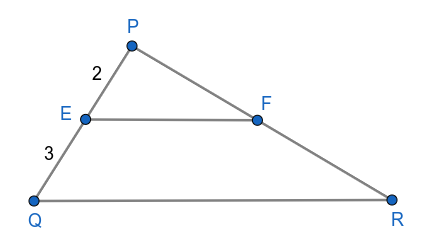
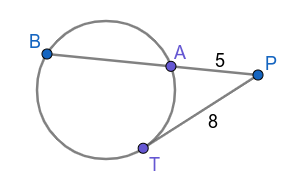

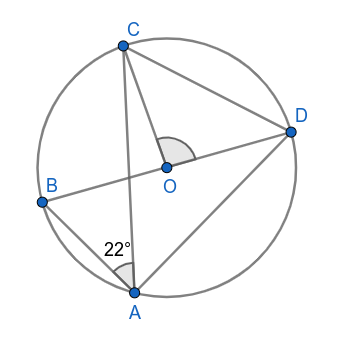
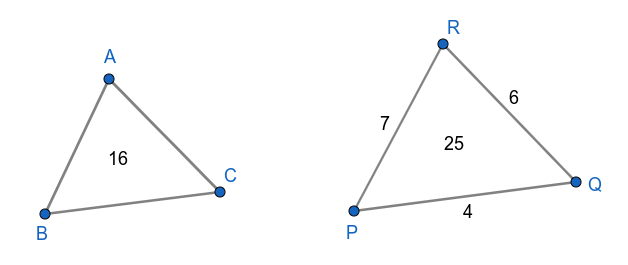
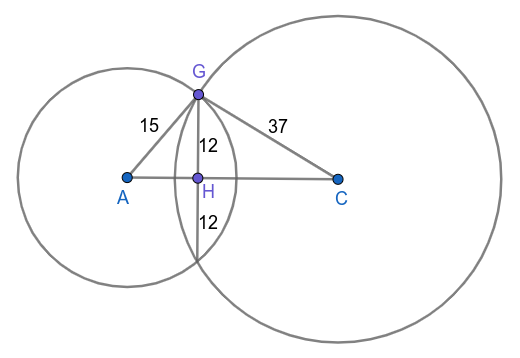
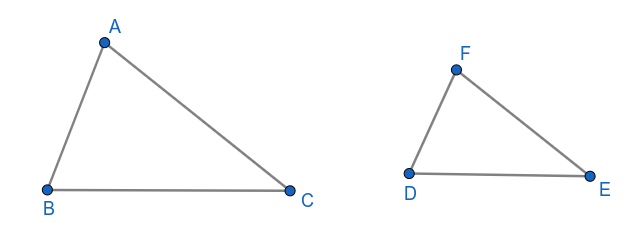

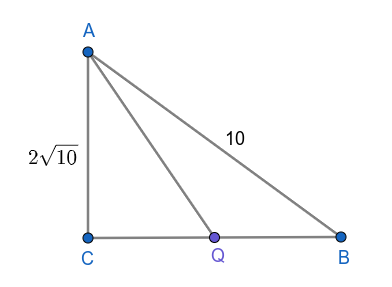


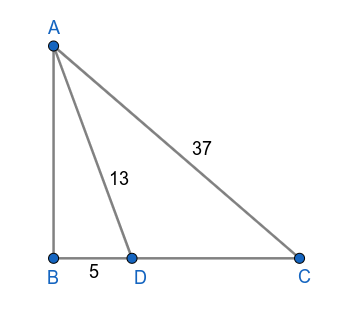
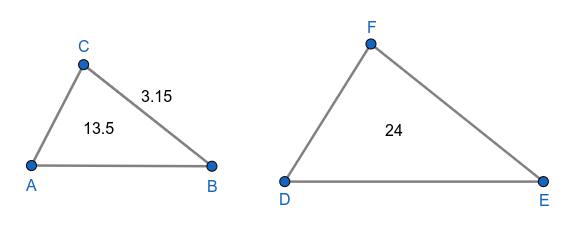
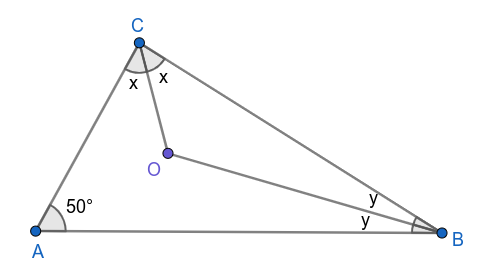
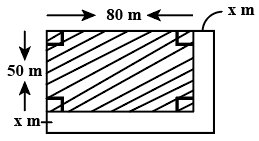
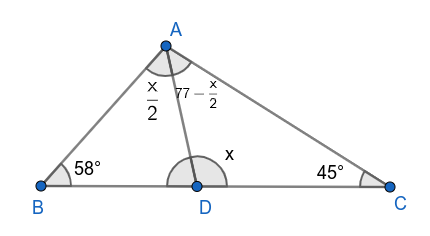
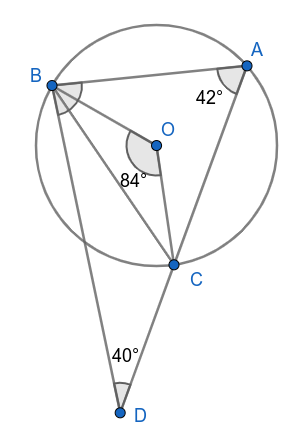

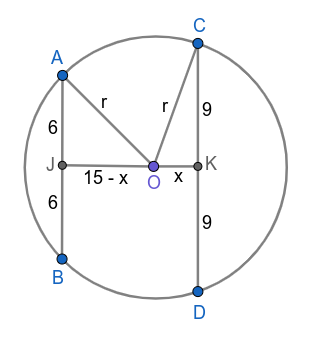
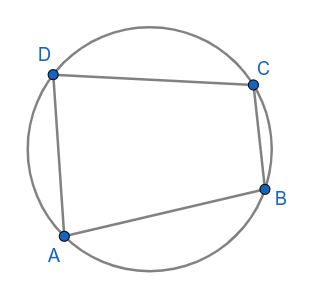

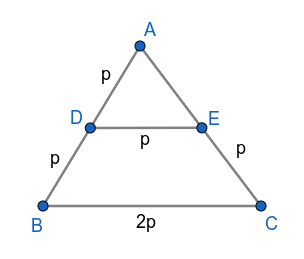
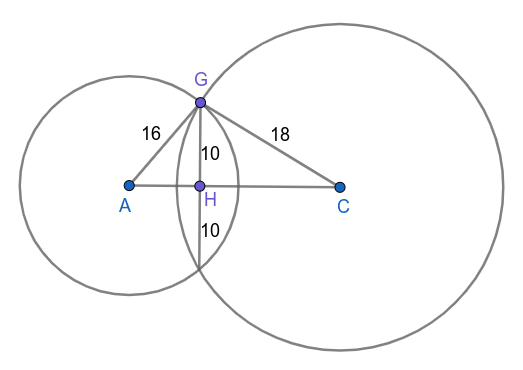


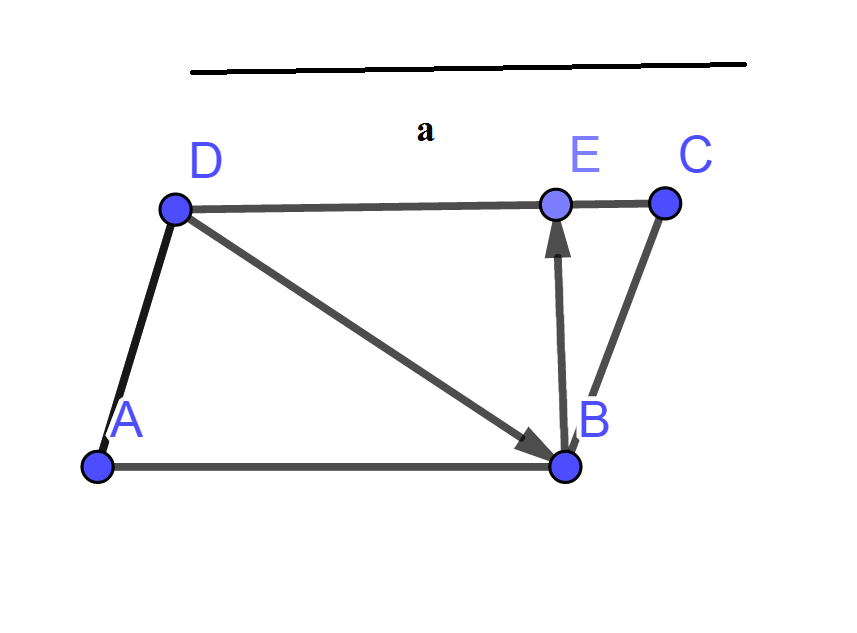


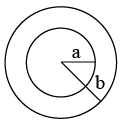


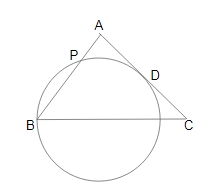


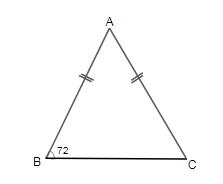


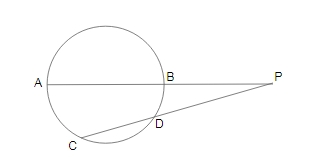


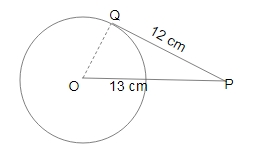


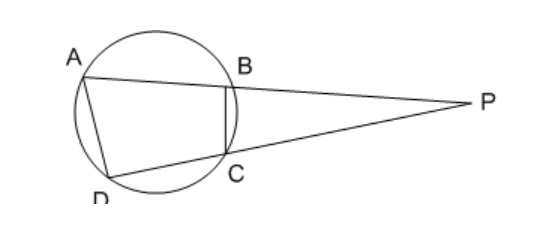


.png)


.png)

.png)
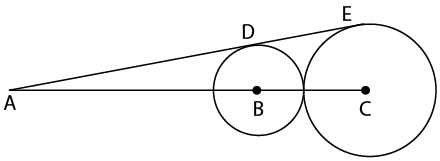
.png)


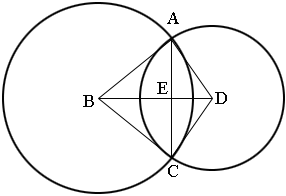

.png)

_v7itwYM.png)


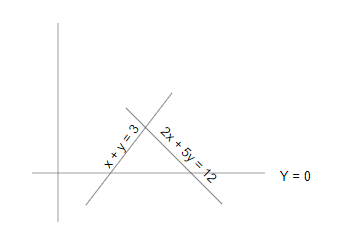
.png)
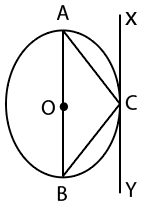
.png)


.png)

.png)
.png)
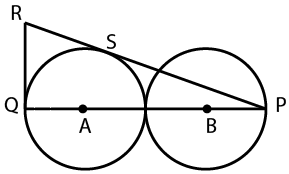

_kWG1pFo.png)


.png)

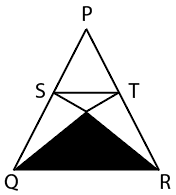
.png)


.png)
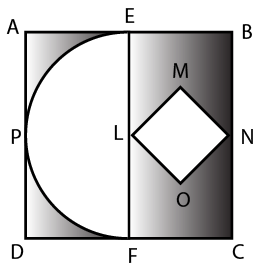
.png)
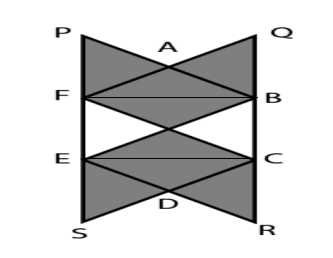
.png)


.png)


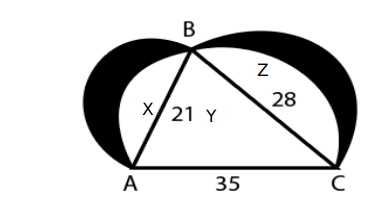

.png)

.png)
.png)
.png)
.png)


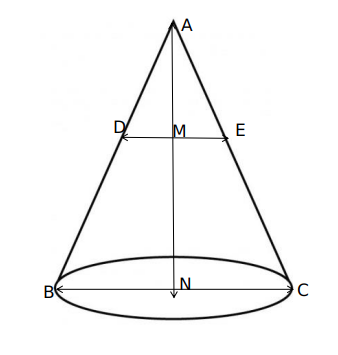




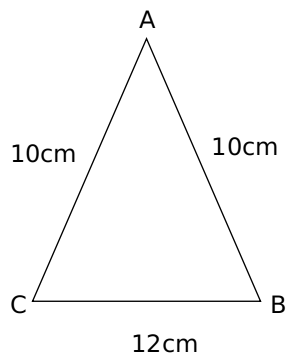
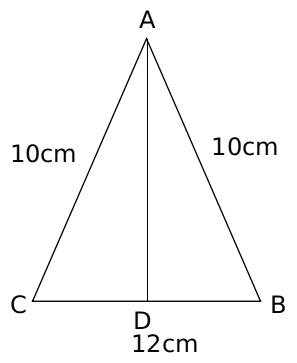

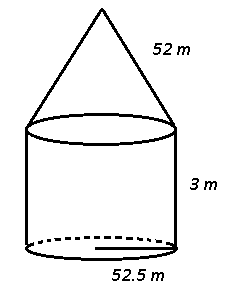


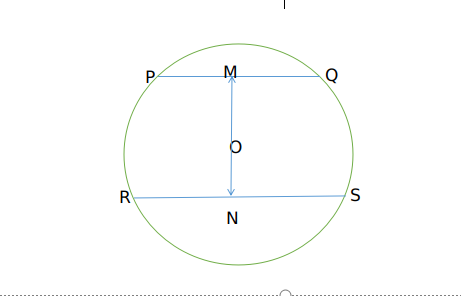


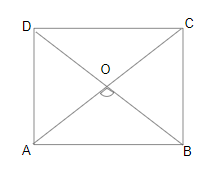


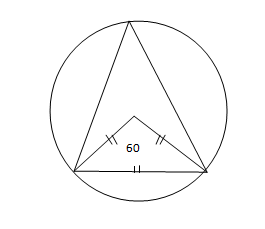


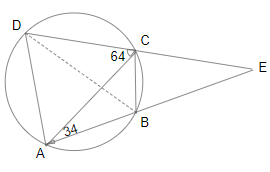


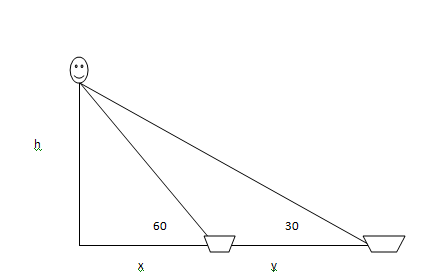


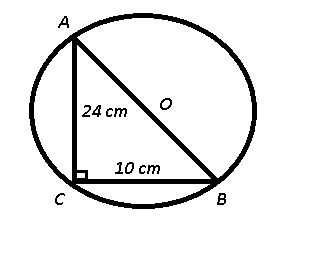 Given : In ΔABC, ∠BCA = 90°, AC = 24 cm and BC = 10 cm
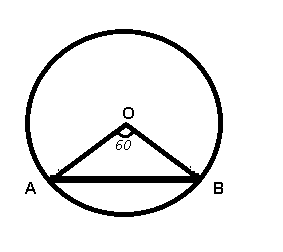
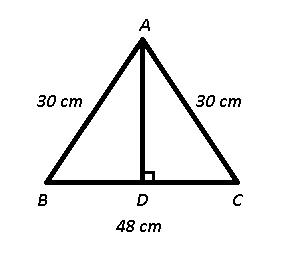
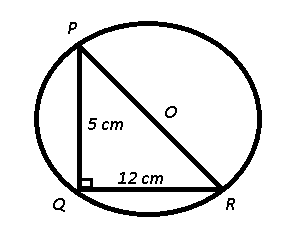
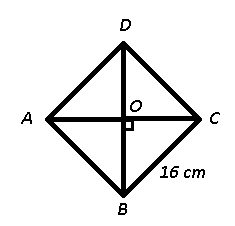
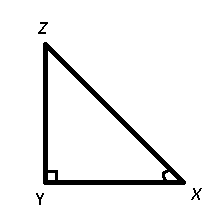


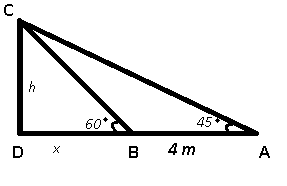

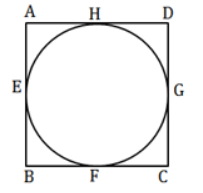
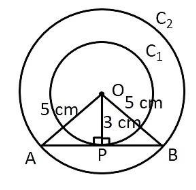
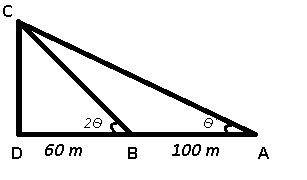

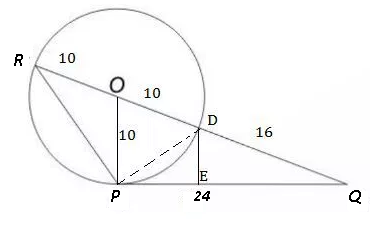

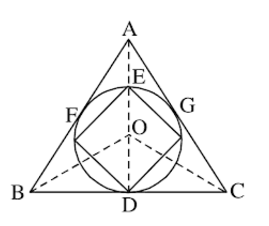
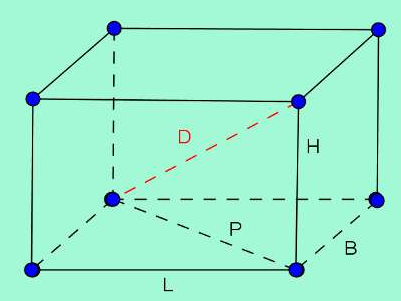


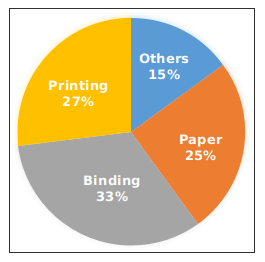


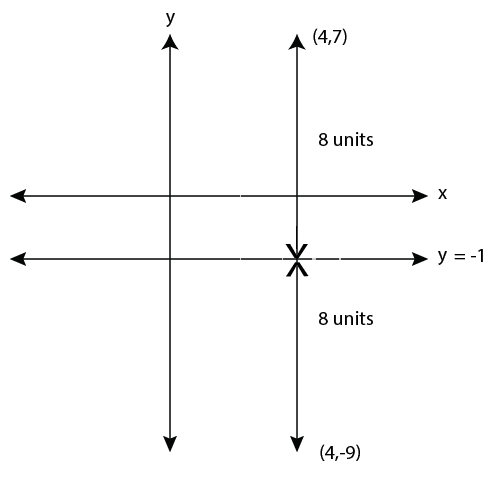


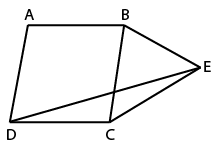

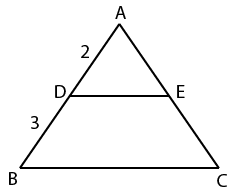

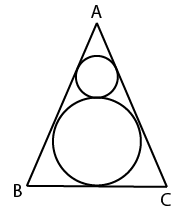
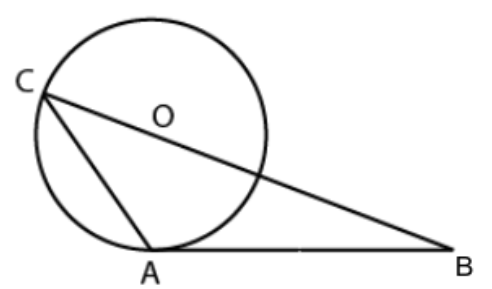
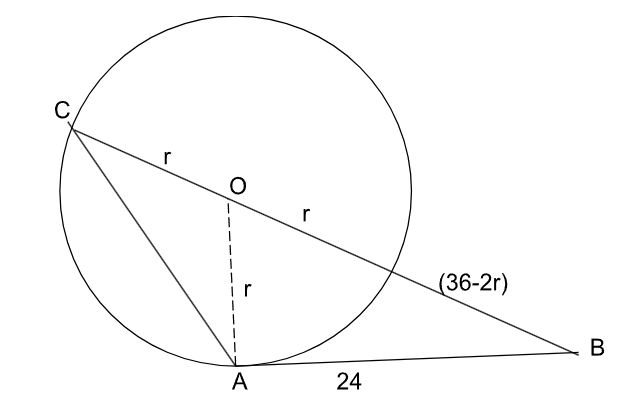

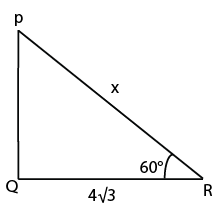
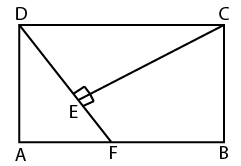


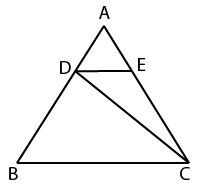


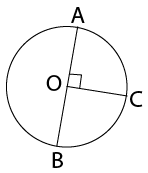


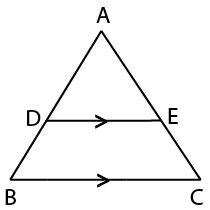


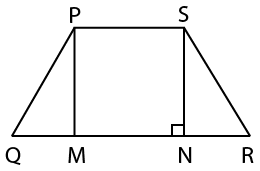


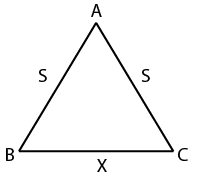
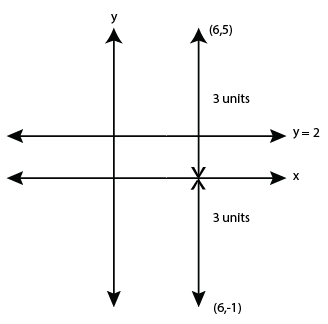


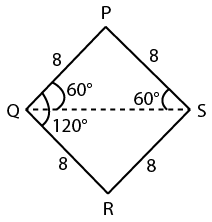
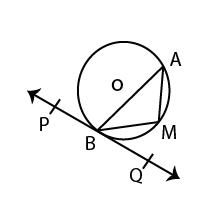
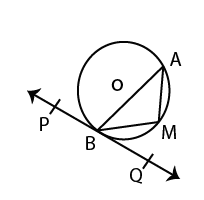
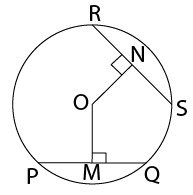

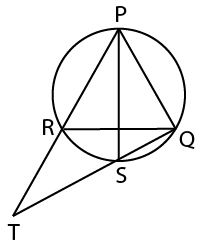
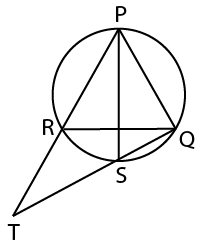


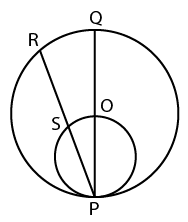
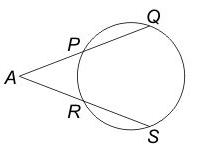
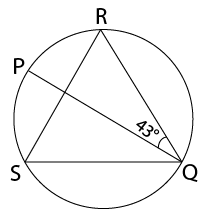

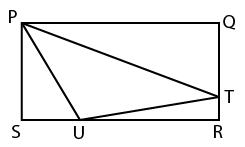


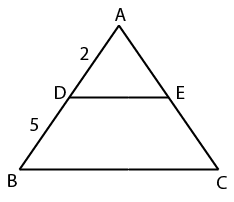

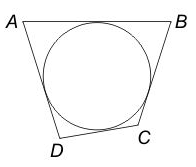
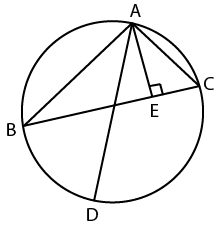
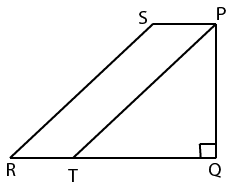
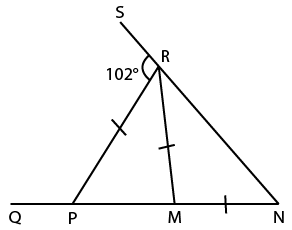

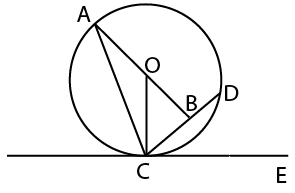
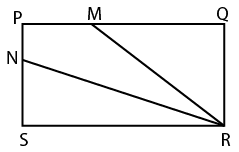

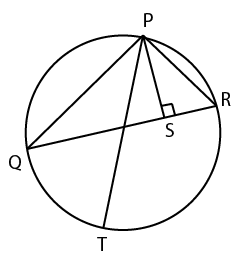
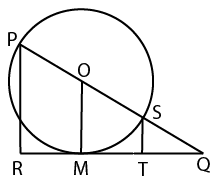
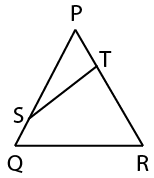


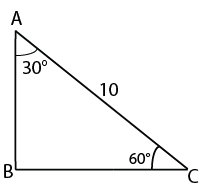


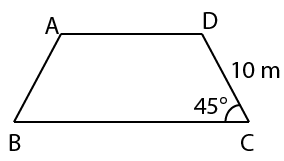


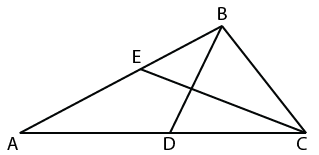


.PNG)


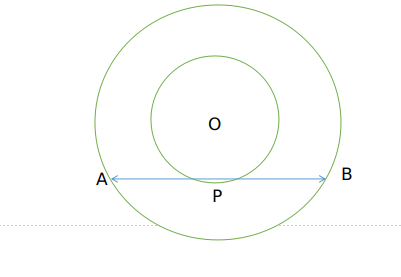


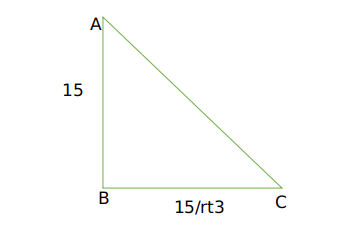
.PNG)