If $$N=(\frac{\sqrt{7}-\sqrt{5}}{\sqrt{7}+\sqrt{5}})$$, then what is the value of $$\frac{1}{N}$$ ?
A
$$6-\sqrt{35}$$
B
$$6+\sqrt{35}$$
C
$$7+\sqrt{35}$$
D
$$7-\sqrt{35}$$
View Explanation
Hide Explanation
Given : $$N=\frac{\sqrt7-\sqrt5}{\sqrt7+\sqrt5}$$
=> $$\frac{1}{N}=\frac{\sqrt7+\sqrt5}{\sqrt7-\sqrt5}$$
Rationalizing the denominator, we get :
= $$\frac{\sqrt7+\sqrt5}{\sqrt7-\sqrt5}\times\frac{\sqrt7+\sqrt5}{\sqrt7+\sqrt5}$$
= $$\frac{(\sqrt7+\sqrt5)^2}{(\sqrt7-\sqrt5)(\sqrt7+\sqrt5)}$$
= $$\frac{7+5+2(\sqrt7)(\sqrt5)}{7-5}$$
= $$\frac{12+2\sqrt{35}}{2}=6+\sqrt{35}$$
=> Ans - (B)
If $$\frac{1}{N}=\frac{(\sqrt{6}+\sqrt{5})}{\sqrt{6}-\sqrt{5}}$$, then what is the value of N ?
A
$$6-\sqrt{30}$$
B
$$6+\sqrt{30}$$
C
$$11-2\sqrt{30}$$
D
$$11+2\sqrt{5}$$
View Explanation
Hide Explanation
Given : $$\frac{1}{N}=\frac{\sqrt6+\sqrt5}{\sqrt6-\sqrt5}$$
=> $$N=\frac{\sqrt6-\sqrt5}{\sqrt6+\sqrt5}$$
Rationalizing the denominator, we get :
=> $$N=\frac{\sqrt6-\sqrt5}{\sqrt6+\sqrt5}\times\frac{\sqrt6-\sqrt5}{\sqrt6-\sqrt5}$$
=> $$N=\frac{(\sqrt6-\sqrt5)^2}{(\sqrt6+\sqrt5)(\sqrt6-\sqrt5)}$$
=> $$N=\frac{6+5-2(\sqrt6)(\sqrt5)}{6-5}$$
=> $$N=11-2\sqrt{30}$$
=> Ans - (C)
If N = (√6 - √5)/(√6 + √5), then what is the value of N + (1/N)?
View Explanation
Hide Explanation
Given N = (√6 - √5)/(√6 + √5)
Now, N + (1/N) = $$\frac{\sqrt{6} - \sqrt{5}}{\sqrt{6} + \sqrt{5}}$$ + $$\frac{\sqrt{6} + \sqrt{5}}{\sqrt{6} - \sqrt{5}}$$
$$\Rightarrow 6 + 5 - 2\sqrt{30} + 6 + 5 + 2\sqrt{30}$$ = 11 + 11 = 22
Hence, option D is the correct answer.
If P = ($$\sqrt{7}-\sqrt{6})/(\sqrt{7}+\sqrt{6})$$, then what is the value of P + (1/P)?
View Explanation
Hide Explanation
Given : $$P=\frac{\sqrt7-\sqrt6}{\sqrt7+\sqrt6}$$ ---------------(i)
=> $$\frac{1}{P}=\frac{\sqrt7+\sqrt6}{\sqrt7-\sqrt6}$$ ----------(ii)
Adding equations (i) and (ii),
=> $$P+\frac{1}{P}=(\frac{\sqrt7-\sqrt6}{\sqrt7+\sqrt6})+(\frac{\sqrt7+\sqrt6}{\sqrt7-\sqrt6})$$
= $$\frac{(\sqrt7-\sqrt6)^2+(\sqrt7+\sqrt6)^2}{(\sqrt7+\sqrt6)(\sqrt7-\sqrt6)}$$
= $$\frac{(13-2\sqrt{42})+(13+2\sqrt{42})}{7-6}$$
= $$13+13=26$$
=> Ans - (D)
Which value among $$\sqrt[4]{7}, \sqrt[3]{11}\ and\ \sqrt[12]{1257}\ $$is the largest ?
A
$$\sqrt[3]{11}$$
B
$$\sqrt[4]{7}$$
C
$$\sqrt[12]{1257}$$
D
All are equal
View Explanation
Hide Explanation
Terms : $$\sqrt[4]{7}, \sqrt[3]{11}\ and\ \sqrt[12]{1257}\ $$
L.C.M. of exponents (4,3,12) = 12
Multiplying the exponents by 12, we get :
$$\equiv(7)^{\frac{12}{4}},$$ $$(11)^{\frac{12}{3}}$$ and $$(1257)^{\frac{12}{12}}$$
$$\equiv(7)^3,(11)^4,(1257)^1$$
$$\equiv343,14641,1257$$
Thus, largest number = $$14641\equiv\sqrt[3]{11}$$
=> Ans - (A)
What is the simplified value of $$(3 + 1)(3^{2} + 1)(3^{4} + 1)(3^{8} + 1)(3^{16} + 1)$$?
A
$$(3^{32} - 1)/2$$
B
$$(3^{16} - 1)/2$$
C
$$(3^{64} - 1)/2$$
D
$$(3^{128} - 1)/2$$
Given $$(3 + 1)(3^{2} + 1)(3^{4} + 1)(3^{8} + 1)(3^{16} + 1)$$
Multiply and divide by (3 - 1)
$$\frac{(3 - 1)(3 + 1)(3^{2} + 1)(3^{4} + 1)(3^{8} + 1)(3^{16} + 1)}{3 - 1}$$
$$\frac{(3^{2} -1)(3^{2} + 1)(3^{4} + 1)(3^{8} + 1)(3^{16} + 1)}{2}$$
$$\frac{(3^{8} - 1)(3^{8} + 1)(3^{16} + 1)}{2}$$
$$\frac{(3^{16} - 1)(3^{16} + 1)}{2}$$
$$\frac{3^{32} - 1}{2}$$
Hence, option A is the correct answer.
What is the value of $$\ \frac{(1.1)^{3}+(0.7)^{3}}{(1.1)^{2}-1.1\times0.7+(0.7)^{2}}$$?
View Explanation
Hide Explanation
Expression = $$\ \frac{(1.1)^{3}+(0.7)^{3}}{(1.1)^{2}-1.1\times0.7+(0.7)^{2}}$$
Let $$x=1.1$$ and $$y=0.7$$
= $$\frac{x^3+y^3}{x^2-xy+y^2}$$
= $$\frac{(x+y)(x^2-xy+y^2)}{x^2-xy+y^2}$$
= $$x+y=1.1+0.7=1.8$$
=> Ans - (D)
What is the value of positive square root of $$69+28\sqrt{5}$$ ?
A
$$7+2\sqrt{5}$$
B
$$7-2\sqrt{5}$$
C
$$2+7\sqrt{5}$$
D
$$2-7\sqrt{5}$$
View Explanation
Hide Explanation
Let $$x=69+28\sqrt5$$
=> $$x=69+2(2)(7)(\sqrt{5})$$
=> $$x=(49)+(20)+2(7)(2\sqrt5)$$
=> $$x=(7)^2+(2\sqrt5)^2+2(7)(2\sqrt5)$$
=> $$x=(7+2\sqrt5)^2$$
=> Positive square root of $$x=7+2\sqrt5$$
=> Ans - (A)
What is the value of $$\ \sqrt{1+\frac{1}{2^{2}}+\frac{1}{3^{2}}}+\sqrt{1+\frac{1}{3^{2}}+\frac{1}{4^{2}}}+\sqrt{1+\frac{1}{4^{2}}+\frac{1}{5^{2}}}\ $$?
A
18/5
B
4/3
C
7/3
D
33/10
View Explanation
Hide Explanation
Expression = $$\ \sqrt{1+\frac{1}{2^{2}}+\frac{1}{3^{2}}}+\sqrt{1+\frac{1}{3^{2}}+\frac{1}{4^{2}}}+\sqrt{1+\frac{1}{4^{2}}+\frac{1}{5^{2}}}\ $$
= $$\ \sqrt{1+\frac{1}{4}+\frac{1}{9}}+\sqrt{1+\frac{1}{9}+\frac{1}{16}}+\sqrt{1+\frac{1}{16}+\frac{1}{25}}\ $$
= $$\sqrt{\frac{36+9+4}{36}}+\sqrt{\frac{144+16+9}{144}}+\sqrt{\frac{400+25+16}{400}}$$
= $$\sqrt{\frac{49}{36}}+\sqrt{\frac{169}{144}}+\sqrt{\frac{441}{400}}$$
= $$\frac{7}{6}+\frac{13}{12}+\frac{21}{20}$$
= $$\frac{70+65+63}{60}=\frac{198}{60}=\frac{33}{10}$$
=> Ans - (D)
For what value of N, 270N will be a perfect square, where 270N is a 4 digit number??
View Explanation
Hide Explanation
Number = 270N
We know that $$(50)^2=2500$$ and $$(51)^2=2601$$
Thus, $$(52)^2=2704$$
=> $$N=4$$
=> Ans - (C)
What is the value of $$\ (203+107)^{2}-(203 - 107)^{2}\ $$?
A
85886
B
86884
C
43442
D
87884
View Explanation
Hide Explanation
Expression = $$\ (203+107)^{2}-(203 - 107)^{2}\ $$
Let $$x=(203+107)$$ and $$y=(203-107)$$
=> $$x^2-y^2=(x+y)(x-y)$$
= $$[(203+107)+(203-107)][(203+107)-(203-107)]$$
= $$406\times214=86884$$
=> Ans - (B)
What is the value of $$3^{2}+7^{2}+13^{2}+17^{2}-1^{2}-5^{2}-9^{2}-11^{2}-15^{2}$$?
View Explanation
Hide Explanation
Expression = $$3^{2}+7^{2}+13^{2}+17^{2}-1^{2}-5^{2}-9^{2}-11^{2}-15^{2}$$
= $$(9+49+169+289)-(1+25+81+121+225)$$
= $$516-453=63$$
=> Ans - (D)
Which value among √11 + √5, √14 + √2, √8 + √8 is the largest?
A
√11 + √5
B
√14 + √2
C
√8 + √8
D
All are equal
View Explanation
Hide Explanation
Given √11 + √5, √14 + √2, √8 + √8
If we add the numbers of each element we get same value i.e 16 (11 + 5 = 14 + 2 = 8 + 8 = 16)
Now multiply the numbers of each element,
11 x 5 = 55, 14 x 2 = 28, 8 x 8 = 64
Element with highest value will be the highest number
√8 + √8 is the highest value
Hence, option C is the correct answer.
If 46N is divisible by 18, then what is the value of N?
View Explanation
Hide Explanation
For a number to be divisible by 18, it should be even and sum of its digits should be divisible by 9.
Sum of digits of 46N = $$4+6+N=(N+10)$$
=> $$N+10=18$$
=> $$N=18-10=8$$
=> Ans - (D)
What is the value of $$\frac{(0.5^{3})-(0.1)^{3}}{(0.5)^{2}+0.5 \times 0.1+(0.1)^{2}}$$?
View Explanation
Hide Explanation
Given $$\frac{(0.5^{3})-(0.1)^{3}}{(0.5)^{2}+0.5 \times 0.1+(0.1)^{2}}$$......(1)
we know that $$a^{3} - b^{3} = (a - b) (a^{2} + ab + b^{2})$$......(2)
Substitute (2) in (1)
$$\frac{(0.5-0.1)(0.5)^{2} + 0.5 \times 0.1 + (0.1)^{2}}{(0.5)^{2}+0.5 \times 0.1+(0.1)^{2}}$$
$$0.5 - 0.1 = 0.4$$
Hence, option B is the correct answer.
What is the value of $$\frac{(0.7)^{3}-(0.4)^{3}}{(0.7)^{2}+\ 0.7\times0.4+(0.4)^{2}}\ $$?
View Explanation
Hide Explanation
Expression = $$\frac{(0.7)^{3}-(0.4)^{3}}{(0.7)^{2}+\ 0.7\times0.4+(0.4)^{2}}\ $$
Let $$x=0.7$$ and $$y=0.4$$
= $$\frac{x^3-y^3}{x^2+xy+y^2}$$
= $$\frac{(x-y)(x^2+xy+y^2)}{x^2+xy+y^2}$$
= $$x-y=0.7-0.4=0.3$$
=> Ans - (A)
What is the value of $$999\frac{1}{3}+999\frac{1}{6}+999\frac{1}{12}+999\frac{1}{20}+999\frac{1}{30}$$?
A
$$999\frac{1}{6}$$
B
$$999\frac{5}{6}$$
C
$$4995\frac{1}{6}$$
D
$$4995\frac{4}{6}$$
View Explanation
Hide Explanation
Expression : $$999\frac{1}{3}+999\frac{1}{6}+999\frac{1}{12}+999\frac{1}{20}+999\frac{1}{30}$$
= $$(999+999+999+999+999)+(\frac{1}{3}+\frac{1}{6}+\frac{1}{12}+\frac{1}{20}+\frac{1}{30})$$
= $$(4995)+(\frac{20+10+5+3+2}{60})$$
= $$4995+\frac{40}{60}$$
= $$4995\frac{4}{6}$$
=> Ans - (D)
If 2A = 3B, then what is the value of (A + B)/A?
View Explanation
Hide Explanation
Given, 2A = 3B i.e
$$\frac{A}{B} = \frac{3}{2}$$ (or) $$\frac{B}{A} = \frac{2}{3}$$
Now, $$\frac{A+B}{A} \Rightarrow (\frac{A}{A} + \frac{B}{A}$$) $$\Rightarrow (1 + \frac{2}{3}) = \frac{5}{3}$$
Hence, option D is the correct answer.
If 3A = 5B, then what is the value of (A + B)/B?
View Explanation
Hide Explanation
Given : $$3A=5B$$
=> $$\frac{A}{B}=\frac{5}{3}$$
Let $$A=5$$ and $$B=3$$
To find : $$\frac{(A+B)}{B}$$
= $$\frac{(5+3)}{3}=\frac{8}{3}$$
=> Ans - (A)
If a - b : b - c : c - d = 1 : 2 : 3, then what is the value of (a + d) : c?
A
1 : 2
B
2 : 1
C
4 : 1
D
3 : 1
View Explanation
Hide Explanation
Given = $$(a-b):(b-c):(c-d)=1:2:3$$
=> $$\frac{a-b}{b-c}=\frac{1}{2}$$
=> $$2a-2b=b-c$$
=> $$2a+c=3b$$ -----------(i)
Similarly, $$\frac{b-c}{c-d}=\frac{2}{3}$$
=> $$3b-3c=2c-2d$$
=> $$3b=5c-2d$$ ----------(ii)
Substituting above value in equation (i), we get :
=> $$2a+c=5c-2d$$
=> $$2a+2d=5c-c$$
=> $$2(a+d)=4c$$
=> $$\frac{a+d}{c}=\frac{4}{2}=2$$
$$\therefore$$ $$(a+d):c=2:1$$
=> Ans - (B)
A trader sells two articles for Rs 14784 each. If he gains 12% on one and losses 12% on other, then what is the value (in Rs) of the loss?
View Explanation
Hide Explanation
Selling price of each article = Rs. 14,784
Profit % on one article = 12%
=> Cost price of first article = $$\frac{14784}{(100+12)}\times100$$
= $$\frac{14784}{1.12}=Rs.$$ $$13,200$$
Similarly, cost price of second article = $$\frac{14784}{(100-12)}\times100$$
= $$\frac{14784}{0.88}=Rs.$$ $$16,800$$
Thus, total cost price = $$13,200+16,800=Rs.$$ $$30,000$$
Total selling price = $$14,784+14,784=Rs.$$ $$29,568$$
$$\therefore$$ Total loss = $$30,000-29,568=Rs.$$ $$432$$
=> Ans - (C)
P is 20% more than Q and 40% less than R. If value of Q is Rs 150, then what is the value of R (in Rs)?
View Explanation
Hide Explanation
Given P is 20% more than Q,
P = 120% of Q (or) P = (6/5) x 150 (Q = 150)
P = 180
P is 40% less than R,
P = 60% of R (or) 180 = (3/5) x R
R = 300
Hence, option A is the correct answer.
X is 30% more than Y and 25% less than Z. If value of Y is Rs 300, then what is the value (in Rs) of Z ?
View Explanation
Hide Explanation
Given : $$Y=300$$
Also, X is 30% more than Y
=> $$X=300+(\frac{30}{100}\times300)$$
= $$300+90=390$$
And, X is 25% less than Z
=> $$Z=\frac{390}{(100-25)}\times100$$
= $$\frac{390}{3}\times4=520$$
=> Ans - (D)
The price of motor cycle depreciates every year by 10%. If the value of the motor cycle after 3 years will be Rs 36450, then what is the present value (in Rs) of the motor cycle?
A
45000
B
50000
C
48000
D
51000
View Explanation
Hide Explanation
Let the present value of motor cycle = Rs. $$x$$
Rate of depreciation = 10%
=> Value of the motor cycle after 3 years = $$x\times(1-\frac{10}{100})\times(1-\frac{10}{100})(1-\frac{10}{100})$$
=> $$x\times(\frac{90}{100})^3=36450$$
=> $$x=36450\times\frac{100^3}{90^3}$$
=> $$x=0.05\times1000000=50000$$
$$\therefore$$ The present value (in Rs) of the motor cycle = Rs. 50,000
=> Ans - (B)
The price of motorcycle depreciates every year by 8%. If the value of the motorcycle after 2 years will be Rs 84640, then what is the present value (in Rs) of the motorcycle?
A
90000
B
102000
C
110000
D
100000
View Explanation
Hide Explanation
Given that price of motorcycle depreciates every year by 8% then after 2 years,
92% of 92% of $$x = 84,640$$
$$\frac{92}{100}$$ x $$\frac{92}{100}$$ x $$x = 84,640$$
$$x = 100000$$
Hence, option D is the correct answer.
A certain sum becomes Rs 1020 in 5 years and Rs 1200 in 8 years at simple interest. What is the value of principal?
View Explanation
Hide Explanation
Simple interest for 3 years = 1200 - 1020 = 180 (or 60 for 1 year)
Then simple interest for 5 years = 300
Sum becomes 1020 in 5 years, hence, principal amount = 1020 - 300 = 720.
Hence, option D is the correct answer.
If the angles of a triangle are (2x - 8)$$^{o}$$, (2x + 18)$$^{o}$$and 6x$$^{o}$$. What is the value of 3x (in degrees)?
View Explanation
Hide Explanation
Sum of angles of a triangle = $$180^\circ$$
=> $$(2x-8)^\circ+(2x+18)^\circ+(6x)^\circ=180^\circ$$
=> $$10x+10=180$$
=> $$10x=180-10=170$$
=> $$x=\frac{170}{10}=17$$
$$\therefore$$ $$3x=3\times17=51$$
=> Ans - (C)
If $$(1/x) + (1/y) + (1/z) = 0$$ and $$x + y + z = 11$$, then what is the value of $$x^{3}+y^{3}+z^{3}-3xyz$$ ?
A
1331
B
2662
C
3993
D
14641
View Explanation
Hide Explanation
Given : $$\frac{1}{x}+\frac{1}{y}+\frac{1}{z}=0$$
=> $$\frac{yz+zx+xy}{xyz}=0$$
=> $$xy+yz+zx=0$$ -------------(i)
Also, $$x+y+z=11$$ ------------(ii)
Squaring both sides, we get :
=> $$(x+y+z)^2=(11)^2$$
=> $$(x^2+y^2+z^2)+2(xy+yz+zx)=121$$
Substituting value from equation (i),
=> $$x^2+y^2+z^2=121$$ ------------(iii)
To find : $$x^{3}+y^{3}+z^{3}-3xyz$$
= $$(x+y+z)[(x^2+y^2+z^2)-(xy+yz+zx)]$$
Substituting values from equations (i), (ii) and (iii),
= $$(11)(121-0)$$
= $$11\times121=1331$$
=> Ans - (A)
If $$x^{2} -7x + 1 = 0$$, then what is the value of $$x + \frac{1}{x}$$?
View Explanation
Hide Explanation
Given : $$x^2-7x+1=0$$
Dividing both sides by $$'x'$$
=> $$x-7+\frac{1}{x}=0$$
=> $$x+\frac{1}{x}=7$$
=> Ans - (A)
If $$\ (x/y)^{5a-3}\ $$ =$$\ (y/x)^{17-3a}$$, then what is the value of a?
View Explanation
Hide Explanation
Given : $$\ (x/y)^{5a-3}\ $$ =$$\ (y/x)^{17-3a}$$
=> $$\ (x/y)^{5a-3}\ =\ (x/y)^{3a-17}$$
=> $$5a-3=3a-17$$
=> $$5a-3a=-17+3$$
=> $$2a=-14$$
=> $$a=\frac{-14}{2}=-7$$
=> Ans - (A)
What is the value of $$[\frac{1}{1-x^{(p-q)}}+\frac{1}{1-x^{(q-p)}}]\ $$?
A
0
B
1
C
$$(x^{q}-x^{p})/(x^{q}+x^{p})$$
D
$$(x^{q}+x^{p})/(x^{q}-x^{p})$$
View Explanation
Hide Explanation
Expression = $$[\frac{1}{1-x^{(p-q)}}+\frac{1}{1-x^{(q-p)}}]\ $$
= $$(\frac{1}{1-\frac{x^p}{x^q}})+(\frac{1}{1-\frac{x^q}{x^p}})$$
= $$(\frac{x^q}{x^q-x^p})+(\frac{x^p}{x^p-x^q})$$
= $$(\frac{x^q}{x^q-x^p})-(\frac{x^p}{x^q-x^p})$$
= $$\frac{x^q-x^p}{x^q-x^p}=1$$
=> Ans - (B)
When a = 61, b = 63 and c = 65, then what is the value of a$$^{3}$$ + b$$^{3}$$ + c$$^{3}$$ - 3abc?
A
1456
B
2268
C
4536
D
5460
View Explanation
Hide Explanation
We know that $$(a + b + c)^{3} - 3abc= \frac{1}{2}(a + b + c)((a - b)^{2} + (b - c)^{2} + (c - a)^{2})$$
$$\Rightarrow \frac{1}{2} (61 + 63 + 65)((61 - 63)^{2}$$ + $$(63 - 65)^{2}$$ + $$(65 - 61)^{2})$$
$$\Rightarrow \frac{1}{2} (189)(2^{2} + 2^{2} + 4^{2})$$ = $$ \frac{1}{2} (189)(24) = 2268$$
Hence, option B is the correct answer.
If $$x^{2}- 2\sqrt{10}x+ 1 = 0$$, then what is the value of $$x - \frac{1}{x}$$?
View Explanation
Hide Explanation
Given : $$x^2-2\sqrt{10}x+1=0$$
Dividing both sides by $$'x'$$
=> $$x+\frac{1}{x}=2\sqrt{10}$$
Squaring both sides, we get :
=> $$x^2+\frac{1}{x^2}+2(x)(\frac{1}{x})=40$$
=> $$x^2+\frac{1}{x^2}=40-2=38$$
=> $$(x-\frac{1}{x})^2+2(x)(\frac{1}{x})=38$$
=> $$(x-\frac{1}{x})^2=38-2=36$$
=> $$x-\frac{1}{x}=\sqrt{36}=6$$
=> Ans - (B)
If $$\ x^{2}\ - 3x + 1 = 0$$, then what is the value of $$x + \frac{1}{x} $$?
View Explanation
Hide Explanation
Given : $$x^2-3x+1=0$$
Dividing both sides by $$'x'$$
=> $$x-3+\frac{1}{x}=0$$
=> $$x+\frac{1}{x}=3$$
=> Ans - (A)
What is the simplified value of $$\ [\frac{(1+x^{3})}{(x^{2}-1)}\div\frac{(x^{2}+1-x)}{(x+1)}] \times (x-1)$$?
A
$$1$$
B
$$x$$
C
$$x + 1$$
D
$$\frac{1}{x-1}$$
View Explanation
Hide Explanation
Expression = $$\ [\frac{(1+x^{3})}{(x^{2}-1)}\div\frac{(x^{2}+1-x)}{(x+1)}]\times(x-1)$$
= $$[\frac{1+x^3}{(x-1)(x+1)}\times\frac{x+1}{x^2+1-x}](x-1)$$
= $$[\frac{(x+1)(x^2+1-x)}{(x-1)}\times\frac{1}{(x^2+1-x)}](x-1)$$
= $$\frac{(x+1)}{(x-1)}\times(x-1)=(x+1)$$
=> Ans - (C)
What is the value of $$\ (\frac{x^{2}-x-6}{x^{2}+x-12})\div(\frac{x^{2}+5x+6}{x^{2}+7x+12})?$$
A
1
B
(x - 3)/(x + 3)
C
(x + 4) / (x - 3)
D
(x - 3) (x+4)
View Explanation
Hide Explanation
Expression = $$\ (\frac{x^{2}-x-6}{x^{2}+x-12})\div(\frac{x^{2}+5x+6}{x^{2}+7x+12})$$
= $$\ (\frac{x^{2}-x-6}{x^{2}+x-12})\times(\frac{x^{2}+7x+12}{x^{2}+5x+6})$$
= $$\ (\frac{(x-3)(x+2)}{(x+4)(x-3)})\times(\frac{(x+4)(x+3)}{(x+3)(x+2)})$$
= $$1$$
=> Ans - (A)
If $$a + b + c = - 11$$, then what is the value of $$\ (a + 4)^{3}+(b+ 5)^{3}+(c + 2)^{3}-3(a + 4)(b + 5)(c + 2)\ $$?
A
-1331
B
-121
C
0
D
1331
View Explanation
Hide Explanation
Given : $$a+b+c=-11$$
=> $$a+b+c+11=0$$
=> $$(a+4)+(b+5)+(c+2)=0$$
Let $$(a+4)=x$$, $$(b+5)=y$$ and $$(c+2)=z$$
=> $$x+y+z=0$$ -----------(i)
To find : $$\ (a + 4)^{3}+(b+ 5)^{3}+(c + 2)^{3}-3(a + 4)(b + 5)(c + 2)\ $$
= $$x^3+y^3+z^3-3xyz$$
= $$(x+y+z)(x^2+y^2+z^2-xy-yz-zx)$$
Substituting value from equation (i), we get :
= $$(0)(x^2+y^2+z^2-xy-yz-zx)=0$$
=> Ans - (C)
If $$\ \frac{3x-1}{x}+\frac{5y-1}{y}+\frac{7z-1}{z}$$= 0, then what is the value of $$\ \frac{1}{x}+\frac{1}{y}+\frac{1}{z}\ $$?
Given : $$\ \frac{3x-1}{x}+\frac{5y-1}{y}+\frac{7z-1}{z}=0$$
=> $$(3-\frac{1}{x})+(5-\frac{1}{y})+(7-\frac{1}{z})=0$$
=> $$\frac{1}{x}+\frac{1}{y}+\frac{1}{z}=3+5+7$$
=> $$\frac{1}{x}+\frac{1}{y}+\frac{1}{z}=15$$
=> Ans - (C)
If $$\frac{x+\sqrt{x^{2}-1}}{x-\sqrt{x^{2}-1}}+\frac{x-\sqrt{x^{2}-1}}{x+\sqrt{x^{2}-1}}$$= 62, then what is the value of $$x$$ ($$x < 0$$) ?
View Explanation
Hide Explanation
Expression : $$\frac{x+\sqrt{x^{2}-1}}{x-\sqrt{x^{2}-1}}+\frac{x-\sqrt{x^{2}-1}}{x+\sqrt{x^{2}-1}}=62$$
=> $$\frac{(x+\sqrt{x^2-1})^2+(x-\sqrt{x^2-1})^2}{(x-\sqrt{x^2-1})(x+\sqrt{x^2-1})}=62$$
=> $$\frac{(x^2+x^2-1+2x\sqrt{x^2-1})+(x^2+x^2-1-2x\sqrt{x^2-1})}{(x^2)-(x^2-1)}=62$$
=> $$\frac{4x^2-2}{1}=62$$
=> $$4x^2-2=62$$
=> $$4x^2=62+2=64$$
=> $$x^2=\frac{64}{4}=16$$
=> $$x=\sqrt{16}=\pm4$$
$$\because x<0$$, => $$x=-4$$
=> Ans - (A)
If$$\ x^{2}+\frac{1}{x^{2}}=\frac{7}{4}\ $$for x > 0, then what is the value of $$\ x^{3}+\frac{1}{x^{3}}\ $$
A
$$\frac{3\sqrt{3}}{\sqrt{5}}$$
B
$$\frac{3\sqrt{15}}{5}$$
C
$$\frac{3\sqrt{15}}{8}$$
D
$$\frac{3\sqrt{5}}{8}$$
View Explanation
Hide Explanation
Given : $$\ x^{2}+\frac{1}{x^{2}}=\frac{7}{4}\ $$
=> $$(x+\frac{1}{x})^2-2(x)(\frac{1}{x})=\frac{7}{4}$$
=> $$(x+\frac{1}{x})^2=\frac{7}{4}+2=\frac{15}{4}$$
=> $$x+\frac{1}{x}=\frac{\sqrt{15}}{2}$$
Cubing both sides, we get :
=> $$x^3+\frac{1}{x^3}+3(x)(\frac{1}{x})(x+\frac{1}{x})=(\frac{\sqrt{15}}{2})^3$$
=> $$x^3+\frac{1}{x^3}+3(\frac{\sqrt{15}}{2})=\frac{15\sqrt{15}}{8}$$
=> $$x^3+\frac{1}{x^3}=\frac{15\sqrt{15}}{8}-\frac{3\sqrt{15}}{2}$$
=> $$x^3+\frac{1}{x^3}=\frac{3\sqrt{15}}{8}$$
=> Ans - (C)
If$$\frac{1}{x+2}=\frac{3}{y+3}=\frac{1331}{z+1331}=\frac{1}{3}$$, then what is the value of $$\frac{x}{x+1}+\frac{4}{y+2}+\frac{z}{z+2662}?$$
View Explanation
Hide Explanation
Given $$\frac{1}{x+2}=\frac{1}{3}$$
We get x = 1 .....(1)
$$\frac{3}{y+3}=\frac{1}{3}$$
we get y = 6 .....(2)
$$\frac{1331}{z+1331}=\frac{1}{3}$$
we get z = 2662 ....(3)
We need to find $$\frac{x}{x+1}+\frac{3}{y+3}+\frac{z}{z+2662}$$
Substitute equations (1), (2) and (3) in the above equation
= $$\frac{1}{1+1}+\frac{3}{6+3}+\frac{2662}{2662+2662}$$
= $$\frac{1}{2}+\frac{3}{9}+\frac{1}{2}$$
= $$\frac{3}{2}$$
Hence, option C is the correct answer.
If $$\ \sqrt{7x+12}+\sqrt{7x-12}=3+\sqrt{33}\ $$, then what is the value of x?
View Explanation
Hide Explanation
Expression : $$\ \sqrt{7x+12}+\sqrt{7x-12}=3+\sqrt{33}\ $$
$$(7x-12)$$ must be greater than equal to 0.
=> $$7x-12\geq0$$
=> $$x\geq\frac{12}{7}$$
Thus, first two options are eliminated. Putting $$x=3$$ in above equation,
=> $$\sqrt{7(3)+12}+\sqrt{7(3)-12}$$
=> $$\sqrt{33}+\sqrt9$$
= $$3+\sqrt{33}=$$ R.H.S.
=> Ans - (C)
If $$\ x^{2}\ - 3x + 1 = 0$$, then what is the value of $$\ x^{4}\ $$+ $$\ \frac{1}{x^{4}}$$?
View Explanation
Hide Explanation
Given : $$x^2-3x+1=0$$
Dividing both sides by $$'x'$$
=> $$x+\frac{1}{x}=3$$
Squaring both sides, we get :
=> $$x^2+\frac{1}{x^2}+2(x)(\frac{1}{x})=9$$
=> $$x^2+\frac{1}{x^2}=9-2=7$$
Again squaring both sides,
=> $$x^4+\frac{1}{x^4}+2(x^2)(\frac{1}{x^2})=49$$
=> $$x^4+\frac{1}{x^4}=49-2=47$$
=> Ans - (C)
If $$x^{2} - 8x + 1 = 0$$, then what is the value of $$x^{2}+\frac{1}{x^{2}}$$?
View Explanation
Hide Explanation
Given : $$x^2-8x+1=0$$
Dividing both sides by $$'x'$$
=> $$x+\frac{1}{x}=8$$
Squaring both sides, we get :
=> $$x^2+\frac{1}{x^2}+2(x)(\frac{1}{x})=64$$
=> $$x^2+\frac{1}{x^2}=64-2=62$$
=> Ans - (D)
If$$\ x^{2}+\frac{1}{x^{2}}=\frac{7}{4}$$ for x > 0, then what is the value of x + $$\frac{1}{x}$$?
View Explanation
Hide Explanation
Let,
$$(x + \frac{1}{x})^{2}$$ = $$\ x^{2}+\frac{1}{x^{2}} + 2(x)(\frac{1}{x})$$
$$(x + \frac{1}{x})^{2}$$ = $$\frac{7}{4} + 2$$
$$(x + \frac{1}{x})^{2}$$ = $$\frac{15}{4}$$
$$(x + \frac{1}{x})$$ = $$\frac{\sqrt{15}}{2}$$
Hence, option B is the correct answer.
If$$x^{2} - 3x + 1 = 0$$, then what is the value of $$x^{2}+ \frac{1}{x^{2}}$$?
View Explanation
Hide Explanation
Given : $$x^2-3x+1=0$$
Dividing both sides by $$'x'$$
=> $$x+\frac{1}{x}=3$$
Squaring both sides, we get :
=> $$x^2+\frac{1}{x^2}+2(x)(\frac{1}{x})=9$$
=> $$x^2+\frac{1}{x^2}=9-2=7$$
=> Ans - (B)
If $$x + \frac{1}{x} = 3\sqrt{2}$$, then what is the value of $$x^{5}+\frac{1}{x^5}$$
A
$$178\sqrt{3}$$
B
$$789\sqrt{2}$$
C
$$1581\sqrt{2}$$
D
$$717\sqrt{2}$$
View Explanation
Hide Explanation
Given : $$x+\frac{1}{x}=3\sqrt2=k$$
Now, $$x^5+\frac{1}{x^5}=[(x^3+\frac{1}{x^3})\times(x^2+\frac{1}{x^2})]-(x+\frac{1}{x})$$
= $$[(x+\frac{1}{x})^3-3(x+\frac{1}{x})\times(x+\frac{1}{x})^2-2(x)(\frac{1}{x})]-(x+\frac{1}{x})$$
= $$[(k^3-3k)\times(k^2-2)]-(k)$$
= $$[(54\sqrt2-9\sqrt2)\times(18-2)]-(3\sqrt2)$$
= $$(45\sqrt2\times16)-3\sqrt2$$
= $$720\sqrt2-3\sqrt2=717\sqrt2$$
=> Ans - (D)
If x + y + z = 0, then what is the value of $$\frac{x^{2}}{yz}+\frac{y^{2}}{xz}+\frac{z^{2}}{xy}$$?
View Explanation
Hide Explanation
Given x + y + z = 0. So, x + y = -z, y + z = -x, z + x = -y -----------(1)
$$\frac{x^{2}}{yz}+\frac{y^{2}}{xz}+\frac{z^{2}}{xy}$$
$$\frac{x^{3} + y^{3} + z^{3}}{xyz}$$ -----------(2)
We know that, $$a^{3} + b^{3} + c^{3} = (a+b+c)^{3} - 3ab(a+b) - 3bc(b+c) - 3ac(a+c) - 6abc$$
Hence, equation (2) can be written as,
$$\frac{(x+y+z)^{3} - 3xy(x+y) - 3yz(y+z) - 3zx(x+z) - 6xyz}{xyz}$$
Now substitute equation (1) in the above equation,
$$\frac{(0)^{3} + 3xy(z) + 3yz(x) + 3zx(y) - 6xyz}{xyz}$$
$$\frac{3xyz}{xyz}$$ = 3
Hence, option D is the correct answer.
If $$\ x^{4}+\frac{1}{x^{4}}\ $$= 98 and $$x > 1$$, then what is the value of $$x-\frac{1}{x}\ ?$$
A
$$2$$
B
$$2\sqrt{2}$$
C
$$\sqrt{5}$$
D
$$\sqrt{3}$$
View Explanation
Hide Explanation
Given : $$\ x^{4}+\frac{1}{x^{4}}\ =98$$
=> $$(x^2+\frac{1}{x^2})^2-2(x^2)(\frac{1}{x^2})=98$$
=> $$(x^2+\frac{1}{x^2})^2=98+2=100$$
=> $$x^2+\frac{1}{x^2}=\sqrt{100}=10$$
=> $$(x-\frac{1}{x})^2+2(x)(\frac{1}{x})=10$$
=> $$(x-\frac{1}{x})^2=10-2=8$$
=> $$x-\frac{1}{x}=\sqrt8=2\sqrt2$$
=> Ans - (B)
What is the simplified value of $$\ (x^{32}+\frac{1}{x^{32}})(x^{8}+\frac{1}{x^{8}})(x-\frac{1}{x})(x^{16}+\frac{1}{x^{16}})(x+\frac{1}{x})(x^{4}+\frac{1}{x^{4}})$$?
A
$$(x^{64}+\frac{1}{x^{64}})$$
B
$$\frac{(x^{64}-\frac{1}{x^{64}})}{(x^{2}+\frac{1}{x^{2}})}$$
C
$$\frac{(x^{64}-\frac{1}{x^{64}})}{(x+\frac{1}{{x}})}$$
D
$$\frac{(x^{32}-\frac{1}{x^{32}})}{(x+\frac{1}{{x}})}$$
View Explanation
Hide Explanation
Expression = $$\ (x^{32}+\frac{1}{x^{32}})(x^{8}+\frac{1}{x^{8}})(x-\frac{1}{x})(x^{16}+\frac{1}{x^{16}})(x+\frac{1}{x})(x^{4}+\frac{1}{x^{4}})$$
= $$\ (x^{32}+\frac{1}{x^{32}})(x^{8}+\frac{1}{x^{8}})(x^2-\frac{1}{x^2})(x^{16}+\frac{1}{x^{16}})(x^{4}+\frac{1}{x^{4}})$$
Multiply and divide by $$(x^2+\frac{1}{x^2})$$, we get :
= $$\frac{1}{x^2+\frac{1}{x^2}}\times\ (x^{32}+\frac{1}{x^{32}})(x^{8}+\frac{1}{x^{8}})(x^2-\frac{1}{x^2})(x^2+\frac{1}{x^2})(x^{16}+\frac{1}{x^{16}})(x^{4}+\frac{1}{x^{4}})$$
= $$\frac{1}{x^2+\frac{1}{x^2}}\times\ (x^{32}+\frac{1}{x^{32}})(x^{8}+\frac{1}{x^{8}})(x^{16}+\frac{1}{x^{16}})(x^{4}+\frac{1}{x^{4}})(x^4-\frac{1}{x^4})$$
= $$\frac{1}{x^2+\frac{1}{x^2}}\times\ (x^{32}+\frac{1}{x^{32}})(x^{8}+\frac{1}{x^{8}})(x^{16}+\frac{1}{x^{16}})(x^{8}-\frac{1}{x^{8}})$$
= $$\frac{1}{x^2+\frac{1}{x^2}}\times\ (x^{32}+\frac{1}{x^{32}})(x^{16}+\frac{1}{x^{16}})(x^{16}-\frac{1}{x^{16}})$$
= $$\frac{1}{x^2+\frac{1}{x^2}}\times\ (x^{32}+\frac{1}{x^{32}})(x^{32}-\frac{1}{x^{32}})$$
= $$\frac{1}{x^2+\frac{1}{x^2}}\times\ (x^{64}-\frac{1}{x^{64}})$$
=> Ans - (B)
What is the value of $$\ \frac{(a^{2}+b^{2})(a-b)-(a-b)^{2}}{a^{2}b-ab^{2}}$$?
View Explanation
Hide Explanation
Expression : $$\ \frac{(a^{2}+b^{2})(a-b)-(a-b)^{2}}{a^{2}b-ab^{2}}$$
= $$\ \frac{(a-b)[(a^{2}+b^{2})-(a-b)]}{(ab)(a-b)}$$
= $$\frac{(a^2+b^2)-(a-b)}{ab}$$
= $$\frac{(a-b)^2+2ab-(a-b)}{ab}$$
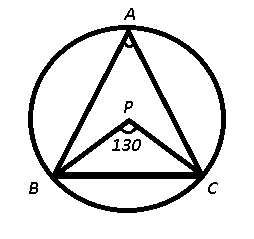
If P is the circum-center in ΔABC, ∠BPC = 130°, then what is the value (in degrees) of ∠BAC?
View Explanation
Hide Explanation
Given : P is the circum-center in ΔABC and ∠BPC = 30°
To find : $$\angle$$ BAC = ?
Solution : In a circle, angle subtended by an arc at the centre is double the angle subtended by the same arc on any other point on the circle
=> $$\angle BPC = 2 \times \angle BAC$$
=> $$\angle$$ BAC = $$\frac{130^\circ}{2}=65^\circ$$
=> Ans - (C)
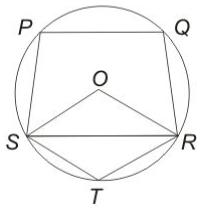
In the given figure, O is the center of the circle, $$\ \angle$$PQR = 100$$^\circ\ $$and $$\angle$$STR = 105$$^\circ$$. What is the value (in degrees) of $$\ \angle$$OSP?
View Explanation
Hide Explanation
Given : $$\ \angle$$PQR = 100$$^\circ\ $$and $$\angle$$STR = 105$$^\circ$$
To find : $$\ \angle$$OSP = ?
Solution : Quadrilateral PQRS is cyclic quadrilateral, hence opposite angles are supplementary.
=> $$\angle$$ PQR + $$\angle$$ PSR = $$180^\circ$$
=> $$\angle$$ PSR = $$180^\circ-100^\circ=80^\circ$$ --------------(i)
Also, angle at the centre is double the angle at any point on the circumference of the circle in the same segment.
=> reflex ($$\angle$$ SOR) = $$2$$ $$\times$$ $$\angle$$ STR
=> reflex ($$\angle$$ SOR) = $$2\times105^\circ=210^\circ$$
Thus, $$\angle$$ SOR = $$360^\circ-210^\circ=150^\circ$$
Now, in $$\triangle$$ SOR, OS = OR = radius
=> $$\angle$$ OSR = $$\angle$$ ORS = $$15^\circ$$ ----------(ii)
Subtracting equation (ii) from (i), we get :
$$\therefore$$ $$\angle$$ OSP = $$80^\circ-15^\circ=65^\circ$$
=> Ans - (D)
In ΔPQR, ∠P : ∠Q : ∠R = 1 : 3 : 5. What is the value (in degrees) of ∠R - ∠P?
View Explanation
Hide Explanation
Let, ∠P = 1x, ∠Q = 3x, ∠R = 5x
Sum of interior angles of a triangle = 180 degrees i.e
∠P + ∠Q + ∠R = 180 degrees
$$\Rightarrow$$ 9x = 180 (or) x = 20
∠R - ∠P = 5x - 1x
∠R - ∠P = 4x (or) 4 x 20
∠R - ∠P = 80
Hence, option B is the correct answer.
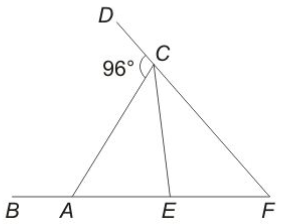
In the given figure, EF = CE = CA, What is the value (in degrees) of $$\angle$$EAC?
View Explanation
Hide Explanation
Given : EF = CE = CA
=> $$\angle$$ CAE = $$\angle$$ CEA = $$x$$ and $$\angle$$ ECF = $$\angle$$ EFC = $$y$$
To find : $$\angle$$ EAC = $$x=?$$
Solution : Using exterior angle property, => $$\angle$$ CAE + $$\angle$$ CFE = $$\angle$$ ACD
=> $$x+y=96^\circ$$ -----------------(i)
Also, $$\angle$$ CEF = $$(180^\circ-2y)=180^\circ-x$$
=> $$x=2y$$ ------------(ii)
Substituting it in equation (i), => $$2y+y=3y=96^\circ$$
=> $$y=\frac{96}{3}=32^\circ$$
$$\therefore$$ $$x=2\times32=64^\circ$$
=> Ans - (B)
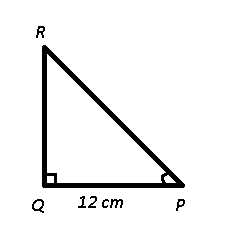
If ΔPQR is right angled at Q, PQ = 12 and ∠PRQ = 30°, then what is the value of QR?
A
$$12\sqrt{3}$$
B
$$12\sqrt{2}$$
C
$$12$$
D
$$24$$
View Explanation
Hide Explanation
Given : ΔPQR is right angled at Q, PQ = 12 and ∠PRQ = 30°
To find : QR = ?
Solution : $$tan(\angle R)=\frac{PQ}{QR}$$
=> $$tan(30^\circ)=\frac{12}{QR}$$
=> $$\frac{1}{\sqrt3}=\frac{12}{QR}$$
=> $$QR=12\sqrt3$$ cm
=> Ans - (A)
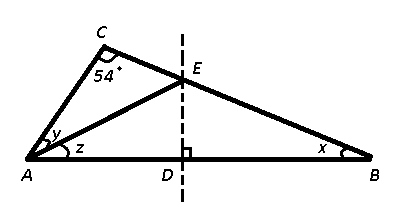
In ΔABC, ∠C = 54°, the perpendicular bisector of AB at D meets BC at E. If ∠EAC = 42°, then what is the value (in degrees) of ∠ABC?
View Explanation
Hide Explanation
Given : ED is the perpendicular bisectors of AB, $$\angle C=54^\circ$$ and $$\angle EAC=y=42^\circ$$
To find : $$\angle B=x=?$$
Solution : In $$\triangle$$ EAC, using exterior angle property,
=> $$\angle$$ AEB = $$\angle$$ C + $$y$$
=> $$\angle$$ AEB = $$54^\circ+42^\circ=96^\circ$$
Thus, in $$\triangle$$ AEB, => $$x+z=180^\circ-96^\circ=84^\circ$$ ------------(i)
Also, in $$\triangle$$ EAD and $$\triangle$$ BDE
AD = DB (DE bisects AB)
$$\angle$$ EAD = $$\angle$$ EDB = $$90^\circ$$
DE = DE (Common)
Thus, $$\triangle$$ EAD $$\cong$$ $$\triangle$$ BDE (By SAS criterion)
=> $$x=z$$ (By CPCT)
Substituting above value in equation (i), we get :
=> $$x+x=2x=84^\circ$$
=> $$x=\frac{84}{2}=42^\circ$$
=> Ans - (B)
In the given figure, O is the centre of the circle, $$\angle$$PQO=30 $$^\circ$$and$$\ \angle$$\ QRO = $$\ 45^\circ\$$. What is the value (in degrees) of $$\angle$$POR?
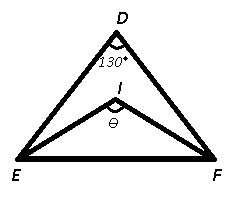
In an isosceles triangle DEF, ∠D = 130°. If I is the incentre of the triangle, then what is the value (in degrees) of ∠EIF?
View Explanation
Hide Explanation
Given : I is the incentre of $$\triangle$$ DEF and $$\angle$$ D = 130°
To find : $$\angle$$ EIF = $$\theta$$ = ?
Incentre of a triangle = $$90^\circ+\frac{\angle D}{2}$$
=> $$\theta=90^\circ+\frac{130^\circ}{2}$$
=> $$\theta=90^\circ+65^\circ$$
=> $$\theta=155^\circ$$
=> Ans - (C)
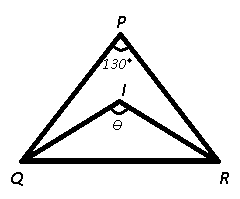
In an isosceles triangle PQR, ∠P = 130$$^\circ$$. If I is the in-centre of the triangle, then what is the value (in degrees) of ∠QIR?
View Explanation
Hide Explanation
Given : I is the incentre of $$\triangle$$ PQR and $$\angle$$ BAC = 130°
To find : $$\angle$$ QIR = $$\theta$$ = ?
Incentre of a triangle = $$90^\circ+\frac{\angle P}{2}$$
=> $$\theta=90^\circ+\frac{130^\circ}{2}$$
=> $$\theta=90^\circ+65^\circ$$
=> $$\theta=155^\circ$$
=> Ans - (C)
In the given figure, O is the centre of the circle, OQ is perpendicular to RS and $$\angle$$SRT = $$30^\circ\ $$. If RS=10$$\surd2$$, then what is the value of PR$$^{2}$$?
A
200(1 + √3)
B
300(2 + √3)
C
200(2 + √3)
D
100(3 + 2√3)
$$2\frac{1}{5}x^{2}\ $$= 2750, find the value of x ?
A
25
B
$$25\sqrt{3}$$
C
$$25\sqrt{2}$$
D
20
$$2\frac{1}{5}x^{2}=2750$$
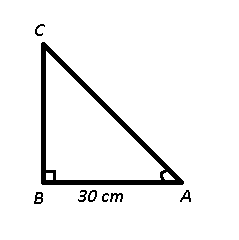
If ΔABC is right angled at B, AB = 30 and ∠ACB = 60°, then what is the value of AC?
A
$$20$$
B
$$20\sqrt{3}$$
C
$$40$$
D
$$60$$
View Explanation
Hide Explanation
It is given that $$\triangle$$ ABC is a right angled at B, AB = 30 cm and $$\angle C=60^\circ$$
Now, in right $$\triangle$$ ABC,
=> $$sin(\angle C)=\frac{AB}{AC}$$
=> $$sin(60^\circ)=\frac{30}{AC}$$
=> $$\frac{\sqrt3}{2}=\frac{30}{AC}$$
=> $$AC=\frac{2}{\sqrt3}\times30=20\sqrt3$$ cm
=> Ans - (B)
In the following figure, O is the centre of the circle and $$\ \angle$$PRQ = $$\ 50^\circ$$. What is the value (in degrees) of $$\ \angle$$PTQ?
View Explanation
Hide Explanation
Given : $$\ \angle$$PRQ = $$\ 50^\circ$$
To find : $$\ \angle$$PTQ = ?
Solution : Quadrilateral PRQT is a cyclic quadrilateral, in which opposite angles are supplementary.
=> $$\angle$$ PRQ + $$\angle$$ PTQ = $$180^\circ$$
=> $$\angle$$ PTQ = $$180^\circ-50^\circ=130^\circ$$
=> Ans - (C)
If 2cos$$^{2}$$ θ - 1 = 0 and θ is acute, then what is the value of (cot$$^{2}$$ θ - tan$$^{2}$$ θ)?
View Explanation
Hide Explanation
Given : $$2cos^2\theta-1=0$$
=> $$cos^2\theta=\frac{1}{2}$$
=> $$cos\theta=\sqrt{\frac{1}{2}}=\frac{1}{\sqrt2}$$
=> $$\theta=cos^{-1}(\frac{1}{\sqrt2})=45^\circ$$
$$\therefore$$ $$cot^2\theta-tan^2\theta$$
= $$cot^2(45^\circ)-tan^2(45^\circ)$$
= $$1-1=0$$
=> Ans - (A)
If 4sin$$^{2}$$ 2θ - 3 = 0 and θ is acute, then what is the value of (cot$$\ ^{2}\ $$ θ + tan $$^{2}$$ θ)?
View Explanation
Hide Explanation
Given : $$4sin^22\theta-3=0$$
=> $$sin^22\theta=\frac{3}{4}$$
=> $$sin2\theta=\sqrt{\frac{3}{4}}=\frac{\sqrt3}{2}$$
=> $$sin2\theta=sin(60^\circ)$$
=> $$2\theta=60$$
=> $$\theta=\frac{60}{2}=30^\circ$$
$$\therefore$$ $$cot^2\theta+tan^2\theta$$
= $$cot^2(30^\circ)+tan^2(30^\circ)$$
= $$(\sqrt3)^2+(\frac{1}{\sqrt3})^2$$
= $$3+\frac{1}{3}=\frac{10}{3}$$
=> Ans - (C)
If sec$$\theta=\frac{13}{12}\ and\ \theta\ $$is acute, then what is the value of $$(\sqrt{cot\theta+tan \theta})$$?
A
$$\frac{13}{2\sqrt{15}}$$
B
$$\frac{12}{2\sqrt{13}}$$
C
$$\frac{13}{2\sqrt{5}}$$
D
$$\frac{2}{13}$$
View Explanation
Hide Explanation
Given,
sec$$\theta = \frac{13}{12}$$
Then, cot$$\ \theta = \frac{12}{5}$$ and tan$$\ \theta = \frac{5}{12}$$
$$(\sqrt{cot\theta+tan \theta})$$ = $$(\sqrt{\frac{12}{5}+\frac{5}{12}})$$ = $$(\sqrt{\frac{169}{60}})$$ = $$\frac{13}{2\sqrt{15}}$$
Hence, option A is the correct answer.
If $$\sin\theta+\cos\theta=\sqrt{3}\cos(90-\theta)$$, then what is the value of $$\tan\theta$$ ?
A
$$\sqrt{3}-1$$
B
$$\sqrt{3}+1$$
C
$$\frac{(\sqrt{3}+1)}{2}$$
D
$$\frac{(\sqrt{3}-1)}{2}$$
View Explanation
Hide Explanation
Given : $$sin\theta+cos\theta=\sqrt3cos(90^\circ-\theta)$$
=> $$sin\theta+cos\theta=\sqrt3sin\theta$$
=> $$cos\theta=sin\theta(\sqrt3-1)$$
=> $$\frac{sin\theta}{cos\theta}=\frac{1}{\sqrt3-1}$$
=> $$tan\theta=\frac{1}{\sqrt3-1}\times\frac{\sqrt3+1}{\sqrt3+1}$$
=> $$tan\theta=\frac{\sqrt3+1}{3-1}$$
=> $$tan\theta=\frac{\sqrt3+1}{2}$$
=> Ans - (C)
If tan $$\ \theta\ $$= $$\ \frac{2}{3}\ $$, then what is the value of $$\ \frac{15sin^{2} \theta-3cos^{2} \theta}{5sin^{2} \theta+3cos^{2} \theta}$$?
A
$$\frac{33}{32}$$
B
$$\frac{11}{29}$$
C
$$\frac{33}{47}$$
D
$$\frac{11}{32}$$
View Explanation
Hide Explanation
Given : $$tan\ \theta=\frac{2}{3}$$
=> $$\frac{sin\ \theta}{cos\ \theta}=\frac{2}{3}$$
Let $$sin\ \theta=2$$ and $$cos\ \theta=3$$
To find : $$\ \frac{15sin^{2} \theta-3cos^{2} \theta}{5sin^{2} \theta+3cos^{2} \theta}$$
= $$\frac{15(2)^2-3(3)^2}{5(2)^2+3(3)^2}$$
= $$\frac{60-27}{20+27}$$
= $$\frac{33}{47}$$
=> Ans - (C)
If $$(1+ tan^{2} \theta) = \frac{625}{49}\ and\ \theta\ $$is acute, then what is the value of $$\ (\sqrt{sin \theta+cos\ \theta})\ $$?
A
1
B
$$\frac{5}{4}\sqrt{\frac{31}{42}}$$
C
$$\frac{\sqrt{31}}{5}$$
D
5/7
View Explanation
Hide Explanation
Given,
$$(1+ tan^{2}\theta)$$ = $$\frac{625}{49}$$ (or) $$sec^{2}\theta$$ = $$\frac{625}{49}$$
$$sec\ \theta$$ = $$\frac{25}{7}$$
$$Cos\ \theta = \frac{7}{25}$$ and $$sin\ \theta = \frac{24}{25}$$
$$\ \sqrt{sin \theta+cos\ \theta}\ = \sqrt{\frac{7 + 24}{25}}$$ = $$\sqrt{\frac{31}{25}}$$ = $$\frac{\sqrt{31}}{5}$$
Hence, option C is the correct answer.
If √5 tan θ = 5 sin θ, then what is the value of (sin$$^{2}$$ θ - cos$$^{2}$$θ)?
View Explanation
Hide Explanation
Given : $$\sqrt5tan\ \theta=5sin\ \theta$$
=> $$\frac{sin\ \theta}{cos\ \theta}=\sqrt5sin\ \theta$$
=> $$cos\ \theta=\frac{1}{\sqrt5}$$
=> $$cos^2\ \theta=\frac{1}{5}$$ ---------------(i)
Now, $$sin^2\ \theta=1-cos^2\ \theta$$
=> $$sin^2\ \theta=1-\frac{1}{5}=\frac{4}{5}$$ --------------(ii)
Subtracting equation (i) from (ii), we get :
$$\therefore$$ $$(sin^2\ \theta-cos^2\ \theta)=\frac{4}{5}-\frac{1}{5}=\frac{3}{5}$$
=> Ans - (A)
If $$\ \frac{1}{cos\theta+sec\theta}=\frac{1}{2}\ $$, then what is the value of $$\ cos^{100}\ \theta+sec^{100}\ \theta\ $$?
View Explanation
Hide Explanation
Given : $$\ \frac{1}{cos\theta+sec\theta}=\frac{1}{2}\ $$
=> $$\ \frac{1}{cos\theta+\frac{1}{cos\theta}}=\frac{1}{2}\ $$
=> $$\ \frac{cos\theta}{cos^2\theta+1}=\frac{1}{2}\ $$
=> $$cos^2\theta+1-2cos\theta=0$$
=> $$(cos\theta-1)^2=0$$
=> $$cos\theta=1$$
Also, $$sec\theta=\frac{1}{cos\theta}=1$$
$$\therefore$$ $$\ cos^{100}\ \theta+sec^{100}\ \theta\ $$
= $$(1)^{100}+(1)^{100}=1+1=2$$
=> Ans - (C)
If $$\ \frac{cos\theta}{1+sin\theta}+\frac{cos\theta}{1-sin\theta}\ $$= 4 and $$\ \theta\ $$is acute, then what is the value of (in degrees) of $$\ \theta$$?
View Explanation
Hide Explanation
Expression : $$\ \frac{cos\theta}{1+sin\theta}+\frac{cos\theta}{1-sin\theta}\ =4$$
=> $$cos\theta( \frac{1}{1+sin\theta}+\frac{1}{1-sin\theta}) =4$$
=> $$cos\theta(\frac{(1-sin\theta)+(1+sin\theta)}{(1+sin\theta)(1-sin\theta)})=4$$
=> $$cos\theta\times\frac{2}{1-sin^2\theta}=4$$
=> $$cos\theta\times\frac{1}{cos^2\theta}=\frac{4}{2}$$
=> $$\frac{1}{cos\theta}=2$$
=> $$cos\theta=\frac{1}{2}$$
=> $$\theta=cos^{-1}(\frac{1}{2})=60^\circ$$
=> Ans - (C)
If tan A = $$\frac{1}{3}\ $$and tan B = $$\frac{2}{5}$$, then what is the value of tan (2A + B) ?
A
8/15
B
6/13
C
37/115
D
23/14
View Explanation
Hide Explanation
Given : $$tanA=\frac{1}{3}$$ and $$tanB=\frac{2}{5}$$
=> $$tan2A=\frac{2tanA}{1-tan^2A}$$
=> $$tan2A=\frac{2\times\frac{1}{3}}{1-(\frac{1}{3})^2}$$
=> $$tan2A=\frac{\frac{2}{3}}{\frac{8}{9}}$$
=> $$tan2A=\frac{2}{3}\times\frac{9}{8}=\frac{3}{4}$$
To find : $$tan(2A+B)$$
= $$\frac{tan(2A)+tan(B)}{1-tan(2A)tan(B)}$$
= $$\frac{\frac{3}{4}+\frac{2}{5}}{1-(\frac{3}{4})(\frac{2}{5})}$$
= $$\frac{\frac{(15+8)}{20}}{1-\frac{3}{10}}$$
= $$\frac{23}{20}\times\frac{10}{7}$$
= $$\frac{23}{14}$$
=> Ans - (D)
if$$\ \frac{1}{sin \theta+cosec \theta}=\frac{1}{2}\ $$, then what is the value of sin$$^{100}\ \theta\ +\ cosec^{100}\ \theta$$?
View Explanation
Hide Explanation
Given : $$\ \frac{1}{sin \theta+cosec \theta}=\frac{1}{2}\ $$
=> $$\ \frac{1}{sin\theta+\frac{1}{sin\theta}}=\frac{1}{2}\ $$
=> $$\ \frac{sin\theta}{sin^2\theta+1}=\frac{1}{2}\ $$
=> $$sin^2\theta+1-2sin\theta=0$$
=> $$(sin\theta-1)^2=0$$
=> $$sin\theta=1$$
Also, $$cosec\theta=\frac{1}{sin\theta}=1$$
$$\therefore$$ $$\ sin^{100}\ \theta+cosec^{100}\ \theta\ $$
= $$(1)^{100}+(1)^{100}=1+1=2$$
=> Ans - (D)
If sin θ + $$sin^{2}$$ θ = 1, then what is the value of $$(cos^{12}\ \theta\ + 3\ cos^{10}\ \theta+3\ cos^{8}\ \theta\ + cos^{6}\ \theta -1)$$
View Explanation
Hide Explanation
Given $$sin \theta + sin^{2} \theta = 1$$
$$\Rightarrow sin$$ θ = 1 - $$sin^{2}$$ θ $$\Rightarrow$$ $$sin$$ θ = $$cos^{2}$$ θ .....(1)
Now, $$(cos^{12}\ \theta\ + 3\ cos^{10}\ \theta+3\ cos^{8}\ \theta\ + cos^{6}\ \theta -1)$$
$$(cos^{4} \theta$$ + $$cos^{2} \theta)^{3}$$ - 1
Substitute equation (1) in the above equation
$$(sin^{2} \theta$$ + $$cos^{2} \theta)^{2}$$ - 1
1 - 1 = 0
Hence, option B is the correct answer.
What is the simplified value of 1 + cot A cot $$(\frac{A}{2})$$?
A
cos$$\ (\frac{A}{2})$$
B
$$sin^{2}(\frac{A}{2})$$
C
$$\frac{1}{2}cosec^{2}(\frac{A}{2})$$
D
cos A
View Explanation
Hide Explanation
Now We have :
What is the simplified value of [(1 + sec 2θ) $$tan^{2}$$ θ] + 1?
A
cos2 θ
B
1
C
sec 2θ
D
cosec θ
What is the simplified value of $$\ \frac{7}{sec^{2} \theta}+ \frac{3}{1+cot^{2} \theta}+ 4\ sin^{2} \theta$$?
View Explanation
Hide Explanation
Expression : $$\ \frac{7}{sec^{2} \theta}+ \frac{3}{1+cot^{2} \theta}+ 4\ sin^{2} \theta$$
= $$7cos^2\ \theta+\frac{3}{cosec^2\ \theta}+4sin^2\ \theta$$
= $$7cos^2\ \theta+3sin^2\ \theta+4sin^2\ \theta$$
= $$7cos^2\ \theta+7sin^2\ \theta$$
= $$7(cos^2\ \theta+sin^2\ \theta)$$
= $$7\times1=7$$
=> Ans - (D)
If cot $$\theta=\sqrt{11}\ and\ \theta\ $$is acute, then what is the value of $$(\frac{cosec^{2}\ \theta\ +\ sec^{2}\ \theta}{cosec^{2}\ \theta\ -\ sec^{2}\ \theta})$$?
View Explanation
Hide Explanation
Given, cot $$\theta=\sqrt{11}$$
$$(\frac{cosec^{2}\ \theta\ +\ sec^{2}\ \theta}{cosec^{2}\ \theta\ -\ sec^{2}\ \theta})$$ = $$(\frac{1 + cot^{2}\ \theta\ +\ 1 + tan^{2}\ \theta}{1 + cot^{2}\ \theta\ -\ 1 + tan^{2}\ \theta})$$
$$\Rightarrow (\frac{1 + 11\ +\ 1 + \frac{1}{11}}{1 + 11\ -\ 1 + \frac{1}{11}})$$ = $$(\frac{\frac{144}{11}}{\frac{120}{11}})$$ = $$\frac{144}{20}$$
$$\Rightarrow \frac{6}{5}$$
Hence, option B is the correct answer.
If tan$$\ (\frac{\theta}{2})tan(\frac{2\theta}{5})\ $$= 1, then what is the value (in degrees) of $$\theta$$?
A
45°
B
90°
C
100°
D
120°
View Explanation
Hide Explanation
Given : $$tan(\frac{\theta}{2})tan(\frac{2\theta}{5})=1$$ --------------(i)
Now, we know that $$tan(A+B)=\frac{tanA+tanB}{1-tanAtanB}$$
=> $$tan(\frac{\theta}{2}+\frac{2\theta}{5})=[tan(\frac{\theta}{2})+tan(\frac{2\theta}{5})]\div[1-tan(\frac{\theta}{2})tan(\frac{2\theta}{5})]$$
Substituting value from equation (i), we get :
=> $$tan(\frac{\theta}{2}+\frac{2\theta}{5})=\frac{tan(\frac{\theta}{2})+tan(\frac{2\theta}{5})}{0}$$
=> $$tan(\frac{\theta}{2}+\frac{2\theta}{5})=tan(90^\circ)$$
=> $$\frac{\theta}{2}+\frac{2\theta}{5}=90$$
=> $$\frac{5\theta+4\theta}{10}=90$$
=> $$\theta=90\times\frac{10}{9}$$
=> $$\theta=100^\circ$$
=> Ans - (C)
What is the simplified value of [1+ $$cos^{2}$$ θ $$cosec^{2}$$ θ] - $$cot^{2}$$ θ?
View Explanation
Hide Explanation
Expression : $$[1+cos^2\theta cosec^2\theta]-cot^2\theta$$
= $$[1+\frac{cos^2\theta}{sin^2\theta}]-cot^2\theta$$
= $$1+cot^2\theta-cot^2\theta=1$$
=> Ans - (C)
What is the value of $$\ \frac{tan^{2}25^\circ}{cosec^{2}65^\circ}+\frac{cot^{2}25^\circ}{sec^{2}65^\circ}\ $$+ 2tan$$\ 20^\circ\ tan\ 45^\circ\ tan\ 70^\circ\ $$?
View Explanation
Hide Explanation
Expression = $$\ \frac{tan^{2}25^\circ}{cosec^{2}65^\circ}+\frac{cot^{2}25^\circ}{sec^{2}65^\circ}\ + 2tan\ 20^\circ\ tan\ 45^\circ\ tan\ 70^\circ\ $$
= $$\ \frac{tan^{2}25^\circ}{cosec^{2}(90^\circ-25^\circ)}+\frac{cot^{2}25^\circ}{sec^{2}(90^\circ-25^\circ)}\ + 2tan\ 20^\circ\ tan\ 45^\circ\ tan\ (90^\circ-20^\circ\ )$$
Using, $$cosec(90^\circ-\theta)=sec\theta$$
= $$\ \frac{tan^{2}25^\circ}{sec^{2}25^\circ}+\frac{cot^{2}25^\circ}{cosec^{2}25^\circ}\ + 2tan\ 20^\circ\ tan\ 45^\circ\ cot\ 20^\circ\ $$
= $$(\frac{sin^225^\circ}{cos^225^\circ}\times cos^225^\circ)+(\frac{cos^225^\circ}{sin^225^\circ}\times sin^225^\circ)+(2tan20^\circ.cot20^\circ.tan45^\circ)$$
$$\because tan\ \theta. cot\ \theta=1$$
= $$(sin^225^\circ+cos^225^\circ)+(2\times1)$$
= $$1+2=3$$
=> Ans - (C)
If $$(\cos \theta + 31^\circ)=\sin47^\circ$$, then what is the value of $$\sin 5\theta $$?
A
$$\frac{1}{2}$$
B
$$\frac{1}{\sqrt{2}}$$
C
$$\frac{\sqrt{3}}{2}$$
D
$$0$$
View Explanation
Hide Explanation
Given : $$cos(\theta+31^\circ)=sin(47^\circ)$$
=> $$cos(\theta+31^\circ)=sin(90^\circ-43^\circ)$$
Using, $$sin(90^\circ-x)=cos (x)$$
=> $$cos(\theta+31^\circ)=cos(43^\circ)$$
=> $$\theta+31^\circ=43^\circ$$
=> $$\theta=43^\circ-31^\circ$$
=> $$\theta=12^\circ$$
$$\therefore$$ $$sin(5\theta)=sin(5\times12^\circ)$$
= $$sin(60^\circ)=\frac{\sqrt3}{2}$$
=> Ans - (C)
If cosec θ + 3 sec θ = 5 cosec θ, then what is the value of cot θ?
View Explanation
Hide Explanation
Given : $$cosec\theta+3sec\theta=5cosec\theta$$
=> $$3sec\theta=5cosec\theta-cosec\theta$$
=> $$3sec\theta=4cosec\theta$$
=> $$\frac{3}{cos\theta}=\frac{4}{sin\theta}$$
=> $$\frac{cos\theta}{sin\theta}=\frac{3}{4}$$
=> $$cot\theta=\frac{3}{4}$$
=> Ans - (B)
If cosec θ + $$cosec^{2}$$ θ = 1, then what is the value of ($$cot^{12}\ θ - 3\ cot^{10}\ θ + 3 cot^{8}\ θ - cot^{6}\ θ)$$?
$$If\ \frac{cos\ \theta}{1+sin\ \theta}+ \frac{cos\ \theta}{1-sin\ \theta}=2\sqrt{2}\ and\ \theta\ $$is acute, then what is the value (in degrees) of $$\theta$$?
View Explanation
Hide Explanation
Given,
$$ \frac{cos\ \theta}{1+sin\ \theta}+ \frac{cos\ \theta}{1-sin\ \theta}=2\sqrt{2}\ $$
$$\cos\theta(\frac{1}{1+sin\ \theta}+ \frac{1}{1-sin\ \theta})=2\sqrt{2}\ $$
$$\cos\theta (\frac{1 - \sin\theta + 1 + \sin\theta}{1^{2} - \sin^{2}\theta}) = 2\sqrt{2}$$
$$\cos\theta (\frac{2}{\cos^{2}\theta}) = 2\sqrt{2}$$
$$\cos\theta = \frac{1}{\sqrt{2}}$$
$$\theta = 45^{\circ}$$
Hence, option B is the correct answer.
What is the simplified value of$$\ \frac{3}{cosec^{2}\theta}+\frac{5}{1+tan^{2}\theta}-2cos^{2}\theta$$?
View Explanation
Hide Explanation
Expression = $$\ \frac{3}{cosec^{2}\theta}+\frac{5}{1+tan^{2}\theta}-2cos^{2}\theta$$
= $$3sin^{2}\theta+\frac{5}{sec^{2}\theta}-2cos^{2}\theta$$
= $$3sin^{2}\theta+5cos^{2}\theta-2cos^{2}\theta$$
= $$3sin^{2}\theta+3cos^{2}\theta$$
= $$3(sin^{2}\theta+cos^{2}\theta)$$
= $$3\times1=3$$
=> Ans - (A)
The value of $$\sqrt{2\sqrt[3]{4}\sqrt{2\sqrt[3]{4}}\sqrt[4]{2\sqrt[3]{4}}.....}$$ is
A
$$2\sqrt[3]4$$
B
$$\sqrt{2\sqrt[3]4}$$
C
$$2\sqrt4$$
D
$$\sqrt[3]4$$
View Explanation
Hide Explanation
To find : $$y=\sqrt{2\sqrt[3]{4}\sqrt{2\sqrt[3]{4}}\sqrt[4]{2\sqrt[3]{4}}.....}$$
Let $$2\sqrt[3]4=x$$
=> $$y=\sqrt{(x)\times(\sqrt{x})\times(\sqrt[4]{x})\times.......}$$
=> $$y^2=(x)^{[1+\frac{1}{2}+\frac{1}{4}+......+\infty]}$$
Now, sum of infinite G.P. = $$\frac{a}{(1-r)}$$, where first term = $$a=1$$ and common ratio = $$r=\frac{1}{2}$$
=> $$y^2=(x)^{\frac{1}{1-\frac{1}{2}}}$$
=> $$y^2=(x)^2$$
=> $$y=x$$
$$\therefore$$ $$\sqrt{2\sqrt[3]{4}\sqrt{2\sqrt[3]{4}}\sqrt[4]{2\sqrt[3]{4}}.....}=2\sqrt[3]4$$
=> Ans - (A)
The value of$$\ \frac{3\sqrt{2}}{(\sqrt{3}+\sqrt{6})}-\frac{4\sqrt{3}}{(\sqrt{6}+\sqrt{2})}+\frac{\sqrt{6}}{(\sqrt{2}+\sqrt{3})}\ $$is
A
$$\sqrt{2}$$
B
0
C
$$\sqrt{3}$$
D
$$\sqrt{6}$$
View Explanation
Hide Explanation
$$\frac{3\sqrt{2}}{(\sqrt{3}+\sqrt{6})}-\frac{4\sqrt{3}}{(\sqrt{6}+\sqrt{2})}+\frac{\sqrt{6}}{(\sqrt{2}+\sqrt{3})}$$
= $$\frac{6\sqrt{6}+18+6\sqrt{2}+6\sqrt{3}-(12\sqrt{2}+24+12\sqrt{3}+12\sqrt{6})+6\sqrt{3}+6+6\sqrt{6}+6\sqrt{2}}{(\sqrt{3}+\sqrt{6})(\sqrt{6}+\sqrt{2})(\sqrt{2}+\sqrt{3})}$$
= $$\frac{6\sqrt{6}+18+6\sqrt{2}+6\sqrt{3}-12\sqrt{2}-24-12\sqrt{3}-12\sqrt{6}+6\sqrt{3}+6+6\sqrt{6}+6\sqrt{2}}{(\sqrt{3}+\sqrt{6})(\sqrt{6}+\sqrt{2})(\sqrt{2}+\sqrt{3})}$$
=0
If$$\ a^{2}+b^{2}+c^{2}$$= 2(a-b-c)-3, then the value of 4a - 3b + 5c is
View Explanation
Hide Explanation
$$\ a^{2}+b^{2}+c^{2}$$= 2(a-b-c)-3
$$ a^{2}-2a+1+b^{2}+2b+1+c^{2}+2c+1$$=0
$$(a-1)^{2}$$=0$$\Rightarrow$$a=1
4a-3b+5c= 4(1)-3(-1)+5(-1)=4+3-5=2
If 2x + $$\ \frac{2}{x}\ $$= 3 then the value of $$\ x^{3}+\frac{1}{x^{3}}$$+ 2 is
A
-$$\frac{9}{8}$$
B
-$$\frac{25}{8}$$
C
$$\frac{7}{8}$$
D
11
View Explanation
Hide Explanation
Given 2x+$$\frac{1}{x} =$$ 3
2(x+$$\frac{1}{x}) =$$ 3
$$\Rightarrow$$ x+$$\frac{1}{x} = \frac{3}{2}$$
Cubing on both sides
(x+$$\frac{1}{x})^{3} = \frac{27}{8}$$
x$$^{3}$$+$$\frac{1}{x^{3}}$$+3$$\times$$x$$\times$$ $$\frac{1}{x}$$(x+$$\frac{1}{x}$$) $$= \frac{27}{8}$$
$$\Rightarrow x^{3}+\frac{1}{x^{3}}+3(\frac{3}{2}) = \frac{27}{8}$$
$$\Rightarrow x^{3}+\frac{1}{x^{3}} = \frac{27}{8}-\frac{9}{2} = \frac{-9}{8}$$
$$x^{3}+\frac{1}{x^{3}}+2 = \frac{-9}{8}+2 = \frac{7}{8}$$
If X = $$\ \sqrt[3]{5}\ $$+ 2, then the value of $$\ x^{3}-6x^{2}\ $$+ 12x - 13 is
View Explanation
Hide Explanation
Given x=\sqrt[3]{5}+2
$$\ x^{3}-6x^{2}\ $$+ 12x - 13
= $$(\sqrt[3]{5}+2)^{3}-6(\sqrt[3]{5}+2)^{2}+12(\sqrt[3]{5}+2)-13$$
= $$(5+8+6\times5^{\frac{2}{3}}+12\times5^{\frac{1}{3}})-6[5^{\frac{1}{3}}+4+4\times5^{\frac{1}{3}}]+12(5^{\frac{1}{3}}+2)-13$$
= $$13+6\times5^{\frac{2}{3}}+12\times5^{\frac{1}{3}}-6\times5^{\frac{2}{3}}-24-24\times5^{\frac{1}{3}}+12\times5^{\frac{1}{3}}+24-13$$
= 0
Find the value of $$\ \sqrt{30+\sqrt{30}+...}$$
View Explanation
Hide Explanation
Let X=$$ \sqrt{30+\sqrt{30}+...}$$
Above equation can be written as
X=$$\Rightarrow\sqrt{30+X}$$
Squaring on both sides
$$X^{2}$$=30+X
$$X^{2}$$-X-30=0
$$X^{2}$$-6X+5X-30=0
X(X-6)+5(X-6)=0
(X-6)(X+5)=0
X=-5,6
Taking positive value
X=6
Sin A + Sin$$^{2}\ $$A = 1, then the value of cos$$^{2}\ $$A + cos$$^{4}\ $$A is
A
2
B
$$\frac{2}{3}$$
C
$$1\frac{1}{2}$$
D
1
View Explanation
Hide Explanation
Given sin A+$$sin^{2}$$ A=1
==> sin A = 1-$$sin^{2}$$ A
==> sin A = $$cos^{2}$$ A ($$\because cos^{2}A+sin^{2}A$$=1)
$$cos^{2}$$ A=sin A ==> $$cos^{4}A$$=$$sin^{2}A $$
$$\therefore cos^{2}A+cos^{4}A=1 ( \because sin A+sin^{2}A=1)$$
The value of $$\frac{(75.8)^{2}-(35.8)^{2}}{40}$$ is
A
121.6
B
40
C
160
D
111.6
View Explanation
Hide Explanation
$$\frac{75.8^{2}-35.8^{2}}{40}$$=$$\frac{(75.8+35.8)(75.8-35.8)}{40}$$
If $$x + y = 4$$, then what is the value of $$x^{3} +y^{3} +12xy$$?
View Explanation
Hide Explanation
Given : $$x+y=4$$ -----------(i)
Cubing both sides, we get :
=> $$(x+y)^3=(4)^3$$
=> $$x^3+y^3+3xy(x+y)=64$$
=> $$x^3+y^3+3xy(4)=64$$
=> $$x^3+y^3+12xy=64$$
=> Ans - (C)
If $$x^{4}+\frac{1}{x^{4}}= 198$$ and $$x>0$$, then what is the value of $$x^{2}-\frac{1}{x^{2}}$$?
A
$$14$$
B
$$2\sqrt{7}$$
C
$$10\sqrt{2}$$
D
$$10$$
View Explanation
Hide Explanation
Given : $$\ x^{4}+\frac{1}{x^{4}}\ =198$$
=> $$(x^2-\frac{1}{x^2})^2+2(x^2)(\frac{1}{x^2})=198$$
=> $$(x^2-\frac{1}{x^2})^2=198-2=196$$
=> $$x^2-\frac{1}{x^2}=\sqrt{196}=14$$
=> Ans - (A)
If $$3x - \frac{1}{3x} = 9$$, then what is the value of $$x^{2} + \frac{x^2}{81}$$?
View Explanation
Hide Explanation
Given : $$3x-\frac{1}{3x}=9$$
Dividing both sides by 3, => $$x-\frac{1}{9x}=3$$
Squaring both sides, we get :
=> $$(x-\frac{1}{9x})^2=(3)^2$$
=> $$x^2+\frac{1}{81x^2}-2(x)(\frac{1}{9x})=9$$
=> $$(x^2+\frac{1}{81x^2})-\frac{2}{9}=9$$
=> $$(x^2+\frac{1}{81x^2})=9+\frac{2}{9}$$
=> $$(x^2+\frac{1}{81x^2})=\frac{83}{9}$$
=> Ans - (B)
If $$x^{3} - y^{3} = 112$$ and $$x - y = 4$$, then what is the value of $$x^{2} + y^{2}$$?
View Explanation
Hide Explanation
Given : $$x^3-y^3=112$$ --------------(i)
Also, $$x-y=4$$ -------------(ii)
Cubing both sides, we get :
=> $$(x-y)3=(4)^3$$
=> $$(x^3-y^3)-3(x)(y)(x-y)=64$$
Substituting values from equations (i) and (ii),
=> $$112-3xy(4)=64$$
=> $$12xy=112-64=48$$
=> $$xy=\frac{48}{12}=4$$ -----------(iii)
Now, squaring equation (ii), we get :
=> $$x^2+y^2-2xy=16$$
=> $$x^2+y^2=16+8=24$$
=> Ans - (C)
If $$x = 5 - \frac{1}{x} $$, then what is the value of $$x^{5} + \frac{1}{x^{5}}$$?
A
625
B
3125
C
2525
D
2500
View Explanation
Hide Explanation
Given : $$x=5-\frac{1}{x}$$
=> $$x+\frac{1}{x}=5=k$$
Now, $$x^5+\frac{1}{x^5}=[(x^3+\frac{1}{x^3})\times(x^2+\frac{1}{x^2})]-(x+\frac{1}{x})$$
= $$[(x+\frac{1}{x})^3-3(x+\frac{1}{x})\times(x+\frac{1}{x})^2-2(x)(\frac{1}{x})]-(x+\frac{1}{x})$$
= $$[(k^3-3k)\times(k^2-2)]-(k)$$
= $$[(125-15)\times(25-2)]-(5)$$
= $$(110\times23)-5$$
= $$2530-5=2525$$
=> Ans - (C)
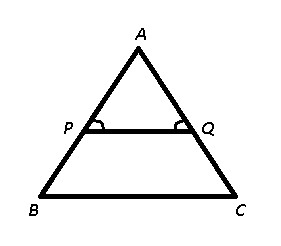
In ΔABC, ∠A : ∠B : ∠C = 3 : 3 : 4. A line parallel to BC is drawn which touches AB and AC at P and Q respectively. What is the value of ∠AQP - ∠APQ?
View Explanation
Hide Explanation
Given : ∠A : ∠B : ∠C = 3 : 3 : 4 and PQ is parallel to BC
To find : ∠AQP - ∠APQ = ?
Solution : Let $$\angle A=3x$$, $$\angle B=3x$$ and $$\angle C=4x$$
Thus, in $$\triangle$$ ABC,
=> $$\angle A+\angle B+\angle C=180^\circ$$
=> $$3x+3x+4x=180^\circ$$
=> $$x=\frac{180^\circ}{10}=18^\circ$$
$$\because$$ PQ $$\parallel$$ BC, => $$\angle$$ APQ = $$\angle$$ B and $$\angle$$ AQP = $$\angle$$ C (Corresponding angles)
$$\therefore$$ $$\angle$$ AQP - $$\angle$$ APQ = $$4x-3x=x=18^\circ$$
=> Ans - (B)
In the given figure, O is the center of the circle, $$\angle$$CAO = 35$$^\circ$$. What is the value (in degrees) of $$\ \angle$$AOB?
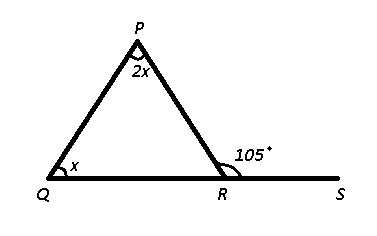
The side QR of ΔPQR is produced to S. If ∠PRS = 105° and ∠Q = (1/2)∠P, then what is the value of ∠P?
View Explanation
Hide Explanation
Let $$\angle Q=x$$, => $$\angle P=2x$$
Using exterior angle property in $$\triangle$$ PQR,
=> $$\angle$$ P + $$\angle$$ Q = $$\angle$$ PRS
=> $$2x+x=105^\circ$$
=> $$x=\frac{105^\circ}{3}=35^\circ$$
$$\therefore$$ $$\angle P=2\times35^\circ=70^\circ$$
=> Ans - (C)
What is the simplified value of$$\ \sqrt{\frac{sec^{2} \theta+cosec^{2} \theta}{4}}$$?
A
cosec 2θ
B
sec 2θ
C
cosec θ sec θ
D
tan θ
View Explanation
Hide Explanation
Expression = $$\ \sqrt{\frac{sec^{2} \theta+cosec^{2} \theta}{4}}$$
= $$\ \sqrt{\frac{(\frac{1}{cos^2\ \theta})+(\frac{1}{sin^2\ \theta})}{4}}$$
= $$\ \sqrt{\frac{(\frac{sin^2\ \theta+cos^2\ \theta)}{sin^2\ \theta.cos^2\ \theta}}{4}}$$
= $$\sqrt{\frac{1}{4sin^2\ \theta cos^2\ \theta}}$$
= $$\sqrt{(\frac{1}{2sin\ \theta cos\ \theta})^2}$$
= $$\frac{1}{sin2\theta}=cosec2\theta$$
=> Ans - (A)
If$$\ \frac{x-xtan^{2}15^\circ}{1+tan^{2}15^\circ}$$= sin $$60^\circ\ $$+ cos 30$$^\circ\ $$, then what is then what is the value of x?
View Explanation
Hide Explanation
$$tan15^\circ=\frac{\sqrt3-1}{\sqrt3+1}$$
Expression = $$\ \frac{x-xtan^{2}15^\circ}{1+tan^{2}15^\circ}$$= sin $$60^\circ\ $$+ cos 30$$^\circ\ $$
=> $$\ \frac{x(1-tan^{2}15^\circ)}{1+tan^{2}15^\circ}= \frac{\sqrt3}{2}+\frac{\sqrt3}{2}$$
=> $$x\times\frac{1-(\frac{\sqrt3-1}{\sqrt3+1})^2}{1+(\frac{\sqrt3-1}{\sqrt3+1})^2}=\sqrt3$$
=> $$x\times\frac{(\sqrt3+1)^2-(\sqrt3-1)^2}{(\sqrt3+1)^2+(\sqrt3-1)^2}=\sqrt3$$
=> $$x\times\frac{(3+1+2\sqrt3)-(3+1-2\sqrt3)}{(3+1+2\sqrt3)+(3+1-2\sqrt3)}=\sqrt3$$
=> $$x\times\frac{4\sqrt3}{8}=\sqrt3$$
=> $$x=\frac{8}{4}=2$$
=> Ans - (A)
What is the simplified value of $$\ \frac{2sin^{3}\ \theta\ - sin\theta}{cos\theta\ -\ 2\ cos^{3}\ \theta}$$?
A
tan θ
B
sin θ
C
cos θ
D
cot θ
View Explanation
Hide Explanation
Expression : $$\ \frac{2sin^{3}\ \theta\ - sin\theta}{cos\theta\ -\ 2\ cos^{3}\ \theta}$$
= $$\ \frac{sin\ \theta(2sin^{2}\ \theta\ - 1)}{cos\ \theta(2 -\ 2\ cos^{2}\ \theta)}$$
= $$\frac{sin\ \theta(cos2\ \theta)}{cos\ \theta(cos2\ \theta)}$$
= $$\frac{sin\ \theta}{cos\ \theta}=tan\ \theta$$
=> Ans - (A)
If $$tan(\theta)tan(5\theta)=1$$, then what is the value of $$sin 2\theta$$ ?
A
$$0$$
B
$$\frac{1}{2}$$
C
$$1\sqrt2$$
D
$$\frac{\sqrt3}{2}$$
View Explanation
Hide Explanation
Given : $$tan(\theta)tan(5\theta)=1$$
Using, $$tan(A+B)=\frac{tanA+tanB}{1-tanAtanB}$$
$$tan(\theta+5\theta)=\frac{tan(\theta)+tan(5\theta)}{1-tan(\theta)tan(5\theta)}$$
=> $$tan(6\theta)=\frac{tan(\theta)+tan(5\theta)}{1-1}$$
=> $$tan(6\theta)=\infty$$
=> $$tan(6\theta)=tan(90^\circ)$$
=> $$6\theta=90^\circ$$
=> $$\theta=\frac{90^\circ}{6}=15^\circ$$
$$\therefore$$ $$sin(2\theta)=sin(2\times15^\circ)$$
= $$sin(30^\circ)=\frac{1}{2}$$
=> Ans - (B)
The value of 0.65 x 0.65 + 0.35 x 0.35+0.70 x 0.65 is
A
1.75
B
1.00
C
1.65
D
1.55
View Explanation
Hide Explanation
Expression : $$(0.65\times0.65)+(0.35\times0.35)+(0.70\times0.65)$$
= $$(0.65)^2+(0.35)^2+2(0.35)(0.65)$$
Comparing with : $$(x)^2+(y)^2+2(x)(y)=(x+y)^2$$
= $$(0.65+0.35)^2=(1)^2=1$$
=> Ans - (B)
If$$\ x^{2}$$- 3x + 1 = 0, then the value of $$\ x^{5}+\frac{1}{x^{5}}\ $$is equal to
$$x^{2}-3x+1$$=0
Taking 'x' common
x(x-3+$$\frac{1}{x})$$=0
$$\Rightarrow x+\frac{1}{x}$$=$$3\rightarrow(1)$$
Squaring on both sides
$$x^{2}+\frac{1}{x^{2}}+2\times x\times\frac{1}{x}$$=9
$$\Rightarrow x^{2}+\frac{1}{x^{2}}$$=$$7\rightarrow(2)$$
Cubing equation(1) on both sides
$$x^{3}+\frac{1}{x^{3}}+3\times x\times\frac{1}{x}(x+\frac{1}{x})$$=27
$$x^{3}+\frac{1}{x^{3}}$$+$$3\times 1\times3$$=27($$\because x+\frac{1}{x}$$=3)
$$x^{3}+\frac{1}{x^{3}}$$=27-9=$$18\rightarrow(3)$$
Squaring equation(2) on both sides
$$x^{4}+\frac{1}{x^{4}}+2\times x^{2}\times\frac{1}{x^{2}}$$=49
$$x^{4}+\frac{1}{x^{4}}$$=$$47\rightarrow(4)$$
Multiplying equation(1) and equation(4)
$$(x^{4}+\frac{1}{x^{4}})(x+\frac{1}{x}$$)=$$47\times3$$
$$x^{5}+\frac{1}{x^{5}}+x^{3}+\frac{1}{x^{3}}$$=$$47\times3$$=141
$$x^{5}+\frac{1}{x^{5}}+18$$=141($$\because x^{3}+\frac{1}{x^{3}}$$)
$$\therefore x^{5}+\frac{1}{x^{5}}$$=123
The value of cosec$$^{2}\ 18^\circ\ - \frac{1}{cot^{2}72^\circ}\ $$is
A
$$\frac{1}{\sqrt{3}}$$
B
$$\frac{\sqrt{2}}{3}$$
C
$$\frac{1}{2}$$
D
1
View Explanation
Hide Explanation
cosec$$^{2}\ 18^\circ\ - \frac{1}{cot^{2}72^\circ}\ $$
= cosec$$^{2} 18^\circ - tan^{2} 72^\circ$$ ($$\because \frac{1}{cot^{2} \ominus}$$=$$tan^{2}\ominus$$)
= cosec$$^{2} 18^\circ$$ - $$tan^{2} (90-72)^\circ$$
Instructions
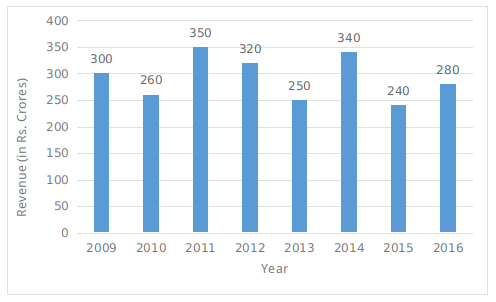
The bar graph given below represents the revenue of a firm for 8 years. All the revenue figures have been shown in terms of Rs crores.
What is the total value of revenue of the firm (in crores Rs) in years 2010, 2011 and 2012?
View Explanation
Hide Explanation
Total value of revenue of the firm in years 2010, 2011 and 2012 = 260 + 350 + 320 = 930
Hence, option B is the correct answer.
If $$x,y,z \neq 0$$ and $$\frac{1}{x^{2}}+\frac{1}{y^{2}}+\frac{1}{z^{2}}$$ = $$\frac{1}{xy}+\frac{1}{yz}+\frac{1}{zx}$$
A
x+ y+ z= 0
B
x+y=z
C
x-y=0
D
x=y = z
View Explanation
Hide Explanation
Expression : $$\frac{1}{x^{2}}+\frac{1}{y^{2}}+\frac{1}{z^{2}}$$ = $$\frac{1}{xy}+\frac{1}{yz}+\frac{1}{zx}$$
Taking L.C.M on both sides
= $$\frac{x^2 + y^2 + z^2}{x^2 y^2 z^2} = \frac{xy + yz + zx}{x^2 y^2 z^2}$$
= $$x^2 + y^2 + z^2 - xy - yz - zx = 0$$
= $$\frac{1}{2} [(x-y)^2 + (y-z)^2 + (z-x)^2] = 0$$
=> $$(x = y)$$ and $$(y = z)$$ and $$(z = x)$$
=> $$x = y = z$$
If $$a^{2} + b^{2} + c^{2} + 3 = 2 (a- b - c)$$, then the value of $$2 a - b + c$$ is :
View Explanation
Hide Explanation
Expression : $$a^{2} + b^{2} + c^{2} + 3 = 2 (a- b - c)$$
=> $$(a^2 - 2a + 1) + (b^2 + 2b + 1) + (c^2 + 2c + 1) = 0$$
=> $$(a-1)^2 + (b+1)^2 + (c+1)^2 = 0$$
$$\therefore$$$$ a-1 = 0 => a = 1$$
and $$b+1 = 0 => b = -1$$
and $$c+1 = 0 => c = -1$$
To find : $$2a - b + c$$
= $$2*1 - (-1) + (-1)$$
= $$2 + 1 - 1 = 2$$
Mohan gets 3 marks for each correct sum and loses 2 marks for each wrong sum. He attempts 30 sums and obtains 40 marks. The number of sums solved correctly is
View Explanation
Hide Explanation
Let no. of correct questions be $$x$$ and incorrect be $$y$$
=> $$x + y = 30$$
Also, $$3x - 2y = 40$$
Solving above equations, we get :
=> $$x = 20$$ and $$y = 10$$
=> No. of correct sums = 20
A fraction becomes 9/11 , if 2 is added to both the numerator and the denominator. If 3 is added to both the numerator and the denominator it becomes 5/6 . What is the fraction ?
View Explanation
Hide Explanation
Let the fraction be $$\frac{x}{y}$$
=> $$\frac{x+2}{y+2} = \frac{9}{11}$$
=> $$11x + 22 = 9y + 18$$
=> $$11x - 9y + 4 = 0$$
Also, $$\frac{x+3}{y+3} = \frac{5}{6}$$
=> $$6x + 18 = 5y + 15$$
=> $$6x - 5y + 3 = 0$$
Solving above equations, we get $$x = 7$$ and $$y = 9$$
=> Required fraction = $$\frac{7}{9}$$
If a* b= a+ b+ a/b, then the value of 12 * 4 is :
View Explanation
Hide Explanation
If $$a*b = a + b + \frac{a}{b}$$
=> $$12*4 = 12 + 4 + \frac{12}{4}$$
= $$16 + 3 = 19$$
If $$x^{2}+y^{2}+z^{2}=2(x-y-z)-3$$, then the value of $$2x-3y+4z$$ is [Assume that x, y, z are all real numbers) :
View Explanation
Hide Explanation
Expression : $$x^{2}+y^{2}+z^{2}=2(x-y-z)-3$$
=> $$x^2 - 2x + y^2 + 2y + z^2 + 2z + 3 = 0$$
=> $$(x^2 - 2x + 1) + (y^2 + 2y + 1) + (z^2 + 2z + 1) = 0$$
=> $$(x-1)^2 + (y+1)^2 + (z+1)^2 = 0$$
=> $$x = 1 , y = -1 , z = -1$$
To find : $$2x-3y+4z$$
= $$(2*1) - (3* -1) + (4* -1)$$
= $$2+3-4 = 1$$
If (a + b + c) = 0, then $$(\frac{a^{2}}{bc}+\frac{b^{2}}{ca}+\frac{c^{2}}{ab})$$ is
View Explanation
Hide Explanation
given (a + b + c) = 0
if (a + b + c) = 0,
$$a^{3}+b^{3}+c^{3}=3abc$$
$$\frac{a^{3}+b^{3}+c^{3}}{abc}=3$$
$$\frac{a^{3}}{abc}+\frac{b^{3}}{abc}+\frac{c^{3}}{abc}=3$$
$$\frac{a^{2}}{bc}+\frac{b^{2}}{ca}+\frac{c^{2}}{ab}=3$$
so the answer is option A.
If x and y are positive real numbers and xy = 8, then the minimum value of 2x + y is
View Explanation
Hide Explanation
As $$x$$ & $$y$$ are positive real numbers, we can use AM $$\geq$$ GM
Let two numbers be $$2x$$ and $$y$$
=> $$\frac{2x + y}{2} \geq \sqrt{2xy}$$
=> $$2x + y \geq 2\sqrt{16}$$
=> $$2x + y \geq 8$$
=> Minimum value of $$(2x + y)$$ is 8
The graphs of 2x + 1 = 0 and 3y- 9 = 0 intersect at the point
A
(-1/2, -3)
B
(-1/2, 3)
C
(1/2, -3)
D
None of these
View Explanation
Hide Explanation
Equations : $$2x + 1 = 0$$ and $$3y - 9 = 0$$
Solving above equations, we get :
$$x = \frac{-1}{2}$$ and $$y = 3$$
=> The graphs of above equations will intersect at $$(\frac{-1}{2} , 3)$$
The total cost of 8 buckets and 5 mugs is 92 and the total cost of 5 buckets and 8 mugs is 77. Find the cost of 2 mugs and 3 buckets.
View Explanation
Hide Explanation
Let cost of 1 bucket be $$x$$ and one mug be $$y$$
=> $$8x + 5y = 92$$
and $$5x + 8y = 77$$
Solving above equations, we get $$x = 9$$ and $$y = 4$$
=> Cost of 2 mugs and 3 buckets = $$3x + 2y$$
= 3*9 + 2*4 = 35
The total cost of 8 buckets and 5 mugs is 92 and the total cost of 5 buckets and 8 mugs is 77. Find the cost of 2 mugs and 3 buckets.
View Explanation
Hide Explanation
Let cost of 1 bucket be $$x$$ and one mug be $$y$$
=> $$8x + 5y = 92$$
and $$5x + 8y = 77$$
Solving above equations, we get $$x = 9$$ and $$y = 4$$
=> Cost of 2 mugs and 3 buckets = $$3x + 2y$$
= 3*9 + 2*4 = 35
Find the maximum number of trees which can be planted, 20 metres apart, on the two sides of a straight road 1760 metres long
View Explanation
Hide Explanation
To understand this, let's focus on one side to begin with.
If it was 40 meters, you could have planted three trees
If it was 'n' meters, you could have planted $$(\frac{n}{20}+1)$$ trees
Number of trees that can be planted on one side = $$\frac{1760}{20}+1$$ = 88 + 1 = 89
Total trees = 89*2 = 178
If 4x/3 + 2P = 12, for what value of P, x = 6?
View Explanation
Hide Explanation
Expression : $$\frac{4x}{3} + 2P = 12$$
Putting x = 6, we get :
=> $$8 + 2P = 12$$
=> $$P = \frac{4}{2} = 2$$
If $$\frac{4x}{3}+2p=12$$ for what value of $$p, x=6$$ ?
View Explanation
Hide Explanation
Expression : $$\frac{4x}{3}+2p=12$$
Putting x = 6
=> $$8 + 2p = 12$$
=> $$p = \frac{4}{2} = 2$$
If $$x^{2} - y^{2} = 80$$ and x- y= 8, then the average of x and y is
View Explanation
Hide Explanation
$$x^{2} - y^{2} = 80$$ and $$x - y= 8$$
=> $$x + y = \frac{x^2 - y^2}{x - y} = \frac{80}{8}$$
= 10
$$\therefore$$ Required average = 10/2 = 5
The straight line 2x + 3y = 12 passes through :
A
1st, 2nd and 3rd quadrant
B
1st, 2nd and 4th quadrant
C
2nd, 3rd and 4th quadrant
D
1st, 3rd and 4th quadrant
The line above represents the equation $$2x + 3y = 12$$
Clearly, it passes through 1st, 2nd and 4th quad.
If a + b+c= 0, then the value $$(\frac{a+b}{c}+\frac{b+c}{a}+\frac{c+a}{b})$$ $$(\frac{a}{b+c}+\frac{b}{c+a}+\frac{c}{a+b})$$ is:
View Explanation
Hide Explanation
Given : $$a+b+c = 0$$
Let $$a = 1 , b = 1$$ and $$c = -2$$ [We can take any values that satisfy above equation]
To find : $$(\frac{a+b}{c}+\frac{b+c}{a}+\frac{c+a}{b})$$ $$(\frac{a}{b+c}+\frac{b}{c+a}+\frac{c}{a+b})$$
= $$(\frac{2}{-2} + \frac{-1}{1} + \frac{-1}{1}) (\frac{1}{-1} + \frac{1}{-1} + \frac{-2}{2})$$
= $$(-3) (-3) = 9$$
If a, b, c are non-zero, $$a+\frac{1}{b}=1$$ and $$b+\frac{1}{c}=1$$ then the value of abc is :
View Explanation
Hide Explanation
It is given that : $$b + \frac{1}{c} = 1$$
=> $$b = (1 - \frac{1}{c})$$ -------------Eqn(1)
Also, $$a + \frac{1}{b} = 1$$
=> $$a = 1 - \frac{1}{b}$$
=> $$a = 1 - \frac{1}{1 - \frac{1}{c}}$$ [Using Eqn(1)]
=> $$a = (1 - \frac{c}{c-1})$$ ---------------Eqn(2)
To find : $$abc$$
Using eqn(1) and (2)
= $$(1 - \frac{c}{c-1}) (1 - \frac{1}{c}) (c)$$
= $$(\frac{-1}{c-1}) (\frac{c-1}{c}) (c)$$
= $$-1$$
The value of a machine depreciates every year at the rate of 10% on its value at the beginning of that year. If the current value of the machine is r 729, its worth 3years ago was:
A
1000
B
750.87
C
947.10
D
800
View Explanation
Hide Explanation
Let the value of the machine 3 years ago be $$100x$$
Since, every year value decreases by 10%
=> Current value = $$(0.9)^3 * 100x = 729$$
=> $$100x = \frac{729}{0.729} = 1000$$
=> $$x = 10$$
=> Value 3 years ago = Rs. 1,000
 91- 6303239042