For the following questions answer them individually
Given below are two statements:
Statement I: Sucrose is dextrorotatory. However, sucrose upon hydrolysis gives a solution having mixture of products. This solution shows laevorotation.
Statement II : Hydrolysis of sucrose gives glucose and fructose. Since the laevorotation of glucose is more than the dextrorotation of fructose, the resulting solution becomes laevorotato1y.
In the light of the above statements, choose the correct answer from the options given below
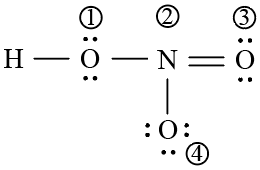
The formal charges on the atoms marked as (1) to (4) in the Lew is representation
of $$HNO_{3}$$ molecule respectively are
Consider a solution of $$CO_{2} (g)$$ dissolved in water in a closed container.
Which one of the following plots correctly represents variation of log (partial pressure of $$CO_{2}$$ in vapour phase above water) [y-axis] with log (mole fraction of $$CO_{2}$$ in water) [x-axis] at $$ 25^{o}C $$?
The energy required by electrons, present in the first Bohr orbit of hydrogen atom to J $$ mol^{-1}C $$ be excited to second Bohr orbit is ______ .
Given $$ R_{H}=2.18\times 10^{-11} $$
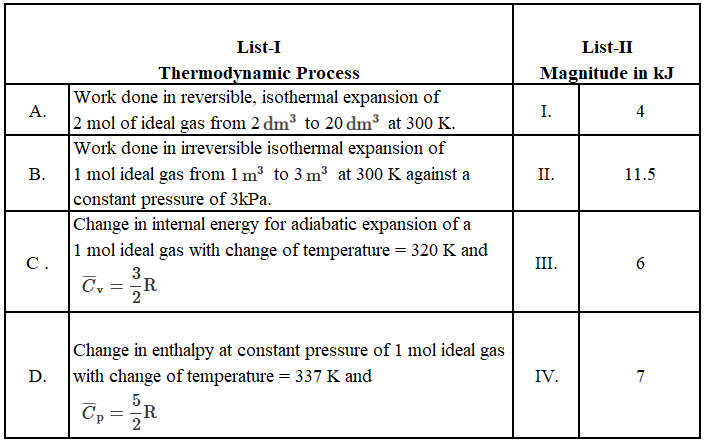
Match the LIST-I with LIST-II
Choose the correct answer from the options given below:
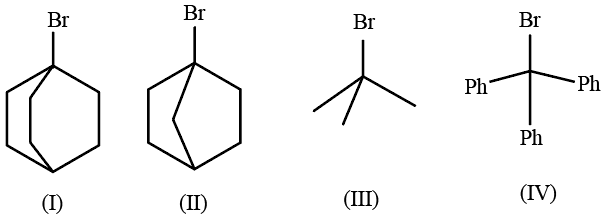
The correct order of the rate of reaction of the following reactants with nucleophile by $$S_{N}1$$ mechanism is :
(Given: Structures I and II are rigid)
Given below are two statements:
Statement I: The Henry's law constant $$K_{H}$$ is constant with respect to variations in solution's concentration over the range for which the solution is ideally dilute.
Statement II: $$K_{H}$$ does not differ for the same solute in different solvents.
In the light of the above statements, choose the correct answer from the options given below
As compared with chlorocyclohexane, which of the following statements correctly apply to chlorobenzene?
A. The magnitude of negative charge is more on chlorine atom.
B. The C - Cl bond has partial double bond character.
C. C - Cl bond is less polar.
D. C - Cl bond is longer due to repulsion between delocalised electrons of the aromatic ring and lone pairs of electrons of chlorine.
E. The C - Cl bond is formed using $$ sp^{2} $$ hybridised orbital of carbon.
Choose the correct answer from the options given below:
A$$\rightarrow$$ product (First order reaction).
Three sets of experiment were performed for a reaction under similar experimental conditions:
Run 1 $$\Rightarrow$$ 100 mL of 10 M solution of reactant A
Run 2 $$\Rightarrow$$ 200 mL of 10 M solution of reactant A
Run 3 $$\Rightarrow$$ 100 mL of 10 M solution of reactant A + 100 mL of $$H_{2}O$$ added.
The correct variation of rate of reaction is
Given below are two statements:
Statement I: The halogen that makes longest bond with hydrogen in HX, has the smallest covalent radius in its group.
Statement II: A group 15 element's hydride $$EH_{3}$$ has the lowest boiling point among corresponding hydrides of other group 15 elements. The maximum covalency of that element E is 4.
In the light of the above statements, choose the correct answer from the options given below
A 'p'-block element (E) and hydrogen form a binary cation $$(EH_{x})^{+}$$ , while $$EH_{3}$$ on treatment with $$K_{2}HgI_{4}$$ in alkaline medium gives a precipitate of basic mercury(II)amido- iodine. Given below are first ionisation enthalpy values ($$kJ mol^{-1}$$) for first element each from group 13, 14, 15 and 16. Identify the correct first ionisation enthalpy value for element E.
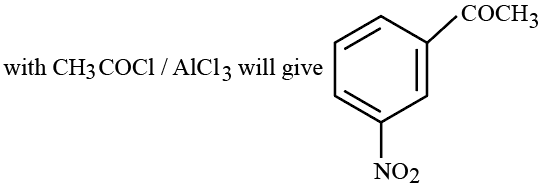
Given below are two statements:
Statement I: Benzene is nitrated to give nitrobenzene, which on further treatment
Statement II: -$$NO_{2}$$ group is a m-directing, and deactivating group.
In the light of the above statements, choose the most appropriate answer from the options given below
Given below are two statements:
Statement I: Phenol on treatment with . $$CHCL_{3}$$/aq. $$KOH$$ under refluxing condition, followed by acidification produces $$p$$-hydroxy benzaldehyde as the major product and $$o$$-hydroxy benzaldehyde as the minor product.
Statement II: The mixture of $$p$$-hydroxybenzaldehyde and $$o$$-
hydroxybenzaldehyde can be easily separated through steam distillation.
In the light of the above statements, choose the correct answer from the options given below
A first row transition metal (M) does not liberate $$H_{2}$$ gas from dilute HCI. 1 mol of aqueous solution of $$MSO_{4}$$ is treated with excess of aqueous KCN and then $$H_{2} S(g)$$ is passed through the solution. The amount of MS (metal sulphide) formed from the above reaction is _______ mol.
Consider the transition metal ions $$Mn^{3+}, Cr^{3+}, Fe ^{3+}$$ and $$Co^{3+}$$ and all form low spin octahedral complexes. The correct decreasing order of unpaired electrons in their respective d-orbitals of the complexes is
Two p-block elements $$X$$ and $$Y$$ form fluorides of the type $$EF_{3}$$. The fluoride compound $$XF_{3}$$ is a Lewis acid and $$YF_{3}$$ is a Lewis base. The hybridizations of the central atoms of $$XF_{3}$$ and $$YF_{3}$$ respectively are
'A' is a neutral organic compound $$(M.F : C_{8}H_{9}ON)$$. On treatment with aqueous $$Br_{2}/Ho_{(-)}$$, 'A' forms a compound 'B' which is soluble in dilute acid. 'B' on treatment with aqueous $$NaNO_{2} / HCl (0-5^{o}C)$$ produces a compound 'C' which on treatment with $$CuCN/NaCN$$ produces 'D'. Hydrolysis of 'D' produces 'E' which is also obtainable from the hydrolysis of'A'. 'E' on treatment with acidified $$KMnO_{4}$$ produces 'F'. 'F' contains two different types of hydrogen atoms. The structure of 'A' is
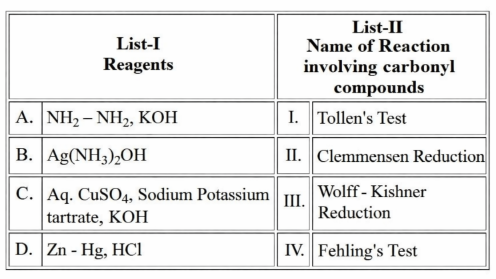
Match the LIST-I with LIST-II
Choose the correct answer from the options given below:
In the reaction,
$$ 2Al(s)+6HCl(aq)\rightarrow2Al^{3+}(aq)+6cl^{-}(aq)+3H_{2}(g)$$
The correct order of reactivity of $$CH_{3} Br$$ in methanol with the following
nucleophiles is
$$F^{-}, I^{-}, C_{2}H_{5}O^{-}$$ and $$C_{6}H_{5}O^{-}$$
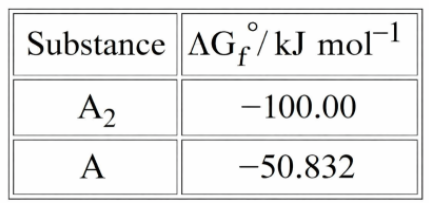
Dissociation of a gas $$A_{2}$$ takes place according to the following chemical reaction.
At equilibrium, the total pressure is 1 bar at 300K.
$$A_{2}(g)\rightleftharpoons 2A(g)$$
The standard Gibbs energy of formation of the involved substances has been
provided below:
The degree of dissociation of $$A_{2} (g)$$ is given by $$(x\times10^{-2})^{1/2} $$ where $$x$$ =
_____ . (Nearest integer).
[Given: $$R=8 J \text{ }mol^{-1}K^{-1},\log{2}=0.3010, \log {3}=0.48]$$
Assume degree of dissociation is not negligible.
The temperature at which the rate constants of the given below two gaseous reactions become equal is ______ K. (Nearest integer)
$$X \rightarrow Y $$ $$ k_{1}=10^{6}e^{\frac{-30000}{T}}$$
$$P \rightarrow Q $$ $$ k_{2}=10^{4}e^{\frac{-24000}{T}}$$
Given: ln 10 = 2.303
Consider the following electrochemical cell at 298K
$$ Pt \mid HSnO_2{^-}(aq)\mid Sn(OH)_6{^{2-}}(aq)\mid OH^{-}(aq)\mid Bi_{2}O_{3}(s)\mid Bi(s)$$.
If the reaction quotient at a given time is $$10^{6}$$, then the cell $$EMF (E_{cell})$$ is _____ $$\times 10^{-1} V$$ (Nearest integer).
Given the standard half-cell reduction potential as
$$E_{Bi_{2}O_{3}/Hi,OH^{-}}^{o}=-0.44V \text{ and }E_{Sn(OH)_6^{2-}/HSnO_2^{-}, OH^{-}}^{o}=-0.90V$$
Sodium fusion extract of an organic compound (Y) with $$CHCl_{3}$$ and chlorine water gives violet color to the $$CHCl_{3} $$ layer. 0.15g of $$(Y)$$ gave 0.12g of the silver halide precipitate in Carius method. Percentage of halogen in the compound $$(Y)$$ is _______ . (Nearest integer)
(Given : molar mass g $$mol^{-}$$ C : 12 , H : 1, Cl : 35.5, Br : 80 , I : 127)
The cycloalkene $$(X)$$ on bromination consumes one mole of bromine per mole of $$(X)$$ and gives the product $$(Y)$$ in which $$C:Br$$ ratio is 3: 1. The percentage of bromine in the product $$(Y)$$ is _____ %. (Nearest integer)
( Given: molar mass in g $$mol^{-} H: 1, C: 12 , 0: 16, Br: 80$$)