For the following questions answer them individually
A 60HP electric motor lifts an elevator having a maximum total load capacity of 2000 kg. If the frictional force on the elevator is 4000 N, the speed of the elevator at full load is close to: (1 HP = 746 W, $$g = 10$$ m s$$^{-2}$$)
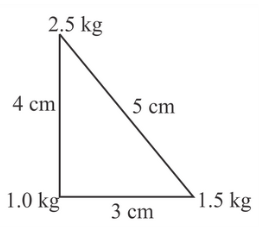
Three point particles of masses 1.0 kg, 1.5 kg and 2.5 kg are placed at three corners of a right angle triangle of sides 4.0 cm, 3.0 cm and 5.0 cm as shown in the figure. The centre of mass of the system is at a point:
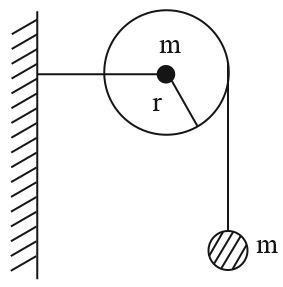
As shown in the figure, a bob of mass m is tied to a massless string whose other end portion is wound on a fly wheel (disc) of radius r and mass m. When released from rest the bob starts falling vertically. When it has covered a distance of h, the angular speed of the wheel will be:
The radius of gyration of a uniform rod of length $$l$$, about an axis passing through a point $$\frac{l}{4}$$ away from the centre of the rod, and perpendicular to it, is:
A satellite of mass $$M$$ is launched vertically upwards with an initial speed $$u$$ from the surface of the earth. After it reaches height $$R$$ ($$R$$ = radius of the earth), it ejects a rocket of mass $$\frac{M}{10}$$ so that subsequently the satellite moves in a circular orbit. The kinetic energy of the rocket is ($$G$$ is the gravitational constant; $$M_e$$ is the mass of the earth):
Speed of a transverse wave on a straight wire (mass 6.0 g, length 60 cm and area of cross-section 1.0 mm$$^2$$) is 90 m s$$^{-1}$$. If the Young's modulus of wire is $$16 \times 10^{11}$$ N m$$^{-2}$$, the extension of wire over its natural length is:
A litre of dry air at STP expands adiabatically to a volume of 3 litres. If $$\gamma = 1.40$$, the work done by air is: ($$3^{1.4} = 4.6555$$) [Take air to be an ideal gas]
Two moles of an ideal gas, with $$\frac{C_p}{C_v} = \frac{5}{3}$$, are mixed with three moles of another ideal gas $$\frac{C_p}{C_v} = \frac{4}{3}$$. The value of $$\frac{C_p}{C_v}$$ for the mixture is
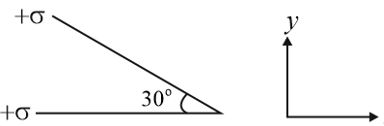
Two infinite planes each with uniform surface charge density $$+\sigma$$ are kept in such a way that the angle between them is 30$$^\circ$$. The electric field in the region shown between them is given by:
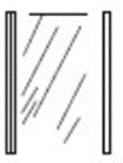
A parallel plate capacitor has plates of area A separated by distance d between them. It is filled with a dielectric which has a dielectric constant that varies as $$K(x) = K_0(1 + \alpha x)$$ where $$x$$ is the distance measured from one of the plates. If $$(\alpha d) \ll 1$$, the total capacitance of the system is best given by the expression:
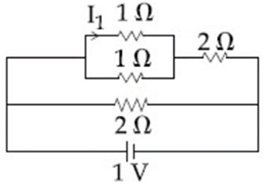
The current $$I_1$$ (in A) flowing through 1$$\Omega$$ resistor in the following circuit is:
A long solenoid of radius R carries a time $$(t)$$ dependent current $$I(t) = I_0 t(1 - t)$$. A ring of radius 2R is placed coaxially near its middle. During the time interval $$0 \le t \le 1$$, the induced current $$(I_R)$$ and the induced EMF $$(V_R)$$ in the ring change as:
Consider a circular coil of wire carrying constant current I, forming a magnetic dipole. The magnetic flux through an infinite plane that contains the circular coil and excluding the circular coil area is given by $$\phi_i$$. The magnetic flux through the area of the circular coil area is given by $$\phi_0$$. Which of the following option is correct?
A LCR circuit behaves like a clamped harmonic oscillator. Comparing it with a physical spring-mass damped oscillator having damping constant 'b', the correct equivalence would be:
If the magnetic field in a plane electromagnetic wave is given by $$\vec{B} = 3 \times 10^{-8} \sin(1.6 \times 10^3 x + 48 \times 10^{10} t)\hat{j}\,T$$, then what will be the expression for electric field?
If we need a magnification of 375 from a compound microscope of tube length 150mm and an objective of focal length 5mm, the focal length of the eye-piece, should be close to:
A polarizer - analyser set is adjusted such that the intensity of light coming out of the analyser is just 36% of the original intensity. Assuming that the polarizer - analyser set does not absorb any light, the angle by which the analyser needs to be rotated further, to reduce the output intensity to zero, is ($$\sin^{-1}\left(\frac{3}{5}\right) = 37^\circ$$)
Visible light of wavelength $$6000 \times 10^{-8}$$ cm falls normally on a single slit and produces a diffraction pattern. It is found that the second diffraction minimum is at 60$$^\circ$$ from the central maximum. If the first minimum is produced at $$\theta_1$$, then $$\theta_1$$ is close to
The time period of revolution of electron in its ground state orbit in a hydrogen atom is $$1.6 \times 10^{-16}$$ s. The frequency of revolution of the electron in its first excited state (in s$$^{-1}$$) is:
Which of the following gives a reversible operation?
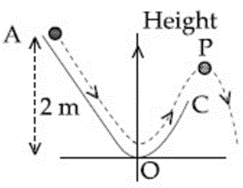
A particle (m = 1 kg) slides down a frictionless track (AOC) starting from rest at a point A (height 2m). After reaching C, the particle continues to move freely in air as a projectile. When it reaches its highest point P (height 1m), the kinetic energy of the particle (in J) is: (Figure drawn is schematic and not to scale; take $$g = 10$$ ms$$^{-2}$$)
A non-isotropic solid metal cube has coefficients of linear expansion as: $$5 \times 10^{-5}$$/$$^\circ$$C along the x-axis and $$5 \times 10^{-6}$$/$$^\circ$$C along the y and the z-axis. If the coefficient of volume expansion of the solid is $$C \times 10^{-6}$$/$$^\circ$$C then the value of C is
A Carnot engine operates between two reservoirs of temperatures 900K and 300K. The engine performs 1200J of work per cycle. The heat energy (in J) delivered by the engine to the low temperature reservoir, in a cycle, is
A loop ABCDEFA of straight edges has six corner points A(0, 0, 0), B(5, 0, 0), C(5, 5, 0), D(0, 5, 0), E(0, 5, 5) and F(0, 0, 5). The magnetic field in this region is $$\vec{B} = (3\hat{i} + 4\hat{k})$$ T. The quantity of flux through the loop ABCDEFA (in Wb) is
A beam of electromagnetic radiation of intensity $$6.4 \times 10^{-5}$$ W/cm$$^2$$ is comprised of wavelength, $$\lambda = 310$$ nm. It falls normally on a metal (work function $$\varphi = 2$$ eV) of surface area of 1 cm$$^2$$. If one in $$10^3$$ photons ejects an electron, total number of electrons ejected in 1s is $$10^x$$. ($$hc = 1240$$ eVnm, $$1$$ eV $$= 1.6 \times 10^{-19}$$ J), then $$x$$ is