Match List I with List II.
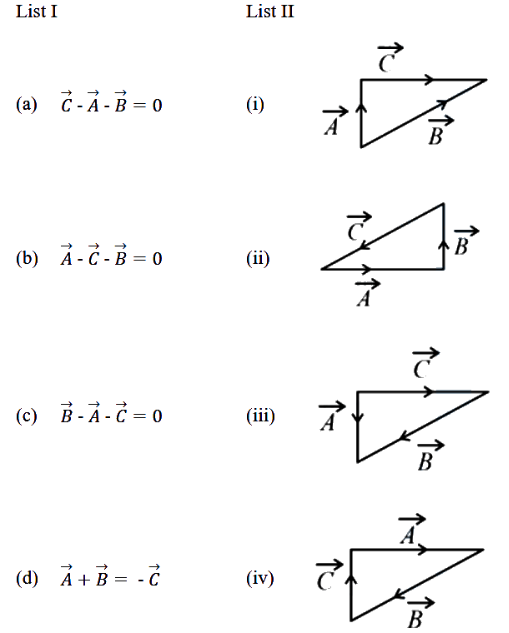
Choose the correct answer from the options given below:
Sign in
Please select an account to continue using cracku.in
↓ →

Join Our JEE Preparation Group
Prep with like-minded aspirants; Get access to free daily tests and study material.
Match List I with List II.
Choose the correct answer from the options given below:
Login to view the detailed solution.
Water droplets are coming from an open tap at a particular rate. The spacing between a droplet observed at 4$$^{th}$$ second after its fall to the next droplet is 34.3 m. At what rate the droplets are coming from the tap? (Take $$g = 9.8$$ m s$$^{-2}$$)
Login to view the detailed solution.
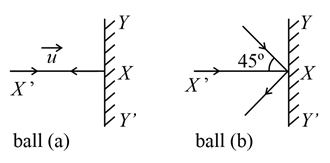
Two billiard balls of equal mass 30 g strike a rigid wall with same speed of 108 kmph (as shown) but at different angles. If the balls get reflected with the same speed, then the ratio of the magnitude of impulses imparted to ball a and ball b by the wall along X direction is:
Login to view the detailed solution.
.webp)
Given below are two statements: one is labelled as Assertion A and the other is labelled as Reason R.
Assertion A: Moment of inertia of a circular disc of mass M and radius R about X, Y axes (passing through its plane) and Z-axis which is perpendicular to its plane were found to be $$I_x$$, $$I_y$$ and $$I_z$$, respectively. The respective radii of gyration about all the three axes will be the same.
Reason R: A rigid body making rotational motion has fixed mass and shape. In the light of the above statements, choose the most appropriate answer from the options given below:
Login to view the detailed solution.
The minimum and maximum distances of a planet revolving around the Sun are $$x_1$$ and $$x_2$$. If the minimum speed of the planet on its trajectory is $$v_0$$, then its maximum speed will be:
Login to view the detailed solution.
Two wires of same length and radius are joined end to end and loaded. The Young's moduli of the materials of the two wires are $$Y_1$$ and $$Y_2$$. The combination behaves as a single wire then its Young's modulus is:
Login to view the detailed solution.
.webp)
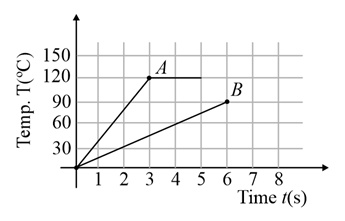
Two different metal bodies A and B of equal mass are heated at a uniform rate under similar conditions. The variation of temperature of the bodies is graphically represented as shown in the figure. The ratio of specific heat capacities is:
Login to view the detailed solution.
A monoatomic ideal gas, initially at temperature $$T_1$$ is enclosed in a cylinder fitted with a frictionless piston. The gas is allowed to expand adiabatically to a temperature $$T_2$$ by releasing the piston suddenly. If $$l_1$$ and $$l_2$$ are the lengths of the gas column, before and after the expansion respectively, then the value of $$\frac{T_1}{T_2}$$ will be:
Login to view the detailed solution.
For a gas $$C_P - C_V = R$$ in a state P and $$C_P - C_V = 1.10R$$ in a state Q. $$T_P$$ and $$T_Q$$ are the temperatures in two different states P and Q, respectively. Then
Login to view the detailed solution.
.webp)
A parallel plate capacitor with plate area 'A' and distance of separation 'd' is filled with a dielectric. What is the capacity of the capacitor when permittivity of the dielectric varies as:
$$\varepsilon_x = \varepsilon_0 + kx$$, for $$0 < x \le \frac{d}{2}$$
$$\varepsilon_x = \varepsilon_0 + k(d-x)$$, for $$\frac{d}{2} \le x \le d$$
Login to view the detailed solution.
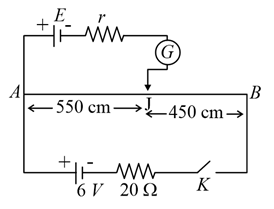
In the given figure, there is a circuit of potentiometer of length AB = 10 m. The resistance per unit length is 0.1 $$\Omega$$ per cm. Across AB, a battery of emf E and internal resistance r is connected. The maximum value of emf measured by this potentiometer is:
Login to view the detailed solution.
A linearly polarised electromagnetic wave in vacuum is $$$E = 3.1\cos 1.8z - 5.4 \times 10^6 t \hat{i}$$$ N C$$^{-1}$$ is incident normally on a perfectly reflecting wall at $$z = a$$. Choose the correct option.
Login to view the detailed solution.
.webp)
A ray of laser of a wavelength 630 nm is incident at an angle of 30$$^\circ$$ at the diamond-air interface. It is going from diamond to air. The refractive index of diamond is 2.42 and that of air is 1. Choose the correct option.
Login to view the detailed solution.
In the Young's double slit experiment, the distance between the slits varies in time as $$d\left(t\right)=d_0+a_0\sin\omega t$$; where $$d_0$$, $$\omega$$ and $$a_0$$ are constants. The difference between the largest fringe width and the smallest fringe width obtained over time is given as:
Login to view the detailed solution.
What should be the order of arrangement of de-Broglie wavelength of electron $$\lambda_e$$, an $$\alpha$$-particle $$\lambda_\alpha$$ and proton $$\lambda_p$$ given that all have the same kinetic energy?
Login to view the detailed solution.

A particle of mass 4M at rest disintegrates into two particles of mass M and 3M, respectively, having non zero velocities. The ratio of de-Broglie wavelength of particle of mass M to that of mass 3M will be:
Login to view the detailed solution.
Some nuclei of a radioactive material are undergoing radioactive decay. The time gap between the instances when a quarter of the nuclei have decayed and when half of the nuclei have decayed is given as: (where $$\lambda$$ is the decay constant)
Login to view the detailed solution.
The half-life of $$^{198}$$Au is 3 days. If atomic weight of $$^{198}$$Au is 198 g mol$$^{-1}$$, then the activity of 2 mg of $$^{198}$$Au is [in disintegration second$$^{-1}$$]:
Login to view the detailed solution.
_1.webp)
Identify the logic operation carried out.
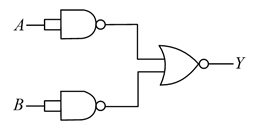
Login to view the detailed solution.
In amplitude modulation, the message signal $$V_m(t) = 10\sin 2\pi \times 10^5 t$$ volts and carrier signal $$V_C(t) = 20\sin 2\pi \times 10^7 t$$ volts. The modulated signal now contains the message signal with lower side band and upper side band frequency, therefore the bandwidth of modulated signal is $$\alpha$$ kHz. The value of $$\alpha$$ is:
Login to view the detailed solution.
A body of mass 2 kg moving with a speed of 4 m s$$^{-1}$$ makes an elastic collision with another body at rest and continues to move in the original direction but with one fourth of its initial speed. The speed of the two body centre of mass is $$\frac{x}{10}$$. Find the value of x.
Login to view the detailed solution.
A particle of mass $$m$$ is moving in time $$t$$ on a trajectory given by,
$$\vec{r} = 10\alpha t^2 \hat{i} + 5\beta (t - 5)\hat{j}$$
where $$\alpha$$ and $$\beta$$ are dimensional constants. The angular momentum of the particle becomes the same as it was for $$t = 0$$ at time $$t =$$ ___ seconds.
Login to view the detailed solution.
In the reported figure, two bodies A and B of masses 200 g and 800 g are attached with the system of springs. Springs are kept in a stretched position with some extension when the system is released. The horizontal surface is assumed to be frictionless. The angular frequency will be ___ rad s$$^{-1}$$ when $$k = 20$$ N m$$^{-1}$$.
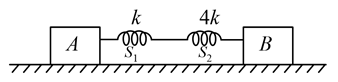
Login to view the detailed solution.
A pendulum bob has a speed of 3 m s$$^{-1}$$ at its lowest position. The pendulum is 50 cm long. The speed of bob, when the length makes an angle of 60$$^\circ$$ to the vertical will be ___ m s$$^{-1}$$. ($$g = 10$$ m s$$^{-2}$$)
Login to view the detailed solution.
A particle of mass 1 mg and charge $$q$$ is lying at the mid-point of two stationary particles kept at a distance 2 m when each is carrying same charge $$q$$. If the free charged particle is displaced from its equilibrium position through distance $$x$$ ($$x << 1$$ m). The particle executes SHM. Its angular frequency of oscillation will be ___ $$\times 10^5$$ rad s$$^{-1}$$ (if $$q^2 = 10C^2$$)
Login to view the detailed solution.
An electric bulb rated as 200 W at 100 V is used in a circuit having 200 V supply. The resistance R that must be put in series with the bulb so that the bulb delivers the same power is ___ $$\Omega$$.
Login to view the detailed solution.
The value of aluminium susceptibility is $$2.2 \times 10^{-5}$$. The percentage increase in the magnetic field if space within a current carrying toroid is filled with aluminium is $$\frac{x}{10^4}$$. Then the value of $$x$$ is ___.
Login to view the detailed solution.
A circular conducting coil of radius 1 m is being heated by the change of magnetic field $$\vec{B}$$ passing perpendicular to the plane in which the coil is laid. The resistance of the coil is 2 $$\mu\Omega$$. The magnetic field is slowly switched off such that its magnitude changes in time as
$$B = \frac{4}{\pi} \times 10^{-3} T\left(1 - \frac{t}{100}\right)$$
The energy dissipated by the coil before the magnetic field is switched off completely is $$E =$$ ___ mJ.
Login to view the detailed solution.
An inductor of 10 mH is connected to a 20 V battery through a resistor of 10 k$$\Omega$$ and a switch. After a long time, when maximum current is set up in the circuit, the current is switched off. The current in the circuit after 1 $$\mu$$s is $$\frac{x}{100}$$ mA. Then $$x$$ is equal to ___. (Take $$e^{-1} = 0.37$$)
Login to view the detailed solution.
Student A and student B used two screw gauges of equal pitch and 100 equal circular divisions to measure the radius of a given wire. The actual value of the radius of the wire is 0.322 cm. The absolute value of the difference between the final circular scale readings observed by the students A and B is ___.
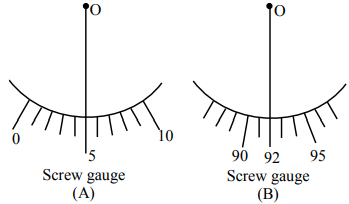
Given pitch = 0.1 cm.
Login to view the detailed solution.
Educational materials for JEE preparation
 Share
Share