91- 6303239042
 IPMAT WhatsApp Group




 Preferred Source

 Google Discover
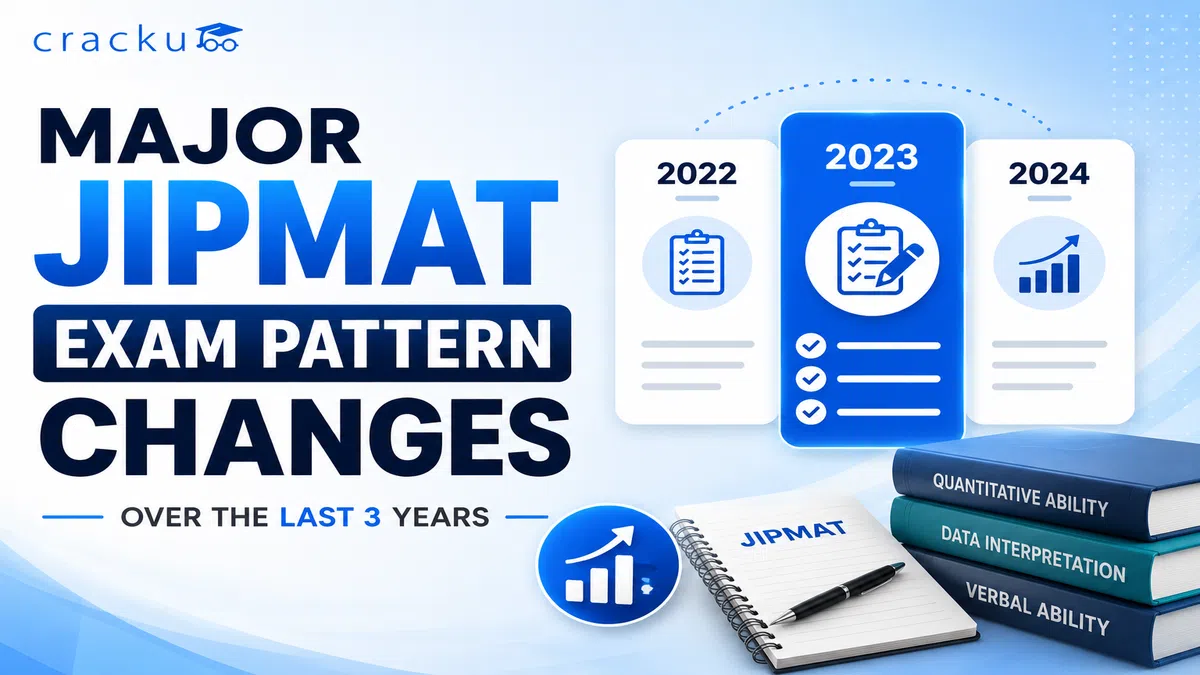
JIPMAT Exam Pattern Changes Over the Last 3 Years
The Joint Integrated Programme in Management Admission Test (JIPMAT) is one of the most preferred exams in India for undergraduate management. NTA (National Testing Agency) is the body responsible for this national-level examination, which is exclusively for high school graduates aspiring to enrol in the 5-year Integrated Programme in Management (IPM) at IIM Jammu and IIM Bodh Gaya. Unlike many other turbulent management exams, NTA has a very well-structured plan for the JIPMAT Exam. However, closer examination of trends in JIPMAT for the past couple of years exhibits noticeable internal changes. While the quantity of questions is unchanged, styles of question delivery, length of reading, and area weights have undergone huge variations.
This article gives information about the JIPMAT exam pattern changes over the last 3 years which includes year wise exam pattern changes, section-wise difficulty level and effect of pattern changes on cut-offs.
Year-Wise JIPMAT Exam Pattern: Questions, Time & Structure
The following table gives details about the year-wise JIPMAT exam pattern with total questions, time duration and exam structure:
Particulars | JIPMAT 2023 | JIPMAT 2024 | JIPMAT 2025 |
Exam Mode | CBT | CBT | CBT |
Number of Sections | 3 | 3 | 3 |
Quantitative Aptitude | 33 Questions | 33 Questions | 33 Questions |
DILR | 33 Questions | 33 Questions | 33 Questions |
VARC | 34 Questions | 34 Questions | 34 Questions |
Total Questions | 100 | 100 | 100 |
Total Marks | 400 | 400 | 400 |
Correct Answer | +4 Marks | +4 Marks | +4 Marks |
Incorrect Answer | -1 Mark | -1 Mark | -1 Mark |
Duration | 150 Minutes | 150 Minutes | 150 Minutes |
Sectional Time Limit | No | No | No |
JIPMAT Exam Pattern Changes in the last 3 years:
While preparing for the JIPMAT, a hasty decision or relying upon an old set of study material is rather risky. Taking a closer look at the progression in the past 3 years from 2023-2025 we see that NTA has strategically transformed the JIPMAT exam from a mere speed based Arithmetic examination to one that tests one's structure, endurance, conceptual application.
While NTA has held the base structure-100 questions in 150 mins steady, the change is the design of the questions.
- Changes in the framing of questions: Gone are the days when the question used to be just one line. Over the past 3 years, we see that even in basic arithmetic or data interpretation, they have wrapped them up in longer contexts, or with more variables.
- The Length Factor: the overall density has noticeably increased and the previous practice papers were often well within the time limit, which was the opposite for students in recent years, with the time clock always being the rival in the paper due to lengthy RCs and multiple logical questions.
- Novelty of Structure: NTA is consciously incorporating a hybrid structure with complex match-the-following questions, data sufficiency statements etc., so a student needs to solve a couple of sub-parts in order to reach an answer for one question.
Read More: JIPMAT Exam Day Instructions 2026, Guidelines, Things to Carry
JIPMAT 2025 Exam Pattern Changes
JIPMAT 2025 took place on April 26, 2025-just about a month before the 2024 test date, owing to an adjusted schedule by the NTA. The timing of the exam was from 3 p.m. To 5:30 p.m.
Changes in the JIPMAT 2025:
While the basic structure remained identical to 2024: 100 MCQs, three sections, 150 mins and +4/-1 marking, there was a slight modification on a qualitative basis:
- The VARC section saw some notable difference: There was a minor but significant jump in the difficulty of VARC (verbal ability) compared to 2024. While vocabulary words were slightly more uncommon and difficult to interpret than usual, reading comprehension was more focused on analysis and drawing inference from the passages, as opposed to simple recall of facts and details. Many of the analysis-level questions "stood out in difficulty."
- QA didn't change: Quant was exclusively on Class 10 topics and concentrated on arithmetic and easy to crack reasoning questions without a trace of Higher Mathematics.
- DILR was easy to crack: Many test-takers considered Data Interpretation and Logical Reasoning to be the simplest section, as it involved straightforward data and logical interpretation questions that were easy to grasp. In fact, a good majority of students are believed to have completed this section.
JIPMAT 2024 Exam Pattern Changes
The JIPMAT 2024 exam was conducted on June 6, 2024 and a number of shifts in the difficulty level and the complexity of question types could be noticed across the sections-particularly in VARC and DILR.
Changes in the JIPMAT 2024:
VARC Section-tougher and more diverse:
In VARC, the 2024 paper was definitely tougher. New questions like "Match the Columns"-which had not been asked in previous JIPMAT tests-were introduced, along with questions testing inference on complex Reading Comprehension passages that were higher on the difficulty level.
QA section-moderate with new twists:
The Quant section of the paper was again at moderate difficulty and adhered to the Class 10 mathematics curriculum. However, like in VARC, a question pattern of "Match the Following" had been introduced in the section for the first time that demanded a longer time even for simpler questions.
DILR section-slightly more difficult:
The DILR section was marginally more difficult in 2024 than the previous year. A significant modification made in this section was the integration of mathematical questions within the logical reasoning questions, thus adding an extra layer of complexity.
Read More: JIPMAT Last-Minute Preparation Tips 2026, Section-wise Strategy
JIPMAT 2023 Exam Pattern Change
The JIPMAT 2023 examination was conducted on May 24-28, 2023. Overall, the difficulty level was deemed easy to moderate, with variations across sections.
Changes in the JIPMAT 2023:
QA section: The Quant section was of easy to moderate difficulty. The questions were mostly arithmetic-based and within the typical Class 10 mathematics syllabus.
VARC section: The VARC section was the easiest section of the three. Reading Comprehension passages were simple to comprehend, and questions related to para-jumbles and idioms were easy to answer. The only atypical component was questions about synonyms and antonyms that tested difficult vocabulary.
DILR section: The logical reasoning section was the most difficult of the three, with difficulty level ranging from moderate to hard. This marked a significant rise in difficulty level from JIPMAT 2022.
JIPMAT Difficulty Level Changes Over the Last 3 Years
The table illustrates the section-wise difficulty level of JIPMAT exam over the last 3 years:
Section | JIPMAT 2023 | JIPMAT 2024 | JIPMAT 2025 |
Quantitative Aptitude | Easy to Moderate | Moderate | Easy to Moderate |
DILR | Moderate to Difficult | Slightly Difficult | Easy to Moderate |
VARC | Easy | Moderate-Difficult | Moderate-Difficult |
Overall | Easy to Moderate | Moderate | Moderate |
Some important trends:
- DILR has had the highest variation; it was from moderate to tough in 2023, moderately tough in 2024 and incredibly easy in 2025.
- The VARC section has been becoming tougher and tougher since 2023 (it was the easiest section till the easy exam of 2023 and is the toughest section currently). Hence students should practice vocabulary building and analytical reading from analytical passages for the VARC section.
- The QA section has remained strictly at class 10 level throughout the time.
- It appears as though the papers are becoming IPMAT Indore like, which are analytical, application driven and concept-oriented, even if the syllabus has not been revised.
Effect of Pattern Changes on Cut-Offs
The table provides the JIPMAT cut-off trends for the IIM Jammu and IIM Bodh Gaya for the general candidates:
Exam Iteration | IIM Jammu Cut-Off (General) | IIM Bodh Gaya Cut-Off (General) |
JIPMAT 2023 | ~328 - 332 Marks | ~320 - 325 Marks |
JIPMAT 2024 | ~318 - 324 Marks | ~308 - 314 Marks |
JIPMAT 2025 | ~310 - 315 Marks | ~300 - 305 Marks |
Consequences of these trends on the Cut-off:
1. The more difficult the paper, the lower the cutoff will be:
One of the things we have seen in 2023 cut-offs was a drop by almost 12 marks in general section score even though the number of aspirants increased because of high difficulty in DILR.The moral is quite clear.If the paper is going to be more difficult, the candidates will also give a poor score in the exam, so the cutoffs will also drop.
2. Moderate difficulty VARC section in 2024 resulted in low cutoffs:
With the rise in the difficulty level in the VARC section (which has maximum questions), the general score of the candidates compressed thereby decreasing the cutoffs slightly in 2024 compared to 2023.
3. Individual section cutoffs are as important as overall cutoffs:
In the case of both IIM Jammu and IIM Bodh Gaya, cutoff is based on both overall cut-off and individual section cut-off. Shift in the level of difficulty for DILR and VARC implies that the candidates should prepare well for these sections if they are aspiring for these institutes.
4. Composite score is a new trend:
In the case of IIM Bodh Gaya, composite score is computed by taking 70% weightage of JIPMAT score and 15% weightage of Class 10 and Class 12 each. For IIM Jammu, it takes 60% weightage for JIPMAT score and 15% weightage for both Class 10 and Class 12 and the rest of the marks will go to the gender diversity. So even if you get a somewhat low score in JIPMAT, you can easily compensate for it with your class 10 and 12 percentage.
Read More: JIPMAT Exam Day Strategy 2026, Guidelines, Last Minute Tips
JIPMAT Exam Pattern Changes Over the Last 3 Years: Conclusion
The JIPMAT exam pattern changes over the last 3 years show that the exam has become more analytical, even though the basic structure has remained the same. Students still have to answer 100 questions in 150 minutes, but the question style, reading load and section-wise difficulty have changed. VARC has become more inference-based, DILR has shown frequent difficulty shifts, and Quant has continued to stay close to Class 10-level concepts.
For JIPMAT aspirants, understanding these pattern changes is important for building the right preparation strategy. Instead of depending only on old papers, students should practise updated mock tests, focus on reading comprehension, revise arithmetic concepts and prepare for mixed-format reasoning questions. A balanced preparation across QA, DILR and VARC can help candidates improve their score and handle future JIPMAT exam pattern changes confidently.