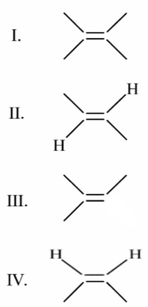
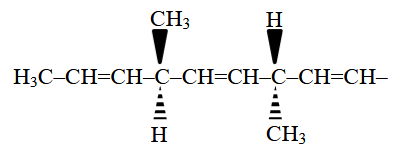
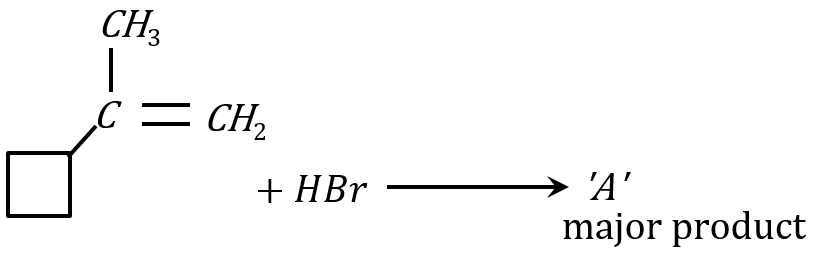
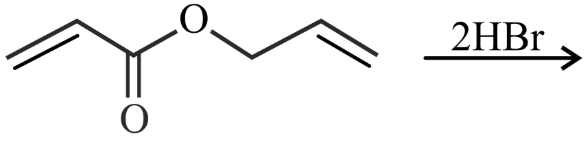
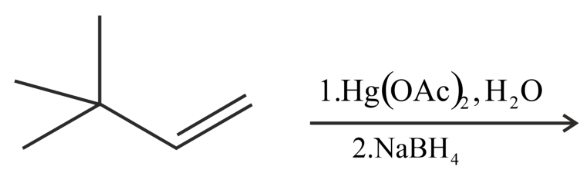
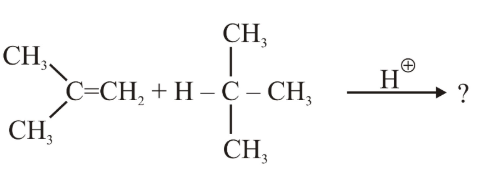
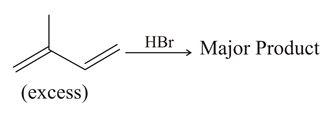
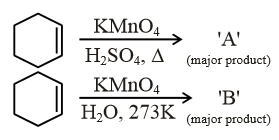
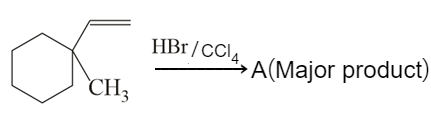
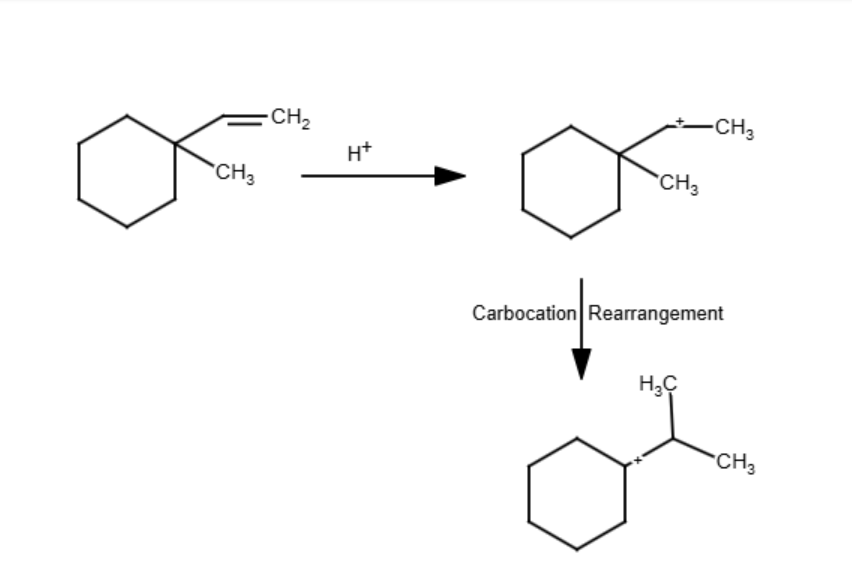
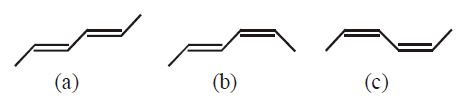
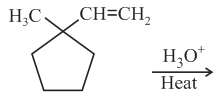
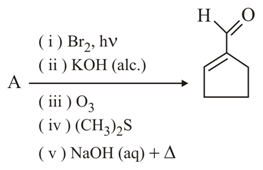
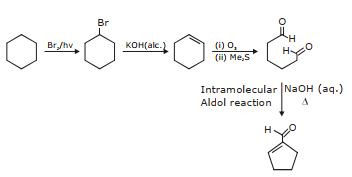
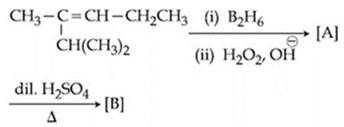
Anange the following alkenes in decreasing order of stability.

Choose the correct answer from the options given below:
Sign in
Please select an account to continue using cracku.in
↓ →
Join Our JEE Preparation Group
Prep with like-minded aspirants; Get access to free daily tests and study material.
Anange the following alkenes in decreasing order of stability.

Choose the correct answer from the options given below:
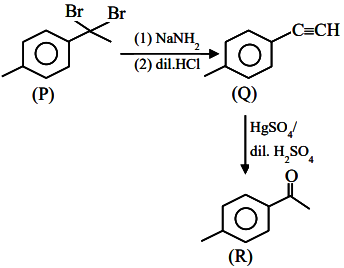
The dibromo compound [P] (molecular formula : $$C_{9}H_{10}Br_{2}$$) when heated with excess sodamide followed by treatment with dilute HO gives [Q]. On wanning [Q] with mercuric sulphate and
dilute sulphuric acid yield [R] which gives positive Iodofonn test but negative Tollen's test. The compound [P] is:
IUPAC name of the some alkenes are given below.
Find out the correct stability order.
$$\textbf{A.}$$ 2-Methylbut-2-ene
$$\textbf{B.}$$ $$\textit{cis}$$-But-2-ene
$$\textbf{C.}$$ 2,3-Dimethylbut-2-ene
$$\textbf{D.}$$ Prop-1-ene
Choose the correct answer from the options given below:
"P" is a hydrocarbon of molecular formula: $$C_8H_{14}$$. On ozonolysis, "P" forms "Q". "Q" on treatment with alkali under reflux condition produces "R", which on treatment with $$I_2$$/NaOH gives a yellow precipitate. Acidification of the solution gives "S". The structure of "S" is given below:-

The correct structure of "P" is
The cycloalkene $$(X)$$ on bromination consumes one mole of bromine per mole of $$(X)$$ and gives the product $$(Y)$$ in which $$C:Br$$ ratio is 3: 1. The percentage of bromine in the product $$(Y)$$ is _____ %. (Nearest integer)
( Given: molar mass in g $$mol^{-} H: 1, C: 12 , 0: 16, Br: 80$$)
We need to find the percentage of bromine in product Y.
To determine the cycloalkene, the cycloalkene X consumes one mole of $$Br_2$$ per mole of X (adds across the double bond), and in the product Y the C:Br ratio is 3:1 (by atoms). A cycloalkene $$C_nH_{2n-2}$$ (general formula) adds $$Br_2$$ to give $$C_nH_{2n-2}Br_2$$. For C:Br = 3:1, we need $$n:2 = 3:1$$, so $$n = 6$$. The cycloalkene is cyclohexene ($$C_6H_{10}$$), and the product is 1,2-dibromocyclohexane ($$C_6H_{10}Br_2$$).
Calculating the molecular mass of product Y gives $$M_Y = 6(12) + 10(1) + 2(80) = 72 + 10 + 160 = 242$$.
To calculate the percentage of bromine, we use $$\% Br = \frac{160}{242} \times 100 = 66.12\%$$.
The percentage of bromine is approximately $$66\%$$ (nearest integer). Therefore, the answer is 66.
The incorrect statements regarding geometrical isomerism are : (A) Propene shows geometrical isomerism. (B) Trans isomer has identical atoms/groups on the opposite sides of the double bond. (C) Cis-but-2-ene has higher dipole moment than trans-but-2-ene. (D) 2-methylbut-2-ene shows two geometrical isomers. (E) Trans-isomer has lower melting point than cis isomer. Choose the correct answer from the options given below :
We need to identify the incorrect statements regarding geometrical isomerism.
(A) Propene shows geometrical isomerism.
Propene is $$CH_3-CH=CH_2$$. One carbon of the double bond has two identical groups (two H atoms). For geometrical isomerism, each carbon of the double bond must have two different substituents. Since one carbon has 2 H atoms, propene does NOT show geometrical isomerism. Statement (A) is INCORRECT.
(B) Trans isomer has identical atoms/groups on the opposite sides of the double bond.
By definition, trans isomers have identical groups on opposite sides of the double bond. This is CORRECT.
(C) Cis-but-2-ene has higher dipole moment than trans-but-2-ene.
In cis-but-2-ene, the two methyl groups are on the same side, so the bond dipoles add up, giving a non-zero dipole moment. In trans-but-2-ene, the methyl groups are on opposite sides, and the dipoles cancel out, giving zero (or nearly zero) dipole moment. So cis has a higher dipole moment. This is CORRECT.
(D) 2-methylbut-2-ene shows two geometrical isomers.
2-methylbut-2-ene is $$CH_3-C(CH_3)=CH-CH_3$$. The carbon bearing the double bond at position 2 has two methyl groups (identical substituents). Since one carbon of the double bond has two identical groups, it cannot show geometrical isomerism. Statement (D) is INCORRECT.
(E) Trans-isomer has lower melting point than cis isomer.
Generally, trans isomers have higher melting points than cis isomers because they are more symmetrical and pack better in the crystal lattice. So the statement that trans has lower melting point is INCORRECT.
The incorrect statements are (A), (D), and (E).
The correct answer is Option 2: (A), (D) and (E) Only.
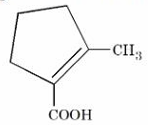
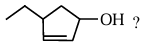
What is the correct IUPAC name of
The number of optically active products obtained from the complete ozonolysis of the given compound is :
Which compound would give 3-methyl-6-oxoheptanal upon ozonolysis ?

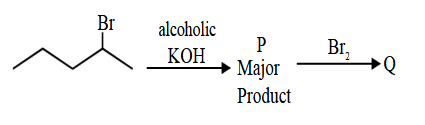
Consider the above sequence of reactions. 151 g of 2-bromopentane is made to react. Yield of major product P is 80% whereas Q is 100%.
Mass of product Q obtained is _________ g.
(Given molar mass in g mol$$^{-1}$$ H: 1, C: 12, O: 16, Br: 80)
Methods used for purification of organic compounds are based on :
Methods used for purification of organic compounds (such as distillation, crystallization, chromatography, etc.) depend on both the nature of the compound being purified and the type of impurities present.
For example, distillation is used when the compound and impurity have different boiling points, while crystallization depends on solubility differences. The choice of method depends on both factors.
The correct answer is Option 1: nature of compound and presence of impurity.
The correct statement among the following, for a "chromatography" purification method is :
In chromatography: polar compounds interact more strongly with the polar stationary phase (silica) and move slower, giving smaller Rf values. Non-polar compounds move faster with larger Rf.
The correct answer is Option (3): Rf of a polar compound is smaller than that of a non-polar compound.
Given below are two statements : Statement (I) : Kjeldahl method is applicable to estimate nitrogen in pyridine. Statement (II) : The nitrogen present in pyridine can easily be converted into ammonium sulphate in Kjeldahl method. In the light of the above statements, choose the correct answer from the options given below :
We need to evaluate two statements about the Kjeldahl method and its applicability to pyridine.
Analysis of Statement (I): "Kjeldahl method is applicable to estimate nitrogen in pyridine."
This statement is FALSE. The Kjeldahl method is NOT applicable to compounds where nitrogen is present in a ring structure (as in pyridine, quinoline, and similar heterocyclic compounds), or in nitro groups ($$-NO_2$$) and azo groups ($$-N=N-$$). This is because the nitrogen in these structures is particularly resistant to being converted to ammonium sulphate by digestion with concentrated sulphuric acid.
Analysis of Statement (II): "The nitrogen present in pyridine can easily be converted into ammonium sulphate in Kjeldahl method."
This statement is also FALSE. The nitrogen in pyridine's ring structure cannot be easily liberated and converted to ammonium sulphate $$(NH_4)_2SO_4$$ during the digestion step of the Kjeldahl method. In the Kjeldahl method, the organic compound is digested with concentrated $$H_2SO_4$$ in the presence of a catalyst (such as $$K_2SO_4$$ and $$CuSO_4$$), which converts organic nitrogen to $$(NH_4)_2SO_4$$. However, the nitrogen locked in the aromatic ring of pyridine resists this conversion because of the extra stability of the aromatic ring.
Since both statements are false, the correct answer is Option (2): Both Statement I and Statement II are false.
Which of the following statements are correct? A. Glycerol is purified by vacuum distillation because it decomposes at its normal boiling point. B. Aniline can be purified by steam distillation as aniline is miscible in water. C. Ethanol can be separated from ethanol water mixture by azeotropic distillation because it forms azeotrope. D. An organic compound is pure, if mixed M.P. is remained same. Choose the most appropriate answer from the options given below :
We need to determine which statements about purification techniques are correct.
Statement A: "Glycerol is purified by vacuum distillation because it decomposes at its normal boiling point."
Glycerol has a normal boiling point of about 290 degC, but it begins to decompose around 250 degC. Vacuum distillation lowers the boiling point by reducing the pressure, allowing glycerol to be distilled at a lower temperature without decomposition. This statement is correct. ✓
Statement B: "Aniline can be purified by steam distillation as aniline is miscible in water."
While it is true that aniline can be purified by steam distillation, the reason given is incorrect. Steam distillation works for compounds that are immiscible (or sparingly soluble) in water, not miscible. Aniline is only slightly soluble in water (about 3.6 g/100 mL at 20 degC), which is why it can be steam-distilled - the two immiscible liquids distil at a temperature below the boiling point of either component. The statement incorrectly claims aniline is miscible in water. This statement is incorrect. ✗
Statement C: "Ethanol can be separated from ethanol-water mixture by azeotropic distillation because it forms an azeotrope."
Ethanol and water form a minimum boiling azeotrope at 95.6% ethanol (by weight) at 78.1 degC. Simple distillation cannot separate them beyond this composition. Azeotropic distillation (using a third component like benzene or cyclohexane as an entrainer) can break the azeotrope and separate pure ethanol. This statement is correct. ✓
Statement D: "An organic compound is pure, if mixed M.P. is remained same."
The mixed melting point test is a standard purity test: if a sample is mixed with a pure reference compound and the melting point remains unchanged (no depression), then the sample is the same pure compound. If impurities are present, the melting point would be depressed. This statement is correct. ✓
Conclusion: Statements A, C, and D are correct.
The correct answer is Option 2: A, C, D only.
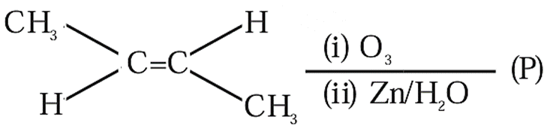
Consider the given reaction. Trans-2-butene $$\xrightarrow{(i) O_3}$$ $$\xrightarrow{(ii) Zn/H_2O}$$ (P)
The total number of oxygen atoms present per molecule of the product (P) is _______.
3-Methylhex-2-ene on reaction with HBr in presence of peroxide forms an addition product (A). The number of possible stereoisomers for 'A' is _______.
3-Methylhex-2-ene: $$CH_3CH=C(CH_3)CH_2CH_2CH_3$$
In the presence of peroxides, HBr adds via anti-Markovnikov (free radical) mechanism. The Br adds to the less substituted carbon of the double bond.
The product is: $$CH_3CHBr-CH(CH_3)-CH_2CH_2CH_3$$ (Br on C-2).
Let's check for stereocenters:
C-2: $$CHBr$$ bonded to $$CH_3$$, $$H$$, $$Br$$, and $$CH(CH_3)CH_2CH_2CH_3$$ — this is a chiral center.
C-3: $$CH(CH_3)$$ bonded to $$CH_3$$, $$H$$, $$CHBrCH_3$$, and $$CH_2CH_2CH_3$$ — this is a chiral center.
With 2 chiral centers, the maximum number of stereoisomers = $$2^2 = 4$$.
Since the two chiral centers have different substituents (they are not equivalent), all 4 stereoisomers are distinct (no meso form).
The number of possible stereoisomers is $$\boxed{4}$$.
Choose the correct set of reagents for the following conversion
trans Ph - CH = CH - CH$$_3$$ $$\rightarrow$$ cis Ph - CH = CH - CH$$_3$$
We need to convert trans-PhCH=CHCH$$_3$$ to cis-PhCH=CHCH$$_3$$.
Trans to cis conversion cannot be done directly. The approach is:
1. Convert the double bond to a triple bond (via addition-elimination)
2. Then selectively reduce the triple bond to give the cis alkene
1. Br$$_2$$: Anti addition to the trans alkene gives a vicinal dibromide
2. Alc. KOH: Double dehydrohalogenation (two eliminations) gives the alkyne PhC$$\equiv$$CCH$$_3$$
3. NaNH$$_2$$: Strong base for the second elimination (if needed) to ensure complete conversion to alkyne
4. H$$_2$$/Lindlar catalyst: Selective syn-hydrogenation of the alkyne gives the cis alkene
The key is that Lindlar's catalyst (Pd/CaCO$$_3$$/quinoline) gives cis (syn) addition, while Na in liquid NH$$_3$$ (Birch conditions) would give the trans product.
Option B: Br$$_2$$, alc KOH, NaNH$$_2$$, H$$_2$$ Lindlar Catalyst - this correctly uses Lindlar's catalyst for cis selectivity.
The correct answer is Option B: Br$$_2$$, alc KOH, NaNH$$_2$$, H$$_2$$ Lindlar Catalyst.
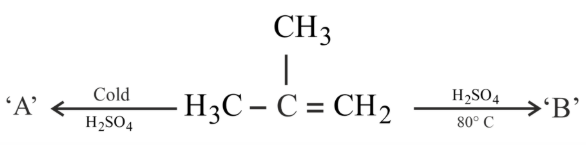
3015150The major products 'A' and 'B', respectively, are
The water gas on reacting with cobalt as a catalyst forms
Water gas is a mixture of carbon monoxide ($$CO$$) and hydrogen ($$H_2$$), produced by passing steam over hot coke:
$$C + H_2O \rightarrow CO + H_2$$
When water gas is passed over a cobalt ($$Co$$) catalyst under appropriate conditions of temperature and pressure, it produces methanoic acid (formic acid).
The balanced reaction is:
$$CO + H_2O \rightarrow HCOOH$$
Here, carbon monoxide reacts with water (present as steam) in the presence of a cobalt catalyst to form methanoic acid ($$HCOOH$$).
Let us verify why the other options are incorrect:
Option A (Methanal / Formaldehyde, $$HCHO$$): Methanal is obtained by catalytic oxidation of methanol using a silver or iron-molybdenum oxide catalyst. It is not a direct product of water gas with a cobalt catalyst.
Option C (Ethanol, $$C_2H_5OH$$): Ethanol can be produced from syngas but requires different catalysts (such as rhodium-based catalysts) and specific conditions. Cobalt catalyst does not directly produce ethanol from water gas.
Option D (Methanol, $$CH_3OH$$): Methanol is produced from syngas ($$CO + 2H_2$$) using a $$ZnO$$-$$Cr_2O_3$$ catalyst at high pressure. The reaction is $$CO + 2H_2 \rightarrow CH_3OH$$. This requires a different catalyst, not cobalt.
Therefore, the correct answer is Option B: Methanoic acid.

The two products formed in above reaction are
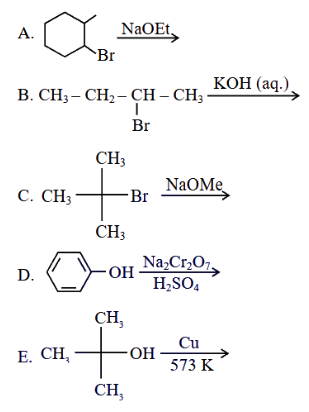
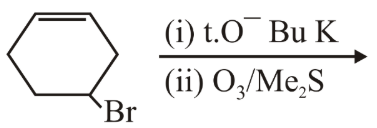
The one giving maximum number of isomeric alkenes on dehydrohalogenation reaction is (excluding rearrangement)
We need to find which compound gives the maximum number of isomeric alkenes on dehydrohalogenation (excluding rearrangement).
1-Bromo-2-methylbutane: CH$$_2$$Br-CH(CH$$_3$$)-CH$$_2$$-CH$$_3$$
The only $$\beta$$-carbon is C2. Elimination gives: 2-methylbut-1-ene.
Number of isomeric alkenes = 1
2-Bromopropane: CH$$_3$$-CHBr-CH$$_3$$
$$\beta$$-hydrogens are on C1 and C3 (equivalent). Elimination gives only: propene.
Number of isomeric alkenes = 1
2-Bromopentane: CH$$_3$$-CHBr-CH$$_2$$-CH$$_2$$-CH$$_3$$
$$\beta$$-hydrogens at C1 and C3:
Elimination from C1: gives pent-1-ene
Elimination from C3: gives pent-2-ene, which exists as both (E)-pent-2-ene and (Z)-pent-2-ene
Number of isomeric alkenes = 3 (maximum)
2-Bromo-3,3-dimethylpentane: CH$$_3$$-CHBr-C(CH$$_3$$)$$_2$$-CH$$_2$$-CH$$_3$$
C3 is quaternary (no $$\beta$$-H). Only $$\beta$$-H at C1.
Elimination from C1: gives 3,3-dimethylpent-1-ene
Number of isomeric alkenes = 1
2-Bromopentane gives the maximum number of isomeric alkenes (3).
The correct answer is Option 3: 2-Bromopentane.
Find out the major product from the following reaction.
Find out the major products from the following reactions.
17 mg of a hydrocarbon (M.F. C$$_{10}$$H$$_{16}$$) takes up 8.40 mL of the H$$_2$$ gas measured at 0°C and 760 mm of Hg. Ozonolysis of the same hydrocarbon yields

The number of double bond/s present in the hydrocarbon is
Molar mass of the hydrocarbon (X) which on ozonolysis consumes one mole of O$$_3$$ per mole of (X) and gives one mole each of ethanal and propanone is ______ g mol$$^{-1}$$ (Molar mass of C: 12 g mol$$^{-1}$$, H: 1 g mol$$^{-1}$$)
Hydrocarbon (X) on ozonolysis consumes one mole of O₃ per mole of X and gives one mole each of ethanal (CH₃CHO) and propanone (CH₃COCH₃).
Since each C=C double bond consumes one mole of O₃ in ozonolysis, the consumption of one mole of O₃ indicates the presence of a single C=C double bond in the molecule.
Ozonolysis cleaves this double bond into two carbonyl fragments:
$$>C=C< \xrightarrow{O_3} >C=O + O=C<$$
One fragment is ethanal (CH₃CHO), implying one side of the original double bond was CH₃-CH=, and the other fragment is propanone ((CH₃)₂CO), implying the other side was =C(CH₃)₂.
Rejoining these fragments across the double bond produces the structure
$$CH_3\text{-}CH=C(CH_3)_2$$
which corresponds to 2-methylbut-2-ene.
The molecular formula of this hydrocarbon is C₅H₁₀, and its molar mass is
$$M = 5 \times 12 + 10 \times 1 = 60 + 10 = 70 \text{ g mol}^{-1}$$
Therefore, the molar mass of hydrocarbon X is 70 g mol⁻¹.
The number of possible isomeric products formed when 3-chloro-1-butene reacts with HCl through carbocation formation is _______
When 3-chloro-1-butene reacts with HCl, the reaction proceeds by initial protonation of the alkene double bond to generate a carbocation intermediate. Because the system forms an allylic carbocation, it is stabilized by resonance, distributing the positive charge across two different carbon positions before the chloride nucleophile attacks.
Protonation ($\text{H}^+$ attack) occurs at $\text{C}_1$ of 3-chloro-1-butene (CH2=CH-CH(Cl)-CH3) to yield a secondary carbocation at $\text{C}_2$. Then, the original chlorine atom can also generate an allylic network, or directly protonating the structure leads to a highly stable resonance hybrid:
→ Resonance Structures:
The chloride ion ($\text{Cl}^-$) attacks the resulting active carbocation centers, leading to the following distinct structural products along with their respective stereoisomers:
| Product Structure | IUPAC Name | Chiral Center Presence | Isomer Count |
|---|---|---|---|
| CH3-CH(Cl)-CH(Cl)-CH3 | 2,3-dichlorobutane | Contains 2 identical chiral carbons (Forms Meso and d/l pair) | 3 isomers (1 Meso + 2 Optically Active) |
| CH3-CH=CH-CH2Cl | 1-chloro-2-butene | No chiral center, but shows Geometrical Isomerism | 2 isomers (cis and trans) |
| CH3-CH(Cl)-CH=CH2 | 3-chloro-1-butene | Contains 1 chiral carbon (Regenerated reactant path options) | 2 isomers (d and l enantiomers) |
Accounting specifically for the distinct sets of structural combinations stemming directly from the unique symmetrical distributions of the 2,3-dichlorobutane path alongside the allylically shifted 1-chloro-2-butene configurations:
Which among the following pairs of structures will give different products on ozonolysis? (Consider the double bonds in the structures are rigid and not delocalized.)
Given below are two statements.
Statement I: The presence of weaker $$\pi$$-bonds make alkenes less stable than alkanes
Statement II: The strength of the double bond is greater than that of carbon-carbon single bond.
In the light of the above statements, choose the correct answer from the options given below.
We need to evaluate both statements about alkenes and alkanes.
Statement I: "The presence of weaker $$\pi$$-bonds make alkenes less stable than alkanes."
The $$\pi$$ bond in alkenes is formed by the lateral overlap of unhybridized p-orbitals. This lateral overlap is less effective than the head-on overlap in $$\sigma$$ bonds, making the $$\pi$$ bond weaker and more reactive. Due to the presence of this weaker $$\pi$$ bond, alkenes are more reactive (less stable) than alkanes, which contain only strong $$\sigma$$ bonds.
Statement I is correct.
Statement II: "The strength of the double bond is greater than that of carbon-carbon single bond."
The bond energy of a C=C double bond is approximately $$614$$ kJ/mol, while the bond energy of a C-C single bond is approximately $$347$$ kJ/mol. Since $$614 > 347$$, the double bond is indeed stronger than the single bond overall (even though the $$\pi$$ component individually is weaker than a $$\sigma$$ bond).
Statement II is correct.
Note: There is no contradiction between the two statements. The double bond as a whole is stronger than a single bond, but the presence of the weaker $$\pi$$ bond component makes the molecule more reactive at that site.
The correct answer is Option A: Both Statement I and Statement II are correct.
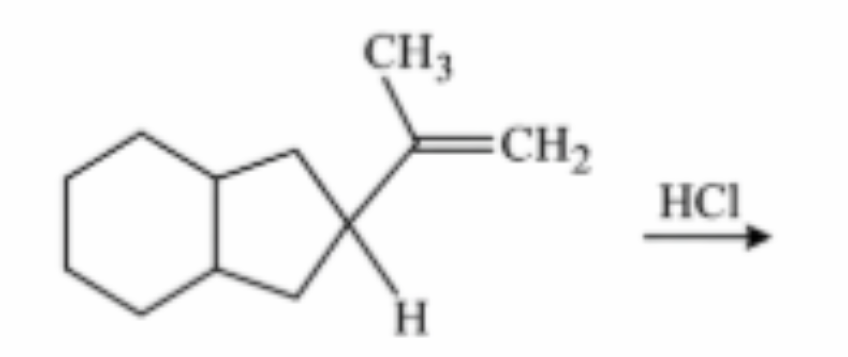
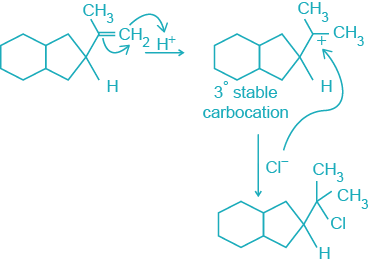
Major product of the following reaction is
The major product of the following reaction is:
The product formed in the following reaction.

is:
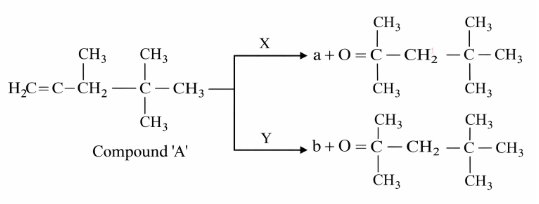
A compound 'A' on reaction with 'X' and 'Y' produces the same major product but different by-products 'a' and 'b'. Oxidation of 'a' gives a substance produced by ants.

'X' and 'Y' respectively are
Choose the correct option for the following reactions.
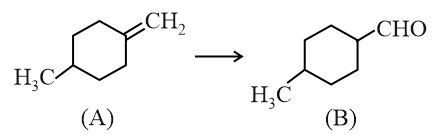
Which of the following reagents / reactions will convert 'A' to 'B'?
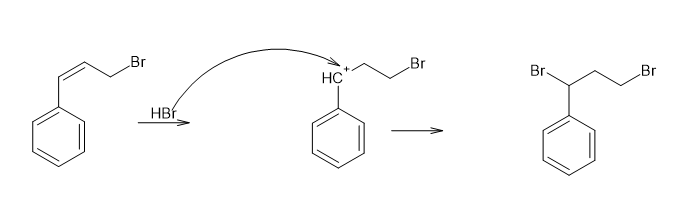
The major product (P) in the reaction
H+ would attach on double bond and breaks it at the same time Br- would attach with + position after breaking of double bond. Hence the resultant compound would be B
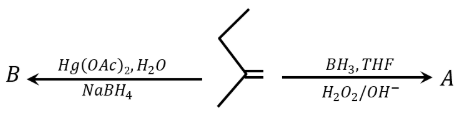
'A' and 'B' respectively are
A $$\xrightarrow[(2) Zn-H_2O]{(1) O_3 \atop}$$ Ethane-1,2-dicarbaldehyde + Glyoxal/Oxaldehyde
B $$\xrightarrow[(2) Zn-H_2O]{(1) O_3 \atop}$$ 5-oxohexanal
We need to find compounds A and B based on the ozonolysis products.
For compound A:
A on ozonolysis gives ethane-1,2-dicarbaldehyde ($$OHC-CH_2-CH_2-CHO$$) and glyoxal ($$OHC-CHO$$).
In ozonolysis of cyclic dienes, each double bond is cleaved. For a six-membered ring with two double bonds:
Cyclohex-1,3-diene has double bonds at C1=C2 and C3=C4 positions. On ozonolysis followed by reductive workup ($$Zn/H_2O$$):
- Cleavage at C1=C2 and C3=C4 gives two fragments.
- The fragment from C2-C3 (single bond between the two double bonds) gives glyoxal: $$OHC-CHO$$
- The fragment from C4-C5-C6-C1 gives $$OHC-CH_2-CH_2-CHO$$ (ethane-1,2-dicarbaldehyde)
So compound A is cyclohex-1,3-diene.
For compound B:
B on ozonolysis gives 5-oxohexanal ($$CH_3-CO-CH_2-CH_2-CH_2-CHO$$).
Since only one product is formed, B must be a cyclic compound with one double bond. On ozonolysis, the ring opens at the double bond to give a single dicarbonyl compound.
5-oxohexanal has the structure: $$CH_3-CO-CH_2-CH_2-CH_2-CHO$$
The two carbonyl carbons (C1 aldehyde and C2 ketone at C5 position counted from the aldehyde end) were originally connected by a double bond in the ring.
Reconnecting these carbons: we get a 5-membered ring with a methyl substituent. The compound is 1-methylcyclopent-1-ene.
Verification: 1-methylcyclopent-1-ene has the double bond between C1 (bearing $$CH_3$$) and C2. Ozonolysis cleaves this to give a ketone at C1 ($$-CO-CH_3$$) and an aldehyde at C2 ($$-CHO$$), with the remaining chain $$-CH_2-CH_2-CH_2-$$ connecting them, giving $$CH_3CO-CH_2CH_2CH_2-CHO$$ = 5-oxohexanal. This is correct.
Therefore, A is cyclohex-1,3-diene and B is 1-methylcyclopent-1-ene.
Hence, the correct answer is Option C.
Number of grams of bromine that will completely react with $$5.0$$ g of pent-1-ene is ______ $$\times 10^{-2}$$ g. (Atomic mass of Br $$= 80$$ g/mol) [Nearest integer]
To determine the mass of bromine that reacts completely with 5.0 g of pent-1-ene, we first consider the addition reaction of pent-1-ene ($$CH_2{=}CHCH_2CH_2CH_3$$) with bromine across the double bond:
$$CH_2{=}CHCH_2CH_2CH_3 + Br_2 \rightarrow CH_2BrCHBrCH_2CH_2CH_3$$ Because one mole of pent-1-ene reacts with one mole of $$Br_2$$, the stoichiometric ratio is 1:1.
Next, the molar mass of pent-1-ene is calculated from its molecular formula $$C_5H_{10}$$:
$$M = 5(12) + 10(1) = 60 + 10 = 70 \text{ g/mol}$$ As a result, the number of moles in 5.0 g of pent-1-ene is:
$$n = \frac{5.0}{70} = \frac{1}{14} \text{ mol}$$.
Since the molar ratio between pent-1-ene and $$Br_2$$ is 1:1, the required amount of $$Br_2$$ is also $$\frac{1}{14}$$ mol. Given that the molar mass of $$Br_2$$ is 2 × 80 = 160 g/mol, the mass of $$Br_2$$ needed becomes:
$$\text{Mass of } Br_2 = \frac{1}{14} \times 160 = \frac{160}{14} = 11.4286 \text{ g}$$.
Finally, expressing this mass in the desired format gives:
$$11.4286 \text{ g} = 1142.86 \times 10^{-2} \text{ g} \approx 1143 \times 10^{-2} \text{ g}$$ therefore the correct answer is 1143.
The major product 'A' of the following given reaction has $$sp^2$$ hybridized carbon atoms.
$$2,7\text{-Dimethyl-2,6-octadiene} \xrightarrow{H^+} A$$ (Major Product)
The number of $$sp^2$$ hybridized carbon atoms in 'A' is ______
The major product formed in the following reaction is:
The stereoisomers that are formed by electrophilic addition of bromine to trans-but-2-ene is/are:
We have trans-but-2-ene, that is $$\mathrm{CH_3\!-\!CH=CH\!-\!CH_3}$$ with the two $$\mathrm{CH_3}$$ groups on opposite sides of the double bond. During the electrophilic addition of bromine, the reaction always proceeds through a cyclic bromonium ion. The first step is
$$$\mathrm{CH_3\!-\!CH=CH\!-\!CH_3 + Br_2 \;\longrightarrow\;} \mathrm{CH_3\!-\!CH\!\!\overset{+}{\!\!\!\!Br}\!-\!CH\!-\!CH_3} \;+\;Br^-$$$
Now, bromide ion $$Br^-$$ opens the three-membered ring from the side opposite to the $$\overset{+}{Br}$$ (anti-addition). So the two bromine atoms always enter from opposite faces of the original double bond plane.
To see the stereochemical result clearly we assign the substituents around each sp3 carbon after addition. Let us choose the configuration in which on carbon-2 ($$C_2$$) the incoming nucleophilic $$Br^-$$ attacks from the front while on carbon-3 ($$C_3$$) it attacks from the rear. We can write the skeletal formula obtained:
$$$\mathrm{CH_3\,(front\;Br)\,CH\!-\!CH\,(back\;Br)\,CH_3}$$$
The molecule so obtained possesses two chiral centres, $$C_2$$ and $$C_3$$. We assign priorities by the C.I.P. rules (stated briefly: atom with higher atomic number gets higher priority). On each centre
Priority order: $$$Br(1) > CH_2CH_3(2) > CH_3(3) > H(4).$$$
Because the bromines are on opposite faces, one centre becomes $$R$$ while the other automatically becomes $$S$$. Explicitly, if $$C_2$$ is $$R$$, $$C_3$$ is $$S$$; the mirror image would have $$C_2$$ as $$S$$ and $$C_3$$ as $$R$$. However these two descriptions represent the same molecule: it has an internal mirror plane passing through the middle of the C-C bond and bisecting the molecule. Hence the compound is superimposable on its mirror image and is optically inactive. Such a stereoisomer is called a meso form.
If, in the bromonium opening step, we imagine the attack sequence reversed—i.e. bromide coming from the rear on $$C_2$$ and from the front on $$C_3$$—we draw
$$$\mathrm{CH_3\,(back\;Br)\,CH\!-\!CH\,(front\;Br)\,CH_3}$$$
Again, priority assignment shows $$C_2$$ to be $$S$$ and $$C_3$$ to be $$R$$, producing exactly the same $$RS$$ (meso) configuration as above. Thus the two routes give two structures that are identical, not different stereoisomers. No $$RR$$ or $$SS$$ combination can arise because anti-addition on a trans alkene never places the two bromines on the same face, a prerequisite for those diastereomeric pairs.
Therefore, electrophilic anti-addition of $$Br_2$$ to trans-but-2-ene furnishes only one unique stereoisomer, viz. the meso-2,3-dibromobutane. The phrase “2 identical mesomers” in the option list simply recognises that the reaction pathway can be visualised in two ways but both lead to the same meso product.
Hence, the correct answer is Option A.
An organic compound 'A' C$$_4$$H$$_8$$ on treatment with KMnO$$_4$$/H$$^+$$ yields compound 'B' C$$_3$$H$$_6$$O. Compound 'A' also yields compound 'B' on ozonolysis. Compound 'A' is:
We are told that the hydrocarbon ‘A’ has molecular formula $$C_4H_8$$. The general formula $$C_nH_{2n}$$ corresponds either to an alkene (one C=C bond) or to a cycloalkane (all C-C single bonds inside a ring). So ‘A’ must be either an alkene or a four-membered ring.
After hot acidic permanganate oxidation (written as $$KMnO_4/H^+$$) the only organic product obtained is ‘B’ with formula $$C_3H_6O$$. Hot $$KMnO_4$$ completely cleaves a C=C bond and converts each carbon of that double bond as follows:
• “Internal” carbon (no attached H) → Ketone.
• “Secondary” carbon (one attached H) → Carboxylic acid.
• “Terminal” vinyl carbon $$( =CH_2)$$ → $$CO_2$$.
Because only one organic fragment remains (three carbons long) and one carbon has been lost, the cleavage must have destroyed a terminal $$=CH_2$$ group, giving $$CO_2$$, while the other carbon of the double bond (which had no hydrogens) became the three-carbon ketone $$C_3H_6O$$.
Let us write the unknown alkene in the general form $$R_2C=CH_2$$. Applying the above rule:
$$$\displaystyle R_2C=CH_2 \;\xrightarrow[\text{hot}]{KMnO_4/H^+}\; R_2C=O\;+\;CO_2$$$
The ketone obtained has formula $$C_3H_6O$$. For a ketone the carbonyl carbon is already counted, so its alkyl parts must supply three carbons in total. The only way to supply three carbons with the pattern $$R_2C=O$$ is to make both $$R$$ groups methyl, because
$$$ (CH_3)_2C=O\;\text{ is acetone (propan-2-one), formula }C_3H_6O.$$$
Therefore
$$$ R = CH_3 \quad\Longrightarrow\quad A = (CH_3)_2C=CH_2 $$$
This structure is named 2-methylpropene.
Now we verify the second fact, ozonolysis. Ozonolysis also cleaves the C=C bond but under reductive work-up (Zn/H2O) stops at carbonyl compounds:
$$$ (CH_3)_2C=CH_2 \;\xrightarrow[\;Zn/H_2O\;]{O_3}\; (CH_3)_2C=O \;+\; H_2C=O $$$
The products are acetone $$(C_3H_6O)$$ and formaldehyde $$(CH_2O)$$. Thus the same compound ‘B’ (acetone) is again formed, satisfying the condition in the statement.
Any of the other options fails:
• $$\text{But-2-ene}\;(CH_3CH=CHCH_3)$$ would give two molecules of ethanal $$(C_2H_4O).$$
• $$\text{Cyclobutane}$$ and $$\text{1-methylcyclopropane}$$ contain no C=C bond; their oxidative cleavage patterns cannot furnish a single $$C_3H_6O$$ fragment while losing only one carbon.
Hence, the only structure consistent with all the data is 2-methylpropene.
Hence, the correct answer is Option A.
For above chemical reactions, identify the correct statement from the following:
Oxidation: Alkenes on reaction with cold, dilute, aqueous solution of potassium permanganate (Baeyer’s reagent) produce vicinal glycols. Decolorisation of KMnO4 solution is used as a test for unsaturation.
Acidic potassium permanganate or acidic potassium dichromate oxidises alkenes to ketones and/or acids depending upon the nature of the alkene and the experimental conditions.
$$ \mathrm{CH_3-CH=CH-CH_3 \xrightarrow{KMnO_4/H^+} 2CH_3COOH} $$
Given below are two statements : one is labelled as Assertion (A) and the other is labelled as Reason (R).
Assertion (A): Treatment of bromine water with propene yields 1-bromopropan-2-ol.
Reason (R): Attack of water on bromonium ion follows Markovnikov rule and results in 1-bromopropan-2-ol.
In the light of the above statements, choose the most appropriate answer from the options given below:
We have the alkene propene, whose condensed formula is $$\mathrm{CH_3-CH=CH_2}$$.
When bromine is added in the presence of excess water, the actual reagent in aqueous medium is written as $$\mathrm{Br_2/H_2O}$$. The overall transformation is the formation of a bromohydrin, that is, simultaneous addition of $$\mathrm{Br}$$ and $$\mathrm{OH}$$ across the C=C double bond.
The first elementary step is electrophilic attack of $$\mathrm{Br_2}$$ on the double bond. The $$\pi$$ electrons of the C=C bond act as a nucleophile and displace $$\mathrm{Br^-}$$ from $$\mathrm{Br_2}$$, producing a cyclic bromonium ion. This step may be written as
$$\mathrm{CH_3-CH=CH_2 \;+\; Br_2 \;\longrightarrow\; [CH_3-CH-CH_2]^+}$$
with $$\mathrm{Br}$$ bridging the two carbons, and a free $$\mathrm{Br^-}$$ in the medium.
Now water, which is abundant and a better nucleophile than $$\mathrm{Br^-}$$ because of its higher concentration, attacks this three-membered bromonium ring. A key point is that the attack is Markovnikov. Before using that rule, we state it explicitly:
Markovnikov rule: In an electrophilic addition to an alkene, the nucleophilic part of the reagent attaches to the more substituted carbon atom of the double bond, while the electrophilic part attaches to the less substituted carbon.
In the bromonium ion derived from propene, carbon 2 (the middle carbon) is secondary, whereas carbon 1 (the terminal carbon) is primary. According to Markovnikov rule, the nucleophile $$\mathrm{H_2O}$$ must therefore attack carbon 2. We write the attack step as
$$\mathrm{[CH_3-CH-CH_2]^+ + H_2O \;\longrightarrow\; CH_3-CH(OH)-CH_2Br + H^+}$$
The proton released is immediately taken up by $$\mathrm{Br^-}$$ or by another water molecule, regenerating neutral medium; the essential organic product remains:
$$\mathrm{CH_3-CH(OH)-CH_2Br}$$
Let us name this compound systematically. We number the longest carbon chain from either end, but we keep the lowest possible locant for the functional group with priority, which here is the hydroxyl group. Thus carbon 2 bears the $$\mathrm{OH}$$ group and carbon 1 bears the $$\mathrm{Br}$$ atom:
$$\mathrm{HO-CH(CH_3)-CH_2Br}$$ = 1-bromopropan-2-ol
So, the experimental observation given in the Assertion is completely correct.
Now we examine the Reason. It says that the attack of water on the bromonium ion follows Markovnikov rule and therefore gives the same product, 1-bromopropan-2-ol. We have just followed the mechanism and indeed found that application of Markovnikov orientation is precisely why $$\mathrm{OH}$$ ends up on C 2 and $$\mathrm{Br}$$ on C 1. Thus the Reason is also true and it is the exact explanation of the Assertion.
In the list of options, the statement “Both (A) and (R) are true and (R) is the correct explanation of (A)” corresponds to Option C (the third option).
Hence, the correct answer is Option C.
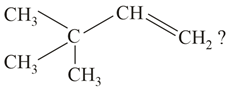
What is the major product formed by HI on reaction with the above compound?
The molecule is 3,3-dimethylbut-1-ene. When this alkene undergoes a typical electrophilic addition reaction, such as hydration with an acid catalyst or reaction with a hydrogen halide like $$HBr$$ or $$HI$$, the process is entirely dictated by the formation and rearrangement of a carbocation intermediate to achieve maximum thermodynamic stability.
The reaction begins when the electron-rich pi bond of the alkene attacks an electrophile, typically a proton ($$H^+$$). According to Markovnikov's rule, the proton adds to the terminal carbon atom (the $$CH_2$$ group at the end of the double bond). This specific placement is favored because it leaves the resulting positive charge on the adjacent, more substituted internal carbon atom. This initial step forms a secondary carbocation, where the positively charged carbon is directly bonded to two other carbon groups.
While secondary carbocations have a moderate level of stability, this specific molecule has a structural feature that allows it to reach a much lower, more stable energy state. Immediately adjacent to the positively charged secondary carbon is a quaternary carbon atom, which is densely packed with three attached methyl groups. Because the molecule is dynamic, it will spontaneously rearrange to relieve energy. An entire methyl group, along with its bonding pair of electrons, physically migrates from the quaternary carbon over to the adjacent positively charged carbon. This fundamental organic mechanism is known as a 1,2-methyl shift.
When the methyl group moves, the positive charge shifts back to the carbon that just lost the group. The newly formed intermediate is now a tertiary carbocation, meaning the positively charged carbon is bonded to three other carbon atoms. This tertiary carbocation is significantly more stable than the initial secondary one. This massive boost in stability is primarily due to hyperconjugation, an effect where the electron density from the numerous adjacent carbon-hydrogen bonds partially overlaps with and stabilizes the empty p-orbital of the positive carbon.
Because the tertiary carbocation is so exceptionally stable, the 1,2-methyl shift happens very rapidly. The final step of the reaction occurs when a nucleophile in the solution, such as a bromide ion or a water molecule, attacks this stable tertiary center, resulting in a rearranged major product rather than a simple addition product. Thus, the correct option is B.
The number of acyclic structural isomers (including geometrical isomers) for pentene are ___.
For pentene ($$\text{C}_5\text{H}_{10}$$), we need to count all acyclic structural isomers including geometrical (cis-trans) isomers.
The possible structures are: (1) pent-1-ene: $$\text{CH}_2{=}\text{CH-CH}_2\text{-CH}_2\text{-CH}_3$$, (2) trans-pent-2-ene: $$\text{CH}_3\text{-CH}{=}\text{CH-CH}_2\text{-CH}_3$$, (3) cis-pent-2-ene, (4) 2-methylbut-1-ene: $$\text{CH}_2{=}\text{C(CH}_3\text{)-CH}_2\text{-CH}_3$$, (5) 3-methylbut-1-ene: $$\text{CH}_2{=}\text{CH-CH(CH}_3\text{)}_2$$, and (6) 2-methylbut-2-ene: $$\text{CH}_3\text{-C(CH}_3\text{)}{=}\text{CH-CH}_3$$.
Pent-1-ene has no geometrical isomers because one carbon of the double bond bears two hydrogen atoms. Pent-2-ene has both cis and trans forms since each doubly-bonded carbon has two different groups. 2-methylbut-1-ene has no geometrical isomers (terminal $$=\text{CH}_2$$). 3-methylbut-1-ene has no geometrical isomers (terminal $$=\text{CH}_2$$). 2-methylbut-2-ene has no geometrical isomers because one carbon bears two methyl groups.
The total count is $$6$$.
A chloro compound "A".
(i) forms aldehydes on ozonolysis followed by the hydrolysis.
(ii) when vaporized completely 1.53 g of A, gives 448 mL of vapour at STP. The number of carbon atoms in a molecule of compound A is _________
We are told that compound $$A$$ is a chloro-compound and that on ozonolysis followed by hydrolysis it produces only aldehydes. Recall that:
Whenever an alkene $$\,{\displaystyle R_1CH=CHR_2}\,$$ is treated with ozone and then hydrolysed, the double bond is split and each carbon of the double bond becomes the carbon of a carbonyl group. If every carbon of the original double bond possessed at least one hydrogen, both carbonyl products will be aldehydes. Hence we infer that $$A$$ is an alkene that contains one chlorine atom and possesses exactly one C=C double bond.
Let its molecular formula be written as $$\mathrm{C_nH_mCl}$$. We next determine its molar mass from the vapour-density data.
At STP, one mole of any gas occupies $$22.4\ \text{L}$$. Here,
Volume of vapour obtained = $$448\ \text{mL}=0.448\ \text{L}$$.
So, number of moles present is
$$n_{\text{mole}}=\dfrac{\text{volume}}{22.4\ \text{L mol}^{-1}} =\dfrac{0.448}{22.4}=0.020\ \text{mol}.$$
The given mass that produced this vapour is $$1.53\ \text{g}$$, hence the molar mass $$M$$ of $$A$$ is
$$M=\dfrac{\text{mass}}{\text{moles}} =\dfrac{1.53\ \text{g}}{0.020\ \text{mol}} =76.5\ \text{g mol}^{-1}.$$
Writing the molar mass in terms of the unknown numbers of atoms, we have
$$M = 12n + m + 35.5,$$
because one carbon contributes $$12\ \text{u}$$, one hydrogen gives $$1\ \text{u}$$, and one chlorine contributes $$35.5\ \text{u}$$ to the molar mass.
Equating this to the experimentally obtained value,
$$12n + m + 35.5 = 76.5 \quad\Longrightarrow\quad 12n + m = 41.$$
Next, we employ the idea of the degree of unsaturation (also called the index of hydrogen deficiency, IHD). For a straight-chain saturated chloro-alkane with $$n$$ carbons we would expect $$2n+2$$ hydrogens. Each ring, double bond or halogen atom reduces this count by the following rule:
IHD formula: $$\text{IHD}=\dfrac{2n+2 - (m + X)}{2},$$ where $$X$$ is the number of halogen atoms.
In our case there is one Cl atom, so $$X=1$$. Because we have already concluded that there is one C=C double bond and no rings, $$\text{IHD}=1$$. Therefore
$$1=\dfrac{2n+2 - (m+1)}{2} \;\Longrightarrow\; 2=2n+2 - m -1 \;\Longrightarrow\; m = 2n -1.$$
We now possess two simultaneous relations, namely
$$12n + m = 41,$$
$$m = 2n - 1.$$
Substituting the second into the first,
$$12n + (2n - 1) = 41 \;\Longrightarrow\; 14n - 1 = 41 \;\Longrightarrow\; 14n = 42 \;\Longrightarrow\; n = 3.$$
Thus the molecule contains exactly $$3$$ carbon atoms. Immediately we can verify the hydrogen count:
$$m = 2n - 1 = 2(3) - 1 = 5,$$
which gives the molecular formula $$\mathrm{C_3H_5Cl}$$ and satisfies the molar mass check:
$$M = 12(3) + 5 + 35.5 = 36 + 5 + 35.5 = 76.5\ \text{g mol}^{-1},$$
in full agreement with the experimental value.
Hence, the correct answer is Option 3.
Which of the following compounds produces an optically inactive compound on hydrogenation?
The major products of the following reaction are:
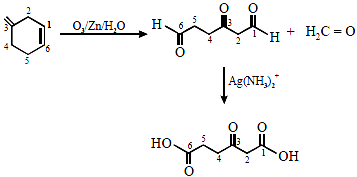
An unsaturated hydrocarbon X absorbs two hydrogen molecules on catalytic hydrogenation, and also gives following reaction:
X $$\xrightarrow[\frac{(ii) Zn}{H_2O}]{(i) O_3}$$ A $$\xrightarrow{[Ag(NH_3)_2]^+}$$ B (3-oxo-hexanedicarboxylic acid). X will be:
The correct order of heat of combustion for following alkadienes is:
The major product formed in the following reaction is:
$$\text{CH}_2\text{CH} = \text{CHCH(CH}_3)_2 \xrightarrow{\text{HBr}}$$
The major product in the following reaction is:
In the following reaction A is:
The major product [B] in the following sequence of reactions is:
Which one of the following alkenes when treated with HCl yields majorly an anti Markovnikov product?
First we recall the general statement of Markovnikov’s rule: on electrophilic addition of $$\mathrm{HX}$$ to an unsymmetrical alkene, the proton $$\left(\mathrm{H^+}\right)$$ attaches to that double-bonded carbon which already bears the larger number of hydrogen atoms, because this mode of attack generates the more stable carbocation. Put algebraically, if the alkene is $$\mathrm{C_a=C_b}$$, then in the Markovnikov pathway $$\mathrm{H^+}$$ goes to the carbon rich in hydrogens and the intermediate carbocation appears on the other carbon.
The stability of the intermediate carbocation is decided mainly by two electronic effects: the inductive effect $$\left(-I\ \text{or}\ +I\right)$$ and the mesomeric or resonance effect $$\left(-M\ \text{or}\ +M\right)$$ of the substituent already attached to that carbon. A group which donates electron density by $$+I$$ or $$+M$$ stabilises the positive charge, whereas a group which withdraws electron density by a strong $$-I$$ effect destabilises it. Hence, if a substituent has a very powerful $$-I$$ effect and lacks any meaningful $$+M$$ donation, the carbocation situated adjacent to it becomes highly unstable, and the reaction may proceed by the opposite orientation, i.e. the anti-Markovnikov mode.
Now we analyse each given alkene one by one.
Option A : $$\mathrm{CH_3O{-}CH=CH_2}$$
The methoxy group $$\left(\mathrm{-OCH_3}\right)$$ exerts a $$+M$$ resonance donation because of the lone pairs on oxygen. In the Markovnikov pathway the proton adds to the terminal $$\mathrm{CH_2}$$ carbon and the carbocation appears on the carbon bearing $$\mathrm{-OCH_3}$$:
$$\mathrm{CH_3O{-}CH=CH_2\ \overset{H^+}{\underset{\text{Markovnikov}}{\rightarrow}}\ CH_3O{-}\overset{+}{\mathrm{CH}}{-}CH_3$$
The positive charge is strongly stabilised by resonance with the oxygen lone pair, so this path is preferred. Hence the product is Markovnikov, not anti-Markovnikov.
Option B : $$\mathrm{Cl{-}CH=CH_2}$$
Chlorine possesses a weak $$+M$$ effect as well as a $$-I$$ effect. When the carbocation is placed on the chlorine-bearing carbon (Markovnikov orientation) the lone pairs of chlorine can offer some resonance stabilisation:
$$\mathrm{Cl{-}CH=CH_2\ \overset{H^+}{\underset{\text{Markovnikov}}{\rightarrow}}\ Cl{-}\overset{+}{\mathrm{CH}}{-}CH_3}$$
The $$+M$$ relief outweighs the inductive withdrawal; consequently the Markovnikov product remains major. No anti-Markovnikov preference is observed.
Option C : $$\mathrm{H_2N{-}CH=CH_2}$$
The amino group $$\left(\mathrm{-NH_2}\right)$$ is a very strong $$+M$$ donor. Exactly as in Option A, the Markovnikov pathway places the positive charge adjacent to the donor nitrogen, which is highly stabilising by resonance:
$$\mathrm{H_2N{-}CH=CH_2\ \overset{H^+}{\underset{\text{Markovnikov}}{\rightarrow}}\ H_2N{-}\overset{+}{\mathrm{CH}}{-}CH_3}$$
Therefore this alkene also obeys Markovnikov’s rule.
Option D : $$\mathrm{CF_3{-}CH=CH_2}$$
The trifluoromethyl group $$\left(\mathrm{-CF_3}\right)$$ is one of the strongest electron-withdrawing groups known; it shows an intense $$-I$$ effect and has no $$+M$$ resonance donation, because the fluorines are not conjugated with the carbocation centre through a lone-pair bridge as chlorine can be. Examine the two possible orientations:
Markovnikov attack (proton to the terminal $$\mathrm{CH_2}$$ carbon):
$$\mathrm{CF_3{-}CH=CH_2\ \overset{H^+}{\underset{\text{Markovnikov}}{\rightarrow}}\ CF_3{-}\overset{+}{\mathrm{CH}}{-}CH_3}$$
The carbocation $$\mathrm{CF_3{-}\overset{+}{CH}{-}CH_3}$$ is directly attached to the very powerful $$-I$$ group $$\mathrm{CF_3}$$, so the positive charge is pulled even further electron-deficient and becomes extremely unstable.
Anti-Markovnikov attack (proton to the $$\mathrm{CF_3{-}CH}$$ carbon):
$$\mathrm{CF_3{-}CH=CH_2\ \overset{H^+}{\underset{\text{anti-M}}{\rightarrow}}\ CF_3{-}CH_2{-}\overset{+}{\mathrm{CH}}_2$$
Now the positive charge resides on the terminal carbon, which is not adjacent to the $$\mathrm{-CF_3}$$ group, so it does not suffer the strong inductive withdrawal. Even though both carbocations are primary, the one formed in the anti-Markovnikov pathway is appreciably more stable because it is farther from the electron-withdrawing group. Therefore the reaction proceeds predominantly by this orientation, giving the anti-Markovnikov product $$\mathrm{CF_3{-}CH_2{-}CH_2Cl}$$.
Thus, among the four alkenes, only the trifluoromethyl-substituted alkene in Option D furnishes the anti-Markovnikov addition product with $$\mathrm{HCl}$$.
Hence, the correct answer is Option D.
The major product(s) obtained in the following reaction is/are:
The major product of the following addition reaction is
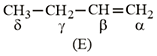
Which hydrogen in compound (E) is easily replaceable during bromination reaction in presence of light?
But-2-ene on reaction with alkaline KMnO$$_4$$ at elevated temperature followed by acidification will give:
We are given the alkene but-2-ene, whose condensed structural formula is $$\mathrm{CH_3-CH=CH-CH_3}$$. In an oxidation reaction with hot, alkaline potassium permanganate ($$\mathrm{KMnO_4 + OH^-}$$), followed by acidification (addition of $$\mathrm{H^+}$$), the double bond undergoes oxidative cleavage.
First, recall the general rule (state the formula):
$$\text{Alkene}\;(\mathrm{R_1-CH=CH-R_2})\; +\;[\mathrm{O}]\;\xrightarrow{\text{hot } \mathrm{KMnO_4}/\mathrm{OH^-}} \; \text{cleaves to}\; \mathrm{R_1-COO^-} + \mathrm{R_2-COO^-}$$
After this oxidative cleavage step, the basic medium gives carboxylate ions. Subsequent acidification converts each carboxylate ion into its corresponding carboxylic acid:
$$\mathrm{R-COO^- + H^+ \;\longrightarrow\; R-COOH}$$
Now we apply the rule to but-2-ene. Identify $$R_1$$ and $$R_2$$ on either side of the double bond:
We have $$\mathrm{CH_3-CH=CH-CH_3}$$, so $$R_1 = \mathrm{CH_3}$$ attached to the left carbon and $$R_2 = \mathrm{CH_3}$$ attached to the right carbon. Both sides are identical.
Performing oxidative cleavage:
$$ \mathrm{CH_3-CH=CH-CH_3} \;+\;[\mathrm{O}] \;\xrightarrow{\text{hot } \mathrm{KMnO_4}/\mathrm{OH^-}} \; \underbrace{\mathrm{CH_3-COO^-}}_{\text{acetate ion}} \;+\; \underbrace{\mathrm{CH_3-COO^-}}_{\text{another acetate ion}} $$
Next we acidify (add $$\mathrm{H^+}$$):
$$ \mathrm{CH_3-COO^- + H^+ \;\longrightarrow\; CH_3-COOH} $$
The same step occurs for the second acetate ion. So we finally obtain two molecules of acetic acid:
$$ \mathrm{CH_3-COOH + CH_3-COOH} $$
No aldehyde or diol is produced because the oxidative cleavage under these strong conditions fully oxidises each alkene carbon to the carboxylic acid level.
Therefore, the product set is “2 molecules of $$\mathrm{CH_3COOH}$$”, which matches Option A.
Hence, the correct answer is Option A.
The major product of the following reaction is:
The trans-alkenes are formed by the reduction of alkynes with:
We have to find out which reagent converts an alkyne ($$R-C \equiv C-R'$$) into a trans (that is, $$E$$-) alkene. In organic chemistry two standard partial‐reduction methods are famous:
1. The Lindlar catalyst, written as $$H_{2} / Pd-CaCO_{3} \ or\ Pd/BaSO_{4} \ (poisoned)$$, gives syn addition of hydrogen. Because both hydrogens add from the same face, the product is the cis (or $$Z$$-) alkene.
2. The dissolving-metal reduction, usually $$Na / liq. NH_{3}$$ (or $$Li / liq. NH_{3}$$), proceeds through radicals and delivers the two hydrogens from opposite faces (anti-addition). Anti-addition produces the trans (or $$E$$-) alkene.
Let us write the key steps for the dissolving-metal (Birch) reduction of an internal alkyne:
$$ R-C \equiv C-R' \;\overset{Na,\ liq.\ NH_{3}}{\underset{\text{-33 °C}}{\rightarrow}} R{-}\underset{\text{trans}}{\text{CH}=\text{CH}}{-}R' $$
Step-wise mechanism (shown only to keep every algebraic/chemical step explicit):
1. Electron addition from $$Na$$ gives a radical anion: $$R-C \equiv C-R' + e^- \to R-C \equiv C-R'^{\bullet-}$$
2. Protonation by liquid ammonia ($$NH_{3}$$ is the proton source) forms a vinyl radical: $$R-C \equiv C-R'^{\bullet- + NH3 \to R-C(H)=C^{\bullet}-R' + NH2^-}$$
3. A second electron addition gives a vinyl anion: $$R-C(H)=C^{\bullet-R' + e^- \to R-CH= C^{-}-R'}$$
4. Final protonation furnishes the trans-alkene: $$R-CH= C^{--R' + NH3 \to R-CH=CH-R' + NH2^-}$$
Because the two protonation steps take place from opposite sides of the molecule, the overall result is anti-addition, giving the trans product.
Now we test each option given in the question:
A. $$Sn/HCl$$ - this reagent is used for reducing nitro groups to amines, not for selective alkyne reduction. It does not give trans-alkenes.
B. $$H_{2}-Pd/C, BaSO_{4}$$ - this is exactly the Lindlar (poisoned) catalyst discussed above; it furnishes cis alkenes, not trans.
C. $$NaBH_{4}$$ - sodium borohydride is a mild hydride donor; it reduces aldehydes and ketones, but it does not reduce carbon-carbon triple bonds at all.
D. $$Na / liq. NH_{3}$$ - as explained, this is the dissolving-metal (Birch) reduction that converts an alkyne specifically into a trans alkene.
So, the only reagent that satisfies the requirement is Option D.
Hence, the correct answer is Option D.
The major product of the following reaction is:
3-Methyl-pent-2-ene on reaction with HBr in presence of peroxide forms an addition product. The number of possible stereoisomers for the product is
We have the alkene 3-methyl-pent-2-ene, whose condensed form may be written as $$CH_3-CH=C(CH_3)-CH_2-CH_3$$. The double bond is between carbon-2 and carbon-3.
In the presence of peroxide, the addition of $$HBr$$ follows the anti-Markovnikov (peroxide) rule. Stated in words, this rule says that in a radical addition of $$HBr$$, the bromine radical adds first to the double-bond carbon that will give the more stable carbon radical; afterwards that radical abstracts a hydrogen from another $$HBr$$ molecule. Hence the final product places bromine on the less substituted alkene carbon.
Applying the rule, let us compare the two possibilities:
• If $$Br\cdot$$ added to C-3, the radical would reside on C-2, a secondary radical.
• If $$Br\cdot$$ added to C-2, the radical would reside on C-3, a tertiary radical (more stable).
Because the tertiary radical is preferred, $$Br\cdot$$ adds to C-2 and the radical forms on C-3; this radical then captures $$H\cdot$$ from another $$HBr$$. So the net result is
$$CH_3-CH=C(CH_3)-CH_2-CH_3 \;\xrightarrow[\text{peroxide}]{HBr}\; CH_3-CH(Br)-CH(CH_3)-CH_2-CH_3$$
The IUPAC name of the product is 2-bromo-3-methylpentane.
Now we examine stereochemistry. In the product the only π bond has been converted to σ bonds, so any stereoisomerism will arise solely from chiral (asymmetric) carbon atoms.
Checking each carbon:
• Carbon-2 bears $$Br$$, $$H$$, $$CH_3$$ (left side), and $$CH(CH_3)-CH_2-CH_3$$ (right side). The four substituents are all different, therefore carbon-2 is a chiral centre.
• Carbon-3 bears $$H$$, $$CH_3$$ (its methyl substituent), $$CH_2-CH_3$$ (to the right), and $$CH(Br)-CH_3$$ (to the left). Again the four groups are different, so carbon-3 is also a chiral centre.
• All other carbons possess at least two identical substituents and are achiral.
Thus the molecule contains $$n = 2$$ stereogenic centres. The maximum number of stereoisomers obtainable from $$n$$ independent chiral centres is given by the formula $$2^{\,n}$$.
Applying the formula, $$2^{\,2} = 4$$ possible stereoisomers are predicted: the pairs $$(R,R)\;,\;(S,S)\;,\;(R,S)\;,\;(S,R)$$. No internal mirror plane exists in the molecule, so none of these coincide or collapse into a meso form, and all four are distinct.
Hence, the correct answer is Option C.
The hydrocarbon with seven carbon atoms containing a neopentyl and a vinyl group is:
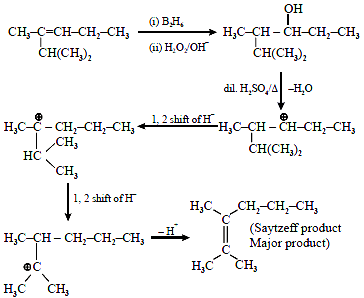
First we recall the meanings of the two special names given in the statement:
• A vinyl group is the fragment $$CH_2=CH-$$. In other words, the double bond must be at the very end of the molecule so that the terminal carbon is $$CH_2$$ and is directly attached to the rest of the skeleton.
• A neopentyl group is the fragment $$(CH_3)_3CCH_2-$$. The characteristic feature is a $$CH_2-$$ unit that is bonded to a quaternary carbon bearing three methyl groups.

The required hydrocarbon must therefore contain both of these pieces somewhere in its structure and, when all carbon atoms are counted, the total must be seven.
Now we test every option one by one.
Option A : 2,2-dimethyl-4-pentene
Writing the carbon chain explicitly, we have
$$CH_3C(CH_3)_2CH_2CH_2CH=CH_2$$
Counting carbons: the pentane parent contributes $$5$$ and the two methyl groups contribute $$2$$, so the total is indeed $$7$$. However the double bond is shown at position 4 on the parent chain, so the fragment at the end is $$CH_3CH=$$, not $$CH_2=CH-$$. Therefore the terminal vinyl group is missing. Hence this option cannot satisfy the condition.
Option B : 4,4-dimethylpent-1-ene
First we write the parent chain of five carbons and place the double bond at carbon 1 as demanded by “pent-1-ene”:
$$CH_2=CH-CH_2-C-CH_3$$
The carbon labelled $$C$$ (carbon 4 in the name) still needs the two methyl substituents written in the name. Adding them gives
$$CH_2=CH-CH_2-C(CH_3)_2-CH_3$$
Now count the carbons:
• Parent chain = $$5$$.
• Two extra methyl groups = $$2$$.
Total $$= 5 + 2 = 7$$.
Next we look for the required fragments:
1. The left end is $$CH_2=CH-$$, exactly the vinyl group.
2. If we disconnect the bond immediately to the right of the $$CH_2-$$ unit, what remains on the right is $$C(CH_3)_3$$ : a quaternary carbon bonded to three methyl groups. Thus the fragment $$CH_2-C(CH_3)_3$$ is present, which is precisely the neopentyl group.
Hence this single structure simultaneously contains a vinyl group, a neopentyl group, and has seven carbon atoms. So Option B satisfies every requirement.
Option C : isopropyl-2-butene
Convert the name into a structure:
$$CH_3CH=CHCH_3$$ is the but-2-ene parent, and an isopropyl group $$CH_3CH(CH_3)-$$ is attached. Joining them gives a total of $$4 + 3 = 7$$ carbons; however the double bond is internal, so the molecule ends in $$CH_3CH=$$ rather than $$CH_2=CH-$$. Therefore the vinyl criterion fails, and there is no neopentyl fragment either.
Option D : 2,2-dimethyl-3-pentene
Its chain is
$$CH_3C(CH_3)_2CH=CHCH_3$$
Again the double bond lies inside the chain, giving no terminal $$CH_2=CH-$$ unit. Consequently the vinyl group is absent, so this option is also ruled out.
Among the four possibilities only Option B, 4,4-dimethylpent-1-ene, fulfils all the conditions laid down in the question.
Hence, the correct answer is Option B.
The reaction of propene with HOCl ($$Cl_2 + H_2O$$) proceeds through the intermediate:
We have propene, whose formula is $$CH_3 - CH = CH_2$$. When chlorine is passed through water, the well-known reaction $$Cl_2 + H_2O \rightarrow HOCl + HCl$$ takes place, so the real reagent that finally adds to the alkene is hypochlorous acid $$HOCl$$.
For the addition to begin, we recall the general rule that $$HOCl$$ polarises to give an electrophile $$Cl^+$$ and a nucleophile $$OH^-$$. The electrophile is the species that first attacks the electron-rich carbon-carbon double bond.
So, in the first step, propene donates the $$\pi$$ electrons of its double bond to the electrophile $$Cl^+$$. Because an electrophilic addition always proceeds through the more stable carbocation, we have to decide to which carbon the $$Cl^+$$ should attach.
Let us examine the two possibilities one by one:
1. Suppose $$Cl^+$$ adds to the middle carbon (C-2). The skeleton after this attack would be $$CH_3 - CHCl - CH_2^+.$$ The positive charge now resides on C-3, which is a primary carbocation and therefore relatively unstable.
2. Suppose instead that $$Cl^+$$ adds to the terminal carbon (C-3). The skeleton produced in that case is $$CH_3 - CH^+ - CH_2Cl.$$ Here the positive charge is on C-2. This centre is attached to two carbon atoms (C-1 and C-3), so it is a secondary carbocation. A secondary carbocation is significantly more stable than a primary one.
Because the mechanism always proceeds through the more stable intermediate, the second alternative is preferred. Hence the reaction passes through the carbocation
$$CH_3 - CH^+ - CH_2 - Cl.$$
This structure corresponds exactly to Option D in the list supplied.
Hence, the correct answer is Option 4.
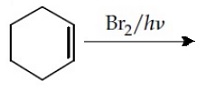
Bromination of cyclohexene under conditions given below yields:
Under $$Br_2/h\nu$$, the reaction proceeds via a free-radical mechanism.
A bromine radical abstracts an allylic hydrogen, forming a resonance-stabilized allylic radical. Bromination therefore occurs at a single allylic position while the double bond remains unchanged.
Therefore, the major product is 3-bromocyclohexene.
Which of the following compounds will exhibit geometrical isomerism?
First, recall the basic condition for geometrical (cis-trans) isomerism in alkenes. We state the rule:
For an alkene $$R^1R^2C=CR^3R^4$$ to show geometrical isomerism, each of the two doubly‐bonded carbons must be attached to two different groups. Because rotation about the $$C=C$$ bond is restricted, different spatial arrangements (cis and trans or the more general $$E$$/$$Z$$) become possible only when the four substituents $$R^1,\,R^2,\,R^3,\,R^4$$ are not all identical in pairs on either carbon.
Now we examine every option one by one, drawing or visualising the structure of the compound and checking the substituents on each doubly-bonded carbon.
Option A : 1,1-Diphenyl-1-propane
The word “propane’’ tells us there is no double bond at all; the compound is saturated. Without a $$C=C$$ bond (or a suitably constrained ring), geometrical isomerism cannot arise. So Option A fails the very first requirement.
Option B : 1-Phenyl-2-butene
Let us write its carbon skeleton. Numbering starts from the end nearer the double bond:
$$\text{Ph-CH}_2-CH=CH-CH_3$$
• The double bond is between C-2 and C-3.
• On C-2 we have the groups $$\text{Ph-CH}_2-$$ and $$H$$, clearly two different substituents.
• On C-3 we have $$CH_3$$ and $$H$$, again two different substituents.
Since both doubly-bonded carbons possess two different groups, the alkene fulfils the stated rule. Rotation is locked, so we can arrange similar groups on the same side (cis) or on opposite sides (trans). Therefore Option B does exhibit geometrical isomerism.
Option C : 3-Phenyl-1-butene
Its structure is
$$CH_2=CH-CH_2-CH_2-\text{Ph}$$
The double bond is now at the very end, between C-1 and C-2.
• Carbon C-1 carries two identical substituents, namely $$H$$ and $$H$$ (it is $$CH_2=$$).
Because the two groups on C-1 are identical, the required difference is missing; no cis-trans pair can be generated. Hence Option C does not show geometrical isomerism.
Option D : 2-Phenyl-1-butene
The formula becomes
$$CH_2=CH-CH(\text{Ph})-CH_3$$
Again the double bond is terminal (between C-1 and C-2).
• Carbon C-1 still has two identical $$H$$ atoms.
Thus the same objection raised for Option C applies here as well. Option D cannot display geometrical isomerism.
Among the four possibilities, only Option B satisfies the necessary condition on both double-bonded carbons. All the others fail because either there is no double bond or one of the double-bonded carbons bears two identical substituents.
Hence, the correct answer is Option 2.
Which compound would give 5-keto-2-methyl hexanal upon ozonolysis?
We first write the name of the required ozonolysis product exactly as given in the question:
$$\text{5-keto-2-methyl hexanal}$$
This name tells us four vital pieces of information.
1. “hex-” shows that the longest carbon skeleton in the required fragment contains $$6$$ carbon atoms.
2. “-anal’’ tells us that carbon-1 of that skeleton is an aldehydic carbon, that is, $$\,-CHO$$.
3. “5-keto’’ tells us that carbon-5 of the same chain is a ketonic carbonyl $$\bigl(>C\! =\! O\bigr)$$.
4. “2-methyl’’ tells us that a $$CH_3$$ group is attached to carbon-2 of the chain.
So in the product we must have
$$\begin{aligned}
\text{C-1}&: && \; -CHO\\
\text{C-2}&: && \; -CH(CH_3)-\\
\text{C-3}&: && \; -CH_2-\\
\text{C-4}&: && \; -CH_2-\\
\text{C-5}&: && \; -CO-\\
\text{C-6}&: && \; -CH_3
\end{aligned}$$
The structure obtained by placing these pieces in order is therefore
$$\boxed{\,OHC-CH(CH_3)-CH_2-CH_2-CO-CH_3\,}$$
Ozonolysis is nothing but cleavage of a $$C=C$$ double bond, each vinylic carbon being converted into a carbonyl centre:
Thus our required product contains both kinds of carbonyls. Evidently, during the cleavage
We therefore back-translate the product into the only double bond that can furnish it:
remove the oxygen of the aldehyde group and remove the oxygen of the ketone group, then join the two carbon centres thus freed by a double bond. This “reverse ozonolysis” step gives
$$
\begin{aligned}
&O\;{\Large\strikethrough{\text{HC}}}-CH(CH_3)-CH_2-CH_2-{\Large\strikethrough{\text{CO}}}-CH_3\\[4pt]
&\;\;\;\;\;\;\;\downarrow\;\text{join the two centres}\\[4pt]
&CH_2\;=\;C(CH_3)-CH_2-CH_2-CO-CH_3
\end{aligned}
$$
The fragment we have reconstructed is
$$\boxed{\,CH_2= C(CH_3)-CH_2-CH_2-CO-CH_3\,}$$
Notice carefully:
Exactly that pattern - a terminal $$CH_2= C<$$ group flanked two carbons away from a pre-existing $$>C\!=\!O$$ - occurs in compound (3) of the options. The other three alternatives all fail on at least one count:
Because only option (3) contains the exact $$CH_2= C(CH_3)-$$ sub-unit and the correctly placed pre-existing keto group, it alone can furnish the target fragment together with formaldehyde as the co-product, exactly as demanded by the rules stated above.
Hence, the correct answer is Option C (3).
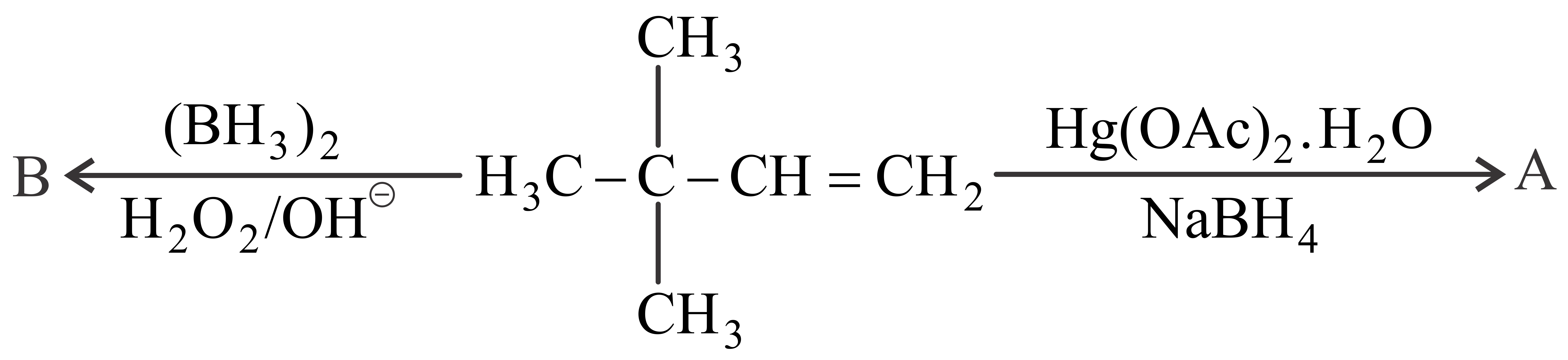
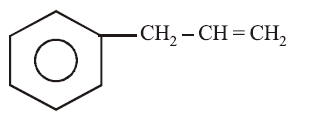
on mercuration-demercuration produces the major product:
The reagent $$Hg(OAc)_2/H_2O$$ followed by $$NaBH_4$$ adds an $$-OH$$ group to the more substituted carbon of the alkene and an $$-H$$ to the less substituted carbon.
Unlike acid-catalyzed hydration, this process occurs via a cyclic mercurinium ion intermediate, which prevents carbocation rearrangement.
For allylbenzene, the more substituted carbon in the vinyl group is the secondary carbon ($$C_2$$).
The major product is therefore 1-phenylpropan-2-ol.
In the presence of peroxide, HCl and HI do not give anti-Markownikoff's addition of alkenes because:
Anti-Markownikoff addition is possible only in case of HBr and not in HCl and HI. In HBr, both the chain initiation and propagation steps are exothermic, while in HCl, first step is exothermic, and second step is endothermic. In HI, the first step is heavily endothermic, and the second step is exothermic. Hence HCl and HI do not undergo anti-Markownikoff’s addition.
In the hydroboration-oxidation reaction of propene with diborane, H$$_2$$O$$_2$$ and NaOH, the organic compound formed is:
The hydroboration-oxidation reaction of propene involves two main steps: hydroboration with diborane (B2H6) followed by oxidation with hydrogen peroxide (H2O2) and sodium hydroxide (NaOH). Propene has the structure CH3CH=CH2, which is an unsymmetrical alkene. The double bond is between the second carbon (CH group) and the third carbon (CH2 group), with the third carbon being less substituted.
In the hydroboration step, diborane dissociates into BH3, which acts as an electrophile. Boron attaches to the less substituted carbon (the terminal CH2 group) due to its higher electron density, while hydrogen attaches to the more substituted carbon (the CH group). This addition follows anti-Markovnikov orientation. The reaction proceeds as follows:
CH3CH=CH2 + BH3 $$\rightarrow$$ CH3CH2CH2BH2
However, diborane typically forms trialkylboranes. With excess propene, the reaction yields tripropylborane:
3 CH3CH=CH2 + (1/2) B2H6 $$\rightarrow$$ (CH3CH2CH2)3B
In the oxidation step, the alkylborane is treated with H2O2 and NaOH. This replaces the boron group with a hydroxyl group (OH), attaching it to the same carbon that was bonded to boron. The reaction for the trialkylborane is:
(CH3CH2CH2)3B + 3 H2O2 + NaOH $$\rightarrow$$ 3 CH3CH2CH2OH + sodium borate
The organic product is propan-1-ol, CH3CH2CH2OH, where the OH group is attached to the terminal carbon.
Now, comparing with the options:
The product matches option A. This is consistent with anti-Markovnikov addition, where the OH group attaches to the less substituted carbon.
Hence, the correct answer is Option A.
6 litres of an alkene require 27 litres of oxygen at constant temperature and pressure for complete combustion. The alkene is :
The balanced chemical equation for the complete combustion of an alkene is:
$$C_nH_{2n} + \frac{3n}{2}O_2 \rightarrow nCO_2 + nH_2O$$
$$\frac{\text{Volume of } O_2}{\text{Volume of alkene}} = \frac{3n/2}{1} = \frac{3n}{2}$$
$$\frac{27}{6} = \frac{3n}{2}$$
$$n = \frac{4.5}{1.5} = 3$$
The value $$n = 3$$ corresponds to the molecular formula $$C_3H_6$$, which is Propene.
The addition of HI in the presence of peroxide catalyst does not follow anti-Markovnikov's rule because :
The question asks why the addition of HI to an alkene in the presence of peroxide does not follow anti-Markovnikov's rule. First, recall that anti-Markovnikov addition occurs for HBr with peroxides due to a free radical mechanism. Peroxides generate radicals that initiate a chain reaction: the bromine radical adds to the less substituted carbon of the alkene, forming a more stable carbon radical, which then abstracts a hydrogen from HBr, giving the anti-Markovnikov product.
Now, consider HI. The options must be evaluated:
Option A suggests HI is a strong reducing agent. While HI can act as a reducing agent, this property does not directly prevent anti-Markovnikov addition. The reducing ability might affect other reactions but is not the primary reason here.
Option B claims the H-I bond is too strong to break homolytically. However, the bond dissociation energy (BDE) of H-I is approximately 299 kJ/mol, which is weaker than H-Br (366 kJ/mol) and H-Cl (431 kJ/mol). Thus, the H-I bond breaks more easily, not less, so this option is incorrect.
Option C states that the iodine atom combines with a hydrogen atom to reform HI. In the free radical mechanism, the iodine radical (I•) adds to the alkene to form a carbon radical, which then abstracts a hydrogen from HI to produce the alkyl iodide and regenerate I•. This propagation step is essential for the chain reaction and does not inherently prevent anti-Markovnikov addition. The reversibility of the addition step is key, not reformation of HI.
Option D states that the iodine atom is not reactive enough to add across a double bond. This is correct. The iodine radical has low reactivity due to its large size and low electronegativity. The carbon-iodine bond formed is weak (BDE ≈ 234 kJ/mol), making the addition to the alkene reversible. For anti-Markovnikov addition to occur, the radical addition must be irreversible and fast enough to sustain the chain reaction. However, the iodine radical's addition is slow and reversible, allowing the ionic mechanism (which follows Markovnikov's rule) to dominate. The ionic mechanism is faster for HI because I⁻ is a good nucleophile, and the reaction proceeds via carbocation intermediates.
Hence, the correct answer is Option D.
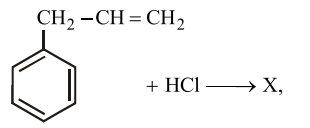
X is:
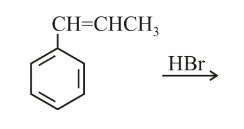
Initial protonation of the alkene double bond creates a secondary carbocation: $$\text{Ph}-\text{CH}_2-\text{CH}^+-\text{CH}_3$$.
This secondary carbocation undergoes a 1,2-hydride shift to form a more stable benzylic carbocation: $$\text{Ph}-\text{CH}^+-\text{CH}_2-\text{CH}_3$$. The benzylic carbocation is highly stable due to resonance with the benzene ring.
Nucleophilic attack by $$\text{Cl}^-$$ on this benzylic position yields 1-chloro-1-phenylpropane.
Consider the following sequence of reactions
Compound '$$C$$' is
How many cyclic structures are possible for $$\text{C}_4\text{H}_6$$?
Ozonolysis of an organic compound gives formaldehyde as one of the products. This confirms the presence of:
Out of the following, the alkene that exhibits optical isomerism is
One mole of a symmetrical alkene on ozonolysis gives two moles of an aldehyde having a molecular mass of $$44$$ u. The alkene is
The alkene that exhibits geometrical isomerism is:
In the following sequence of reactions, the alkene affords the compound '$$B$$' $$$CH_3 CH = CHCH_3 \xrightarrow{O_3} A \xrightarrow{H_2 O,\ Zn} B.$$$ The compound B is
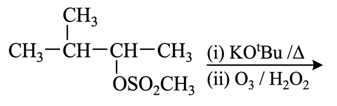
The alkene formed as a major product in the above elimination reaction is
Reaction of one molecule of HBr with one molecule of 1,3-butadiene at $$40^\circ$$C gives predominantly
Acid catalyzed hydration of alkenes except ethene leads to the formation of
Terms of Service
Predict your JEE Main percentile, rank & performance in seconds
Educational materials for JEE preparation