Let $$\alpha, \beta \epsilon \mathbb R$$ be such that the fonction $$f(x) =\left\{\begin{array}{||}2\alpha(x^{2}-2)+2\beta x & \quad,{x<1}\\(\alpha +3)x+(\alpha -\beta) & \quad ,{x\geq 1}\\\end{array}\right.$$ be differentiable at all $$x\epsilon \beta$$. Then $$34(\alpha +\mathbb R)$$ is equal to
JEE Continuity & Differentiability Questions
Continuity at (x=1):
$$-2\alpha+2\beta=2\alpha-\beta+3;\Rightarrow;3\beta=4\alpha+3$$
Differentiability at (x=1):
$$4\alpha+2\beta=\alpha+3;\Rightarrow;2\beta=3-3\alpha$$
Solve:
$$\frac{4\alpha+3}{3}=\frac{3-3\alpha}{2}$$
$$;\Rightarrow;\alpha=\frac{3}{17},;\beta=\frac{21}{17}$$
$$\alpha+\beta=\frac{24}{17}$$
$$\quad\Rightarrow\quad34(\alpha+\beta)=48$$
Let $$f(x) = \left\{\begin{array}{l l}\frac{ax^{2}+2ax+3}{4x^{2}+4x-3} ,& x\neq\quad -\frac{3}{2},\frac{1}{2}\\b, & \quad x=-\frac{3}{2},\frac{1}{2}\\\end{array}\right.$$
be continuous at $$x=-\frac{3}{2}$$. If $$fof(x)=\frac{7}{5}$$ then x is equal to:
The given function is
$$f(x)=\begin{cases}\dfrac{ax^{2}+2ax+3}{4x^{2}+4x-3}, & x\neq-\dfrac{3}{2},\,\dfrac{1}{2}\\[4pt] b, & x=-\dfrac{3}{2},\,\dfrac{1}{2}\end{cases}$$
Step 1: Determine $$a$$ using continuity at $$x=-\dfrac{3}{2}$$.
For continuity, the limit of the first branch as $$x\rightarrow-\dfrac{3}{2}$$ must be finite, so both numerator and denominator must vanish there:
Denominator:
$$4x^{2}+4x-3=0$$ at $$x=-\dfrac{3}{2}$$ (verify: $$4(2.25)-6-3=0$$).
Numerator:
$$ax^{2}+2ax+3=0\quad\text{at}\;x=-\dfrac{3}{2}$$
Substitute $$x=-\dfrac{3}{2}$$:
$$a\left(\dfrac{9}{4}\right)+2a\left(-\dfrac{3}{2}\right)+3=0$$
$$\dfrac{9a}{4}-3a+3=0$$
$$-\dfrac{3a}{4}+3=0$$
$$a=4$$.
Step 2: Simplify the algebraic fraction with $$a=4$$.
Numerator: $$4x^{2}+8x+3=(2x+3)(2x+1)$$
Denominator: $$4x^{2}+4x-3=(2x+3)(2x-1)$$
For $$x\neq-\dfrac{3}{2},\,\dfrac{1}{2}$$ the common factor $$2x+3$$ cancels, giving
$$f(x)=\dfrac{2x+1}{2x-1}\quad\text{(with a hole at }x=-\dfrac{3}{2}\text{)}.$$
Step 3: Find $$b$$ for continuity at $$x=-\dfrac{3}{2}$$.
The limit as $$x\rightarrow-\dfrac{3}{2}$$ of the simplified form is
$$b=f\!\Bigl(-\dfrac{3}{2}\Bigr)=\dfrac{2\left(-\dfrac{3}{2}\right)+1}{2\left(-\dfrac{3}{2}\right)-1}= \dfrac{-3+1}{-3-1}= \dfrac{-2}{-4}= \dfrac{1}{2}.$$
Step 4: Set up the composition $$f(f(x))$$.
Let $$y=f(x)=\dfrac{2x+1}{2x-1}$$ (defined for $$x\neq\dfrac12,-\dfrac32$$).
Then
$$f(f(x))=f(y)=\dfrac{2y+1}{2y-1}.$$
Step 5: Use the given condition $$f(f(x))=\dfrac{7}{5}$$.
$$\dfrac{2y+1}{2y-1}=\dfrac{7}{5}$$
Cross-multiply:
$$5(2y+1)=7(2y-1)$$
$$10y+5=14y-7$$
$$12=4y$$
$$y=3.$$
Step 6: Solve $$f(x)=3$$ to find $$x$$.
$$\dfrac{2x+1}{2x-1}=3$$
$$2x+1=3(2x-1)=6x-3$$
$$4=4x$$
$$x=1.$$
Check the domain: $$x=1$$ is not $$\dfrac12$$ or $$-\dfrac32$$, so it is valid.
Therefore, the required value of $$x$$ is $$1$$.
Option D.
Let [t] denote the greatest integer less than or equal to t. If the function $$f(x) = \begin{cases} b^2 \sin\!\left(\dfrac{\pi}{2}\left[\dfrac{\pi}{2}(\cos x + \sin x)\cos x\right]\right), & x < 0 \\[10pt] \dfrac{\sin x - \dfrac{1}{2}\sin 2x}{x^3}, & x > 0 \\[10pt] a, & x = 0 \end{cases}$$ is continuous at x = 0,then $$a^{2} + b^{2}$$ is equal to
We need to find $$a^2 + b^2$$ given that f(x) is continuous at x = 0.
The right-hand limit as $$x \to 0^+$$ is
$$\lim_{x \to 0^+} \frac{\sin x - \tfrac{1}{2}\sin 2x}{x^3} \;=\; \lim_{x \to 0^+} \frac{\sin x - \sin x \cos x}{x^3} \;=\; \lim_{x \to 0^+} \frac{\sin x(1 - \cos x)}{x^3}$$
Using Taylor expansions: $$\sin x \approx x - \tfrac{x^3}{6}$$ and $$1 - \cos x \approx \tfrac{x^2}{2}$$, we get
$$= \lim_{x \to 0^+} \frac{x \cdot \tfrac{x^2}{2}}{x^3} = \tfrac{1}{2}$$
For continuity at 0 we must have $$a = \tfrac{1}{2}$$.
Next, the left-hand limit as $$x \to 0^-$$ is
$$\lim_{x \to 0^-} b^2 \sin\Bigl(\tfrac{\pi}{2}\bigl[\tfrac{\pi}{2}(\cos x + \sin x)\cos x\bigr]\Bigr).$$
As $$x \to 0^-$$, $$\cos x \to 1$$ and $$\sin x \to 0$$, so
$$\tfrac{\pi}{2}(\cos x + \sin x)\cos x \to \tfrac{\pi}{2}\cdot1\cdot1 = \tfrac{\pi}{2},$$
and the greatest integer function gives $$\bigl[\tfrac{\pi}{2}\bigr] = 1.$$ Hence the expression becomes
$$b^2 \sin\Bigl(\tfrac{\pi}{2}\cdot1\Bigr) = b^2 \sin\Bigl(\tfrac{\pi}{2}\Bigr) = b^2.$$
Continuity then requires $$b^2 = a = \tfrac{1}{2}$$.
Finally,
$$a^2 + b^2 = \Bigl(\tfrac{1}{2}\Bigr)^2 + \tfrac{1}{2} = \tfrac{1}{4} + \tfrac{1}{2} = \tfrac{3}{4}.$$
Therefore, $$a^2 + b^2 = $$ Option 2: $$\frac{3}{4}$$.
For the function $$f(x) = e^{\sin|x|} - |x|$$, $$x \in \mathbf{R}$$, consider the following statements :
Statement I : $$f$$ is differentiable for all $$x \in \mathbf{R}$$.
Statement II : $$f$$ is increasing in $$\left(-\pi, -\frac{\pi}{2}\right)$$.
In the light of the above statements, choose the correct answer from the options given below :
This problem requires checking the differentiability and monotonicity of a composite function involving absolute values. Let's break it down statement by statement.
The function is $$f(x) = e^{\sin |x|} - |x|$$.
Statement I: Differentiability at $$x = 0$$
Since $$e^{\sin |x|}$$ and $$|x|$$ are differentiable everywhere except potentially at $$x = 0$$ (due to the modulus), we need to check the derivative at the origin.
- For $$x > 0$$: $$f(x) = e^{\sin x} - x$$
- For $$x < 0$$: $$f(x) = e^{\sin(-x)} - (-x) = e^{-\sin x} + x$$
- $$\cos x$$: In the third quadrant, $$\cos x$$ is negative.
- $$-\sin x$$: In the third quadrant, $$\sin x$$ is negative, so $$-\sin x$$ is positive. This makes $$e^{-\sin x} > 1$$.
- The product $$-e^{-\sin x} \cos x$$:
- Statement I: True
- Statement II: True
$$f'(x) = e^{\sin x} \cdot \cos x - 1$$
Right Hand Derivative (RHD) at $$0$$: $$f'(0^+) = e^0 \cdot \cos(0) - 1 = 1(1) - 1 = 0$$.
$$f'(x) = e^{-\sin x} \cdot (-\cos x) + 1$$
Left Hand Derivative (LHD) at $$0$$: $$f'(0^-) = e^0 \cdot (-1) + 1 = -1 + 1 = 0$$.
Since LHD = RHD = 0, the function is differentiable at $$x = 0$$. Since it is also differentiable for all other $$x \in \mathbb{R}$$, Statement I is True.
Statement II: Increasing in $$(-\pi, -\pi/2)$$
To check if the function is increasing, we look at the sign of $$f'(x)$$ in the given interval.
In the interval $$(-\pi, -\pi/2)$$, $$x$$ is negative, so we use the derivative formula for $$x < 0$$:
$$f'(x) = -e^{-\sin x} \cos x + 1$$
Let's analyze the components in $$(-\pi, -\pi/2)$$:
$$\text{(negative)} \cdot \text{(positive)} \cdot \text{(negative)} = \text{Positive}$$
Since $$f'(x)$$ is the sum of a positive term and $$1$$, $$f'(x) > 0$$ for all $$x \in (-\pi, -\pi/2)$$.
Thus, the function is strictly increasing in this interval. Statement II is True.
Final Conclusion
Correct Option: A
Let $$\left[\cdot\right]$$ denote the greatest integer function, and let f (x) = $$\min \left\{\sqrt{2x},x^{2}\right\}$$. Let S = $$\left\{x \in (-2,2): \text{the function,} g(x)= |x|\left[x^{2}\right]\text{is discontinuous at x} \right\}.$$ Then $$\sum_{x\in S}f(x)$$ equals
We need to find the set $$S$$ of points in $$(-2, 2)$$ where $$g(x) = |x|[x^2]$$ is discontinuous, where $$[\cdot]$$ is the greatest integer function.
The function $$|x|$$ is continuous everywhere. The function $$[x^2]$$ is discontinuous where $$x^2$$ takes integer values. In the interval $$(-2, 2)$$, $$x^2$$ ranges from $$0$$ to $$4$$ (not including 4).
So $$[x^2]$$ has potential discontinuities where $$x^2 = 0, 1, 2, 3$$, i.e., at $$x = 0, \pm 1, \pm\sqrt{2}, \pm\sqrt{3}$$.
The product $$g(x) = |x| \cdot [x^2]$$ is discontinuous at points where $$[x^2]$$ is discontinuous, UNLESS the discontinuity is "absorbed" by $$|x| = 0$$.
At $$x = 0$$: $$|x| = 0$$, and $$[x^2]$$ jumps from $$0$$ to $$0$$ (for small $$|x|$$, $$x^2$$ is between 0 and 1, so $$[x^2] = 0$$). Actually, for $$x \to 0$$, $$x^2 \to 0^+$$, so $$[x^2] = 0$$. And $$g(0) = 0 \cdot 0 = 0$$. So $$g$$ is continuous at $$x = 0$$.
At $$x = \pm 1$$: $$|x| = 1 \neq 0$$, and $$[x^2]$$ has a jump. Let us check $$x = 1$$:
For $$x \to 1^-$$: $$x^2 \to 1^-$$, so $$[x^2] = 0$$, giving $$g(x) \to 1 \cdot 0 = 0$$.
For $$x \to 1^+$$: $$x^2 \to 1^+$$, so $$[x^2] = 1$$, giving $$g(x) \to 1 \cdot 1 = 1$$.
$$g(1) = 1 \cdot [1] = 1 \cdot 1 = 1$$.
Since left limit $$\neq$$ right limit, $$g$$ is discontinuous at $$x = 1$$. Similarly at $$x = -1$$.
At $$x = \pm\sqrt{2}$$: $$|x| = \sqrt{2} \neq 0$$. Check $$x = \sqrt{2}$$:
For $$x \to \sqrt{2}^-$$: $$x^2 \to 2^-$$, $$[x^2] = 1$$, $$g(x) \to \sqrt{2} \cdot 1 = \sqrt{2}$$.
For $$x \to \sqrt{2}^+$$: $$x^2 \to 2^+$$, $$[x^2] = 2$$, $$g(x) \to \sqrt{2} \cdot 2 = 2\sqrt{2}$$.
Left limit $$\neq$$ right limit, so $$g$$ is discontinuous at $$x = \sqrt{2}$$. Similarly at $$x = -\sqrt{2}$$.
At $$x = \pm\sqrt{3}$$: $$|x| = \sqrt{3} \neq 0$$. Check $$x = \sqrt{3}$$:
For $$x \to \sqrt{3}^-$$: $$[x^2] = 2$$, $$g(x) \to 2\sqrt{3}$$.
For $$x \to \sqrt{3}^+$$: $$[x^2] = 3$$, $$g(x) \to 3\sqrt{3}$$.
Discontinuous at $$x = \pm\sqrt{3}$$.
So $$S = \{-\sqrt{3}, -\sqrt{2}, -1, 1, \sqrt{2}, \sqrt{3}\}$$.
Now we compute $$f(x) = \min\{\sqrt{2x}, x^2\}$$ for each $$x \in S$$. Note that $$\sqrt{2x}$$ requires $$x \geq 0$$, so for negative $$x$$, $$\sqrt{2x}$$ is not real. Let us re-examine the problem.
Actually, reading more carefully: $$f(x) = \min\{\sqrt{2x}, x^2\}$$. For negative values of $$x$$, $$\sqrt{2x}$$ is undefined (in reals). This likely means the problem intends $$f(x) = \min\{|2x|^{1/2}, x^2\}$$ or similar, but let us check with just $$f(x) = x^2$$ for negative $$x$$ (since $$\sqrt{2x}$$ is not real, the min defaults to $$x^2$$).
Alternatively, perhaps $$f(x) = \min\{\sqrt{2}x, x^2\}$$ (i.e., $$\sqrt{2} \cdot x$$). Let us check this interpretation since it works for all real $$x$$.
With $$f(x) = \min\{\sqrt{2} \cdot x, x^2\}$$:
Finding where $$\sqrt{2} \cdot x = x^2$$: $$x^2 - \sqrt{2}x = 0$$, so $$x(x - \sqrt{2}) = 0$$, giving $$x = 0$$ or $$x = \sqrt{2}$$.
For $$x \lt 0$$: $$\sqrt{2}x \lt 0$$ and $$x^2 \gt 0$$, so $$\min = \sqrt{2}x$$.
For $$0 \lt x \lt \sqrt{2}$$: $$\sqrt{2}x \gt x^2$$ (since $$x \lt \sqrt{2}$$), so $$\min = x^2$$.
For $$x \gt \sqrt{2}$$: $$x^2 \gt \sqrt{2}x$$ (since $$x \gt \sqrt{2}$$), so $$\min = \sqrt{2}x$$.
Now computing $$f(x)$$ for each $$x \in S$$:
$$f(-\sqrt{3}) = \sqrt{2} \cdot (-\sqrt{3}) = -\sqrt{6}$$
$$f(-\sqrt{2}) = \sqrt{2} \cdot (-\sqrt{2}) = -2$$
$$f(-1) = \sqrt{2} \cdot (-1) = -\sqrt{2}$$
$$f(1) = 1^2 = 1$$ (since $$0 \lt 1 \lt \sqrt{2}$$)
$$f(\sqrt{2}) = (\sqrt{2})^2 = 2$$ (at the boundary, both are equal: $$\sqrt{2} \cdot \sqrt{2} = 2$$)
$$f(\sqrt{3}) = \sqrt{2} \cdot \sqrt{3} = \sqrt{6}$$ (since $$\sqrt{3} \gt \sqrt{2}$$)
$$\sum_{x \in S} f(x) = -\sqrt{6} - 2 - \sqrt{2} + 1 + 2 + \sqrt{6} = 1 - \sqrt{2}$$
The answer is Option B: $$1 - \sqrt{2}$$.
Consider the following three statements for the function $$f: (0, \infty ) \rightarrow \mathbb R$$ defined by
$$f(x)= |\log_{e}{x}|-|x-1|:$$
(I)f is differentiable at all x > 0.
(II)f is increasing in (0, 1).
(III)f is decreasing in (1, $$\infty$$).
Then.
We split the function based on the critical point $$x=1$$:
• For $$0 < x < 1$$: $$\ln x$$ is negative and $$(x-1)$$ is negative.
$$f(x) = (-\ln x) - (-(x - 1)) = -\ln x + x - 1$$
$$f'(x) = -\frac{1}{x} + 1 = \frac{x - 1}{x}$$. Since $$x < 1$$, $$f'(x) < 0$$ (Decreasing).
• For $$x \ge 1$$: $$\ln x$$ is positive and $$(x-1)$$ is positive.
$$f(x) = \ln x - (x - 1) = \ln x - x + 1$$
$$f'(x) = \frac{1}{x} - 1 = \frac{1 - x}{x}$$. Since $$x > 1$$, $$f'(x) < 0$$ (Decreasing).
Check Differentiability at $$x=1$$:
• Left derivative: $$f'(1^-) = \frac{1-1}{1} = 0$$.
• Right derivative: $$f'(1^+) = \frac{1-1}{1} = 0$$.
Since they match, $$f$$ is differentiable at $$x=1$$.
Conclusion: (I) True: It is differentiable everywhere in its domain.
(II) False: It is decreasing in $$(0, 1)$$.
(III) True: It is decreasing in $$(1, \infty)$$.
Correct Answer: Only (I) and (III) are TRUE.
Let $$f(x) = x^{3}+ x^{2}f'(1)+2xf''(2)+f'''(3)$$, $$x\epsilon R$$. Then the value of f'(5) is :
$$f(x) = x^3 + x^2 f'(1) + 2xf''(2) + f'''(3)$$.
$$f'(1) = a$$, $$f''(2) = b$$ and $$f'''(3) = c$$ yields $$f(x) = x^3 + ax^2 + 2bx + c$$.
$$f'(x) = 3x^2 + 2ax + 2b$$, $$f''(x) = 6x + 2a$$ and $$f'''(x) = 6$$.
$$f'''(3) = 6 = c$$.
we have $$f''(2) = 12 + 2a = b$$.
$$f'(1) = 3 + 2a + 2b = a$$.
$$3 + 2a + 2b = a \Rightarrow a + 2b = -3$$ (i) and $$b = 12 + 2a$$ (ii).
Substituting (ii) into (i) yields $$a + 2(12 + 2a) = -3 \Rightarrow 5a + 24 = -3 \Rightarrow a = -\frac{27}{5}$$.
Substitution into (ii) then gives $$b = 12 + 2(-27/5) = 12 - 54/5 = 6/5$$.
$$f'(x) = 3x^2 + 2(-27/5)x + 2(6/5) = 3x^2 - \frac{54}{5}x + \frac{12}{5}$$.
It follows that $$f'(5) = 75 - \frac{270}{5} + \frac{12}{5} = 75 - 54 + \frac{12}{5} = 21 + \frac{12}{5} = \frac{105 + 12}{5} = \frac{117}{5}$$.
Let $$ f(x)=x^{2025}-x^{2000}, x \text{ }\epsilon \text{ }[0,1] $$ and the minimmu value of the function $$ f(x)$$ in the interval [0, 1] be $$(80)^{80}(n)^{-81}$$. Then n is equal to
Let $$f(x) = \begin{cases} e^{x-1}, & x < 0 \\ x^2 - 5x + 6, & x \geq 0 \end{cases}$$ and $$g(x) = f(|x|) + |f(x)|$$. If the number of points where $$g$$ is not continuous and is not differentiable are $$\alpha$$ and $$\beta$$ respectively, then $$\alpha + \beta$$ is equal to :
Let $$(2a, a)$$ be the largest interval in which the function $$f(t)=\frac{|t+1|}{t^{2}},t < 0$$, is strictly decreasing. Then the local maximum value of the function $$g(x)=2\log_{e}(x-2)+a x^{2}+4x-a,x > 2$$, is______.
The function is $$f(t)=\dfrac{|t+1|}{t^{2}},\;t\lt 0$$.
To decide where $$f(t)$$ is strictly decreasing we must study its derivative.
Because of the absolute value we treat the two sign-regions of $$t+1$$ separately.
$$t\lt -1\;(\;t+1\lt 0\;)$$ Here $$|t+1|=-(t+1)$$, so $$f(t)=\dfrac{-(t+1)}{t^{2}}=\dfrac{-t-1}{t^{2}}.$$
Using $$\dfrac{u}{v}\Rightarrow f'(t)=\dfrac{u'v-uv'}{v^{2}}$$ with $$u=-(t+1),\;u'=-1,\;v=t^{2},\;v'=2t,$$ we get $$f'(t)=\dfrac{(-1)t^{2}-\bigl(-(t+1)\bigr)2t}{t^{4}} =\dfrac{-t^{2}+2t(t+1)}{t^{4}} =\dfrac{t^{2}+2t}{t^{4}} =\dfrac{t(t+2)}{t^{4}} =\dfrac{t+2}{t^{3}}.$$
Since $$t^{3}\lt 0$$ for $$t\lt 0,$$ the sign of $$f'(t)$$ is opposite to the sign of $$t+2$$: • for $$t\lt -2$$, $$t+2\lt 0$$ ⇒ $$f'(t)\gt 0$$ (increasing) • for $$-2\lt t\lt -1$$, $$t+2\gt 0$$ ⇒ $$f'(t)\lt 0$$ (decreasing)
Case 2:$$-1\lt t\lt 0\;(\;t+1\gt 0\;)$$ Now $$|t+1|=t+1,$$ so $$f(t)=\dfrac{t+1}{t^{2}}.$$
With $$u=t+1,\;u'=1,\;v=t^{2},\;v'=2t$$, $$f'(t)=\dfrac{1\cdot t^{2}-(t+1)2t}{t^{4}} =\dfrac{t^{2}-2t(t+1)}{t^{4}} =\dfrac{-t(t+2)}{t^{4}} =-\dfrac{t+2}{t^{3}}.$$
Again $$t^{3}\lt 0$$, so the sign of $$f'(t)$$ is the same as the sign of $$t+2$$: for every $$t\in(-1,0)$$ we have $$t+2\gt 0$$ ⇒ $$f'(t)\gt 0$$ (increasing).
Combining both cases, $$f(t)$$ is strictly decreasing only on the open interval $$(-2,-1).$$ The question states this interval as $$(2\alpha,\alpha),$$ hence $$2\alpha=-2,\;\alpha=-1.$$
Next, consider $$g(x)=2\log_{e}(x-2)+\alpha x^{2}+4x-\alpha,\;x\gt 2.$$ Substituting $$\alpha=-1$$ gives $$g(x)=2\ln(x-2)-x^{2}+4x+1.$$
Differentiate to locate critical points: $$g'(x)=\dfrac{2}{x-2}-2x+4.$$ Setting $$g'(x)=0$$, $$\dfrac{2}{x-2}-2x+4=0\quad\Rightarrow\quad \frac{1}{x-2}-x+2=0.$$ Multiply by $$x-2$$: $$1=(x-2)^{2}\;\Rightarrow\;x-2=\pm1.$$ Since $$x\gt 2,$$ take $$x-2=1$$ ⇒ $$x=3.$$
Second derivative: $$g''(x)=-\dfrac{2}{(x-2)^{2}}-2.$$ At $$x=3,$$ $$g''(3)=-2-2=-4\lt 0,$$ so $$x=3$$ is a point of local maximum.
Maximum value: $$g(3)=2\ln(3-2)-3^{2}+4\cdot3+1 =2\ln1-9+12+1 =0+4=4.$$
Therefore, the local maximum value of $$g(x)$$ is $$4$$.
Let $$f(x) = \begin{cases} x^3 + 8, & x < 0 \\ x^2 - 4, & x \ge 0 \end{cases}$$ and $$g(x) = \begin{cases} (x - 8)^{1/3}, & x < 0 \\ (x + 4)^{1/2}, & x \ge 0 \end{cases}$$. Then the number of points, where the function $$g \circ f$$ is discontinuous, is __________.
The number of points, at which the function $$f(x) = \max\{6x, 2 + 3x^2\} + |x - 1|\cos\left|x^2 - \frac{1}{4}\right|$$, $$x \in (-\pi, \pi)$$, is not differentiable, is _____.
The number of points in the interval $$[2, 4]$$, at which the function $$f(x) = \left\lfloor x^2 - x - \frac{1}{2} \right\rfloor$$, where $$[\cdot]$$ denotes the greatest integer function, is discontinuous, is _________.
For a function of the form $$f(x)=\lfloor g(x)\rfloor$$ the only points of discontinuity occur when $$g(x)$$ itself is an integer. This is because the greatest-integer (floor) function makes a jump of size $$1$$ whenever its argument crosses an integral value.
Here $$g(x)=x^{2}-x-\dfrac12$$. We must therefore solve
$$x^{2}-x-\dfrac12=n,$$ where $$n\in\mathbb{Z}$$. Rearranging,
$$x^{2}-x-\left(n+\dfrac12\right)=0$$ is a quadratic with roots
$$x=\dfrac{1\pm\sqrt{1+4\left(n+\dfrac12\right)}}{2} =\dfrac{1\pm\sqrt{4n+3}}{2}.$$
We want those roots that lie inside the given interval $$[2,4]$$.
Case + : $$x=\dfrac{1+\sqrt{4n+3}}{2}$$Impose $$2\le x\le4$$:
$$2\le\dfrac{1+\sqrt{4n+3}}{2}\le4 \;\Longrightarrow\; 4\le1+\sqrt{4n+3}\le8$$
Subtract $$1$$ and square-root inequality signs stay the same (all quantities are non-negative):
$$3\le\sqrt{4n+3}\le7 \;\Longrightarrow\; 9\le4n+3\le49$$
$$\Longrightarrow\;6\le4n\le46 \;\Longrightarrow\;1.5\le n\le11.5.$$
Since $$n$$ is an integer,
$$n=2,3,4,5,6,7,8,9,10,11\quad\text{(total 10 values).}$$
Case − : $$x=\dfrac{1-\sqrt{4n+3}}{2}$$Because $$\sqrt{4n+3}\gt0,$$ the numerator $$1-\sqrt{4n+3}\le1$$, hence
$$x\le\dfrac12\lt2,$$
so no root from the “minus” branch can lie inside $$[2,4]$$.
Therefore exactly one $$x$$ in $$[2,4]$$ corresponds to each of the ten integers $$n=2$$ through $$11$$, giving 10 discontinuity points in the required interval.
Hence, the number of points of discontinuity of $$f(x)$$ in $$[2,4]$$ is $$\mathbf{10}$$.
If $$f(x)= \begin{cases}\frac{a|x|+x^{2}-2(\sin|x|)(\cos|x|)}{x} & ,x \neq 0\\b & ,x = 0\end{cases}$$
is continuous at x = 0, then a + b is equal to
For continuity at x = 0: $$\lim_{x \to 0^+} \frac{ax + x^2 - 2\sin x\cos x}{x} = \lim_{x \to 0^+} \frac{ax + x^2 - \sin 2x}{x}$$
$$= a + 0 - 2 = a - 2$$ (using $$\sin 2x/x \to 2$$)
$$\lim_{x \to 0^-} \frac{-ax + x^2 - 2\sin(-x)\cos(-x)}{x} = \frac{-ax + x^2 + \sin 2x}{x} = -a + 0 + 2 = 2 - a$$
For continuity: $$a - 2 = 2 - a \implies 2a = 4 \implies a = 2$$. Then $$b = a - 2 = 0$$.
$$a + b = 2 + 0 = 2$$
The answer is Option 3: 2.
Let $$f: R\rightarrow R$$ be a twice differentiable function such that $$f''(x) > 0$$ for all $$x\in R$$ and f'(a-1)=0, where a is a real number. Let g(x)= $$f(\tan^{2}x- 2\tan x+a)$$, $$0 < x < \frac{\pi}{2}$$.
Consider the following two statements :
(I) $$\text{g is increasing in } \left(0, \frac{\pi}{4} \right)$$
(II) $$\text{g is deceasing in } \left( \frac{\pi}{4} , \frac{\pi}{2} \right)$$
Then,
Let $$h(x) = \tan^2 x - 2\tan x + a = (\tan x - 1)^2 + (a-1)$$.
$$g'(x) = f'(h(x)) \cdot h'(x)$$
$$h'(x) = 2\tan x \sec^2 x - 2\sec^2 x = 2\sec^2 x(\tan x - 1)$$
Analyze the sign of $$g'(x)$$:
Since $$f''(x) > 0$$, $$f'$$ is strictly increasing. $$f'(a-1) = 0$$.
$$f'(h(x)) > 0$$ when $$h(x) > a-1$$, i.e., $$(\tan x - 1)^2 > 0$$, which is true for all $$x \neq \pi/4$$.
At $$x = \pi/4$$: $$h(\pi/4) = 0 + a - 1 = a - 1$$, so $$f'(h(\pi/4)) = f'(a-1) = 0$$.
For $$x \neq \pi/4$$: $$f'(h(x)) > 0$$.
$$h'(x) = 2\sec^2 x(\tan x - 1)$$: negative for $$x \in (0, \pi/4)$$, positive for $$x \in (\pi/4, \pi/2)$$.
(I) In $$(0, \pi/4)$$: $$g'(x) = f'(h(x)) \cdot h'(x) = (+)(−) < 0$$. g is DECREASING, not increasing. Statement I is FALSE.
(II) In $$(\pi/4, \pi/2)$$: $$g'(x) = (+)(+) > 0$$. g is INCREASING, not decreasing. Statement II is FALSE.
Neither statement is true.
The correct answer is Option B: Neither (I) nor (II) is True.
The sum of all the elements in the range of $$f(x) =Sgn(\sin x) + Sgn(\cos x) +Sgn(\tan x) +Sg n(\cot x)$$, $$x \neq \frac{n\pi}{2}, n\epsilon Z, \text{ where } Sgn(t)=\begin{cases}1, & \text{ if } t>0\\-1 & \text{ if } t<0\end{cases} ,is:$$
We need to find the sum of all elements in the range of: $$f(x) = \text{Sgn}(\sin x) + \text{Sgn}(\cos x) + \text{Sgn}(\tan x) + \text{Sgn}(\cot x)$$ where $$x \neq \frac{n\pi}{2}$$ and $$\text{Sgn}(t) = \begin{cases} 1, & t > 0 \\ -1, & t < 0 \end{cases}$$.
Noting that $$\text{Sgn}(\tan x) = \text{Sgn}(\sin x) \cdot \text{Sgn}(\cos x)$$ and that $$\text{Sgn}(\cot x) = \text{Sgn}(\cos x) \cdot \text{Sgn}(\sin x)$$, it follows that $$\text{Sgn}(\tan x) = \text{Sgn}(\cot x)$$.
Introducing the variables $$a = \text{Sgn}(\sin x) = \pm 1$$ and $$b = \text{Sgn}(\cos x) = \pm 1$$ allows us to express the function as $$f(x) = a + b + 2ab$$.
In Quadrant I where $$a = 1$$ and $$b = 1$$, $$f = 4$$; in Quadrant II where $$a = 1$$ and $$b = -1$$, $$f = -2$$; in Quadrant III where $$a = -1$$ and $$b = -1$$, $$f = 0$$; and in Quadrant IV where $$a = -1$$ and $$b = 1$$, $$f = -2$$.
Thus the range of $$f$$ is $$\{-2,0,4\}$$ and the sum of these values is $$-2 + 0 + 4 = 2$$.
The answer is Option D: $$2$$.
If the function $$f(x)=\frac{e^{x}(e^{\tan x-x}-1)+\log_{e}{(\sec x+\tan x)}-x}{\tan x-x}$$ is continuous at x = 0, then the value of f(O) is equal to
For continuity at (x=0),
$$f(0)=\lim_{x\to0}\frac{e^x\left(e^{\tan x-x}-1\right)+\log_e(\sec x+\tan x)-x}{\tan x-x}$$
Use expansions near (x=0):
$$\tan x=x+\frac{x^3}{3}+o(x^3)$$
$$\tan x-x=\frac{x^3}{3}+o(x^3)$$
Also,
$$e^{\tan x-x}-1\sim\tan x-x$$
hence
$$e^x(e^{\tan x-x}-1)\sim\tan x-x$$
$$\log(\sec x+\tan x)$$
has expansion
$$\log(\sec x+\tan x)=x+\frac{x^3}{6}+o(x^3)$$
$$\log(\sec x+\tan x)-x=\frac{x^3}{6}+o(x^3)$$
So numerator becomes
$$\left(\frac{x^3}{3}\right)+\left(\frac{x^3}{6}\right)$$
$$=\frac{x^3}{2}$$
Denominator:
$$\frac{x^3}{3}$$
$$f(0)=\lim_{x\to0}\frac{x^3/2}{x^3/3}$$
$$=\frac{1/2}{1/3}$$
$$=\frac{3}{2}$$
Let $$\mathbb{R}$$ denote the set of all real numbers. Let $$a_i, b_i \in \mathbb{R}$$ for $$i \in \{1, 2, 3\}$$. Define the functions $$f: \mathbb{R} \to \mathbb{R}$$, $$g: \mathbb{R} \to \mathbb{R}$$, and $$h: \mathbb{R} \to \mathbb{R}$$ by
$$f(x) = a_1 + 10x + a_2 x^2 + a_3 x^3 + x^4,$$
$$g(x) = b_1 + 3x + b_2 x^2 + b_3 x^3 + x^4,$$
$$h(x) = f(x+1) - g(x+2).$$
If $$f(x) \neq g(x)$$ for every $$x \in \mathbb{R}$$, then the coefficient of $$x^3$$ in $$h(x)$$ is
First isolate the polynomial that encodes the condition “$$f(x)\neq g(x)$$ for every $$x$$”.
Define $$d(x)=f(x)-g(x)\,.$$
Using the given expressions,
$$\begin{aligned} d(x)&=\bigl(a_1+10x+a_2x^2+a_3x^3+x^4\bigr) -\bigl(b_1+3x+b_2x^2+b_3x^3+x^4\bigr)\\ &=\bigl(a_1-b_1\bigr)+\bigl(10-3\bigr)x+\bigl(a_2-b_2\bigr)x^2 +\bigl(a_3-b_3\bigr)x^3. \end{aligned}$$
The $$x^4$$ terms cancel, so $$d(x)$$ is at most cubic: $$d(x)=\alpha+\beta x+\gamma x^2+\delta x^3,$$ where $$\delta=a_3-b_3\,.$$
The statement $$f(x)\neq g(x)\;\forall x\in\mathbb{R}$$ means $$d(x)\neq 0$$ for all real $$x$$. If $$\delta\neq 0$$, then $$d(x)$$ is a genuine cubic. For a real cubic with non-zero leading coefficient,
$$\lim_{x\to\infty}d(x)=\text{sign}(\delta)\,\infty,\qquad \lim_{x\to-\infty}d(x)=-\text{sign}(\delta)\,\infty.$$
The Intermediate Value Theorem then forces at least one real root, contradicting $$d(x)\neq 0$$. Hence the cubic term must vanish:
$$\boxed{a_3-b_3=0}\;\Longrightarrow\;a_3=b_3.$$
Now compute the coefficient of $$x^3$$ in $$h(x)=f(x+1)-g(x+2).$$
First expand $$f(x+1)$$ and $$g(x+2)$$ up to the $$x^3$$ terms.
$$\begin{aligned} f(x+1)&=a_1+10(x+1)+a_2(x+1)^2+a_3(x+1)^3+(x+1)^4\\ &=\dots+\bigl(a_3+4\bigr)x^3+\dots\\[6pt] g(x+2)&=b_1+3(x+2)+b_2(x+2)^2+b_3(x+2)^3+(x+2)^4\\ &=\dots+\bigl(b_3+8\bigr)x^3+\dots \end{aligned}$$
(The intermediate “$$\dots$$” terms are not required because only the $$x^3$$ coefficients are needed.)
Subtract to get $$h(x)$$:
Coefficient of $$x^3$$ in $$h(x)$$ $$=\;(a_3+4)-(b_3+8)=a_3-b_3-4.$$
Using $$a_3=b_3$$ established above,
$$a_3-b_3-4=0-4=-4.$$
Therefore the coefficient of $$x^3$$ in $$h(x)$$ is $$\mathbf{-4}$$.
Option C which is: $$-4$$
Let the function f(x) = $$(x^{2}+1) |x^{2}-ax+2|+\cos|x|$$ be not differentiable at the two points x = $$\alpha$$ = 2 and $$x= \beta$$. Then the distance of the point $$(\alpha , \beta)$$ from the line $$12x+5y+10=0$$ is equal to :
The function is $$f(x) = (x^2+1)|x^2-ax+2| + \cos|x|$$. Note that $$\cos|x| = \cos x$$, which is differentiable everywhere, so any non-differentiability arises solely from the factor $$|x^2 - ax + 2|$$ and occurs where $$x^2 - ax + 2 = 0$$.
Since $$x = \alpha = 2$$ is given as a point of non-differentiability, it must satisfy $$4 - 2a + 2 = 0$$, which yields $$a = 3$$. Substituting this into the quadratic gives $$x^2 - 3x + 2 = (x-1)(x-2) = 0$$, so the roots are $$x = 1$$ and $$x = 2$$.
At $$x = 2$$, we have $$(x^2+1) = 5 \ne 0$$, confirming that the absolute value causes non-differentiability and hence $$\alpha = 2$$. At $$x = 1$$, we have $$(x^2+1) = 2 \ne 0$$, which similarly yields the other point of non-differentiability $$\beta = 1$$. Thus $$(\alpha,\beta) = (2,1)$$.
To find the distance from $$(2,1)$$ to the line $$12x + 5y + 10 = 0$$, we use the formula
$$ d = \frac{|12(2) + 5(1) + 10|}{\sqrt{144 + 25}} = \frac{|24 + 5 + 10|}{13} = \frac{39}{13} = 3 $$.
Therefore, the correct answer is Option 3: 3.
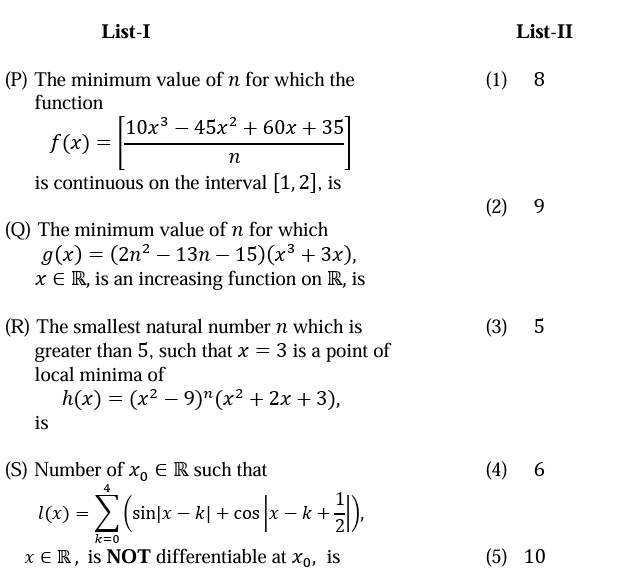
Let $$\mathbb{R}$$ denote the set of all real numbers. For a real number $$x$$, let $$[x]$$ denote the greatest integer less than or equal to $$x$$. Let $$n$$ denote a natural number.
Match each entry in List-I to the correct entry in List-II and choose the correct option.
Case P: We need the smallest natural number $$n$$ such that the function $$f(x)=\left[\dfrac{10x^{3}-45x^{2}+60x+35}{n}\right]$$ is continuous on $$[1,2]$$.
The inner polynomial is $$p(x)=10x^{3}-45x^{2}+60x+35$$.
Evaluate at the end-points:
$$p(1)=10-45+60+35=60,\qquad p(2)=80-180+120+35=55.$$
Since $$p'(x)=30(x-1)(x-2)$$ is negative for $$1\lt x\lt 2,$$ $$p(x)$$ decreases strictly from $$60$$ to $$55$$, so on $$[1,2]$$ we have$$55\le p(x)\le 60.$$(The full range is actually $$[55,60]$$.)
Hence $$\dfrac{p(x)}{n}$$ lies in $$\left[\dfrac{55}{n},\dfrac{60}{n}\right]$$. For $$f(x)=[p(x)/n]$$ to be continuous, the entire interval $$[55/n,\,60/n]$$ must be contained in one open interval $$(k,k+1)$$ for some integer $$k$$ (otherwise the greatest-integer function jumps inside $$[1,2]$$).
The length of this interval is $$\dfrac{60-55}{n}=\dfrac{5}{n},$$ so we first need $$\dfrac{5}{n}\lt 1\;\Longrightarrow\;n\gt 5.$$ Now test successive natural numbers $$n\gt 5$$.
• $$n=6:\;[55/6,60/6]=[9.166\ldots,10].$$ The right end equals an integer; $$f(x)$$ jumps at $$x=1$$, so discontinuous.
• $$n=7:\;[7.857\ldots,8.571\ldots]$$ crosses the integer $$8$$ ⇒ discontinuous.
• $$n=8:\;[6.875,7.5]$$ crosses the integer $$7$$ ⇒ discontinuous.
• $$n=9:\;[6.111\ldots,6.666\ldots]\subset(6,7).$$ No integer is touched; hence $$f(x)$$ is continuous.
Thus the minimum $$n$$ is $$9$$. In List-II the number $$9$$ is entry (2). So (P) → (2).
Case Q: For $$g(x)=(2n^{2}-13n-15)(x^{3}+3x)$$ to be increasing on all $$\mathbb{R}$$ we need $$g'(x)\ge 0$$ everywhere.
$$g'(x)=(2n^{2}-13n-15)\bigl(3x^{2}+3\bigr)=3(2n^{2}-13n-15)(x^{2}+1).$$ Since $$x^{2}+1\gt 0$$ for all $$x,$$ the sign of $$g'(x)$$ is governed by $$A(n)=2n^{2}-13n-15.$$ Set $$A(n)\gt 0$$:
$$2n^{2}-13n-15\gt 0.$$
The roots of $$2n^{2}-13n-15=0$$ are $$n=\dfrac{13\pm\sqrt{169+120}}{4}=\dfrac{13\pm17}{4}\; \Rightarrow\; n=-1,\;7.5.$$ The quadratic is positive for $$n\gt 7.5$$ (or $$n\lt -1$$, which is irrelevant here). Hence the least natural $$n$$ making $$g$$ increasing is $$n=8$$.
Entry $$8$$ is (1) in List-II. So (Q) → (1).
Case R: We need the smallest natural $$n\gt 5$$ such that $$x=3$$ is a point of local minima of $$h(x)=(x^{2}-9)^{n}(x^{2}+2x+3).$$
Notice $$(x^{2}-9)^{n}=(x-3)^{n}(x+3)^{n},$$ and near $$x=3,$$ the factor $$(x+3)^{n}(x^{2}+2x+3)$$ is positive (its value at $$x=3$$ is $$6^{n}\cdot18\gt 0$$). Thus near $$x=3$$, $$h(x)$$ behaves like a positive constant times $$(x-3)^{n}$$.
• If $$n$$ is odd, $$(x-3)^{n}$$ changes sign about $$x=3$$, so $$x=3$$ is neither a local minimum nor a maximum.
• If $$n$$ is even, $$(x-3)^{n}\ge 0$$ with a zero at $$x=3$$ and positive values on both sides, giving a local minimum.
Therefore $$n$$ must be the smallest even natural number $$\gt 5,$$ i.e. $$n=6$$.
Entry $$6$$ is (4) in List-II. So (R) → (4).
Case S: Define $$l(x)=\sum_{k=0}^{4}\Bigl(\sin|x-k|+\cos\bigl|x-k+\tfrac12\bigr|\Bigr).$$ A finite sum is nondifferentiable exactly where at least one summand is nondifferentiable.
1. $$\sin|t|$$ is nondifferentiable at $$t=0$$ because $$\dfrac{d}{dt}\sin|t|=\cos|t|\operatorname{sgn}(t),$$ whose one-sided limits at $$t=0$$ are $$+1$$ and $$-1$$.
2. $$\cos|t|$$ is differentiable everywhere since $$\dfrac{d}{dt}\cos|t|=-\sin|t|\operatorname{sgn}(t),$$ and both one-sided limits at $$t=0$$ are $$0$$.
Hence nondifferentiability of $$l(x)$$ occurs only where $$|x-k|=0$$, i.e. at $$x=k,\quad k=0,1,2,3,4.$$ (The cos-terms never introduce new singularities.)
Thus there are $$5$$ real numbers $$x_{0}$$ at which $$l(x)$$ is not differentiable.
Entry $$5$$ in List-II corresponds to the number $$5$$. So (S) → (3).
Collecting all the matches:
(P) → (2), (Q) → (1), (R) → (4), (S) → (3).
Therefore the correct option is:
Option B which is: (P)→(2), (Q)→(1), (R)→(4), (S)→(3).
Let $$f(x) = \begin{cases} (1 + ax)^{1/x}, & x \lt 0 \\ 1 + b, & x = 0 \\ \frac{(x+4)^{1/2} - 2}{(x+c)^{1/3} - 2}, & x \gt 0 \end{cases}$$ be continuous at $$x = 0$$. Then $$e^a bc$$ is equal to
The function is defined as
$$f(x)=\begin{cases}(1+ax)^{1/x}, & x\lt 0\\[4pt]1+b, & x=0\\[4pt]\dfrac{(x+4)^{1/2}-2}{(x+c)^{1/3}-2}, & x\gt 0\end{cases}$$
For continuity at $$x=0$$ we must have
$$\lim_{x\to 0^-}f(x)=f(0)=\lim_{x\to 0^+}f(x).$$
Case 1 : Left-hand limit
Recall the standard limit $$\lim_{x\to 0}\left(1+kx\right)^{\tfrac{1}{x}}=e^{k}.$$ Putting $$k=a$$, we get
$$\lim_{x\to 0^-}(1+ax)^{1/x}=e^{a}.$$
Case 2 : Value at $$x=0$$
From the definition, $$f(0)=1+b.$$ Continuity demands
$$e^{a}=1+b \quad -(1)$$
Case 3 : Right-hand limit
We first make the denominator zero at $$x=0$$ so that a finite limit can exist:
$$\bigl(x+c\bigr)^{1/3}-2=0\ \text{ at }x=0\;\Rightarrow\;c^{1/3}=2\;\Rightarrow\;c=8.$$
Now evaluate the limit with $$c=8$$:
$$L=\lim_{x\to 0^+}\dfrac{(x+4)^{1/2}-2}{(x+8)^{1/3}-2}.$$
Let $$x\to 0^+$$, write $$x=h$$ with $$h\to 0^+$$.
Numerator expansion around $$h=0$$: $$(4+h)^{1/2}=2\left(1+\tfrac{h}{4}\right)^{1/2}\approx 2\left(1+\tfrac{1}{2}\cdot\tfrac{h}{4}\right)=2+\tfrac{h}{4}.$$ Hence $$(4+h)^{1/2}-2\approx\tfrac{h}{4}.$$
Denominator expansion around $$h=0$$: $$(8+h)^{1/3}=2\left(1+\tfrac{h}{8}\right)^{1/3}\approx2\left(1+\tfrac{1}{3}\cdot\tfrac{h}{8}\right)=2+\tfrac{h}{12}.$$ Hence $$(8+h)^{1/3}-2\approx\tfrac{h}{12}.$$
Therefore
$$L=\lim_{h\to 0^+}\dfrac{\tfrac{h}{4}}{\tfrac{h}{12}}=\dfrac{1/4}{1/12}=3.$$
Continuity requires this limit to equal $$f(0)=1+b$$, so
$$1+b=3\;\Rightarrow\;b=2 \quad -(2)$$
Using $$(1)$$ and $$(2)$$:
$$e^{a}=1+b=3\;\Rightarrow\;a=\ln 3.$$
We already obtained $$c=8$$. Finally, compute $$e^{a}\,b\,c$$:
$$e^{a}\,b\,c = 3 \times 2 \times 8 = 48.$$
Thus $$e^{a}bc = 48$$, which corresponds to Option C.
If the function $$f(x) = \frac{\tan(\tan x) - \sin(\sin x)}{\tan x - \sin x}$$ is continuous at $$x = 0$$, then $$f(0)$$ is equal to _____.
We have to evaluate the limit
$$\lim_{x \to 0}\; \frac{\tan(\tan x)\;-\;\sin(\sin x)}{\tan x\;-\;\sin x}$$
because, for continuity at $$x = 0$$, the value $$f(0)$$ must equal this limit.
Step 1: Expand $$\tan x$$ and $$\sin x$$ about $$x = 0$$ up to the order $$x^{3}$$.
$$\tan x = x + \frac{x^{3}}{3} + O(x^{5})$$
$$\sin x = x - \frac{x^{3}}{6} + O(x^{5})$$
Step 2: Denote
$$A = \tan x, \qquad B = \sin x.$$
Using the results from Step 1,
$$A - B = \left(x + \frac{x^{3}}{3}\right) - \left(x - \frac{x^{3}}{6}\right) + O(x^{5}) = \frac{x^{3}}{2} + O(x^{5}).$$
Step 3: Expand $$\tan A$$ and $$\sin B$$ for small arguments $$A, B$$.
For any small $$y$$,
$$\tan y = y + \frac{y^{3}}{3} + O(y^{5}),$$
$$\sin y = y - \frac{y^{3}}{6} + O(y^{5}).$$
Applying these with $$y = A$$ and $$y = B$$:
$$\tan(\tan x) = \tan A = A + \frac{A^{3}}{3} + O(x^{5}),$$
$$\sin(\sin x) = \sin B = B - \frac{B^{3}}{6} + O(x^{5}).$$
Step 4: Form the numerator.
$$\tan A - \sin B = (A - B) + \left(\frac{A^{3}}{3} + \frac{B^{3}}{6}\right) + O(x^{5}).$$
Because $$A = x + O(x^{3})$$ and $$B = x + O(x^{3})$$, we have $$A^{3} = x^{3} + O(x^{5})$$ and $$B^{3} = x^{3} + O(x^{5}).$$ Hence
$$\frac{A^{3}}{3} + \frac{B^{3}}{6} = \frac{x^{3}}{3} + \frac{x^{3}}{6} + O(x^{5}) = \frac{x^{3}}{2} + O(x^{5}).$$
Therefore
$$\tan A - \sin B = \left(\frac{x^{3}}{2}\right) + \left(\frac{x^{3}}{2}\right) + O(x^{5}) = x^{3} + O(x^{5}).$$
Step 5: Form the denominator (already obtained in Step 2):
$$\tan x - \sin x = \frac{x^{3}}{2} + O(x^{5}).$$
Step 6: Take the ratio and pass to the limit:
$$\frac{\tan(\tan x) - \sin(\sin x)}{\tan x - \sin x} = \frac{x^{3} + O(x^{5})}{\dfrac{x^{3}}{2} + O(x^{5})}
= \frac{x^{3}\left[1 + O(x^{2})\right]}{\dfrac{x^{3}}{2}\left[1 + O(x^{2})\right]}
= 2 \cdot \frac{1 + O(x^{2})}{1 + O(x^{2})}.$$
As $$x \to 0$$, the terms $$O(x^{2})$$ vanish, giving
$$\lim_{x \to 0}\; \frac{\tan(\tan x) - \sin(\sin x)}{\tan x - \sin x} = 2.$$
Hence, to make $$f(x)$$ continuous at $$x = 0$$, we must define
$$f(0) = 2.$$
Answer: $$f(0) = 2$$.
Let $$f(x) = \left\{\begin{array}{l l}3x & \quad {x<0}\\min\left\{1+x+[x],x+2[x]\right\}, & \quad {0\leq x\leq 2}\\ 5, & \quad {x>2,} \end{array}\right.$$ where [.] denotes greatest integer function. If $$\alpha$$ and $$\beta$$ are the number of points, where f is not continuous and is not differentiable, respectively, then $$\alpha +\beta$$ equals_________
$$f(x)$$ on $$[0, 2]$$ is $$\min\{1+x+[x], x+2[x]\}$$.
• $$0 \leq x < 1$$: $$\min\{1+x, x\} = x$$
• $$1 \leq x < 2$$: $$\min\{2+x, x+2\} = x+2$$
• At $$x=2$$: $$\min\{1+2+2, 2+4\} = 5$$
Full function:
$$f(x) = \begin{cases} 3x & x < 0 \\ x & 0 \leq x < 1 \\ x+2 & 1 \leq x < 2 \\ 5 & x \geq 2 \end{cases}$$
• Continuity $$(\alpha)$$:
o At $$x=0$$: $$LHL=0, RHL=0$$ (Cont.)
o At $$x=1$$: $$LHL=1, RHL=3$$ (Discont.)
o At $$x=2$$: $$LHL=4, RHL=5$$ (Discont.)
$$\alpha = 2$$
• Differentiability $$(\beta)$$:
o Not diff at $$x=1, 2$$ (due to discontinuity).
o At $$x=0$$: $$LHD=3, RHD=1$$ (Not diff.)
$$\beta = 3$$
Total $$\alpha + \beta = 2 + 3 = \mathbf{5}$$.
Let $$f : \mathbb{R} \to \mathbb{R}$$ be a thrice differentiable odd function satisfying $$f'(x) \geq 0$$, $$f''(x) = f(x)$$, $$f(0) = 0$$, $$f'(0) = 3$$. Then $$9f(\log_e 3)$$ is equal to _____.
We are given the differential equation $$f''(x)=f(x)$$ together with the facts that $$f$$ is thrice differentiable, odd, $$f'(x)\ge 0$$ for all $$x$$, $$f(0)=0$$ and $$f'(0)=3$$. Our goal is to find $$9f(\log_e 3)$$.
Step 1 - General solution of $$f''(x)=f(x)$$.
For the linear, constant-coefficient differential equation $$f''(x)=f(x)$$, the auxiliary equation is $$m^2-1=0$$ giving roots $$m=\pm1$$. Hence the general solution is
$$f(x)=C_1e^{x}+C_2e^{-x}$$ $$-(1)$$
Step 2 - Using the odd-function condition.
Because $$f$$ is odd, $$f(-x)=-f(x)$$ for every $$x$$. Substitute $$-x$$ in $$(1)$$:
$$f(-x)=C_1e^{-x}+C_2e^{x}$$.
Set this equal to $$-f(x)=-(C_1e^{x}+C_2e^{-x})$$:
$$C_1e^{-x}+C_2e^{x}= -C_1e^{x}-C_2e^{-x}$$.
Collecting like terms gives$$(C_1+C_2)(e^{x}+e^{-x})=0 \quad\text{for all }x.$$
Since $$e^{x}+e^{-x}\neq0$$, we must have $$C_1+C_2=0$$, so $$C_2=-C_1$$.
Step 3 - Rewrite $$f(x)$$ with a single constant.
Insert $$C_2=-C_1$$ in $$(1)$$:
$$f(x)=C_1(e^{x}-e^{-x})=2C_1\sinh x.$$
Let $$k=2C_1$$; then
$$f(x)=k\sinh x.$$ $$-(2)$$
Step 4 - Use the initial slope $$f'(0)=3$$.
Differentiate $$(2)$$:
$$f'(x)=k\cosh x.$$
At $$x=0$$, $$\cosh 0=1$$, so
$$f'(0)=k\cdot1=3\quad\Longrightarrow\quad k=3.$$
Step 5 - Explicit form of $$f(x)$$.
With $$k=3$$, equation $$(2)$$ becomes
$$f(x)=3\sinh x.$$
Notice $$f'(x)=3\cosh x\ge0$$ for all $$x$$, satisfying the given monotonicity condition.
Step 6 - Evaluate $$f(\log_e 3)$$.
Let $$u=\log_e 3$$, then $$e^{u}=3$$ and $$e^{-u}=1/3$$.
Recall $$\sinh u=\dfrac{e^{u}-e^{-u}}{2}$$, so
$$\sinh(\log_e 3)=\frac{3-\frac13}{2}=\frac{9-1}{6}=\frac83=\frac43.$$
Therefore
$$f(\log_e 3)=3\left(\frac43\right)=4.$$
Step 7 - Compute $$9f(\log_e 3)$$.
$$9f(\log_e 3)=9\times4=36.$$
Hence the required value is $$36$$.
Let m and n be the number of points at which the function $$f(x) = \max\{x, x^3, x^5, \ldots, x^{21}\}$$, $$x \in \mathbb{R}$$, is not differentiable and not continuous, respectively. Then $$m + n$$ is equal to ________.
The function is the maximum of all odd powers of $$x$$ up to $$x^{21}$$:
$$f(x)=\max\{x,\;x^{3},\;x^{5},\ldots ,x^{21}\},\qquad x\in\mathbb{R}$$
Because all exponents are odd, the sign of every term equals the sign of $$x$$. To decide which power is largest in each interval, compare their magnitudes.
Case 1: $$x\gt 1$$.
For numbers bigger than $$1$$, the higher the exponent, the larger the value.
Hence the $$21^{\text{st}}$$ power dominates:
$$f(x)=x^{21},\qquad x\in(1,\infty)$$
Case 2: $$0\lt x\lt 1$$.
For numbers between $$0$$ and $$1$$, higher exponents make the value smaller.
Thus the first power is the greatest:
$$f(x)=x,\qquad x\in(0,1)$$
Case 3: $$-1\lt x\lt 0$$.
Here the values are negative but their absolute values are less than $$1$$.
The term closest to zero (largest among negatives) is again the highest exponent:
$$f(x)=x^{21},\qquad x\in(-1,0)$$
Case 4: $$x\lt -1$$.
For negative numbers with magnitude exceeding $$1$$, higher powers are more negative.
The least negative term is the first power:
$$f(x)=x,\qquad x\in(-\infty,-1)$$
The only points where the defining formula changes are $$x=-1,\,0,\,1$$. These are the only candidates for non-continuity or non-differentiability.
Continuity check
Compute the two candidate expressions at the switching points.
At $$x=-1$$: $$x=-1,\;x^{21}=(-1)^{21}=-1\;\Rightarrow\;f(-1)=-1$$.
Both one-sided limits equal $$-1$$, so $$f$$ is continuous.
At $$x=0$$: all terms are $$0\;\Rightarrow\;f(0)=0$$. Both one-sided limits are $$0$$, so $$f$$ is continuous.
At $$x=1$$: $$x=1,\;x^{21}=1\;\Rightarrow\;f(1)=1$$. Both one-sided limits are $$1$$, so $$f$$ is continuous.
Therefore the function is continuous everywhere, giving
$$n=0$$
Differentiability check
On each open interval the function equals an elementary power and is differentiable. Check derivatives from the left and right at the three boundary points.
The two relevant derivatives are
Left region (where $$f(x)=x$$): $$f'(x)=1$$.
Right region (where $$f(x)=x^{21}$$): $$f'(x)=21x^{20}$$.
• At $$x=-1$$: left derivative $$1$$, right derivative $$21(-1)^{20}=21$$ ⟹ unequal.
• At $$x=0$$: left derivative $$21(0)^{20}=0$$, right derivative $$1$$ ⟹ unequal.
• At $$x=1$$: left derivative $$1$$, right derivative $$21(1)^{20}=21$$ ⟹ unequal.
Hence $$f(x)$$ is not differentiable at exactly three points: $$x=-1,\,0,\,1$$.
Thus
$$m=3$$
Finally, $$m+n=3+0=3$$.
Answer: 3
Let $$\mathbb{R}$$ denote the set of all real numbers. Define the function $$f: \mathbb{R} \to \mathbb{R}$$ by
$$f(x) = \begin{cases} 2 - 2x^2 - x^2 \sin \frac{1}{x} & \text{if } x \neq 0, \\ 2 & \text{if } x = 0. \end{cases}$$
Then which one of the following statements is TRUE?
The function is defined by
$$f(x)=\begin{cases}2-2x^{2}-x^{2}\sin\frac1x,&x\neq0\\[4pt]2,&x=0\end{cases}$$
1. Continuity at $$x=0$$
$$\displaystyle\lim_{x\to0}\bigl(2-2x^{2}-x^{2}\sin\tfrac1x\bigr)=2-0-0=2=f(0)$$
Hence $$f$$ is continuous at the origin.
2. Differentiability at $$x=0$$
Use the definition of the derivative:
$$\begin{aligned}
f'(0)&=\lim_{h\to0}\frac{f(h)-f(0)}{h}
=\lim_{h\to0}\frac{-2h^{2}-h^{2}\sin\tfrac1h}{h}\\[4pt]
&=\lim_{h\to0}\bigl(-h(2+\sin\tfrac1h)\bigr)=0.
\end{aligned}$$
The limit exists, so $$f$$ is differentiable at $$x=0$$ with $$f'(0)=0$$.
Therefore Option A is false.
3. Derivative for $$x\neq0$$
Differentiate term-wise:
$$\begin{aligned} f'(x)&=\frac{d}{dx}\Bigl(-2x^{2}-x^{2}\sin\tfrac1x\Bigr)\\[4pt] &=-4x-\Bigl[2x\sin\tfrac1x-x^{2}\cos\tfrac1x\cdot\frac1{x^{2}}\Bigr]\\[4pt] &=-4x-2x\sin\tfrac1x+\cos\tfrac1x\\[4pt] &=\cos\tfrac1x-4x-2x\sin\tfrac1x.\qquad(x\neq0) \end{aligned}$$
Near the origin the terms $$-4x$$ and $$-2x\sin\tfrac1x$$ are of order $$x$$ and tend to $$0$$, while $$\cos\tfrac1x$$ oscillates between $$-1$$ and $$1$$. Hence the sign of $$f'(x)$$ changes infinitely often in every punctured neighbourhood of $$0$$.
4. Testing the options
Option B: To be decreasing on $$(0,\delta)$$ we would need $$f'(x)\le0$$ for all $$x\in(0,\delta)$$. But pick a sequence $$x_n=\tfrac1{2n\pi}$$; then $$\cos\tfrac1{x_n}=\cos(2n\pi)=1$$ and
$$f'(x_n)=1-4x_n-2x_n\sin(2n\pi)=1-4x_n>0$$
for all sufficiently large $$n$$. Thus $$f$$ is not always decreasing on any interval $$(0,\delta)$$, so Option B is false.
Option C: To be increasing on $$(-\delta,0)$$ we would need $$f'(x)\ge0$$ there. Take the sequence $$y_n=-\tfrac1{(2n+1)\pi}$$; then $$\cos\tfrac1{y_n}=\cos\bigl(-(2n+1)\pi\bigr)=-1$$ and
$$f'(y_n)=-1-4y_n-2y_n\sin\bigl(-(2n+1)\pi\bigr)=-1-4y_n<0$$
for all large $$n$$ (since $$y_n\to0^-$$). Therefore, no matter how small $$\delta$$ is chosen, $$f'(x)$$ takes negative values in $$(-\delta,0)$$, so $$f$$ cannot be increasing there. Hence Option C is true.
Option D: For $$x\neq0$$ we have
$$f(x)=2-x^{2}\bigl(2+\sin\tfrac1x\bigr), \qquad 1\le2+\sin\tfrac1x\le3,$$
so $$f(x)\le2-x^{2}<2$$ for every non-zero $$x$$. Thus $$f(0)=2$$ is a strict maximum, not a minimum.
Therefore Option D is false.
Conclusion
The only correct statement is Option C:
“For any positive real number $$\delta$$, the function $$f$$ is NOT an increasing function on the interval $$(-\delta,0)$$.”
Let $$f : \mathbb{R} \to \mathbb{R}$$ be a twice differentiable function such that $$(\sin x \cos y)(f(2x+2y) - f(2x-2y)) = (\cos x \sin y)(f(2x+2y) + f(2x-2y))$$, for all $$x, y \in \mathbb{R}$$. If $$f'(0) = \frac{1}{2}$$, then the value of $$24 f''\left(\frac{5\pi}{3}\right)$$ is:
We are given that $$(\sin x \cos y)(f(2x+2y) - f(2x-2y)) = (\cos x \sin y)(f(2x+2y) + f(2x-2y))$$ for all $$x, y \in \mathbb{R}$$.
Rearranging: $$\sin x \cos y \cdot f(2x+2y) - \sin x \cos y \cdot f(2x-2y) = \cos x \sin y \cdot f(2x+2y) + \cos x \sin y \cdot f(2x-2y)$$.
Collecting terms with $$f(2x+2y)$$ and $$f(2x-2y)$$:
$$f(2x+2y)(\sin x \cos y - \cos x \sin y) = f(2x-2y)(\sin x \cos y + \cos x \sin y)$$
Using the sine addition and subtraction formulas: $$\sin x \cos y - \cos x \sin y = \sin(x-y)$$ and $$\sin x \cos y + \cos x \sin y = \sin(x+y)$$.
So $$f(2x+2y) \sin(x-y) = f(2x-2y) \sin(x+y)$$.
This gives $$\frac{f(2x+2y)}{\sin(x+y)} = \frac{f(2x-2y)}{\sin(x-y)}$$.
Let $$u = x+y$$ and $$v = x-y$$. Then $$\frac{f(2u)}{\sin u} = \frac{f(2v)}{\sin v}$$ for all valid $$u, v$$. This means $$\frac{f(2u)}{\sin u}$$ is a constant, say $$c$$.
Therefore $$f(t) = c \sin\left(\frac{t}{2}\right)$$ for all $$t$$.
Now $$f'(t) = \frac{c}{2} \cos\left(\frac{t}{2}\right)$$. Given $$f'(0) = \frac{1}{2}$$:
$$\frac{c}{2} \cos(0) = \frac{1}{2}$$, so $$\frac{c}{2} = \frac{1}{2}$$, giving $$c = 1$$.
Therefore $$f(t) = \sin\left(\frac{t}{2}\right)$$, $$f'(t) = \frac{1}{2}\cos\left(\frac{t}{2}\right)$$, and $$f''(t) = -\frac{1}{4}\sin\left(\frac{t}{2}\right)$$.
Now $$f''\left(\frac{5\pi}{3}\right) = -\frac{1}{4}\sin\left(\frac{5\pi}{6}\right) = -\frac{1}{4} \cdot \frac{1}{2} = -\frac{1}{8}$$.
Therefore $$24 f''\left(\frac{5\pi}{3}\right) = 24 \cdot \left(-\frac{1}{8}\right) = -3$$.
Hence, the correct answer is Option B.
If the function $$f(x)=\begin{cases}\frac{2}{x}\{\sin((k_1+1)x)+\sin(k_2-1)x\}, & x<0 \\4, & x=0 \\\frac{2}{x}\log_e\left(\frac{2+k_1x}{2+k_2x}\right), & x>0\end{cases}$$ is continuous at x=0, then $$k_1^2+k_2^2$$ is equal to
For continuity, $$LHL = RHL = f(0) = 4$$.
1. Left Hand Limit (LHL):
$$\lim_{x \to 0^-} \frac{2}{x} (\sin((k_1+1)x) + \sin((k_2-1)x))$$
Using $$\lim_{x \to 0} \frac{\sin ax}{x} = a$$:
$$LHL = 2((k_1+1) + (k_2-1)) = 2(k_1 + k_2)$$.
Set $$2(k_1 + k_2) = 4 \implies \mathbf{k_1 + k_2 = 2}$$.
2. Right Hand Limit (RHL):
$$\lim_{x \to 0^+} \frac{2}{x} \log_e \left( \frac{2+k_1x}{2+k_2x} \right) = \lim_{x \to 0^+} \frac{2}{x} \log_e \left( \frac{1+\frac{k_1}{2}x}{1+\frac{k_2}{2}x} \right)$$
Using $$\lim_{x \to 0} \frac{\log(1+ax)}{x} = a$$:
$$RHL = 2(\frac{k_1}{2} - \frac{k_2}{2}) = k_1 - k_2$$.
Set $$k_1 - k_2 = 4$$.
Solving for $$k_1, k_2$$:
Adding the equations: $$2k_1 = 6 \implies k_1 = 3$$.
Subtracting: $$2k_2 = -2 \implies k_2 = -1$$.
Result: $$k_1^2 + k_2^2 = 3^2 + (-1)^2 = 9 + 1 = \mathbf{10}$$. (Option D
Let $$\mathbb{R}$$ denote the set of all real numbers. Let $$f: \mathbb{R} \to \mathbb{R}$$ be defined by
$$f(x) = \begin{cases} \frac{6x + \sin x}{2x + \sin x} & \text{if } x \neq 0, \\ \frac{7}{3} & \text{if } x = 0. \end{cases}$$
Then which of the following statements is (are) TRUE?
The function is given by
$$f(x)=\dfrac{6x+\sin x}{2x+\sin x}\;,\;x\neq 0,\qquad f(0)=\dfrac73.$$
1. Behaviour at the origin
First-order Taylor expansion about $$x=0$$ gives
$$\sin x=x-\dfrac{x^{3}}6+O(x^{5}),\qquad \cos x=1-\dfrac{x^{2}}2+O(x^{4}).$$
Hence
$$6x+\sin x=6x+\left(x-\dfrac{x^{3}}6\right)=7x-\dfrac{x^{3}}6+O(x^{5}),$$ $$2x+\sin x=2x+\left(x-\dfrac{x^{3}}6\right)=3x-\dfrac{x^{3}}6+O(x^{5}).$$
Therefore
$$f(x)=\dfrac{7x-\dfrac{x^{3}}6+O(x^{5})}{3x-\dfrac{x^{3}}6+O(x^{5})} =\dfrac73\!\left[\,1+\dfrac{2x^{2}}{63}+O(x^{4})\right] =\dfrac73+\dfrac{2x^{2}}{27}+O(x^{4}).$$
Near the origin we thus have
$$f(x)=\dfrac73+\dfrac{2x^{2}}{27}+O(x^{4}).$$
This gives $$f'(0)=0$$ and $$f''(0)=\dfrac{4}{27}\;(\gt 0).$$ Hence $$x=0$$ is a point of local minimum. Option B is therefore correct, while Option A is not.
2. Critical points for $$x\neq 0$$
For $$x\neq 0$$ write $$N=6x+\sin x,\;D=2x+\sin x,$$ so that $$f(x)=\dfrac{N}{D}.$$ Using the quotient rule,
$$f'(x)=\dfrac{N' D-N D'}{D^{2}} =\dfrac{(6+\cos x)(2x+\sin x)-(6x+\sin x)(2+\cos x)}{(2x+\sin x)^{2}} =\dfrac{4\bigl(\sin x-x\cos x\bigr)}{(2x+\sin x)^{2}}.$$
Since $$(2x+\sin x)^{2}\gt 0\quad\text{for all }x\gt 0,$$ the sign of $$f'(x)$$ is governed solely by
$$g(x)=\sin x-x\cos x.$$
3. Location of critical points
Setting $$f'(x)=0$$ gives $$g(x)=0\iff \sin x-x\cos x=0 \iff\tan x = x.$$ The well-known equation $$\tan x=x$$ has one solution in every interval $$\bigl(n\pi,\;n\pi+\tfrac{\pi}{2}\bigr), \;n=1,2,3,\ldots$$ apart from $$x=0.$$ Denote these positive roots by $$x_1,x_2,x_3,\dots$$ in increasing order:
$$x_1\approx4.493,\;x_2\approx7.725,\;x_3\approx10.904,\; x_4\approx14.066,\;x_5\approx17.279,\;\ldots$$
4. Nature of each critical point
Differentiate $$g(x)$$:
$$g'(x)=\cos x-\cos x+x\sin x = x\sin x.$$
Thus, at a root $$x_n,$$ the sign of $$g'(x_n)=x_n\sin x_n$$ is the sign of $$\sin x_n.$$ Inside $$\bigl(n\pi,\;n\pi+\tfrac{\pi}{2}\bigr)$$ we have $$\sin x\;\begin{cases} \gt 0,& n\; \text{even},\\[4pt] \lt 0,& n\; \text{odd}. \end{cases}$$ Therefore
• If $$n$$ is odd ($$1,3,5,\dots$$) then $$g'(x_n)\lt 0:$$
$$g(x)$$ crosses the $$x$$-axis from positive to negative, so
$$f'(x)$$ changes $$+\to-$$ and $$x_n$$ is a local maximum.
• If $$n$$ is even ($$2,4,6,\dots$$) then $$g'(x_n)\gt 0:$$
$$g(x)$$ crosses from negative to positive, so
$$f'(x)$$ changes $$-\to+$$
and $$x_n$$ is a local minimum.
5. Counting extrema in the required intervals
(i) Interval $$[\pi,6\pi]\;( \approx[3.142,18.850] ):$$ roots inside this range are $$x_1,x_2,x_3,x_4,x_5.$$ Among these, maxima occur at the odd-indexed roots $$x_1,x_3,x_5.$$ Hence the number of local maxima is $$3.$$ Option C is correct.
(ii) Interval $$[2\pi,4\pi]\;( \approx[6.283,12.566] ):$$ only the root $$x_2\approx7.725$$ lies in this interval, and it is a local minimum (even index). Therefore there is exactly $$1$$ local minimum here. Option D is correct.
6. Final verdict
The true statements are:
Option B, Option C, and Option D.
Let $$[x]$$ denote the greatest integer function, and let $$m$$ and $$n$$ respectively be the numbers of the points where the function $$f(x) = [x] + |x-2|, -2 < x < 3,$$ is not continuous and not differentiable. Then $$m+n$$ is equal to:
Consider the function $$f(x) = [x] + |x - 2|$$ for $$-2 < x < 3$$, where $$[x]$$ is the greatest integer function. We need to find $$m + n$$, with $$m$$ denoting the number of points of discontinuity and $$n$$ the number of points of non-differentiability.
Since $$|x - 2|$$ is continuous everywhere and $$[x]$$ is discontinuous at all integers, within the interval $$(-2,3)$$ the integers are $$-1, 0, 1, 2$$. Because $$f(x)$$ combines these two parts and only $$[x]$$ causes discontinuities, it follows that $$f(x)$$ is discontinuous exactly at $$x = -1, 0, 1, 2$$, giving $$m = 4$$.
Next, a function fails to be differentiable either where it is discontinuous or where it has a corner or cusp. From the discontinuities already identified at $$x = -1, 0, 1, 2$$, $$f$$ is non-differentiable at those four points. Although $$|x - 2|$$ introduces a corner at $$x = 2$$, this point has already been counted among the discontinuities. No additional points of non-differentiability arise because between consecutive integers both $$[x]$$ (which is constant) and $$|x - 2|$$ (which is linear) are differentiable. Therefore, $$n = 4$$.
Putting these together yields $$m + n = 4 + 4 = 8$$.
The correct answer is Option (2): 8.
Let $$f : \mathbb{R} \to \mathbb{R}$$ and $$g : \mathbb{R} \to \mathbb{R}$$ be functions defined by $$f(x) = \begin{cases} x|x|\sin\left(\frac{1}{x}\right), & x \neq 0, \\ 0, & x = 0, \end{cases}$$ and $$g(x) = \begin{cases} 1 - 2x, & 0 \leq x \leq \frac{1}{2}, \\ 0, & \text{otherwise}. \end{cases}$$
Let $$a, b, c, d \in \mathbb{R}$$. Define the function $$h : \mathbb{R} \to \mathbb{R}$$ by $$h(x) = af(x) + b\left(g(x) + g\left(\frac{1}{2} - x\right)\right) + c(x - g(x)) + d \cdot g(x)$$, $$x \in \mathbb{R}$$.
Match each entry in List-I to the correct entry in List-II.
| List-I | List-II | ||
|---|---|---|---|
| (P) | If $$a = 0, b = 1, c = 0$$ and $$d = 0$$, then | (1) | $$h$$ is one-one |
| (Q) | If $$a = 1, b = 0, c = 0$$ and $$d = 0$$, then | (2) | $$h$$ is onto |
| (R) | If $$a = 0, b = 0, c = 1$$ and $$d = 0$$, then | (3) | $$h$$ is differentiable on $$\mathbb{R}$$ |
| (S) | If $$a = 0, b = 0, c = 0$$ and $$d = 1$$, then | (4) | the range of $$h$$ is $$[0, 1]$$ |
| (5) | the range of $$h$$ is $$\{0, 1\}$$ |
The four basic building blocks are
$$f(x)=\begin{cases}x|x|\sin\!\left(\dfrac1x\right),&x\neq0\\[4pt]0,&x=0\end{cases},\qquad g(x)=\begin{cases}1-2x,&0\le x\le\dfrac12\\[4pt]0,&\text{otherwise}\end{cases}$$
and the composite function
$$h(x)=a\,f(x)+b\,[\,g(x)+g\!\left(\tfrac12-x\right)]+c\,[\,x-g(x)]+d\,g(x).$$
Case P (a=0, b=1, c=0, d=0)
Then $$h(x)=g(x)+g\!\left(\tfrac12-x\right).$$
For $$0\le x\le\dfrac12$$ we have $$g(x)=1-2x$$ and, since $$0\le\dfrac12-x\le\dfrac12,$$
$$g\!\left(\tfrac12-x\right)=1-2\!\left(\tfrac12-x\right)=2x.$$
Hence $$h(x)=1-2x+2x=1\quad\text{for }0\le x\le\dfrac12.$$
For $$x\lt0$$ or $$x\gt\dfrac12$$ both arguments of $$g$$ lie outside $$[0,\tfrac12],$$ so $$g=0$$ there and $$h(x)=0.$$ Thus $$h(x)=\begin{cases}1,&0\le x\le\dfrac12\\[4pt]0,&\text{otherwise}\end{cases}.$$
The only attained values are $$0$$ and $$1,$$ so the range is $$\{0,1\}.$$ This matches item (5).
Case Q (a=1, b=0, c=0, d=0)
Here $$h(x)=f(x)=x|x|\sin\!\left(\dfrac1x\right)\;(x\ne0),\;h(0)=0.$$
Differentiability at $$x=0$$:
$$\lim_{h\to0}\dfrac{f(h)-f(0)}h
=\lim_{h\to0}|h|\sin\!\left(\dfrac1h\right)=0,$$
because $$|\,\sin(1/h)\,|\le1$$ and $$|h|\to0.$$
For $$x\ne0$$ the formula is a product/composition of differentiable functions, so $$f$$ is differentiable there as well.
Hence $$h$$ is differentiable on the whole of $$\mathbb R,$$ giving item (3).
Case R (a=0, b=0, c=1, d=0)
Now $$h(x)=x-g(x).$$ Using the definition of $$g$$:
$$h(x)=\begin{cases} x,&x\lt0\\[4pt] x-(1-2x)=3x-1,&0\le x\le\dfrac12\\[4pt] x,&x\gt\dfrac12 \end{cases}$$
Ranges of the three pieces:
- $$x\lt0:\;h=x\;\Longrightarrow\;(-\infty,0)$$
- $$0\le x\le\dfrac12:\;h=3x-1\;\Longrightarrow\;[-1,\tfrac12]$$
- $$x\gt\dfrac12:\;h=x\;\Longrightarrow\;(\tfrac12,\infty)$$
The union $$(-\infty,0)\cup[-1,\tfrac12]\cup(\tfrac12,\infty)=\mathbb R.$$ Therefore every real number is achieved; $$h$$ is onto, corresponding to item (2).
Case S (a=0, b=0, c=0, d=1)
Then $$h(x)=g(x).$$ For $$0\le x\le\dfrac12,\;h(x)=1-2x,$$ which decreases continuously from $$1$$ to $$0.$$ Hence $$\operatorname{Range}(h)=[0,1],$$ giving item (4).
Collecting all the matches:
P → (5), Q → (3), R → (2), S → (4).
Thus the correct option is
Option C which is: (P) → (5), (Q) → (3), (R) → (2), (S) → (4).
Let $$f : \mathbb{R} \to \mathbb{R}$$ be a function defined by
$$f(x) = \begin{cases} x^2 \sin\left(\frac{\pi}{x^2}\right), & \text{if } x \neq 0, \\ 0, & \text{if } x = 0. \end{cases}$$
Then which of the following statements is TRUE?
The given function is
$$f(x)=\begin{cases}x^{2}\sin\!\left(\dfrac{\pi}{x^{2}}\right), & x\ne 0,\\[4pt] 0, & x=0.\end{cases}$$
For $$x\ne 0$$ the factor $$x^{2}$$ is never zero, so the zeros of $$f(x)$$ (apart from $$x=0$$) come only from the sine term:
$$\sin\!\left(\dfrac{\pi}{x^{2}}\right)=0 \;\Longrightarrow\; \dfrac{\pi}{x^{2}}=n\pi,\; n\in\mathbb{Z}.$$ Cancelling $$\pi$$ (and discarding $$n=0$$ because it would give the undefined value $$x=\infty$$) we get
$$\dfrac{1}{x^{2}}=n,\; n=1,2,3,\dots$$ $$\Longrightarrow\; x=\pm\dfrac{1}{\sqrt{n}}.$$
Therefore, for positive $$x$$ the zeros are exactly
$$x_{n}=\dfrac{1}{\sqrt{n}},\quad n=1,2,3,\dots$$
We now test each option.
Option A: $$f(x)=0$$ has infinitely many solutions in $$\Bigl[\dfrac{1}{10^{10}},\infty\Bigr).$$
The condition $$x_{n}\ge\dfrac{1}{10^{10}}$$ gives
$$\dfrac{1}{\sqrt{n}}\ge\dfrac{1}{10^{10}}
\;\Longrightarrow\;
\sqrt{n}\le 10^{10}
\;\Longrightarrow\;
n\le 10^{20}.$$
There are only $$10^{20}$$ such integers, a (very) large but finite number. Hence Option A is false.
Option B: $$f(x)=0$$ has no solutions in $$\Bigl[\dfrac{1}{\pi},\infty\Bigr).$$
Require
$$x_{n}\ge\dfrac{1}{\pi}
\;\Longrightarrow\;
\dfrac{1}{\sqrt{n}}\ge\dfrac{1}{\pi}
\;\Longrightarrow\;
\sqrt{n}\le\pi
\;\Longrightarrow\;
n\le\pi^{2}\approx 9.87.$$
The integers $$n=1,2,\dots,9$$ all satisfy this, so there are nine zeros in the stated interval. Hence Option B is false.
Option C: The set of solutions of $$f(x)=0$$ in $$\Bigl(0,\dfrac{1}{10^{10}}\Bigr)$$ is finite.
Here we need
$$x_{n}\lt\dfrac{1}{10^{10}}
\;\Longrightarrow\;
\dfrac{1}{\sqrt{n}}\lt\dfrac{1}{10^{10}}
\;\Longrightarrow\;
\sqrt{n}\gt 10^{10}
\;\Longrightarrow\;
n\gt 10^{20}.$$
All integers $$n=10^{20}+1,10^{20}+2,\dots$$ work, and there are infinitely many of them. So Option C is false.
Option D: $$f(x)=0$$ has more than 25 solutions in $$\Bigl(\dfrac{1}{\pi^{2}},\dfrac{1}{\pi}\Bigr).$$
The inequalities
$$\dfrac{1}{\pi^{2}}\lt x_{n}\lt\dfrac{1}{\pi}$$
give
$$\dfrac{1}{\pi^{2}}\lt\dfrac{1}{\sqrt{n}}\lt\dfrac{1}{\pi}
\;\Longrightarrow\;
\pi\lt\sqrt{n}\lt\pi^{2}
\;\Longrightarrow\;
\pi^{2}\lt n\lt\pi^{4}.$$
Numerically,
$$\pi^{2}\approx 9.87,\qquad
\pi^{4}\approx 97.41.$$
Thus $$n=10,11,\dots,97$$ are all admissible—there are
$$97-10+1=88$$
such integers, far exceeding 25. Therefore Option D is true.
Hence the only correct statement is:
Option D which is: $$f(x)=0$$ has more than 25 solutions in the interval $$\Bigl(\dfrac{1}{\pi^{2}},\dfrac{1}{\pi}\Bigr).$$
Let $$f, g : \mathbb{R} \rightarrow \mathbb{R}$$ be defined as : $$f(x) = |x - 1|$$ and $$g(x) = \begin{cases} e^x, & x \geq 0 \\ x + 1, & x \leq 0 \end{cases}$$. Then the function $$f(g(x))$$ is
Given $$f(x) = |x - 1|$$ and $$g(x) = \begin{cases} e^x, & x \geq 0 \\ x + 1, & x \leq 0 \end{cases}$$
We need to analyze $$f(g(x)) = |g(x) - 1|$$.
Case 1: $$x \geq 0$$
$$g(x) = e^x \geq 1$$, so $$f(g(x)) = |e^x - 1| = e^x - 1$$.
Case 2: $$x \leq 0$$
$$g(x) = x + 1$$. When $$x = 0$$, $$g(0) = 1$$. When $$x < 0$$, $$g(x) < 1$$.
$$f(g(x)) = |x + 1 - 1| = |x| = -x$$ (since $$x \leq 0$$).
So $$f(g(x)) = \begin{cases} e^x - 1, & x \geq 0 \\ -x, & x \leq 0 \end{cases}$$
At $$x = 0$$: $$e^0 - 1 = 0$$ and $$-0 = 0$$. Continuous.
One-one check:
For $$x \geq 0$$: $$e^x - 1$$ is strictly increasing from 0 to $$\infty$$.
For $$x \leq 0$$: $$-x$$ is strictly decreasing (as a function of x) from $$\infty$$ to 0.
Both parts give non-negative outputs, and both give value 0 at $$x = 0$$. For any $$c > 0$$, there are two values of $$x$$ giving $$f(g(x)) = c$$: one positive (from $$e^x - 1 = c$$) and one negative (from $$-x = c$$, i.e., $$x = -c$$). So the function is not one-one.
Onto check:
The range of $$f(g(x))$$ is $$[0, \infty)$$, but the codomain is $$\mathbb{R}$$. Negative values are never attained. So it is not onto.
The correct answer is Option (1): neither one-one nor onto.
Consider the function $$f: (0, 2) \to \mathbb{R}$$ defined by $$f(x) = \frac{x}{2} + \frac{2}{x}$$ and the function $$g(x)$$ defined by $$g(x) = \begin{cases} \min\{f(t)\},\ 0 < t \leq x & \text{and } 0 < x \leq 1 \\ \frac{3}{2} + x, & 1 < x < 2 \end{cases}$$. Then
For $$x \in (0,2)$$ the given function is $$f(x)=\dfrac{x}{2}+\dfrac{2}{x}\,.$$
Differentiate to study its monotonicity:
$$f'(x)=\dfrac{1}{2}-\dfrac{2}{x^{2}}\;.$$ $$-(1)$$
Put $$f'(x)=0$$:
$$\dfrac{1}{2}-\dfrac{2}{x^{2}}=0 \Longrightarrow x^{2}=4 \Longrightarrow x=2.$$
The point $$x=2$$ lies at the right end of the open interval $$(0,2)$$, so inside the domain we have
$$x\lt 2 \;\Rightarrow\; x^{2}\lt 4 \;\Rightarrow\; \dfrac{2}{x^{2}}\gt\dfrac{1}{2} \;\Rightarrow\; f'(x)\lt 0.$$
Thus $$f(x)$$ is strictly decreasing on $$(0,2).$$ For any $$x\in(0,1]$$ the minimum value of $$f(t)$$ on $$(0,t]\;$$ occurs at the right end point $$t=x$$ itself:
$$\min\{f(t):0\lt t\le x\}=f(x).$$
Hence the definition of $$g(x)$$ simplifies to
$$g(x)=f(x)=\dfrac{x}{2}+\dfrac{2}{x},\qquad 0\lt x\le 1.$$ $$-(2)$$
For $$1\lt x\lt 2$$ we are directly given
$$g(x)=\dfrac{3}{2}+x.$$ $$-(3)$$
CONTINUITY AT $$x=1$$
Left-hand limit:
Using $$(2)$$, $$\displaystyle \lim_{x\to1^{-}}g(x)=f(1)=\dfrac{1}{2}+2=\dfrac{5}{2}.$$
Right-hand limit:
Using $$(3)$$, $$\displaystyle \lim_{x\to1^{+}}g(x)=\dfrac{3}{2}+1=\dfrac{5}{2}.$$
Since both one-sided limits are equal and $$g(1)=\dfrac{5}{2},$$ $$g(x)$$ is continuous at $$x=1.$$ On every other point of $$(0,2)$$ the defining expressions are elementary, so $$g(x)$$ is continuous on the whole interval $$(0,2).$$
DIFFERENTIABILITY AT $$x=1$$
Left derivative:
From $$(2)$$, using $$(1)$$,
$$g'_{-}(1)=f'(1)=\dfrac{1}{2}-\dfrac{2}{1^{2}}=-\dfrac{3}{2}.$$
Right derivative:
From $$(3)$$,
$$g'_{+}(1)=\dfrac{d}{dx}\bigl(\dfrac{3}{2}+x\bigr)\big|_{x=1}=1.$$
Because $$g'_{-}(1)\neq g'_{+}(1),$$ the derivative does not exist at $$x=1.$$ Everywhere else in $$(0,2)$$ the expressions in $$(2)$$ and $$(3)$$ are differentiable, so $$g(x)$$ fails to be differentiable only at $$x=1.$$
Therefore $$g(x)$$ is continuous but not differentiable at $$x=1.$$ Hence, Option A is correct.
For $$a, b > 0$$, let $$f(x) = \begin{cases} \frac{\tan((a+1)x) + b\tan x}{x}, & x < 0 \\ 3, & x = 0 \\ \frac{\sqrt{ax + b^2x^2} - \sqrt{ax}}{b\sqrt{ax}\sqrt{x}}, & x > 0 \end{cases}$$ be a continuous function at $$x = 0$$. Then $$\frac{b}{a}$$ is equal to :
Let $$a$$ and $$b$$ be real constants such that the function $$f$$ defined by $$f(x) = \begin{cases} x^2 + 3x + a, & x \leq 1 \\ bx + 2, & x > 1 \end{cases}$$ be differentiable on $$R$$. Then, the value of $$\int_{-2}^{2} f(x) \, dx$$ equals
For differentiability at $$x = 1$$: continuity and equal derivatives.
Continuity: $$1 + 3 + a = b + 2 \Rightarrow a + 4 = b + 2 \Rightarrow b = a + 2$$ ... (1)
Derivatives: $$f'(x) = 2x + 3$$ for $$x \leq 1$$, $$f'(x) = b$$ for $$x > 1$$.
At $$x = 1$$: $$2 + 3 = b \Rightarrow b = 5$$. From (1): $$a = 3$$.
$$f(x) = \begin{cases} x^2 + 3x + 3, & x \leq 1 \\ 5x + 2, & x > 1 \end{cases}$$
$$\int_{-2}^{2} f(x)dx = \int_{-2}^{1}(x^2+3x+3)dx + \int_{1}^{2}(5x+2)dx$$
$$= \left[\frac{x^3}{3}+\frac{3x^2}{2}+3x\right]_{-2}^{1} + \left[\frac{5x^2}{2}+2x\right]_{1}^{2}$$
At $$x=1$$: $$\frac{1}{3}+\frac{3}{2}+3 = \frac{2+9+18}{6} = \frac{29}{6}$$
At $$x=-2$$: $$-\frac{8}{3}+6-6 = -\frac{8}{3}$$
First integral: $$\frac{29}{6}+\frac{8}{3} = \frac{29+16}{6} = \frac{45}{6}$$
At $$x=2$$: $$10+4 = 14$$. At $$x=1$$: $$\frac{5}{2}+2 = \frac{9}{2}$$.
Second integral: $$14 - \frac{9}{2} = \frac{19}{2}$$
Total: $$\frac{45}{6} + \frac{19}{2} = \frac{45}{6} + \frac{57}{6} = \frac{102}{6} = 17$$.
The answer is Option (4): $$\boxed{17}$$.
Let $$f : [-1, 2] \rightarrow \mathbb{R}$$ be given by $$f(x) = 2x^2 + x + [x^2] - [x]$$, where $$[t]$$ denotes the greatest integer less than or equal to $$t$$. The number of points, where $$f$$ is not continuous, is :
The polynomial part $$2x^{2}+x$$ is continuous everywhere, so any discontinuity of $$f(x)=2x^{2}+x+[x^{2}]-[x]$$ can come only from the step functions $$[x]$$ or $$[x^{2}]$$.
Step 1: Locate the points where $$[x]$$ or $$[x^{2}]$$ can jump.
• $$[x]$$ jumps at every integer lying in $$[-1,2]$$, namely
$$x=-1,\,0,\,1,\,2$$.
• $$[x^{2}]$$ jumps whenever $$x^{2}=k$$ for an integer $$k$$.
For $$x\in[-1,2]$$ the values $$k=0,1,2,3,4$$ are possible, giving
$$x=0,\;x=\pm1,\;x=\pm\sqrt2,\;x=\pm\sqrt3,\;x=\pm2.$$
Inside $$[-1,2]$$ this list reduces to
$$x=-1,\,0,\,1,\,\sqrt2,\,\sqrt3,\,2.$$
Thus the only candidates for discontinuity are
$$x=-1,\,0,\,1,\,\sqrt2,\,\sqrt3,\,2.$$
Step 2: Examine each candidate.
Case 1: $$x=0$$
Left limit (take $$x\rightarrow0^{-}$$): $$[x]=-1,\;[x^{2}]=0$$
$$\displaystyle \lim_{x\to0^{-}}f(x)=2x^{2}+x+0-(-1)=2x^{2}+x+1\longrightarrow1.$$
Right limit (take $$x\rightarrow0^{+}$$): $$[x]=0,\;[x^{2}]=0$$
$$\displaystyle \lim_{x\to0^{+}}f(x)=2x^{2}+x+0-0\longrightarrow0.$$
Since the two limits differ, $$f$$ is discontinuous at $$x=0$$.
Case 2: $$x=-1$$ (left end-point has only a right‐hand limit)
Value: $$f(-1)=2(1)+(-1)+1-(-1)=3.$$
Right limit (take $$x\rightarrow-1^{+}$$): $$[x]=-1,\;[x^{2}]=0$$
$$\displaystyle \lim_{x\to-1^{+}}f(x)=2x^{2}+x+0-(-1)=2x^{2}+x+1\longrightarrow2.$$
Right limit $$\neq$$ value, so $$f$$ is discontinuous at $$x=-1$$.
Case 3: $$x=1$$
Left limit ( $$[x]=0,\,[x^{2}]=0$$ ): $$\;2x^{2}+x \longrightarrow3$$.
Value at 1 ( $$[1]=1,\,[1^{2}]=1$$ ): $$2+1+1-1=3$$.
Right limit ( $$[x]=1,\,[x^{2}]=1$$ ): $$\;2x^{2}+x \longrightarrow3$$.
Both limits equal the value, so $$f$$ is continuous at $$x=1$$.
Case 4: $$x=\sqrt2$$
Here $$[x]=1.$$
Left limit ( $$[x^{2}]=1$$ ): $$2x^{2}+x \longrightarrow4+\sqrt2.$$
Right limit ( $$[x^{2}]=2$$ ): $$2x^{2}+x+1 \longrightarrow5+\sqrt2.$$
Limits differ ⇒ discontinuity at $$x=\sqrt2$$.
Case 5: $$x=\sqrt3$$
Again $$[x]=1.$$
Left limit ( $$[x^{2}]=2$$ ): $$2x^{2}+x+1 \longrightarrow7+\sqrt3.$$
Right limit ( $$[x^{2}]=3$$ ): $$2x^{2}+x+2 \longrightarrow8+\sqrt3.$$
Limits differ ⇒ discontinuity at $$x=\sqrt3$$.
Case 6: $$x=2$$ (right end-point has only a left‐hand limit)
Value: $$f(2)=2(4)+2+4-2=12.$$
Left limit ( $$[x]=1,\,[x^{2}]=3$$ ): $$2x^{2}+x+3-1=2x^{2}+x+2\longrightarrow12.$$
Left limit equals the value, so $$f$$ is continuous at $$x=2$$.
Step 3: Count the discontinuities.
The function fails to be continuous exactly at
$$x=-1,\,0,\,\sqrt2,\,\sqrt3.$$
Total number of discontinuity points = $$4$$.
Hence, Option D is correct.
Let $$f: \mathbb{R} \to \mathbb{R}$$ be defined as $$f(x) = \begin{cases} \frac{a - b\cos 2x}{x^2}, & x < 0 \\ x^2 + cx + 2, & 0 \leq x \leq 1 \\ 2x + 1, & x > 1 \end{cases}\\$$ If $$f$$ is continuous everywhere in $$\mathbb{R}$$ and $$m$$ is the number of points where $$f$$ is NOT differentiable then $$m + a + b + c$$ equals:
Continuity at $$x=0$$
$$\lim_{x \to 0^-} \frac{a - b \cos 2x}{x^2} = f(0) = 2$$.
For the limit to exist, the numerator must be $$0$$ at $$x=0$$: $$a - b \cos(0) = 0 \implies a = b$$.
Using L'Hôpital's Rule: $$\lim_{x \to 0} \frac{2b \sin 2x}{2x} = \lim_{x \to 0} \frac{4b \cos 2x}{2} = 2b$$.
Given the limit is $$2$$, then $$2b = 2 \implies \mathbf{b = 1, a = 1}$$.
Continuity at $$x=1$$
$$f(1) = 1^2 + c(1) + 2 = 3 + c$$.
$$\lim_{x \to 1^+} (2x + 1) = 3$$.
Setting them equal: $$3 + c = 3 \implies \mathbf{c = 0}$$.
Differentiability ($$m$$)
• At $$x=0$$: $$f'(x)$$ for $$x > 0$$ is $$2x + c = 2x$$. At $$x=0$$, $$f'(0^+) = 0$$. Using the expansion of $$\cos 2x$$, the left-hand derivative is also $$0$$. So $$f$$ is differentiable at $$x=0$$.
• At $$x=1$$: $$f'(1^-) = 2(1) + 0 = 2$$. $$f'(1^+) = 2$$. It is differentiable at $$x=1$$.
Thus, $$m = 0$$.
Final Calculation: $$m + a + b + c = 0 + 1 + 1 + 0 = 2$$.
Let $$f : R to R$$ be a function given by $$f(x) = \begin{cases}\frac{1-\cos 2x}{x^2}, & x < 0\\ \alpha, & x = 0\\ \frac{\beta\sqrt{1-\cos x}}{x}, & x > 0\end{cases}$$, where $$\alpha, \beta \in R$$. If f is continuous at x = 0, then $$\alpha^2 + \beta^2$$ is equal to:
As x→0⁻: (1-cos2x)/x² = 2sin²x/x² → 2. So α = 2.
As x→0⁺: β√(1-cosx)/x = β·√(2sin²(x/2))/x = β·√2|sin(x/2)|/x ≈ β·√2·(x/2)/x = β/(√2)
Wait: √(1-cosx) = √(2sin²(x/2)) = √2|sin(x/2)| ≈ √2·x/2 for small x>0
So β√(1-cosx)/x ≈ β·√2·x/(2x) = β/√2
For continuity: β/√2 = 2, so β = 2√2
α² + β² = 4 + 8 = 12
The correct answer is Option 2: 12.
Let $$f(x) = |2x^2 + 5|x| - 3|$$, $$x \in R$$. If $$m$$ and $$n$$ denote the number of points where $$f$$ is not continuous and not differentiable respectively, then $$m + n$$ is equal to:
Continuity (m): The function is a composition of absolute value and polynomials, which are continuous everywhere. Thus, $$m = 0$$.
Differentiability (n): Let $$g(x) = 2x^2 + 5|x| - 3$$.
o At $$x = 0$$: $$5|x|$$ creates a sharp corner. Since the derivative of $$2x^2-3$$ is 0 at x=0, the non-differentiability of |x| at 0 makes f(x) non-differentiable at x = 0.
o At roots of $$g(x) = 0$$:
For $$x\ge 0$$: $$2x^2 + 5x - 3 = 0 \implies (2x - 1)(x + 3) = 0 \implies x = 1/2$$ (Since $$x \ge 0$$).
For $$x < 0$$: $$2x^2 - 5x - 3 = 0 \implies (2x + 1)(x - 3) = 0 \implies x = -1/2$$ (Since x < 0).
The outer absolute value $$|\cdot|$$ creates sharp corners at $$x = 1/2$$ and $$x = -1/2$$.
Total points of non-differentiability $$n = 3$$ (at $$x = 0, \pm 1/2$$).
$$m + n = 0 + 3 = 3$$.
Correct Option: D
Let $$g(x)$$ be a linear function and $$f(x) = \begin{cases} g(x), & x \leq 0 \\ \left(\frac{1+x}{2+x}\right)^{1/x}, & x > 0 \end{cases}$$, is continuous at $$x = 0$$. If $$f'(1) = f(-1)$$, then the value of $$g(3)$$ is
Let $$g(x)$$ be linear, so write $$g(x)=ax+b$$.
For continuity of $$f(x)$$ at $$x=0$$ we need the right-hand limit of the second branch to equal $$g(0)$$.
Consider $$y(x)=\left(\dfrac{1+x}{2+x}\right)^{1/x}$$ for $$x\gt 0$$.
Take logarithm:
$$\ln y=\frac{1}{x}\ln\!\left(\frac{1+x}{2+x}\right)=\frac{\ln(1+x)-\ln(2+x)}{x}.$$
Using series $$\ln(1+z)=z-\dfrac{z^{2}}{2}+O(z^{3})$$ about $$z=0$$,
$$\ln(1+x)-\ln(2+x)=-\ln2+\frac{x}{2}+O(x^{2}).$$
Hence
$$\ln y=\frac{-\ln2}{x}+\frac{1}{2}+O(x).$$
As $$x\to 0^{+}$$, $$\dfrac{-\ln2}{x}\to -\infty$$, so $$y(x)\to 0.$$
Therefore $$\displaystyle\lim_{x\to0^{+}}f(x)=0,$$ which must equal $$g(0)=b.$$
Thus $$b=0$$ and $$g(x)=ax.$$
Next, compute $$f'(1)$$ from the second branch.
Again set $$y(x)=\left(\dfrac{1+x}{2+x}\right)^{1/x}.$$
With $$\ln y=u(x)=\dfrac{1}{x}\ln\!\left(\dfrac{1+x}{2+x}\right),$$ we have
$$\frac{y'}{y}=u'(x).$$
Write $$v(x)=\ln(1+x)-\ln(2+x)$$ so that $$u(x)=\dfrac{v(x)}{x}.$$
Then
$$v'(x)=\frac{1}{1+x}-\frac{1}{2+x}.$$
At $$x=1$$:
$$v(1)=\ln2-\ln3=\ln\!\left(\frac{2}{3}\right),$$
$$v'(1)=\frac{1}{2}-\frac{1}{3}=\frac{1}{6}.$$
Therefore
$$u'(1)=\frac{1\cdot v'(1)-v(1)}{1^{2}}=\frac{1}{6}-\ln\!\left(\frac{2}{3}\right).$$
Also $$y(1)=\left(\frac{2}{3}\right)^{1}= \frac{2}{3}.$$
Hence
$$f'(1)=y'(1)=y(1)\,u'(1)=\frac{2}{3}\Bigl(\frac{1}{6}-\ln\!\frac{2}{3}\Bigr).$$
The condition $$f'(1)=f(-1)$$ gives
$$\frac{2}{3}\Bigl(\frac{1}{6}-\ln\!\frac{2}{3}\Bigr)=g(-1)=a(-1)=-a.$$
Solve for $$a$$:
$$a=-\frac{2}{3}\Bigl(\frac{1}{6}-\ln\!\frac{2}{3}\Bigr)=-\frac{1}{9}+\frac{2}{3}\ln\!\frac{2}{3}.$$
Finally,
$$g(3)=3a=3\!\left(-\frac{1}{9}+\frac{2}{3}\ln\!\frac{2}{3}\right)
=-\frac{1}{3}+2\ln\!\frac{2}{3}
=\ln\!\frac{4}{9}-\frac{1}{3}
=\ln\!\frac{4}{9e^{1/3}}.$$
Hence $$g(3)=\log_e\frac{4}{9e^{1/3}},$$ which corresponds to Option D.
Consider the function $$f: (0, \infty) \rightarrow R$$ defined by $$f(x) = e^{-|\log_e x|}$$. If $$m$$ and $$n$$ be respectively the number of points at which $$f$$ is not continuous and $$f$$ is not differentiable, then $$m + n$$ is
f(x)=e^{-|ln x|}. For x>0: |ln x|=ln x if x≥1, -ln x if 0
f(x)=e^{-ln x}=1/x for x≥1. f(x)=e^{ln x}=x for 0
f is continuous everywhere (including x=1). m=0.
At x=1: left derivative=1, right derivative=-1. Not differentiable. n=1.
m+n=0+1=1.
The answer is Option (3): 1.
Consider the function $$f(x) = \begin{cases} \frac{a(7x - 12 - x^2)}{b|x^2 - 7x + 12|}, & x < 3 \\ 2^{\frac{\sin(x-3)}{x - [x]}}, & x > 3 \\ b, & x = 3 \end{cases}$$, where $$[x]$$ denotes the greatest integer less than or equal to $$x$$. If $$S$$ denotes the set of all ordered pairs $$(a, b)$$ such that $$f(x)$$ is continuous at $$x = 3$$, then the number of elements in $$S$$ is :
Left Hand Limit (LHL).
$$f(x) = \frac{a(7x-12-x^2)}{b|x^2-7x+12|} = \frac{-a(x^2-7x+12)}{b|x^2-7x+12|}$$.
For $$x < 3$$, $$x^2-7x+12$$ is positive. So $$|x^2-7x+12| = (x^2-7x+12)$$.
$$LHL = \frac{-a}{b}$$.
Right Hand Limit (RHL).
$$2^{\frac{\sin(x-3)}{x-\lfloor x \rfloor}}$$. For $$x \to 3^+$$, $$\lfloor x \rfloor = 3$$.
$$RHL = 2^{\lim_{x \to 3} \frac{\sin(x-3)}{x-3}} = 2^1 = 2$$.
For continuity, $$LHL = RHL = f(3) \implies \frac{-a}{b} = 2$$ and $$b = 2$$.
If $$b = 2$$, then $$\frac{-a}{2} = 2 \implies a = -4$$.
There is only 1 such pair: $$(-4, 2)$$.
Let $$[t]$$ denote the greatest integer less than or equal to $$t$$. Let $$f : [0, \infty) \rightarrow \mathbb{R}$$ be a function defined by $$f(x) = \left[\frac{x}{2} + 3\right] - [\sqrt{x}]$$. Let $$S$$ be the set of all points in the interval $$[0, 8]$$ at which $$f$$ is not continuous. Then $$\sum_{a \in S} a$$ is equal to ___________
We need to find the sum of all points in $$[0, 8]$$ where $$f(x) = [x/2 + 3] - [\sqrt{x}]$$ is discontinuous, where $$[t]$$ is the greatest integer function.
The function $$[x/2 + 3]$$ is discontinuous when $$x/2 + 3$$ is an integer, i.e., $$x/2$$ is an integer, which gives $$x = 0, 2, 4, 6, 8$$.
The function $$[\sqrt{x}]$$ is discontinuous when $$\sqrt{x}$$ is an integer, i.e., $$x = 0, 1, 4$$ (in $$[0,8]$$, we have $$\sqrt{x} = 0, 1, 2$$ at $$x = 0, 1, 4$$; at $$9$$, $$\sqrt{x} = 3$$ but $$9 > 8$$).
Potential discontinuity points of $$f = [x/2 + 3] - [\sqrt{x}]$$ are the union $$\{0, 1, 2, 4, 6, 8\}$$, though some discontinuities may cancel.
At $$x = 0$$ (the left endpoint), we check right continuity. We have $$f(0) = [3] - [0] = 3$$, and as $$x \to 0^+$$, $$f = [x/2 + 3] - [\sqrt{x}] = 3 - 0 = 3$$, so $$f$$ is continuous from the right at 0.
At $$x = 1$$, near the left we get $$f(1^-) = [3 + \epsilon] - [1 - \epsilon] = 3 - 0 = 3$$. At $$x = 1$$, $$f(1) = [3.5] - [1] = 3 - 1 = 2$$, so a jump occurs and $$f$$ is discontinuous at 1.
At $$x = 2$$, $$f(2^-) = [4 - \epsilon] - [\sqrt{2 - \epsilon}] = 3 - 1 = 2$$, while $$f(2) = [4] - [\sqrt{2}] = 4 - 1 = 3$$, so there is a jump and $$f$$ is discontinuous at 2.
At $$x = 4$$, we calculate carefully: $$f(4) = [4/2 + 3] - [\sqrt{4}] = [5] - [2] = 5 - 2 = 3$$. The left-hand limit is $$f(4^-) = [2 - \epsilon + 3] - [\sqrt{4 - \epsilon}] = [5 - \epsilon] - [2 - \delta] = 4 - 1 = 3$$, and the right-hand limit is $$f(4^+) = [2 + \epsilon + 3] - [\sqrt{4 + \epsilon}] = [5 + \epsilon] - [2 + \delta] = 5 - 2 = 3$$. Since both one-sided limits equal $$f(4)$$, the discontinuities cancel and $$f$$ is continuous at 4.
At $$x = 6$$, $$f(6^-) = [6 - \epsilon] - [\sqrt{6 - \epsilon}] = 5 - 2 = 3$$, while $$f(6) = [6] - [\sqrt{6}] = 6 - 2 = 4$$, so a jump occurs and $$f$$ is discontinuous at 6.
At $$x = 8$$, $$f(8^-) = [7 - \epsilon] - [\sqrt{8 - \epsilon}] = 6 - 2 = 4$$ and $$f(8) = [7] - [2\sqrt{2}] = 7 - 2 = 5$$, so $$f$$ is discontinuous at 8.
Thus the discontinuity points in $$[0,8]$$ are $$\{1,2,6,8\}$$, and their sum is $$1 + 2 + 6 + 8 = 17$$, which is the final answer.
If the function $$f(x) = \begin{cases} \frac{1}{|x|}, & |x| \geq 2 \\ ax^2 + 2b, & |x| < 2 \end{cases}$$ is differentiable on $$\mathbb{R}$$, then $$48(a + b)$$ is equal to _______.
Continuity at $$x = 2$$
For $$f(x)$$ to be differentiable, it must first be continuous.
• $$\lim_{x \to 2^+} f(x) = \frac{1}{2}$$
• $$\lim_{x \to 2^-} f(x) = a(2)^2 + 2b = 4a + 2b$$
• Equation 1: $$4a + 2b = \frac{1}{2} \implies 8a + 4b = 1$$
Differentiability at $$x = 2$$
• For $$x > 2$$, $$f(x) = x^{-1}$$, so $$f'(x) = -x^{-2}$$. At $$x=2$$, $$f'(2^+) = -\frac{1}{4}$$.
• For $$x < 2$$, $$f(x) = ax^2 + 2b$$, so $$f'(x) = 2ax$$. At $$x=2$$, $$f'(2^-) = 4a$$.
• Equation 2: $$4a = -\frac{1}{4} \implies a = -\frac{1}{16}$$
Step 3: Solve for $$b$$ and final value
Substitute $$a$$ into Equation 1:
$$8(-\frac{1}{16}) + 4b = 1 \implies -\frac{1}{2} + 4b = 1 \implies 4b = \frac{3}{2} \implies b = \frac{3}{8}$$
• $$a + b = -\frac{1}{16} + \frac{6}{16} = \frac{5}{16}$$
• $$48(a + b) = 48 \times \frac{5}{16} = 3 \times 5 = \mathbf{15}$$
Let $$f : (0, \pi) \rightarrow \mathbb{R}$$ be a function given by
$$f(x) = \begin{cases} \left(\frac{8}{7}\right)^{\frac{\tan 8x}{\tan 7x}}, & 0 < x < \frac{\pi}{2} \\ a - 8, & x = \frac{\pi}{2} \\ (1 + |\cot x|)^{\frac{b}{|\tan x|}}, & \frac{\pi}{2} < x < \pi \end{cases}$$
where $$a, b \in \mathbb{Z}$$. If $$f$$ is continuous at $$x = \frac{\pi}{2}$$, then $$a^2 + b^2$$ is equal to ________
Let $$f : (0,1) \to \mathbb{R}$$ be the function defined as $$f(x) = [4x]\left(x - \frac{1}{4}\right)^2\left(x - \frac{1}{2}\right)$$, where $$[x]$$ denotes the greatest integer less than or equal to $$x$$. Then which of the following statements is(are) true?
For $$x \in (0,1)$$ the term $$[4x]$$ (greatest-integer function) is constant on each open sub-interval of length $$\tfrac14$$.
Explicitly
$$[4x]=\begin{cases} 0,& 0\lt x\lt \tfrac14\\ 1,& \tfrac14\le x\lt \tfrac12\\ 2,& \tfrac12\le x\lt \tfrac34\\ 3,& \tfrac34\le x\lt 1 \end{cases}$$
Hence the given function is
$$f(x)=\begin{cases} 0,& 0\lt x\lt \tfrac14\\[4pt] (x-\tfrac14)^2\,(x-\tfrac12),& \tfrac14\le x\lt \tfrac12\\[4pt] 2\,(x-\tfrac14)^2\,(x-\tfrac12),& \tfrac12\le x\lt \tfrac34\\[4pt] 3\,(x-\tfrac14)^2\,(x-\tfrac12),& \tfrac34\le x\lt 1 \end{cases}$$
The only points where discontinuity or non-differentiability can occur are the junctions $$x=\tfrac14,\ \tfrac12,\ \tfrac34$$ because inside each open interval the formula is a polynomial.
Case 1: $$x=\tfrac14$$Left-hand value: $$\lim_{x\to(\tfrac14)^-}f(x)=0$$ (since $$f=0$$ on the first interval).
Function value: $$f(\tfrac14)=1\cdot0^2(-\tfrac14)=0$$.
Right-hand value: $$\lim_{x\to(\tfrac14)^+}(x-\tfrac14)^2(x-\tfrac12)=0$$.
All three coincide, so the function is continuous.
For $$x\ge\tfrac14$$ write $$g(x)=(x-\tfrac14)^2(x-\tfrac12)$$.
Then $$g'(x)=2(x-\tfrac14)(x-\tfrac12)+(x-\tfrac14)^2$$.
Evaluating at $$x=\tfrac14$$ gives $$g'(\tfrac14)=0$$, whereas the left derivative (from the constant zero part) is also $$0$$.
Thus $$f$$ is differentiable at $$x=\tfrac14$$.
Left-hand value: $$\lim_{x\to(\tfrac12)^-}(x-\tfrac14)^2(x-\tfrac12)=0$$.
Right-hand value: $$\lim_{x\to(\tfrac12)^+}2(x-\tfrac14)^2(x-\tfrac12)=0$$.
Function value: $$f(\tfrac12)=2\cdot(\tfrac14)^2\cdot0=0$$.
Therefore $$f$$ is continuous at $$x=\tfrac12$$.
Left derivative: $$g'(\tfrac12)=\tfrac1{16}$$.
Right derivative: $$\dfrac{d}{dx}[\,2g(x)\,]\big|_{x=\tfrac12}=2g'(\tfrac12)=\tfrac18$$.
Because $$\tfrac1{16}\ne\tfrac18$$, the derivatives differ and $$f$$ is not differentiable at $$x=\tfrac12$$.
Left-hand value: $$\lim_{x\to(\tfrac34)^-}2(x-\tfrac14)^2(x-\tfrac12)=2\bigl(\tfrac12\bigr)^2\bigl(\tfrac14\bigr)=\tfrac18$$.
Right-hand value: $$\lim_{x\to(\tfrac34)^+}3(x-\tfrac14)^2(x-\tfrac12)=3\bigl(\tfrac12\bigr)^2\bigl(\tfrac14\bigr)=\tfrac{3}{16}$$.
Since the limits are unequal, $$f$$ is discontinuous at $$x=\tfrac34$$.
There are no other points to check, so
• $$f$$ is discontinuous only at $$x=\tfrac34$$ ⇒ exactly one point of discontinuity in $$(0,1)$$.
• Among the remaining junctions, only $$x=\tfrac12$$ is continuous but not differentiable ⇒ exactly one such point.
Hence Options A and B are true.
Concerning Option C: non-differentiability occurs at $$x=\tfrac12$$ (corner) and $$x=\tfrac34$$ (discontinuity), i.e. at two points, not “more than three” ⇒ Option C is false.
Concerning Option D: the function can be negative only on $$(\tfrac14,\tfrac12)$$ where $$h(x)=(x-\tfrac14)^2(x-\tfrac12)$$. Setting $$h'(x)=0$$ yields the critical point $$x=\tfrac5{12}$$. At this point $$h\!\left(\tfrac5{12}\right)=\left(\tfrac1{6}\right)^2\!\left(-\tfrac1{12}\right)=-\tfrac1{432}$$. Since this is less than $$-\tfrac1{512}$$, the claimed minimum is incorrect ⇒ Option D is false.
Final result: Option A and Option B are the only correct statements.
Let S be the set of all twice differentiable functions $$f$$ from $$\mathbb{R}$$ to $$\mathbb{R}$$ such that $$\frac{d^2f}{dx^2}(x) > 0$$ for all $$x \in (-1, 1)$$. For $$f \in S$$, let $$X_f$$ be the number of points $$x \in (-1, 1)$$ for which $$f(x) = x$$. Then which of the following statements is(are) true?
Let $$f \in S$$.
Define $$g(x)=f(x)-x \;,\; x\in \mathbb{R}$$.
Then $$g''(x)=f''(x)\gt 0$$ for all $$x\in (-1,1)$$, so $$g$$ is a strictly convex function on $$(-1,1)$$.
A basic property of strictly convex functions is:
Property - A strictly convex function defined on an interval can intersect any straight line in at most two distinct points.
(If it had three or more intersections, the chord between the outer two points would lie strictly below the graph at the middle point, contradicting convexity.)
Here the line is $$y=0$$ for the function $$g(x)$$. Hence, inside $$(-1,1)$$ the equation $$g(x)=0$$ - equivalently $$f(x)=x$$ - can have at most two distinct solutions.
Therefore, for every $$f\in S$$, the number of fixed points satisfies $$X_f\le 2$$.
So Option B is TRUE.
Next we examine the existence of functions giving $$X_f=0,1,2$$.
Case 1: $$X_f=0$$Choose $$f_0(x)=x+x^2+1$$.
Then $$f_0''(x)=2\gt 0$$ for all $$x$$, so $$f_0\in S$$.
Moreover $$f_0(x)-x=x^2+1\gt 0$$ for every $$x\in (-1,1)$$, hence there is no solution of $$f_0(x)=x$$ inside that interval and $$X_{f_0}=0$$.
Thus Option A is TRUE.
Choose $$f_1(x)=x+x^2$$.
Again $$f_1''(x)=2\gt 0$$, so $$f_1\in S$$.
Now $$f_1(x)=x \;\Longleftrightarrow\; x^2=0 \;\Longleftrightarrow\; x=0$$, which lies inside $$(-1,1)$$. Hence $$X_{f_1}=1$$.
Because such a function exists, the statement “There does NOT exist any function with $$X_f=1$$” is false, so Option D is FALSE.
Choose $$f_2(x)=x+x^2-\dfrac14$$.
Here $$f_2''(x)=2\gt 0$$, so $$f_2\in S$$.
Solve $$f_2(x)=x$$:
$$x+x^2-\dfrac14 = x \;\Longleftrightarrow\; x^2-\dfrac14 =0
\;\Longleftrightarrow\; x=\pm\dfrac12$$.
Both solutions lie in $$(-1,1)$$, giving $$X_{f_2}=2$$.
Thus Option C is TRUE.
Combining all the above, the correct statements are:
Option A, Option B and Option C.
Let $$f : (0,1) \to \mathbb{R}$$ be a function defined by $$f(x) = \frac{1}{1-e^{-x}}$$, and $$g(x) = (f(-x) - f(x))$$. Consider two statements
(I) $$g$$ is an increasing function in $$(0, 1)$$
(II) $$g$$ is one-one in $$(0, 1)$$
Then,
Given $$f(x) = \dfrac{1}{1 - e^{-x}}$$ on $$(0, 1)$$ and $$g(x) = f(-x) - f(x)$$.
Simplifying $$g(x)$$:
$$f(-x) = \frac{1}{1 - e^x}$$
$$f(x) = \frac{1}{1 - e^{-x}} = \frac{e^x}{e^x - 1}$$
$$g(x) = \frac{1}{1 - e^x} - \frac{e^x}{e^x - 1} = \frac{-1}{e^x - 1} - \frac{e^x}{e^x - 1} = \frac{-(1 + e^x)}{e^x - 1}$$
$$g(x) = -1 - \frac{2}{e^x - 1}$$
(I) Is $$g$$ increasing in $$(0, 1)$$?
$$g'(x) = \frac{2e^x}{(e^x - 1)^2}$$
For $$x \in (0, 1)$$: $$e^x > 0$$ and $$(e^x - 1)^2 > 0$$, so $$g'(x) > 0$$.
Therefore $$g$$ is strictly increasing on $$(0, 1)$$. (I) is TRUE.
(II) Is $$g$$ one-one in $$(0, 1)$$?
Since $$g$$ is strictly increasing on $$(0, 1)$$, it is one-one. (II) is TRUE.
The answer is Option D: Both (I) and (II) are true.
If the function $$f(x) = \begin{cases} (1+|\cos x|)^{\frac{\lambda}{|\cos x|}}, & 0 < x < \frac{\pi}{2} \\ \mu, & x = \frac{\pi}{2} \\ e^{\frac{\cot 6x}{\cot 4x}}, & \frac{\pi}{2} < x < \pi \end{cases}$$ is continuous at $$x = \frac{\pi}{2}$$, then $$9\lambda + 6\log_e \mu + \mu^6 - e^{6\lambda}$$ is equal to
For continuity at $$x = \frac{\pi}{2}$$, we need the left-hand limit, right-hand limit, and function value to be equal.
Left-hand limit ($$x \to \frac{\pi}{2}^-$$):
As $$x \to \frac{\pi}{2}^-$$, $$|\cos x| \to 0^+$$. Let $$u = |\cos x|$$:
$$(1 + u)^{\lambda/u} \to e^{\lambda} \quad \text{(standard limit)}$$
Right-hand limit ($$x \to \frac{\pi}{2}^+$$):
Let $$x = \frac{\pi}{2} + h$$ where $$h \to 0^+$$:
$$\cot 6x = \cot(3\pi + 6h) = \cot(6h) \quad (\text{period } \pi)$$
$$\cot 4x = \cot(2\pi + 4h) = \cot(4h) \quad (\text{period } \pi)$$
$$\frac{\cot 6h}{\cot 4h} = \frac{\cos 6h \cdot \sin 4h}{\sin 6h \cdot \cos 4h} \to \frac{4h}{6h} = \frac{2}{3} \quad \text{as } h \to 0$$
So the right-hand limit is $$e^{2/3}$$.
Continuity condition:
$$e^{\lambda} = \mu = e^{2/3}$$
$$\lambda = \frac{2}{3}, \quad \mu = e^{2/3}$$
Computing the expression:
$$9\lambda + 6\log_e \mu + \mu^6 - e^{6\lambda}$$
$$= 9 \cdot \frac{2}{3} + 6 \cdot \frac{2}{3} + (e^{2/3})^6 - e^{6 \cdot 2/3}$$
$$= 6 + 4 + e^4 - e^4 = 10$$
Therefore, the correct answer is Option D: $$\mathbf{10}$$.
Let $$f(x) = x^2 - [x] + |-x + [x]|$$, where $$x \in \mathbb{R}$$ and $$[t]$$ denotes the greatest integer less than or equal to $$t$$. Then, $$f$$ is
Determine the continuity of $$f(x) = x^2 - [x] + |-x + [x]|$$ at $$x = 0$$ and $$x = 1$$.
Since $$x - [x] = \{x\}$$ (the fractional part, always $$\geq 0$$), we have $$|-x + [x]| = |-(x - [x])| = |\{x\}| = \{x\} = x - [x].$$ Thus $$f(x) = x^2 - [x] + (x - [x]) = x^2 + x - 2[x].$$
For $$x \in [-1, 0)$$, $$[x] = -1$$ so $$f(x) = x^2 + x + 2$$. For $$x \in [0, 1)$$, $$[x] = 0$$ so $$f(x] = x^2 + x$$. For $$x \in [1, 2)$$, $$[x] = 1$$ so $$f(x) = x^2 + x - 2$$.
At $$x = 0$$, $$f(0) = 0^2 + 0 = 0$$, $$\lim_{x \to 0^+} f(x) = 0$$, and $$\lim_{x \to 0^-} f(x) = 2$$. Since the left and right limits differ, f is not continuous at $$x = 0$$.
At $$x = 1$$, $$f(1) = 1 + 1 - 2 = 0$$, $$\lim_{x \to 1^+} f(x) = 0$$, and $$\lim_{x \to 1^-} f(x) = 2$$. Since the left limit differs from the function value, f is not continuous at $$x = 1$$.
The correct answer is Option D: not continuous at $$x = 0$$ and $$x = 1$$.
Let $$f(x) = 2x + \tan^{-1}x$$ and $$g(x) = \log_e(\sqrt{1+x^2} + x)$$, $$x \in [0, 3]$$. Then
Let $$f(x) = \begin{cases} x^2\sin\frac{1}{x}; & x \neq 0 \\ 0; & x = 0 \end{cases}$$, then at $$x = 0$$
We need to analyze the continuity and differentiability of $$f(x) = \begin{cases} x^2\sin\frac{1}{x}, & x \neq 0 \\ 0, & x = 0 \end{cases}$$.
We start by examining the continuity of $$f$$ at $$x = 0$$.
$$\lim_{x \to 0} x^2\sin\frac{1}{x} = 0$$ (since $$|x^2\sin(1/x)| \leq x^2 \to 0$$).
This equals $$f(0) = 0$$, so $$f$$ is continuous at $$x = 0$$.
Next, we consider the differentiability of $$f$$ at $$x = 0$$.
$$f'(0) = \lim_{h \to 0} \frac{f(h) - f(0)}{h} = \lim_{h \to 0} \frac{h^2\sin(1/h)}{h} = \lim_{h \to 0} h\sin\frac{1}{h} = 0$$.
Therefore, $$f$$ is differentiable at $$x = 0$$ with $$f'(0) = 0$$.
Then, we check the continuity of the derivative $$f'$$ at $$x = 0$$.
For $$x \neq 0$$, $$f'(x) = 2x\sin\frac{1}{x} + x^2 \cdot \cos\frac{1}{x} \cdot \left(-\frac{1}{x^2}\right) = 2x\sin\frac{1}{x} - \cos\frac{1}{x}$$.
We look at the limit:
$$\lim_{x \to 0} f'(x) = \lim_{x \to 0}\left(2x\sin\frac{1}{x} - \cos\frac{1}{x}\right)$$.
The first term tends to 0, but $$\cos(1/x)$$ oscillates between $$-1$$ and $$1$$ as $$x \to 0$$, so this limit does not exist.
Hence, the derivative $$f'$$ is not continuous at $$x = 0$$.
In conclusion, $$f$$ is continuous and differentiable at $$x = 0$$, but $$f'$$ is not continuous there. The correct choice is Option 2: $$f$$ is continuous but $$f'$$ is not continuous.
Let $$[x]$$ denote the greatest integer function and $$f(x) = \max\{1 + x + [x], 2 + x, x + 2[x]\}$$, $$0 \leq x \leq 2$$, where $$f$$ is not continuous and $$n$$ be the number of points in $$(0, 2)$$, where $$f$$ is not differentiable. Then $$(m + n)^2 + 2$$ is equal to
Let $$f$$ and $$g$$ be two functions defined by $$f(x) = \begin{cases} x + 1, & x < 0 \\ |x - 1|, & x \geq 0 \end{cases}$$ and $$g(x) = \begin{cases} x + 1, & x < 0 \\ 1, & x \geq 0 \end{cases}$$. Then $$(g \circ f)(x)$$ is
Let k and m be positive real numbers such that the function $$f(x) = \begin{cases} 3x^2 + k\sqrt{x + 1}, & 0 < x < 1 \\ mx^2 + k^2, & x \geq 1 \end{cases}$$ is differentiable for all $$x > 0$$. Then $$\frac{8f'(8)}{f'(\frac{1}{8})}$$ is equal to _____.
We are given a piecewise function:
$$f(x) = \begin{cases} 3x^2 + k\sqrt{x + 1}, & 0 < x < 1 \\ mx^2 + k^2, & x \geq 1 \end{cases}$$
where $$k$$ and $$m$$ are positive real numbers, and $$f(x)$$ is differentiable for all $$x > 0$$.
For $$f$$ to be differentiable at $$x = 1$$, it must first be continuous there. Equating the left-hand and right-hand limits:
$$3(1)^2 + k\sqrt{1 + 1} = m(1)^2 + k^2$$
$$3 + k\sqrt{2} = m + k^2 \quad \cdots (i)$$
The derivatives of each piece are:
For $$0 < x < 1$$: $$f'(x) = 6x + \dfrac{k}{2\sqrt{x+1}}$$
For $$x \geq 1$$: $$f'(x) = 2mx$$
Equating derivatives at $$x = 1$$:
$$6 + \dfrac{k}{2\sqrt{2}} = 2m \quad \cdots (ii)$$
From equation (ii): $$m = 3 + \dfrac{k}{4\sqrt{2}}$$
Substituting into equation (i):
$$3 + k\sqrt{2} = 3 + \dfrac{k}{4\sqrt{2}} + k^2$$
$$k\sqrt{2} - \dfrac{k}{4\sqrt{2}} = k^2$$
$$k\left(\sqrt{2} - \dfrac{1}{4\sqrt{2}}\right) = k^2$$
Since $$k > 0$$, we divide both sides by $$k$$:
$$k = \sqrt{2} - \dfrac{1}{4\sqrt{2}} = \dfrac{8 - 1}{4\sqrt{2}} = \dfrac{7}{4\sqrt{2}} = \dfrac{7\sqrt{2}}{8}$$
Then from (ii): $$2m = 6 + \dfrac{7\sqrt{2}}{8 \cdot 2\sqrt{2}} = 6 + \dfrac{7}{16} = \dfrac{103}{16}$$
$$m = \dfrac{103}{32}$$
Since $$8 \geq 1$$, we use $$f'(x) = 2mx$$:
$$f'(8) = 2 \cdot \dfrac{103}{32} \cdot 8 = \dfrac{103}{2}$$
Since $$0 < \dfrac{1}{8} < 1$$, we use $$f'(x) = 6x + \dfrac{k}{2\sqrt{x+1}}$$:
$$f'\!\left(\dfrac{1}{8}\right) = \dfrac{3}{4} + \dfrac{\frac{7\sqrt{2}}{8}}{2\sqrt{\frac{9}{8}}} = \dfrac{3}{4} + \dfrac{\frac{7\sqrt{2}}{8}}{\frac{3}{\sqrt{2}}} = \dfrac{3}{4} + \dfrac{7\sqrt{2} \cdot \sqrt{2}}{8 \cdot 3} = \dfrac{3}{4} + \dfrac{7}{12} = \dfrac{4}{3}$$
$$\dfrac{8f'(8)}{f'\!\left(\dfrac{1}{8}\right)} = \dfrac{8 \cdot \dfrac{103}{2}}{\dfrac{4}{3}} = \dfrac{412}{\dfrac{4}{3}} = 412 \times \dfrac{3}{4} = \boxed{309}$$
3015150 3015150Let $$a \in \mathbb{Z}$$ and $$t$$ be the greatest integer $$\le t$$, then the number of points, where the function $$f(x) = a + 13|\sin x|$$, $$x \in (0, \pi)$$ is not differentiable, is ______.
Given: $$f(x) = [a + 13\sin x]$$ for $$x \in (0, \pi)$$, where $$[t]$$ denotes the greatest integer function and $$a \in \mathbb{Z}$$.
Since $$\sin x > 0$$ for $$x \in (0, \pi)$$, we have $$|sin x| = \sin x$$.
The function $$g(x) = a + 13\sin x$$ ranges from slightly above $$a$$ (near $$x = 0, \pi$$) to $$a + 13$$ (at $$x = \pi/2$$).
The floor function $$[g(x)]$$ is not differentiable whenever $$g(x)$$ passes through an integer value. Since $$a$$ is an integer, the integer values that $$g(x)$$ passes through are $$a+1, a+2, \ldots, a+12$$ (going up and coming down) and $$a+13$$ (at the peak).
For each integer $$a+k$$ where $$k = 1, 2, \ldots, 12$$: the function $$g(x)$$ crosses this value twice (once while increasing, once while decreasing), giving 2 non-differentiable points each.
For $$k = 13$$: $$g(x) = a+13$$ only at $$x = \pi/2$$ (the maximum), giving 1 non-differentiable point.
Total non-differentiable points = $$12 \times 2 + 1 = 25$$.
The answer is 25.
Let $$[x]$$ be the greatest integer $$\leq x$$. Then the number of points in the interval $$(-2, 1)$$ where the function $$f(x) = |[x]| + \sqrt{x - [x]}$$ is discontinuous, is _____.
We need to find the number of points of discontinuity of $$f(x) = |[x]| + \sqrt{x - [x]}$$ in the interval $$(-2, 1)$$, where $$[x]$$ denotes the greatest integer function.
Note that $$x - [x] = \{x\}$$ is the fractional part function, which satisfies $$0 \leq \{x\} < 1$$. So $$f(x) = |[x]| + \sqrt{\{x\}}$$.
Let us analyze $$f(x)$$ on each sub-interval:
For $$x \in (-2, -1)$$: $$[x] = -2$$, so $$f(x) = |-2| + \sqrt{x - (-2)} = 2 + \sqrt{x + 2}$$.
For $$x \in [-1, 0)$$: $$[x] = -1$$, so $$f(x) = |-1| + \sqrt{x - (-1)} = 1 + \sqrt{x + 1}$$.
For $$x \in [0, 1)$$: $$[x] = 0$$, so $$f(x) = |0| + \sqrt{x - 0} = \sqrt{x}$$.
Checking continuity at $$x = -1$$:
Left-hand limit: $$\lim_{x \to -1^-} f(x) = 2 + \sqrt{-1 + 2} = 2 + 1 = 3$$.
Value at $$x = -1$$: $$f(-1) = 1 + \sqrt{-1 + 1} = 1 + 0 = 1$$.
Since $$3 \neq 1$$, $$f$$ is discontinuous at $$x = -1$$.
Checking continuity at $$x = 0$$:
Left-hand limit: $$\lim_{x \to 0^-} f(x) = 1 + \sqrt{0 + 1} = 1 + 1 = 2$$.
Value at $$x = 0$$: $$f(0) = \sqrt{0} = 0$$.
Since $$2 \neq 0$$, $$f$$ is discontinuous at $$x = 0$$.
Within each sub-interval $$(-2, -1)$$, $$(-1, 0)$$, and $$(0, 1)$$, the function is continuous (being a sum of a constant and a continuous radical function).
Therefore, the number of points of discontinuity in $$(-2, 1)$$ is $$\boxed{2}$$.
Let $$f: [-2, 2] \to \mathbb{R}$$ be defined by $$f(x) = \begin{cases} x[x], & -2 < x < 0 \\ (x - 1)[x], & 0 \leq x \leq 2 \end{cases}$$ where $$[x]$$ denotes the greatest integer function. If $$m$$ and $$n$$ respectively are the number of points in $$(-2, 2)$$ at which $$y = |f(x)|$$ is not continuous and not differentiable, then $$m + n$$ is equal to _______.
To solve for the number of points where $$y = |f(x)|$$ is not continuous ($$m$$) and not differentiable ($$n$$) on the interval $$(-2, 2)$$, we break down the function $$f(x)$$ based on the greatest integer function $$[x]$$.
1. Define $$f(x)$$ Piecewise
- For $$x \in (-2, -1)$$: $$[x] = -2 \implies f(x) = -2x$$
- For $$x \in [-1, 0)$$: $$[x] = -1 \implies f(x) = -x$$
- For $$x \in [0, 1)$$: $$[x] = 0 \implies f(x) = (x-1)(0) = 0$$
- For $$x \in [1, 2)$$: $$[x] = 1 \implies f(x) = (x-1)(1) = x-1$$
- At $$x = 2$$: $$[x] = 2 \implies f(x) = (2-1)(2) = 2$$
2. Analyze $$|f(x)|$$ for Continuity ($$m$$)
We check the points where the definition changes: $$x = -1, 0, 1$$.
- At $$x = -1$$: $$\lim_{x \to -1^-} |-2x| = 2$$ and $$\lim_{x \to -1^+} |-x| = 1$$. Discontinuous.
- At $$x = 0$$: $$\lim_{x \to 0^-} |-x| = 0$$ and $$\lim_{x \to 0^+} |0| = 0$$. Continuous.
- At $$x = 1$$: $$\lim_{x \to 1^-} |0| = 0$$ and $$\lim_{x \to 1^+} |x-1| = 0$$. Continuous.
So, $$m = 1$$ (at $$x = -1$$).
3. Analyze $$|f(x)|$$ for Differentiability ($$n$$)
A function is not differentiable if it is discontinuous or has a "sharp corner" (LHD $$\neq$$ RHD).
- At $$x = -1$$: Discontinuous, so not differentiable.
- At $$x = 0$$: * LHD: $$\frac{d}{dx}|-x| = \frac{d}{dx}(x) = 1$$ (since $$x$$ is negative approaching 0)
- RHD: $$\frac{d}{dx}|0| = 0$$.
- LHD $$\neq$$ RHD, so not differentiable.
- At $$x = 1$$:
- LHD: $$\frac{d}{dx}|0| = 0$$
- RHD: $$\frac{d}{dx}|x-1| = 1$$
- LHD $$\neq$$ RHD, so not differentiable.
So, $$n = 3$$ (at $$x = -1, 0, 1$$).
4. Final Calculation
$$m + n = 1 + 3 = \mathbf{4}$$
Let $$\alpha$$ be a positive real number. Let $$f: \mathbb{R} \to \mathbb{R}$$ and $$g: (\alpha, \infty) \to \mathbb{R}$$ be the functions defined by
$$f(x) = \sin\left(\frac{\pi x}{12}\right)$$ and $$g(x) = \frac{2\log_e(\sqrt{x} - \sqrt{\alpha})}{\log_e(e^{\sqrt{x}} - e^{\sqrt{\alpha}})}$$.
Then the value of $$\lim_{x \to \alpha^+} f(g(x))$$ is ______.
We have to find $$\displaystyle\lim_{x\to\alpha^{+}} f(g(x))$$ where
$$f(x)=\sin\!\left(\frac{\pi x}{12}\right), \qquad g(x)=\frac{2\ln\!\bigl(\sqrt{x}-\sqrt{\alpha}\bigr)}{\ln\!\bigl(e^{\sqrt{x}}-e^{\sqrt{\alpha}}\bigr)}, \qquad \alpha \gt 0.$$
Step 1 : Rewrite the limit of $$g(x)$$ as $$x\to\alpha^{+}$$.
Set $$h=\sqrt{x}-\sqrt{\alpha}, \qquad h\gt 0$$ when $$x\to\alpha^{+}.$$ Then $$\sqrt{x}=\sqrt{\alpha}+h \;\;\Longrightarrow\;\; x=(\sqrt{\alpha}+h)^{2}.$$ Consequently $$h\to0^{+}$$ is equivalent to $$x\to\alpha^{+}.$$
Step 2 : Express numerator and denominator of $$g(x)$$ in terms of $$h$$.
Numerator:
$$2\ln\!\bigl(\sqrt{x}-\sqrt{\alpha}\bigr)=2\ln h.$$
Denominator:
$$\ln\!\bigl(e^{\sqrt{x}}-e^{\sqrt{\alpha}}\bigr) =\ln\!\Bigl(e^{\sqrt{\alpha}+h}-e^{\sqrt{\alpha}}\Bigr) =\ln\!\Bigl(e^{\sqrt{\alpha}}\bigl(e^{h}-1\bigr)\Bigr)$$
$$=\ln\!\bigl(e^{\sqrt{\alpha}}\bigr)+\ln\!\bigl(e^{h}-1\bigr) =\sqrt{\alpha}+\ln\!\bigl(e^{h}-1\bigr).$$
Step 3 : Use the first-order expansion of $$e^{h}-1$$ for small $$h$$.
For $$h\to0^{+},\;\; e^{h}-1=h+\dfrac{h^{2}}{2}+O(h^{3}).$$ Hence
$$\ln\!\bigl(e^{h}-1\bigr) =\ln h+\ln\!\Bigl(1+\dfrac{h}{2}+O(h^{2})\Bigr) =\ln h+O(h).$$
Therefore
$$\text{Denominator}= \sqrt{\alpha}+\ln h+O(h).$$
Step 4 : Evaluate the limit of $$g(x)$$.
Combine the results:
$$g(x)=\frac{2\ln h}{\ln h+\sqrt{\alpha}+O(h)} =\frac{2}{1+\dfrac{\sqrt{\alpha}+O(h)}{\ln h}}.$$
As $$h\to0^{+},\; \ln h\to-\infty\;$$ so $$\dfrac{\sqrt{\alpha}+O(h)}{\ln h}\to0.$$ Thus
$$\lim_{h\to0^{+}} g(x)=2.$$
Step 5 : Apply $$f(x)=\sin\!\left(\dfrac{\pi x}{12}\right)$$ to this limit.
$$\lim_{x\to\alpha^{+}} f\!\bigl(g(x)\bigr) =\sin\!\left(\frac{\pi}{12}\times\lim_{x\to\alpha^{+}} g(x)\right) =\sin\!\left(\frac{\pi}{12}\times2\right) =\sin\!\left(\frac{\pi}{6}\right) =\frac12.$$
Therefore the required limit equals 0.50.
If $$\beta = \displaystyle\lim_{x \to 0} \dfrac{e^{x^3} - (1-x^3)^{1/3} + \left((1-x^2)^{1/2} - 1\right)\sin x}{x \sin^2 x}$$, then the value of $$6\beta$$ is _______.
Let
$$N(x)=e^{x^{3}}-\left(1-x^{3}\right)^{1/3}+\bigl((1-x^{2})^{1/2}-1\bigr)\sin x,$$
$$D(x)=x\sin^{2}x.$$
We need $$\beta=\displaystyle\lim_{x\to 0}\dfrac{N(x)}{D(x)}.$$
Step 1 : Expand every term about $$x=0$$
Maclaurin series that will be used:
• $$e^{t}=1+t+\dfrac{t^{2}}{2}+\dots$$
• $$(1+u)^{n}=1+nu+\dfrac{n(n-1)}{2}u^{2}+\dots$$
• $$\sin x = x-\dfrac{x^{3}}{6}+\dfrac{x^{5}}{120}+\dots$$
(i) $$e^{x^{3}} = 1+x^{3}+\dfrac{x^{6}}{2}+O(x^{9}).$$
(ii) $$(1-x^{3})^{1/3}=1+\dfrac{1}{3}(-x^{3})+\dfrac{1/3(-2/3)}{2}(-x^{3})^{2}+O(x^{9}) =1-\dfrac{x^{3}}{3}-\dfrac{x^{6}}{9}+O(x^{9}).$$
Hence
$$e^{x^{3}}-\left(1-x^{3}\right)^{1/3} =(1+x^{3}+\tfrac{x^{6}}{2})-(1-\tfrac{x^{3}}{3}-\tfrac{x^{6}}{9})+O(x^{9}) =\dfrac{4}{3}x^{3}+\dfrac{11}{18}x^{6}+O(x^{9}).$$
(iii) $$(1-x^{2})^{1/2}=1-\dfrac{x^{2}}{2}-\dfrac{x^{4}}{8}+O(x^{6}),$$
so $$(1-x^{2})^{1/2}-1=-\dfrac{x^{2}}{2}-\dfrac{x^{4}}{8}+O(x^{6}).$$
Multiply by $$\sin x$$:
$$\bigl((1-x^{2})^{1/2}-1\bigr)\sin x =\Bigl(-\dfrac{x^{2}}{2}-\dfrac{x^{4}}{8}+O(x^{6})\Bigr) \Bigl(x-\dfrac{x^{3}}{6}+\dfrac{x^{5}}{120}+O(x^{7})\Bigr).$$
Keep terms up to $$x^{5}$$ (higher-order terms will vanish upon taking the limit):
$$$ \begin{aligned} &-\dfrac{x^{2}}{2}\cdot x =-\dfrac{x^{3}}{2},\\ &-\dfrac{x^{2}}{2}\cdot\Bigl(-\dfrac{x^{3}}{6}\Bigr)=+\dfrac{x^{5}}{12},\\ &-\dfrac{x^{4}}{8}\cdot x =-\dfrac{x^{5}}{8}. \end{aligned} $$$
Adding these,
$$\bigl((1-x^{2})^{1/2}-1\bigr)\sin x =-\dfrac{x^{3}}{2}-\dfrac{x^{5}}{24}+O(x^{7}).$$
(iv) Combine parts (i)-(iii):
$$$ \begin{aligned} N(x)&=\Bigl(\dfrac{4}{3}x^{3}+\dfrac{11}{18}x^{6}\Bigr) +\Bigl(-\dfrac{x^{3}}{2}-\dfrac{x^{5}}{24}\Bigr)+O(x^{7})\\ &=\dfrac{5}{6}x^{3}-\dfrac{x^{5}}{24}+\dfrac{11}{18}x^{6}+O(x^{7}). \end{aligned} $$$
(v) Now expand the denominator:
$$\sin x = x-\dfrac{x^{3}}{6}+\dfrac{x^{5}}{120}+O(x^{7}),$$
so
$$\sin^{2}x =\bigl(x-\dfrac{x^{3}}{6}+\dfrac{x^{5}}{120}\bigr)^{2} =x^{2}-\dfrac{x^{4}}{3}+\dfrac{2x^{6}}{45}+O(x^{8}).$$
Therefore
$$D(x)=x\sin^{2}x =x^{3}-\dfrac{x^{5}}{3}+\dfrac{2x^{7}}{45}+O(x^{9}).$$
Step 2 : Form the quotient
Write both series factored by $$x^{3}$$:
$$N(x)=x^{3}\Bigl(\dfrac{5}{6}-\dfrac{x^{2}}{24}+\dfrac{11x^{3}}{18}+O(x^{4})\Bigr),$$
$$D(x)=x^{3}\Bigl(1-\dfrac{x^{2}}{3}+\dfrac{2x^{4}}{45}+O(x^{6})\Bigr).$$
Hence
$$\dfrac{N(x)}{D(x)} =\dfrac{\dfrac{5}{6}-\dfrac{x^{2}}{24}+O(x^{3})} {1-\dfrac{x^{2}}{3}+O(x^{4})}.$$
Using $$\dfrac{1}{1-z}=1+z+O(z^{2})$$ for small $$z$$,
$$$ \begin{aligned} \frac{N(x)}{D(x)} &=\Bigl(\dfrac{5}{6}-\dfrac{x^{2}}{24}+O(x^{3})\Bigr) \Bigl(1+\dfrac{x^{2}}{3}+O(x^{4})\Bigr)\\[4pt] &=\dfrac{5}{6}+O(x^{2}). \end{aligned} $$$
Step 3 : Take the limit
As $$x\to 0$$, the higher-order terms vanish, giving
$$\beta=\dfrac{5}{6}.$$
Therefore
$$6\beta = 6\left(\dfrac{5}{6}\right)=5.$$
Final Answer: 5
Let $$f : \mathbb{R} \to \mathbb{R}$$ be a function defined as $$f(x) = a \sin\left(\frac{\pi[x]}{2}\right) + [2 - x]$$, $$a \in \mathbb{R}$$, where $$[t]$$ is the greatest integer less than or equal to $$t$$. If $$\lim_{x \to -1} f(x)$$ exists, then the value of $$\int_0^4 f(x) \, dx$$ is equal to
We are given $$f(x) = \dfrac{x}{(1+x)^{1/x}}$$ for $$x > 0$$ and $$f(0) = e$$.
To check continuity at $$x = 0$$, we evaluate $$\displaystyle\lim_{x \to 0^+} f(x)$$.
We know the standard limit $$\displaystyle\lim_{x \to 0} (1+x)^{1/x} = e$$.
As $$x \to 0^+$$, the numerator $$x \to 0$$ and the denominator $$(1+x)^{1/x} \to e$$.
Therefore $$\displaystyle\lim_{x \to 0^+} f(x) = \dfrac{0}{e} = 0$$.
But $$f(0) = e \neq 0$$. Since the limit does not equal the function value, $$f$$ is not continuous at $$x = 0$$.
The correct answer is Option D.
The function $$f: \mathbb{R} \to \mathbb{R}$$ defined by $$f(x) = \lim_{n \to \infty} \frac{\cos(2\pi x) - x^{2n}\sin(x-1)}{1 + x^{2n+1} - x^{2n}}$$ is continuous for all $$x$$ in
We have $$f(x) = \lim_{n \to \infty} \frac{\cos(2\pi x) - x^{2n}\sin(x-1)}{1 + x^{2n+1} - x^{2n}}$$.
To evaluate this limit, we need to consider different cases based on the value of $$|x|$$.
Case 1: $$|x| < 1$$. Here $$x^{2n} \to 0$$ and $$x^{2n+1} \to 0$$ as $$n \to \infty$$. So $$f(x) = \frac{\cos(2\pi x) - 0}{1 + 0 - 0} = \cos(2\pi x)$$.
Case 2: $$|x| > 1$$. We divide numerator and denominator by $$x^{2n}$$:
$$f(x) = \lim_{n \to \infty} \frac{\frac{\cos(2\pi x)}{x^{2n}} - \sin(x-1)}{\frac{1}{x^{2n}} + x - 1} = \frac{0 - \sin(x-1)}{0 + x - 1} = \frac{-\sin(x-1)}{x-1}$$Case 3: $$x = 1$$. Then $$x^{2n} = 1$$ and $$x^{2n+1} = 1$$. So $$f(1) = \frac{\cos(2\pi) - \sin(0)}{1 + 1 - 1} = \frac{1 - 0}{1} = 1$$.
Case 4: $$x = -1$$. Then $$x^{2n} = (-1)^{2n} = 1$$ and $$x^{2n+1} = (-1)^{2n+1} = -1$$. So $$f(-1) = \frac{\cos(-2\pi) - \sin(-2)}{1 + (-1) - 1} = \frac{1 - \sin(-2)}{-1} = \frac{1 + \sin 2}{-1} = -(1 + \sin 2)$$.
Now let us check continuity at the critical points $$x = 1$$ and $$x = -1$$.
At $$x = 1$$: From Case 1 (as $$x \to 1^-$$): $$\cos(2\pi \cdot 1) = 1$$. From Case 2 (as $$x \to 1^+$$): $$\frac{-\sin(x-1)}{x-1} \to -1$$ (since $$\frac{\sin(x-1)}{x-1} \to 1$$). The function value is $$f(1) = 1$$. Since the left limit is 1 but the right limit is $$-1$$, the function is discontinuous at $$x = 1$$.
At $$x = -1$$: From Case 1 (as $$x \to -1^+$$): $$\cos(2\pi(-1)) = \cos(-2\pi) = 1$$. From Case 2 (as $$x \to -1^-$$): $$\frac{-\sin(-1-1)}{-1-1} = \frac{-\sin(-2)}{-2} = \frac{\sin 2}{-2} = -\frac{\sin 2}{2}$$. The function value is $$f(-1) = -(1 + \sin 2)$$. The left limit is $$-\frac{\sin 2}{2}$$ and the right limit is $$1$$, neither of which equals $$-(1 + \sin 2)$$. So the function is discontinuous at $$x = -1$$.
For all other points, the function is continuous (being composed of continuous functions in each region, with the regions being open intervals).
Therefore $$f$$ is continuous for all $$x \in \mathbb{R} - \{-1, 1\}$$.
Hence, the correct answer is Option 2.
Let $$f(x) = \begin{cases} \frac{\sin(x-|x|)}{x-|x|}, & x \in (-2, -1) \\ \max(2x, 3[|x|]), & |x| < 1 \\ 1, & \text{otherwise} \end{cases}$$
where $$[t]$$ denotes greatest integer $$\leq t$$. If $$m$$ is the number of points where $$f$$ is not continuous and $$n$$ is the number of points where $$f$$ is not differentiable, the ordered pair $$(m, n)$$ is:
If the function $$f(x) = \begin{cases} \dfrac{\log_e(1-x+x^2) + \log_e(1+x+x^2)}{\sec x - \cos x}, & x \in \left(-\dfrac{\pi}{2}, \dfrac{\pi}{2}\right) - \{0\} \\ k, & x = 0 \end{cases}$$ is continuous at $$x = 0$$, then $$k$$ is equal to:
We need to find $$k$$ such that the given piecewise function is continuous at $$x = 0$$, i.e., $$k = \displaystyle\lim_{x \to 0} \frac{\log_e(1-x+x^2) + \log_e(1+x+x^2)}{\sec x - \cos x}$$.
Using the logarithm property $$\log a + \log b = \log(ab)$$:
$$\log_e(1-x+x^2) + \log_e(1+x+x^2) = \log_e\left((1-x+x^2)(1+x+x^2)\right)$$
Expanding the product:
$$(1-x+x^2)(1+x+x^2) = (1+x^2)^2 - x^2 = 1 + 2x^2 + x^4 - x^2 = 1 + x^2 + x^4$$
So the numerator = $$\log_e(1 + x^2 + x^4)$$.
$$\sec x - \cos x = \frac{1}{\cos x} - \cos x = \frac{1 - \cos^2 x}{\cos x} = \frac{\sin^2 x}{\cos x}$$
$$\lim_{x \to 0} \frac{\log_e(1 + x^2 + x^4)}{\dfrac{\sin^2 x}{\cos x}} = \lim_{x \to 0} \frac{\log_e(1 + x^2 + x^4) \cdot \cos x}{\sin^2 x}$$
As $$x \to 0$$, using the standard limit $$\log_e(1+u) \approx u$$ for small $$u$$:
$$\log_e(1 + x^2 + x^4) \approx x^2 + x^4 \quad (\text{since } x^2 + x^4 \to 0)$$
Also, as $$x \to 0$$: $$\sin x \approx x$$, so $$\sin^2 x \approx x^2$$, and $$\cos x \to 1$$.
Substituting these approximations:
$$\lim_{x \to 0} \frac{(x^2 + x^4) \cdot 1}{x^2} = \lim_{x \to 0} (1 + x^2) = 1$$
We can verify using L'Hopital's rule. As $$x \to 0$$, both numerator and denominator approach 0 (it is a $$\frac{0}{0}$$ form since $$\log_e(1) = 0$$ and $$\sec 0 - \cos 0 = 0$$).
For continuity at $$x = 0$$, we need $$k = 1$$.
Therefore, the correct answer is Option A: 1.
Let $$f : \mathbb{R} \to \mathbb{R}$$ be defined as $$f(x) = \begin{cases} [e^x], & x < 0 \\ ae^x + [x-1], & 0 \leq x < 1 \\ b + [\sin(\pi x)], & 1 \leq x < 2 \\ [e^{-x}] - c, & x \geq 2 \end{cases}$$
where $$a, b, c \in \mathbb{R}$$ and $$[t]$$ denotes greatest integer less than or equal to $$t$$. Then, which of the following statements is true?
We analyze the piecewise function for continuity at the boundary points $$x = 0, 1, 2$$. For $$x < 0$$ we have $$f(x) = [e^x]$$, and since $$0 < e^x < 1$$ for $$x < 0$$, $$[e^x] = 0$$. For $$0 \le x < 1$$, $$f(x) = ae^x + [x-1]$$, and since $$x - 1 \in [-1, 0)$$, $$[x-1] = -1$$, so $$f(x) = ae^x - 1$$. For $$1 \le x < 2$$, $$f(x) = b + [\sin(\pi x)]$$; at $$x = 1$$, $$\sin(\pi) = 0$$ gives $$[\sin(\pi)] = 0$$ and $$f(1) = b$$, while for $$x \in (1, 2)$$, $$\sin(\pi x) < 0$$ since $$\pi x \in (\pi, 2\pi)$$ and $$-1 \le \sin(\pi x) < 0$$, so $$[\sin(\pi x)] = -1$$ and $$f(x) = b - 1$$. For $$x \ge 2$$, $$f(x) = [e^{-x}] - c$$, and since $$0 < e^{-x} < 1$$ for $$x \ge 2$$, $$[e^{-x}] = 0$$, hence $$f(x) = -c$$.
The left limit at $$x \to 0^-$$ is $$\lim_{x \to 0^-} [e^x] = 0$$, and the right value is $$f(0) = a\cdot1 - 1 = a - 1$$, so continuity at $$x = 0$$ gives $$a - 1 = 0$$ and thus $$a = 1$$.
At $$x = 1$$, $$f(1) = b$$ but the right-hand limit is $$\lim_{x \to 1^+} f(x) = b - 1$$, which never equals $$b$$ for any $$b$$, so $$f$$ is always discontinuous at $$x = 1$$, making Option A false.
The left limit at $$x \to 2^-$$ is $$b - 1$$ and $$f(2) = -c$$, so continuity at $$x = 2$$ requires $$b - 1 = -c$$, giving $$c = 1 - b$$.
For $$f$$ to be discontinuous at exactly one point (namely $$x = 1$$), it must be continuous at $$x = 0$$ and $$x = 2$$, so $$a = 1$$ and $$c = 1 - b$$. Since $$b$$ can be any real number, we have $$a + b + c = 1 + b + (1 - b) = 2 \neq 1$$.
Option B is false, and Option C is true. Therefore, the correct answer is Option C.
The number of points, where the function $$f: \mathbb{R} \to \mathbb{R}$$, $$f(x) = |x - 1|\cos|x - 2|\sin|x - 1| + (x - 3)|x^2 - 5x + 4|$$, is NOT differentiable, is
We have $$f(x) = |x - 1|\cos|x - 2|\sin|x - 1| + (x - 3)|x^2 - 5x + 4|$$. We note that $$x^2 - 5x + 4 = (x - 1)(x - 4)$$, so the critical points to examine for differentiability are $$x = 1, 2, 3,$$ and $$4$$.
At $$x = 2$$: Near $$x = 2$$, we have $$|x - 1| = x - 1$$ (smooth) and $$\sin|x - 1| = \sin(x - 1)$$ (smooth). Also, $$\cos|x - 2| = \cos(|x - 2|)$$, and since cosine is an even function, $$\cos|x - 2| = \cos(x - 2)$$, which is differentiable. For the second term, $$x^2 - 5x + 4 < 0$$ near $$x = 2$$, so $$|x^2 - 5x + 4| = -(x^2 - 5x + 4)$$, a polynomial. Hence $$f$$ is differentiable at $$x = 2$$.
At $$x = 3$$: Near $$x = 3$$, $$|x - 1| = x - 1$$ and $$|x - 2| = x - 2$$ are both smooth. Also $$x^2 - 5x + 4 < 0$$ near $$x = 3$$ (since $$9 - 15 + 4 = -2$$), so $$|x^2 - 5x + 4| = -(x^2 - 5x + 4)$$, again a polynomial. Hence $$f$$ is differentiable at $$x = 3$$.
At $$x = 1$$: The first term is $$|x - 1|\cos|x - 2|\sin|x - 1|$$. Near $$x = 1$$, $$|x - 1|\sin|x - 1| \approx (x - 1)^2$$ (since $$\sin|x-1|/|x-1| \to 1$$), which is smooth with derivative 0 at $$x = 1$$. So the first term is differentiable at $$x = 1$$.
The second term is $$(x - 3)|(x - 1)(x - 4)| = (x - 3)(4 - x)|x - 1|$$ near $$x = 1$$ (since $$x - 4 < 0$$). For $$x > 1$$: this equals $$(x - 3)(4 - x)(x - 1)$$, with derivative at $$x = 1$$: evaluating from the expansion, we get $$(-2)(3)(1) = -6$$... more precisely, we compute the derivative of $$g(x) = (x-3)(4-x)(x-1)$$ at $$x = 1$$: $$g'(x)$$ at $$x = 1$$ equals $$(4-x)(x-1) + (x-3)(-(x-1)) + (x-3)(4-x)$$ evaluated at $$x = 1$$, giving $$0 + 0 + (-2)(3) = -6$$.
For $$x < 1$$: this equals $$(x - 3)(4 - x)(1 - x)$$, and by the same method the derivative at $$x = 1$$ is $$0 + 0 + (-2)(3)(-1) = 6$$.
Since the left derivative ($$6$$) differs from the right derivative ($$-6$$), $$f$$ is not differentiable at $$x = 1$$.
At $$x = 4$$: The first term is differentiable ($$|x - 1|$$ and $$|x - 2|$$ are smooth near $$x = 4$$). The second term is $$(x - 3)(x - 1)|x - 4|$$.
For $$x > 4$$: $$(x - 3)(x - 1)(x - 4)$$. The derivative at $$x = 4$$ is: expanding as $$h(x) = (x^2 - 4x + 3)(x - 4)$$, we get $$h'(x) = (2x - 4)(x - 4) + (x^2 - 4x + 3)$$, so $$h'(4) = 0 + 3 = 3$$.
For $$x < 4$$: $$(x - 3)(x - 1)(4 - x)$$. The derivative at $$x = 4$$ is: expanding as $$h(x) = (x^2 - 4x + 3)(4 - x) = -x^3 + 8x^2 - 19x + 12$$, we get $$h'(x) = -3x^2 + 16x - 19$$, so $$h'(4) = -48 + 64 - 19 = -3$$.
Since the left derivative ($$-3$$) differs from the right derivative ($$3$$), $$f$$ is not differentiable at $$x = 4$$.
In total, $$f$$ is not differentiable at exactly 2 points: $$x = 1$$ and $$x = 4$$.
Hence, the correct answer is Option B.
If for $$p \neq q \neq 0$$, the function $$f(x) = \frac{7\sqrt[p]{729+x} - 3}{\sqrt[3]{729+qx} - 9}$$ is continuous at $$x = 0$$, then
If $$f(x) = \begin{cases} x + a, & x \le 0 \\ |x - 4|, & x > 0 \end{cases}$$ and $$g(x) = \begin{cases} x + 1, & x < 0 \\ (x-4)^2 + b, & x \ge 0 \end{cases}$$ are continuous on $$\mathbb{R}$$, then $$(gof)(2) + (fog)(-2)$$ is equal to:
We have $$f(x) = \begin{cases} x + a, & x \le 0 \\ |x - 4|, & x > 0 \end{cases}$$ and $$g(x) = \begin{cases} x + 1, & x < 0 \\ (x-4)^2 + b, & x \ge 0 \end{cases}$$
To ensure continuity at $$x = 0$$, for $$f$$ the left limit is $$0 + a = a$$ and the right limit is $$|0 - 4| = 4$$, so $$a = 4$$. Substituting this into $$g$$, the left limit is $$0 + 1 = 1$$ and the right value is $$(0-4)^2 + b = 16 + b$$, giving $$b = -15$$.
Next, since $$2 > 0$$, we have $$f(2) = |2 - 4| = 2$$ and then $$g(f(2)) = g(2) = (2 - 4)^2 + (-15) = 4 - 15 = -11$$ (since $$2 \ge 0$$).
Then, for $$(f \circ g)(-2)$$, we compute $$g(-2) = -2 + 1 = -1$$ (since $$-2 < 0$$) and $$f(g(-2)) = f(-1) = -1 + 4 = 3$$ (since $$-1 \le 0$$).
From this, $$(g \circ f)(2) + (f \circ g)(-2) = -11 + 3 = -8$$.
Therefore, the correct answer is Option D: $$-8$$.
Let $$f, g : \mathbf{R} \to \mathbf{R}$$ be functions defined by
$$f(x) = \begin{cases} [x] & , x < 0 \\ |1-x| & , x \geq 0 \end{cases}$$ and
$$g(x) = \begin{cases} e^x - x & , x < 0 \\ (x-1)^2 - 1 & , x \geq 0 \end{cases}$$
where $$[x]$$ denote the greatest integer less than or equal to $$x$$. Then, the function fog is discontinuous at exactly
Given:
$$f(x) = \begin{cases} [x], & x < 0 \\ |1 - x|, & x \geq 0 \end{cases}$$
$$g(x) = \begin{cases} e^x - x, & x < 0 \\ (x - 1)^2 - 1, & x \geq 0 \end{cases}$$
where $$[x]$$ is the greatest integer function.
Analyze $$g(x)$$ on different intervals:
- For $$x < 0$$: $$g(x) = e^x - x$$. Since $$g'(x) = e^x - 1 < 0$$, $$g$$ is decreasing. As $$x \to -\infty$$, $$g \to +\infty$$; at $$x = 0^-$$, $$g \to 1$$. So $$g(x) > 1$$ for all $$x < 0$$.
- For $$x \geq 0$$: $$g(x) = (x-1)^2 - 1 = x^2 - 2x = x(x - 2)$$. Minimum at $$x = 1$$: $$g(1) = -1$$. Also $$g(0) = 0$$ and $$g(2) = 0$$.
Compute $$f(g(x))$$ on each interval:
For $$x < 0$$: $$g(x) > 1 \geq 0$$, so $$f(g(x)) = |1 - g(x)| = g(x) - 1 = e^x - x - 1$$. This is continuous on $$(-\infty, 0)$$.
For $$x \geq 0$$: We need to split based on the sign of $$g(x)$$:
- $$g(x) < 0$$ for $$x \in (0, 2)$$: Here $$g(x) \in [-1, 0)$$, so $$f(g(x)) = [g(x)]$$. Since $$g(x) \in [-1, 0)$$, we get $$[g(x)] = -1$$. So $$f(g(x)) = -1$$ on $$(0, 2)$$.
- $$g(x) = 0$$ at $$x = 0$$ and $$x = 2$$: $$f(0) = |1 - 0| = 1$$.
- $$g(x) > 0$$ for $$x > 2$$: $$f(g(x)) = |1 - g(x)| = |1 - x^2 + 2x|$$.
Check continuity at critical points:
At $$x = 0$$:
- Left limit: $$\lim_{x \to 0^-} (e^x - x - 1) = 1 - 0 - 1 = 0$$
- Right limit: $$\lim_{x \to 0^+} [g(x)] = [g(0^+)]$$. For $$x$$ slightly greater than 0, $$g(x) = x(x-2) \approx -2x < 0$$, so $$[g(x)] = -1$$.
- Value: $$f(g(0)) = f(0) = |1 - 0| = 1$$
- Left limit $$= 0$$, right limit $$= -1$$, value $$= 1$$: Discontinuous $$\boldsymbol{\times}$$
At $$x = 2$$:
- Left limit: $$\lim_{x \to 2^-} (-1) = -1$$
- Right limit: $$\lim_{x \to 2^+} |1 - x^2 + 2x| = |1 - 4 + 4| = 1$$
- Value: $$f(g(2)) = f(0) = 1$$
- Left limit $$= -1 \neq 1$$: Discontinuous $$\boldsymbol{\times}$$
For $$x > 2$$: $$f(g(x)) = |1 - x^2 + 2x| = |-(x^2 - 2x - 1)| = |-(x - 1)^2 + 2|$$
This equals $$2 - (x-1)^2$$ when $$(x-1)^2 < 2$$, i.e., $$x < 1 + \sqrt{2} \approx 2.414$$, and $$(x-1)^2 - 2$$ otherwise. At $$x = 1 + \sqrt{2}$$, the expression inside the absolute value is 0, and the function is continuous.
No other points of discontinuity exist (the function on $$(-\infty, 0)$$ and $$(0, 2)$$ and $$(2, \infty)$$ are each continuous within their intervals).
Therefore, $$f \circ g$$ is discontinuous at exactly two points: $$x = 0$$ and $$x = 2$$.
The correct answer is Option B: two points.
Let $$f(x) = \min\{1, 1 + x\sin x\}, 0 \leq x \leq 2\pi$$. If $$m$$ is the number of points, where $$f$$ is not differentiable and $$n$$ is the number of points, where $$f$$ is not continuous, then the ordered pair $$(m, n)$$ is equal to
Let the function $$f(x) = \begin{cases} \frac{\log_e(1+5x) - \log_e(1+\alpha x)}{x} & \text{if } x \neq 0 \\ 10 & \text{if } x = 0 \end{cases}$$ be continuous at $$x = 0$$. Then $$\alpha$$ is equal to
We need the function $$f(x) = \begin{cases} \dfrac{\log_e(1+5x) - \log_e(1+\alpha x)}{x} & \text{if } x \neq 0 \\ 10 & \text{if } x = 0 \end{cases}$$ to be continuous at $$x = 0$$.
For continuity, we need $$\displaystyle\lim_{x \to 0} f(x) = f(0) = 10$$. We compute the limit using the standard result $$\displaystyle\lim_{x \to 0} \dfrac{\log_e(1+kx)}{x} = k$$.
We have $$\displaystyle\lim_{x \to 0} \dfrac{\log_e(1+5x) - \log_e(1+\alpha x)}{x} = \lim_{x \to 0} \dfrac{\log_e(1+5x)}{x} - \lim_{x \to 0} \dfrac{\log_e(1+\alpha x)}{x} = 5 - \alpha$$.
Setting $$5 - \alpha = 10$$, we get $$\alpha = -5$$.
Hence, the correct answer is Option D: $$-5$$.
The number of points where the function
$$f(x) = \begin{cases} |2x^2 - 3x - 7| & \text{if } x \leqslant -1 \\ [4x^2 - 1] & \text{if } -1 < x < 1 \\ |x+1| + |x-2| & \text{if } x \geqslant 1 \end{cases}$$
where $$[t]$$ denotes the greatest integer $$\leqslant t$$, is discontinuous is ______
Let $$f(x) = [2x^2 + 1]$$ and $$g(x) = \begin{cases} 2x - 3, & x < 0 \\ 2x + 3, & x \geq 0 \end{cases}$$, where $$[t]$$ is the greatest integer $$\leq t$$. Then, in the open interval $$(-1, 1)$$, the number of points where $$f \circ g$$ is discontinuous is equal to ______.
We have $$f(x) = [2x^2 + 1]$$ (where $$[\cdot]$$ is the greatest integer function) and $$g(x) = \begin{cases} 2x - 3, & x < 0 \\ 2x + 3, & x \geq 0 \end{cases}$$.
We need to find the number of points where $$f \circ g$$ is discontinuous in $$(-1, 1)$$.
For $$x \in (-1, 0)$$: $$g(x) = 2x - 3$$, so $$g(x) \in (-5, -3)$$. Then $$f(g(x)) = [2(2x-3)^2 + 1] = [2(4x^2 - 12x + 9) + 1] = [8x^2 - 24x + 19]$$.
As $$x$$ ranges over $$(-1, 0)$$, the expression $$h_1(x) = 8x^2 - 24x + 19$$ is a continuous function. At $$x = -1$$: $$h_1(-1) = 8 + 24 + 19 = 51$$. At $$x = 0$$: $$h_1(0) = 19$$. The minimum of $$h_1$$ on $$(-1, 0)$$ is at $$x = 0$$ (since vertex is at $$x = 3/2$$ which is outside this interval), so $$h_1$$ decreases from $$51$$ to $$19$$ on $$(-1, 0)$$.
The greatest integer function $$[h_1(x)]$$ is discontinuous whenever $$h_1(x)$$ passes through an integer. Since $$h_1$$ decreases continuously from $$51$$ to $$19$$, it passes through the integers $$50, 49, 48, \ldots, 20$$ — that is $$31$$ integer values. Each gives a point of discontinuity.
For $$x \in [0, 1)$$: $$g(x) = 2x + 3$$, so $$g(x) \in [3, 5)$$. Then $$f(g(x)) = [2(2x+3)^2 + 1] = [8x^2 + 24x + 19]$$.
Let $$h_2(x) = 8x^2 + 24x + 19$$. At $$x = 0$$: $$h_2(0) = 19$$. At $$x = 1$$: $$h_2(1) = 8 + 24 + 19 = 51$$. The function $$h_2$$ increases from $$19$$ to $$51$$ on $$[0, 1)$$, passing through integers $$20, 21, \ldots, 50$$ — that is $$31$$ integer values, each giving a discontinuity.
At $$x = 0$$, we check continuity. From the left: $$\lim_{x \to 0^-} [8x^2 - 24x + 19] = [19] = 19$$. From the right: $$f(g(0)) = [8(0) + 24(0) + 19] = [19] = 19$$. Since both sides give $$19$$, $$f \circ g$$ is continuous at $$x = 0$$. So $$x = 0$$ does not add a discontinuity.
The total number of discontinuities is $$31 + 31 = 62$$.
If $$[t]$$ denotes the greatest integer $$\leq t$$, then number of points, at which the function $$f(x) = 4|2x+3| + 9\left[x + \frac{1}{2}\right] - 12[x+20]$$ is not differentiable in the open interval $$(-20, 20)$$, is _____
We have $$f(x) = 4|2x+3| + 9\!\left[x + \frac{1}{2}\right] - 12[x + 20]$$ on the open interval $$(-20, 20)$$, where $$[t]$$ denotes the greatest integer less than or equal to $$t$$.
Since 20 is an integer, $$[x + 20] = [x] + 20$$, so $$f(x) = 4|2x+3| + 9\!\left[x + \frac{1}{2}\right] - 12[x] - 240$$.
The term $$4|2x+3|$$ is continuous everywhere and differentiable at all points except $$x = -\frac{3}{2}$$, where the expression inside the absolute value changes sign.
The floor function $$[x]$$ is discontinuous (and hence not differentiable) at every integer. The floor function $$\left[x + \frac{1}{2}\right]$$ is discontinuous at every point where $$x + \frac{1}{2}$$ is an integer, i.e., at every half-integer of the form $$x = n - \frac{1}{2}$$ for integer $$n$$. These are the points $$\ldots, -\frac{3}{2}, -\frac{1}{2}, \frac{1}{2}, \frac{3}{2}, \ldots$$
The combination $$g(x) = 9\!\left[x + \frac{1}{2}\right] - 12[x]$$ is potentially not differentiable at every integer and every half-integer. At an integer $$x = n$$, the function $$[x]$$ jumps by 1 (causing a discontinuity of $$-12$$) while $$\left[x + \frac{1}{2}\right]$$ is continuous. Since the jump is $$-12 \neq 0$$, $$g$$ is discontinuous at every integer. At a half-integer $$x = n + \frac{1}{2}$$, the function $$\left[x + \frac{1}{2}\right]$$ jumps by 1 (causing a discontinuity of $$+9$$) while $$[x]$$ is continuous. Since the jump is $$9 \neq 0$$, $$g$$ is discontinuous at every half-integer. A function that is discontinuous at a point cannot be differentiable there.
In the interval $$(-20, 20)$$, the integers are $$-19, -18, \ldots, 18, 19$$, totalling 39 points. The half-integers are $$-19.5, -18.5, \ldots, 18.5, 19.5$$, totalling 40 points. The point $$x = -\frac{3}{2}$$ where the absolute value term is non-differentiable is already counted among the half-integers.
Therefore the total number of points where $$f$$ is not differentiable is $$39 + 40 = 79$$.
Hence, the correct answer is $$\boxed{79}$$.
Let $$f(x) = \begin{cases} \{4x^2 - 8x + 5\}, & \text{if } 8x^2 - 6x + 1 \ge 0 \\ [4x^2 - 8x + 5], & \text{if } 8x^2 - 6x + 1 < 0 \end{cases}$$, where $$[\alpha]$$ denotes the greatest integer less than or equal to $$\alpha$$ . Then the number of points in $$\mathbb{R}$$ where $$f$$ is not differentiable is ______.
We have $$f(x) = \begin{cases} \{4x^2 - 8x + 5\}, & \text{if } 8x^2 - 6x + 1 \ge 0 \\ [4x^2 - 8x + 5], & \text{if } 8x^2 - 6x + 1 < 0 \end{cases}$$ where $$\{\alpha\}$$ is the fractional part and $$[\alpha]$$ is the greatest integer function.
Observe that $$g(x) = 4x^2 - 8x + 5 = 4(x-1)^2 + 1$$.
Since $$g$$ attains its minimum at $$x = 1$$, this minimum value is $$g(1) = 1$$.
Moreover, $$g$$ is symmetric about $$x = 1$$.
To determine the intervals where each branch of $$f$$ applies, we solve $$8x^2 - 6x + 1 = 0$$.
$$8x^2 - 6x + 1 = (2x - 1)(4x - 1) = 0 \implies x = \dfrac{1}{4} \text{ or } x = \dfrac{1}{2}$$
It follows that $$8x^2 - 6x + 1 < 0$$ on $$\left(\dfrac{1}{4},\, \dfrac{1}{2}\right)$$ and is non-negative elsewhere.
Hence $$f(x) = \{g(x)\}$$ outside $$\left(\dfrac{1}{4},\, \dfrac{1}{2}\right)$$ and $$f(x) = [g(x)]$$ on $$\left(\dfrac{1}{4},\, \dfrac{1}{2}\right)$$.
In particular, evaluating $$g$$ at the endpoints of $$\left(\dfrac{1}{4},\, \dfrac{1}{2}\right)$$ yields:
$$g\!\left(\dfrac{1}{4}\right) = 4\!\left(\dfrac{3}{4}\right)^2 + 1 = 4 \cdot \dfrac{9}{16} + 1 = \dfrac{13}{4} = 3.25$$
$$g\!\left(\dfrac{1}{2}\right) = 4\!\left(\dfrac{1}{2}\right)^2 + 1 = 4 \cdot \dfrac{1}{4} + 1 = 2$$
Thus, on $$\left(\dfrac{1}{4},\, \dfrac{1}{2}\right)$$, $$g$$ decreases from $$3.25$$ to $$2$$.
Within this interval, the value of $$[g(x)]$$ depends on whether $$g(x)$$ lies in $$[3,3.25)$$ or $$[2,3)$$.
In particular, $$[g(x)]$$ equals $$3$$ when $$g(x)\in[3,3.25)$$ and equals $$2$$ when $$g(x)\in[2,3)$$.
Solving $$g(x)=3\implies (x-1)^2=\dfrac{1}{2}\implies x=1-\dfrac{1}{\sqrt{2}}\approx 0.293$$.
Since this value lies in $$\left(\dfrac{1}{4},\, \dfrac{1}{2}\right)$$, the floor function jumps from $$3$$ to $$2$$ at that point.
Next, examining the endpoints of $$\left(\dfrac{1}{4},\, \dfrac{1}{2}\right)$$, we find the following left and right limits of $$f(x)$$.
At $$x = \dfrac{1}{4}$$: from the left, $$f = \{g(1/4)\} = \{3.25\} = 0.25$$; from the right, $$f = [g(1/4^+)] = 3$$. There is a jump discontinuity.
At $$x = \dfrac{1}{2}$$: from the left, $$f = [g(1/2^-)] = 2$$; from the right, $$f = \{g(1/2)\} = \{2\} = 0$$. There is a jump discontinuity.
Therefore, the non-differentiable points occur at
(1) $$x = \dfrac{1}{4}$$: discontinuity between the two branches.
(2) $$x = 1 - \dfrac{1}{\sqrt{2}}$$: floor function jumps from $$3$$ to $$2$$.
(3) $$x = \dfrac{1}{2}$$: discontinuity between the two branches.
Thus, the answer is $$3$$.
Let $$\alpha \in R$$ be such that the function $$f(x) = \begin{cases} \frac{\cos^{-1}(1-\{x\}^2)\sin^{-1}(1-\{x\})}{\{x\}-\{x\}^3}, & x \neq 0 \\ \alpha, & x = 0 \end{cases}$$ is continuous at $$x = 0$$, where $$\{x\} = x - [x]$$, $$[x]$$ is the greatest integer less than or equal to $$x$$. Then:
We need to check continuity at $$x = 0$$ for $$f(x) = \frac{\cos^{-1}(1 - \{x\}^2)\sin^{-1}(1 - \{x\})}{\{x\} - \{x\}^3}$$ where $$\{x\} = x - [x]$$.
For the right-hand limit ($$x \to 0^+$$): $$\{x\} = x$$, so $$f(x) = \frac{\cos^{-1}(1 - x^2)\sin^{-1}(1 - x)}{x - x^3} = \frac{\cos^{-1}(1 - x^2)\sin^{-1}(1 - x)}{x(1 - x^2)}$$.
As $$x \to 0^+$$: Using the approximation $$\cos^{-1}(1 - t) \approx \sqrt{2t}$$ for small $$t$$, we get $$\cos^{-1}(1 - x^2) \approx x\sqrt{2}$$. Also, $$\sin^{-1}(1 - x) \to \sin^{-1}(1) = \frac{\pi}{2}$$ and $$1 - x^2 \to 1$$.
So the right-hand limit $$= \frac{x\sqrt{2} \cdot \frac{\pi}{2}}{x \cdot 1} = \frac{\pi}{\sqrt{2}}$$.
For the left-hand limit ($$x \to 0^-$$): Let $$x = -\varepsilon$$ where $$\varepsilon \to 0^+$$. Then $$[x] = -1$$, so $$\{x\} = x - (-1) = 1 - \varepsilon$$.
Now $$1 - \{x\}^2 = 1 - (1-\varepsilon)^2 = 2\varepsilon - \varepsilon^2 \to 0$$, so $$\cos^{-1}(1 - \{x\}^2) \to \cos^{-1}(0) = \frac{\pi}{2}$$.
Also $$1 - \{x\} = \varepsilon$$, so $$\sin^{-1}(1 - \{x\}) = \sin^{-1}(\varepsilon) \approx \varepsilon$$.
The denominator: $$\{x\} - \{x\}^3 = (1-\varepsilon)(1-(1-\varepsilon)^2) = (1-\varepsilon)\varepsilon(2-\varepsilon) \approx 2\varepsilon$$.
So the left-hand limit $$= \frac{\frac{\pi}{2} \cdot \varepsilon}{2\varepsilon} = \frac{\pi}{4}$$.
Since the right-hand limit $$\frac{\pi}{\sqrt{2}} \neq \frac{\pi}{4}$$ (the left-hand limit), the function cannot be made continuous at $$x = 0$$. Therefore, no such $$\alpha$$ exists.
If $$f: R \to R$$ is a function defined by $$f(x) = x - 1\cos\frac{2x-1}{2}\pi$$, where $$[\cdot]$$ denotes the greatest integer function, then $$f$$ is:
We have $$f(x) = [x] \cos\left(\frac{2x - 1}{2}\pi\right)$$, where $$[x]$$ denotes the greatest integer function.
We know that $$[x]$$ is discontinuous at every integer. So we check the behaviour of $$f$$ at any integer $$n$$.
At $$x = n$$ (an integer): $$f(n) = [n] \cdot \cos\left(\frac{2n - 1}{2}\pi\right) = n \cdot \cos\left(n\pi - \frac{\pi}{2}\right)$$.
Now $$\cos\left(n\pi - \frac{\pi}{2}\right) = \cos(n\pi)\cos\left(\frac{\pi}{2}\right) + \sin(n\pi)\sin\left(\frac{\pi}{2}\right) = 0 + 0 = 0$$.
So $$f(n) = 0$$ for every integer $$n$$.
As $$x \to n$$, we have $$[x] \to n$$ or $$n - 1$$ (from the left), which is bounded, and $$\cos\left(\frac{2x - 1}{2}\pi\right) \to \cos\left(\frac{2n - 1}{2}\pi\right) = 0$$.
So $$\lim_{x \to n} f(x) = (\text{bounded}) \times 0 = 0 = f(n)$$.
Since the only possible points of discontinuity are at integers, and the function is continuous at every integer, $$f$$ is continuous for every real $$x$$.
Hence, the correct answer is Option D.
Let $$f: R \to R$$ be defined as $$f(x) = \begin{cases} 2\sin\left(-\frac{\pi x}{2}\right), & \text{if } x < -1 \\ |ax^2 + x + b|, & \text{if } -1 \leq x \leq 1 \\ \sin(\pi x), & \text{if } x > 1 \end{cases}$$
If $$f(x)$$ is continuous on $$R$$, then $$a + b$$ equals:
For $$f(x)$$ to be continuous on $$\mathbb{R}$$, it must be continuous at $$x = -1$$ and $$x = 1$$.
At $$x = 1$$: from the right, $$\displaystyle\lim_{x \to 1^+} \sin(\pi x) = \sin\pi = 0$$. From the middle piece, $$f(1) = |a + 1 + b|$$. For continuity, $$|a + 1 + b| = 0$$, so $$a + b = -1$$.
At $$x = -1$$: from the left, $$\displaystyle\lim_{x \to -1^-} 2\sin\left(-\dfrac{\pi x}{2}\right) = 2\sin\left(\dfrac{\pi}{2}\right) = 2$$. From the middle piece, $$f(-1) = |a - 1 + b| = |a + b - 1| = |-1 - 1| = |-2| = 2$$. This is consistent, confirming continuity at $$x = -1$$.
Therefore $$a + b = -1$$.
Let $$f: R \to R$$ be defined as
$$f(x) = \begin{cases} \frac{\lambda x^2 - 5x + 6}{\mu(5x - x^2 - 6)} & x < 2 \\ e^{\frac{\tan(x-2)}{x - [x]}} & x > 2 \\ \mu & x = 2 \end{cases}$$
where $$[x]$$ is the greatest integer less than or equal to $$x$$. If $$f$$ is continuous at $$x = 2$$, then $$\lambda + \mu$$ is equal to:
Let a function $$f : R \to R$$ be defined as,
$$$f(x) = \begin{cases} \sin x - e^x & \text{if } x \le 0 \\ a + [-x] & \text{if } 0 < x < 1 \\ 2x - b & \text{if } x \ge 1 \end{cases}$$$
Where $$[x]$$ is the greatest integer less than or equal to $$x$$. If $$f$$ is continuous on $$R$$, then $$(a + b)$$ is equal to:
For continuity we need to check the two potential discontinuities at $$x = 0$$ and $$x = 1$$.
At $$x = 0$$: The left-hand limit is $$\lim_{x \to 0^-}(\sin x - e^x) = \sin 0 - e^0 = -1$$. For the right-hand limit, when $$0 < x < 1$$, we have $$-1 < -x < 0$$, so $$[-x] = -1$$. Thus the right-hand limit is $$\lim_{x \to 0^+}(a + [-x]) = a - 1$$. Setting equal: $$a - 1 = -1$$, giving $$a = 0$$.
At $$x = 1$$: For the left-hand limit, as $$x \to 1^-$$ with $$0 < x < 1$$, we have $$-x \to -1^+$$, so $$[-x] = -1$$. Thus the left-hand limit is $$0 + (-1) = -1$$. The right-hand value is $$2(1) - b = 2 - b$$. Setting equal: $$2 - b = -1$$, giving $$b = 3$$.
Therefore $$a + b = 0 + 3 = 3$$.
Let $$f: [0, \infty) \to [0, \infty)$$ be defined as $$f(x) = \int_0^x [y] dy$$ where $$[x]$$ is the greatest integer less than or equal to $$x$$. Which of the following is true?
We are given the function $$f : [0,\infty) \to [0,\infty)$$ defined by the rule
$$f(x)=\int_{0}^{x}[y]\,dy,$$
where $$[y]$$ denotes the greatest integer less than or equal to $$y$$ (the “floor-function”). Our task is to test the four statements about the continuity and differentiability of $$f$$.
First we must understand the exact algebraic form of $$f(x)$$ on every sub-interval between two consecutive integers. Let us take an arbitrary non-negative integer $$n$$ and look at all $$x$$ that satisfy
$$n\le x<n+1.$$
For any such $$x$$ we always have $$[y]=n$$ whenever the variable of integration $$y$$ itself satisfies $$n\le y<n+1$$. Hence, over the interval $$[n,n+1)$$, the integrand is the constant $$n$$. To integrate from 0 to $$x$$ we split the whole range $$[0,x]$$ into unit pieces:
$$ \int_{0}^{x}[y]\,dy =\int_{0}^{1}[y]\,dy +\int_{1}^{2}[y]\,dy +\cdots +\int_{n-1}^{n}[y]\,dy +\int_{n}^{x}[y]\,dy. $$
On each earlier unit interval $$[k,k+1]$$ (where $$k=0,1,\dots ,n-1$$) the integrand equals the integer $$k$$. Relying on the fact that the length of every such interval is exactly 1, we evaluate them one by one:
$$ \int_{k}^{k+1}[y]\,dy=\int_{k}^{k+1}k\,dy =k\int_{k}^{k+1}dy =k(1)=k. $$
Hence the sum of the first $$n$$ integrals is
$$ \sum_{k=0}^{n-1}k =0+1+2+\dots +(n-1). $$
We recall the formula for the sum of the first $$m$$ natural numbers:
$$ 0+1+2+\dots +m=\frac{m(m+1)}{2}. $$
Using $$m=n-1$$ we get
$$ \sum_{k=0}^{n-1}k=\frac{(n-1)n}{2}. $$
The last part of the integral is over $$[n,x]$$ where the integrand is the constant $$n$$. Its value is
$$ \int_{n}^{x}n\,dy =n\int_{n}^{x}dy =n(x-n). $$
Combining everything, for every $$x$$ with $$n\le x<n+1$$ we have
$$ f(x)=\frac{(n-1)n}{2}+n(x-n). $$
That is an explicit linear expression in $$x$$ inside each open interval $$(n,n+1).$$ Now we test continuity at the integer point $$x=n.$$ We must compare the left-hand limit, the value actually taken, and the right-hand limit.
Left-hand limit as $$x\to n^-$$ (use the formula with $$n-1$$ because $$x$$ lies in $$(n-1,n)$$):
$$ \lim_{x\to n^-}f(x) =\frac{(n-2)(n-1)}{2}+(n-1)\bigl(n-(n-1)\bigr) =\frac{(n-2)(n-1)}{2}+(n-1)(1). $$
Simplifying term by term,
$$ (n-1)(1)=n-1, $$
so
$$ \frac{(n-2)(n-1)}{2}+n-1 =\frac{(n-1)\bigl(n-2+2\bigr)}{2} =\frac{(n-1)n}{2}. $$
Now the actual value when $$x=n$$ is obtained by direct substitution in the defining integral:
$$ f(n)=\int_{0}^{n}[y]\,dy. $$
Everything up to $$y=n$$ has been covered earlier, hence
$$ f(n)=\frac{(n-1)n}{2}, $$
the same number that just appeared.
Right-hand limit as $$x\to n^+$$ (use the formula with $$n$$ because now $$x$$ lies in $$(n,n+1)$$):
$$ \lim_{x\to n^+}f(x) =\frac{(n-1)n}{2}+n\bigl(n-n\bigr) =\frac{(n-1)n}{2}+n\cdot0 =\frac{(n-1)n}{2}. $$
Therefore the left-hand limit, the value at $$x=n$$, and the right-hand limit are identical. Hence $$f$$ is continuous at every integer, and of course it is linear (hence continuous) on every open interval between integers. All together, $$f$$ is continuous on the whole half-line $$[0,\infty).$$
Now we turn to differentiability. Whenever $$x$$ lies strictly between two integers, say $$n<x<n+1,$$ the integrand $$[y]$$ is continuous at $$y=x$$, so the Fundamental Theorem of Calculus (stated as “If $$F(x)=\int_{a}^{x}g(t)dt$$ and $$g$$ is continuous at $$x$$ then $$F'(x)=g(x)$$”) applies. Hence
$$ f'(x)=[x]=n \quad\text{for }n<x<n+1. $$
Thus $$f'(x)$$ exists and equals a constant integer on every open interval between integers.
Finally, examine differentiability at the integer point $$x=n$$ itself. The derivative, if it exists, must match the two one-sided limits of the difference quotient. We compute:
Left-hand derivative
$$ \lim_{h\to0^-}\frac{f(n+h)-f(n)}{h} =\lim_{h\to0^-}\frac{(n-1)(n-2)/2+(n-1)(h+1)-\frac{(n-1)n}{2}}{h} =\lim_{h\to0^-}\frac{(n-1)h}{h}=n-1. $$
Right-hand derivative
$$ \lim_{h\to0^+}\frac{f(n+h)-f(n)}{h} =\lim_{h\to0^+}\frac{\frac{(n-1)n}{2}+n\,h-\frac{(n-1)n}{2}}{h} =\lim_{h\to0^+}\frac{n\,h}{h}=n. $$
Because $$n-1\ne n,$$ the two one-sided derivatives are unequal, so $$f'(n)$$ does not exist. Therefore $$f$$ is not differentiable at any integer, but it is differentiable everywhere else.
Gathering all conclusions:
• $$f$$ is continuous at every point of $$[0,\infty).$$
• $$f$$ fails to be differentiable precisely at the integers and is differentiable everywhere else.
This matches exactly the wording of Option A.
Hence, the correct answer is Option A.
Let $$f : R \to R$$ be defined as $$f(x) = \begin{cases} \frac{x^3}{(1-\cos 2x)^2} \log_e\left(\frac{1+2xe^{-2x}}{(1-xe^{-x})^2}\right), & x \neq 0 \\ \alpha, & x = 0 \end{cases}$$
If $$f$$ is continuous at $$x = 0$$, then $$\alpha$$ is equal to:
If Rolle's theorem holds for the function $$f(x) = x^3 - ax^2 + bx - 4$$, $$x \in [1, 2]$$ with $$f'\left(\frac{4}{3}\right) = 0$$, then ordered pair $$(a, b)$$ is equal to:
Given $$f(x) = x^3 - ax^2 + bx - 4$$ on $$[1, 2]$$ with Rolle's theorem applicable, we need $$f(1) = f(2)$$ and $$f'\left(\frac{4}{3}\right) = 0$$.
Computing $$f(1) = 1 - a + b - 4 = -3 - a + b$$ and $$f(2) = 8 - 4a + 2b - 4 = 4 - 4a + 2b$$.
Setting $$f(1) = f(2)$$: $$-3 - a + b = 4 - 4a + 2b$$, which simplifies to $$3a - b = 7$$ ... (i).
Now $$f'(x) = 3x^2 - 2ax + b$$. Setting $$f'\left(\frac{4}{3}\right) = 0$$: $$3 \cdot \frac{16}{9} - 2a \cdot \frac{4}{3} + b = 0$$, which gives $$\frac{16}{3} - \frac{8a}{3} + b = 0$$. Multiplying by 3: $$16 - 8a + 3b = 0$$ ... (ii).
From (i): $$b = 3a - 7$$. Substituting into (ii): $$16 - 8a + 3(3a - 7) = 0$$, which gives $$16 - 8a + 9a - 21 = 0$$, so $$a - 5 = 0$$, hence $$a = 5$$.
Then $$b = 3(5) - 7 = 8$$.
Therefore, the ordered pair $$(a, b) = (5, 8)$$.
Let $$f : \left(-\frac{\pi}{4}, \frac{\pi}{4}\right) \rightarrow R$$ be defined as,
$$f(x) = \begin{cases} (1 + |\sin x|)^{\frac{3a}{|\sin x|}}, & -\frac{\pi}{4} < x < 0 \\ b, & x = 0 \\ e^{\cot 4x / \cot 2x}, & 0 < x < \frac{\pi}{4} \end{cases}$$
If $$f$$ is continuous at $$x = 0$$ then the value of $$6a + b^2$$ is equal to:
We want the function to be continuous at $$x = 0$$, so the left-hand limit, the value at the point, and the right-hand limit must all be equal. In symbols:
$$\lim_{x \to 0^-} f(x) \;=\; f(0) \;=\; \lim_{x \to 0^+} f(x).$$
First we examine $$x \to 0^-$$. For $$x < 0$$ we have
$$f(x) \;=\; (1 + |\sin x|)^{\dfrac{3a}{|\sin x|}}.$$
Because $$x < 0$$, $$\sin x < 0$$ and therefore $$|\sin x| = -\sin x$$. Put $$t = |\sin x|$$; then as $$x \to 0^-$$ we get $$t \to 0^+$$. We now recall the standard limit formula
$$\lim_{t \to 0} (1 + t)^{\frac{k}{t}} \;=\; e^{\,k}.$$
Comparing, we see $$k = 3a$$, so
$$\lim_{x \to 0^-} f(x) \;=\; \lim_{t \to 0^+} (1 + t)^{\frac{3a}{t}} \;=\; e^{\,3a}.$$
Next we examine $$x \to 0^+$$. For $$0 < x < \dfrac{\pi}{4}$$ we have
$$f(x) \;=\; e^{\frac{\cot 4x}{\cot 2x}}.$$
We need $$\displaystyle \lim_{x \to 0^+} \frac{\cot 4x}{\cot 2x}$$. Using the small-angle expansion $$\cot \theta \approx \dfrac{1}{\theta}$$ (the dominant term as $$\theta \to 0$$), we get
$$\cot 4x \;\approx\; \frac{1}{4x}, \qquad \cot 2x \;\approx\; \frac{1}{2x}.$$
Hence
$$\frac{\cot 4x}{\cot 2x} \;\approx\; \frac{\dfrac{1}{4x}}{\dfrac{1}{2x}} \;=\; \frac{1}{4x}\cdot 2x \;=\; \frac12.$$
Therefore
$$\lim_{x \to 0^+} f(x) \;=\; e^{\frac12} \;=\; e^{\,1/2}.$$
Now let $$f(0) = b$$. Continuity demands
$$e^{\,3a} = b = e^{\,1/2}.$$
Equating the exponents in the first equality gives
$$3a = \frac12 \;\Longrightarrow\; a = \frac16.$$
The second equality already gives
$$b = e^{\,1/2}.$$
We now compute the required expression:
$$6a + b^2 \;=\; 6\bigl(\tfrac16\bigr) + \bigl(e^{\,1/2}\bigr)^2 \;=\; 1 + e.$$
Hence, the correct answer is Option 3.
Let $$[t]$$ denote the greatest integer less than or equal to $$t$$. Let $$f(x) = x - [x]$$, $$g(x) = 1 - x + [x]$$, and $$h(x) = \min\{f(x), g(x)\}$$, $$x \in [-2, 2]$$. Then $$h$$ is:
We begin with the three functions that have been defined:
$$f(x)=x-[x],\qquad g(x)=1-x+[x],\qquad h(x)=\min\{f(x),g(x)\},\qquad x\in[-2,2].$$
Here $$[t]$$ denotes the greatest integer less than or equal to $$t$$ (the floor function). For every real number $$x$$ we can write $$x=[x]+\{x\},$$ where $$\{x\}=x-[x]$$ is the fractional part of $$x$$ and satisfies $$0\le\{x\}\lt 1.$$ Hence, for every $$x,$$
$$f(x)=\{x\}\qquad\text{and}\qquad g(x)=1-\{x\}.$$
Because $$0\le\{x\}\lt 1,$$ it follows that
$$0\le f(x)\lt 1,\qquad 0\lt g(x)\le1,\qquad f(x)+g(x)=1.$$
Let us examine the behaviour of $$f(x)$$ and $$g(x)$$ on a typical integral interval. Fix an integer $$n$$; then for every $$x$$ in the half-open interval $$n\le x\lt n+1$$ we have $$[x]=n$$ and hence
$$f(x)=x-n,\qquad g(x)=1-(x-n)=1-f(x).$$
Inside this interval $$f(x)$$ increases linearly from $$0$$ up to $$1^{-}$$ while $$g(x)$$ decreases linearly from $$1$$ down to $$0^{+}.$$ Now we find where the two graphs meet. We solve
$$f(x)=g(x)\;\;\Longrightarrow\;\;x-n=1-(x-n)\;\;\Longrightarrow\;\;2(x-n)=1\;\;\Longrightarrow\;\;x=n+\tfrac12.$$
So the only point of intersection in the interval $$[n,n+1)$$ is at $$x=n+\dfrac12,$$ where both $$f$$ and $$g$$ take the value $$\dfrac12.$$ Therefore, in that interval
$$\begin{cases} f(x)\lt g(x)&\text{for}\;n\le x\lt n+\dfrac12,\\[4pt] f(x)=g(x)&\text{for}\;x=n+\dfrac12,\\[4pt] f(x)\gt g(x)&\text{for}\;n+\dfrac12\lt x\lt n+1. \end{cases}$$
Because $$h(x)=\min\{f(x),g(x)\},$$ we deduce the explicit description
$$ h(x)= \begin{cases} f(x)=x-n,& & n\le x\le n+\dfrac12,\\[6pt] g(x)=1-x+n,& & n+\dfrac12\le x\lt n+1. \end{cases} $$
Thus, on each integral interval $$[n,n+1)$$ the graph of $$h$$ is a “V”-shaped line: it rises with slope $$+1$$ from $$0$$ up to $$\dfrac12$$ and then falls with slope $$-1$$ back to $$0.$$ Next we study continuity.
Continuity at interior points of an interval $$ (n,n+1) $$. Inside $$ (n,n+1) $$ the formula for $$ h $$ is linear, so $$ h $$ is continuous there.
Continuity at the midpoint $$ n+\tfrac12 $$. The left-hand limit equals the common value $$\dfrac12,$$ the right-hand limit also equals $$\dfrac12,$$ and $$h(n+\tfrac12)=\dfrac12.$$ Hence the function is continuous at the midpoint.
Continuity at an integer $$ n $$.
Approaching $$ n $$ from the left we are in the interval $$ (n-\tfrac12,n) $$ where $$h(x)=g(x)=1-(x-n)=n+1-x.$$ Taking the limit as $$ x\to n^- $$ gives $$\displaystyle\lim_{x\to n^-}h(x)=1-(n-n)=0.$$
Approaching $$ n $$ from the right we are in the interval $$ (n,n+\tfrac12) $$ where $$h(x)=f(x)=x-n.$$ Taking the limit as $$ x\to n^+ $$ gives $$\displaystyle\lim_{x\to n^+}h(x)=n-n=0.$$
The value of the function at the integer itself is $$h(n)=\min\bigl\{f(n)=0,\;g(n)=1\bigr\}=0.$$ Since the left-hand limit, the right-hand limit and the value are all equal, $$ h $$ is continuous at every integer.
Because the above discussion covers every point in the domain, we conclude that $$h(x)$$ is continuous on the whole closed interval $$[-2,2].$$
Now we analyse differentiability. We first compute the derivative in the open sub-intervals where the formula is linear.
For $$n\lt x\lt n+\dfrac12,\qquad h(x)=x-n\;\Longrightarrow\;h'(x)=1.$$ For $$n+\dfrac12\lt x\lt n+1,\qquad h(x)=1-x+n\;\Longrightarrow\;h'(x)=-1.$$
Thus, inside each linear segment the derivative exists and equals $$\pm1.$$ Possible points of non-differentiability are therefore the junction points, namely
• all midpoints $$x=n+\dfrac12,$$ • all integers $$x=n.$$ Let us check each of these.
At a midpoint $$ n+\tfrac12 $$. Left-hand derivative $$h'_- = 1,$$ right-hand derivative $$h'_+ = -1.$$ Since the one-sided derivatives are unequal, $$ h $$ is not differentiable here.
At an integer $$ n $$. Left-hand derivative (coming from the segment with slope $$-1$$) equals $$-1,$$ right-hand derivative (coming from the segment with slope $$+1$$) equals $$+1.$$ Again the derivatives are unequal, so $$ h $$ is not differentiable here either.
Within the open interval $$(-2,2)$$ the integers that occur are $$-1,\,0,\,1$$ (three points). The midpoints that occur are
$$-1.5,\;-0.5,\;0.5,\;1.5$$
(four points). Hence, inside $$(-2,2)$$ the total number of non-differentiable points is
$$3+4=7,$$
which is certainly “more than four.”
Combining the two conclusions we have:
• $$ h $$ is continuous on $$[-2,2].$$ • $$ h $$ fails to be differentiable at seven points of $$(-2,2).$$
This description matches exactly Option A, which states “continuous in $$[-2,2]$$ but not differentiable at more than four points in $$(-2,2).$$”
Hence, the correct answer is Option A.
Let the functions $$f : R \to R$$ and $$g : R \to R$$ be defined as:
$$f(x) = \begin{cases} x+2, & x < 0 \\ x^2, & x \geq 0 \end{cases}$$ and $$g(x) = \begin{cases} x^3, & x < 1 \\ 3x-2, & x \geq 1 \end{cases}$$
Then, the number of points in $$R$$ where $$(f \circ g)(x)$$ is NOT differentiable is equal to:
We have $$f(x) = \begin{cases} x+2, & x < 0 \\ x^2, & x \geq 0 \end{cases}$$ and $$g(x) = \begin{cases} x^3, & x < 1 \\ 3x-2, & x \geq 1 \end{cases}$$. We need to find where $$(f \circ g)(x) = f(g(x))$$ is not differentiable.
For $$x < 0$$: $$g(x) = x^3 < 0$$, so $$f(g(x)) = x^3 + 2$$. For $$0 \leq x < 1$$: $$g(x) = x^3 \geq 0$$, so $$f(g(x)) = (x^3)^2 = x^6$$. For $$x \geq 1$$: $$g(x) = 3x - 2 \geq 1 > 0$$, so $$f(g(x)) = (3x-2)^2$$.
At $$x = 0$$: From the left, $$\lim_{x \to 0^-}(x^3 + 2) = 2$$. From the right, $$\lim_{x \to 0^+} x^6 = 0$$. Also $$f(g(0)) = f(0) = 0$$. Since the left-hand limit does not equal the function value, $$f \circ g$$ is not continuous (hence not differentiable) at $$x = 0$$.
At $$x = 1$$: From the left, $$\lim_{x \to 1^-} x^6 = 1$$. From the right, $$(3(1)-2)^2 = 1$$. So $$f \circ g$$ is continuous at $$x = 1$$. The left derivative is $$6x^5|_{x=1} = 6$$ and the right derivative is $$2(3x-2)(3)|_{x=1} = 6$$. Since both derivatives are equal, $$f \circ g$$ is differentiable at $$x = 1$$.
Therefore, there is exactly 1 point in $$\mathbb{R}$$ where $$(f \circ g)(x)$$ is not differentiable.
The function $$f(x) = |x^2 - 2x - 3| \cdot e^{9x^2-12x+4}$$ is not differentiable at exactly:
We have a composite function
$$f(x)=\;|x^{2}-2x-3|\; \cdot e^{\,9x^{2}-12x+4}$$
To locate the points where $$f(x)$$ is not differentiable, we first note that the exponential part $$e^{\,9x^{2}-12x+4}$$ is an elementary exponential function. An exponential function of the form $$e^{g(x)}$$ is differentiable for every real number because its derivative is
$$\dfrac{d}{dx}\bigl(e^{g(x)}\bigr)=g'(x)\,e^{g(x)},$$
and both $$g(x)$$ and $$g'(x)$$ are polynomials here. Therefore, any loss of differentiability can occur only because of the modulus (absolute-value) factor $$|x^{2}-2x-3|$$.
A function of the type $$|u(x)|$$ is differentiable everywhere except possibly at those values of $$x$$ where its inside expression $$u(x)$$ equals zero. Hence, we first solve
$$x^{2}-2x-3 = 0.$$
We factor the quadratic:
$$x^{2}-2x-3=(x-3)(x+1).$$
Setting each factor to zero gives
$$x-3=0 \;\Longrightarrow\; x = 3,$$
$$x+1=0 \;\Longrightarrow\; x = -1.$$
Thus the inside of the modulus vanishes precisely at
$$x=-1 \quad\text{and}\quad x=3.$$
Next, we verify that differentiability indeed fails at these two points. Whenever $$u(x)=0,$$ the expression $$|u(x)|$$ changes from $$u(x)$$ on one side to $$-u(x)$$ on the other. This causes the left-hand derivative (LHD) and the right-hand derivative (RHD) of the overall function to differ, because the sign of $$u(x)$$ flips. Consequently the derivative does not exist at those points.
At every other point, $$x^{2}-2x-3\neq0,$$ so the modulus simply contributes a factor of either $$+1$$ or $$-1,$$ and both the modulus and the exponential part are smooth there. Hence the product remains differentiable.
Therefore the function loses differentiability only at
$$x=-1 \quad\text{and}\quad x=3,$$
giving exactly two distinct points of non-differentiability.
Hence, the correct answer is Option B.
If the function $$f(x) = \begin{cases} \frac{1}{x}\log_e\left(\frac{1+\frac{x}{b}}{1-\frac{x}{b}}\right), & x < 0 \\ k, & x = 0 \\ \frac{\cos^2 x - \sin^2 x - 1}{\sqrt{x^2+1}-1}, & x > 0 \end{cases}$$ is continuous at $$x = 0$$, then $$\frac{1}{a} + \frac{1}{b} + \frac{4}{k}$$ is equal to:
We have been given a piece-wise definition
$$ f(x)= \begin{cases} \dfrac1x\;\log_e\!\left(\dfrac{1+\dfrac{x}{a}}{1-\dfrac{x}{b}}\right), & x<0\\[10pt] k, & x=0\\[8pt] \dfrac{\cos ^2x-\sin ^2x-1}{\sqrt{x^{2}+1}-1}, & x>0 \end{cases} $$and are told that the function is continuous at the point $$x=0$$. For continuity we must have
$$ \lim_{x\to 0^-}f(x)=f(0)=\lim_{x\to 0^+}f(x)=k . $$We shall therefore compute the left-hand limit (LHL) and the right-hand limit (RHL) separately and then equate them to $$k$$.
Left-hand limit
The expression to be handled for $$x<0$$ is
$$ \frac{1}{x}\, \log_e\!\left(\frac{1+\dfrac{x}{a}}{1-\dfrac{x}{b}}\right) . $$For small $$x,$$ use the series expansion
$$ \log_e(1+u)=u-\frac{u^{2}}{2}+\frac{u^{3}}{3}-\cdots ,\qquad |u|<1 . $$Put
$$ u=\frac{x}{a}\quad\text{and}\quad v=\frac{x}{b}. $$Then
$$ \log_e(1+u)=\frac{x}{a}-\frac{x^{2}}{2a^{2}}+O(x^{3}),\qquad \log_e(1-v)=-(v+\frac{v^{2}}{2}+O(v^{3}))=-\frac{x}{b}-\frac{x^{2}}{2b^{2}}+O(x^{3}). $$Therefore
$$ \log_e\!\Bigl(\frac{1+\tfrac{x}{a}}{1-\tfrac{x}{b}}\Bigr) =\Bigl(\frac{x}{a}-\frac{x^{2}}{2a^{2}}\Bigr) -\Bigl(-\frac{x}{b}-\frac{x^{2}}{2b^{2}}\Bigr) +O(x^{3}) =x\!\left(\frac1a+\frac1b\right)+O(x^{2}). $$Dividing by $$x$$ and letting $$x\to 0^-$$ gives
$$ \lim_{x\to 0^-}f(x)=\frac1a+\frac1b . $$Right-hand limit
For $$x>0$$ we have
$$ \frac{\cos ^2x-\sin ^2x-1}{\sqrt{x^{2}+1}-1}. $$Recall the double-angle identity
$$ \cos ^2x-\sin ^2x=\cos 2x . $$Hence the numerator is $$\cos 2x-1$$. Using the Maclaurin series
$$ \cos 2x=1-\frac{(2x)^{2}}{2}+\frac{(2x)^{4}}{24}-\cdots =1-2x^{2}+\frac{2x^{4}}{3}-\cdots , $$we obtain
$$ \cos 2x-1=-2x^{2}+O(x^{4}). $$For the denominator employ the binomial expansion of the square root:
$$ \sqrt{1+x^{2}}=1+\frac{x^{2}}{2}-\frac{x^{4}}{8}+O(x^{6}), $$so
$$ \sqrt{1+x^{2}}-1=\frac{x^{2}}{2}-\frac{x^{4}}{8}+O(x^{6}). $$Now form the quotient:
$$ \frac{\cos 2x-1}{\sqrt{1+x^{2}}-1} =\frac{-2x^{2}+O(x^{4})}{\dfrac{x^{2}}{2}+O(x^{4})} =\frac{-2+O(x^{2})}{\tfrac12+O(x^{2})}\;. $$Letting $$x\to 0^+$$ we get
$$ \lim_{x\to 0^+}f(x)=-4 . $$Equating the limits to $$k$$
$$ k=\frac1a+\frac1b=-4. $$Required expression
$$ \frac1a+\frac1b+\frac4k =k+\frac4k =-4+\frac4{-4} =-4-1 =-5 . $$That value corresponds to Option D.
Hence, the correct answer is Option D.Let $$f : [0, \infty) \rightarrow [0, 3]$$ be a function defined by $$f(x) = \begin{cases} \max\{\sin t : 0 \leq t \leq \pi\}, & x \in [0, \pi] \\ 2 + \cos x, & x > \pi \end{cases}$$. Then which of the following is true?
We are given a function $$f : [0,\infty) \to [0,3]$$ defined by
$$ f(x)= \begin{cases} \displaystyle\max\{\sin t \;:\; 0\le t\le\pi\}, & 0\le x\le\pi,\\[4pt] 2+\cos x, & x>\pi. \end{cases} $$
On the interval $$[0,\pi]$$ the expression $$\max\{\sin t : 0\le t\le\pi\}$$ is a single real number, because for all real numbers $$t$$ in that closed interval the function $$\sin t$$ attains its largest value at $$t=\dfrac{\pi}{2}$$. We know the familiar fact
$$ \sin\Bigl(\dfrac{\pi}{2}\Bigr)=1\quad\text{and}\quad 0\le\sin t\le 1\text{ for }0\le t\le\pi. $$
Hence the maximum is actually the constant $$1$$. Therefore, for every $$x$$ with $$0\le x\le\pi$$ we have
$$ f(x)=1. $$
So we can rewrite the definition in a simpler two-piece form:
$$ f(x)= \begin{cases} 1, & 0\le x\le\pi,\\[6pt] 2+\cos x, & x>\pi. \end{cases} $$
Now we examine continuity and differentiability.
1. Continuity inside each open sub-interval.
• For $$0<x<\pi$$ the function is the constant $$1$$, which is continuous.
• For $$x>\pi$$ the expression $$2+\cos x$$ is a sum of continuous functions, hence continuous.
Therefore inside the separate pieces $$f$$ is continuous.
2. Continuity at the junction $$x=\pi$$.
We compute the left-hand value, the right-hand value and the limit.
Left value and left limit:
$$ \lim_{x\to\pi^-}f(x)=1,\qquad f(\pi)=1. $$
Right limit:
$$ \lim_{x\to\pi^+}f(x)=\lim_{x\to\pi^+}(2+\cos x)=2+\cos\pi=2-1=1. $$
Because left limit, right limit and the actual value are all equal to $$1$$, the function is continuous at $$x=\pi$$.
3. Differentiability inside each open sub-interval.
• For $$0<x<\pi$$ the function is constant, so
$$ f'(x)=0\quad\text{for }0<x<\pi. $$
• For $$x>\pi$$ we differentiate $$2+\cos x$$. Using the standard derivative $$\dfrac{d}{dx}(\cos x)=-\sin x$$, we get
$$ f'(x)=-\sin x\quad\text{for }x>\pi. $$
Thus $$f$$ is differentiable at every point inside the two pieces.
4. Differentiability at the junction $$x=\pi$$.
To check differentiability at a boundary point we must verify that the left-hand derivative and the right-hand derivative exist and are equal.
Left-hand derivative (using the constant piece):
$$ f'_-(\pi)=\lim_{h\to0^-}\frac{f(\pi+h)-f(\pi)}{h} =\lim_{h\to0^-}\frac{1-1}{h}=0. $$
Right-hand derivative (using the second piece):
Starting with the formula $$f(x)=2+\cos x$$ for $$x>\pi$$ and differentiating, we have $$f'(x)=-\sin x$$. Therefore
$$ f'_+(\pi)=\lim_{h\to0^+}\frac{f(\pi+h)-f(\pi)}{h} =\left[-\sin x\right]_{x=\pi}= -\sin\pi = 0. $$
The two one-sided derivatives are equal and finite, so $$f$$ is differentiable at $$x=\pi$$ as well.
5. Differentiability on $$(0,\infty)$$.
We have now shown that for every point $$x$$ with $$0<x<\pi$$, for every point $$x$$ with $$x>\pi$$, and also at the critical point $$x=\pi$$ itself, the derivative exists. Therefore $$f$$ is differentiable everywhere in the open interval $$(0,\infty)$$.
6. Final choice.
Among the options, the only statement that matches our conclusion is:
Option B: “$$f$$ is differentiable everywhere in $$(0,\infty)$$.”
Hence, the correct answer is Option B.
Let $$f$$ be any continuous function on $$[0, 2]$$ and twice differentiable on $$(0, 2)$$. If $$f(0) = 0$$, $$f(1) = 1$$ and $$f(2) = 2$$, then:
We have a function $$f$$ that is continuous on $$[0,2]$$ and twice differentiable on $$(0,2)$$ with the data $$f(0)=0,\;f(1)=1,\;f(2)=2$$. In order to bring the three equal end-values required by Rolle’s Theorem into the problem, let us introduce a new auxiliary function
$$g(x)=f(x)-x.$$
This simple subtraction is motivated by the desire to “cancel’’ the given values of $$f$$ at the three integer points. Indeed, substituting $$x=0,1,2$$ we obtain
$$\begin{aligned} g(0)&=f(0)-0 =0,\\ g(1)&=f(1)-1 =0,\\ g(2)&=f(2)-2 =0. \end{aligned}$$
Thus $$g$$ is continuous on $$[0,2]$$, differentiable (in fact twice differentiable) on $$(0,2)$$, and it satisfies $$g(0)=g(1)=g(2)=0$$.
Now recall the statement of Rolle’s Theorem: “If a function is continuous on $$[a,b]$$, differentiable on $$(a,b)$$ and $$h(a)=h(b)$$, then there exists some $$c\in(a,b)$$ such that $$h'(c)=0.$$”
We apply Rolle’s Theorem first to the interval $$[0,1]$$ for the function $$g$$. Because $$g(0)=g(1)=0$$, there is a point $$c_{1}\in(0,1)$$ with
$$g'(c_{1})=0.$$
We repeat the same reasoning on the interval $$[1,2]$$. Since $$g(1)=g(2)=0$$, there is another point $$c_{2}\in(1,2)$$ satisfying
$$g'(c_{2})=0.$$
At this stage we know that $$g'$$ vanishes at two distinct points $$c_{1}$$ and $$c_{2}$$ lying strictly inside $$(0,2)$$. Because $$g'$$ is continuous on $$[c_{1},c_{2}]$$ and differentiable on $$(c_{1},c_{2})$$ (again a consequence of the differentiability properties of $$f$$), we can apply Rolle’s Theorem once more—but now to the derivative $$g'$$ itself—on the interval $$[c_{1},c_{2}]$$. Since $$g'(c_{1})=g'(c_{2})=0$$, there exists some point $$c\in(c_{1},c_{2})\subset(0,2)$$ such that
$$g''(c)=0.$$
But $$g(x)=f(x)-x$$, so differentiating twice gives $$g''(x)=f''(x)-0=f''(x).$$ Therefore
$$f''(c)=0\quad\text{for some }c\in(0,2).$$
This conclusion matches exactly Option C, which states “$$f''(x)=0$$ for some $$x\in(0,2).$$”
Observe furthermore that
• Option A (“$$f''(x)>0$$ for all $$x$$”) is impossible because we have just found a point where $$f''$$ equals zero.
• Option B (“$$f'(x)=0$$ for some $$x$$”) is not guaranteed; the example $$f(x)=x$$ satisfies all given conditions yet has $$f'(x)=1$$ everywhere.
• Option D (“$$f'(x)=0$$ for all $$x$$”) is certainly false for the same linear example.
Hence, the correct answer is Option C.
Let $$f : R \to R$$ be a function defined as
$$$f(x) = \begin{cases} \frac{\sin(a+1)x + \sin 2x}{2x}, & \text{if } x < 0 \\ b, & \text{if } x = 0 \\ \frac{\sqrt{x+bx^3} - \sqrt{x}}{bx^{5/2}}, & \text{if } x > 0 \end{cases}$$$
If $$f$$ is continuous at $$x = 0$$, then the value of $$a + b$$ is equal to :
If $$f(x) = \begin{cases} \int_0^x (5 + |1 - t|) \, dt, & x > 2 \\ 5x + 1, & x \leq 2 \end{cases}$$, then
We begin by writing the definition of the function clearly:
$$ f(x)= \begin{cases} \displaystyle\int_{0}^{x}\bigl(5+\lvert 1-t\rvert\bigr)\,dt, & x>2\\[6pt] 5x+1, & x\le 2 \end{cases} $$
The questions to check are continuity and differentiability at the points where the formula changes or where the integrand changes its algebraic form. The possible “trouble spots’’ are therefore $$x=2$$ (where the definition changes) and $$x=1$$ (where $$\lvert 1-t\rvert$$ changes its expression).
Step 1 : Continuity at $$x=2$$
We must compare the left-hand limit, the right-hand limit and the actual value.
Left value (or left limit) comes from the polynomial part because for $$x\le 2$$ we have $$f(x)=5x+1$$. Substituting $$x=2$$, we get
$$f(2^{-})=5\cdot 2+1=10+1=11.$$
Right value is obtained from the integral formula with the upper limit $$x=2$$:
$$ f(2^{+})=\int_{0}^{2}\bigl(5+\lvert 1-t\rvert\bigr)\,dt. $$
To compute the integral, we split the interval at the point where the absolute-value expression changes sign, namely $$t=1$$.
For $$0\le t\le 1$$, we have $$\lvert 1-t\rvert=1-t$$, so
$$5+\lvert 1-t\rvert = 5+(1-t)=6-t.$$
For $$1\le t\le 2$$, we have $$\lvert 1-t\rvert=t-1$$, so
$$5+\lvert 1-t\rvert = 5+(t-1)=4+t.$$
Hence,
$$ \begin{aligned} f(2^{+}) &= \int_{0}^{1}(6-t)\,dt \;+\;\int_{1}^{2}(4+t)\,dt\\[6pt] &=\Bigl[6t-\tfrac{t^{2}}{2}\Bigr]_{0}^{1}\;+\;\Bigl[4t+\tfrac{t^{2}}{2}\Bigr]_{1}^{2}. \end{aligned} $$
Evaluating each bracket,
$$ \begin{aligned} \Bigl[6t-\tfrac{t^{2}}{2}\Bigr]_{0}^{1}&=\left(6\cdot1-\tfrac{1^{2}}{2}\right)-0=6-\tfrac12=\tfrac{11}{2},\\[6pt] \Bigl[4t+\tfrac{t^{2}}{2}\Bigr]_{1}^{2}&=\left(4\cdot2+\tfrac{2^{2}}{2}\right)-\left(4\cdot1+\tfrac{1^{2}}{2}\right)\\ &=(8+2)-(4+\tfrac12)=10-4.5=\tfrac{11}{2}. \end{aligned} $$
Adding the two halves,
$$f(2^{+})=\tfrac{11}{2}+\tfrac{11}{2}=11.$$
Because $$f(2^{-})=11$$ and $$f(2^{+})=11$$, we have
$$\lim_{x\to 2}f(x)=f(2)=11.$$
Therefore $$f(x)$$ is continuous at $$x=2$$.
Step 2 : Differentiability at $$x=2$$
For $$x\lt 2$$ we use the simple polynomial part, so
$$f'(x)=\dfrac{d}{dx}(5x+1)=5.$$
Hence the left derivative at 2 is
$$f'(2^{-})=5.$$
For $$x\gt 2$$ we invoke the Fundamental Theorem of Calculus, which states that if
$$F(x)=\int_{a}^{x}g(t)\,dt,$$
then $$F'(x)=g(x)$$ provided $$g$$ is continuous at $$x$$. Here $$g(t)=5+\lvert 1-t\rvert$$ is continuous for all real $$t$$, so
$$f'(x)=5+\lvert 1-x\rvert,\qquad x\gt 2.$$
Substituting $$x=2$$ from the right,
$$f'(2^{+})=5+\lvert 1-2\rvert=5+1=6.$$
The left derivative equals 5 while the right derivative equals 6, i.e.
$$f'(2^{-})\ne f'(2^{+}).$$
Because the two one-sided derivatives are unequal, $$f(x)$$ is not differentiable at $$x=2$$.
Step 3 : Differentiability at $$x=1$$
The point $$x=1$$ lies in the region $$x\le 2$$, so in a neighbourhood of 1 the definition is simply $$f(x)=5x+1$$. Since a linear function has a constant derivative 5 everywhere, $$f(x)$$ is certainly differentiable at $$x=1$$.
Step 4 : Collecting the facts
We have shown that
- $$f(x)$$ is continuous at $$x=2$$,
- but it is not differentiable at $$x=2$$ (the derivatives from the two sides differ),
- and $$f(x)$$ is differentiable at $$x=1$$.
Thus the function is “continuous but not differentiable at $$x=2$$.’’ This matches Option C.
Hence, the correct answer is Option C.
Let $$f$$ be a twice differentiable function defined on $$R$$ such that $$f(0) = 1$$, $$f'(0) = 2$$ and $$f'(x) \neq 0$$ for all $$x \in R$$. If $$\begin{vmatrix} f(x) & f'(x) \\ f'(x) & f''(x) \end{vmatrix} = 0$$, for all $$x \in R$$, then the value of $$f(1)$$ lies in the interval
We are given that $$f$$ is twice differentiable on $$\mathbb{R}$$ with $$f(0) = 1$$, $$f'(0) = 2$$, $$f'(x) \neq 0$$ for all $$x$$, and $$\begin{vmatrix} f(x) & f'(x) \\ f'(x) & f''(x) \end{vmatrix} = 0$$ for all $$x$$.
Expanding the determinant gives $$f(x) \cdot f''(x) - [f'(x)]^2 = 0$$, which can be rewritten as $$\frac{f(x) \cdot f''(x) - [f'(x)]^2}{[f(x)]^2} = 0$$.
This is exactly $$\frac{d}{dx}\left(\frac{f'(x)}{f(x)}\right) = 0$$. Therefore, $$\frac{f'(x)}{f(x)} = k$$ for some constant $$k$$.
Using the initial conditions, $$k = \frac{f'(0)}{f(0)} = \frac{2}{1} = 2$$. So $$\frac{f'(x)}{f(x)} = 2$$, which gives $$\frac{d}{dx}[\ln|f(x)|] = 2$$.
Integrating, $$\ln|f(x)| = 2x + C_1$$, so $$f(x) = Ce^{2x}$$. Using $$f(0) = 1$$, we get $$C = 1$$, and therefore $$f(x) = e^{2x}$$.
Now, $$f(1) = e^2 \approx 7.389$$, which lies in the interval $$(6, 9)$$.
Therefore, the value of $$f(1)$$ lies in the interval $$(6, 9)$$.
A function $$f$$ is defined on $$[-3, 3]$$ as
$$f(x) = \begin{cases} \min\{|x|, 2 - x^2\}, & -2 \leq x \leq 2 \\ [|x|], & 2 < |x| \leq 3 \end{cases}$$
where $$[x]$$ denotes the greatest integer $$\leq x$$. The number of points, where $$f$$ is not differentiable in $$(-3, 3)$$ is ______.
For $$-2 \leq x \leq 2$$, we have $$f(x) = \min\{|x|, 2 - x^2\}$$. Setting $$|x| = 2 - x^2$$ gives $$x^2 + |x| - 2 = 0$$, so $$|x| = 1$$, meaning $$x = \pm 1$$. For $$|x| < 1$$: at $$x = 0$$, $$|x| = 0 < 2 = 2 - x^2$$, so $$f(x) = |x|$$. For $$1 < |x| < 2$$: at $$x = 1.5$$, $$|x| = 1.5 > 2 - 2.25 = -0.25$$, so $$f(x) = 2 - x^2$$.
For $$2 < |x| \leq 3$$, $$f(x) = [|x|]$$ (greatest integer function). So for $$2 < x \leq 3$$, $$f(x) = [x] = 2$$, and for $$-3 \leq x < -2$$, $$f(x) = [|x|] = 2$$.
Now we identify points of non-differentiability in $$(-3, 3)$$:
At $$x = 0$$: $$f(x) = |x|$$ has a corner (left derivative $$= -1$$, right derivative $$= 1$$), so $$f$$ is not differentiable.
At $$x = 1$$: for $$x < 1$$, $$f(x) = x$$ with derivative 1. For $$x > 1$$, $$f(x) = 2 - x^2$$ with derivative $$-2x = -2$$. Since $$1 \neq -2$$, not differentiable. Similarly at $$x = -1$$: left derivative of $$2-x^2$$ is $$-2(-1) = 2$$, right derivative of $$|x| = -x$$ is $$-1$$. Not differentiable.
At $$x = 2$$: $$f(2) = \min\{2, -2\} = -2$$ from the left, but $$f(x) = [x] = 2$$ for $$x$$ just above 2. Since $$f(2^-) = -2 \neq 2 = f(2^+)$$, there is a discontinuity, hence not differentiable.
At $$x = -2$$: similarly $$f(-2) = \min\{2, -2\} = -2$$ and $$f(x) = 2$$ for $$x$$ just below $$-2$$. Discontinuity, hence not differentiable.
No other points of non-differentiability exist (the greatest integer function $$[|x|] = 2$$ is constant on $$(2, 3)$$ and $$(-3, -2)$$, so it is differentiable there).
The total number of points of non-differentiability is $$5$$.
Consider the function $$f(x) = \frac{P(x)}{\sin(x - 2)}$$, $$x \neq 2$$, and $$f(x) = 7$$, $$x = 2$$ where $$P(x)$$ is a polynomial such that $$P''(x)$$ is always a constant and $$P(3) = 9$$. If $$f(x)$$ is continuous at $$x = 2$$, then $$P(5)$$ is equal to _________.
We have the function defined as $$f(x)=\dfrac{P(x)}{\sin\,(x-2)} \quad\text{for }x\neq 2$$ and $$f(2)=7.$$
Because the question states that $$f(x)$$ is continuous at $$x=2$$, the limit of the first formula as $$x\to 2$$ must equal the explicitly given value at that point. Hence we require
$$\lim_{x\to 2}\dfrac{P(x)}{\sin\,(x-2)} \;=\;7.$$
Next we use the standard limit fact $$\displaystyle\lim_{u\to 0}\frac{\sin u}{u}=1,$$ which can be rewritten (by taking reciprocals) as $$\displaystyle\lim_{u\to 0}\frac{u}{\sin u}=1.$$ Writing $$u = x-2,$$ we see that $$u\to 0$$ exactly when $$x\to 2.$$ Therefore near $$x=2$$ we may replace $$\sin (x-2)$$ by $$(x-2)$$ inside limits. It follows that, to keep the fraction finite, the numerator must also vanish at $$x=2.$$ So we must have
$$P(2)=0.$$
With $$P(2)=0$$ established, both numerator and denominator approach $$0$$ in the limit, so L’Hospital’s Rule may be applied. L’Hospital’s Rule states that if $$\displaystyle\lim_{x\to a} \dfrac{g(x)}{h(x)}$$ is an indeterminate form $$0/0,$$ then
$$\lim_{x\to a}\dfrac{g(x)}{h(x)}=\lim_{x\to a}\dfrac{g'(x)}{h'(x)},$$
provided the latter limit exists. Using $$g(x)=P(x)$$ and $$h(x)=\sin(x-2),$$ we obtain
$$\lim_{x\to 2}\dfrac{P(x)}{\sin (x-2)}=\lim_{x\to 2}\dfrac{P'(x)}{\cos (x-2)}.$$
Since $$\cos(0)=1,$$ the right-hand limit simplifies to $$P'(2).$$ Continuity therefore forces
$$P'(2)=7.$$
The problem also states that $$P''(x)$$ is a constant for all $$x.$$ A constant second derivative implies that $$P(x)$$ must be a quadratic polynomial. Let us write
$$P''(x)=k,\qquad k\text{ constant}.$$
Integrating once,
$$P'(x)=kx+d,$$
where $$d$$ is a constant of integration. Substituting $$x=2$$ and using $$P'(2)=7$$ gives
$$k\cdot 2+d=7\quad\Longrightarrow\quad 2k+d=7. \quad -(1)$$
Integrating $$P'(x)$$ again yields
$$P(x)=\frac{k}{2}x^{2}+dx+e,$$
with a second integration constant $$e.$$ Using the already-proved fact $$P(2)=0$$ we substitute $$x=2$$ to get
$$\frac{k}{2}\,(2)^{2}+d\,(2)+e=0 \;\Longrightarrow\; 2k+2d+e=0. \quad -(2)$$
We are additionally told that $$P(3)=9.$$ Substituting $$x=3$$ gives
$$\frac{k}{2}\,(3)^{2}+d\,(3)+e=9 \;\Longrightarrow\; \frac{9k}{2}+3d+e=9. \quad -(3)$$
Now we solve the simultaneous linear equations (1), (2) and (3).
From (1) we can express $$d$$ directly:
$$d=7-2k.$$
Substituting this value of $$d$$ into (2) gives
$$2k+2(7-2k)+e=0 \;\Longrightarrow\; 2k+14-4k+e=0 \;\Longrightarrow\; -2k+14+e=0 \;\Longrightarrow\; e=2k-14.$$
Next we insert both $$d=7-2k$$ and $$e=2k-14$$ into equation (3):
$$\frac{9k}{2}+3(7-2k)+(2k-14)=9.$$
Performing the algebra step by step,
$$\frac{9k}{2}+21-6k+2k-14=9,$$
which simplifies to
$$\frac{9k}{2}-4k+7=9.$$
Combining the $$k$$ terms by writing $$-4k=-\dfrac{8k}{2},$$ we get
$$\frac{9k}{2}-\frac{8k}{2}+7=9 \;\Longrightarrow\; \frac{k}{2}+7=9 \;\Longrightarrow\; \frac{k}{2}=2 \;\Longrightarrow\; k=4.$$
With $$k=4,$$ we quickly find the remaining constants:
$$d=7-2k=7-8=-1,$$
$$e=2k-14=8-14=-6.$$
Therefore the explicit quadratic polynomial is
$$P(x)=\frac{4}{2}x^{2}-x-6=2x^{2}-x-6.$$
Finally we compute $$P(5):$$
$$P(5)=2(5)^{2}-5-6=2\cdot25-5-6=50-5-6=39.$$
So, the answer is $$39$$.
Let $$a, b \in R$$, $$b \neq 0$$. Defined a function, $$f(x) = \begin{cases} a\sin\frac{\pi}{2}(x-1), & \text{for } x \leq 0 \\ \frac{\tan 2x - \sin 2x}{bx^3}, & \text{for } x > 0 \end{cases}$$
If $$f$$ is continuous at $$x = 0$$, then $$10 - ab$$ is equal to _________
We are given the real-valued function
$$f(x)= \begin{cases} a\sin\left(\dfrac{\pi}{2}(x-1)\right), & x\le 0\\[6pt] \dfrac{\tan 2x-\sin 2x}{b\,x^{3}}, & x\gt0 \end{cases}$$
and we know that $$b\neq 0$$. For continuity at $$x=0$$ we must have
$$\lim_{x\to 0^-}f(x)=f(0)=\lim_{x\to 0^+}f(x).$$
Left-hand value and limit
Because the first branch is defined for $$x\le 0$$, the value of the function at the point itself is obtained from that branch:
$$f(0)=a\sin\left(\frac{\pi}{2}(0-1)\right)=a\sin\left(-\frac{\pi}{2}\right).$$
Using $$\sin(-\theta)=-\sin\theta$$ and the fact that $$\sin\frac{\pi}{2}=1$$, we get
$$f(0)=a(-1)=-a.$$
Since the formula is the same for all $$x\le 0$$, the left-hand limit as $$x\to 0^-$$ is also $$-a$$.
Right-hand limit
For $$x\gt0$$ the function is
$$f(x)=\frac{\tan 2x-\sin 2x}{b\,x^{3}}.$$ To find $$\displaystyle\lim_{x\to 0^+}f(x)$$, we expand the numerator in powers of $$x$$ (Maclaurin series).
Standard Maclaurin series (stated first):
$$\sin\theta=\theta-\frac{\theta^{3}}{6}+O(\theta^{5}),\qquad \tan\theta=\theta+\frac{\theta^{3}}{3}+O(\theta^{5}).$$
Now substitute $$\theta=2x$$.
We have $$$ \begin{aligned} \tan 2x &= 2x+\frac{(2x)^{3}}{3}+O(x^{5}) = 2x+\frac{8x^{3}}{3}+O(x^{5}),\\[4pt] \sin 2x &= 2x-\frac{(2x)^{3}}{6}+O(x^{5}) = 2x-\frac{8x^{3}}{6}+O(x^{5}) = 2x-\frac{4x^{3}}{3}+O(x^{5}). \end{aligned} $$$
Subtracting term by term:
$$\tan 2x-\sin 2x =\bigl(2x+\frac{8x^{3}}{3}\bigr)-\bigl(2x-\frac{4x^{3}}{3}\bigr)+O(x^{5}) =(2x-2x)+\frac{8x^{3}}{3}+\frac{4x^{3}}{3}+O(x^{5}) =4x^{3}+O(x^{5}).$$
Therefore, near $$x=0$$,
$$\tan 2x-\sin 2x \;=\;4x^{3}+O(x^{5}).$$
Substituting this into the expression for $$f(x)$$ when $$x\gt0$$, we obtain
$$f(x)=\frac{4x^{3}+O(x^{5})}{b\,x^{3}} =\frac{4}{b}+O(x^{2}).$$
Hence
$$\lim_{x\to 0^+}f(x)=\frac{4}{b}.$$
Imposing continuity
Continuity at $$x=0$$ requires
$$-a=\frac{4}{b}.$$
Rewriting, we get
$$ab=-4.$$
We are asked to evaluate $$10-ab$$. Substituting $$ab=-4$$ gives
$$10-ab=10-(-4)=14.$$
So, the answer is $$14$$.
Let $$f : [0, 3] \rightarrow R$$ be defined by $$f(x) = \min\{x - [x], 1 + [x] - x\}$$ where $$[x]$$ is the greatest integer less than or equal to $$x$$. Let $$P$$ denote the set containing all $$x \in [0, 3]$$ where $$f$$ is discontinuous, and $$Q$$ denote the set containing all $$x \in (0, 3)$$ where $$f$$ is not differentiable. Then the sum of number of elements in $$P$$ and $$Q$$ is equal to _________.
We have the function $$f:[0,3]\to\mathbb R$$ given by
$$f(x)=\min\{x-[x],\;1+[x]-x\},$$
where $$[x]$$ denotes the greatest integer less than or equal to $$x$$. For each integer $$n$$ with $$0\le n\le2$$, every point $$x$$ in the sub-interval $$[n,n+1)$$ satisfies $$[x]=n$$, so we may write
$$x-[x]=x-n\quad\text{and}\quad 1+[x]-x = 1+n-x.$$
If we introduce the fractional part $$\{x\}=x-n\;(0\le\{x\}<1)$$, then inside the same sub-interval we obtain the much simpler expression
$$f(x)=\min\{\{x\},\;1-\{x\}\}.$$
Now $$\{x\}$$ increases linearly from $$0$$ to $$1$$ while $$1-\{x\}$$ decreases linearly from $$1$$ to $$0$$. The smaller of the two is therefore
$$\{x\}\quad\text{when}\quad\{x\}\le\frac12,\qquad\text{and}\qquad1-\{x\}\quad\text{when}\quad\{x\}\ge\frac12.$$
Hence on each open unit interval $$(n,n+1)$$ the function assumes the piece-wise linear form
$$ f(x)= \begin{cases} \{x\}, & 0\le\{x\}\le\dfrac12,\\\\ 1-\{x\}, & \dfrac12\le\{x\}<1. \end{cases} $$
Continuity is checked first. At a non-end-point $$x$$ lying strictly between two consecutive integers, $$f$$ is given by one of the linear formulas above, so it is continuous there. At an integer $$k\;(k=0,1,2,3)$$ we have
$$\lim_{x\to k^-}f(x)=0,\qquad\lim_{x\to k^+}f(x)=0,$$
while directly from the definition
$$f(k)=\min\{k-k,\;1+k-k\}=0.$$
Since the left limit, the right limit and the value of the function coincide, $$f$$ is continuous at every integer as well. Thus the set
$$P=\{x\in[0,3]\mid f\text{ is discontinuous at }x\}$$
is empty, so $$|P|=0.$$
We now investigate differentiability. Inside each open interval $$(n,n+1)$$ we already have linear pieces, so the derivative exists there and equals
$$f'(x)= \begin{cases} 1, & 0<\{x\}<\dfrac12,\\\\ -1, & \dfrac12<\{x\}<1. \end{cases} $$
Possible trouble points are where these two formulas meet, namely where $$\{x\}=\dfrac12$$, and also the integers where two adjacent unit intervals meet.
(i) Points with fractional part ½.
Solving $$\{x\}=\dfrac12$$ in each interval $$(n,n+1)$$ gives
$$x=n+\dfrac12.$$
Within the domain $$[0,3]$$ this yields the three points
$$x=0.5,\;1.5,\;2.5.$$
At each of them the left derivative equals $$1$$ while the right derivative equals $$-1$$, so $$f$$ is not differentiable there.
(ii) Integer points.
At an integer $$k$$ the left derivative (coming from the slope $$-1$$ of the segment that ends at $$x=k$$) equals $$-1$$, whereas the right derivative (coming from the slope $$1$$ of the segment that starts at $$x=k$$) equals $$1$$. Therefore $$f$$ fails to be differentiable at every integer.
All integers in our closed interval are $$0,1,2,3$$, but the set
$$Q=\{x\in(0,3)\mid f\text{ is not differentiable at }x\}$$
excludes the endpoints $$0$$ and $$3$$. Consequently only $$1$$ and $$2$$ from the list above belong to $$Q$$.
Collecting everything lying strictly between $$0$$ and $$3$$, the non-differentiable points are
$$1,\;2,\;0.5,\;1.5,\;2.5,$$
so $$|Q|=5.$$
Finally, the required sum is
$$|P|+|Q| = 0 + 5 = 5.$$
Hence, the correct answer is Option 5.
Let $$f : R \to R$$ and $$g : R \to R$$ be defined as $$f(x) = \begin{cases} x+a, & x < 0 \\ |x-1|, & x \geq 0 \end{cases}$$ and $$g(x) = \begin{cases} x+1, & x < 0 \\ (x-1)^2 + b, & x \geq 0 \end{cases}$$, where $$a, b$$ are non-negative real numbers. If $$g \circ f(x)$$ is continuous for all $$x \in R$$, then $$a + b$$ is equal to ________.
We need $$g(f(x))$$ to be continuous for all $$x \in R$$. First, note that $$f(x) = x + a$$ for $$x < 0$$ and $$f(x) = |x-1|$$ for $$x \geq 0$$.
For $$x < 0$$: $$f(x) = x + a$$. If $$a \geq 0$$, then as $$x \to 0^-$$, $$f(x) \to a \geq 0$$. For $$x$$ sufficiently negative, $$f(x) < 0$$. The transition happens at $$x = -a$$.
For $$x < -a$$: $$f(x) = x + a < 0$$, so $$g(f(x)) = f(x) + 1 = x + a + 1$$. For $$-a \leq x < 0$$: $$f(x) = x + a \geq 0$$, so $$g(f(x)) = (f(x) - 1)^2 + b = (x+a-1)^2 + b$$. For $$x \geq 0$$: $$f(x) = |x-1| \geq 0$$, so $$g(f(x)) = (|x-1|-1)^2 + b$$.
Checking continuity at $$x = -a$$: From the left, $$g(f(-a^-)) = -a + a + 1 = 1$$. From the right, $$g(f(-a^+)) = (-a + a - 1)^2 + b = 1 + b$$. For continuity: $$1 = 1 + b$$, so $$b = 0$$.
Checking continuity at $$x = 0$$: From the left (with $$-a \leq x < 0$$), $$g(f(0^-)) = (0 + a - 1)^2 + b = (a-1)^2$$. From the right, $$g(f(0^+)) = (|0-1|-1)^2 + b = (1-1)^2 + 0 = 0$$. For continuity: $$(a-1)^2 = 0$$, so $$a = 1$$.
Therefore $$a + b = 1 + 0 = 1$$.
The answer is $$1$$.
The number of points, at which the function $$f(x) = |2x + 1| - 3|x + 2| + |x^2 + x - 2|$$, $$x \in R$$ is not differentiable, is ______
We have $$f(x) = |2x + 1| - 3|x + 2| + |x^2 + x - 2|$$. Note that $$x^2 + x - 2 = (x + 2)(x - 1)$$, so $$|x^2 + x - 2| = |x + 2||x - 1|$$.
The critical points where the expressions inside the absolute values change sign are $$x = -\frac{1}{2}$$ (from $$|2x+1|$$), $$x = -2$$ (from $$|x+2|$$), and $$x = 1$$ (from $$|x-1|$$).
We analyze each interval and check differentiability at each critical point.
For $$x < -2$$: $$|2x+1| = -(2x+1)$$, $$|x+2| = -(x+2)$$, $$|x+2||x-1| = (-(x+2))(-(x-1)) = (x+2)(x-1)$$. So $$f(x) = -(2x+1) + 3(x+2) + (x+2)(x-1) = -2x - 1 + 3x + 6 + x^2 + x - 2 = x^2 + 2x + 3$$.
For $$-2 < x < -\frac{1}{2}$$: $$|2x+1| = -(2x+1)$$, $$|x+2| = x+2$$, $$|x+2||x-1| = (x+2)(-(x-1)) = -(x+2)(x-1)$$. So $$f(x) = -(2x+1) - 3(x+2) - (x+2)(x-1) = -2x - 1 - 3x - 6 - x^2 - x + 2 = -x^2 - 6x - 5$$.
At $$x = -2$$: Left derivative from $$x^2 + 2x + 3$$ is $$2(-2) + 2 = -2$$. Right derivative from $$-x^2 - 6x - 5$$ is $$-2(-2) - 6 = -2$$. Both equal $$-2$$, so $$f$$ is differentiable at $$x = -2$$.
For $$-\frac{1}{2} < x < 1$$: $$|2x+1| = 2x+1$$, $$|x+2| = x+2$$, $$|x+2||x-1| = (x+2)(1-x)$$. So $$f(x) = (2x+1) - 3(x+2) + (x+2)(1-x) = 2x + 1 - 3x - 6 - x^2 - x + 2 = -x^2 - 2x - 3$$.
At $$x = -\frac{1}{2}$$: Left derivative from $$-x^2 - 6x - 5$$ is $$-2(-\frac{1}{2}) - 6 = -5$$. Right derivative from $$-x^2 - 2x - 3$$ is $$-2(-\frac{1}{2}) - 2 = -1$$. Since $$-5 \neq -1$$, $$f$$ is not differentiable at $$x = -\frac{1}{2}$$.
For $$x > 1$$: $$|2x+1| = 2x+1$$, $$|x+2| = x+2$$, $$|x+2||x-1| = (x+2)(x-1)$$. So $$f(x) = (2x+1) - 3(x+2) + (x+2)(x-1) = 2x + 1 - 3x - 6 + x^2 + x - 2 = x^2 - 7$$.
At $$x = 1$$: Left derivative from $$-x^2 - 2x - 3$$ is $$-2(1) - 2 = -4$$. Right derivative from $$x^2 - 7$$ is $$2(1) = 2$$. Since $$-4 \neq 2$$, $$f$$ is not differentiable at $$x = 1$$.
Therefore, the number of points where $$f$$ is not differentiable is $$2$$.
Let a function $$g : [0, 4] \to R$$ be defined as
$$g(x) =\begin{cases}\max\limits_{0 \le t \le x} \{ t^3 - 6t^2 + 9t - 3 \}, & 0 \le x \le 3 \\4 - x, & 3 < x \le 4\end{cases}$$
then the number of points in the interval $$(0, 4)$$ where $$g(x)$$ is NOT differentiable, is ___.
Let $$h(t) = t^3 - 6t^2 + 9t - 3$$. We find its critical points: $$h'(t) = 3t^2 - 12t + 9 = 3(t-1)(t-3)$$. So $$h$$ has a local maximum at $$t=1$$ with $$h(1) = 1 - 6 + 9 - 3 = 1$$, a local minimum at $$t=3$$ with $$h(3) = 27 - 54 + 27 - 3 = -3$$, and $$h(0) = -3$$.
For $$0 \le x \le 3$$, $$g(x) = \max_{0 \le t \le x} h(t)$$. We track how this running maximum evolves as $$x$$ increases from 0 to 3.
At $$x=0$$: $$g(0) = h(0) = -3$$.
For $$0 < x \le 1$$: $$h$$ is increasing (since $$h'(t) > 0$$ on $$(0,1)$$), so the maximum on $$[0,x]$$ is $$h(x)$$. Thus $$g(x) = h(x)$$ on $$(0,1]$$.
For $$1 < x \le 3$$: $$h$$ decreases from $$h(1)=1$$ to $$h(3)=-3$$. The maximum on $$[0,x]$$ is still $$h(1) = 1$$. Thus $$g(x) = 1$$ on $$(1,3]$$.
For $$3 < x \le 4$$: $$g(x) = 4 - x$$.
Now we check differentiability at each transition point in $$(0,4)$$:
At $$x = 1$$: For $$x \le 1$$, $$g(x) = h(x)$$, so $$g'(1^-) = h'(1) = 0$$. For $$x > 1$$, $$g(x) = 1$$, so $$g'(1^+) = 0$$. Both one-sided derivatives equal 0, so $$g$$ is differentiable at $$x=1$$.
At $$x = 3$$: For $$x \le 3$$, $$g(x) = 1$$, so $$g'(3^-) = 0$$. For $$x > 3$$, $$g(x) = 4-x$$, so $$g'(3^+) = -1$$. Since $$0 \neq -1$$, $$g$$ is NOT differentiable at $$x = 3$$.
We also check $$x = 0$$ (the running maximum): at $$x = 0$$, $$h(0) = -3$$ is a local min, but the maximum function starts equalling $$h(x)$$ immediately and $$h'(0) = 9 > 0$$, so no issue there for $$x \in (0,4)$$.
Therefore, the number of points in $$(0, 4)$$ where $$g$$ is not differentiable is $$\boxed{1}$$.
Let $$f : R \to R$$ be a function defined as $$f(x) = \begin{cases} 3\left(1 - \frac{|x|}{2}\right) & \text{if } |x| \le 2 \\ 0 & \text{if } |x| > 2 \end{cases}$$
Let $$g : R \to R$$ be given by $$g(x) = f(x+2) - f(x-2)$$. If $$n$$ and $$m$$ denote the number of points in $$R$$ where $$g$$ is not continuous and not differentiable, respectively, then $$n + m$$ is equal to ___.
The function $$f(x) = \begin{cases} 3\left(1 - \frac{|x|}{2}\right) & \text{if } |x| \le 2 \\ 0 & \text{if } |x| > 2 \end{cases}$$ is a triangular function with peak value 3 at $$x = 0$$, decreasing linearly to 0 at $$x = \pm 2$$.
We can write $$f$$ piecewise as: $$f(x) = 0$$ for $$x < -2$$; $$f(x) = 3 + \frac{3x}{2}$$ for $$-2 \le x \le 0$$; $$f(x) = 3 - \frac{3x}{2}$$ for $$0 \le x \le 2$$; $$f(x) = 0$$ for $$x > 2$$.
Now $$g(x) = f(x+2) - f(x-2)$$. The function $$f(x+2)$$ is nonzero when $$|x+2| \le 2$$, i.e., $$-4 \le x \le 0$$. The function $$f(x-2)$$ is nonzero when $$|x-2| \le 2$$, i.e., $$0 \le x \le 4$$.
Computing $$f(x+2)$$ piecewise: For $$-4 \le x \le -2$$, we have $$x + 2 \in [-2, 0]$$, so $$f(x+2) = 3 + \frac{3(x+2)}{2} = 6 + \frac{3x}{2}$$. For $$-2 \le x \le 0$$, we have $$x + 2 \in [0, 2]$$, so $$f(x+2) = 3 - \frac{3(x+2)}{2} = -\frac{3x}{2}$$.
Computing $$f(x-2)$$ piecewise: For $$0 \le x \le 2$$, we have $$x - 2 \in [-2, 0]$$, so $$f(x-2) = 3 + \frac{3(x-2)}{2} = \frac{3x}{2}$$. For $$2 \le x \le 4$$, we have $$x - 2 \in [0, 2]$$, so $$f(x-2) = 3 - \frac{3(x-2)}{2} = 6 - \frac{3x}{2}$$.
Therefore $$g(x)$$ is: $$g(x) = 0$$ for $$x < -4$$; $$g(x) = 6 + \frac{3x}{2}$$ for $$-4 \le x \le -2$$; $$g(x) = -\frac{3x}{2}$$ for $$-2 \le x \le 0$$; $$g(x) = -\frac{3x}{2}$$ for $$0 \le x \le 2$$; $$g(x) = -6 + \frac{3x}{2}$$ for $$2 \le x \le 4$$; $$g(x) = 0$$ for $$x > 4$$.
Notice that on $$[-2, 2]$$, $$g(x) = -\frac{3x}{2}$$ is a single linear piece, so $$g$$ is smooth there (including at $$x = 0$$).
Checking continuity at each breakpoint: At $$x = -4$$: left limit is 0 and $$g(-4) = 6 - 6 = 0$$. Continuous. At $$x = -2$$: left value $$= 6 - 3 = 3$$ and right value $$= 3$$. Continuous. At $$x = 0$$: both sides give 0. Continuous. At $$x = 2$$: left value $$= -3$$ and right value $$= -6 + 3 = -3$$. Continuous. At $$x = 4$$: left value $$= -6 + 6 = 0$$ and right value $$= 0$$. Continuous.
So $$g$$ is continuous everywhere, meaning $$n = 0$$.
Checking differentiability: At $$x = -4$$: left derivative is 0, right derivative is $$\frac{3}{2}$$. Not differentiable. At $$x = -2$$: left derivative is $$\frac{3}{2}$$, right derivative is $$-\frac{3}{2}$$. Not differentiable. At $$x = 0$$: both sides have derivative $$-\frac{3}{2}$$. Differentiable. At $$x = 2$$: left derivative is $$-\frac{3}{2}$$, right derivative is $$\frac{3}{2}$$. Not differentiable. At $$x = 4$$: left derivative is $$\frac{3}{2}$$, right derivative is 0. Not differentiable.
So $$g$$ is not differentiable at 4 points: $$x = -4, -2, 2, 4$$, giving $$m = 4$$.
Therefore $$n + m = 0 + 4 = 4$$.
Let $$[t]$$ denote the greatest integer $$\leq t$$. The number of points where the function $$f(x) = [x]|x^2 - 1| + \sin\frac{\pi}{[x]+3} - [x+1]$$, $$x \in (-2, 2)$$ is not continuous is _________.
Let us remember the definition: for any real number $$t$$ the symbol $$[t]$$ denotes “the greatest integer less than or equal to $$t$$.” The function to be studied is
$$f(x)= [x]\;|x^{2}-1|+\sin\!\left(\dfrac{\pi}{[x]+3}\right)-[x+1],\qquad x\in(-2,2).$$
The only positions where discontinuity can occur are the points at which at least one of the three component expressions $$[x]$$, $$|x^{2}-1|$$ or $$[x+1]$$ changes its algebraic description. The absolute-value term $$|x^{2}-1|$$ is continuous everywhere, so we only need to watch where the greatest-integer symbols change value, i.e. at integer values of $$x$$. Inside the open interval $$(-2,2)$$ those integers are $$x=-1,\;0,\;1.$$
We therefore study the function separately on the four open sub-intervals determined by these integers.
1. Interval $$(-2,-1)$$
Here we have $$[x]=-2.$$ Therefore $$[x]+3=1$$ and $$\sin\!\left(\dfrac{\pi}{[x]+3}\right)=\sin(\pi)=0.$$ Further, $$x+1\in(-1,0)$$ so $$[x+1]=-1.$$ Substituting these three results gives
$$f(x)=(-2)\,|x^{2}-1|+0-(-1)= -2|x^{2}-1|+1.$$
2. Interval $$(-1,0)$$
Now $$[x]=-1,$$ whence $$[x]+3=2$$ and $$\sin\!\left(\dfrac{\pi}{[x]+3}\right)=\sin\!\left(\dfrac{\pi}{2}\right)=1.$$ Also $$x+1\in(0,1)$$ so $$[x+1]=0.$$ Hence
$$f(x)=(-1)\,|x^{2}-1|+1-0= -|x^{2}-1|+1.$$
3. Interval $$(0,1)$$
Here $$[x]=0,$$ giving $$[x]+3=3$$ and $$\sin\!\left(\dfrac{\pi}{[x]+3}\right)=\sin\!\left(\dfrac{\pi}{3}\right)=\dfrac{\sqrt3}{2}.$$ Also $$x+1\in(1,2)$$ so $$[x+1]=1.$$ Therefore
$$f(x)=0\cdot|x^{2}-1|+\dfrac{\sqrt3}{2}-1=\dfrac{\sqrt3}{2}-1,$$
a constant on this whole sub-interval.
4. Interval $$(1,2)$$
Now $$[x]=1,$$ so $$[x]+3=4$$ and $$\sin\!\left(\dfrac{\pi}{[x]+3}\right)=\sin\!\left(\dfrac{\pi}{4}\right)=\dfrac{\sqrt2}{2}.$$ Moreover $$x+1\in(2,3)$$ hence $$[x+1]=2.$$ We obtain
$$f(x)=1\cdot|x^{2}-1|+\dfrac{\sqrt2}{2}-2=|x^{2}-1|+\dfrac{\sqrt2}{2}-2.$$
Within each open sub-interval the formula is built only from continuous pieces (constants, the continuous absolute value, and simple arithmetic), so $$f(x)$$ is continuous there. We now examine the three candidate points one by one.
Point $$x=-1$$
Left-hand limit (using the $$(-2,-1)$$ formula):
$$\lim_{x\to-1^-}f(x)= -2|(-1)^{2}-1|+1=-2\cdot0+1=1.$$
Right-hand limit (using the $$(-1,0)$$ formula):
$$\lim_{x\to-1^+}f(x)= -|(-1)^{2}-1|+1=-0+1=1.$$
Value of the function at $$x=-1$$:
$$f(-1)=(-1)\cdot0+\sin\!\left(\dfrac{\pi}{2}\right)-[0]=0+1-0=1.$$
Both limits equal the function value, hence $$f(x)$$ is continuous at $$x=-1.$$
Point $$x=0$$
Left-hand limit (use $$(-1,0)$$):
$$\lim_{x\to0^-}f(x)= -|0^{2}-1|+1=-(1)+1=0.$$
Right-hand limit (use $$(0,1)$$, which is constant):
$$\lim_{x\to0^+}f(x)=\dfrac{\sqrt3}{2}-1.$$
Since $$0\neq\dfrac{\sqrt3}{2}-1,$$ the two one-sided limits are different, so the function jumps here. Consequently $$f(x)$$ is not continuous at $$x=0$$ (even though $$f(0)=\dfrac{\sqrt3}{2}-1$$ equals the right limit).
Point $$x=1$$
Left-hand limit (use $$(0,1)$$, constant):
$$\lim_{x\to1^-}f(x)=\dfrac{\sqrt3}{2}-1.$$
Right-hand limit (use $$(1,2)$$):
$$\lim_{x\to1^+}f(x)=|1^{2}-1|+\dfrac{\sqrt2}{2}-2=0+\dfrac{\sqrt2}{2}-2.$$
Because $$\dfrac{\sqrt3}{2}-1\neq\dfrac{\sqrt2}{2}-2,$$ the one-sided limits differ, giving another jump. Hence $$f(x)$$ is discontinuous at $$x=1$$ (again the actual value $$f(1)=\dfrac{\sqrt2}{2}-2$$ matches only the right limit).
There are no other integers inside the open interval $$(-2,2),$$ so the complete list of discontinuities is $$\{0,\,1\}.$$ Thus the number of points of discontinuity is $$2.$$
So, the answer is $$2.$$
If $$f(x) = \begin{cases} \frac{\sin(a+2)x + \sin x}{x} & ; x < 0 \\ b & ; x = 0 \\ \frac{(x+3x^2)^{1/3} - x^{1/3}}{x^{1/3}} & ; x > 0 \end{cases}$$ is continuous at $$x = 0$$, then $$a + 2b$$ is equal to:
Condition for Continuity
For the function$$f(x)$$ to be continuous at $$x = 0$$, the following condition must be satisfied:
$$\lim_{x \to 0^-} f(x) = f(0) = \lim_{x \to 0^+} f(x)$$
1. Evaluation of the Left Hand Limit (LHL)
Using the piece defined for $$x < 0$$:
$$\text{LHL} = \lim_{x \to 0^-} \left( \frac{\sin(a+2)x + \sin x}{x} \right)$$
We can split this into two separate limits:
$$\text{LHL} = \lim_{x \to 0^-} \frac{\sin(a+2)x}{x} + \lim_{x \to 0^-} \frac{\sin x}{x}$$
Using the standard trigonometric limit $$\lim_{\theta \to 0} \frac{\sin(k\theta)}{\theta} = k$$, we get:
$$LHL\ =\ \left(a+2\right)\ +\ 1$$
$$LHL\ =\ a+3$$
2. Evaluation of the Right Hand Limit (RHL)
Using the piece defined for $$x > 0$$:
$$\text{RHL} = \lim_{x \to 0^+} \frac{(x + 3x^2)^{1/3} - x^{1/3}}{x^{4/3}}$$
Factor $x^{1/3}$ out of the numerator to simplify:
$$\text{RHL} = \lim_{x \to 0^+} \frac{x^{1/3} \left[ (1 + 3x)^{1/3} - 1 \right]}{x^{4/3}} = \lim_{x \to 0^+} \frac{(1 + 3x)^{1/3} - 1}{x}$$
Applying the binomial approximation $$\left(1+z\right)^n\approx\ 1+nz\ for\ z\longrightarrow\ 0:$$:
$$\text{RHL} = \lim_{x \to 0^+} \frac{\left( 1 + \frac{1}{3}(3x) \right) - 1}{x} = \lim_{x \to 0^+} \frac{x}{x} = 1$$
3. Solving for $$a$$ and $$b$$
Since $$f(0) = b$$, we equate the LHL and RHL to $$b$$:
- From RHL: $$b = 1$$
- From LHL: $$a + 3 = b \implies a + 3 = 1 \implies a = -2$$
Final Result
The problem asks for the value of $$a + 2b$$:
$$a + 2b = (-2) + 2(1) = 0$$
Let $$f : \mathbb{R} \to \mathbb{R}$$ be a function defined by $$f(x) = \max\{x, x^2\}$$. Let $$S$$ denote the set of all points in $$\mathbb{R}$$, where $$f$$ is not differentiable. Then:
We are given the real-valued function $$f:\mathbb R\to\mathbb R$$ defined by $$f(x)=\max\{x,\;x^2\}\,.$$
To analyse differentiability we first express $$f$$ as a piece-wise function, because at each real number we must decide which of the two expressions, $$x$$ or $$x^2$$, is larger.
We compare $$x^2$$ with $$x$$:
$$x^2\ge x\;\Longleftrightarrow\;x^2-x\ge0\;\Longleftrightarrow\;x(x-1)\ge0.$$
The inequality $$x(x-1)\ge0$$ holds when $$x\le0$$ or $$x\ge1$$, and it fails when $$0<x<1$$. Hence
$$ f(x)= \begin{cases} x^2,& x\le0,\\[4pt] x, & 0\lt x\lt 1,\\[4pt] x^2,& x\ge1. \end{cases} $$
Now we differentiate each branch separately.
For $$x<0$$ we have $$f(x)=x^2,$$ so using the standard rule $$\dfrac{d}{dx}(x^n)=nx^{n-1}$$ we get
$$f'(x)=2x\qquad(x<0).$$
For $$0<x<1$$ we have $$f(x)=x,$$ and the derivative of $$x$$ is
$$f'(x)=1\qquad(0<x<1).$$
For $$x>1$$ we have again $$f(x)=x^2,$$ giving
$$f'(x)=2x\qquad(x>1).$$
Thus $$f'$$ is well defined everywhere except possibly at the junction points $$x=0$$ and $$x=1$$. We must examine these two points separately by comparing the left-hand and right-hand derivatives.
Point $$x=0$$.
The left-hand derivative is the limit of $$2x$$ as $$x\to0^-$$:
$$\lim_{x\to0^-}2x=0.$$
The right-hand derivative is the limit of $$1$$ as $$x\to0^+$$:
$$\lim_{x\to0^+}1=1.$$
Because $$0\ne1$$, the two one-sided derivatives are unequal, so $$f$$ is not differentiable at $$x=0$$.
Point $$x=1$$.
The left-hand derivative is the limit of $$1$$ as $$x\to1^-$$:
$$\lim_{x\to1^-}1=1.$$
The right-hand derivative is the limit of $$2x$$ as $$x\to1^+$$:
$$\lim_{x\to1^+}2x=2.$$
Since $$1\ne2$$, the one-sided derivatives differ, so $$f$$ is not differentiable at $$x=1$$.
For every other real number the function matches just one smooth branch, and the derivative we calculated is finite and continuous, hence $$f$$ is differentiable everywhere except at $$0$$ and $$1$$.
Therefore the set $$S$$ of non-differentiability points is
$$S=\{0,1\}.$$
Among the given options, this set corresponds to Option A.
Hence, the correct answer is Option A.
If a function $$f(x)$$ defined by $$f(x) = \begin{cases} ae^x + be^{-x}, & -1 \le x < 1 \\ cx^2, & 1 \le x \le 3 \\ ax^2 + 2cx, & 3 < x \le 4 \end{cases}$$ be continuous for some $$a, b, c \in R$$ and $$f'(0) + f'(2) = e$$, then the value of $$a$$ is:
We have the piece‐wise definition
$$f(x)=\begin{cases} ae^{x}+be^{-x}, & -1\le x<1\\[4pt] cx^{2}, & 1\le x\le3\\[4pt] ax^{2}+2cx, & 3<x\le4 \end{cases}$$
Because the question says that $$f(x)$$ is continuous everywhere in its domain, the left-hand and right-hand limits at the points where the rule changes must be equal to the actual function value. Thus we must impose continuity at $$x=1$$ and at $$x=3$$.
At $$x=1$$, the value coming from the first branch is
$$f(1^-)=ae^{1}+be^{-1}=ae+ \frac{b}{e}.$$
The value given by the second branch is
$$f(1^+)=c\,(1)^2=c.$$
Equating these two for continuity, we get
$$ae+\frac{b}{e}=c\qquad\qquad (1).$$
At $$x=3$$, the value from the second branch is
$$f(3^-)=c\,(3)^2=9c,$$
while the value from the third branch is
$$f(3^+)=a\,(3)^2+2c\,(3)=9a+6c.$$
Equality of these two expressions gives
$$9c=9a+6c.$$
Simplifying,
$$9c-6c=9a\;\;\Longrightarrow\;\;3c=9a\;\;\Longrightarrow\;\;c=3a\qquad\qquad (2).$$
Now we substitute $$c=3a$$ into equation (1):
$$ae+\frac{b}{e}=3a.$$
Isolating $$b$$, we write
$$\frac{b}{e}=3a-ae\;\;\Longrightarrow\;\;b=e\bigl(3a-ae\bigr)=ae(3-e)\qquad\qquad (3).$$
Next we turn to the derivative. For each interval we differentiate the corresponding expression.
• For $$-1<x<1$$ we have $$f(x)=ae^{x}+be^{-x}$$, so
$$f'(x)=ae^{x}-be^{-x}.$$
• For $$1<x<3$$ we have $$f(x)=cx^{2}$$, so
$$f'(x)=2cx.$$
• For $$3<x\le4$$ we have $$f(x)=ax^{2}+2cx$$, so
$$f'(x)=2ax+2c.$$
Therefore
$$f'(0)=ae^{0}-be^{0}=a-b,$$
because $$e^{0}=1.$$
Also, $$2$$ lies in the interval $$1\le x\le3,$$ so we use the middle derivative:
$$f'(2)=2c\,(2)=4c.$$
The problem tells us that
$$f'(0)+f'(2)=e.$$
Substituting the expressions just found,
$$(a-b)+4c=e.$$
Now we insert the relations (2) and (3): $$c=3a$$ and $$b=ae(3-e).$$
Thus
$$(a-ae(3-e))+4(3a)=e.$$
First combine like terms:
$$a-ae(3-e)+12a=e.$$
Notice that $$a+12a=13a,$$ so
$$13a-ae(3-e)=e.$$
Factor out $$a$$ from the left‐hand side:
$$a\bigl(13-e(3-e)\bigr)=e.$$
Now compute the bracket:
$$e(3-e)=3e-e^{2},$$
so
$$13-e(3-e)=13-(3e-e^{2})=13-3e+e^{2}=e^{2}-3e+13.$$
Hence we have
$$a\,(e^{2}-3e+13)=e.$$
Finally, solving for $$a$$ gives
$$a=\frac{e}{e^{2}-3e+13}.$$
This value matches Option D.
Hence, the correct answer is Option D.
If $$y^2 + \log_e(\cos^2 x) = y$$, $$x \in \left(-\frac{\pi}{2}, \frac{\pi}{2}\right)$$ then:
We start from the given implicit relation
$$y^2 + \log_e(\cos^2 x) = y,\qquad x\in\left(-\dfrac{\pi}{2},\dfrac{\pi}{2}\right).$$
Re-arranging,
$$y^2 - y + \log_e(\cos^2 x)=0.$$
First we determine the value of $$y$$ at $$x=0$$. Putting $$x=0$$ gives $$\cos 0 =1$$ and hence $$\log_e(\cos^2 0)=\log_e 1 =0$$. The equation reduces to
$$y^2 - y =0 \;\Longrightarrow\; y(y-1)=0,$$
so $$y(0)=0$$ or $$y(0)=1$$. Both roots are admissible; we shall keep the symbol $$y(0)$$ for the moment and let the computation decide the sign of the second derivative later, because the final result involves an absolute value.
To obtain derivatives we differentiate the implicit equation. Throughout, we treat $$y$$ as a function of $$x$$ and write $$y'=dy/dx,\; y''=d^2y/dx^2$$.
First derivative - We differentiate
$$y^2 - y + \log_e(\cos^2 x)=0$$
term by term. By the chain rule, $$d(y^2)/dx = 2yy'$$ and $$d(-y)/dx=-y'$$. For the logarithmic term we first recall the formula $$\dfrac{d}{dx}\bigl(\log_e u\bigr)=\dfrac{u'}{u}$$. Taking $$u=\cos^2 x$$ we have $$u'=2\cos x(-\sin x)=-\sin(2x)$$ and $$u=\cos^2 x$$, whence
$$\dfrac{d}{dx}\log_e(\cos^2 x)=\frac{-\sin(2x)}{\cos^2 x} =-\,\frac{2\sin x\cos x}{\cos^2 x}=-2\tan x.$$
Putting these pieces together, the differentiated equation is
$$2yy' - y' - 2\tan x = 0.$$
Collecting the $$y'$$ terms gives
$$(2y-1)y' = 2\tan x,$$
and so
$$y'=\frac{2\tan x}{\,2y-1\,}.$$
At $$x=0$$ we have $$\tan 0 =0$$, while $$2y(0)-1$$ is either $$-1$$ (if $$y(0)=0$$) or $$+1$$ (if $$y(0)=1$$). In either case the numerator is zero, hence
$$y'(0)=0.$$
Second derivative - We now differentiate the relation
$$(2y-1)y' = 2\tan x$$
once more with respect to $$x$$.
Using the product rule,
$$\frac{d}{dx}\bigl[(2y-1)y'\bigr]=(2y-1)y'' + 2y'(y'),$$
because $$d(2y-1)/dx = 2y'$$. On the right, $$d(2\tan x)/dx=2\sec^2 x$$. Therefore,
$$(2y-1)y'' + 2(y')^2 = 2\sec^2 x.$$
We now evaluate at $$x=0$$. We already established $$y'(0)=0$$, while $$\sec 0 =1$$. Hence the term containing $$(y')^2$$ vanishes and we obtain
$$(2y(0)-1)\,y''(0)=2\cdot 1^2=2,$$
so that
$$y''(0)=\frac{2}{\,2y(0)-1\,}.$$
If $$y(0)=1$$ the denominator is $$+1$$ and $$y''(0)=+2$$; if $$y(0)=0$$ the denominator is $$-1$$ and $$y''(0)=-2$$. In either situation the absolute value is the same:
$$|y''(0)| = 2.$$
We have also found $$y'(0)=0$$, so $$|y'(0)|+|y''(0)| = 0+2 = 2,$$ demonstrating that the other numerical options do not match.
Therefore the statement which is always true is $$|y''(0)| = 2$$.
Hence, the correct answer is Option C.
The function $$f(x) = \begin{cases} \frac{\pi}{4} + \tan^{-1}x, & |x| \leq 1 \\ \frac{1}{2}(|x| - 1), & |x| > 1 \end{cases}$$ is:
We have a function defined in two pieces,
$$ f(x)= \begin{cases} \dfrac{\pi}{4}+\tan^{-1}x, & |x|\le 1 \\[6pt] \dfrac12\,(|x|-1), & |x|>1 \end{cases} $$
Because the definition changes only at the points where the condition $$|x|=1$$ holds, that is, at $$x=-1$$ and $$x=1$$, any question about continuity or differentiability can arise only at these two points; elsewhere each individual formula is a standard elementary function and is automatically continuous and differentiable.
Continuity at $$x=1$$
The value of the function at $$x=1$$ comes from the first formula (since $$|1|\le1$$):
$$ f(1)=\frac{\pi}{4}+\tan^{-1}1 =\frac{\pi}{4}+\frac{\pi}{4} =\frac{\pi}{2}. $$
The right-hand limit, with $$x\to1^+$$, uses the second formula. For $$x>1$$ we have $$|x|=x$$, so
$$ \lim_{x\to1^+}f(x) =\lim_{x\to1^+}\frac12\,(x-1) =\frac12\,(1-1) =0. $$
The two numbers $$\dfrac{\pi}{2}$$ and $$0$$ are unequal, hence the right-hand limit is not equal to the value of the function. Therefore $$f$$ is not continuous at $$x=1$$.
Continuity at $$x=-1$$
Its value, now from the same first formula, is
$$ f(-1)=\frac{\pi}{4}+\tan^{-1}(-1) =\frac{\pi}{4}-\frac{\pi}{4} =0. $$
For $$x<-1$$ we have $$|x|=-x$$, so using the second formula the left-hand limit becomes
$$ \lim_{x\to-1^-}f(x) =\lim_{x\to-1^-}\frac12\,((-x)-1) =\frac12\,\bigl(-(-1)-1\bigr) =\frac12\,(1-1) =0. $$
The right-hand limit (from the first formula) is the same number, $$0$$, so both one-sided limits exist and equal the value of the function. Hence $$f$$ is continuous at $$x=-1$$.
Because the only discontinuity occurs at $$x=1$$, we conclude that
$$ f(x)\text{ is continuous on }\mathbb R-\{1\}. $$
Differentiability at $$x=-1$$
The derivative inside $$|x|\le1$$ is obtained from the standard rule $$\dfrac{d}{dx}\tan^{-1}x=\dfrac1{1+x^2}$$. Thus, for $$-1<x<1$$,
$$ f'(x)=\frac{1}{1+x^2}. $$
Taking the right-hand derivative at $$x=-1$$, we substitute $$x=-1$$:
$$ f'_+( -1)=\frac1{1+(-1)^2}=\frac12. $$
For $$x<-1$$ the expression $$f(x)=\dfrac12(-x-1)$$ can be differentiated directly, giving
$$ f'(x)=\frac12(-1)=-\frac12. $$
This is a constant, so the left-hand derivative at $$x=-1$$ is
$$ f'_-( -1)=-\frac12. $$
Since $$\dfrac12\neq-\dfrac12$$, the two one-sided derivatives disagree and $$f$$ is not differentiable at $$x=-1$$.
Differentiability at $$x=1$$
Differentiability always implies continuity, but we have already shown that $$f$$ is not even continuous at $$x=1$$. Therefore $$f$$ is certainly not differentiable at $$x=1$$.
Conclusion
We have shown:
• Continuous everywhere except at $$x=1$$.
• Differentiable everywhere except at $$x=-1$$ and $$x=1$$.
So the function is continuous on $$\mathbb R-\{1\}$$ and differentiable on $$\mathbb R-\{-1,1\}$$.
Hence, the correct answer is Option A.
If the function $$f(x) = \begin{cases} k_1(x - \pi)^2 - 1, & x \leq \pi \\ k_2 \cos x, & x > \pi \end{cases}$$ is twice differentiable, then the ordered pair $$(k_1, k_2)$$ is equal to:
For the given piece-wise definition we have
$$f(x)=\begin{cases} k_1\,(x-\pi)^2-1,& x\le \pi\\[4pt] k_2\cos x,& x>\pi \end{cases}$$
To be twice differentiable at the joining point $$x=\pi$$, the function itself, its first derivative and its second derivative must all be continuous there.
1. Continuity of the function at $$x=\pi$$
Left-hand value:
$$f(\pi^-)=k_1\,(\pi-\pi)^2-1=k_1\cdot 0-1=-1$$
Right-hand value:
$$f(\pi^+)=k_2\cos\pi=k_2(-1)=-k_2$$
For continuity we equate the two:
$$-1=-k_2\Longrightarrow k_2=1$$
2. Continuity of the first derivative at $$x=\pi$$
First we write the standard differentiation formulas we will use:
• For $$x^n$$ we use $$\dfrac{d}{dx}\bigl(x^n\bigr)=n\,x^{\,n-1}.$$
• For $$\cos x$$ we use $$\dfrac{d}{dx}\bigl(\cos x\bigr)=-\sin x.$$
Left-hand derivative:
$$f'(x)=\dfrac{d}{dx}\bigl(k_1(x-\pi)^2-1\bigr)=k_1\cdot 2(x-\pi)=2k_1(x-\pi)$$
Therefore
$$f'(\pi^-)=2k_1(\pi-\pi)=0$$
Right-hand derivative (using $$k_2=1$$ already obtained):
$$f'(x)=\dfrac{d}{dx}\bigl(k_2\cos x\bigr)=-k_2\sin x=-\sin x$$
Hence
$$f'(\pi^+)=-(\sin\pi)=0$$
Because both one-sided derivatives equal $$0$$, the first derivative is continuous automatically for every $$k_1$$ when $$k_2=1$$. So we proceed to the second derivative.
3. Continuity of the second derivative at $$x=\pi$$
The second derivative on the left side is obtained by differentiating $$f'(x)=2k_1(x-\pi)$$ once more:
$$f''(x)=\dfrac{d}{dx}\bigl(2k_1(x-\pi)\bigr)=2k_1$$
Thus
$$f''(\pi^-)=2k_1$$
On the right side we differentiate $$f'(x)=-\sin x$$ again, recalling the formula $$\dfrac{d}{dx}(\sin x)=\cos x$$ and carrying the minus sign:
$$f''(x)=\dfrac{d}{dx}\bigl(-\sin x\bigr)=-\cos x$$
So
$$f''(\pi^+)=-(\cos\pi)= -(-1)=1$$
For the second derivative to be continuous we need
$$f''(\pi^-)=f''(\pi^+) \Longrightarrow 2k_1=1$$
Solving this simple linear equation gives
$$k_1=\dfrac{1}{2}$$
Combining the two conditions, we finally obtain
$$\bigl(k_1,k_2\bigr)=\left(\dfrac12,\,1\right)$$
Hence, the correct answer is Option A.
Let $$f : \mathbb{R} \to \mathbb{R}$$ be defined as $$f(x) = \begin{cases} x^5\sin\left(\frac{1}{x}\right) + 5x^2, & x < 0 \\ 0, & x = 0 \\ x^5\cos\left(\frac{1}{x}\right) + \lambda x^2, & x > 0 \end{cases}$$. The value of $$\lambda$$ for which $$f''(0)$$ exists, is___.
We are given the piece-wise real function
$$ f(x)= \begin{cases} x^{5}\sin\!\left(\dfrac1x\right)+5x^{2}, & x<0,\\[6pt] 0, & x=0,\\[6pt] x^{5}\cos\!\left(\dfrac1x\right)+\lambda x^{2}, & x>0. \end{cases} $$
Our task is to find the value of the constant $$\lambda$$ for which the second derivative $$f''(0)$$ exists.
According to the definition of a derivative, the first derivative at zero is
$$ f'(0)=\lim_{x\to0}\frac{f(x)-f(0)}{x}. $$
We therefore begin by computing $$f'(0)$$ from the left and from the right.
Left side ($$x<0$$)
For $$x<0$$ we have $$f(x)=x^{5}\sin\!\left(\dfrac1x\right)+5x^{2}$$, so
$$ \frac{f(x)-f(0)}{x} =\frac{x^{5}\sin\!\left(\dfrac1x\right)+5x^{2}-0}{x} =x^{4}\sin\!\left(\dfrac1x\right)+5x. $$
Because $$-1\le\sin\theta\le1$$ for every real $$\theta$$, the factor $$x^{4}$$ forces the first term to $$0$$ as $$x\to0$$, and the second term $$5x$$ also tends to $$0$$. Hence
$$ \lim_{x\to0^-}\frac{f(x)-f(0)}{x}=0. $$
Right side ($$x>0$$)
For $$x>0$$ we have $$f(x)=x^{5}\cos\!\left(\dfrac1x\right)+\lambda x^{2}$$, so
$$ \frac{f(x)-f(0)}{x} =\frac{x^{5}\cos\!\left(\dfrac1x\right)+\lambda x^{2}-0}{x} =x^{4}\cos\!\left(\dfrac1x\right)+\lambda x. $$
Again, the boundedness of $$\cos$$ and the explicit factor of $$x$$ make both terms approach $$0$$ as $$x\to0$$. Thus
$$ \lim_{x\to0^+}\frac{f(x)-f(0)}{x}=0. $$
Since both one-sided limits are equal, we have
$$ f'(0)=0. $$
Next we recall the definition of the second derivative:
$$ f''(0)=\lim_{x\to0}\frac{f'(x)-f'(0)}{x}. $$
Therefore we now compute the first derivative away from zero and then take the above limit.
Derivative for $$x<0$$
Write $$g(x)=x^{5}\sin\!\left(\tfrac1x\right).$$ Using the product rule and the chain rule,
$$ \frac{d}{dx}\,x^{5}\sin\!\left(\tfrac1x\right) =5x^{4}\sin\!\left(\tfrac1x\right) +x^{5}\cos\!\left(\tfrac1x\right)\left(-\frac1{x^{2}}\right) =5x^{4}\sin\!\left(\tfrac1x\right)-x^{3}\cos\!\left(\tfrac1x\right). $$
The derivative of $$5x^{2}$$ is plainly $$10x$$. Hence for $$x<0$$
$$ f'(x)=5x^{4}\sin\!\left(\tfrac1x\right)-x^{3}\cos\!\left(\tfrac1x\right)+10x. $$
Derivative for $$x>0$$
For $$x^{5}\cos\!\left(\tfrac1x\right)$$, again apply the product and chain rules:
$$ \frac{d}{dx}\,x^{5}\cos\!\left(\tfrac1x\right) =5x^{4}\cos\!\left(\tfrac1x\right) +x^{5}\!\left(-\sin\!\left(\tfrac1x\right)\right)\!\left(-\frac1{x^{2}}\right) =5x^{4}\cos\!\left(\tfrac1x\right)+x^{3}\sin\!\left(\tfrac1x\right). $$
The derivative of $$\lambda x^{2}$$ is $$2\lambda x$$. Consequently, for $$x>0$$
$$ f'(x)=5x^{4}\cos\!\left(\tfrac1x\right)+x^{3}\sin\!\left(\tfrac1x\right)+2\lambda x. $$
We now evaluate the limit that defines $$f''(0)$$ separately from the left and from the right.
Left-hand limit
For $$x<0$$, subtract $$f'(0)=0$$ and divide by $$x$$:
$$ \frac{f'(x)-f'(0)}{x} =\frac{5x^{4}\sin\!\left(\tfrac1x\right)-x^{3}\cos\!\left(\tfrac1x\right)+10x}{x} =5x^{3}\sin\!\left(\tfrac1x\right)-x^{2}\cos\!\left(\tfrac1x\right)+10. $$
The first two terms contain factors $$x^{3}$$ and $$x^{2}$$, respectively, both of which drive them to $$0$$ because $$\sin$$ and $$\cos$$ stay between $$-1$$ and $$1$$. Therefore
$$ \lim_{x\to0^-}\frac{f'(x)-f'(0)}{x}=10. $$
Right-hand limit
For $$x>0$$ we get
$$ \frac{f'(x)-f'(0)}{x} =\frac{5x^{4}\cos\!\left(\tfrac1x\right)+x^{3}\sin\!\left(\tfrac1x\right)+2\lambda x}{x} =5x^{3}\cos\!\left(\tfrac1x\right)+x^{2}\sin\!\left(\tfrac1x\right)+2\lambda. $$
Again the first two terms shrink to $$0$$ as $$x\to0$$, leaving
$$ \lim_{x\to0^+}\frac{f'(x)-f'(0)}{x}=2\lambda. $$
For the second derivative $$f''(0)$$ to exist, the left-hand and right-hand limits must coincide; hence we require
$$ 10 = 2\lambda. $$
Solving immediately yields
$$ \lambda = 5. $$
So, the answer is $$5$$.
If the function $$f$$ defined on $$\left(-\frac{1}{3}, \frac{1}{3}\right)$$ by $$f(x) = \begin{cases} \frac{1}{x}\log_e\left(\frac{1+3x}{1-2x}\right), & \text{when } x \neq 0 \\ k, & \text{when } x = 0 \end{cases}$$, is continuous, then $$k$$ is equal to
We have a piece-wise definition of the function $$f$$ on the open interval $$\left(-\tfrac13,\; \tfrac13\right)$$:
$$ f(x)= \begin{cases} \dfrac{1}{x}\,\log_e\!\left(\dfrac{1+3x}{\,1-2x\,}\right), & \text{when } x\neq 0,\\[6pt] k, & \text{when } x=0. \end{cases} $$
The problem asks for the real number $$k$$ that makes the function continuous at $$x=0$$. By the definition of continuity, we need
$$ \lim_{x\to 0} f(x)=f(0)=k. $$
Thus we must evaluate the limit of the first branch as $$x\to 0$$ and then set that equal to $$k$$.
Observe that as $$x\to 0$$, both the numerator and the denominator inside the first branch approach zero:
$$ \log_e\!\left(\dfrac{1+3x}{1-2x}\right)\;\xrightarrow{x\to 0}\;\log_e 1 = 0, \quad x\xrightarrow{x\to 0}0, $$
so the limit has the indeterminate form $$\dfrac 0 0$$. The standard way to handle this form is to quote and use L’Hôpital’s Rule, which states:
“If $$\displaystyle\lim_{x\to a}\!g(x)=0$$ and $$\displaystyle\lim_{x\to a}\!h(x)=0$$ (or both infinite) and the derivatives exist near $$a$$, then
$$ \lim_{x\to a}\dfrac{g(x)}{h(x)}=\lim_{x\to a}\dfrac{g'(x)}{h'(x)}, $$
provided the right-hand limit exists.”
Here we identify
$$ g(x)=\log_e\!\left(\dfrac{1+3x}{1-2x}\right),\qquad h(x)=x. $$
We first find the derivative of $$g(x)$$. To simplify the logarithm we separate it using the logarithm identity $$\log(a/b)=\log a-\log b$$:
$$ g(x)=\log_e(1+3x)\;-\;\log_e(1-2x). $$
Now differentiate term by term:
$$ g'(x)=\dfrac{d}{dx}\bigl[\log_e(1+3x)\bigr]-\dfrac{d}{dx}\bigl[\log_e(1-2x)\bigr]. $$
Using the basic derivative formula $$\dfrac{d}{dx}\log_e(1+ax)=\dfrac{a}{1+ax}$$, we obtain
$$ g'(x)=\dfrac{3}{1+3x}-\!\Bigl(-\dfrac{2}{1-2x}\Bigr) =\dfrac{3}{1+3x}+\dfrac{2}{1-2x}. $$
The derivative of the denominator $$h(x)=x$$ is simply
$$ h'(x)=\dfrac{d}{dx}(x)=1. $$
Applying L’Hôpital’s Rule, the desired limit becomes
$$ \lim_{x\to 0}\dfrac{g(x)}{h(x)} =\lim_{x\to 0}\dfrac{g'(x)}{h'(x)} =\lim_{x\to 0}\Bigl[\dfrac{3}{1+3x}+\dfrac{2}{1-2x}\Bigr]. $$
Now we simply substitute $$x=0$$ into the rational expressions because they are continuous there:
$$ \dfrac{3}{1+3(0)}+\dfrac{2}{1-2(0)} =\dfrac{3}{1}+\dfrac{2}{1} =3+2 =5. $$
Thus
$$ \lim_{x\to 0} \dfrac{1}{x}\log_e\!\left(\dfrac{1+3x}{\,1-2x\,}\right)=5. $$
For continuity at the origin we therefore require
$$ k = 5. $$
Hence, the correct answer is Option 5.
Let $$f(x) = x \cdot \left[\frac{x}{2}\right]$$, for $$-10 < x < 10$$, where $$[t]$$ denotes the greatest integer function. Then the number of points of discontinuity of $$f(x)$$ is equal to
We are given the function
$$f(x)=x\,[\,\frac{x}{2}\,],\qquad -10<x<10,$$
where $$[t]$$ denotes the greatest-integer (floor) function. Our task is to count the points inside the open interval $$(-10,10)$$ where $$f(x)$$ is not continuous.
First recall a basic fact about the greatest-integer function:
Whenever the argument of $$[\,\cdot\,]$$ crosses an integer, the value of the greatest-integer function jumps by $$1$$. In symbols, $$[t]$$ is discontinuous exactly at all integer values of $$t$$.
In our expression the argument of the floor function is $$\dfrac{x}{2}$$, so the jump (and therefore the possible discontinuity) occurs whenever
$$\frac{x}{2}=k\quad\text{with }k\in\mathbb Z.$$
Solving for $$x$$ we obtain
$$x=2k,\quad k\in\mathbb Z.$$
Thus the only potential points of discontinuity for $$f(x)$$ in the interval $$(-10,10)$$ are the even integers lying strictly between $$-10$$ and $$10$$:
$$x=-8,-6,-4,-2,0,2,4,6,8.$$
There are nine such points. We must, however, check each of them because the product by the factor $$x$$ might cancel the jump at some specific point.
Let us analyse each candidate point.
1. The point $$x=0$$.
For $$x>0$$ and sufficiently close to $$0$$ we have $$0<x<2$$, so $$\dfrac{x}{2}\in(0,1)$$ and hence $$\bigl[\dfrac{x}{2}\bigr]=0$$. Therefore
$$f(x)=x\cdot 0=0 \quad\text{for }0<x<2.$$
For $$x<0$$ and sufficiently close to $$0$$ we have $$-2<x<0$$, so $$\dfrac{x}{2}\in(-1,0)$$ and hence $$\bigl[\dfrac{x}{2}\bigr]=-1$$. Therefore
$$f(x)=x\cdot(-1)=-x \quad\text{for }-2<x<0.$$
Taking the limit from the right:
$$\lim_{x\to0^{+}}f(x)=\lim_{x\to0^{+}}0=0.$$
Taking the limit from the left:
$$\lim_{x\to0^{-}}f(x)=\lim_{x\to0^{-}}(-x)=0.$$
Both one-sided limits are equal and equal to zero. The actual value of the function at $$x=0$$ is
$$f(0)=0\cdot\Bigl[\frac{0}{2}\Bigr]=0\cdot0=0.$$
Hence the function is continuous at $$x=0$$. Therefore $$x=0$$ does not contribute to the count of discontinuities.
2. The other even integers: $$x=\pm2,\pm4,\pm6,\pm8$$.
We illustrate the reasoning for a representative point, say $$x=2k$$ with $$k\neq0$$, because the algebra is identical for every such $$k$$.
Pick $$x_{0}=2k$$ with $$k\neq0$$. Then $$\dfrac{x_{0}}{2}=k$$ is an integer. Setting $$x=x_{0}+h$$ with a tiny positive $$h$$ (approach from the right) we have
$$\frac{x}{2}=k+\frac{h}{2},\qquad 0<h\ll1,$$
so
$$\Bigl[\frac{x}{2}\Bigr]=k \quad\text{for }x\to x_{0}^{+}.$$
Therefore the right-hand limit is
$$\lim_{x\to x_{0}^{+}}f(x)=\lim_{h\to0^{+}}(x_{0}+h)\,k \;=\;x_{0}\,k.$$
Now approach from the left, i.e. take $$x=x_{0}-h$$ with $$0<h\ll1$$:
$$\frac{x}{2}=k-\frac{h}{2}\quad\Longrightarrow\quad \Bigl[\frac{x}{2}\Bigr]=k-1.$$
Thus the left-hand limit is
$$\lim_{x\to x_{0}^{-}}f(x)=\lim_{h\to0^{+}}(x_{0}-h)\,(k-1) \;=\;x_{0}\,(k-1).$$
Compute the difference between the two one-sided limits:
$$x_{0}\,k - x_{0}\,(k-1)=x_{0}.$$
Since $$x_{0}=2k\neq0$$, this difference is non-zero. Therefore the two one-sided limits are different, which means the function is discontinuous at $$x_{0}=2k.$$
The same calculation applies verbatim for every non-zero even integer in our list. Consequently $$f(x)$$ is discontinuous at each of
$$x=-8,-6,-4,-2,2,4,6,8.$$
Counting the discontinuities
We found discontinuities at eight points and confirmed continuity at $$x=0$$. No other points inside $$(-10,10)$$ cause trouble, so the total number of discontinuities of $$f(x)$$ in the given interval is
$$8.$$
So, the answer is $$8$$.
Let S be the set of points where the function $$f(x) = |2 - |x - 3||$$, $$x \in R$$, is not differentiable. Then $$\sum_{x \in S} f(f(x))$$ is equal to
We are given the function $$f(x)=\left|\,2-\bigl|x-3\bigr|\,\right|$$ for all real numbers $$x$$. A point where a function contains the symbol $$|\,\cdot\,|$$ can fail to be differentiable in only one of two situations:
1. The outer absolute value changes from the form $$|u|=u$$ to $$|u|=-u$$, that is, when its argument $$u$$ becomes $$0$$.
2. The inner expression itself is an absolute-value function such as $$|x-3|$$, which is not differentiable at the point where its own argument is zero.
We therefore inspect the two absolute values present.
(i) Zero of the inner absolute value.
The inner symbol is $$|x-3|$$, which becomes zero when $$x-3=0$$, i.e. at $$x=3$$. Because $$|x-3|$$ is not differentiable at that point, the composite function $$f(x)$$ can also fail to be differentiable at $$x=3$$.
(ii) Zero of the outer absolute value.
The argument of the outer absolute value is $$2-|x-3|$$. Setting it equal to zero, we get
$$2-|x-3|=0\;\Longrightarrow\;|x-3|=2
\;\Longrightarrow\;x-3=\pm2
\;\Longrightarrow\;x=1\;\text{ or }\;x=5.$$
Thus $$x=1$$ and $$x=5$$ are two more candidate points of non-differentiability.
No other values of $$x$$ make either absolute value switch slope, so the set of points where $$f(x)$$ is not differentiable is $$S=\{1,\,3,\,5\}.$$
We now need the sum $$\sum_{x\in S} f\!\bigl(f(x)\bigr) =f\!\bigl(f(1)\bigr)+f\!\bigl(f(3)\bigr)+f\!\bigl(f(5)\bigr).$$ To compute these terms smoothly, we first write $$f(x)$$ without nested absolute values. Let us consider the value of $$|x-3|$$ and then of $$f(x)=|2-|x-3||$$ step by step.
When $$|x-3|\le 2$$ (that is, $$1\le x\le 5$$) the inner quantity $$2-|x-3|$$ is non-negative, so the outer absolute value does nothing and $$f(x)=2-|x-3|.$$ When $$|x-3|>2$$ (that is, $$x<1$$ or $$x>5$$) the inner quantity is negative, so the outer absolute value adds a minus sign and $$f(x)=|x-3|-2.$$ Next we remove the remaining absolute value $$|x-3|$$ to obtain four linear pieces:
For $$1\le x\le 3$$: here $$|x-3|=3-x,$$ so $$f(x)=2-(3-x)=x-1.$$ For $$3\le x\le 5$$: here $$|x-3|=x-3,$$ so $$f(x)=2-(x-3)=5-x.$$ For $$x>5$$: here $$|x-3|=x-3,$$ so $$f(x)=x-3-2=x-5.$$ For $$x<1$$: here $$|x-3|=3-x,$$ so $$f(x)=3-x-2=1-x.$$
Using these explicit formulas we evaluate $$f(x)$$ at the three points in $$S$$.
At $$x=1$$ (lies in the interval $$1\le x\le 3$$):
$$f(1)=1-1=0.$$
At $$x=3$$ (lies in either $$1\le x\le 3$$ or $$3\le x\le 5$$, both give the same value):
$$f(3)=3-1=2 \quad\text{or}\quad f(3)=5-3=2.$$
At $$x=5$$ (lies in $$3\le x\le 5$$):
$$f(5)=5-5=0.$$
Now we must feed these results back into the function once more.
For $$x=1$$ we need $$f\!\bigl(f(1)\bigr)=f(0).$$
Since $$0<1,$$ the appropriate formula is $$f(x)=1-x,$$ giving
$$f(0)=1-0=1.$$
For $$x=3$$ we need $$f\!\bigl(f(3)\bigr)=f(2).$$
Because $$2\in[1,3],$$ we again use $$f(x)=x-1,$$ so
$$f(2)=2-1=1.$$
For $$x=5$$ we need $$f\!\bigl(f(5)\bigr)=f(0),$$ already evaluated above as $$1.$$
Adding the three results, we obtain $$\sum_{x\in S} f\!\bigl(f(x)\bigr)=1+1+1=3.$$ So, the answer is $$3$$.
Let $$f(x) = 15 - |x - 10|$$; $$x \in R$$. Then the set of all values of $$x$$, at which the function $$g(x) = f(f(x))$$ is not differentiable, is:
We have the first‐level function defined as $$f(x)=15-|x-10|,\;x\in\mathbb R.$$
To discuss the differentiability of the composite $$g(x)=f\!\bigl(f(x)\bigr),$$ we must recall a fact about compositions: a composition $$F(G(x))$$ fails to be differentiable at a point $$x=a$$ if (i) the inner function $$G(x)$$ is not differentiable at $$x=a$$, or (ii) the outer function $$F(u)$$ is not differentiable at the value $$u=G(a).$$ We shall therefore find:
1. The point(s) where $$f(x)$$ itself is not differentiable.
2. The point(s) where the argument of the outer $$f$$ inside $$g(x)$$ equals the non-differentiability point of $$f$$.
Step 1 : Differentiability of $$f(x)$$
The expression $$f(x)=15-|x-10|$$ contains an absolute value. We know the standard result:
For $$h(x)=|x-c|,$$ the function $$h(x)$$ is not differentiable at $$x=c.$$ Everywhere else its derivative exists.
Here $$|x-10|$$ has a corner at $$x=10,$$ so $$f(x)$$ is not differentiable only at
$$x=10.$$
Step 2 : Values of $$x$$ that make the argument of the outer $$f$$ equal to 10
Inside the composite we have $$f(x)$$ fed into another $$f$$. The outer $$f$$ will have a corner whenever its argument equals 10. Hence we must solve
$$f(x)=10.$$
Substituting the definition of $$f(x),$$ we get
$$15-|x-10|=10.$$
Transposing terms gives
$$|x-10| = 15-10 =5.$$
Using the property $$|y|=k \Longrightarrow y=\pm k,$$ we obtain
$$x-10 = 5 \quad\text{or}\quad x-10 = -5.$$
Thus
$$x = 15 \quad\text{or}\quad x = 5.$$
Step 3 : Collecting all points of non-differentiability for $$g(x)$$
As explained, $$g(x)=f(f(x))$$ fails to be differentiable at
- $$x=10$$ (inner $$f$$ is not differentiable), and
- $$x=5,\;15$$ (outer $$f$$ is hit precisely at its corner because $$f(x)=10$$ there).
No other values of $$x$$ cause either type of failure, so the complete set is
$$\{5,\;10,\;15\}.$$
Hence, the correct answer is Option A.
If the function $$f$$ defined on $$\left(\frac{\pi}{6}, \frac{\pi}{3}\right)$$ by $$f(x) = \begin{cases} \frac{\sqrt{2}\cos x - 1}{\cot x - 1}, & x \neq \frac{\pi}{4} \\ k, & x = \frac{\pi}{4} \end{cases}$$ is continuous, then $$k$$ is equal to:
We have a real-valued function defined on the open interval $$\left(\dfrac{\pi}{6},\dfrac{\pi}{3}\right)$$ by
$$ f(x)= \begin{cases} \dfrac{\sqrt{2}\cos x-1}{\cot x-1}, & x\neq\dfrac{\pi}{4}\\[4pt] k, & x=\dfrac{\pi}{4} \end{cases} $$
For continuity at the point $$x=\dfrac{\pi}{4}$$ we require the limit of the first expression as $$x\to\dfrac{\pi}{4}$$ to exist and to be equal to $$k$$, that is
$$ k=\lim_{x\to\pi/4}\dfrac{\sqrt{2}\cos x-1}{\cot x-1}. $$
We now evaluate this limit step by step. First we rewrite the denominator in terms of sine and cosine only. Remember the definition $$\cot x=\dfrac{\cos x}{\sin x}$$. Substituting this, we obtain
$$ \cot x-1=\dfrac{\cos x}{\sin x}-1=\dfrac{\cos x-\sin x}{\sin x}. $$
Putting this back into the fraction gives
$$ f(x)=\dfrac{\sqrt{2}\cos x-1}{\dfrac{\cos x-\sin x}{\sin x}} =\dfrac{\bigl(\sqrt{2}\cos x-1\bigr)\sin x}{\cos x-\sin x}. $$
So the required limit becomes
$$ \lim_{x\to\pi/4}\dfrac{\bigl(\sqrt{2}\cos x-1\bigr)\sin x}{\cos x-\sin x}. $$
Notice that at $$x=\dfrac{\pi}{4}$$ both the numerator and the denominator separately go to zero, because
$$ \sqrt{2}\cos\!\left(\dfrac{\pi}{4}\right)-1=\sqrt{2}\cdot\dfrac{\sqrt{2}}{2}-1=1-1=0 $$
and
$$ \cos\!\left(\dfrac{\pi}{4}\right)-\sin\!\left(\dfrac{\pi}{4}\right)=\dfrac{\sqrt{2}}{2}-\dfrac{\sqrt{2}}{2}=0. $$
Hence the fraction is of the indeterminate type $$\dfrac{0}{0}$$, so we apply the L’Hospital rule. The rule states that if the limits of numerator and denominator give $$0/0$$, then
$$ \lim_{x\to a}\dfrac{u(x)}{v(x)} =\lim_{x\to a}\dfrac{u'(x)}{v'(x)}, $$
provided that the latter limit exists. We therefore differentiate the numerator and the denominator separately.
Let
$$ U(x)=\bigl(\sqrt{2}\cos x-1\bigr)\sin x,\qquad V(x)=\cos x-\sin x. $$
Differentiating $$U(x)$$ with respect to $$x$$, we use the product rule $$\dfrac{d}{dx}\bigl[p(x)q(x)\bigr]=p'(x)q(x)+p(x)q'(x)$$. Writing $$p(x)=\sqrt{2}\cos x-1$$ and $$q(x)=\sin x$$, we get
$$ U'(x)=\bigl[-\sqrt{2}\sin x\bigr]\sin x+\bigl(\sqrt{2}\cos x-1\bigr)\cos x =-\sqrt{2}\sin^{2}x+\bigl(\sqrt{2}\cos x-1\bigr)\cos x. $$
Next we differentiate $$V(x)$$. Using $$\dfrac{d}{dx}\cos x=-\sin x$$ and $$\dfrac{d}{dx}\sin x=\cos x$$, we have
$$ V'(x)=-\sin x-\cos x. $$
Now we evaluate these derivatives at $$x=\dfrac{\pi}{4}$$. Recall that
$$ \sin\!\left(\dfrac{\pi}{4}\right)=\cos\!\left(\dfrac{\pi}{4}\right)=\dfrac{\sqrt{2}}{2}. $$
Therefore, for the numerator derivative:
$$ U'\!\left(\dfrac{\pi}{4}\right)= -\sqrt{2}\left(\dfrac{\sqrt{2}}{2}\right)^2 +\Bigl(\sqrt{2}\cdot\dfrac{\sqrt{2}}{2}-1\Bigr)\dfrac{\sqrt{2}}{2} =-\sqrt{2}\cdot\dfrac12+\bigl(1-1\bigr)\dfrac{\sqrt{2}}{2} =-\dfrac{\sqrt{2}}{2}. $$
(The second term vanishes because $$\sqrt{2}\cdot\dfrac{\sqrt{2}}{2}-1=1-1=0$$.)
For the denominator derivative:
$$ V'\!\left(\dfrac{\pi}{4}\right)= -\dfrac{\sqrt{2}}{2}-\dfrac{\sqrt{2}}{2} =-\sqrt{2}. $$
Hence, by L’Hospital rule, the required limit is
$$ \lim_{x\to\pi/4}\dfrac{U(x)}{V(x)} =\dfrac{U'\!\left(\dfrac{\pi}{4}\right)}{V'\!\left(\dfrac{\pi}{4}\right)} =\dfrac{-\dfrac{\sqrt{2}}{2}}{-\sqrt{2}} =\dfrac{1}{2}. $$
Thus we must choose
$$ k=\dfrac12. $$
Hence, the correct answer is Option A.
Let $$f: (-1, 1) \to R$$ be a function defined by $$f(x) = \max\left\{-|x|, -\sqrt{1-x^2}\right\}$$. If $$K$$ be the set of all points at which $$f$$ is not differentiable, then $$K$$ has exactly:
We are given the function $$f:(-1,1)\to\mathbb R$$ defined by
$$f(x)=\max\left\{-\,|x|,\;-\sqrt{\,1-x^{2}\,}\right\}$$
On the interval $$(-1,1)$$ the two candidate functions inside the maximum are
$$g_{1}(x)=-\,|x| \quad\text{and}\quad g_{2}(x)=-\sqrt{\,1-x^{2}\,}.$$
To decide which of the two is actually equal to $$f(x)$$ at a particular point, we compare their values. For this we first find the points where the two are equal:
We set $$g_{1}(x)=g_{2}(x)$$, so
$$-\,|x|=-\sqrt{\,1-x^{2}\,}\;.$$
Multiplying both sides by $$-1$$ (which does not affect equality) gives
$$|x|=\sqrt{\,1-x^{2}\,}.$$
Both sides are non-negative, so we can square them safely:
$$|x|^{2}=\left(\sqrt{\,1-x^{2}\,}\right)^{2}\;\Longrightarrow\;x^{2}=1-x^{2}.$$
Adding $$x^{2}$$ to both sides yields
$$2x^{2}=1\;\Longrightarrow\;x^{2}=\frac12\;\Longrightarrow\;x=\pm\frac1{\sqrt2}.$$
Thus the two graphs meet only at $$x=\dfrac1{\sqrt2}$$ and $$x=-\dfrac1{\sqrt2}.$$ Next we check which of the two functions is larger (because the larger one is selected by the max operator) on either side of these points.
Take $$x=0$$. We have $$g_{1}(0)=0$$ and $$g_{2}(0)=-1.$$ Clearly $$g_{1}(0)>g_{2}(0),$$ so near the origin the function $$f$$ equals $$g_{1}(x)=-\,|x|.$$
Take $$x=0.9$$ (any value with $$|x|$$ close to 1). Then
$$g_{1}(0.9)=-0.9,\qquad g_{2}(0.9)=-\sqrt{1-0.9^{2}}=-\sqrt{0.19}\approx-0.435.$$
Now $$g_{2}(0.9)>g_{1}(0.9),$$ so near the ends of the interval $$(-1,1)$$ the function $$f$$ equals $$g_{2}(x)=-\sqrt{1-x^{2}}.$$ Therefore the piece-wise description of $$f$$ is
$$ f(x)= \begin{cases} -\,|x|, & |x|\le\dfrac1{\sqrt2},\\[6pt] -\sqrt{\,1-x^{2}\,}, & |x|\ge\dfrac1{\sqrt2}. \end{cases} $$
We now locate the points where $$f$$ fails to be differentiable. There are two possible sources:
(i) points where the selected branch itself is not differentiable;
(ii) junction points where the branch changes (i.e. where $$|x|=\dfrac1{\sqrt2}$$).
First consider $$g_{1}(x)=-\,|x|.$$ The absolute-value function $$|x|$$ is not differentiable at $$x=0,$$ therefore $$g_{1}(x)$$ is not differentiable at $$x=0$$. Since $$|0|=\dfrac0{\sqrt2}\le\dfrac1{\sqrt2},$$ the branch $$g_{1}$$ is indeed active at $$x=0$$, so
$$x=0$$ is a point where $$f$$ is not differentiable.
Everywhere else $$g_{1}$$ has a constant one-sided derivative: for $$x>0,\;g_{1}'(x)=-1;$$ for $$x<0,\;g_{1}'(x)=+1.$$ So no other singularity comes from $$g_{1}$$ itself.
Next consider $$g_{2}(x)=-\sqrt{\,1-x^{2}\,}.$$ Inside $$(-1,1)$$ the function $$\sqrt{\,1-x^{2}\,}$$ is differentiable, so its negative is also differentiable; hence $$g_{2}$$ has no internal cusps.
Thus the remaining possible trouble points are where the branch changes, namely $$x=\dfrac1{\sqrt2}$$ and $$x=-\dfrac1{\sqrt2}.$$ We inspect the derivatives on either side of each such point.
Formula for the derivative of $$g_{2}$$: First write $$g_{2}(x)=-\sqrt{\,1-x^{2}\,}.$$ Using the chain rule,
$$\frac{d}{dx}\bigl[-\sqrt{\,1-x^{2}\,}\bigr] =-\frac1{2\sqrt{\,1-x^{2}\,}}\cdot(-2x) =\frac{x}{\sqrt{\,1-x^{2}\,}}.$$
Now compute the derivatives at the junctions.
1. Point $$x=\dfrac1{\sqrt2}>0$$ Left of this point the active branch is $$g_{1}(x)=-|x|$$ with derivative $$-1.$$ Right of this point the active branch is $$g_{2}(x)$$ with derivative
$$g_{2}'\!\left(\frac1{\sqrt2}\right) =\frac{\frac1{\sqrt2}}{\sqrt{1-\frac12}} =\frac{\frac1{\sqrt2}}{\frac1{\sqrt2}} =1.$$
The left-hand derivative is $$-1$$ and the right-hand derivative is $$+1,$$ so they are unequal. Hence
$$x=\dfrac1{\sqrt2}$$ is a point where $$f$$ is not differentiable.
2. Point $$x=-\dfrac1{\sqrt2}<0$$ Left of this point (more negative) the active branch is $$g_{2}$$ with derivative
$$g_{2}'\!\left(-\frac1{\sqrt2}\right) =\frac{-\frac1{\sqrt2}}{\sqrt{1-\frac12}} =\frac{-\frac1{\sqrt2}}{\frac1{\sqrt2}} =-1.$$
Right of this point the active branch is $$g_{1}(x)=-|x|$$ which, for negative $$x,$$ has derivative $$+1.$$ Again the two one-sided derivatives, $$-1$$ and $$+1,$$ are different, so
$$x=-\dfrac1{\sqrt2}$$ is also a point where $$f$$ is not differentiable.
Combining all our findings, the set $$K$$ of points of non-differentiability is
$$K=\left\{-\dfrac1{\sqrt2},\;0,\;\dfrac1{\sqrt2}\right\},$$
which clearly contains exactly three elements.
Hence, the correct answer is Option C.
Let $$f : R \to R$$ be differentiable at $$c \in R$$ and $$f(c) = 0$$. If $$g(x) = |f(x)|$$, then at $$x = c$$, g is:
We wish to investigate the differentiability of the function $$g(x)=|f(x)|$$ at the point $$x=c$$, given that $$f:\mathbb R \to \mathbb R$$ is differentiable at $$c$$ and $$f(c)=0$$.
Since $$f$$ is differentiable at $$c$$, by definition we have the expansion
$$f(c+h)=f(c)+h\,f'(c)+o(h) \quad\text{as }h\to 0,$$
where $$o(h)$$ denotes a quantity that tends to $$0$$ faster than $$h$$ itself.
Because $$f(c)=0$$, this simplifies to
$$f(c+h)=h\,f'(c)+o(h).$$
Now we examine $$g(c+h)=|f(c+h)|$$. Substituting the above expression, we get
$$g(c+h)=\bigl|\,h\,f'(c)+o(h)\bigr|.$$
We must look at the difference-quotient that defines $$g'(c)$$:
$$\frac{g(c+h)-g(c)}{h} \;=\; \frac{|f(c+h)|-0}{h} \;=\; \frac{\bigl|\,h\,f'(c)+o(h)\bigr|}{h}.$$
Rewrite the numerator by factoring out $$|h|$$:
$$\frac{|h|\,\bigl|f'(c)+o(1)\bigr|}{h} \;=\; \frac{|h|}{h}\;\bigl|f'(c)+o(1)\bigr|,$$
where $$o(1)\to 0$$ as $$h\to 0$$.
Notice that
$$\frac{|h|}{h} = \begin{cases} +1, & h>0,\\[4pt] -1, & h<0. \end{cases}$$
We now distinguish two cases, depending on the value of $$f'(c)$$.
Case 1: $$f'(c)\neq 0$$. Then $$\bigl|f'(c)+o(1)\bigr|\to|f'(c)|\neq 0$$. For $$h>0$$ the quotient tends to $$+|f'(c)|$$, whereas for $$h<0$$ it tends to $$-|f'(c)|$$. Since the right-hand and left-hand limits are unequal, the limit does not exist. Hence $$g$$ is not differentiable at $$x=c$$ when $$f'(c)\neq 0$$.
Case 2: $$f'(c)=0$$. Our expansion becomes $$f(c+h)=o(h)$$, so
$$\bigl|f(c+h)\bigr|=|o(h)|=o(h).$$
Therefore
$$\frac{|f(c+h)|}{h}=\frac{o(h)}{h}=o(1)\to 0\quad\text{as }h\to 0.$$
The limit from both sides equals $$0$$, so $$g'(c)=0$$ exists. Thus $$g$$ is differentiable at $$x=c$$ when $$f'(c)=0$$.
Combining the two cases, we conclude that $$g$$ is differentiable at $$x=c$$ if and only if $$f'(c)=0$$.
Hence, the correct answer is Option C.
Let K be the set of all real values of x where the function $$f(x) = \sin|x| - |x| + 2(x - \pi)\cos|x|$$ is not differentiable. Then the set K is equal to:
We are given the function
$$f(x)=\sin|x|-\;|x|\;+\;2\,(x-\pi)\cos|x|.$$
The elementary functions $$\sin t,\;\cos t,\;t$$ are differentiable everywhere, but the absolute-value function $$|x|$$ is not differentiable at the single point $$x=0$$. Hence, if $$f(x)$$ fails to be differentiable anywhere, it can only happen at $$x=0$$. Nevertheless, we will verify differentiability explicitly.
First we rewrite $$f(x)$$ without the absolute value by splitting the real line into the two natural regions $$x\ge 0$$ and $$x<0$$. For $$x\ge 0$$ we have $$|x|=x$$, while for $$x<0$$ we have $$|x|=-x$$. Using these facts, we obtain
For $$x\ge 0:$$
$$f(x)=\sin x-\;x\;+\;2\,(x-\pi)\cos x.$$
For $$x<0:$$ since $$\sin(-x)=-\sin x$$ and $$\cos(-x)=\cos x$$, we obtain
$$f(x)=\sin(-x)-(-x)+2\,(x-\pi)\cos(-x) =-\sin x+x+2\,(x-\pi)\cos x.$$
Thus the piece-wise definition is
$$f(x)= \begin{cases} \sin x-x+2\,(x-\pi)\cos x,& x\ge 0,\\[6pt] -\sin x+x+2\,(x-\pi)\cos x,& x<0. \end{cases}$$
Now we differentiate each piece. We use the standard rules $$\frac{d}{dx}\bigl(\sin x\bigr)=\cos x,$$ $$\frac{d}{dx}(x)=1,$$ $$\frac{d}{dx}\bigl(\cos x\bigr)=-\sin x,$$ and for the product $$2(x-\pi)\cos x$$ we use the product rule $$\frac{d}{dx}\bigl[u(x)v(x)\bigr]=u'(x)v(x)+u(x)v'(x).$$
Right-hand derivative, $$x>0$$ (use the first branch)
$$\begin{aligned} f'(x) &=\frac{d}{dx}\Bigl(\sin x-x+2(x-\pi)\cos x\Bigr)\\[6pt] &=\cos x-1+2\Bigl[\frac{d}{dx}(x-\pi)\cdot\cos x +(x-\pi)\cdot\frac{d}{dx}(\cos x)\Bigr]\\[6pt] &=\cos x-1+2\Bigl[1\cdot\cos x+(x-\pi)(-\,\sin x)\Bigr]\\[6pt] &=\cos x-1+2\cos x-2(x-\pi)\sin x\\[6pt] &=3\cos x-1-2(x-\pi)\sin x. \end{aligned}$$
Left-hand derivative, $$x<0$$ (use the second branch)
$$\begin{aligned} f'(x) &=\frac{d}{dx}\Bigl(-\sin x+x+2(x-\pi)\cos x\Bigr)\\[6pt] &=-\cos x+1+2\Bigl[1\cdot\cos x+(x-\pi)(-\,\sin x)\Bigr]\\[6pt] &=-\cos x+1+2\cos x-2(x-\pi)\sin x\\[6pt] &=\cos x+1-2(x-\pi)\sin x. \end{aligned}$$
Both formulas are valid away from $$x=0$$, so $$f(x)$$ is certainly differentiable for every $$x\ne 0$$. We now test the possible trouble point $$x=0$$ by taking the limits of the two expressions.
Right-hand derivative at $$x=0$$
Substituting $$x=0$$ in $$3\cos x-1-2(x-\pi)\sin x$$ gives
$$ f'_+(0)=3\cos 0-1-2(0-\pi)\sin 0 =3(1)-1-2(-\pi)(0) =2. $$
Left-hand derivative at $$x=0$$
Substituting $$x=0$$ in $$\cos x+1-2(x-\pi)\sin x$$ gives
$$ f'_-(0)=\cos 0+1-2(0-\pi)\sin 0 =1+1-2(-\pi)(0) =2. $$
The two one-sided derivatives are equal and finite, hence
$$f'(0)=2.$$ Therefore $$f(x)$$ is differentiable at $$x=0$$ as well.
Because $$f(x)$$ is differentiable for all $$x\ne 0$$ and we have just proved differentiability at $$x=0$$, the function is differentiable for every real number. Consequently there is no real value of $$x$$ where $$f(x)$$ fails to be differentiable.
So the set $$K$$ of non-differentiability points is the empty set: $$K=\varnothing.$$
Hence, the correct answer is Option A.
If $$f(x) = \begin{cases} \frac{\sin(p+1)x + \sin x}{x}, & x < 0 \\ q, & x = 0 \\ \frac{\sqrt{x + x^2} - \sqrt{x}}{x^{3/2}}, & x > 0 \end{cases}$$ is continuous at $$x = 0$$, then the ordered pair (p, q) is equal to:
We need to find the ordered pair $$(p, q)$$ such that the given piecewise function is continuous at $$x = 0$$.
For continuity at $$x = 0$$, we need:
$$\lim_{x \to 0^-} f(x) = f(0) = \lim_{x \to 0^+} f(x)$$
Step 1: Right-hand limit ($$x \to 0^+$$)
$$\lim_{x \to 0^+} \frac{\sqrt{x + x^2} - \sqrt{x}}{x^{3/2}}$$
Factor out $$\sqrt{x}$$ from the numerator:
$$= \lim_{x \to 0^+} \frac{\sqrt{x}(\sqrt{1+x} - 1)}{x^{3/2}} = \lim_{x \to 0^+} \frac{\sqrt{1+x} - 1}{x}$$
Rationalize by multiplying numerator and denominator by $$(\sqrt{1+x} + 1)$$:
$$= \lim_{x \to 0^+} \frac{(1+x) - 1}{x(\sqrt{1+x} + 1)} = \lim_{x \to 0^+} \frac{1}{\sqrt{1+x} + 1} = \frac{1}{1 + 1} = \frac{1}{2}$$
Step 2: Value at $$x = 0$$
$$f(0) = q$$
From the continuity condition: $$q = \frac{1}{2}$$
Step 3: Left-hand limit ($$x \to 0^-$$)
$$\lim_{x \to 0^-} \frac{\sin(p+1)x + \sin x}{x}$$
Using the standard limit $$\lim_{\theta \to 0} \frac{\sin \theta}{\theta} = 1$$:
$$= \lim_{x \to 0^-} \left[\frac{\sin(p+1)x}{x} + \frac{\sin x}{x}\right] = (p+1) \cdot 1 + 1 = p + 2$$
Step 4: Apply continuity condition
$$p + 2 = q = \frac{1}{2}$$
$$p = \frac{1}{2} - 2 = -\frac{3}{2}$$
Therefore $$(p, q) = \left(-\frac{3}{2}, \frac{1}{2}\right)$$.
The correct answer is Option A.
If the function $$f(x) = \begin{cases} a|\pi - x| + 1, & x \le 5 \\ b|x - \pi| + 3, & x \gt 5 \end{cases}$$ is continuous at $$x = 5$$, then the value of $$a - b$$ is:
We have the piece-wise definition
$$f(x)=\begin{cases} a\,|\pi-x|+1, & x\le 5\\[4pt] b\,|x-\pi|+3, & x\gt 5 \end{cases}$$
For continuity at a point, the following condition must hold:
$$\lim_{x\to 5^-}f(x)=f(5)=\lim_{x\to 5^+}f(x).$$
First we calculate the actual value of the function at $$x=5$$. Since $$5\le5$$, the first branch is used:
$$f(5)=a\,|\pi-5|+1.$$
Because $$\pi\approx3.14\lt 5$$, the quantity $$\pi-5$$ is negative, so
$$|\pi-5|=5-\pi.$$
Substituting this into the expression for $$f(5)$$, we obtain
$$f(5)=a\,(5-\pi)+1.$$
Next we find the left-hand limit as $$x\to5^-$$. For $$x\lt 5$$ we again use the first branch, and the argument of the absolute value, $$\pi-x$$, is still negative (because $$x\lt 5\lt \pi?$$ No, $$\pi\lt 5$$ so $$\pi-x\lt 0$$), giving
$$\lim_{x\to5^-}f(x)=\lim_{x\to5^-}\bigl(a\,|\pi-x|+1\bigr)=\lim_{x\to5^-}\bigl(a\,(5-\pi)+1\bigr)=a\,(5-\pi)+1.$$
Thus the left-hand limit already equals $$f(5)$$, as expected.
Now we evaluate the right-hand limit. For $$x\gt 5$$ we use the second branch: $$f(x)=b\,|x-\pi|+3.$$ When $$x\gt 5\gt \pi$$, the difference $$x-\pi$$ is positive, hence
$$|x-\pi|=x-\pi.$$
Taking the limit as $$x\to5^+$$ gives
$$\lim_{x\to5^+}f(x)=\lim_{x\to5^+}\bigl(b\,(x-\pi)+3\bigr)=b\,(5-\pi)+3.$$
Continuity demands equality of the two one-sided limits, so we equate:
$$a\,(5-\pi)+1=b\,(5-\pi)+3.$$
Bringing all terms involving $$a$$ and $$b$$ to one side and constants to the other side, we write
$$a\,(5-\pi)-b\,(5-\pi)=3-1.$$
Factoring out the common factor $$5-\pi$$ on the left gives
$$(5-\pi)\,(a-b)=2.$$
Finally, solving for the desired difference $$a-b$$, we divide both sides by $$5-\pi$$:
$$a-b=\frac{2}{5-\pi}.$$
This matches Option A.
Hence, the correct answer is Option A.
Let $$f: [0,1] \to R$$ be such that $$f(xy) = f(x) \cdot f(y)$$, for all $$x, y \in [0,1]$$, and $$f(0) \neq 0$$. If $$y = y(x)$$ satisfies the differential equation, $$\frac{dy}{dx} = f(x)$$ with $$y(0) = 1$$, then $$y\left(\frac{1}{4}\right) + y\left(\frac{3}{4}\right)$$ is equal to:
We have the functional equation $$f(xy)=f(x)\,f(y)\quad \text{for all }x,y\in[0,1]$$ with the additional information $$f(0)\neq 0.$$
To exploit the given relation, we substitute $$y=0.$$ This choice gives $$xy=0$$ for every $$x\in[0,1],$$ so
$$f(0)=f(x\cdot 0)=f(x)\,f(0).$$
Because $$f(0)\neq 0,$$ we may divide both sides by $$f(0),$$ obtaining
$$\frac{f(0)}{f(0)}=\frac{f(x)\,f(0)}{f(0)}\quad\Longrightarrow\quad 1=f(x)\quad\text{for every }x\in[0,1].$$
Hence $$f(x)=1$$ is the only function satisfying the conditions.
Now we turn to the differential equation. Substituting the just-found value of $$f(x),$$ we get
$$\frac{dy}{dx}=f(x)=1.$$
We integrate both sides with respect to $$x.$$ Using the basic antiderivative rule $$\int 1\,dx = x + C,$$ we find
$$y=x+C,$$
where $$C$$ is the constant of integration. The initial condition $$y(0)=1$$ allows us to determine $$C$$:
$$1=y(0)=0+C\quad\Longrightarrow\quad C=1.$$
Therefore the explicit solution is
$$y(x)=x+1.$$
We now evaluate this function at the required points.
For $$x=\dfrac14:$$
$$y\!\left(\frac14\right)=\frac14+1=\frac54.$$
For $$x=\dfrac34:$$
$$y\!\left(\frac34\right)=\frac34+1=\frac74.$$
Adding the two values, we have
$$y\!\left(\frac14\right)+y\!\left(\frac34\right)=\frac54+\frac74=\frac{12}{4}=3.$$
Hence, the correct answer is Option C.
Let $$f: [-1, 3] \rightarrow R$$ be defined as
$$f(x) = \begin{cases} x + x, & -1 \le x < 1 \\ x + x, & 1 \le x < 2 \\ x + x, & 2 \le x \le 3 \end{cases}$$
where [t] denotes the greatest integer less than or equal to t. Then, f is discontinuous at:
We have a piece-wise definition of $$f$$ on the closed interval $$[-1,3]$$:
$$ f(x)= \begin{cases} |x|+[x], & -1\le x<1,\\[4pt] x+|x|, & 1\le x<2,\\[4pt] x+[x], & 2\le x\le 3. \end{cases} $$
Possible points of discontinuity arise
(i) at the internal junctions $$x=1$$ and $$x=2$$ (because the formula itself changes), and
(ii) at those interior points where the greatest-integer function $$[x]$$ jumps, namely at every integer. Inside our domain these integers are $$-1,0,1,2,3$$. The point $$-1$$ is the left boundary and $$3$$ is the right boundary; the integers $$0,1,2$$ lie inside.
We now examine each of these candidates one by one, computing the left-hand limit (LHL), the right-hand limit (RHL) and the actual value of the function.
1. Point $$x=0$$ (lies in the first formula)
For $$x\to0^-$$ we have $$x<0$$, so $$|x|=-x$$ and $$[x]=-1$$. Hence $$f(x)=-x-1$$ and the LHL is $$ \lim_{x\to0^-}(-x-1)= -0-1=-1. $$
For $$x\to0^+$$ we have $$x>0$$, so $$|x|=x$$ and $$[x]=0$$. Hence $$f(x)=x$$ and the RHL is $$ \lim_{x\to0^+}x=0. $$
The function value at $$x=0$$ is obtained from the same first formula: $$ f(0)=|0|+[0]=0+0=0. $$
Since $$\text{LHL}=-1\neq0=\text{RHL}=\!f(0)$$, we get a jump. Therefore $$f$$ is discontinuous at $$x=0$$.
2. Point $$x=1$$ (junction of the first and second formula)
LHL: For $$x\to1^-$$ we are still in the first formula. Here $$x>0$$, so $$|x|=x$$ and $$[x]=0$$. Thus $$f(x)=x+0=x$$, giving $$ \lim_{x\to1^-}f(x)=1. $$
RHL: For $$x\to1^+$$ we use the second formula. Again $$|x|=x$$, hence $$f(x)=x+|x|=x+x=2x$$, so $$ \lim_{x\to1^+}f(x)=2\cdot1=2. $$
Function value at $$x=1$$ is governed by the second piece (since $$1\le x<2$$): $$ f(1)=1+|1|=1+1=2. $$
Because $$\text{LHL}=1\neq2=\text{RHL}=f(1)$$, a jump occurs. Hence $$f$$ is discontinuous at $$x=1$$.
3. Point $$x=2$$ (junction of the second and third formula)
LHL: For $$x\to2^-$$ (still in the second piece) we have $$|x|=x$$, so $$ f(x)=x+|x|=x+x=2x,\qquad \lim_{x\to2^-}f(x)=2\cdot2=4. $$
RHL: For $$x\to2^+$$ we use the third piece. In the neighbourhood $$2<x<3$$ we have $$[x]=2$$, giving $$ f(x)=x+2,\qquad \lim_{x\to2^+}(x+2)=2+2=4. $$
Value at $$x=2$$ (third formula because $$2\le x$$): $$ f(2)=2+[2]=2+2=4. $$
Since $$\text{LHL}=4=\text{RHL}=f(2)$$, the function is continuous at $$x=2$$.
4. Point $$x=3$$ (right end-point of the domain)
We check the left limit because no points lie to the right.
For $$x\to3^-$$ we are in the third piece with $$[x]=2$$, so $$ f(x)=x+2,\qquad \lim_{x\to3^-}(x+2)=3+2=5. $$
The actual value at the boundary is $$ f(3)=3+[3]=3+3=6. $$
The left limit $$5$$ does not equal the function value $$6$$, so $$f$$ is discontinuous at $$x=3$$.
5. Point $$x=-1$$ (left end-point)
Only the right limit matters. For $$x\to-1^+$$ we use the first piece; here $$|x|=-x$$ and $$[x]=-1$$, so $$ f(x)=-x-1,\qquad \lim_{x\to-1^+}(-x-1)=1-1=0. $$
The function value at the boundary is $$ f(-1)=|{-1}|+[{-1}]=1+(-1)=0. $$
Right limit equals the function value, therefore $$f$$ is continuous at $$x=-1$$.
Collecting the results, discontinuities occur exactly at
$$x=0,\;x=1,\;x=3.$$
Thus there are only three points of discontinuity in the interval $$[-1,3]$$.
Hence, the correct answer is Option D.
Let $$f: R \to R$$ be a function defined as
$$f(x) = \begin{cases} 5, & \text{if } x \leq 1 \\ a + bx, & \text{if } 1 < x < 3 \\ b + 5x, & \text{if } 3 \leq x < 5 \\ 30, & \text{if } x \geq 5 \end{cases}$$
Then $$f$$ is:
We first recall the definition of continuity at a point. A real-valued function $$f(x)$$ is continuous at a point $$x=c$$ if and only if the following three quantities are equal:
$$\lim_{x\to c^-}f(x),\qquad \lim_{x\to c^+}f(x),\qquad f(c).$$
The given function is piece-wise and therefore can fail to be continuous only at those points where the rule changes. These points are $$x=1,\;x=3,\;x=5.$$ Everywhere else each branch is a polynomial or a constant, which is automatically continuous. So we check continuity only at these three points.
1. Continuity at $$x=1$$
For $$x\le 1$$ we have $$f(x)=5,$$ so
$$f(1)=5.$$
For $$x>1$$ but still less than $$3$$ the relevant branch is $$f(x)=a+bx.$$ Thus
$$\lim_{x\to1^+}f(x)=a+b(1)=a+b.$$
The left-hand limit is
$$\lim_{x\to1^-}f(x)=5.$$
Setting the three quantities equal, we obtain our first condition:
$$a+b = 5.\qquad (1)$$
2. Continuity at $$x=3$$
The limit from the left (using the branch $$a+bx$$) equals
$$\lim_{x\to3^-}f(x)=a+b(3)=a+3b.$$
The limit from the right and the actual value at $$x=3$$ both use the branch $$b+5x$$ (because $$3\le x<5$$):
$$\lim_{x\to3^+}f(x)=b+5(3)=b+15,$$
and
$$f(3)=b+15.$$
Equating these gives the second condition:
$$a+3b = b+15.\qquad (2)$$
3. Continuity at $$x=5$$
The limit from the left (branch $$b+5x$$) is
$$\lim_{x\to5^-}f(x)=b+5(5)=b+25.$$
The limit from the right and the value at the point come from the constant branch $$30$$ (because $$x\ge5$$):
$$\lim_{x\to5^+}f(x)=30,\qquad f(5)=30.$$
Setting them equal yields our third condition:
$$b+25 = 30\;\;\Longrightarrow\;\;b = 5.\qquad (3)$$
4. Solving the system
We substitute $$b=5$$ from (3) into the earlier conditions.
From (1):
$$a + 5 = 5\;\;\Longrightarrow\;\;a = 0.$$
From (2):
$$a + 3(5) = 5 + 15$$
$$a + 15 = 20$$
$$a = 5.$$
Thus the same symbol $$a$$ must simultaneously be $$0$$ and $$5,$$ which is impossible. The three continuity equations cannot be satisfied together for any real choice of $$a$$ and $$b.$$ Therefore the function cannot be made continuous on the entire real line.
Hence, the correct answer is Option C.
Let $$f(x) = \begin{cases} -1, & -2 \le x \lt 0 \\ x^2 - 1, & 0 \le x \le 2 \end{cases}$$ and $$g(x) = |\eta(x)| + f(|x|)$$. Then, in the interval $$(-2, 2)$$, $$g$$ is:
We have the function
$$f(x)=\begin{cases}-1,&-2\le x\lt 0\\x^{2}-1,&0\le x\le 2\end{cases}$$
and the second function
$$g(x)=|x|+f(|x|).$$
First we examine the term $$f(|x|).$$ Since $$|x|\ge 0$$ for every real $$x,$$ the argument $$|x|$$ always falls in the interval $$[0,2].$$ For this non-negative branch the definition of $$f$$ is
$$f(t)=t^{2}-1\quad\text{when }0\le t\le 2.$$
Substituting $$t=|x|,$$ we obtain
$$f(|x|)=|x|^{2}-1$$
for every $$x$$ with $$-2\lt x\lt 2.$$
Therefore
$$g(x)=|x|+f(|x|)=|x|+|x|^{2}-1.$$
Continuity of $$g$$ in $$(-2,2)$$
For $$x\neq 0$$ the expression $$|x|+|x|^{2}-1$$ is a polynomial in either $$x$$ (when $$x\gt 0$$) or $$-x$$ (when $$x\lt 0$$); polynomials are continuous, so $$g$$ is continuous at every non-zero point.
We now check continuity at $$x=0.$$ We compute the left-hand and right-hand limits:
For $$h\to 0^{+}$$ (that is, $$x=h\gt 0$$)
$$\displaystyle\lim_{h\to 0^{+}}g(h)=\lim_{h\to 0^{+}}\bigl(h+h^{2}-1\bigr)=-1.$$
For $$h\to 0^{-}$$ (that is, $$x=h\lt 0$$)
$$\displaystyle\lim_{h\to 0^{-}}g(h)=\lim_{h\to 0^{-}}\bigl(-h+h^{2}-1\bigr)=-1.$$
The two one-sided limits are equal, so
$$\displaystyle\lim_{x\to 0}g(x)=-1.$$
Because $$g(0)=|0|+|0|^{2}-1=-1,$$ the limit equals the function value, proving that $$g$$ is continuous at $$x=0.$$ Hence $$g$$ is continuous at every point of the open interval $$(-2,2).$$
Differentiability of $$g$$ in $$(-2,2)$$
We next differentiate the two explicit expressions for $$g(x).$$
For $$x\gt 0$$ we have $$g(x)=x+x^{2}-1,$$ so
$$g'(x)=1+2x\quad\text{when }x\gt 0.$$
For $$x\lt 0$$ we have $$g(x)=-x+x^{2}-1,$$ so
$$g'(x)=-1+2x\quad\text{when }x\lt 0.$$
Thus a derivative exists at every non-zero point.
The only point that still needs attention is $$x=0.$$ We use the limit definition of the derivative.
The right-hand derivative at zero is
$$\begin{aligned} g'_{+}(0)&=\lim_{h\to 0^{+}}\frac{g(h)-g(0)}{h} =\lim_{h\to 0^{+}}\frac{(h+h^{2}-1)-(-1)}{h} \\ &=\lim_{h\to 0^{+}}\frac{h+h^{2}}{h} =\lim_{h\to 0^{+}}(1+h)=1. \end{aligned}$$
The left-hand derivative at zero is
$$\begin{aligned} g'_{-}(0)&=\lim_{h\to 0^{-}}\frac{g(h)-g(0)}{h} =\lim_{h\to 0^{-}}\frac{(-h+h^{2}-1)-(-1)}{h} \\ &=\lim_{h\to 0^{-}}\frac{-h+h^{2}}{h} =\lim_{h\to 0^{-}}(-1+h)=-1. \end{aligned}$$
Because $$g'_{+}(0)=1$$ and $$g'_{-}(0)=-1$$ are unequal, the derivative does not exist at $$x=0.$$
Combining our findings:
- $$g$$ is continuous everywhere in \((-2,2).$$
- $$g$$ is differentiable at every point of \((-2,2)$$ except $$x=0.$$
Therefore $$g$$ fails to be differentiable at exactly one point in the open interval \((-2,2).$$
Hence, the correct answer is Option D.
Let $$f(x) = \begin{cases} \max(|x|, x^2), & |x| \leq 2 \\ 8-2|x|, & 2 < |x| \leq 4 \end{cases}$$. Let $$S$$ be the set of points in the interval $$(-4, 4)$$ at which $$f$$ is not differentiable. Then $$S$$:
We begin with the definition of the function
$$ f(x)= \begin{cases} \max\!\bigl(|x|,\;x^{2}\bigr), & |x|\le 2\\[4pt] 8-2|x|, & 2<|x|\le 4 \end{cases} $$
We have to find all points in the open interval $$(-4,\,4)$$ where $$f$$ is not differentiable. Whenever a piece-wise definition changes its analytic form, or whenever the chosen expression itself is non-smooth, a lack of differentiability can occur. Therefore we examine
1. the internal switch between $$|x|$$ and $$x^{2}$$ when $$|x|\le 2$$,
2. the boundary points $$|x|=2$$ where the first case is replaced by $$8-2|x|$$.
First we focus on the part $$|x|\le 2$$, where
$$ f(x)=\max\!\bigl(|x|,\;x^{2}\bigr). $$
To understand which of the two quantities $$|x|$$ and $$x^{2}$$ is larger, we solve the equality
$$ |x| = x^{2}. $$
For $$x\ge 0$$ we have $$|x|=x$$, so
$$ x^{2}=x \;\;\Longrightarrow\;\; x^{2}-x=0 \;\;\Longrightarrow\;\; x(x-1)=0, $$
giving $$x=0$$ or $$x=1$$. For $$x\le 0$$ we have $$|x|=-x$$, hence
$$ x^{2}=-x \;\;\Longrightarrow\;\; x^{2}+x=0 \;\;\Longrightarrow\;\; x(x+1)=0, $$
yielding $$x=0$$ or $$x=-1$$. Thus the two expressions intersect at
$$ x=-1,\;0,\;1. $$
Now test which term dominates in each sub-interval:
• If $$0<|x|<1$$, observe that $$x^{2}<|x|$$, so $$f(x)=|x|$$ there.
• If $$1<|x|\le 2$$, the inequality reverses to $$x^{2}>|x|$$, hence $$f(x)=x^{2}$$ there.
• Exactly at $$|x|=1$$ and at $$x=0$$ the two alternatives are equal, i.e. $$f(1)=f(-1)=f(0)=1$$ or $$0$$ respectively.
Because $$|x|$$ itself contains a corner at $$x=0$$, we inspect the derivative around that point. For small positive $$h$$ we have
$$ \frac{f(0+h)-f(0)}{h} \;=\; \frac{|h|-0}{h}=+1, $$
while for small negative $$h$$ we get
$$ \frac{f(0+h)-f(0)}{h} \;=\; \frac{|h|-0}{h}=-1. $$
The two one-sided limits differ, so $$f$$ is not differentiable at $$x=0$$.
Next consider the points $$x=\pm1$$ where the maximum operator switches from $$|x|$$ to $$x^{2}$$. We compute the derivatives of each candidate expression:
For $$x>0$$,
$$ \frac{d}{dx}|x| = 1, \qquad \frac{d}{dx}x^{2}=2x. $$
Approaching $$x=1$$ from the left (values slightly less than 1) we are in the region $$f(x)=|x|$$, so the left-hand derivative equals $$1$$. Approaching from the right we use $$f(x)=x^{2}$$, so the right-hand derivative equals $$2(1)=2$$. Because $$1\neq2$$, $$f$$ is not differentiable at $$x=1$$.
By symmetry the same reasoning applies at $$x=-1$$. For $$x<0$$ we have $$\dfrac{d}{dx}|x|=-1$$, whereas $$\dfrac{d}{dx}x^{2}=2x=-2$$ at $$x=-1$$. The values $$-1$$ and $$-2$$ are unequal, hence $$f$$ is not differentiable at $$x=-1$$.
We have thus far obtained the points $$x=-1,\,0,\,1$$ inside the interval $$|x|\le2$$.
Now we turn to the boundary $$|x|=2$$, i.e. $$x=2$$ and $$x=-2$$, where the analytic form of $$f$$ switches from the “maximum” description to the linear expression $$8-2|x|$$.
Inside $$|x|\le2$$ and close to $$x=2$$ we are in the sub-region $$1<|x|\le2$$, so $$f(x)=x^{2}$$ there. Its derivative is
$$ \frac{d}{dx}x^{2}=2x, $$
which at $$x=2$$ equals $$2\cdot2=4$$. Outside that boundary, for $$x>2$$, we have $$f(x)=8-2|x|=8-2x$$ (because $$x$$ is positive). The derivative of $$8-2x$$ is $$-2$$. Since $$4\neq-2$$, the derivatives do not match, hence $$f$$ is not differentiable at $$x=2$$.
For $$x=-2$$ the inside expression is still $$x^{2}$$, whose derivative equals $$2x=2(-2)=-4$$ at that point. For $$x<-2$$ we write $$|x|=-x$$, so
$$ f(x)=8-2(-x)=8+2x, $$
whose derivative is $$2$$. Again $$-4\neq2$$, so $$f$$ is not differentiable at $$x=-2$$.
Collecting all points found, the set where $$f$$ fails to be differentiable inside $$(-4,4)$$ is
$$ S=\{-2,\,-1,\,0,\,1,\,2\}. $$
Looking at the given alternatives, this coincides with Option A.
Hence, the correct answer is Option A.
Let S be the set of all points in $$(-\pi, \pi)$$ at which the function, $$f(x) = \min\{\sin x, \cos x\}$$ is not differentiable. Then S is a subset of which of the following?
We have the function $$f(x)=\min\{\sin x,\; \cos x\}$$ defined for all $$x\in(-\pi,\pi)$$. For a function that is the minimum of two differentiable functions, the only possible points of non-differentiability are
1. the points where the two component functions themselves fail to be differentiable, and
2. the points where the two component functions are equal, because at such points the “smaller” branch may switch from one function to the other, creating a corner.
First, both $$\sin x$$ and $$\cos x$$ are differentiable everywhere on $$(-\pi,\pi)$$, so case 1 gives no new points. Hence we focus on case 2: points where $$\sin x=\cos x$$.
We solve $$\sin x=\cos x$$:
Divide both sides by $$\cos x$$ (which is non-zero except at isolated points where the equality is already false):
$$\frac{\sin x}{\cos x}=1 \;\;\Longrightarrow\;\; \tan x = 1.$$
The general solution of $$\tan x = 1$$ is
$$x=\frac{\pi}{4}+n\pi,\qquad n\in\mathbb Z.$$
We restrict to $$(-\pi,\pi)$$, so we list all integral values of $$n$$ that keep $$x$$ in this interval:
For $$n=0: \; x=\frac{\pi}{4}\;(\approx 0.785)$$ is inside the interval.
For $$n=-1: \; x=\frac{\pi}{4}-\pi=-\frac{3\pi}{4}\;(\approx -2.356)$$ is also inside the interval.
For $$n=1: \; x=\frac{\pi}{4}+\pi=\frac{5\pi}{4}\;(\approx 3.927)$$ exceeds $$\pi$$, so it is excluded.
For $$n=-2: \; x=\frac{\pi}{4}-2\pi=-\frac{7\pi}{4}\;(\approx -5.498)$$ is less than $$-\pi$$, so it is also excluded.
Thus the only candidates are
$$x=-\frac{3\pi}{4}\quad\text{and}\quad x=\frac{\pi}{4}.$$
We must now check that the derivative really fails to exist at these points. To do so we examine the “active” branch of the minimum on either side of each point.
Choose a test point just to the left of $$\frac{\pi}{4}$$, say $$x=\frac{\pi}{4}-\varepsilon$$ with $$\varepsilon>0$$ very small:
$$\sin\!\Bigl(\frac{\pi}{4}-\varepsilon\Bigr)\;<\;\cos\!\Bigl(\frac{\pi}{4}-\varepsilon\Bigr)$$ (because near the origin $$\sin x<\cos x$$ and the inequality persists up to the equality point). Hence for $$x<\frac{\pi}{4}$$ we have $$f(x)=\sin x$$, whose derivative is $$f'(x)=\cos x$$.
Now pick a point just to the right, $$x=\frac{\pi}{4}+\varepsilon$$:
$$\sin\!\Bigl(\frac{\pi}{4}+\varepsilon\Bigr)\;>\;\cos\!\Bigl(\frac{\pi}{4}+\varepsilon\Bigr)$$ so for $$x>\frac{\pi}{4}$$ we have $$f(x)=\cos x$$, whose derivative is $$f'(x)=-\sin x$$.
Compute the one-sided derivatives at $$x=\frac{\pi}{4}$$:
Left derivative:
$$\lim_{\varepsilon\to0^+}\cos\!\Bigl(\frac{\pi}{4}-\varepsilon\Bigr)=\cos\!\Bigl(\frac{\pi}{4}\Bigr)=\frac{\sqrt{2}}{2}.$$ Right derivative:
$$\lim_{\varepsilon\to0^+}-\sin\!\Bigl(\frac{\pi}{4}+\varepsilon\Bigr)=-\sin\!\Bigl(\frac{\pi}{4}\Bigr)=-\frac{\sqrt{2}}{2}.$$
These two limits are not equal, so $$f(x)$$ is not differentiable at $$x=\dfrac{\pi}{4}$$. An identical calculation around $$x=-\dfrac{3\pi}{4}$$ shows:
Left derivative at $$x=-\dfrac{3\pi}{4}: \; \frac{\sqrt{2}}{2}$$, Right derivative at $$x=-\dfrac{3\pi}{4}: \; -\frac{\sqrt{2}}{2}$$,
again unequal, confirming non-differentiability there as well.
No other points in $$(-\pi,\pi)$$ make $$\sin x=\cos x$$, and since both component functions are differentiable everywhere, these two points are the entire set:
$$S=\Bigl\{-\frac{3\pi}{4},\; \frac{\pi}{4}\Bigr\}.$$
Now we compare this set with the options given. Option B lists
$$\Bigl\{-\frac{3\pi}{4},\; -\frac{\pi}{4},\; \frac{3\pi}{4},\; \frac{\pi}{4}\Bigr\},$$
which certainly contains both $$-\dfrac{3\pi}{4}$$ and $$\dfrac{\pi}{4}$$. None of the other options contain both of these numbers simultaneously. Therefore $$S$$ is a subset of the set in Option B.
Hence, the correct answer is Option B.
If the function f defined as $$f(x) = \frac{1}{x} - \frac{k-1}{e^{2x} - 1}$$, $$x \neq 0$$ is continuous at $$x = 0$$, then ordered pair (k, f(0)) is equal to:
We want the function
$$f(x)=\frac{1}{x}-\frac{k-1}{e^{2x}-1},\qquad x\neq 0$$
to be continuous at $$x=0$$. By the definition of continuity, we must have
$$\lim_{x\to 0}f(x)=f(0).$$
So we first compute the limit as $$x\to 0$$ and then choose $$k$$ so that this limit exists and is finite.
We note that, near zero, each of the two terms $$\dfrac{1}{x}$$ and $$\dfrac{k-1}{e^{2x}-1}$$ blows up, but it is possible that the infinities cancel each other. To see the cancellation clearly, we expand the exponential in a power series.
The Maclaurin series for the exponential function is
$$e^{t}=1+t+\frac{t^{2}}{2!}+\frac{t^{3}}{3!}+\cdots.$$
Taking $$t=2x$$ we have
$$e^{2x}=1+2x+\frac{(2x)^{2}}{2}+\frac{(2x)^{3}}{6}+\cdots =1+2x+2x^{2}+\frac{4}{3}x^{3}+\cdots.$$
Subtracting $$1$$ from both sides gives
$$e^{2x}-1=2x+2x^{2}+\frac{4}{3}x^{3}+\cdots.$$
Now we study the troublesome fraction
$$\frac{k-1}{e^{2x}-1}.$$
First take out the factor $$2x$$ from the denominator:
$$e^{2x}-1=2x\left(1+x+\frac{2}{3}x^{2}+\cdots\right).$$
Hence
$$\frac{k-1}{e^{2x}-1} =\frac{k-1}{2x}\;\frac{1}{\,1+x+\frac{2}{3}x^{2}+\cdots\,}.$$
We now use the standard expansion
$$\frac{1}{1+z}=1-z+z^{2}-\cdots$$
valid for small $$z$$. Here $$z=x+\dfrac{2}{3}x^{2}+\cdots$$, so keeping only the terms up to order $$x$$ gives
$$\frac{1}{1+x+\frac{2}{3}x^{2}+\cdots}=1-x+\cdots.$$
Thus
$$\frac{k-1}{e^{2x}-1} =\frac{k-1}{2x}\Bigl(1-x+\cdots\Bigr) =\frac{k-1}{2x}-\frac{k-1}{2}+\cdots.$$
Now substitute this approximation into $$f(x)$$:
$$\begin{aligned} f(x) &=\frac{1}{x}-\left(\frac{k-1}{2x}-\frac{k-1}{2}+\cdots\right)\\ &=\left(\frac{1}{x}-\frac{k-1}{2x}\right)+\frac{k-1}{2}+\cdots.\\ \end{aligned}$$
We see a term of the form $$\dfrac{\text{something}}{x}$$. For the limit as $$x\to 0$$ to be finite, the coefficient of $$\dfrac{1}{x}$$ must be zero. Therefore we impose
$$1-\frac{k-1}{2}=0.$$
Solving this simple linear equation:
$$1=\frac{k-1}{2}\;\;\Longrightarrow\;\;k-1=2\;\;\Longrightarrow\;\;k=3.$$
With $$k=3$$ the unwanted $$\dfrac{1}{x}$$ term disappears, and we can read off the constant term that remains:
$$f(x)=\cancel{\left(\frac{1}{x}-\frac{2}{2x}\right)}+\frac{2}{2}+\cdots =1+\cdots.$$
Hence
$$\lim_{x\to 0}f(x)=1.$$
To make the function continuous we define
$$f(0)=1.$$
Thus the ordered pair $$(k,f(0))$$ that works is
$$(3,1).$$
Hence, the correct answer is Option B.
Let $$f(x) = \begin{cases} (x-1)^{\frac{1}{2-x}}, & x > 1, x \neq 2 \\ k, & x = 2 \end{cases}$$. The value of k for which f is continuous at $$x = 2$$ is:
For the function to be continuous at $$x = 2$$, the left-hand and right-hand limits of $$f(x)$$ as $$x \to 2$$ must exist and must be equal to the value of the function at that point. Symbolically, continuity demands
$$\lim_{x \to 2} (x-1)^{\frac{1}{2-x}} \;=\; f(2) \;=\; k.$$
So we have to evaluate the limit
$$L \;=\; \lim_{x \to 2} (x-1)^{\frac{1}{2-x}}.$$
Direct substitution gives $$1^{\infty},$$ an indeterminate form. To resolve it, we first take the natural logarithm. Let
$$y \;=\; (x-1)^{\frac{1}{2-x}}.$$
Taking logarithms on both sides, we obtain
$$\ln y \;=\; \frac{\ln(x-1)}{\,2 - x\,}.$$
Now we must evaluate
$$\lim_{x \to 2} \frac{\ln(x-1)}{\,2 - x\,}.$$
As $$x \to 2,$$ the numerator $$\ln(x-1) \to \ln 1 = 0$$ and the denominator $$2 - x \to 0,$$ giving the indeterminate form $$\frac{0}{0}.$$ According to L’Hospital’s Rule (which states that if $$\lim_{x \to a} \frac{f(x)}{g(x)}$$ is of the form $$\frac{0}{0}$$ or $$\frac{\infty}{\infty},$$ then the limit equals $$\lim_{x \to a} \frac{f'(x)}{g'(x)}$$ provided this derivative limit exists), we may differentiate the numerator and denominator separately:
Numerator derivative: $$\dfrac{d}{dx}\bigl[\ln(x-1)\bigr] = \dfrac{1}{x-1}.$$
Denominator derivative: $$\dfrac{d}{dx}[\,2 - x\,] = -1.$$
Applying L’Hospital’s Rule, we get
$$\lim_{x \to 2} \frac{\ln(x-1)}{\,2 - x\,} \;=\; \lim_{x \to 2} \frac{\dfrac{1}{x-1}}{-1} \;=\; \lim_{x \to 2} \Bigl(-\frac{1}{x-1}\Bigr).$$
Now substituting $$x = 2$$ gives
$$-\frac{1}{2-1} = -1.$$
Thus,
$$\ln y = -1.$$
Exponentiating both sides with base $$e$$, we arrive at
$$y = e^{-1}.$$
Therefore,
$$L = e^{-1}.$$
Continuity requires $$k = L,$$ so
$$k = e^{-1}.$$
Hence, the correct answer is Option C.
Let $$S = \{(\lambda, \mu) \in R \times R : f(t) = (|\lambda|e^t - \mu) \cdot \sin(2|t|), t \in R$$, is a differentiable function$$\}$$. Then S is a subset of?
We have the function
$$f(t)=\bigl(|\lambda|\,e^{t}-\mu\bigr)\;\sin\!\bigl(2|t|\bigr), \qquad t\in\mathbb R.$$
For differentiability we must look carefully at the point where the expression $$|t|$$ changes its definition, namely at $$t=0.$$ Everywhere else, every symbol involved (the exponential, the absolute value already chosen as $$\pm t,$$ and the sine) is smooth, so no further problem occurs. Thus the whole problem reduces to checking the derivative at $$t=0.$$
First we split the function according to the sign of $$t$$ because $$|t|=\begin{cases}t,& t>0,\\ -t,& t<0.\end{cases}$$
For $$t>0$$ we get
$$f(t)=\bigl(|\lambda|\,e^{t}-\mu\bigr)\,\sin(2t). \quad -(1)$$
For $$t<0$$ we get
$$f(t)=\bigl(|\lambda|\,e^{t}-\mu\bigr)\,\sin\!\bigl(2(-t)\bigr)=\bigl(|\lambda|\,e^{t}-\mu\bigr)\,\sin(-2t).$$
Because $$\sin(-x)=-\sin x,$$ this becomes
$$f(t)=-\bigl(|\lambda|\,e^{t}-\mu\bigr)\,\sin(2t). \quad -(2)$$
Exactly at $$t=0$$ we have $$|t|=0,\;e^{0}=1,\;\sin 0 =0,$$ so
$$f(0)=\bigl(|\lambda|\cdot 1-\mu\bigr)\cdot 0=0.$$
Thus the function is already continuous at the origin for every pair $$(\lambda,\mu).$$ We only have to match the two one-sided derivatives there.
Derivative from the right (using (1)): First recall the product rule
$$\dfrac{d}{dt}\{u(t)\,v(t)\}=u'(t)\,v(t)+u(t)\,v'(t).$$
Here $$u(t)=|\lambda|e^{t}\!,\;\;u'(t)=|\lambda|e^{t},$$ and $$v(t)=\sin(2t),\;\;v'(t)=2\cos(2t).$$
So for $$t>0$$
$$f'(t)=|\lambda|e^{t}\sin(2t)+\bigl(|\lambda|e^{t}-\mu\bigr)\;2\cos(2t).$$
Evaluating at $$t=0$$ gives
$$f'_{+}(0)=|\lambda|e^{0}\sin 0+\bigl(|\lambda|e^{0}-\mu\bigr)\;2\cos 0 =|\lambda|\cdot 0+\bigl(|\lambda|-\mu\bigr)\;2\cdot 1 =2\bigl(|\lambda|-\mu\bigr).$$
Derivative from the left (using (2)): We again apply the product rule, remembering the extra minus sign.
Starting with $$g(t)= -\bigl(|\lambda|e^{t}-\mu\bigr)\sin(2t),$$ we have $$g'(t)= -\Bigl[\,|\lambda|e^{t}\sin(2t)+\bigl(|\lambda|e^{t}-\mu\bigr)\;2\cos(2t)\Bigr].$$
At $$t=0$$ this becomes
$$f'_{-}(0)=-\Bigl[\,|\lambda|e^{0}\sin 0+\bigl(|\lambda|e^{0}-\mu\bigr)\;2\cos 0\Bigr] =-\Bigl[\,|\lambda|\cdot 0+\bigl(|\lambda|-\mu\bigr)\;2\Bigr] =-2\bigl(|\lambda|-\mu\bigr).$$
For differentiability at $$t=0$$ we require the two one-sided derivatives to coincide:
$$f'_{+}(0)=f'_{-}(0)\quad\Longrightarrow\quad 2\bigl(|\lambda|-\mu\bigr)=-2\bigl(|\lambda|-\mu\bigr).$$
Adding the right-hand side to the left gives
$$4\bigl(|\lambda|-\mu\bigr)=0,$$ so
$$|\lambda|-\mu=0\quad\Longrightarrow\quad\mu=|\lambda|.$$
Because $$|\lambda|\ge 0$$ for every real $$\lambda,$$ the equality $$\mu=|\lambda|$$ forces $$\mu$$ to be a non-negative real number, while $$\lambda$$ itself can still be any real number.
Therefore the admissible pairs $$(\lambda,\mu)$$ satisfy $$\lambda\in\mathbb R,\quad\mu\in[0,\infty).$$ Symbolically, $$S\subset \mathbb R\times[0,\infty).$$
Among the given options, this set matches exactly with Option A.
Hence, the correct answer is Option A.
Let $$S = \{t \in R : f(x) = |x - \pi| \cdot (e^{|x|} - 1)\sin|x|$$ is not differentiable at $$t\}$$. Then the set S is equal to:
We have the real-valued function
$$f(x)=|x-\pi|\;\bigl(e^{|x|}-1\bigr)\;\sin|x|.$$
Non-differentiability can come only from the two absolute-value expressions $$|x-\pi| \text{ and } |x|.$$ Hence the only candidate points are $$x=0 \quad\text{and}\quad x=\pi.$$ At every other point each factor is either smooth or the product of smooth factors, so the function must be differentiable there.
Checking differentiability at $$x=0$$
For $$x>0$$ we have $$|x|=x,\;|x-\pi|=\pi-x$$ and $$\sin|x|=\sin x.$$ Therefore
$$f(x)=\bigl(\pi-x\bigr)\,(e^{x}-1)\,\sin x.$$ Using the standard Maclaurin expansions $$e^{x}-1 = x+\dfrac{x^{2}}{2}+O(x^{3}),\qquad \sin x = x-\dfrac{x^{3}}{6}+O(x^{5}),$$ we obtain
$$f(x)=\bigl(\pi-x\bigr)\;\bigl(x+\dfrac{x^{2}}{2}+O(x^{3})\bigr)\; \bigl(x+O(x^{3})\bigr) =\bigl(\pi-x\bigr)\;(x^{2}+O(x^{3}))\\ =\pi x^{2}+O(x^{3}).$$
Hence for $$x>0$$
$$\dfrac{f(x)-f(0)}{x-0} =\dfrac{\pi x^{2}+O(x^{3})}{x} =\pi x+O(x^{2})\xrightarrow[x\to0^{+}]{}0.$$
For $$x<0$$ we have $$|x|=-x,\;|x-\pi|=\pi-x$$ and $$\sin|x|=\sin(-x)=-\sin x.$$ Thus
$$f(x)=\bigl(\pi-x\bigr)\,\bigl(e^{-x}-1\bigr)\,\bigl(-\sin x\bigr).$$ Again expanding, $$e^{-x}-1 = -x+\dfrac{x^{2}}{2}+O(x^{3}),\qquad -\sin x = -\bigl(x-\dfrac{x^{3}}{6}+O(x^{5})\bigr)= -x+O(x^{3}),$$ we get
$$f(x)=\bigl(\pi-x\bigr)\;(x^{2}+O(x^{3})) =\pi x^{2}+O(x^{3}).$$
Therefore for $$x<0$$
$$\dfrac{f(x)-f(0)}{x} =\dfrac{\pi x^{2}+O(x^{3})}{x} =\pi x+O(x^{2})\xrightarrow[x\to0^{-}]{}0.$$
Both the right-hand and left-hand derivatives at $$x=0$$ exist and are equal to $$0,$$ so $$f$$ is differentiable at $$x=0.$
Checking differentiability at $$x=\pi$$
Put $$x=\pi+h$$ with $$h\to0.$$ Then $$|x-\pi|=|h|,\;|x|=|\,\pi+h\,|=\pi+h$$ (because $$\pi+h>0$$ for small $$h$$), and $$\sin|x|=\sin(\pi+h)=-\sin h.$$ Thus
$$f(\pi+h)=|h|\;\bigl(e^{\pi+h}-1\bigr)\;(-\sin h) =-|h|\;\sin h\;\bigl(e^{\pi+h}-1\bigr).$$
Write $$K=e^{\pi}-1\;(\text{a positive constant}).$$ For small $$h,$$
$$e^{\pi+h}-1 = K + h\,e^{\pi}+O(h^{2}),\qquad \sin h = h + O(h^{3}).$$ Therefore
$$f(\pi+h)= -|h|\;h\;\bigl(K+O(h)\bigr) = -K\,h\,|h| + O(h^{3}).$$
Now examine the derivative. For $$h>0$$ (i.e. $$x\to\pi^{+}$$)
$$\dfrac{f(\pi+h)-f(\pi)}{h} =\dfrac{-K\,h^{2}+O(h^{3})}{h} =-K\,h+O(h^{2})\xrightarrow[h\to0^{+}]{}0.$$
For $$h<0$$ (i.e. $$x\to\pi^{-}$$)
$$\dfrac{f(\pi+h)-f(\pi)}{h} =\dfrac{-K\,h\,|h|+O(h^{3})}{h} =\dfrac{-K\,h\,(-h)+O(h^{3})}{h} =K\,h+O(h^{2})\xrightarrow[h\to0^{-}]{}0.$$
The two one-sided limits are equal; hence $$f$$ is differentiable at $$x=\pi$$ as well.
Since $$f$$ is differentiable at both possible trouble points and is obviously differentiable everywhere else, there is no point at which differentiability fails. Therefore
$$S=\varnothing.$$
Hence, the correct answer is Option B.
The value of $$k$$ which the function $$f(x) = \begin{cases} \left(\frac{4}{5}\right)^{\frac{\tan 4x}{\tan 5x}}, & 0 < x < \frac{\pi}{2} \\ k + \frac{2}{5}, & x = \frac{\pi}{2} \end{cases}$$ is continuous at $$x = \frac{\pi}{2}$$, is
For a real-valued function to be continuous at a point, the left and right limits must exist and must equal the functional value at that point. Here the given function is
$$ f(x)= \begin{cases} \left(\dfrac{4}{5}\right)^{\dfrac{\tan 4x}{\tan 5x}}, & 0<x<\dfrac{\pi}{2} \\ k+\dfrac{2}{5}, & x=\dfrac{\pi}{2} \end{cases} $$
Because the domain on the left of $$\dfrac{\pi}{2}$$ approaches the point only from within $$\bigl(0,\dfrac{\pi}{2}\bigr)$$, we must evaluate the one-sided limit
$$ \lim_{x\to \frac{\pi}{2}^{-}}\; \left(\dfrac{4}{5}\right)^{\dfrac{\tan 4x}{\tan 5x}} . $$
Set $$x=\dfrac{\pi}{2}-h$$ with $$h>0$$ and $$h\to 0$$. This substitution keeps $$x$$ inside the open interval $$\bigl(0,\dfrac{\pi}{2}\bigr)$$ while allowing us to reach the boundary point. Rewriting the trigonometric arguments:
$$ \tan 4x=\tan\!\bigl(4\!\left(\tfrac{\pi}{2}-h\right)\bigr) =\tan\!\bigl(2\pi-4h\bigr). $$
Using the periodicity $$\tan(\theta+\pi)=\tan\theta$$ and the odd symmetry $$\tan(-\theta)=-\tan\theta$$,
$$ \tan(2\pi-4h)=\tan(-4h)=-\tan 4h. $$
Because $$h$$ is very small, the small-angle approximation $$\tan\theta\approx\theta$$ gives
$$ \tan 4h\approx 4h \quad\Longrightarrow\quad \tan 4x\approx -4h. $$
Next examine the denominator:
$$ \tan 5x=\tan\!\bigl(5\!\left(\tfrac{\pi}{2}-h\right)\bigr) =\tan\!\bigl(\tfrac{5\pi}{2}-5h\bigr). $$
Write $$\tfrac{5\pi}{2}=2\pi+\tfrac{\pi}{2}$$ and use periodicity again:
$$ \tan\!\bigl(\tfrac{5\pi}{2}-5h\bigr) =\tan\!\bigl(\tfrac{\pi}{2}-5h\bigr). $$
The identity $$\tan\!\bigl(\tfrac{\pi}{2}-\theta\bigr)=\cot\theta$$ now yields
$$ \tan 5x=\cot(5h)=\frac{1}{\tan(5h)}. $$
Apply the small-angle approximation once more: $$\tan(5h)\approx 5h$$, so
$$ \tan 5x\approx\frac{1}{5h}. $$
Assembling the ratio in the exponent,
$$ \frac{\tan 4x}{\tan 5x} \ \approx\ \frac{-4h}{\dfrac{1}{5h}} \;=\;(-4h)\,(5h) \;=\;-20h^{2}. $$
Because $$h\to 0$$, we have $$-20h^{2}\to 0^{-}$$. Therefore
$$ \lim_{x\to\frac{\pi}{2}^{-}} \left(\dfrac{4}{5}\right)^{\frac{\tan 4x}{\tan 5x}} = \left(\dfrac{4}{5}\right)^{\,\;\lim\limits_{h\to 0}(-20h^{2})} = \left(\dfrac{4}{5}\right)^{0} =1. $$
Continuity at $$x=\dfrac{\pi}{2}$$ demands that this limit equal the defined functional value there, namely $$k+\dfrac{2}{5}$$. Hence
$$ k+\frac{2}{5}=1 \quad\Longrightarrow\quad k=1-\frac{2}{5} =\frac{3}{5}. $$
Hence, the correct answer is Option D.
Let $$a, b \in R$$, $$(a \neq 0)$$. If the function $$f$$, defined as
$$f(x) = \begin{cases} \frac{2x^2}{a}, & 0 \leq x \lt 1 \\ a, & 1 \leq x \lt \sqrt{2} \\ \frac{2b^2 - 4b}{x^3}, & \sqrt{2} \leq x \lt 8 \end{cases}$$
is continuous in the interval $$[0, \infty)$$, then an ordered pair $$(a, b)$$ can be
We are told that the real-valued constants $$a$$ and $$b$$ make the piece-wise function
$$ f(x)= \begin{cases} \dfrac{2x^{2}}{a}, & 0\le x\lt 1\\[4pt] a, & 1\le x\lt \sqrt2\\[4pt] \dfrac{2b^{2}-4b}{x^{3}}, & \sqrt2\le x\lt 8 \end{cases} $$continuous on the whole interval $$[0,\infty)$$. A function is continuous at a point when
$$\lim_{x\to c^{-}}f(x)=f(c)=\lim_{x\to c^{+}}f(x).$$Inside every open sub-interval the defining formula itself is continuous, so the only possible trouble points are where the formula changes, namely at $$x=1$$ and $$x=\sqrt2$$ (the point $$x=0$$ is safe, because the single formula that covers it already gives $$f(0)=0$$ and the limit as $$x\to0^{+}$$ is also $$0$$).
Condition at $$x=1$$
The limit from the left uses the first formula:
$$ \lim_{x\to1^{-}}\dfrac{2x^{2}}{a}=\dfrac{2(1)^{2}}{a}=\dfrac2a. $$The value (and the limit from the right) at $$x=1$$ comes from the second formula:
$$ f(1)=a. $$For continuity we require
$$ \dfrac2a = a. $$Multiplying both sides by $$a$$ gives
$$ 2 = a^{2}\quad\Longrightarrow\quad a=\pm\sqrt2. $$Thus only two values of $$a$$ are possible:
$$ a = \sqrt2 \quad\text{or}\quad a=-\sqrt2. $$Condition at $$x=\sqrt2$$
The limit from the left (where $$x\lt \sqrt2$$) is simply the constant value $$a$$:
$$ \lim_{x\to(\sqrt2)^{-}}f(x)=a. $$The value (and the limit from the right) at $$x=\sqrt2$$ is obtained from the third formula:
$$ f(\sqrt2)=\frac{\,2b^{2}-4b\,}{(\sqrt2)^{3}}. $$Because $$(\sqrt2)^{3}=\sqrt2\cdot2=2\sqrt2$$, we have
$$ f(\sqrt2)=\frac{2b^{2}-4b}{2\sqrt2} =\frac{2b(b-2)}{2\sqrt2} =\frac{b(b-2)}{\sqrt2}. $$Continuity at $$x=\sqrt2$$ therefore demands
$$ a=\frac{b(b-2)}{\sqrt2}. \cdots(1) $$Substituting the possible values of $$a$$
Case 1: $$a=\sqrt2$$. Then equation (1) becomes
$$ \sqrt2=\frac{b(b-2)}{\sqrt2}\quad\Longrightarrow\quad b(b-2)=2. \cdots(2) $$Case 2: $$a=-\sqrt2$$. Then equation (1) becomes
$$ -\sqrt2=\frac{b(b-2)}{\sqrt2}\quad\Longrightarrow\quad b(b-2)=-2. \cdots(3) $$Checking the four given options
We now verify which listed ordered pair $$(a,b)$$ satisfies the appropriate relation.
• Option A: $$a=-\sqrt2,\; b=1-\sqrt3.$$
For this $$b(b-2)=(1-\sqrt3)(-1-\sqrt3)=2,$$ so we get equation (2), not (3). Hence Option A fails.
• Option B: $$a=\sqrt2,\; b=-1+\sqrt3.$$
Compute $$b(b-2)=(-1+\sqrt3)(-3+\sqrt3)=6-4\sqrt3\neq2,$$ so equation (2) is not satisfied. Option B fails.
• Option C: $$a=\sqrt2,\; b=1-\sqrt3.$$
Again $$b(b-2)=2,$$ which exactly fulfils equation (2). Therefore Option C works.
• Option D: $$a=-\sqrt2,\; b=1+\sqrt3.$$
Here $$b(b-2)=(1+\sqrt3)(-1+\sqrt3)=2,$$ but equation (3) needs $$b(b-2)=-2$$. Hence Option D fails.
Only Option C satisfies all the continuity conditions.
Hence, the correct answer is Option C.
For $$x \in R$$, $$f(x) = |\log 2 - \sin x|$$ and $$g(x) = f(f(x))$$, then
We have been given two real‐valued functions
$$f(x)=\left|\log 2-\sin x\right|\;,\qquad g(x)=f\!\bigl(f(x)\bigr).$$
Our task is to investigate the differentiability of $$g$$ at $$x=0$$ and, if possible, compute $$g'(0).$$
First of all we inspect the inner expression of the absolute value that defines $$f(x).$$ Put
$$h(x)=\log 2-\sin x.$$
At $$x=0$$ we get
$$h(0)=\log 2-\sin 0=\log 2-0=\log 2.$$
Because $$\log 2\approx0.6931>0,$$ the quantity $$h(x)$$ is strictly positive for all $$x$$ sufficiently close to $$0$$ (in fact whenever $$|\sin x|\lt\log 2,$$ i.e. for all small $$x$$).
Whenever $$h(x)>0,$$ the absolute value does nothing, so in that neighbourhood
$$f(x)=h(x)=\log 2-\sin x.$$
Therefore, for $$|x|$$ small, $$f$$ is an ordinary differentiable function and we may differentiate term by term:
$$f'(x)=0-\cos x=-\cos x.$$
Evaluating this derivative at $$x=0$$ we obtain
$$f'(0)=-\cos 0=-1.$$
Next, in order to differentiate the composite function $$g(x)=f(f(x)),$$ we will need the derivative of $$f$$ at the point $$y=f(0).$$ We first compute that point:
$$y=f(0)=\left|\log 2-\sin 0\right|=\left|\log 2\right|=\log 2.$$
Just as before, we must check the sign of the expression inside the absolute value when the input is $$\log 2.$$ We calculate
$$h(\log 2)=\log 2-\sin(\log 2).$$
Numerically, $$\sin(\log 2)\approx\sin(0.6931)\approx0.6390,$$ so
$$h(\log 2)\approx0.6931-0.6390\approx0.0541>0.$$
Since the difference is again positive, the absolute value once more leaves the sign unchanged near $$x=\log 2,$$ and thus around that point we still have
$$f(x)=\log 2-\sin x,$$
whence
$$f'(x)=-\cos x\quad\text{for inputs near }x=\log 2.$$
In particular,
$$f'(\log 2)=-\cos(\log 2).$$
We are now ready to apply the chain rule. Recall the chain rule for derivatives of a composite function:
$$\bigl(F\circ H\bigr)'(x)=F'\bigl(H(x)\bigr)\,H'(x).$$
In our case $$F=f$$ and $$H=f,$$ so for every $$x$$ at which both derivatives exist,
$$g'(x)=f'\bigl(f(x)\bigr)\,f'(x).$$
We have already established that both derivatives exist at $$x=0,$$ so substituting $$x=0$$ gives
$$g'(0)=f'\bigl(f(0)\bigr)\,f'(0)=f'(\log 2)\times(-1).$$
Replacing $$f'(\log 2)$$ by the value found above, we get
$$g'(0)=\bigl(-\cos(\log 2)\bigr)\times(-1)=\cos(\log 2).$$
Because a single, well‐defined value for the derivative exists, the function $$g$$ is certainly differentiable at $$x=0.$$ Hence the numerical value of the derivative is
$$g'(0)=\cos(\log 2).$$
Among the listed alternatives this matches Option D.
Hence, the correct answer is Option D.
If the function $$f(x) = \begin{cases} -x, & x < 1 \\ a + \cos^{-1}(x+b), & 1 \leq x \leq 2 \end{cases}$$ is differentiable at $$x = 1$$, then $$\frac{a}{b}$$ is equal to
To solve the problem, we need to find the value of $$\frac{a}{b}$$ such that the function $$f(x)$$ is differentiable at $$x = 1$$. The function is defined as:
$$ f(x) = \begin{cases} -x, & x < 1 \\ a + \cos^{-1}(x+b), & 1 \leq x \leq 2 \end{cases} $$
For a function to be differentiable at a point, it must be continuous at that point, and the left-hand derivative must equal the right-hand derivative at that point.
Step 1: Ensure continuity at $$x = 1$$
For continuity at $$x = 1$$, the left-hand limit as $$x$$ approaches 1 from the left must equal the right-hand limit as $$x$$ approaches 1 from the right, and both must equal $$f(1)$$.
The left-hand limit ($$x \to 1^-$$) uses the first piece of the function:
$$ \lim_{x \to 1^-} f(x) = \lim_{x \to 1^-} (-x) = -1 $$
The right-hand limit ($$x \to 1^+$$) and $$f(1)$$ use the second piece:
$$ \lim_{x \to 1^+} f(x) = f(1) = a + \cos^{-1}(1 + b) $$
Setting these equal for continuity:
$$ -1 = a + \cos^{-1}(1 + b) \quad \text{(Equation 1)} $$
Step 2: Ensure differentiability at $$x = 1$$
The derivative from the left at $$x = 1$$ is found using the first piece. The derivative of $$-x$$ is $$-1$$, so:
$$ f'_{-}(1) = -1 $$
The derivative from the right at $$x = 1$$ is found using the second piece. The derivative of $$a + \cos^{-1}(x + b)$$ with respect to $$x$$ is computed as follows. Let $$u = x + b$$, so $$\frac{du}{dx} = 1$$. The derivative of $$\cos^{-1}(u)$$ is $$-\frac{1}{\sqrt{1 - u^2}} \cdot \frac{du}{dx}$$. Thus:
$$ \frac{d}{dx} \left[ a + \cos^{-1}(x + b) \right] = -\frac{1}{\sqrt{1 - (x + b)^2}} \cdot 1 = -\frac{1}{\sqrt{1 - (x + b)^2}} $$
Evaluating at $$x = 1$$:
$$ f'_{+}(1) = -\frac{1}{\sqrt{1 - (1 + b)^2}} $$
For differentiability, set the left-hand derivative equal to the right-hand derivative:
$$ -1 = -\frac{1}{\sqrt{1 - (1 + b)^2}} $$
Simplify this equation. Multiply both sides by $$-1$$:
$$ 1 = \frac{1}{\sqrt{1 - (1 + b)^2}} $$
Take reciprocals on both sides (since both sides are positive):
$$ \sqrt{1 - (1 + b)^2} = 1 $$
Square both sides to eliminate the square root:
$$ 1 - (1 + b)^2 = 1 $$
Subtract 1 from both sides:
$$ - (1 + b)^2 = 0 $$
Thus:
$$ (1 + b)^2 = 0 $$
Taking square roots:
$$ 1 + b = 0 $$
Solving for $$b$$:
$$ b = -1 $$
Step 3: Find $$a$$ using continuity
Substitute $$b = -1$$ into Equation 1:
$$ -1 = a + \cos^{-1}(1 + (-1)) = a + \cos^{-1}(0) $$
Since $$\cos^{-1}(0) = \frac{\pi}{2}$$:
$$ -1 = a + \frac{\pi}{2} $$
Solving for $$a$$:
$$ a = -1 - \frac{\pi}{2} $$
Step 4: Compute $$\frac{a}{b}$$
Now substitute $$a = -1 - \frac{\pi}{2}$$ and $$b = -1$$:
$$ \frac{a}{b} = \frac{-1 - \frac{\pi}{2}}{-1} = \frac{ -\left(1 + \frac{\pi}{2}\right) }{-1} = 1 + \frac{\pi}{2} $$
Rewrite as a single fraction:
$$ 1 + \frac{\pi}{2} = \frac{2}{2} + \frac{\pi}{2} = \frac{2 + \pi}{2} = \frac{\pi + 2}{2} $$
Step 5: Verify the solution
Check if the derivative expression is valid at $$x = 1$$ with $$b = -1$$. The denominator in the derivative was $$\sqrt{1 - (x + b)^2}$$. At $$x = 1$$, $$x + b = 1 + (-1) = 0$$, so:
$$ \sqrt{1 - (0)^2} = \sqrt{1} = 1 \neq 0 $$
This is defined and non-zero, so the derivative exists. Also, the square root was valid before squaring because we had $$\sqrt{1 - (1+b)^2} = \sqrt{1 - 0} = 1 > 0$$.
Comparing with the options:
A. $$\frac{\pi + 2}{2}$$
B. $$\frac{\pi - 2}{2}$$
C. $$\frac{-\pi - 2}{2}$$
D. $$-1 - \cos^{-1}(2)$$
Our result matches option A.
Hence, the correct answer is Option A.
Let $$k$$ be a non-zero real number. If $$f(x) = \begin{cases} \frac{(e^x - 1)^2}{\sin\left(\frac{x}{k}\right)\log\left(1 + \frac{x}{4}\right)}, & x \neq 0 \\ 12, & x = 0 \end{cases}$$ is a continuous function at $$x = 0$$, then the value of $$k$$ is
To ensure the function $$f(x)$$ is continuous at $$x = 0$$, the limit as $$x$$ approaches 0 must equal the function value at $$x = 0$$, which is 12. So, we need to evaluate:
$$\lim_{x \to 0} \frac{(e^x - 1)^2}{\sin\left(\frac{x}{k}\right) \log\left(1 + \frac{x}{4}\right)} = 12.$$
As $$x$$ approaches 0, both the numerator $$(e^x - 1)^2$$ and the denominator $$\sin\left(\frac{x}{k}\right) \log\left(1 + \frac{x}{4}\right)$$ approach 0, resulting in a $$\frac{0}{0}$$ indeterminate form. We can resolve this using standard limits:
Recall that $$\lim_{x \to 0} \frac{e^x - 1}{x} = 1$$, $$\lim_{x \to 0} \frac{\sin x}{x} = 1$$, and $$\lim_{x \to 0} \frac{\log(1 + x)}{x} = 1$$.
Rewrite the expression by multiplying numerator and denominator by $$x^2$$:
$$\lim_{x \to 0} \frac{(e^x - 1)^2}{\sin\left(\frac{x}{k}\right) \log\left(1 + \frac{x}{4}\right)} = \lim_{x \to 0} \frac{(e^x - 1)^2 \cdot x^2}{x^2 \cdot \sin\left(\frac{x}{k}\right) \log\left(1 + \frac{x}{4}\right)}.$$
Rearrange the denominator:
$$x^2 \cdot \sin\left(\frac{x}{k}\right) \log\left(1 + \frac{x}{4}\right) = \left[ \frac{\sin\left(\frac{x}{k}\right)}{\frac{x}{k}} \cdot \frac{x}{k} \right] \cdot \left[ \frac{\log\left(1 + \frac{x}{4}\right)}{\frac{x}{4}} \cdot \frac{x}{4} \right] \cdot x^2.$$
Simplify the fractions:
$$\frac{x}{k} \cdot \frac{x}{4} = \frac{x^2}{4k}.$$
So the denominator becomes:
$$\frac{x^2}{4k} \cdot \frac{\sin\left(\frac{x}{k}\right)}{\frac{x}{k}} \cdot \frac{\log\left(1 + \frac{x}{4}\right)}{\frac{x}{4}}.$$
Now the limit is:
$$\lim_{x \to 0} \frac{(e^x - 1)^2 \cdot x^2}{\frac{x^2}{4k} \cdot \frac{\sin\left(\frac{x}{k}\right)}{\frac{x}{k}} \cdot \frac{\log\left(1 + \frac{x}{4}\right)}{\frac{x}{4}}} = \lim_{x \to 0} \frac{(e^x - 1)^2 \cdot 4k}{\frac{\sin\left(\frac{x}{k}\right)}{\frac{x}{k}} \cdot \frac{\log\left(1 + \frac{x}{4}\right)}{\frac{x}{4}}}.$$
Factor out constants and rewrite:
$$4k \cdot \lim_{x \to 0} \frac{(e^x - 1)^2}{x^2} \cdot \frac{1}{\frac{\sin\left(\frac{x}{k}\right)}{\frac{x}{k}} \cdot \frac{\log\left(1 + \frac{x}{4}\right)}{\frac{x}{4}}}.$$
Note that $$\frac{(e^x - 1)^2}{x^2} = \left( \frac{e^x - 1}{x} \right)^2$$. So:
$$4k \cdot \lim_{x \to 0} \left( \frac{e^x - 1}{x} \right)^2 \cdot \frac{1}{\frac{\sin\left(\frac{x}{k}\right)}{\frac{x}{k}} \cdot \frac{\log\left(1 + \frac{x}{4}\right)}{\frac{x}{4}}}.$$
As $$x \to 0$$, each standard limit applies:
$$\lim_{x \to 0} \frac{e^x - 1}{x} = 1 \quad \Rightarrow \quad \lim_{x \to 0} \left( \frac{e^x - 1}{x} \right)^2 = 1^2 = 1.$$
Let $$t = \frac{x}{k}$$. As $$x \to 0$$, $$t \to 0$$:
$$\lim_{x \to 0} \frac{\sin\left(\frac{x}{k}\right)}{\frac{x}{k}} = \lim_{t \to 0} \frac{\sin t}{t} = 1.$$
Let $$u = \frac{x}{4}$$. As $$x \to 0$$, $$u \to 0$$:
$$\lim_{x \to 0} \frac{\log\left(1 + \frac{x}{4}\right)}{\frac{x}{4}} = \lim_{u \to 0} \frac{\log(1 + u)}{u} = 1.$$
Substituting these limits:
$$4k \cdot \frac{1}{1 \cdot 1} = 4k.$$
Set this equal to 12 for continuity:
$$4k = 12.$$
Solving for $$k$$:
$$k = \frac{12}{4} = 3.$$
Hence, the value of $$k$$ is 3.
Therefore, the correct answer is Option C.
If the function $$g(x) = \begin{cases} k\sqrt{x+1}, & 0 \leq x \leq 3 \\ mx + 2, & 3 < x \leq 5 \end{cases}$$ is differentiable, then the value of $$k + m$$ is
The function $$g(x)$$ is defined piecewise and is differentiable. For differentiability, the function must be continuous at every point, including at $$x = 3$$ where the definition changes. Additionally, the derivatives from the left and right must be equal at $$x = 3$$.
First, ensure continuity at $$x = 3$$. The left-hand limit (LHL) as $$x$$ approaches 3 from the left uses the first piece: $$g(x) = k\sqrt{x+1}$$. So, LHL = $$k\sqrt{3+1} = k\sqrt{4} = 2k$$. The right-hand limit (RHL) as $$x$$ approaches 3 from the right uses the second piece: $$g(x) = mx + 2$$. So, RHL = $$m \cdot 3 + 2 = 3m + 2$$. The value of the function at $$x = 3$$ is $$g(3) = k\sqrt{3+1} = 2k$$. For continuity, LHL = RHL = $$g(3)$$, so:
$$2k = 3m + 2 \quad \text{(equation 1)}$$
Next, ensure differentiability at $$x = 3$$. The left-hand derivative (LHD) at $$x = 3$$ comes from the first piece. Differentiate $$g(x) = k\sqrt{x+1} = k(x+1)^{1/2}$$:
$$g'(x) = k \cdot \frac{1}{2} (x+1)^{-1/2} \cdot 1 = \frac{k}{2\sqrt{x+1}}$$
So, LHD at $$x = 3$$ is:
$$\frac{k}{2\sqrt{3+1}} = \frac{k}{2 \cdot 2} = \frac{k}{4}$$
The right-hand derivative (RHD) at $$x = 3$$ comes from the second piece. Differentiate $$g(x) = mx + 2$$:
$$g'(x) = m$$
So, RHD at $$x = 3$$ is $$m$$. For differentiability, LHD = RHD:
$$\frac{k}{4} = m \quad \text{(equation 2)}$$
Now solve the system of equations. Substitute equation 2 into equation 1:
$$2k = 3\left(\frac{k}{4}\right) + 2$$
Simplify:
$$2k = \frac{3k}{4} + 2$$
Multiply both sides by 4 to eliminate the denominator:
$$4 \cdot 2k = 4 \cdot \left(\frac{3k}{4} + 2\right)$$
$$8k = 3k + 8$$
Subtract $$3k$$ from both sides:
$$8k - 3k = 8$$
$$5k = 8$$
Divide both sides by 5:
$$k = \frac{8}{5}$$
Now substitute $$k = \frac{8}{5}$$ into equation 2 to find $$m$$:
$$m = \frac{k}{4} = \frac{\frac{8}{5}}{4} = \frac{8}{5} \cdot \frac{1}{4} = \frac{8}{20} = \frac{2}{5}$$
Finally, compute $$k + m$$:
$$k + m = \frac{8}{5} + \frac{2}{5} = \frac{10}{5} = 2$$
Hence, the correct answer is Option B.
If $$g$$ is the inverse of a function $$f$$ and $$f'(x) = \frac{1}{1+x^5}$$, then $$g'(x)$$ is equal to:
We wish to find the derivative of the inverse function. Let us denote the given function by $$y=f(x)$$ and its inverse by $$x=g(y)$$, so that $$g=f^{-1}$$.
Because $$g$$ and $$f$$ are inverses, we have the relation $$f\!\bigl(g(y)\bigr)=y$$ for every value of $$y$$ that lies in the domain of $$g$$.
Now we differentiate the identity $$f\!\bigl(g(y)\bigr)=y$$ with respect to $$y$$. Applying the chain rule, we obtain
$$f'\!\bigl(g(y)\bigr)\,\cdot\,g'(y)=1.$$
We want an explicit expression for $$g'(y)$$, so we solve for it algebraically. Dividing both sides by $$f'\!\bigl(g(y)\bigr)$$ we get
$$g'(y)=\frac{1}{f'\!\bigl(g(y)\bigr)}.$$
We now substitute the given derivative of $$f$$. According to the statement of the problem,
$$f'(x)=\frac{1}{1+x^{5}}.$$
Replacing the variable $$x$$ by $$g(y)$$ in this formula gives
$$f'\!\bigl(g(y)\bigr)=\frac{1}{1+\{g(y)\}^{5}}.$$
Substituting this result into our expression for $$g'(y)$$, we obtain
$$g'(y)=\frac{1}{\dfrac{1}{1+\{g(y)\}^{5}}}.$$
Simplifying the complex fraction (since dividing by a fraction is the same as multiplying by its reciprocal), we find
$$g'(y)=1+\{g(y)\}^{5}.$$
Because the independent variable in the final answer is conventionally written as $$x$$, we can replace $$y$$ by $$x$$ without changing the meaning:
$$g'(x)=1+\{g(x)\}^{5}.$$
This matches Option B in the list provided.
Hence, the correct answer is Option B.
If $$f(x) = x^2 - x + 5$$, $$x > \frac{1}{2}$$, and g(x) is its inverse function, then g'(7) equals:
We are given the function $$ f(x) = x^2 - x + 5 $$ for $$ x > \frac{1}{2} $$, and we know that $$ g(x) $$ is its inverse function. We need to find $$ g'(7) $$.
To find the derivative of the inverse function at a point, we use the formula:
$$ g'(y) = \frac{1}{f'(g(y))} $$
So, for $$ y = 7 $$, we have:
$$ g'(7) = \frac{1}{f'(g(7))} $$
This means we need to find two things: first, the value of $$ g(7) $$, which is the $$ x $$ such that $$ f(x) = 7 $$, and second, the derivative $$ f'(x) $$ evaluated at that $$ x $$.
Start by solving $$ f(x) = 7 $$:
$$ x^2 - x + 5 = 7 $$
Subtract 7 from both sides:
$$ x^2 - x + 5 - 7 = 0 $$
$$ x^2 - x - 2 = 0 $$
Now, solve this quadratic equation. We factor it:
$$ x^2 - x - 2 = (x - 2)(x + 1) = 0 $$
So, the solutions are $$ x = 2 $$ and $$ x = -1 $$.
But the domain is restricted to $$ x > \frac{1}{2} $$. Since $$ -1 < \frac{1}{2} $$, we discard $$ x = -1 $$. Thus, $$ x = 2 $$ is the solution.
Therefore, $$ g(7) = 2 $$.
Next, find the derivative of $$ f(x) $$. The function is $$ f(x) = x^2 - x + 5 $$, so:
$$ f'(x) = \frac{d}{dx}(x^2 - x + 5) = 2x - 1 $$
Now, evaluate $$ f'(x) $$ at $$ x = g(7) = 2 $$:
$$ f'(2) = 2(2) - 1 = 4 - 1 = 3 $$
Finally, substitute back into the inverse derivative formula:
$$ g'(7) = \frac{1}{f'(g(7))} = \frac{1}{f'(2)} = \frac{1}{3} $$
So, $$ g'(7) = \frac{1}{3} $$.
Looking at the options:
A. $$ -\frac{1}{3} $$
B. $$ \frac{1}{13} $$
C. $$ \frac{1}{3} $$
D. $$ -\frac{1}{13} $$
Hence, the correct answer is Option C.
Let $$f : R \to R$$ be a function such that $$|f(x)| \leq x^2$$, for all $$x \in R$$. Then, at x = 0, f is:
We are given a function $$ f: \mathbb{R} \to \mathbb{R} $$ such that $$ |f(x)| \leq x^2 $$ for all real numbers $$ x $$. We need to analyze the behavior of $$ f $$ at $$ x = 0 $$, specifically checking continuity and differentiability.
First, let us check continuity at $$ x = 0 $$. For continuity, we require that $$ \lim_{x \to 0} f(x) = f(0) $$.
From the given condition, $$ |f(x)| \leq x^2 $$, which implies $$ -x^2 \leq f(x) \leq x^2 $$ for all $$ x $$. Now, consider the limits as $$ x $$ approaches 0:
$$ \lim_{x \to 0} (-x^2) = 0 \quad \text{and} \quad \lim_{x \to 0} x^2 = 0. $$
By the Squeeze Theorem, since $$ f(x) $$ is sandwiched between $$ -x^2 $$ and $$ x^2 $$, both of which approach 0 as $$ x \to 0 $$, we have:
$$ \lim_{x \to 0} f(x) = 0. $$
Now, what is $$ f(0) $$? Using the given condition at $$ x = 0 $$:
$$ |f(0)| \leq (0)^2 = 0. $$
Since the absolute value is non-negative and bounded above by 0, we must have $$ |f(0)| = 0 $$, which implies $$ f(0) = 0 $$. Therefore,
$$ \lim_{x \to 0} f(x) = 0 = f(0), $$
so $$ f $$ is continuous at $$ x = 0 $$.
Next, we check differentiability at $$ x = 0 $$. The derivative at 0 exists if the following limit exists:
$$ f'(0) = \lim_{h \to 0} \frac{f(0 + h) - f(0)}{h} = \lim_{h \to 0} \frac{f(h) - 0}{h} = \lim_{h \to 0} \frac{f(h)}{h}, $$
since $$ f(0) = 0 $$. We need to evaluate this limit.
Again, from $$ |f(h)| \leq h^2 $$, we have:
$$ |f(h)| \leq h^2. $$
For $$ h \neq 0 $$, we can divide both sides by $$ |h| $$ (which is positive):
$$ \frac{|f(h)|}{|h|} \leq \frac{h^2}{|h|} = |h|. $$
Since $$ \frac{|f(h)|}{|h|} = \left| \frac{f(h)}{h} \right| $$, we get:
$$ \left| \frac{f(h)}{h} \right| \leq |h|. $$
This implies:
$$ -|h| \leq \frac{f(h)}{h} \leq |h|. $$
Now, take the limit as $$ h \to 0 $$:
$$ \lim_{h \to 0} (-|h|) = 0 \quad \text{and} \quad \lim_{h \to 0} |h| = 0. $$
By the Squeeze Theorem,
$$ \lim_{h \to 0} \frac{f(h)}{h} = 0. $$
Therefore, the limit exists and equals 0, so $$ f'(0) = 0 $$. Hence, $$ f $$ is differentiable at $$ x = 0 $$.
In conclusion, at $$ x = 0 $$, the function $$ f $$ is both continuous and differentiable.
Hence, the correct answer is Option C.
Let f, g : R → R be two functions defined by $$f(x) = \begin{cases} x\sin\left(\frac{1}{x}\right), & x \neq 0 \\ 0, & x = 0 \end{cases}$$ and $$g(x) = xf(x)$$. Statement I: f is a continuous function at x = 0. Statement II: g is a differentiable function at x = 0.
We are given two functions, $$f$$ and $$g$$, both mapping real numbers to real numbers. The function $$f(x)$$ is defined as:
$$f(x) = \begin{cases} x \sin\left(\frac{1}{x}\right) & \text{if } x \neq 0 \\ 0 & \text{if } x = 0 \end{cases}$$
and $$g(x)$$ is defined as $$g(x) = x \cdot f(x)$$. We need to verify two statements: Statement I claims that $$f$$ is continuous at $$x = 0$$, and Statement II claims that $$g$$ is differentiable at $$x = 0$$.
First, let's check Statement I: continuity of $$f$$ at $$x = 0$$. For $$f$$ to be continuous at $$x = 0$$, the limit of $$f(x)$$ as $$x$$ approaches 0 must equal $$f(0)$$. We know $$f(0) = 0$$. So, we need to compute:
$$\lim_{x \to 0} f(x) = \lim_{x \to 0} x \sin\left(\frac{1}{x}\right)$$
Since $$|\sin(\theta)| \leq 1$$ for any real $$\theta$$, we have:
$$\left| x \sin\left(\frac{1}{x}\right) \right| \leq |x| \cdot 1 = |x|$$
This implies:
$$-|x| \leq x \sin\left(\frac{1}{x}\right) \leq |x|$$
As $$x$$ approaches 0, both $$-|x|$$ and $$|x|$$ approach 0. By the Squeeze Theorem,
$$\lim_{x \to 0} x \sin\left(\frac{1}{x}\right) = 0$$
Thus, $$\lim_{x \to 0} f(x) = 0 = f(0)$$, so $$f$$ is continuous at $$x = 0$$. Statement I is true.
Next, check Statement II: differentiability of $$g$$ at $$x = 0$$. First, express $$g(x)$$ explicitly. Since $$g(x) = x \cdot f(x)$$, and using the definition of $$f(x)$$:
For $$x \neq 0$$, $$f(x) = x \sin\left(\frac{1}{x}\right)$$, so:
$$g(x) = x \cdot \left( x \sin\left(\frac{1}{x}\right) \right) = x^2 \sin\left(\frac{1}{x}\right)$$
At $$x = 0$$, $$g(0) = 0 \cdot f(0) = 0 \cdot 0 = 0$$. Thus,
$$g(x) = \begin{cases} x^2 \sin\left(\frac{1}{x}\right) & \text{if } x \neq 0 \\ 0 & \text{if } x = 0 \end{cases}$$
To check differentiability at $$x = 0$$, we compute the derivative using the limit definition:
$$g'(0) = \lim_{h \to 0} \frac{g(0 + h) - g(0)}{h} = \lim_{h \to 0} \frac{g(h) - 0}{h} = \lim_{h \to 0} \frac{g(h)}{h}$$
For $$h \neq 0$$, $$g(h) = h^2 \sin\left(\frac{1}{h}\right)$$, so:
$$\frac{g(h)}{h} = \frac{h^2 \sin\left(\frac{1}{h}\right)}{h} = h \sin\left(\frac{1}{h}\right)$$
Thus,
$$g'(0) = \lim_{h \to 0} h \sin\left(\frac{1}{h}\right)$$
Again, $$|\sin(\theta)| \leq 1$$, so:
$$\left| h \sin\left(\frac{1}{h}\right) \right| \leq |h| \cdot 1 = |h|$$
This implies:
$$-|h| \leq h \sin\left(\frac{1}{h}\right) \leq |h|$$
As $$h$$ approaches 0, both $$-|h|$$ and $$|h|$$ approach 0. By the Squeeze Theorem,
$$\lim_{h \to 0} h \sin\left(\frac{1}{h}\right) = 0$$
Therefore, $$g'(0)$$ exists and equals 0, so $$g$$ is differentiable at $$x = 0$$. Statement II is true.
Both statements are true. Now, reviewing the options:
A. Both statement I and II are false.
B. Both statement I and II are true.
C. Statement I is true, statement II is false.
D. Statement I is false, statement II is true.
Hence, the correct answer is Option B.
Let $$f(x) = x|x|$$, $$g(x) = \sin x$$ and $$h(x) = (g \circ f)(x)$$. Then:
We are given three real-valued functions.
First, $$f(x)=x\,|x|$$. By analysing the sign of $$x$$, we can write this function in an explicit piece-wise form:
For $$x\ge 0$$ we have $$|x|=x$$, so $$ f(x)=x\cdot x=x^{2}\qquad (x\ge 0). $$
For $$x<0$$ we have $$|x|=-x$$, so $$ f(x)=x\cdot(-x)=-x^{2}\qquad (x<0). $$
Hence $$ f(x)= \begin{cases} x^{2}, & x\ge 0,\\[4pt] -\,x^{2}, & x<0. \end{cases} $$
Second, $$g(x)=\sin x$$.
We define $$h(x)=(g\circ f)(x)=g\bigl(f(x)\bigr)=\sin\bigl(f(x)\bigr).$$ Substituting the above piece-wise form of $$f(x)$$, we obtain
$$ h(x)= \begin{cases} \sin\bigl(x^{2}\bigr), & x\ge 0,\\[4pt] \sin\bigl(-x^{2}\bigr), & x<0. \end{cases} $$
Because $$\sin(-\theta)=-\,\sin\theta$$, this can be rewritten as
$$ h(x)= \begin{cases} \sin(x^{2}), & x\ge 0,\\[4pt] -\,\sin(x^{2}), & x<0. \end{cases} $$
Now we examine differentiability at $$x=0$$ step by step.
Step 1: Find $$f'(x)$$.
For $$x\ne 0$$ the derivative of $$f(x)=x|x|$$ is found directly:
- For $$x>0$$, $$f(x)=x^{2}$$, so $$f'(x)=2x.$$
- For $$x<0$$, $$f(x)=-x^{2}$$, so $$f'(x)=-\,2x.$$
At $$x=0$$ we evaluate the limit definition of derivative:
$$ f'(0)=\lim_{h\to 0}\frac{f(0+h)-f(0)}{h} =\lim_{h\to 0}\frac{h|h|}{h} =\lim_{h\to 0}|h| =0. $$
Collecting these results,
$$ f'(x)= \begin{cases} 2x, & x>0,\\[4pt] 0, & x=0,\\[4pt] -\,2x, & x<0. \end{cases} $$
Step 2: Find $$h'(x)$$ using the Chain Rule.
The Chain Rule states: if $$y=g(f(x))$$ then $$\displaystyle\frac{dy}{dx}=g'\bigl(f(x)\bigr)\,f'(x).$$ Applying it to $$h(x)=\sin\bigl(f(x)\bigr)$$ gives
$$ h'(x)=\cos\bigl(f(x)\bigr)\;f'(x). $$
Because $$f(x)$$ is even and $$\cos(\theta)$$ is also even, it is convenient to keep $$\cos(f(x))$$ unchanged. Substituting the earlier piece-wise forms of $$f(x)$$ and $$f'(x)$$, we obtain for $$x\ne 0$$:
- For $$x>0$$, $$ h'(x)=\cos\!\bigl(x^{2}\bigr)\;\cdot\;2x =2x\,\cos(x^{2}). $$
- For $$x<0$$, $$ h'(x)=\cos\!\bigl(-x^{2}\bigr)\;\cdot\;(-2x) =\cos(x^{2})\,(-2x) =-\,2x\,\cos(x^{2}), $$ because $$\cos(-\theta)=\cos\theta.$$
At $$x=0$$ we use $$f'(0)=0$$ together with $$\cos\bigl(f(0)\bigr)=\cos 0=1$$, giving
$$ h'(0)=\cos(0)\cdot f'(0)=1\cdot 0=0. $$
Thus
$$ h'(x)= \begin{cases} 2x\,\cos(x^{2}), & x>0,\\[4pt] 0, & x=0,\\[4pt] -\,2x\,\cos(x^{2}), & x<0. \end{cases} $$
Step 3: Continuity of $$h'(x)$$ at $$x=0$$.
We compute the right-hand and left-hand limits of $$h'(x)$$ as $$x\to 0$$.
For $$x\to 0^{+}$$, $$ \lim_{x\to 0^{+}}h'(x)=\lim_{x\to 0^{+}}2x\,\cos(x^{2})=2\cdot 0\cdot 1=0. $$
For $$x\to 0^{-}$$, $$ \lim_{x\to 0^{-}}h'(x)=\lim_{x\to 0^{-}}(-2x)\,\cos(x^{2})=(-2)\cdot 0\cdot 1=0. $$
Both one-sided limits equal the value $$h'(0)=0,$$ so $$h'(x)$$ is continuous at $$x=0$$.
Step 4: Differentiate $$h'(x)$$ once more to test the differentiability of $$h'(x)$$ at $$x=0$$.
For $$x>0$$ we differentiate $$h'(x)=2x\,\cos(x^{2})$$ using the Product Rule $$\dfrac{d}{dx}[u\,v]=u'\,v+u\,v'$$ and the Chain Rule $$\dfrac{d}{dx}\cos(x^{2})=-\sin(x^{2})\cdot 2x$$:
$$ \begin{aligned} h''(x) &=\frac{d}{dx}\!\bigl(2x\,\cos(x^{2})\bigr)\\[4pt] &=2\cos(x^{2})+2x\bigl(-\sin(x^{2})\cdot 2x\bigr)\\[4pt] &=2\cos(x^{2})-4x^{2}\sin(x^{2}),\qquad x>0. \end{aligned} $$
For $$x<0$$, $$h'(x)=-2x\,\cos(x^{2}).$$ Differentiating this expression gives
$$ \begin{aligned} h''(x) &=\frac{d}{dx}\!\bigl(-2x\,\cos(x^{2})\bigr)\\[4pt] &=-2\cos(x^{2})+(-2x)\bigl(-\sin(x^{2})\cdot 2x\bigr)\\[4pt] &=-2\cos(x^{2})+4x^{2}\sin(x^{2}),\qquad x<0. \end{aligned} $$
Now we find the one-sided limits of $$h''(x)$$ as $$x\to 0$$.
For $$x\to 0^{+}$$, the term $$-4x^{2}\sin(x^{2})\to 0$$ and $$\cos(x^{2})\to 1,$$ so $$ \lim_{x\to 0^{+}}h''(x)=2\cdot 1=2. $$
For $$x\to 0^{-}$$, the term $$4x^{2}\sin(x^{2})\to 0$$ and again $$\cos(x^{2})\to 1,$$ so $$ \lim_{x\to 0^{-}}h''(x)=-2\cdot 1=-2. $$
The right-hand limit equals $$2$$ while the left-hand limit equals $$-2$$. Because the two limits are unequal, $$h''(0)$$ does not exist. Therefore $$h'(x)$$ is not differentiable at $$x=0$$.
We have shown that
- $$h'(x)$$ exists for every $$x$$,
- $$h'(x)$$ is continuous at $$x=0$$,
- but $$h'(x)$$ is not differentiable at $$x=0$$.
This matches the description in Option C: “$$h'(x)$$ is continuous at $$x = 0$$ but it is not differentiable at $$x = 0$$.”
Hence, the correct answer is Option C.
Consider the function : $$f(x) = [x] + |1 - x|$$, $$-1 \leq x \leq 3$$ where [x] is the greatest integer function.
Statement 1: $$f$$ is not continuous at $$x = 0, 1, 2$$ and 3.
Statement 2: f(x) =$$\begin{cases}-x, & -1 \le x < 0 \\1 - x, & 0 \le x < 1 \\1 + x, & 1 \le x < 2 \\2 + x, & 2 \le x \le 3\end{cases}$$
Breaking down $$f(x) = [x] + |1 - x|$$ across the intervals:
For $$-1 \leq x < 0$$: $$f(x) = -1 + (1 - x) = -x$$
For $$0 \leq x < 1$$: $$f(x) = 0 + (1 - x) = 1 - x$$
For $$1 \leq x < 2$$: $$f(x) = 1 + (x - 1) = x$$
For $$2 \leq x < 3$$: $$f(x) = 2 + (x - 1) = 1 + x$$
At $$x = 3$$: $$f(3) = 3 + |1 - 3| = 5$$
Comparing this with Statement-2, the interval $$1 \leq x < 2$$ should yield $$x$$, not $$1+x$$. Thus, Statement-2 is False.
The function is discontinuous at $$x = 0, 1, 2,$$ and $$3$$ (As G.I.F. is discontinuous at integral values). Thus, Statement-1 is True.
Let $$f$$ be a composite function of $$x$$ defined by $$f(u) = \frac{1}{u^2+u-2}$$, $$u(x) = \frac{1}{x-1}$$. Then the number of points $$x$$ where $$f$$ is discontinuous is :
$$u(x) = \frac{1}{x-1}$$
A rational function is discontinuous where its denominator is zero.
$$x - 1 = 0 \implies \mathbf{x = 1}$$
$$f(u) = \frac{1}{u^2+u-2}$$
$$f(u)$$ is discontinuous at $$u = -2$$ and $$u = 1$$.
Case $$u = -2$$: $$\frac{1}{x-1} = -2 \implies 1 = -2x + 2 \implies 2x = 1 \implies \mathbf{x = 0.5}$$
Case $$u = 1$$: $$\frac{1}{x-1} = 1 \implies 1 = x - 1 \implies \mathbf{x = 2}$$
Combining all identified points, the composite function is discontinuous at $$x \in \{0.5, 1, 2\}$$
Let $$f(x) = -1 + |x - 2|$$, and $$g(x) = 1 - |x|$$; then the set of all points where $$f \circ g$$ is discontinuous is :
We have two real-valued functions defined on the entire real line:
$$f(x)= -1 + |x-2| \qquad\text{and}\qquad g(x)=1 - |x|.$$
First recall a basic fact: the absolute-value function $$|x|$$ is continuous for every real number. Adding or subtracting continuous functions (or constants) preserves continuity. Therefore both $$f(x)$$ and $$g(x)$$ are individually continuous at every real point. We now investigate the composition $$\bigl(f\circ g\bigr)(x)=f\!\bigl(g(x)\bigr).$$
To do that, we explicitly substitute $$g(x)$$ into $$f$$:
$$\bigl(f\circ g\bigr)(x)=f\!\bigl(g(x)\bigr)= -1 + \left|\,g(x)-2\,\right|.$$
First compute the inner difference:
$$g(x)-2 \;=\; \bigl(1-|x|\bigr)-2 \;=\; -1 - |x| \;=\; -\bigl(1+|x|\bigr).$$
Now apply the absolute value. Remember that $$1+|x| \ge 0$$ for all real $$x$$, so
$$\left|\, -\bigl(1+|x|\bigr)\,\right| \;=\; 1+|x|.$$
Substituting this back gives
$$\bigl(f\circ g\bigr)(x)= -1 + \bigl(1+|x|\bigr) = |x|.$$
Thus the composition simplifies beautifully to the simple absolute-value function $$|x|$$.
Because $$|x|$$ is continuous everywhere on the real line, the composition $$f\circ g$$ is also continuous everywhere. Hence there is no point of discontinuity.
Therefore the set of all points where $$f\circ g$$ is discontinuous is the empty set.
Hence, the correct answer is Option D.
Statement-1: The equation $$x\log x = 2 - x$$ is satisfied by at least one value of $$x$$ lying between 1 and 2.
Statement-2: The function $$f(x) = x\log x$$ is an increasing function in $$[1, 2]$$ and $$g(x)=2-x$$ is a decreasing function in $$[1, 2]$$ and the graphs represented by these functions intersect at a point in $$[1, 2]$$.
$$h(x) = x \log x + x - 2$$
At $$x = 1$$: $$h(1) = 1 \cdot \log(1) + 1 - 2 = 0 + 1 - 2 = -1$$.
At $$x = 2$$: $$h(2) = 2 \cdot \log(2) + 2 - 2 = 2 \log(2)$$. Since $$\log(2)$$ is positive, $$h(2) > 0$$.
Because $$h(x)$$ is a continuous function that changes sign from negative to positive between $$x=1$$ and $$x=2$$, the Intermediate Value Theorem (IVT) guarantees there is at least one value $$c \in (1, 2)$$ such that $$h(c) = 0$$. Thus, Statement-1 is true.
For $$f(x) = x \log x$$: The derivative is $$f'(x) = \log x + 1$$. In the interval $$[1, 2]$$, $$\log x$$ is $$\ge 0$$, so $$f'(x) > 0$$. This confirms $$f(x)$$ is increasing.
For $$g(x) = 2 - x$$: The derivative is $$g'(x) = -1$$. Since the derivative is negative, $$g(x)$$ is decreasing.
If one function is strictly increasing and the other is strictly decreasing, they can intersect at most once. Since we already proved via IVT that they must intersect at least once, the behavior described in Statement-2 explains exactly why and how that intersection point exists in the given interval.
Statement 1: A function $$f: R \to R$$ is continuous at $$x_0$$ if and only if $$\lim_{x \to x_0} f(x)$$ exists and $$\lim_{x \to x_0} f(x) = f(x_0)$$. Statement 2: A function $$f: R \to R$$ is discontinuous at $$x_0$$ if and only if, $$\lim_{x \to x_0} f(x)$$ exists and $$\lim_{x \to x_0} f(x) \ne f(x_0)$$.
If $$f: \mathbb{R} \rightarrow \mathbb{R}$$ is a function defined by $$f(x) = [x] \cos\left(\frac{2x-1}{2}\right)\pi$$, where $$[x]$$ denotes the greatest integer function, then $$f$$ is
If $$f(x) = a|\sin x| + b e^{|x|} + c|x|^3$$, where $$a, b, c \in R$$, is differentiable at $$x = 0$$, then
If $$x + |y| = 2y$$, then $$y$$ as a function of $$x$$, at $$x = 0$$ is
The values of $$p$$ and $$q$$ for which the function $$$f(x) = \begin{cases} \dfrac{\sin(p+1)x + \sin x}{x}, & x < 0 \\ q, & x = 0 \\ \dfrac{\sqrt{x + x^2} - \sqrt{x}}{x^{3/2}}, & x > 0 \end{cases}$$$ is continuous for all $$x$$ in $$\mathbb{R}$$, is:
Let $$f: R \to R$$ be a continuous function defined by $$f(x) = \frac{1}{e^x + 2 e^{-x}}$$. Statement-1: $$f(c) = \frac{1}{3}$$, for some $$c \in R$$. Statement-2: $$0 < f(x) \le \frac{1}{2\sqrt{2}}$$, for all $$x \in R$$.
Let $$f(x) = x|x|$$ and $$g(x) = \sin x$$. Statement-1 : $$g \circ f$$ is differentiable at $$x = 0$$ and its derivative is continuous at that point. Statement-2 : $$g \circ f$$ is twice differentiable at $$x = 0$$.
Let $$f(x) = \begin{cases} (x - 1)\sin\left(\frac{1}{x - 1}\right), & \text{if } x \ne 1 \\ 0, & \text{if } x = 1 \end{cases}$$. Then which one of the following is true?
Let $$f: R \to R$$ be a function defined by $$f(x) = \text{Min}\{x + 1, |x| + 1\}$$. Then which of the following is true?
The function $$f: R \sim \{0\} \to R$$ given by $$f(x) = \frac{1}{x} - \frac{2}{e^{2x} - 1}$$ can be made continuous at $$x = 0$$ by defining $$f(0)$$ as
The set of points where $$f(x) = \dfrac{x}{1 + |x|}$$ is differentiable is
If $$f$$ is a real-valued differentiable function satisfying $$|f(x) - f(y)| \leq (x - y)^2, x, y \in R$$ and $$f(0) = 0$$, then $$f(1)$$ equals
Let $$f(x) = \frac{1 - \tan x}{4x - \pi}, x \neq \frac{\pi}{4}, x \in \left[0, \frac{\pi}{2}\right]$$. If $$f(x)$$ is continuous in $$\left[0, \frac{\pi}{2}\right]$$, then $$f\left(\frac{\pi}{4}\right)$$ is