
Join Our JEE Preparation Group
Prep with like-minded aspirants; Get access to free daily tests and study material.
Sign in
Please select an account to continue using cracku.in
↓ →
Join Our JEE Preparation Group
Prep with like-minded aspirants; Get access to free daily tests and study material.
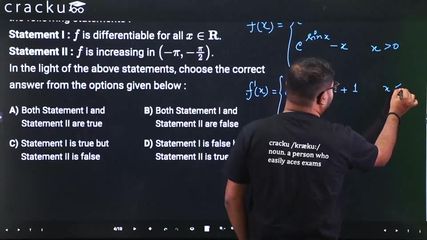
For the function $$f(x) = e^{\sin|x|} - |x|$$, $$x \in \mathbf{R}$$, consider the following statements :
Statement I : $$f$$ is differentiable for all $$x \in \mathbf{R}$$.
Statement II : $$f$$ is increasing in $$\left(-\pi, -\frac{\pi}{2}\right)$$.
In the light of the above statements, choose the correct answer from the options given below :
This problem requires checking the differentiability and monotonicity of a composite function involving absolute values. Let's break it down statement by statement.
The function is $$f(x) = e^{\sin |x|} - |x|$$.
Statement I: Differentiability at $$x = 0$$
Since $$e^{\sin |x|}$$ and $$|x|$$ are differentiable everywhere except potentially at $$x = 0$$ (due to the modulus), we need to check the derivative at the origin.
$$f'(x) = e^{\sin x} \cdot \cos x - 1$$
Right Hand Derivative (RHD) at $$0$$: $$f'(0^+) = e^0 \cdot \cos(0) - 1 = 1(1) - 1 = 0$$.
$$f'(x) = e^{-\sin x} \cdot (-\cos x) + 1$$
Left Hand Derivative (LHD) at $$0$$: $$f'(0^-) = e^0 \cdot (-1) + 1 = -1 + 1 = 0$$.
Since LHD = RHD = 0, the function is differentiable at $$x = 0$$. Since it is also differentiable for all other $$x \in \mathbb{R}$$, Statement I is True.
Statement II: Increasing in $$(-\pi, -\pi/2)$$
To check if the function is increasing, we look at the sign of $$f'(x)$$ in the given interval.
In the interval $$(-\pi, -\pi/2)$$, $$x$$ is negative, so we use the derivative formula for $$x < 0$$:
$$f'(x) = -e^{-\sin x} \cos x + 1$$
Let's analyze the components in $$(-\pi, -\pi/2)$$:
$$\text{(negative)} \cdot \text{(positive)} \cdot \text{(negative)} = \text{Positive}$$
Since $$f'(x)$$ is the sum of a positive term and $$1$$, $$f'(x) > 0$$ for all $$x \in (-\pi, -\pi/2)$$.
Thus, the function is strictly increasing in this interval. Statement II is True.
Final Conclusion
Correct Option: A
Was this solution helpful?
Click on the Email ☝️ to Watch the Video Solution
Create a FREE account and get:
_1.webp)

Educational materials for JEE preparation

Ask our AI anything

AI can make mistakes. Please verify important information.
AI can make mistakes. Please verify important information.
