IPMAT WhatsApp Group



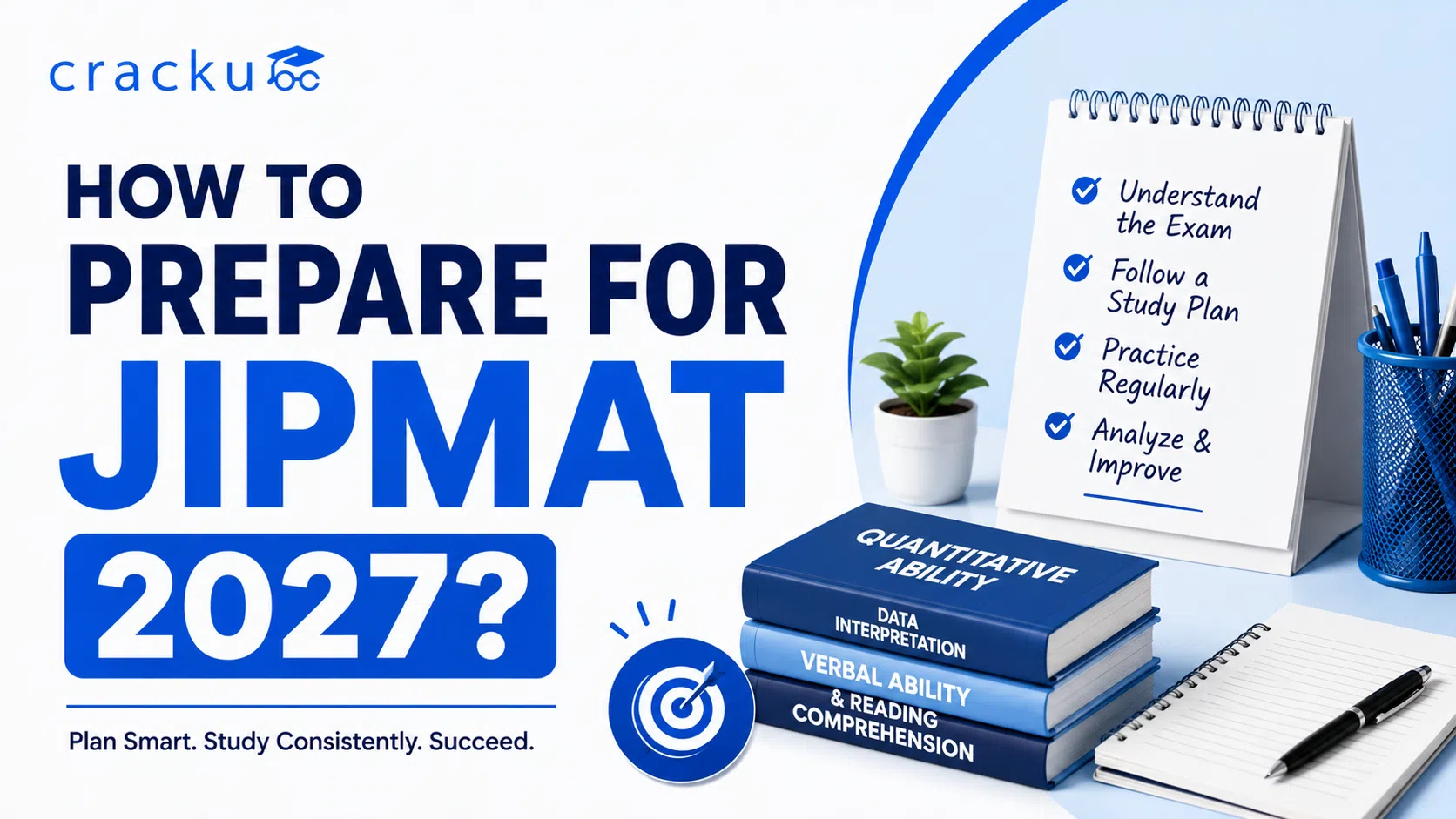
How to Prepare for JIPMAT 2027?
JIPMAT aspirants should be acquainted with the pattern of examination. JIPMAT exam is a computer based examination which lasts for 150 minutes (2.5 hours) and contains 100 Multiple Choice Questions (MCQs). There are no sectional timings and you can switch from one section to another.
JIPMAT preparation in three stages:
- Phase 1-Concept Clearing (1-4 months): The focus is on building the basic foundation in concept and theories. The candidates should focus on basics Mathematics, Formulas, Logical basics and simple English grammar.
- Phase 2- Speed development and practicing (5-7 months): Candidates will have to build their speed to approach more questions. The candidates have to focus on practice of topic wise questions and try using shortcuts in calculations instead of long calculations.
- Phase 3- IntensiveMock Tests (last 2 months): In this final stage, candidates will have to appear for the JIPMAT mock tests in order to get themselves used to the 150 minutes test. This helps candidates develop stamina and a smart approach to switch sections and target areas within the stipulated time frame.
JIPMAT Preparation Strategy 2027
Unlike the case in IPMAT Indore, where higher Mathematics syllabus including higher algebra and Calculus and short answer questions are also asked, JIPMAT 2027 is the class 10 based test that demands extreme speed from the candidates. A score of 300+ (out of 400) marks in the General Category will make it possible to get into JIPMAT.
Fundamental Preparation Strategy:
- Focus on accuracy initially: Because of the severe negative marking, careless attempts can significantly drag down your score. Start with practicing till you solve questions with high accuracy before focusing on the speed.
- Eliminate the usage of calculators: There’s no online calculator available for JIPMAT, so, you will have to get your basic arithmetic and calculations practice through daily calculations on paper to reduce the calculation time.
- Use flexibility of sections: With no section-wise time limits, use the extra time from sections where you score quickly to dedicate towards difficult sections like QA and DILR sets.
How to Prepare for JIPMAT Quantitative Aptitude 2027
The Quantitative Aptitude section of JIPMAT contains 33 questions that require basic school-level mathematics skills, mental aptitude, and time management.
Quantitative Aptitude Syllabus Breakdown & Weightage:
- Arithmetic (35-40%): this is the largest section, comprising concepts like Percentages, Profit & Loss, Simple & Compound Interest, Time-Speed-Distance, Time & Work, Averages, Ratio & Proportion, and Mixtures & Allegations.
- Algebra (15-20%): includes linear and quadratic equations, inequalities, progressions (Arithmetic, Geometric, Harmonic), and functions.
- Number System (10-15%): covers topics like factors & multiples, HCF & LCM, divisibility rules, and remainders.
- Geometry & Mensuration (10-15%): includes triangles, circles, polygons, coordinate geometry, and 2D/3D shapes area and volumes.
- Modern Maths (5-10%): consists of basic Probability, Permutations & Combinations, and Set Theory.
Quantitative Aptitude Preparation Strategy
Revise Basics: begin by refreshing the math concepts from NCERT Class 9 and 10 textbooks. Ensure thorough understanding of all formulas.
Master Mental Math Techniques: familiarize yourself with tables (up to 25), squares (up to 30), cubes (up to 20), and common percentage to fraction conversions (like 16.66% = 1/6).
Create a Formula Journal: keep a separate notebook dedicated to all formulas, theorems, and shortcut methods and review it regularly or aspirants can use JIPMAT Formula PDF which contains formulas for all quants topics
Suggested Resources for Quantitative Aptitude: Quantitative Aptitude for Competitive Examinations by R.S. Aggarwal and JIPMAT Previous Papers which has questions with answers.
Read More: JIPMAT Important Topics 2026, Check VARC, LRDI, Quant Topics
How to Prepare for JIPMAT Data Interpretation & Logical Reasoning 2027
The DILR section comprising 33 questions evaluates the analytical, structured and visual processing abilities. Since there’s no dedicated subject in school dedicated to it, regular practice of puzzles of different types is essential for good performance.
Topics in DILR:
Logical Reasoning (LR): Direction and distance sense, Blood relations, Coding and decoding, Sitting arrangements (linear, circular, grid-based), Syllogisms, Venn Diagrams, Calendars, and Clocks.
Data Interpretation (DI): Data Tables, Bar Graphs, Line Charts, Pie Charts, and Caselets (long descriptive paragraphs containing data).
DILR Prep Strategy:
- Step-1 Develop structural thinking skills for LR problems: For sitting arrangements or any puzzle you do, draw symbols and diagrams on paper, don’t try to solve it in your head.
- Step-2 Get a strong hold on arithmetic basics: Data Interpretation is basically arithmetic that needs high speed, if your basics of ratios, percentages, and averages are firm you can solve all DI questions in minutes.
- Step-3: Spot and learn to avoid Data traps in DI sets: NTA sometimes poses data traps to confuse candidates; for instance, they might confuse units on the chart axis, presenting absolute data and percentage in a mixed pattern. Be observant.
- Step-4 Daily Target: Do at least 3 puzzles of LR and 2 sets of DI every single day.
Section-Wise JIPMAT Preparation Strategy 2027
1. Verbal Ability and Reading Comprehension Strategy 2027:
VARC, with 34 questions, accounts for a major portion of the JIPMAT test.
- Daily Reading: Make it a habit of reading editorial sections of daily newspapers (like the Times of India, The Indian Express) and informative articles related to economics, technology, psychology, etc. This will develop a reading habit and improve your speed to comprehend 400-500 words RC passages.
- Vocabulary and Grammar: Don’t try memorizing vocabulary in chunks; focus on words that appear frequently and use a book like ‘Word Power Made Easy’. Cover basic grammar rules like the concept of tenses, modifiers, and subject-verb agreement in one week.
- Time Allocation: Aim to solve all VARC questions in around 30 to 35 minutes. For the vocabulary section, either you know the meaning or you don’t. There’s no point pondering upon such questions and wasting valuable time.
2. DILR Strategy 2027:
Selection is key: Spend 1 to 2 minutes in this section to pick out the easier sets first. Prioritize sets with simple pie charts or linear seating arrangements and solve those marks before anything else.
Time Allocation: Aim to allocate 45 to 50 minutes for this section. If you are unable to solve a particular set in over 4 minutes, move on to the next one.
3. Quantitative Aptitude Strategy 2027:
The Triage Method: Sort questions into three categories - Easy, Medium, and Hard. ‘Easy’ questions can be solved instantly using a direct formula; ‘Medium’ can be solved with a step-by-step process; ‘Hard’ questions are the ones you might find unfamiliar or too time-consuming.
Time Allocation: Since you will save a lot of time from the VARC section, you can dedicate at least 60 minutes to the quantitative aptitude section without rushing. This will help you solve some of the harder problems, if any, with an additional minute’s time.
Read More: JIPMAT Exam Pattern 2027, Marking Scheme, Total Questions
JIPMAT Preparation Strategy Mistakes to Avoid 2027
Hundreds of diligent aspirants miss their admission targets because of one tiny planning blunder. Watch out for these JIPMAT preparation strategy mistakes to score higher and bag an admit in 2027.
The 4 Fatal Mistakes to Avoid in JIPMAT Preparation:
1. Skipping Verbal Ability: Majority of students spend 90% of their study time crunching math problems and avoid the Verbal Ability and Reading Comprehension section of the test. The reality: JIPMAT’s VARC section is composed of 34 questions and holds considerable weightage to boost up your total score. Don’t let this opportunity slip away by ignoring VARC.
2. Overstudying Advanced Math: You don’t need to prepare for the CAT or the IPMAT Indore with its complex Calculus, Matrices, or tough Trigonometry topics. JIPMAT only asks Class 10-level concepts in the QA section and wants speed from test-takers.Focus on basics and accuracy, rather than wasting time on the complex material for CAT/IPMAT Indore.
3. Hoarding Material: Collecting different books for just one subject might get you stuck in the trap of “analysis paralysis”. The solution? Pick a well-researched, trusted book per section and follow it strictly, page by page, from beginning to end.
4. Taking Mocks Without Analysis: The preparation step for the test is half completed just by writing mocks. Allocate double the amount of time to analysis as you did for test-taking. Try and find out exactly why you got the question wrong- Was it due to some lack of knowledge, was there some calculation mistake, or you simply ran out of time? Make a note and review those mistakes.
Read More: JIPMAT Preparation Strategy, Section-Wise Strategy
How to Prepare for JIPMAT 2027: Conclusion
Preparing for JIPMAT 2027 requires a clear study plan, strong basics, regular practice, and smart mock test analysis. Since the exam is based mainly on Class 10-level concepts, aspirants should focus more on accuracy, speed, and time management instead of studying advanced topics. A balanced JIPMAT preparation strategy 2027 should cover Quantitative Aptitude, Data Interpretation and Logical Reasoning, and Verbal Ability with equal importance.
To score well in JIPMAT 2027, students must revise formulas, practice DILR sets daily, build a reading habit for VARC, and take full-length mock tests in the final phase. Avoiding common mistakes like skipping verbal ability, overstudying advanced math, and ignoring mock analysis can improve your final score. With consistent preparation and the right strategy, aspirants can confidently target a strong score in JIPMAT 2027.