
Join Our JEE Preparation Group
Prep with like-minded aspirants; Get access to free daily tests and study material.
Sign in
Please select an account to continue using cracku.in
↓ →
Join Our JEE Preparation Group
Prep with like-minded aspirants; Get access to free daily tests and study material.
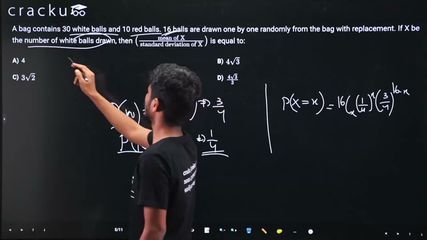
A bag contains 30 white balls and 10 red balls. 16 balls are drawn one by one randomly from the bag with replacement. If X be the number of white balls drawn, then $$\left(\frac{\text{mean of X}}{\text{standard deviation of X}}\right)$$ is equal to:
First, let us recognise that drawing “with replacement” means the composition of the bag never changes. Therefore, for every single draw, the probability of picking a white ball remains constant.
The bag has 30 white balls and 10 red balls, altogether 40 balls. So the probability of getting a white ball in any one draw is
$$p=\frac{\text{number of white balls}}{\text{total balls}}=\frac{30}{40}=\frac34.$$
Because each of the 16 draws is independent and has the same probability of success (drawing a white ball), the random variable $$X=$$ “number of white balls obtained in 16 draws” follows a binomial distribution. We write this as
$$X\sim\text{Binomial}(n=16,\;p=\tfrac34).$$
For a binomially distributed variable we use these standard formulae: • Mean (expected value) $$\mu = np.$$ • Variance $$\sigma^{2} = npq,$$ where $$q=1-p.$$ • Standard deviation $$\sigma = \sqrt{npq}.$$
We substitute $$n=16$$ and $$p=\tfrac34$$.
First, find the mean:
$$\mu = np = 16\left(\frac34\right)=\frac{16\times3}{4}=12.$$
Next, compute $$q$$:
$$q = 1-p = 1-\frac34 = \frac14.$$
Now, find the variance:
$$\sigma^{2} = npq = 16\left(\frac34\right)\left(\frac14\right) = 16 \times \frac{3}{16} = 3.$$
The standard deviation is the square root of the variance, so
$$\sigma = \sqrt{3}.$$
The question asks for the ratio of the mean of $$X$$ to the standard deviation of $$X$$. We therefore write
$$\frac{\text{mean of }X}{\text{standard deviation of }X}=\frac{\mu}{\sigma}= \frac{12}{\sqrt{3}}.$$
To simplify $$\frac{12}{\sqrt{3}}$$, we multiply numerator and denominator by $$\sqrt{3}$$:
$$\frac{12}{\sqrt{3}}\times\frac{\sqrt{3}}{\sqrt{3}}=\frac{12\sqrt{3}}{3}=4\sqrt{3}.$$
Hence, the correct answer is Option B.
Was this solution helpful?
Click on the Email ☝️ to Watch the Video Solution
Create a FREE account and get:
_1.webp)

Educational materials for JEE preparation

Ask our AI anything

AI can make mistakes. Please verify important information.
AI can make mistakes. Please verify important information.


