
Join Our JEE Preparation Group
Prep with like-minded aspirants; Get access to free daily tests and study material.
Sign in
Please select an account to continue using cracku.in
↓ →
Join Our JEE Preparation Group
Prep with like-minded aspirants; Get access to free daily tests and study material.
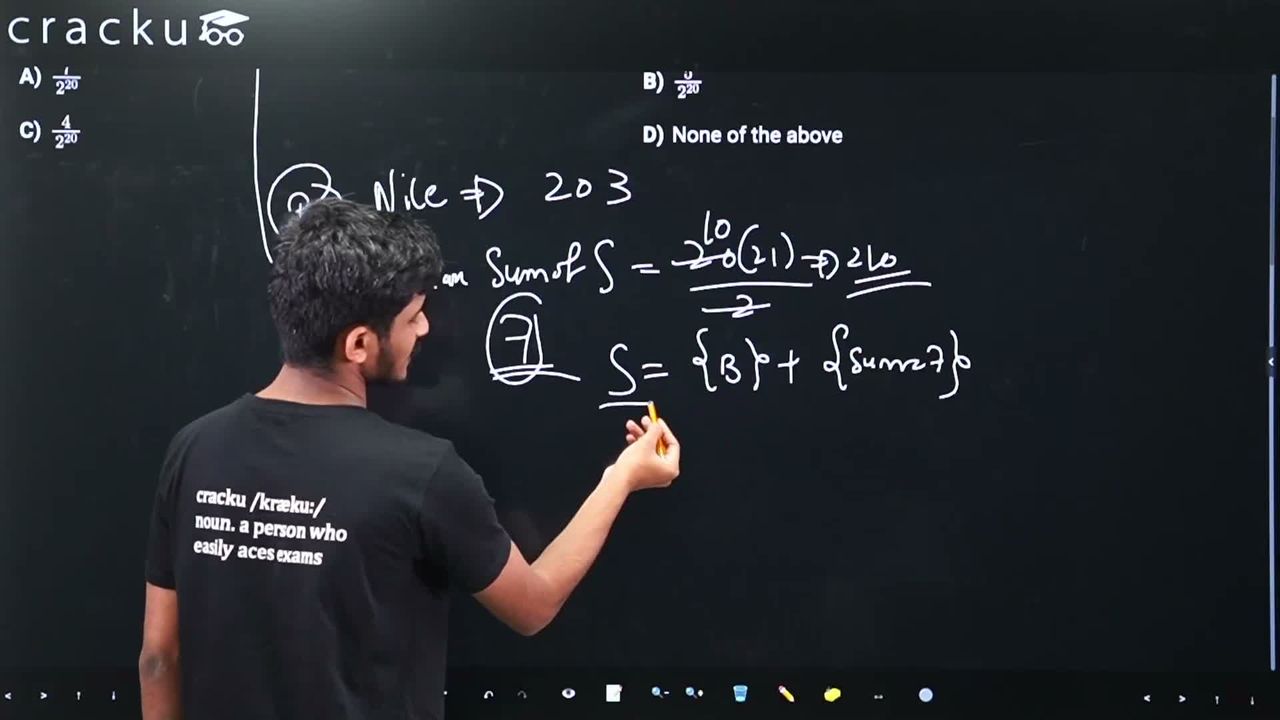
Let $$S = \{1, 2, \ldots, 20\}$$. A subset B of S is said to be "nice" if the sum of the elements of B is 203. Then the probability that a randomly chosen subset of S is "nice" is:
Let us place the ground set in front of us: $$S=\{1,2,3,\ldots ,20\}.$$
The task is to pick a subset $$B\subseteq S$$ whose elements add up to $$203.$$ Because every element of $$S$$ is either in $$B$$ or in its complement $$B^c,$$ the following identity of sums holds:
$$\displaystyle\sum_{x\in S}x=\sum_{x\in B}x+\sum_{x\in B^c}x.$$
The left-hand sum is the total of the first twenty natural numbers. Using the familiar formula for an arithmetic progression,
$$1+2+\cdots +20=\frac{20\cdot 21}{2}=210.$$
We are demanding $$\displaystyle\sum_{x\in B}x=203,$$ so substitution gives
$$210=203+\sum_{x\in B^c}x,$$
which rearranges step by step to
$$\sum_{x\in B^c}x=210-203=7.$$
Thus a subset $$B$$ is “nice’’ exactly when its complement has total $$7.$$ The mapping $$B\longleftrightarrow B^c$$ is a perfect one-to-one correspondence between subsets of sum $$203$$ and subsets of sum $$7,$$ so counting either family gives the same result. Because $$7$$ is a very small number, it is far easier to enumerate the complements.
We now list every subset of $$S$$ whose elements are distinct and add to $$7.$$ Begin with singletons:
$$\{7\}\quad\text{sum}=7.$$
Move on to pairs of distinct elements. We require $$a+b=7,$$ with $$1\le a
$$1+6=7\;\Longrightarrow\;\{1,6\},$$ $$2+5=7\;\Longrightarrow\;\{2,5\},$$ $$3+4=7\;\Longrightarrow\;\{3,4\}.$$
Next, examine triples. We need three different positive integers whose sum is $$7.$$ The only possibility is
$$1+2+4=7\;\Longrightarrow\;\{1,2,4\}.$$
Trying to use four or more distinct numbers fails immediately, because $$1+2+3+4=10>7,$$ and any larger collection would have an even bigger sum.
Therefore the entire catalogue of subsets of $$S$$ whose sum is $$7$$ consists of
$$\bigl\{\; \{7\},\; \{1,6\},\; \{2,5\},\; \{3,4\},\; \{1,2,4\}\;\bigr\}.$$
Exactly five subsets appear in that list, so there are $$5$$ “nice’’ complements and consequently $$5$$ “nice’’ subsets whose sum is $$203.$$
The sample space in the problem is the set of all subsets of $$S,$$ and a set with $$20$$ elements has exactly $$2^{20}$$ subsets. The required probability is therefore
$$\text{Probability}=\frac{\text{number of nice subsets}}{\text{total number of subsets}}=\frac{5}{2^{20}}.$$
Hence, the correct answer is Option B.
Was this solution helpful?
Click on the Email ☝️ to Watch the Video Solution
Create a FREE account and get:
_1.webp)

Educational materials for JEE preparation

Ask our AI anything

AI can make mistakes. Please verify important information.
AI can make mistakes. Please verify important information.


