
Join Our JEE Preparation Group
Prep with like-minded aspirants; Get access to free daily tests and study material.
Sign in
Please select an account to continue using cracku.in
↓ →
Join Our JEE Preparation Group
Prep with like-minded aspirants; Get access to free daily tests and study material.
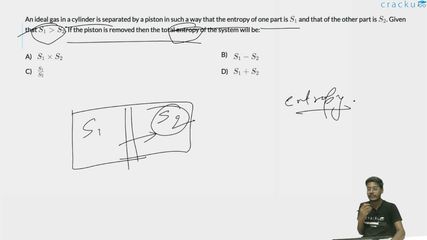
An ideal gas in a cylinder is separated by a piston in such a way that the entropy of one part is $$S_1$$ and that of the other part is $$S_2$$. Given that $$S_1 > S_2$$. If the piston is removed then the total entropy of the system will be:
Entropy is an extensive thermodynamic property, which means it scales with the size of the system and is additive over subsystems. If a composite system is made up of two independent parts with entropies $$S_1$$ and $$S_2$$, the total entropy of the composite system is $$S_{\text{total}} = S_1 + S_2$$.
When the piston separating the two parts of the ideal gas is removed, the gas from both compartments mixes. Since this is an irreversible process (free expansion into each other's space), the entropy of the system can only increase or stay the same according to the second law of thermodynamics. However, for an ideal gas where both sides are at the same temperature and pressure, the mixing does not generate additional entropy.
Regardless of whether additional entropy is generated during mixing, the total entropy is at minimum $$S_1 + S_2$$. Among the given options — $$S_1 \times S_2$$, $$S_1 - S_2$$, $$\frac{S_1}{S_2}$$, and $$S_1 + S_2$$ — the physically meaningful and correct answer is $$S_1 + S_2$$, since entropy is additive.
Was this solution helpful?
Click on the Email ☝️ to Watch the Video Solution
Create a FREE account and get:
_1.webp)

Educational materials for JEE preparation

Ask our AI anything

AI can make mistakes. Please verify important information.
AI can make mistakes. Please verify important information.
