
Join Our JEE Preparation Group
Prep with like-minded aspirants; Get access to free daily tests and study material.
Sign in
Please select an account to continue using cracku.in
↓ →
Join Our JEE Preparation Group
Prep with like-minded aspirants; Get access to free daily tests and study material.
A car $$P$$ travelling at 20 m s$$^{-1}$$ sounds its horn at a frequency of 400 Hz. Another car $$Q$$ is travelling behind the first car in the same direction with a velocity 40 m s$$^{-1}$$. The frequency heard by the passenger of the car $$Q$$ is approximately [Take, velocity of sound = 360 m s$$^{-1}$$]
Car P (source) moves at 20 m/s sounding horn at 400 Hz. Car Q (observer) is behind P moving at 40 m/s in the same direction. Since Q is faster, Q approaches P.
Using the Doppler effect formula for approaching source and observer:
$$f' = f \times \frac{v + v_o}{v - v_s}$$
where $$v = 360$$ m/s (velocity of sound), $$v_o = 40$$ m/s (observer approaching), $$v_s = 20$$ m/s (source being approached).
$$f' = 400 \times \frac{360 + 40}{360 - 20} = 400 \times \frac{400}{340}$$
$$f' = \frac{160000}{340} \approx 470.6 \approx 471 \text{ Hz}$$
Was this solution helpful?
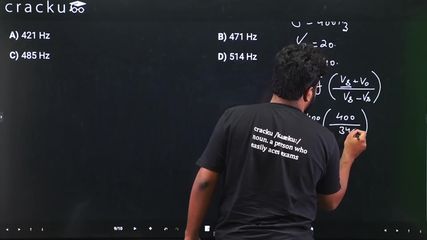
Click on the Email ☝️ to Watch the Video Solution
Create a FREE account and get:
_1.webp)

Educational materials for JEE preparation

Ask our AI anything

AI can make mistakes. Please verify important information.
AI can make mistakes. Please verify important information.


