
Join Our JEE Preparation Group
Prep with like-minded aspirants; Get access to free daily tests and study material.
Sign in
Please select an account to continue using cracku.in
↓ →
Join Our JEE Preparation Group
Prep with like-minded aspirants; Get access to free daily tests and study material.
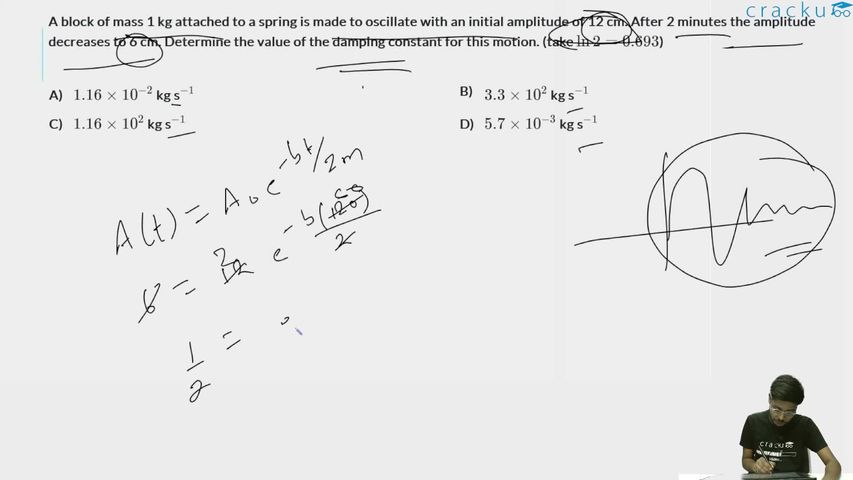
A block of mass 1 kg attached to a spring is made to oscillate with an initial amplitude of 12 cm. After 2 minutes the amplitude decreases to 6 cm. Determine the value of the damping constant for this motion. (take $$\ln 2 = 0.693$$)
In damped oscillation, the amplitude decreases exponentially as $$A(t) = A_0 e^{-bt/(2m)}$$, where $$b$$ is the damping constant, $$m$$ is the mass, and $$A_0$$ is the initial amplitude.
We are given $$A_0 = 12$$ cm, $$A(t) = 6$$ cm at $$t = 2$$ min $$= 120$$ s, and $$m = 1$$ kg. Substituting these values: $$6 = 12 \, e^{-b \times 120/(2 \times 1)}$$, which simplifies to $$\frac{1}{2} = e^{-60b}$$.
Taking the natural logarithm of both sides: $$-\ln 2 = -60b$$, so $$b = \frac{\ln 2}{60} = \frac{0.693}{60} = 0.01155 \approx 1.16 \times 10^{-2}$$ kg s$$^{-1}$$.
Was this solution helpful?
Click on the Email ☝️ to Watch the Video Solution
Create a FREE account and get:
_1.webp)

Educational materials for JEE preparation

Ask our AI anything

AI can make mistakes. Please verify important information.
AI can make mistakes. Please verify important information.


