
Join Our JEE Preparation Group
Prep with like-minded aspirants; Get access to free daily tests and study material.
Sign in
Please select an account to continue using cracku.in
↓ →
Join Our JEE Preparation Group
Prep with like-minded aspirants; Get access to free daily tests and study material.
The direction ratios of normal to the plane through the points (0,-1,0) and (0,0,1) and making an angle $$\frac{\pi}{4}$$ with the plane $$y - z + 5 = 0$$ are: 2,-1,1; $$2, \sqrt{2} - \sqrt{2}$$; $$\sqrt{2}, 1, -1$$; $$2\sqrt{3}, 1, -1$$
Let the required plane be denoted by the equation
$$ax+by+cz+d=0,$$
where $$a,b,c$$ are the direction ratios of its normal and $$d$$ is the constant term. Because only the direction ratios are asked, we shall work exclusively with the normal vector $$\mathbf n=(a,b,c).$$
First, the plane has to pass through the two given points
$$A(0,-1,0)\quad\text{and}\quad B(0,0,1).$$
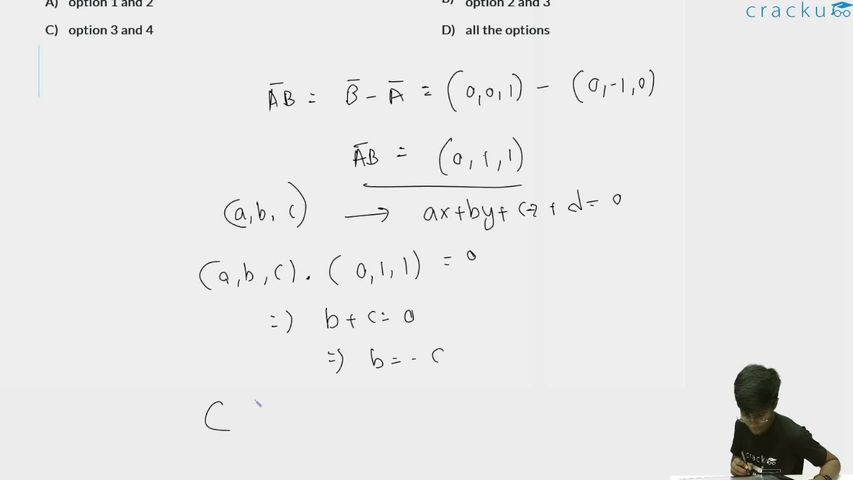
Hence the vector
$$\overrightarrow{AB}=B-A=(0,1,1)$$
lies entirely in the required plane. A normal to the plane must therefore be perpendicular to every vector lying in the plane, so in particular we must have
$$\mathbf n\cdot\overrightarrow{AB}=0.$$ Substituting, this condition is
$$a\cdot0+b\cdot1+c\cdot1=0\;\Longrightarrow\;b+c=0\;\Longrightarrow\;c=-\,b.$$
Thus we can write the normal in the form
$$\mathbf n=(a,b,-\,b).$$
Next, the angle between the required plane and the given plane
$$y-z+5=0$$
is stated to be $$\dfrac{\pi}{4}.$$ The normal of this given plane is
$$\mathbf n_0=(0,\,1,\,-1).$$
The formula for the angle $$\theta$$ between two planes, via their normals, is
$$\cos\theta=\frac{|\mathbf n\cdot\mathbf n_0|}{\lVert\mathbf n\rVert\,\lVert\mathbf n_0\rVert}.$$
We substitute $$\theta=\dfrac{\pi}{4},\;\mathbf n=(a,b,-b),\;\mathbf n_0=(0,1,-1).$$
First the dot product:
$$\mathbf n\cdot\mathbf n_0=(a,b,-b)\cdot(0,1,-1)=a\cdot0+b\cdot1+(-b)\cdot(-1)=b+b=2b.$$
The magnitudes:
$$\lVert\mathbf n\rVert=\sqrt{a^2+b^2+(-b)^2}=\sqrt{a^2+2b^2},$$
$$\lVert\mathbf n_0\rVert=\sqrt{0^2+1^2+(-1)^2}=\sqrt2.$$
Now enforce the angle condition:
$$\cos\left(\frac{\pi}{4}\right)=\frac{|2b|}{\sqrt2\sqrt{a^2+2b^2}} \;\Longrightarrow\; \frac{|2b|}{\sqrt2\sqrt{a^2+2b^2}}=\frac1{\sqrt2}.$$
Multiplying by $$\sqrt2$$ gives
$$|2b|=\sqrt{a^2+2b^2}.$$
Squaring both sides,
$$4b^2=a^2+2b^2 \;\Longrightarrow\; a^2=4b^2-2b^2=2b^2 \;\Longrightarrow\; a=\pm\sqrt2\,b.$$
Combining this with $$c=-b,$$ the normal can therefore be written (taking an arbitrary non-zero $$b$$)
$$\mathbf n=(\sqrt2\,b,\;b,\;-\,b)\quad\text{or}\quad\mathbf n=(-\sqrt2\,b,\;b,\;-\,b).$$
Because any non-zero scalar multiple represents the same set of direction ratios, we may conveniently choose $$b=1.$$ The two possible normals are then
$$\mathbf n_1=(\sqrt2,\;1,\;-1),$$
$$\mathbf n_2=(-\sqrt2,\;1,\;-1)\equiv(\sqrt2,\;-1,\;1)\quad\text{(after multiplying by }\!-1\text{)}.$$
We now compare these with the four collections of direction ratios supplied in the question.
Therefore the correct sets of direction ratios are those given in Options 2 and 3.
Hence, the correct answer is Option B.
Was this solution helpful?
Click on the Email ☝️ to Watch the Video Solution
Create a FREE account and get:
_1.webp)

Educational materials for JEE preparation

Ask our AI anything

AI can make mistakes. Please verify important information.
AI can make mistakes. Please verify important information.
