
Join Our JEE Preparation Group
Prep with like-minded aspirants; Get access to free daily tests and study material.
Sign in
Please select an account to continue using cracku.in
↓ →
Join Our JEE Preparation Group
Prep with like-minded aspirants; Get access to free daily tests and study material.
Let $$\vec{a} = \hat{i} + \hat{j} + \hat{k}$$, $$\vec{b}$$ and $$\vec{c} = \hat{j} - \hat{k}$$ be three vectors such that $$\vec{a} \times \vec{b} = \vec{c}$$ and $$\vec{a} \cdot \vec{b} = 1$$. If the length of projection vector of the vector $$\vec{b}$$ on the vector $$\vec{a} \times \vec{c}$$ is $$l$$, then the value of $$3l^2$$ is equal to _________.
Correct Answer: 2
We have the given vectors
$$\vec a = \hat i + \hat j + \hat k, \qquad \vec c = \hat j - \hat k, \qquad \vec b = x\hat i + y\hat j + z\hat k.$$
The first condition is the cross-product relation
$$\vec a \times \vec b = \vec c.$$
Using the determinant formula for a cross product,
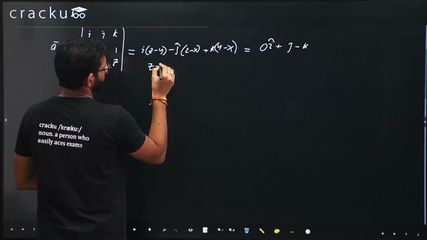
$$\vec a \times \vec b \;=\; \begin{vmatrix} \hat i & \hat j & \hat k\\ 1 & 1 & 1\\ x & y & z \end{vmatrix} \;=\; \hat i(1\cdot z-1\cdot y)\;-\;\hat j(1\cdot z-1\cdot x)\;+\;\hat k(1\cdot y-1\cdot x).$$
Simplifying each component we get
$$\vec a \times \vec b = (\,z-y\,)\hat i - (\,z-x\,)\hat j + (\,y-x\,)\hat k.$$
Because this must equal $$\vec c = 0\hat i + 1\hat j -1\hat k,$$ we equate the corresponding components:
$$z-y = 0,\qquad -(z-x)=1,\qquad y-x=-1.$$
From the first equation we have $$z=y.$$ Substituting $$z=y$$ into the other two equations gives
$$x-z = 1 \quad\text{and}\quad y-x = -1.$$
Since $$z=y$$, the first becomes $$x-y=1$$; the second is already $$y-x=-1$$, so both are identical, confirming consistency. Hence
$$x-y = 1 \;\Longrightarrow\; x = y+1.$$
Letting $$y=t$$ (a parameter), we now have
$$x = t+1, \qquad y = t, \qquad z = t,$$
so that
$$\vec b = (t+1)\hat i + t\hat j + t\hat k.$$
The second given condition is the dot-product relation
$$\vec a \cdot \vec b = 1.$$
Using the formula $$\vec a \cdot \vec b = a_x b_x + a_y b_y + a_z b_z$$, we obtain
$$1(t+1) + 1(t) + 1(t) \;=\; 1.$$
That is
$$(t+1) + t + t \;=\; 1 \;\Longrightarrow\; 3t + 1 = 1 \;\Longrightarrow\; 3t = 0 \;\Longrightarrow\; t = 0.$$
Putting $$t=0$$ back into $$\vec b$$ gives
$$\vec b = 1\hat i + 0\hat j + 0\hat k = \hat i.$$
Next, we need the vector $$\vec a \times \vec c$$. Again applying the cross-product determinant,
$$\vec a \times \vec c = \begin{vmatrix} \hat i & \hat j & \hat k\\ 1 & 1 & 1\\ 0 & 1 & -1 \end{vmatrix} = \hat i(1\cdot(-1)-1\cdot1)\;-\;\hat j(1\cdot(-1)-1\cdot0)\;+\;\hat k(1\cdot1-1\cdot0).$$
This simplifies to
$$\vec a \times \vec c = (-2)\hat i + 1\hat j + 1\hat k.$$
We now wish to find the projection of $$\vec b$$ onto $$\vec a \times \vec c$$. The projection vector formula is
$$\text{proj}_{\vec v}\vec u \;=\; \frac{\vec u\cdot\vec v}{\vec v\cdot\vec v}\,\vec v.$$
Here $$\vec u=\vec b$$ and $$\vec v=\vec a \times \vec c$$. First, compute the needed dot products.
$$\vec b \cdot (\vec a \times \vec c) = (1,0,0)\cdot(-2,1,1) = 1\cdot(-2)+0\cdot1+0\cdot1 = -2.$$
Next, compute the squared magnitude of $$\vec a \times \vec c$$:
$$|\vec a \times \vec c|^2 = (-2)^2 + 1^2 + 1^2 = 4 + 1 + 1 = 6.$$
Therefore the projection vector is
$$\vec p = \frac{-2}{6}\,(\,-2,\,1,\,1) = -\frac13(\,-2,\,1,\,1) = \left(\frac23,\,-\frac13,\,-\frac13\right).$$
Its length $$l$$ is obtained from
$$l^2 = \left(\frac23\right)^2 + \left(-\frac13\right)^2 + \left(-\frac13\right)^2 = \frac49 + \frac19 + \frac19 = \frac69 = \frac23.$$
Hence
$$l^2 = \frac23 \quad\Longrightarrow\quad 3l^2 = 3\left(\frac23\right) = 2.$$
So, the answer is $$2$$.
Was this solution helpful?
Click on the Email ☝️ to Watch the Video Solution
Create a FREE account and get:
_1.webp)

Educational materials for JEE preparation

Ask our AI anything

AI can make mistakes. Please verify important information.
AI can make mistakes. Please verify important information.
