
Join Our JEE Preparation Group
Prep with like-minded aspirants; Get access to free daily tests and study material.
Sign in
Please select an account to continue using cracku.in
↓ →
Join Our JEE Preparation Group
Prep with like-minded aspirants; Get access to free daily tests and study material.
If $$y = y(x)$$, $$y \in \left[0, \frac{\pi}{2}\right)$$ is the solution of the differential equation $$\sec y \frac{dy}{dx} - \sin(x + y) - \sin(x - y) = 0$$, with $$y(0) = 0$$, then $$5y'\left(\frac{\pi}{2}\right)$$ is equal to _________.
Correct Answer: 2
We begin with the given differential equation
$$\sec y \dfrac{dy}{dx}-\sin (x+y)-\sin (x-y)=0.$$
First, we recall the standard trigonometric identity
$$\sin(\alpha+\beta)+\sin(\alpha-\beta)=2\sin\alpha\cos\beta.$$
Using this identity with $$\alpha=x$$ and $$\beta=y,$$ we have
$$\sin(x+y)+\sin(x-y)=2\sin x\cos y.$$
Substituting in the differential equation gives
$$\sec y \dfrac{dy}{dx}-2\sin x\cos y=0.$$
Now we isolate the derivative. Remembering that $$\sec y=\dfrac1{\cos y},$$ we write
$$\dfrac{1}{\cos y}\dfrac{dy}{dx}=2\sin x\cos y.$$
Multiplying both sides by $$\cos y$$ we obtain
$$\dfrac{dy}{dx}=2\sin x\cos^2 y.$$
To separate the variables we divide by $$\cos^2 y$$ and multiply by $$dx$$:
$$\dfrac{dy}{\cos^2 y}=2\sin x\,dx.$$
Since $$\dfrac{1}{\cos^2 y}=\sec^2 y,$$ the equation takes the form
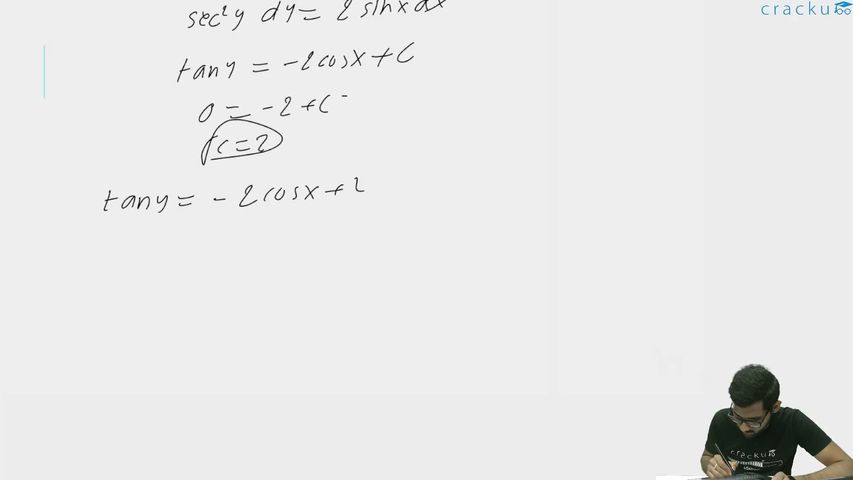
$$\sec^2 y\,dy = 2\sin x\,dx.$$
We now integrate both sides. We use the formula $$\displaystyle\int \sec^2 y\,dy=\tan y$$ and $$\displaystyle\int\sin x\,dx=-\cos x.$$ Thus
$$\tan y = -2\cos x + C,$$
where $$C$$ is the constant of integration.
To determine $$C,$$ we apply the initial condition $$y(0)=0.$$ Substituting $$x=0$$ and $$y=0$$ gives
$$\tan 0 = -2\cos 0 + C \quad\Longrightarrow\quad 0 = -2(1) + C,$$
so
$$C = 2.$$
Hence the implicit solution is
$$\tan y = -2\cos x + 2 = 2(1-\cos x).$$
We are asked to find $$y'\left(\dfrac{\pi}{2}\right).$$ For this we return to the already isolated derivative
$$\dfrac{dy}{dx}=2\sin x\cos^2 y.$$
We need $$\sin x$$ and $$\cos^2 y$$ at $$x=\dfrac{\pi}{2}.$$
First, $$\sin\left(\dfrac{\pi}{2}\right)=1.$$
Next we find $$y$$ at $$x=\dfrac{\pi}{2}.$$ Plugging $$x=\dfrac{\pi}{2}$$ into the relation $$\tan y = 2(1-\cos x)$$ gives
$$\tan y = 2\Bigl(1-\cos\frac{\pi}{2}\Bigr)=2(1-0)=2.$$
Because $$y\in\left[0,\dfrac{\pi}{2}\right),$$ we take the principal value, so $$y=\tan^{-1}2.$$
To compute $$\cos^2 y,$$ we use the identity $$\sec^2 y = 1+\tan^2 y.$$ Hence
$$\sec^2 y = 1 + \tan^2 y = 1 + 2^2 = 5,$$
so
$$\cos^2 y = \dfrac{1}{\sec^2 y} = \dfrac{1}{5}.$$
Now we substitute back into the derivative formula:
$$y'\left(\dfrac{\pi}{2}\right) = 2\bigl(\sin\dfrac{\pi}{2}\bigr)\cos^2 y = 2(1)\left(\dfrac{1}{5}\right)=\dfrac{2}{5}.$$
Finally, we require $$5y'\left(\dfrac{\pi}{2}\right):$$
$$5y'\left(\dfrac{\pi}{2}\right)=5\left(\dfrac{2}{5}\right)=2.$$
So, the answer is $$2$$.
Was this solution helpful?
Click on the Email ☝️ to Watch the Video Solution
Create a FREE account and get:
_1.webp)

Educational materials for JEE preparation

Ask our AI anything

AI can make mistakes. Please verify important information.
AI can make mistakes. Please verify important information.
