
Join Our JEE Preparation Group
Prep with like-minded aspirants; Get access to free daily tests and study material.
Sign in
Please select an account to continue using cracku.in
↓ →
Join Our JEE Preparation Group
Prep with like-minded aspirants; Get access to free daily tests and study material.
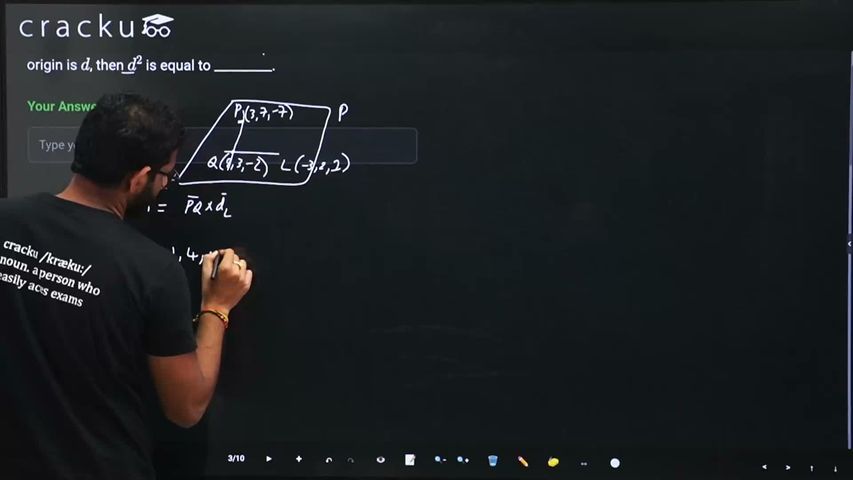
Let a plane $$P$$ pass through the point $$(3, 7, -7)$$ and contain the line, $$\frac{x - 2}{-3} = \frac{y - 3}{2} = \frac{z + 2}{1}$$. If distance of the plane $$P$$ from the origin is $$d$$, then $$d^2$$ is equal to _________.
Correct Answer: 3
We have to find the equation of the plane that (i) passes through the fixed point $$(3,\,7,\,-7)$$ and (ii) contains every point of the given line
$$\frac{x-2}{-3}\;=\;\frac{y-3}{2}\;=\;\frac{z+2}{1}.$$
First we convert the symmetric form of the line into parametric form. Setting the common ratio equal to a parameter $$t,$$ we get
$$\frac{x-2}{-3}=t,\qquad \frac{y-3}{2}=t,\qquad \frac{z+2}{1}=t.$$
From these three equalities we obtain the coordinates of a general point on the line:
$$x = 2 - 3t,\qquad y = 3 + 2t,\qquad z = -2 + t.$$
Hence one particular point on the line (obtained by putting $$t=0$$) is
$$Q(2,\,3,\,-2).$$
The direction ratios of the line are the coefficients that multiply $$t,$$ i.e. $$(-3,\,2,\,1).$$ Therefore a vector along the line is
$$\vec v_1 = \langle -3,\,2,\,1\rangle.$$
Because the required plane must pass through the point $$P(3,\,7,\,-7)$$ as well as the entire given line, the vector
$$\vec v_2 = \overrightarrow{QP} = \langle 3-2,\;7-3,\;-7-(-2)\rangle = \langle 1,\;4,\;-5\rangle$$
also lies within the plane.
A normal vector to the plane can now be obtained by taking the cross-product of the two non-parallel vectors that lie in the plane:
$$\vec n = \vec v_1 \times \vec v_2.$$
Writing the cross-product in determinant form,
$$ \vec n = \begin{vmatrix} \mathbf i & \mathbf j & \mathbf k\\ -3 & 2 & 1\\ 1 & 4 & -5 \end{vmatrix} = \mathbf i\,(2\cdot(-5)-1\cdot4) - \mathbf j\,((-3)\cdot(-5)-1\cdot1) + \mathbf k\,((-3)\cdot4-2\cdot1). $$
Evaluating each component step by step,
$$ \vec n = \mathbf i\,(-10-4) - \mathbf j\,(15-1) + \mathbf k\,(-12-2) = \mathbf i\,(-14) - \mathbf j\,(14) + \mathbf k\,(-14). $$
Thus
$$\vec n = \langle -14,\,-14,\,-14\rangle.$$
Any non-zero scalar multiple of a normal vector serves the same purpose, so we divide by $$-14$$ and take the simpler normal vector
$$\vec n = \langle 1,\,1,\,1\rangle.$$
Using the point-normal form of a plane,
$$\vec n\cdot(\vec r-\vec r_0)=0,$$
where $$\vec r_0$$ represents the position vector of the known point $$P(3,\,7,\,-7),$$ we substitute $$\vec n=\langle 1,1,1\rangle$$ to obtain
$$1\,(x-3)+1\,(y-7)+1\,(z+7)=0.$$
Simplifying term by term,
$$x-3 + y-7 + z+7 = 0 \;\;\Longrightarrow\;\; x + y + z - 3 = 0.$$
Hence the required plane has the Cartesian equation
$$x + y + z - 3 = 0.$$
Now we calculate the perpendicular distance from the origin $$(0,\,0,\,0)$$ to this plane. For a plane $$Ax + By + Cz + D = 0,$$ the distance $$d$$ from a point $$(x_0,\,y_0,\,z_0)$$ is given by the formula
$$d = \frac{\lvert A x_0 + B y_0 + C z_0 + D\rvert} {\sqrt{A^2 + B^2 + C^2}}.$$
In our plane, $$A = 1,\;B = 1,\;C = 1,\;D = -3.$$ Substituting $$x_0 = y_0 = z_0 = 0,$$ we have
$$d = \frac{\lvert 1\cdot0 + 1\cdot0 + 1\cdot0 - 3\rvert} {\sqrt{1^2 + 1^2 + 1^2}} = \frac{\lvert -3\rvert}{\sqrt{3}} = \frac{3}{\sqrt{3}} = \sqrt{3}.$$
Therefore
$$d^2 = (\sqrt{3})^2 = 3.$$
So, the answer is $$3$$.
Was this solution helpful?
Click on the Email ☝️ to Watch the Video Solution
Create a FREE account and get:
_1.webp)

Educational materials for JEE preparation

Ask our AI anything

AI can make mistakes. Please verify important information.
AI can make mistakes. Please verify important information.
