
Join Our JEE Preparation Group
Prep with like-minded aspirants; Get access to free daily tests and study material.
Sign in
Please select an account to continue using cracku.in
↓ →
Join Our JEE Preparation Group
Prep with like-minded aspirants; Get access to free daily tests and study material.
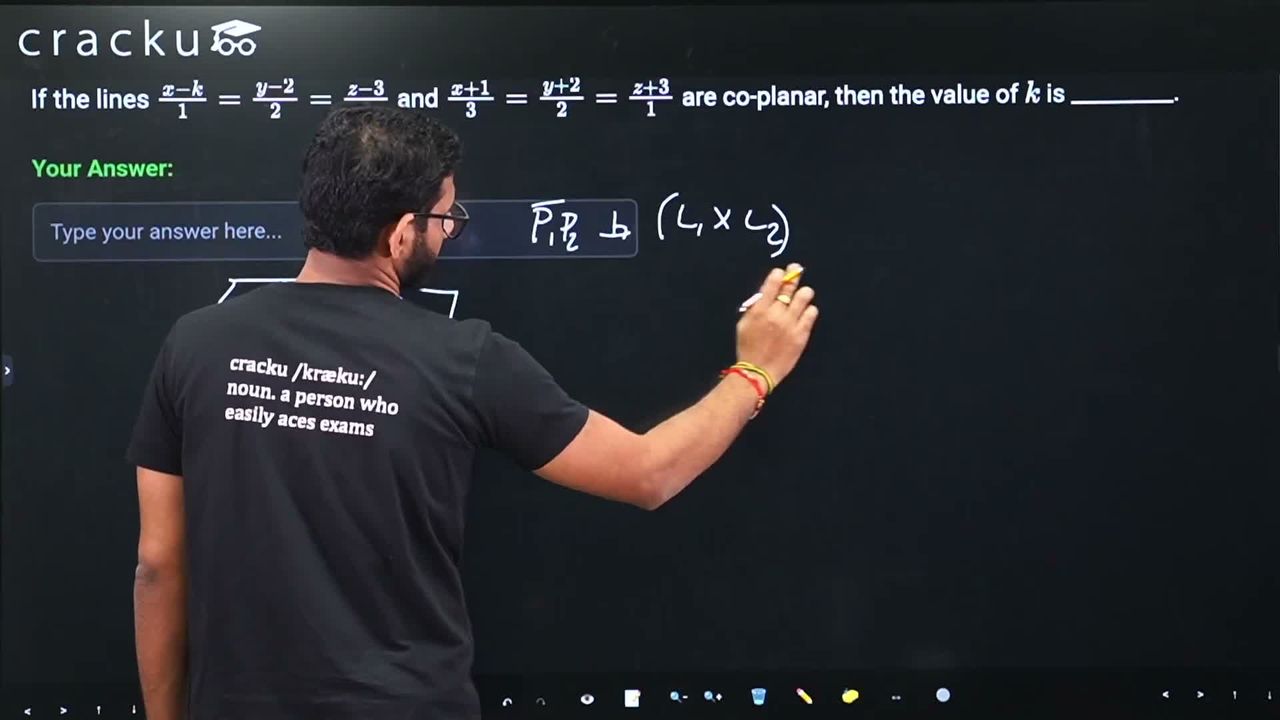
If the lines $$\frac{x - k}{1} = \frac{y - 2}{2} = \frac{z - 3}{3}$$ and $$\frac{x + 1}{3} = \frac{y + 2}{2} = \frac{z + 3}{1}$$ are co-planar, then the value of $$k$$ is _________.
Correct Answer: 1
We have the first line written in symmetric form as $$\dfrac{x-k}{1}=\dfrac{y-2}{2}=\dfrac{z-3}{3}.$$
From this, one immediately sees a point on the line, namely $$P_1(k,\,2,\,3),$$ and the direction ratios (and hence the direction vector) $$\vec a=(1,\,2,\,3).$$
In the same way, the second line $$\dfrac{x+1}{3}=\dfrac{y+2}{2}=\dfrac{z+3}{1}$$ passes through the point $$P_2(-1,\,-2,\,-3)$$ and has direction vector $$\vec b=(3,\,2,\,1).$$
Two lines in three-dimensional space are coplanar precisely when either they intersect or they are parallel. A convenient vector condition that captures both cases at once is:
$$\bigl(\overrightarrow{P_2P_1}\bigr)\cdot(\vec a\times\vec b)=0.$$
Here, $$\overrightarrow{P_2P_1}=P_1-P_2=(k-(-1),\,2-(-2),\,3-(-3))=(k+1,\,4,\,6).$$ (One may equally well use $$P_2-P_1$$; the final equation will differ only by an overall sign, which does not affect the result.)
First we compute the cross product $$\vec a\times\vec b.$$ Setting up the determinant, we get
$$ \vec a\times\vec b= \begin{vmatrix} \mathbf i & \mathbf j & \mathbf k\\ 1 & 2 & 3\\ 3 & 2 & 1 \end{vmatrix}. $$
Expanding,
$$$ \begin{aligned} \vec a\times\vec b &=\mathbf i\,(2\cdot1-3\cdot2)-\mathbf j\,(1\cdot1-3\cdot3)+\mathbf k\,(1\cdot2-2\cdot3)\\[4pt] &=\mathbf i\,(2-6)-\mathbf j\,(1-9)+\mathbf k\,(2-6)\\[4pt] &=(-4,\,8,\,-4). \end{aligned} $$$
Now we take the dot product with $$\overrightarrow{P_2P_1}=(k+1,\,4,\,6):$$
$$$ \begin{aligned} \bigl(\overrightarrow{P_2P_1}\bigr)\cdot(\vec a\times\vec b) &=(k+1)(-4)+4\cdot8+6\cdot(-4)\\[4pt] &=-4(k+1)+32-24\\[4pt] &=-4k-4+8\\[4pt] &=-4k+4. \end{aligned} $$$
For the lines to be coplanar this quantity must be zero, so we set
$$-4k+4=0.$$
Solving,
$$$ -4k=-4 \;\Longrightarrow\; k=1. $$$
So, the answer is $$1$$.
Was this solution helpful?
Click on the Email ☝️ to Watch the Video Solution
Create a FREE account and get:
_1.webp)

Educational materials for JEE preparation

Ask our AI anything

AI can make mistakes. Please verify important information.
AI can make mistakes. Please verify important information.
