
Join Our JEE Preparation Group
Prep with like-minded aspirants; Get access to free daily tests and study material.
Sign in
Please select an account to continue using cracku.in
↓ →
Join Our JEE Preparation Group
Prep with like-minded aspirants; Get access to free daily tests and study material.
A fair coin is tossed $$n-$$ times such that the probability of getting at least one head is at least 0.9. Then the minimum value of $$n$$ is _________.
Correct Answer: 4
We begin with a single throw of a fair coin. In one throw, the probability of getting a head is $$\dfrac12$$ and the probability of getting a tail is also $$\dfrac12$$ because the coin is fair.
When the coin is tossed $$n$$ times, all the throws are independent. The easiest way to find the probability of “at least one head” is to use the complementary event “no head at all,” that is, getting tails in every single throw.
For one throw, the probability of a tail is $$\dfrac12$$. Hence, when the coin is tossed $$n$$ times, the probability of getting a tail on every single throw (that is, zero heads) is $$\left(\dfrac12\right)^n.$$ This uses the multiplication rule for independent events.
Therefore, the probability of getting at least one head in $$n$$ throws is $$ 1-\left(\dfrac12\right)^n. $$
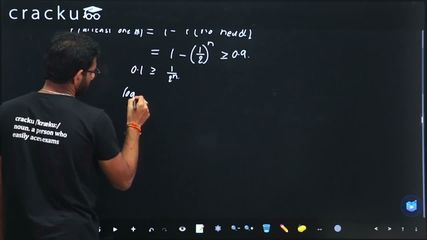
The question tells us that this probability must be at least $$0.9$$, so we set up the inequality: $$ 1-\left(\dfrac12\right)^n \ge 0.9. $$
Rearranging the terms, we isolate the power of $$\dfrac12$$: $$ \left(\dfrac12\right)^n \le 1-0.9 = 0.1. $$
To solve for $$n$$, we take natural logarithms on both sides. (Any logarithm base would work; natural logarithm is convenient.) We state first that for any positive numbers $$a$$ and $$b$$, if $$a<1$$ then $$\ln a<0$$, and dividing by a negative number reverses the inequality sign.
Applying $$\ln$$, we get $$ \ln\!\left(\left(\dfrac12\right)^n\right) \le \ln(0.1). $$ Using the power rule $$\ln(a^k)=k\ln a$$, this becomes $$ n\,\ln\!\left(\dfrac12\right) \le \ln(0.1). $$
Because $$\ln\!\left(\dfrac12\right)<0$$, dividing both sides by this negative number reverses the inequality: $$ n \ge \dfrac{\ln(0.1)}{\ln\!\left(\dfrac12\right)}. $$
We now evaluate the right-hand side numerically: $$ \ln(0.1) \approx -2.302585, \qquad \ln\!\left(\dfrac12\right) \approx -0.693147. $$ Therefore $$ n \ge \dfrac{-2.302585}{-0.693147} \approx 3.321928. $$
Since $$n$$ must be an integer (you cannot toss the coin a fractional number of times), we take the smallest integer not less than $$3.321928$$, which is $$4$$.
We may confirm quickly: for $$n=3$$, the probability of at least one head is $$1-\left(\dfrac12\right)^3 = 1-\dfrac18 = 0.875$$, which is less than $$0.9$$; for $$n=4$$, the probability is $$1-\left(\dfrac12\right)^4 = 1-\dfrac{1}{16} = 0.9375$$, which indeed satisfies the requirement.
So, the answer is $$4$$.
Was this solution helpful?
Click on the Email ☝️ to Watch the Video Solution
Create a FREE account and get:
_1.webp)

Educational materials for JEE preparation

Ask our AI anything

AI can make mistakes. Please verify important information.
AI can make mistakes. Please verify important information.
