
Join Our JEE Preparation Group
Prep with like-minded aspirants; Get access to free daily tests and study material.
Sign in
Please select an account to continue using cracku.in
↓ →
Join Our JEE Preparation Group
Prep with like-minded aspirants; Get access to free daily tests and study material.
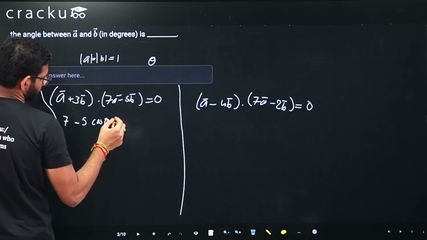
If $$\vec{a}$$ and $$\vec{b}$$ are unit vectors and $$\left(\vec{a} + 3\vec{b}\right)$$ is perpendicular to $$\left(7\vec{a} - 5\vec{b}\right)$$ and $$\left(\vec{a} - 4\vec{b}\right)$$ is perpendicular to $$\left(7\vec{a} - 2\vec{b}\right)$$, then the angle between $$\vec{a}$$ and $$\vec{b}$$ (in degrees) is _________.
Correct Answer: 60
Let us denote the angle between the unit vectors $$\vec a$$ and $$\vec b$$ by $$\theta$$. By definition of the dot product we have
$$\vec a\cdot\vec b \;=\; |\vec a|\,|\vec b|\cos\theta \;=\; 1\cdot1\cdot\cos\theta \;=\; \cos\theta.$$
First we use the fact that $$\bigl(\vec a+3\vec b\bigr)$$ is perpendicular to $$\bigl(7\vec a-5\vec b\bigr)$$. Two vectors are perpendicular exactly when their dot product is zero, so
$$\bigl(\vec a+3\vec b\bigr)\cdot\bigl(7\vec a-5\vec b\bigr)=0.$$
We expand this dot product term by term:
$$\begin{aligned} \bigl(\vec a+3\vec b\bigr)\cdot\bigl(7\vec a-5\vec b\bigr) &= \vec a\cdot(7\vec a) \;+\; \vec a\cdot(-5\vec b)\;+\; 3\vec b\cdot(7\vec a)\;+\; 3\vec b\cdot(-5\vec b)\\[4pt] &= 7\,\vec a\cdot\vec a \;-\; 5\,\vec a\cdot\vec b \;+\; 21\,\vec b\cdot\vec a \;-\; 15\,\vec b\cdot\vec b.\\ \end{aligned}$$
Since $$|\vec a|^2=\vec a\cdot\vec a=1$$ and $$|\vec b|^2=\vec b\cdot\vec b=1$$, and because $$\vec b\cdot\vec a=\vec a\cdot\vec b=\cos\theta,$$ this becomes
$$7(1)\;-\;5(\cos\theta)\;+\;21(\cos\theta)\;-\;15(1)=0.$$
Simplifying we get
$$7-15 \;+\; (-5+21)\cos\theta \;=\; 0 \quad\Longrightarrow\quad -8\;+\;16\cos\theta=0.$$
So
$$16\cos\theta = 8 \quad\Longrightarrow\quad \cos\theta = \frac{8}{16} = \frac12.$$
Now we use the second given perpendicularity: $$\bigl(\vec a-4\vec b\bigr)$$ is perpendicular to $$\bigl(7\vec a-2\vec b\bigr)$$, giving
$$\bigl(\vec a-4\vec b\bigr)\cdot\bigl(7\vec a-2\vec b\bigr)=0.$$
Again we expand fully:
$$\begin{aligned} \bigl(\vec a-4\vec b\bigr)\cdot\bigl(7\vec a-2\vec b\bigr) &= \vec a\cdot(7\vec a)\;+\;\vec a\cdot(-2\vec b)\;-\;4\vec b\cdot(7\vec a)\;-\;4\vec b\cdot(-2\vec b)\\[4pt] &= 7\,\vec a\cdot\vec a \;-\; 2\,\vec a\cdot\vec b \;-\; 28\,\vec b\cdot\vec a \;+\; 8\,\vec b\cdot\vec b.\\ \end{aligned}$$
Substituting $$\vec a\cdot\vec a=1$$, $$\vec b\cdot\vec b=1$$ and $$\vec a\cdot\vec b=\cos\theta$$ gives
$$7(1)\;-\;2(\cos\theta)\;-\;28(\cos\theta)\;+\;8(1)=0.$$
Combining like terms:
$$15 \;-\;30\cos\theta = 0 \quad\Longrightarrow\quad 30\cos\theta = 15 \quad\Longrightarrow\quad \cos\theta = \frac12.$$
Both independent conditions agree on $$\cos\theta=\frac12$$. For $$0^\circ\le\theta\le 180^\circ,$$ the value $$\cos\theta=\frac12$$ corresponds to
$$\theta = 60^\circ.$$
So, the answer is $$60^\circ$$.
Was this solution helpful?
Click on the Email ☝️ to Watch the Video Solution
Create a FREE account and get:
_1.webp)

Educational materials for JEE preparation

Ask our AI anything

AI can make mistakes. Please verify important information.
AI can make mistakes. Please verify important information.
