
Join Our JEE Preparation Group
Prep with like-minded aspirants; Get access to free daily tests and study material.
Sign in
Please select an account to continue using cracku.in
↓ →
Join Our JEE Preparation Group
Prep with like-minded aspirants; Get access to free daily tests and study material.
Let a curve $$y = f(x)$$ pass through the point $$\left(2, (\log_e 2)^2\right)$$ and have slope $$\frac{2y}{x \log_e x}$$ for all positive real values of $$x$$. Then the value of $$f(e)$$ is equal to _________.
Correct Answer: 1
We are told that the curve is described by the equation $$y = f(x)$$ and that, for every positive real $$x$$, its slope (that is, the derivative $$\dfrac{dy}{dx}$$) is given by
$$\frac{dy}{dx} \;=\; \frac{2y}{x\,\log_e x}.$$
Because the derivative involves both $$y$$ and $$x$$, this is a first-order differential equation. We solve it by separating the variables. First we bring every term involving $$y$$ to the left, and every term involving $$x$$ to the right:
$$\frac{1}{y}\,dy \;=\; \frac{2}{x\,\log_e x}\,dx.$$
Now we integrate both sides. The basic integrals we need are stated here:
• The integral $$\displaystyle\int \frac{1}{y}\,dy$$ equals $$\log_e y.$$
• The integral $$\displaystyle\int \frac{1}{x\,\log_e x}\,dx$$ equals $$\log_e|\log_e x|,$$ because the derivative of $$\log_e(\log_e x)$$ is precisely $$\dfrac{1}{x\log_e x}.$$
Using these facts, we integrate:
$$\int \frac{1}{y}\,dy \;=\; \int \frac{2}{x\,\log_e x}\,dx$$
$$\Longrightarrow\quad \log_e y \;=\; 2\,\log_e\!\bigl|\log_e x\bigr| \;+\; C,$$
where $$C$$ is the constant of integration.
Next, we exponentiate both sides to solve for $$y$$ explicitly:
$$y \;=\; e^{\,2\log_e|\log_e x| \;+\; C} \;=\; e^{C}\,\bigl(\log_e x\bigr)^{2}.$$
Writing $$e^{C}$$ as a single constant $$K,$$ we have
$$y \;=\; K\,\bigl(\log_e x\bigr)^{2}.$$
To determine $$K,$$ we use the given point through which the curve passes, namely $$\bigl(2,\;(\log_e 2)^{2}\bigr).$$ Substituting $$x = 2$$ and $$y = (\log_e 2)^{2}$$ into the above relation yields
$$(\log_e 2)^{2} \;=\; K\,(\log_e 2)^{2}.$$
The factor $$(\log_e 2)^{2}$$ is non-zero (because $$\log_e 2 \neq 0$$), so we can divide both sides by it and obtain
$$K = 1.$$
Therefore, the particular solution satisfying the differential equation and the initial condition is
$$y \;=\; \bigl(\log_e x\bigr)^{2}.$$
Finally, we are asked to compute $$f(e),$$ i.e., the value of $$y$$ when $$x = e.$$ Substituting $$x = e$$ into our formula gives
$$f(e) \;=\; \bigl(\log_e e\bigr)^{2} \;=\; (1)^{2} \;=\; 1.$$
So, the answer is $$1$$.
Was this solution helpful?
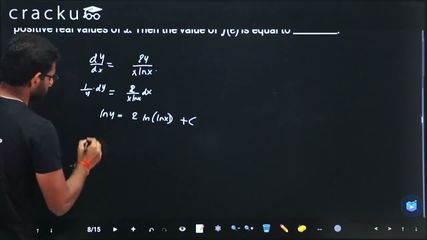
Click on the Email ☝️ to Watch the Video Solution
Create a FREE account and get:
_1.webp)

Educational materials for JEE preparation

Ask our AI anything

AI can make mistakes. Please verify important information.
AI can make mistakes. Please verify important information.
