
Join Our JEE Preparation Group
Prep with like-minded aspirants; Get access to free daily tests and study material.
Sign in
Please select an account to continue using cracku.in
↓ →
Join Our JEE Preparation Group
Prep with like-minded aspirants; Get access to free daily tests and study material.
If $$\int \frac{dx}{(x^2+x+1)^2} = a\tan^{-1}\left(\frac{2x+1}{\sqrt{3}}\right) + b\left(\frac{2x+1}{x^2+x+1}\right) + C$$,$$x > 0$$ where $$C$$ is the constant of integration, then the value of $$9\left(\sqrt{3}a + b\right)$$ is equal to _________.
Correct Answer: 15
We begin with the information that
$$\int \frac{dx}{(x^{2}+x+1)^{2}} =a\tan^{-1}\!\left(\frac{2x+1}{\sqrt{3}}\right) +b\left(\frac{2x+1}{x^{2}+x+1}\right)+C,$$
where $$C$$ is the constant of integration. If we denote the right-hand side (without the constant) by $$F(x)$$, then by the Fundamental Theorem of Calculus we must have
$$F'(x)=\frac{d}{dx}\bigl[F(x)\bigr] =\frac{1}{(x^{2}+x+1)^{2}}.$$
So let us differentiate $$F(x)$$ term by term and equate the result to the required integrand.
First term: We recall the rule
$$\frac{d}{dx}\Bigl[\tan^{-1}(u)\Bigr]=\frac{u'}{1+u^{2}}.$$
Here $$u=\dfrac{2x+1}{\sqrt{3}},$$ so $$u'=\dfrac{2}{\sqrt{3}}.$$ Hence
$$\frac{d}{dx}\!\left[a\tan^{-1}\!\left(\frac{2x+1}{\sqrt{3}}\right)\right] =a\;\frac{\dfrac{2}{\sqrt{3}}}{1+\left(\dfrac{2x+1}{\sqrt{3}}\right)^{2}} =\frac{2a}{\sqrt{3}}\; \frac{1}{\dfrac{3+(2x+1)^{2}}{3}} =\frac{6a}{\sqrt{3}\,\bigl[(2x+1)^{2}+3\bigr]}.$$
We observe that
$$(2x+1)^{2}+3=4x^{2}+4x+4=4(x^{2}+x+1).$$
Therefore the derivative of the first term simplifies to
$$\frac{6a}{\sqrt{3}}\;\frac{1}{4(x^{2}+x+1)} =\frac{3a}{2\sqrt{3}}\;\frac{1}{x^{2}+x+1}.$$
Second term: Write $$g(x)=\dfrac{2x+1}{x^{2}+x+1}.$$ We apply the Quotient Rule, which states
$$\frac{d}{dx}\biggl[\frac{p}{q}\biggr]=\frac{p'q-p\,q'}{q^{2}}.$$
Here $$p=2x+1\;(\Rightarrow p'=2)$$ and $$q=x^{2}+x+1\;(\Rightarrow q'=2x+1).$$ Thus
$$g'(x)=\frac{2(x^{2}+x+1)-(2x+1)(2x+1)}{(x^{2}+x+1)^{2}} =\frac{2x^{2}+2x+2-\bigl(4x^{2}+4x+1\bigr)} {(x^{2}+x+1)^{2}} =\frac{-2x^{2}-2x+1}{(x^{2}+x+1)^{2}}.$$
Multiplying by the constant $$b$$ we obtain
$$\frac{d}{dx}\!\left[b\;\frac{2x+1}{x^{2}+x+1}\right] =b\;\frac{-2x^{2}-2x+1}{(x^{2}+x+1)^{2}}.$$
Combining the two derivatives we have
$$F'(x)=\frac{3a}{2\sqrt{3}}\;\frac{1}{x^{2}+x+1} +b\;\frac{-2x^{2}-2x+1}{(x^{2}+x+1)^{2}}.$$
This expression must equal the given integrand
$$\frac{1}{(x^{2}+x+1)^{2}}.$$
To compare the two, multiply every term by $$(x^{2}+x+1)^{2}$$ so that denominators disappear:
$$\frac{3a}{2\sqrt{3}}\bigl(x^{2}+x+1\bigr) +b\bigl(-2x^{2}-2x+1\bigr)=1.$$
Because this identity must hold for every real $$x$$, the coefficients of the like powers of $$x$$ on both sides must be identical. Write the left-hand side explicitly as a polynomial:
$$\left(\frac{3a}{2\sqrt{3}}\right)x^{2} +\left(\frac{3a}{2\sqrt{3}}\right)x +\left(\frac{3a}{2\sqrt{3}}\right) -2bx^{2}-2bx+b =1.$$
Now equate coefficients.
Coefficient of $$x^{2}\!:$$
$$\frac{3a}{2\sqrt{3}}-2b=0.$$
Coefficient of $$x\!:$$
$$\frac{3a}{2\sqrt{3}}-2b=0.$$
(This is the same equation again, as expected.)
Constant term:
$$\frac{3a}{2\sqrt{3}}+b=1.$$
From the first equation we obtain
$$\frac{3a}{2\sqrt{3}}=2b\quad\Longrightarrow\quad 3a=4b\sqrt{3}.$$
Substitute $$\dfrac{3a}{2\sqrt{3}}=2b$$ into the constant term equation:
$$2b+b=1\quad\Longrightarrow\quad 3b=1\quad\Longrightarrow\quad b=\frac13.$$
Using $$b=\dfrac13$$ in $$3a=4b\sqrt{3}$$ gives
$$3a=4\left(\frac13\right)\sqrt{3} =\frac{4\sqrt{3}}{3} \quad\Longrightarrow\quad a=\frac{4\sqrt{3}}{9}.$$
At this stage we know
$$a=\frac{4\sqrt{3}}{9},\qquad b=\frac13.$$
The required numerical expression is
$$9\bigl(\sqrt{3}\,a+b\bigr) =9\!\left(\sqrt{3}\cdot\frac{4\sqrt{3}}{9} +\frac13\right) =9\!\left(\frac{4\cdot3}{9}+\frac13\right) =9\!\left(\frac43+\frac13\right) =9\!\left(\frac53\right)=15.$$
Hence, the correct answer is Option 15.
Was this solution helpful?
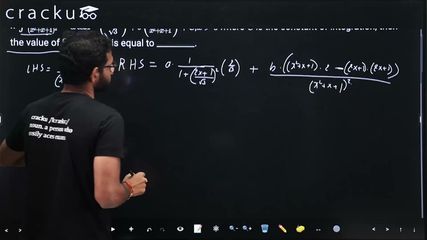
Click on the Email ☝️ to Watch the Video Solution
Create a FREE account and get:
_1.webp)

Educational materials for JEE preparation

Ask our AI anything

AI can make mistakes. Please verify important information.
AI can make mistakes. Please verify important information.
