
Join Our JEE Preparation Group
Prep with like-minded aspirants; Get access to free daily tests and study material.
Sign in
Please select an account to continue using cracku.in
↓ →
Join Our JEE Preparation Group
Prep with like-minded aspirants; Get access to free daily tests and study material.
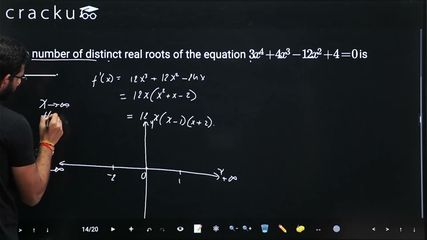
The number of distinct real roots of the equation $$3x^4 + 4x^3 - 12x^2 + 4 = 0$$ is _________.
Correct Answer: 4
We begin with the quartic equation
$$3x^{4}+4x^{3}-12x^{2}+4=0.$$
To determine how many real roots it possesses, we try to factor it into a product of two quadratic polynomials having real coefficients. Let us assume
$$3x^{4}+4x^{3}-12x^{2}+4=(x^{2}+ax+b)\,(3x^{2}+cx+d).$$
We now expand the right-hand side and equate coefficients term by term. Multiplying gives
$$\begin{aligned} (x^{2}+ax+b)\,(3x^{2}+cx+d) &=x^{2}(3x^{2}+cx+d)+ax(3x^{2}+cx+d)+b(3x^{2}+cx+d)\\ &=3x^{4}+cx^{3}+dx^{2}+3ax^{3}+acx^{2}+adx+3bx^{2}+bcx+bd\\ &=3x^{4}+(c+3a)x^{3}+(d+ac+3b)x^{2}+(ad+bc)x+bd. \end{aligned}$$
Comparing this with the original polynomial, we obtain the system
$$\begin{cases} c+3a=4,\\[4pt] d+ac+3b=-12,\\[4pt] ad+bc=0,\\[4pt] bd=4. \end{cases}$$
The last equation $$bd=4$$ suggests the integer possibilities $$(b,d)=(\pm1,\pm4)$$ or $$(\pm2,\pm2)$$. We test $$(b,d)=(-2,-2)$$ because it satisfies $$bd=4$$ and keeps the numbers small.
With $$b=-2$$ and $$d=-2$$, the third equation $$ad+bc=0$$ becomes
$$(-2)a+(-2)c=0 \;\Longrightarrow\; -2(a+c)=0 \;\Longrightarrow\; a+c=0 \;\Longrightarrow\; c=-a.$$
Substituting $$c=-a$$ into $$c+3a=4$$ gives
$$-a+3a=4 \;\Longrightarrow\; 2a=4 \;\Longrightarrow\; a=2,$$
and hence $$c=-2$$.
Finally, we check the second equation $$d+ac+3b=-12$$:
$$-2+(2)(-2)+3(-2)=-2-4-6=-12,$$
which is satisfied exactly. Thus our choice is consistent, and the factorisation is confirmed:
$$3x^{4}+4x^{3}-12x^{2}+4=(x^{2}+2x-2)\,(3x^{2}-2x-2).$$
Setting each quadratic factor equal to zero gives the roots.
For the first quadratic $$x^{2}+2x-2=0,$$ we apply the quadratic formula $$x=\dfrac{-2\pm\sqrt{(2)^{2}-4(1)(-2)}}{2(1)}=\dfrac{-2\pm\sqrt{4+8}}{2}=\dfrac{-2\pm\sqrt{12}}{2}=\dfrac{-2\pm2\sqrt{3}}{2}=-1\pm\sqrt{3}.$$
So we obtain two real roots $$x=-1+\sqrt{3}\quad\text{and}\quad x=-1-\sqrt{3}.$$
For the second quadratic $$3x^{2}-2x-2=0,$$ the quadratic formula gives
$$x=\dfrac{2\pm\sqrt{(-2)^{2}-4(3)(-2)}}{2\cdot3}=\dfrac{2\pm\sqrt{4+24}}{6}=\dfrac{2\pm\sqrt{28}}{6}=\dfrac{2\pm2\sqrt{7}}{6}=\dfrac{1\pm\sqrt{7}}{3}.$$
Thus we obtain two more real roots $$x=\dfrac{1+\sqrt{7}}{3}\quad\text{and}\quad x=\dfrac{1-\sqrt{7}}{3}.$$
All four solutions are real, and it is easy to see that they are distinct because the numerical values $$-1\pm\sqrt{3}$$ and $$(1\pm\sqrt{7})/3$$ are pairwise different.
Therefore the equation possesses four distinct real roots.
So, the answer is $$4$$.
Click on the Email ☝️ to Watch the Video Solution
Create a FREE account and get:
_1.webp)

Educational materials for JEE preparation

Ask our AI anything

AI can make mistakes. Please verify important information.
AI can make mistakes. Please verify important information.


