
Join Our JEE Preparation Group
Prep with like-minded aspirants; Get access to free daily tests and study material.
Sign in
Please select an account to continue using cracku.in
↓ →
Join Our JEE Preparation Group
Prep with like-minded aspirants; Get access to free daily tests and study material.
Let $$A = \{1, 2, 3, \ldots, 20\}$$. Let $$R_1$$ and $$R_2$$ be two relations on $$A$$ such that $$R_1 = \{(a,b) : b \text{ is divisible by } a\}$$ and $$R_2 = \{(a,b) : a \text{ is an integral multiple of } b\}$$. Then, number of elements in $$R_1 - R_2$$ is equal to:
Correct Answer: 46
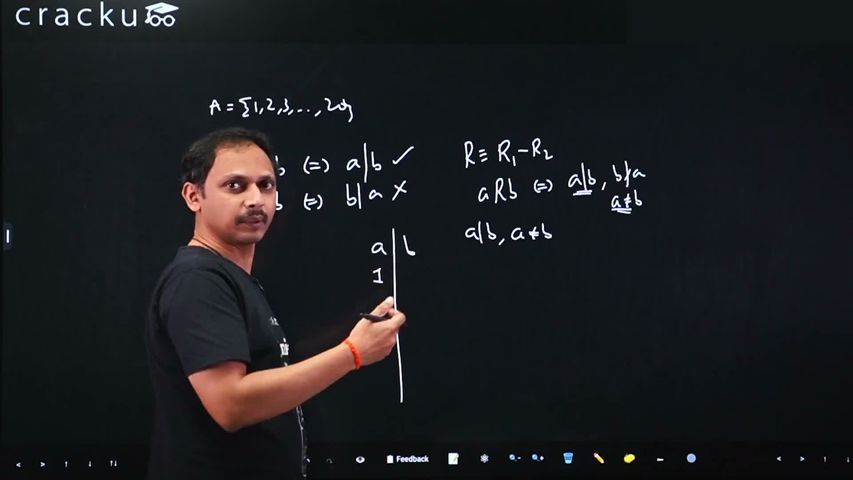
We have $$A = \{1, 2, 3, \ldots, 20\}$$, $$R_1 = \{(a,b) : b \text{ is divisible by } a\}$$, and $$R_2 = \{(a,b) : a \text{ is an integral multiple of } b\}$$.
In this context, $$(a,b)\in R_1$$ means $$a\mid b$$, while $$(a,b)\in R_2$$ means $$b\mid a$$, so that $$R_2 = \{(a,b) : a \text{ is divisible by } b\}$$.
The intersection $$R_1 \cap R_2$$ consists of all pairs $$(a,b)$$ for which $$a\mid b$$ and $$b\mid a$$, forcing $$a=b$$. Hence $$R_1 \cap R_2 = \{(a,a) : a \in A\}$$, which has 20 elements.
To find $$|R_1|$$, note that for each $$a$$ the number of multiples of $$a$$ in $$\{1,\dots,20\}$$ is $$\lfloor 20/a \rfloor$$, giving
$$|R_1| = \sum_{a=1}^{20} \lfloor 20/a \rfloor = 20 + 10 + 6 + 5 + 4 + 3 + 2 + 2 + 2 + 2 + 1 + 1 + 1 + 1 + 1 + 1 + 1 + 1 + 1 + 1 = 66$$
Since $$R_1 - R_2 = R_1 \setminus (R_1 \cap R_2)$$, we obtain
$$|R_1 - R_2| = |R_1| - |R_1 \cap R_2| = 66 - 20 = 46$$
The answer is 46.
Was this solution helpful?
Click on the Email ☝️ to Watch the Video Solution
Create a FREE account and get:
_1.webp)

Educational materials for JEE preparation

Ask our AI anything

AI can make mistakes. Please verify important information.
AI can make mistakes. Please verify important information.
