
Join Our JEE Preparation Group
Prep with like-minded aspirants; Get access to free daily tests and study material.
Sign in
Please select an account to continue using cracku.in
↓ →
Join Our JEE Preparation Group
Prep with like-minded aspirants; Get access to free daily tests and study material.
The number of elements in the set $$S = \{(x,y,z) : x,y,z \in \mathbb{Z}, x + 2y + 3z = 42, x,y,z \geq 0\}$$ equals:
Correct Answer: 169
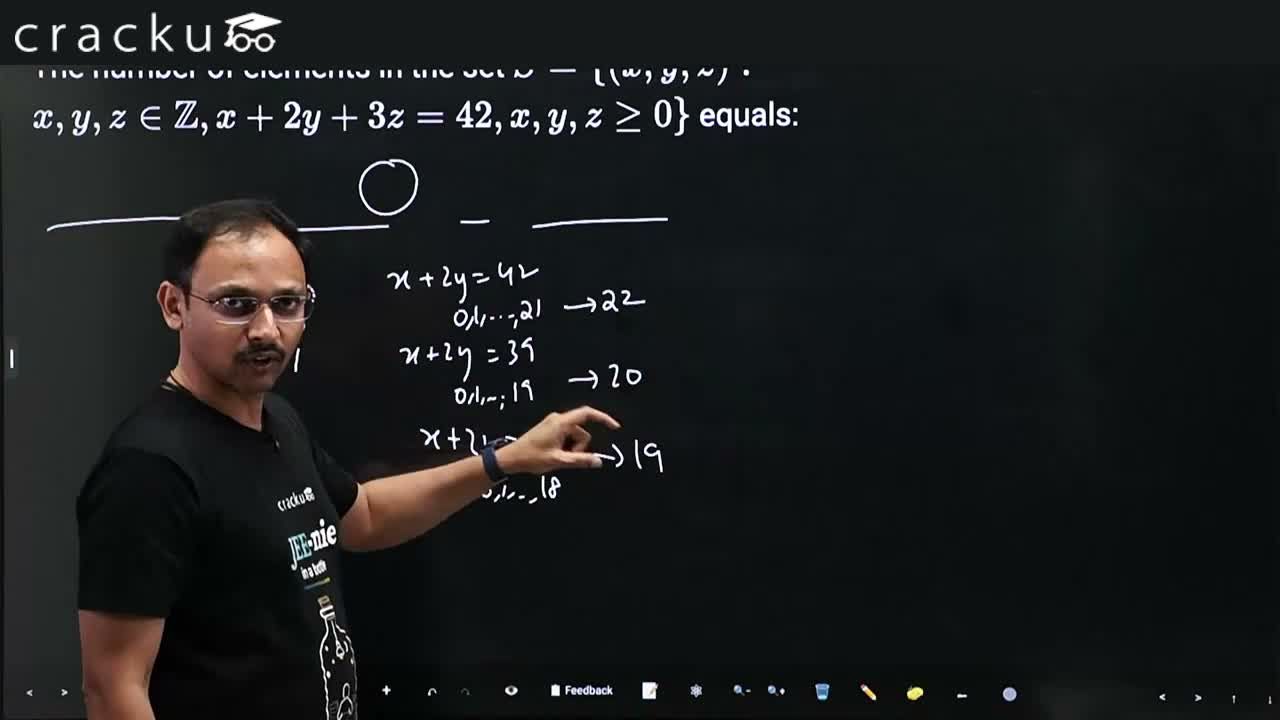
Find the number of elements in $$S = \{(x,y,z): x,y,z \in \mathbb{Z}, x+2y+3z = 42, x,y,z \geq 0\}$$. We seek nonnegative integer solutions to $$x + 2y + 3z = 42$$. For each integer $$z$$ with $$0 \le z \le 14$$ (since $$3z \le 42$$), we set $$R = 42 - 3z$$ and count the nonnegative solutions to $$x + 2y = R$$. Because $$y$$ may range from $$0$$ to $$\lfloor R/2 \rfloor$$, and for each $$y$$ the corresponding $$x = R - 2y$$ is nonnegative, there are $$\lfloor R/2 \rfloor + 1$$ solutions for each fixed $$z$$.
Specifically, when $$z=0$$, we have $$R=42$$ and count $$21+1=22$$; when $$z=1$$, $$R=39$$ giving $$19+1=20$$; when $$z=2$$, $$R=36$$ giving $$18+1=19$$; when $$z=3$$, $$R=33$$ giving $$16+1=17$$; when $$z=4$$, $$R=30$$ giving $$15+1=16$$; when $$z=5$$, $$R=27$$ giving $$13+1=14$$; when $$z=6$$, $$R=24$$ giving $$12+1=13$$; when $$z=7$$, $$R=21$$ giving $$10+1=11$$; when $$z=8$$, $$R=18$$ giving $$9+1=10$$; when $$z=9$$, $$R=15$$ giving $$7+1=8$$; when $$z=10$$, $$R=12$$ giving $$6+1=7$$; when $$z=11$$, $$R=9$$ giving $$4+1=5$$; when $$z=12$$, $$R=6$$ giving $$3+1=4$$; when $$z=13$$, $$R=3$$ giving $$1+1=2$$; and when $$z=14$$, $$R=0$$ giving $$0+1=1$$ solutions.
Summing these counts for $$z=0,1,\dots,14$$ yields $$22+20+19+17+16+14+13+11+10+8+7+5+4+2+1 = 169$$. Therefore, the number of elements in $$S$$ is 169.
Was this solution helpful?
Click on the Email ☝️ to Watch the Video Solution
Create a FREE account and get:
_1.webp)

Educational materials for JEE preparation

Ask our AI anything

AI can make mistakes. Please verify important information.
AI can make mistakes. Please verify important information.
