
Join Our JEE Preparation Group
Prep with like-minded aspirants; Get access to free daily tests and study material.
Sign in
Please select an account to continue using cracku.in
↓ →
Join Our JEE Preparation Group
Prep with like-minded aspirants; Get access to free daily tests and study material.
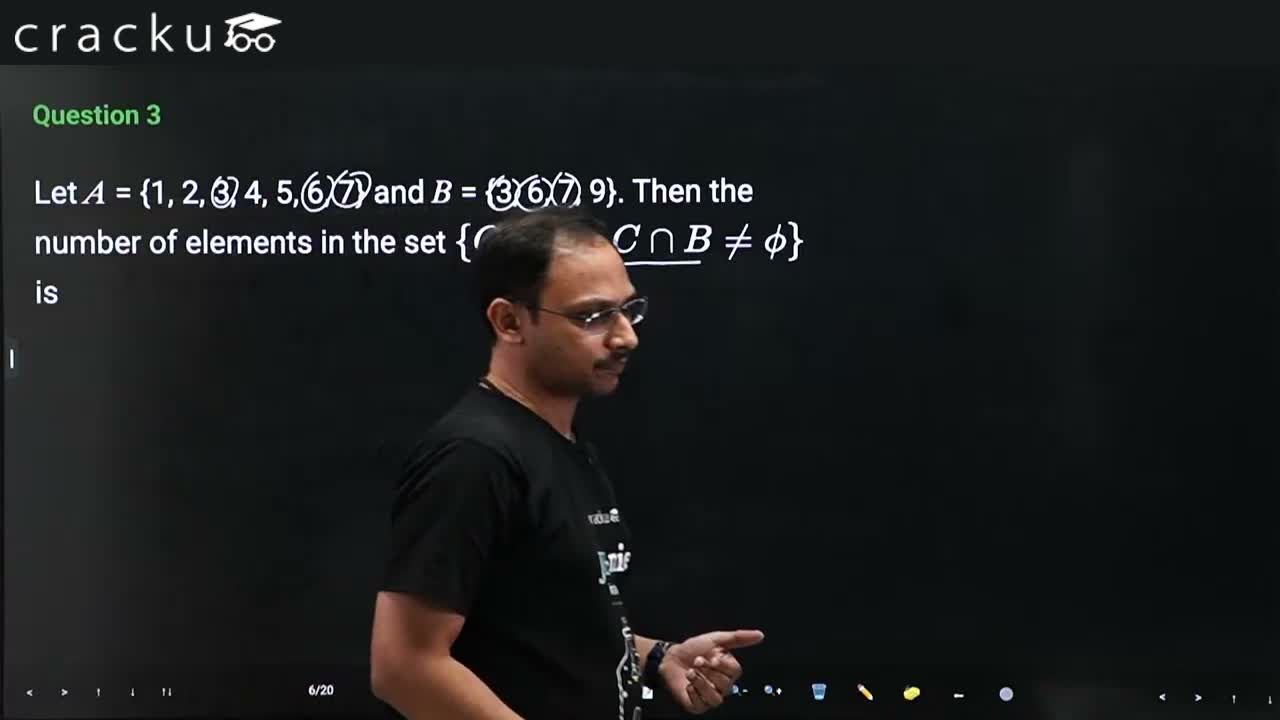
Let 𝐴 = {1, 2, 3, 4, 5, 6, 7} and 𝐵 = {3, 6, 7, 9}. Then the number of elements in the set $$\{C \subseteq A : C \cap B \neq \phi\}$$ is
Correct Answer: 112
The set $$A = \{1, 2, 3, 4, 5, 6, 7\}$$ has 7 elements, so the total number of subsets of $$A$$ is $$2^7 = 128$$.
The set $$B = \{3, 6, 7, 9\}$$. However, since $$C \subseteq A$$, the elements of $$C$$ are only from $$A$$, and $$9 \notin A$$. Therefore, $$C \cap B$$ depends only on the elements common to both $$A$$ and $$B$$, which are $$\{3, 6, 7\}$$. Let $$D = A \cap B = \{3, 6, 7\}$$, so $$|D| = 3$$.
The condition $$C \cap B \neq \phi$$ is equivalent to $$C \cap D \neq \phi$$, meaning $$C$$ must contain at least one element from $$D$$.
The subsets of $$A$$ that do not contain any element from $$D$$ are exactly the subsets of $$A - D$$. Since $$A - D = \{1, 2, 4, 5\}$$ has 4 elements, the number of such subsets is $$2^4 = 16$$.
Therefore, the number of subsets $$C \subseteq A$$ such that $$C \cap B \neq \phi$$ is the total number of subsets minus the subsets with no elements from $$D$$:
$$128 - 16 = 112$$
Alternatively, the number of non-empty subsets of $$D$$ is $$2^3 - 1 = 7$$. For each such subset, any subset of $$A - D$$ (which has $$2^4 = 16$$ subsets) can be combined. Thus, the total is $$7 \times 16 = 112$$.
Both methods confirm that the number of elements in the set $$\{C \subseteq A : C \cap B \neq \phi\}$$ is 112.
Was this solution helpful?
Click on the Email ☝️ to Watch the Video Solution
Create a FREE account and get:
_1.webp)

Educational materials for JEE preparation

Ask our AI anything

AI can make mistakes. Please verify important information.
AI can make mistakes. Please verify important information.
