
Join Our JEE Preparation Group
Prep with like-minded aspirants; Get access to free daily tests and study material.
Sign in
Please select an account to continue using cracku.in
↓ →
Join Our JEE Preparation Group
Prep with like-minded aspirants; Get access to free daily tests and study material.
The mean and standard deviation of 40 observations are 30 and 5 respectively. It was noticed that two of these observations 12 and 10 were wrongly recorded. If $$\sigma$$ is the standard deviation of the data after omitting the two wrong observations from the data, then $$38\sigma^2$$ is equal to ______.
Correct Answer: 238
We have 40 observations with mean 30 and standard deviation 5. Two wrong observations (12 and 10) are removed. We need to find $$38\sigma^2$$ for the remaining 38 observations.
$$\bar{x} = 30 \implies \sum x_i = 40 \times 30 = 1200$$
$$\text{SD} = 5 \implies \text{Var} = 25$$
$$\text{Var} = \dfrac{\sum x_i^2}{40} - \bar{x}^2 = 25$$
$$\dfrac{\sum x_i^2}{40} = 25 + 900 = 925$$
$$\sum x_i^2 = 37000$$
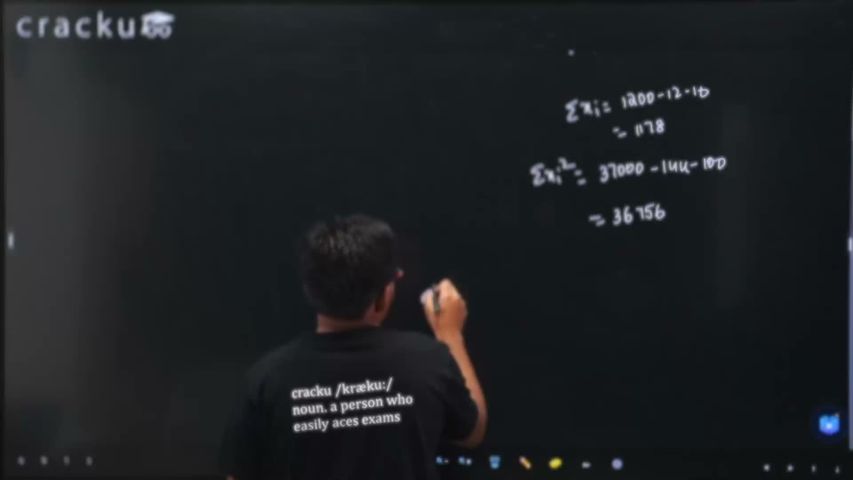
$$\sum x_i' = 1200 - 12 - 10 = 1178$$
$$\sum (x_i')^2 = 37000 - 144 - 100 = 36756$$
$$\bar{x}' = \dfrac{1178}{38} = 31$$
$$\sigma^2 = \dfrac{\sum (x_i')^2}{38} - (\bar{x}')^2 = \dfrac{36756}{38} - 961 = 967.26... - 961$$
Let us compute exactly:
$$\dfrac{36756}{38} = \dfrac{36756}{38} = 967 + \dfrac{10}{38} = 967 + \dfrac{5}{19}$$
$$\sigma^2 = 967 + \dfrac{5}{19} - 961 = 6 + \dfrac{5}{19} = \dfrac{114 + 5}{19} = \dfrac{119}{19}$$
$$38\sigma^2 = 38 \times \dfrac{119}{19} = 2 \times 119 = 238$$
The correct answer is $$\boxed{238}$$.
Was this solution helpful?
Click on the Email ☝️ to Watch the Video Solution
Create a FREE account and get:
_1.webp)

Educational materials for JEE preparation

Ask our AI anything

AI can make mistakes. Please verify important information.
AI can make mistakes. Please verify important information.
