
Join Our JEE Preparation Group
Prep with like-minded aspirants; Get access to free daily tests and study material.
Sign in
Please select an account to continue using cracku.in
↓ →
Join Our JEE Preparation Group
Prep with like-minded aspirants; Get access to free daily tests and study material.
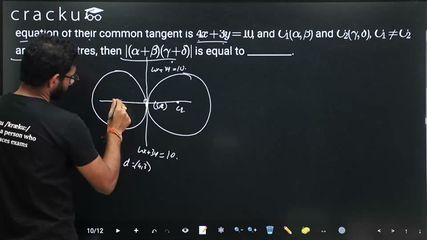
Two circles each of radius 5 units touch each other at the point $$(1, 2)$$. If the equation of their common tangent is $$4x + 3y = 10$$, and $$C_1(\alpha, \beta)$$ and $$C_2(\gamma, \delta)$$, $$C_1 \neq C_2$$ are their centres, then $$|(\alpha + \beta)(\gamma + \delta)|$$ is equal to _________.
Correct Answer: 40
We are told that the two circles have equal radii $$r = 5$$ and touch each other at the point $$P(1,\,2)$$. Their common tangent at the point of contact is given by the straight-line equation $$4x + 3y = 10$$.
For any circle, the radius drawn to the point of tangency is perpendicular to the tangent. Hence the vector along the radius $$\overrightarrow{PC}$$ must be parallel to the normal vector of the tangent. Because the tangent is $$4x + 3y - 10 = 0$$, its normal vector is $$(4,\,3)$$. Therefore every centre lies on the line that passes through $$P(1,\,2)$$ in the direction of $$(4,\,3)$$.
Writing the parametric form of this line, we have $$x = 1 + 4t,\qquad y = 2 + 3t \;,$$ where $$t$$ is a real parameter. Eliminating $$t$$ gives the symmetric form $$\frac{x - 1}{4} = \frac{y - 2}{3}.$$ This is the straight line on which both centres must lie.
Next we use the fact that the distance between a centre and the point of contact is exactly the radius. The distance formula between two points $$(x_1,\,y_1)$$ and $$(x_2,\,y_2)$$ is $$\sqrt{(x_2 - x_1)^2 + (y_2 - y_1)^2}.$$ Setting this distance equal to 5, we obtain $$\sqrt{\,(x - 1)^2 + (y - 2)^2\,} = 5.$$
Because the centres lie on the line found above, let us substitute the parametric coordinates $$x = 1 + 4t,\; y = 2 + 3t$$ into the distance condition:
$$\sqrt{\,(1 + 4t - 1)^2 + (2 + 3t - 2)^2\,} = \sqrt{\,(4t)^2 + (3t)^2\,} = \sqrt{\,16t^2 + 9t^2\,} = \sqrt{25t^2} = 5|t|.$$
We set this equal to 5, obtaining $$5|t| = 5 \;\Longrightarrow\; |t| = 1.$$ Thus the parameter has two possible values: $$t = 1$$ and $$t = -1$$. These correspond to the two different centres situated on opposite sides of the point of contact.
For $$t = 1$$, we find $$C_1(\alpha,\beta) = (1 + 4\cdot1,\; 2 + 3\cdot1) = (5,\,5).$$ Hence $$\alpha = 5,\; \beta = 5.$$
For $$t = -1$$, we find $$C_2(\gamma,\delta) = (1 + 4\cdot(-1),\; 2 + 3\cdot(-1)) = (-3,\,-1).$$ Hence $$\gamma = -3,\; \delta = -1.$$
We are required to evaluate the absolute value $$\left|(\alpha + \beta)(\gamma + \delta)\right|.$$ First compute each sum:
$$\alpha + \beta = 5 + 5 = 10,$$ $$\gamma + \delta = (-3) + (-1) = -4.$$
Multiplying, we get $$(\alpha + \beta)(\gamma + \delta) = 10 \times (-4) = -40.$$ Taking the absolute value, $$\left| -40 \right| = 40.$$
So, the answer is $$40$$.
Was this solution helpful?
Click on the Email ☝️ to Watch the Video Solution
Create a FREE account and get:
_1.webp)

Educational materials for JEE preparation

Ask our AI anything

AI can make mistakes. Please verify important information.
AI can make mistakes. Please verify important information.
