
Join Our JEE Preparation Group
Prep with like-minded aspirants; Get access to free daily tests and study material.
Sign in
Please select an account to continue using cracku.in
↓ →
Join Our JEE Preparation Group
Prep with like-minded aspirants; Get access to free daily tests and study material.
The area (in sq. units) of the region bounded by the curve $$x^2 = 4y$$ and the straight line $$x = 4y - 2$$ is:
We have the parabola $$x^{2}=4y$$, which can be rewritten as $$y=\dfrac{x^{2}}{4}$$, opening upward along the positive $$y$$-axis.
The straight line is given by $$x=4y-2$$. Solving this for $$y$$ gives $$y=\dfrac{x+2}{4}$$.
To find the enclosed region, we first locate the intersection points of the two curves. At their common points we must have equally valued ordinates, so we set
$$\dfrac{x^{2}}{4}=\dfrac{x+2}{4}.$$
Multiplying both sides by $$4$$ removes the denominators:
$$x^{2}=x+2.$$
Bringing all terms to one side yields
$$x^{2}-x-2=0.$$
Factoring,
$$(x-2)(x+1)=0,$$
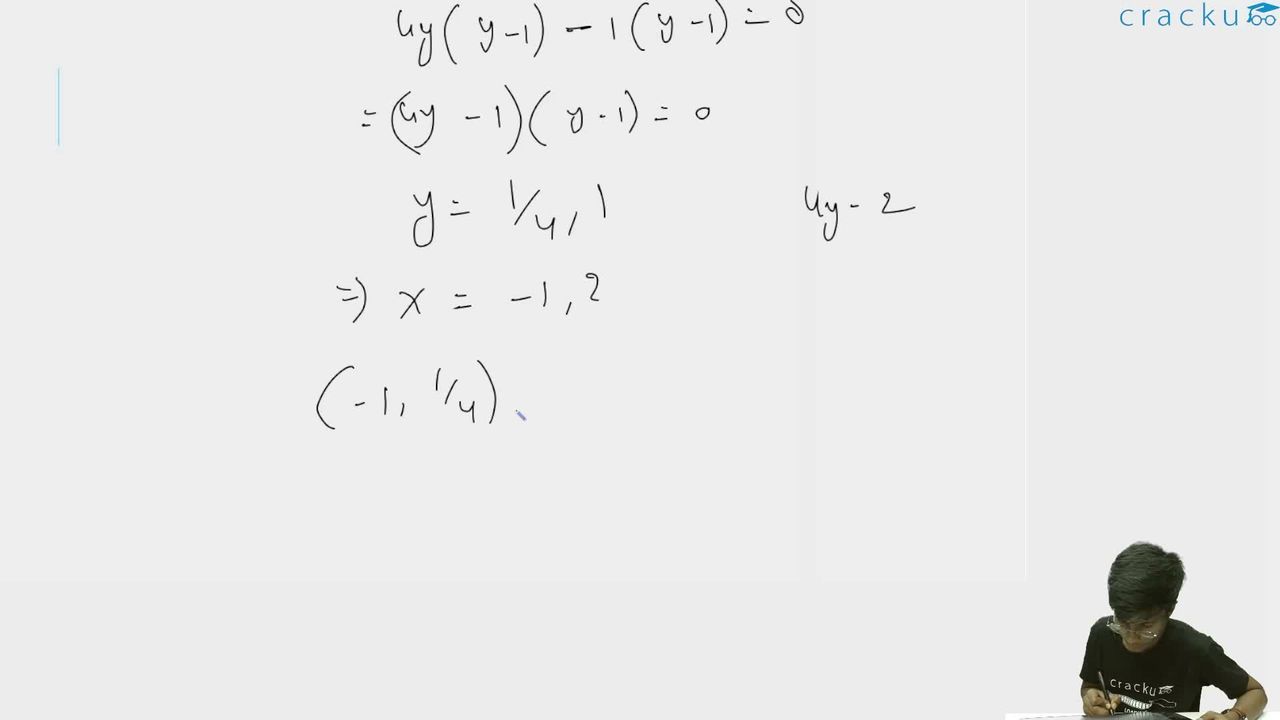
which gives the $$x$$-coordinates of intersection as $$x=2$$ and $$x=-1$$.
Substituting these back into either expression for $$y$$ (say, $$y=\dfrac{x^{2}}{4}$$):
For $$x=2$$, $$y=\dfrac{2^{2}}{4}=1.$$
For $$x=-1$$, $$y=\dfrac{(-1)^{2}}{4}=\dfrac14.$$
Thus the curves meet at the points $$(-1,\dfrac14)$$ and $$(2,1).$$
Next we decide which curve lies above the other between these $$x$$-values. Choosing a convenient test value, say $$x=0$$, gives
Parabola ordinate: $$y=\dfrac{0^{2}}{4}=0,$$
Line ordinate: $$y=\dfrac{0+2}{4}=0.5.$$
Since $$0.5>0$$, the line lies above the parabola in the interval $$-1\le x\le 2$$. Therefore, while integrating with respect to $$x$$, the integrand is “upper curve minus lower curve”:
$$\text{Area}= \int_{-1}^{2}\left[\dfrac{x+2}{4}-\dfrac{x^{2}}{4}\right]dx =\dfrac14\int_{-1}^{2}\bigl(x+2-x^{2}\bigr)\,dx.$$
Expanding inside the integral gives
$$\dfrac14\int_{-1}^{2}\left(-x^{2}+x+2\right)dx.$$
We now integrate term by term. The antiderivative of $$-x^{2}$$ is $$-\dfrac{x^{3}}{3}$$; that of $$x$$ is $$\dfrac{x^{2}}{2}$$; and that of the constant $$2$$ is $$2x$$. Hence
$$\int\left(-x^{2}+x+2\right)dx = -\dfrac{x^{3}}{3}+\dfrac{x^{2}}{2}+2x.$$
Evaluating this from $$x=-1$$ to $$x=2$$ we get
At $$x=2$$: $$-\dfrac{(2)^{3}}{3}+\dfrac{(2)^{2}}{2}+2(2) =-\dfrac{8}{3}+2+4 =-\dfrac{8}{3}+6 =\dfrac{10}{3}.$$
At $$x=-1$$: $$-\dfrac{(-1)^{3}}{3}+\dfrac{(-1)^{2}}{2}+2(-1) =-\dfrac{-1}{3}+\dfrac{1}{2}-2 =\dfrac{1}{3}+\dfrac{1}{2}-2 =\dfrac{2+3-12}{6} =-\dfrac{7}{6}.$$
The definite integral value is therefore
$$\dfrac{10}{3}-\Bigl(-\dfrac{7}{6}\Bigr)=\dfrac{10}{3}+\dfrac{7}{6} =\dfrac{20}{6}+\dfrac{7}{6}=\dfrac{27}{6}=\dfrac{9}{2}.$$
Finally, multiplying by the factor $$\dfrac14$$ that we took outside earlier, the required area is
$$\dfrac14\times\dfrac{9}{2}=\dfrac{9}{8}\text{ square units}.$$
Hence, the correct answer is Option B.
Was this solution helpful?
Click on the Email ☝️ to Watch the Video Solution
Create a FREE account and get:
_1.webp)

Educational materials for JEE preparation

Ask our AI anything

AI can make mistakes. Please verify important information.
AI can make mistakes. Please verify important information.
