
Join Our JEE Preparation Group
Prep with like-minded aspirants; Get access to free daily tests and study material.
Sign in
Please select an account to continue using cracku.in
↓ →
Join Our JEE Preparation Group
Prep with like-minded aspirants; Get access to free daily tests and study material.
Let the foci and length of the latus rectum of an ellipse $$\frac{x^2}{a^2} + \frac{y^2}{b^2} = 1, a > b$$ be $$(\pm 5, 0)$$ and $$\sqrt{50}$$, respectively. Then, the square of the eccentricity of the hyperbola $$\frac{x^2}{b^2} - \frac{y^2}{a^2 b^2} = 1$$ equals
Correct Answer: 51
For the ellipse $$\dfrac{x^2}{a^2}+\dfrac{y^2}{b^2}=1,\; a\gt b$$ the standard facts are
• Distance of each focus from the centre: $$c,\; c^2=a^2-b^2$$
• Length of the latus-rectum: $$L=\dfrac{2b^2}{a}$$
The question gives
$$c=5 \;\; \bigl(\text{foci } (\pm5,0)\bigr), \qquad L=\sqrt{50}$$
Step 1: Use the latus-rectum length.
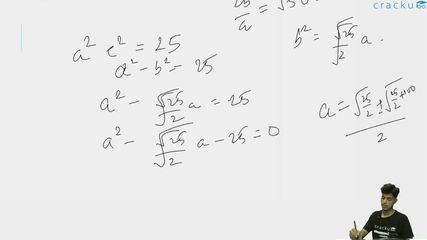
$$\dfrac{2b^2}{a}= \sqrt{50}\;\; \Longrightarrow\;\; b^2=\dfrac{a\sqrt{50}}{2} \quad -(1)$$
Step 2: Use the focus relation.
$$a^2-b^2=25 \quad -(2)$$
Step 3: Substitute $$b^2$$ from $$(1)$$ into $$(2)$$.
$$a^2-\dfrac{a\sqrt{50}}{2}=25$$
Multiply by $$2$$:
$$2a^2-a\sqrt{50}-50=0$$
Step 4: Solve the quadratic in $$a$$.
Using the quadratic formula, $$a=\dfrac{\sqrt{50}\pm\sqrt{(\sqrt{50})^2-4(2)(-50)}}{4}$$
Discriminant: $$(\sqrt{50})^2-4(2)(-50)=50+400=450$$, so $$\sqrt{450}=3\sqrt{50}$$.
Hence $$a=\dfrac{\sqrt{50}\pm3\sqrt{50}}{4}$$. Since $$a\gt0$$, take the positive sign:
$$a=\sqrt{50}, \qquad\Longrightarrow\qquad a^2=50$$
Step 5: Eccentricity of the hyperbola.
The given hyperbola is $$\dfrac{x^2}{b^2}-\dfrac{y^2}{a^2b^2}=1$$
Compare with the standard form $$\dfrac{x^2}{A^2}-\dfrac{y^2}{B^2}=1$$, where
$$A^2=b^2, \qquad B^2=a^2b^2$$
For a hyperbola, $$e^2=1+\dfrac{B^2}{A^2}$$.
Therefore
$$e_{\text{hyper}}^{\,2}=1+\dfrac{a^2b^2}{b^2}=1+a^2$$
Using $$a^2=50$$, we get
$$e_{\text{hyper}}^{\,2}=1+50=51$$
Thus, the square of the eccentricity of the hyperbola equals $$51$$.
Was this solution helpful?
Click on the Email ☝️ to Watch the Video Solution
Create a FREE account and get:
_1.webp)

Educational materials for JEE preparation

Ask our AI anything

AI can make mistakes. Please verify important information.
AI can make mistakes. Please verify important information.
