
Join Our JEE Preparation Group
Prep with like-minded aspirants; Get access to free daily tests and study material.
Sign in
Please select an account to continue using cracku.in
↓ →
Join Our JEE Preparation Group
Prep with like-minded aspirants; Get access to free daily tests and study material.
Let $$E$$ be an ellipse whose axes are parallel to the co-ordinates axes, having its centre at $$(3, -4)$$, one focus at $$(4, -4)$$ and one vertex at $$(5, -4)$$. If $$mx - y = 4$$, $$m \gt 0$$ is a tangent to the ellipse $$E$$, then the value of $$5m^2$$ is equal to _________.
Correct Answer: 3
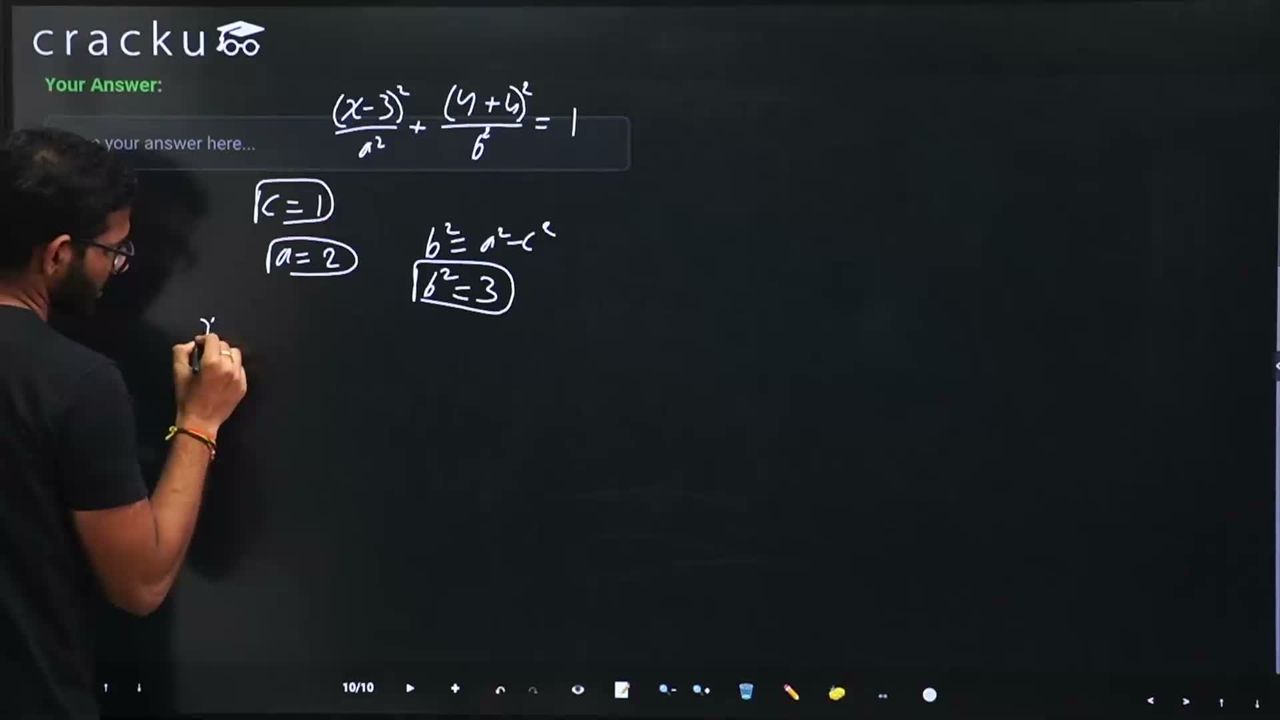
We have an ellipse whose centre is $$(3,-4)$$ and whose axes are parallel to the coordinate axes, so its equation can be written as $$\frac{(x-3)^2}{a^2}+\frac{(y+4)^2}{b^2}=1.$$ Because the given focus $$(4,-4)$$ and the given vertex $$(5,-4)$$ share the same ordinate as the centre, the major axis is clearly horizontal.
The distance from the centre to a vertex equals the semi-major axis length, so $$a = 5-3 = 2 \quad\Longrightarrow\quad a^2 = 4.$$ The distance from the centre to a focus equals the linear eccentricity, so $$c = 4-3 = 1 \quad\Longrightarrow\quad c^2 = 1.$$
For every ellipse with horizontal major axis, the relation $$c^2 = a^2 - b^2$$ holds. Substituting $$a^2 = 4$$ and $$c^2 = 1$$ we obtain $$b^2 = a^2 - c^2 = 4 - 1 = 3.$$ Hence the explicit equation of the ellipse is $$\frac{(x-3)^2}{4}+\frac{(y+4)^2}{3}=1.$$
The line $$mx - y = 4, \; m\gt 0$$ can be rewritten as $$y = mx - 4.$$ Adding 4 to both sides gives $$y + 4 = mx.$$
To check whether this line is a tangent, we substitute $$y = mx - 4$$ (equivalently $$y + 4 = mx$$) into the ellipse:
$$\frac{(x-3)^2}{4} + \frac{(mx)^2}{3} = 1.$$
Expanding $$(x-3)^2$$ yields $$x^2 - 6x + 9,$$ so $$\frac{x^2 - 6x + 9}{4} + \frac{m^2x^2}{3} = 1.$$
Multiplying every term by the L.C.M. $$12$$ clears denominators: $$3(x^2 - 6x + 9) + 4m^2x^2 = 12.$$
Simplifying term by term, $$3x^2 - 18x + 27 + 4m^2x^2 = 12.$$ Collecting like terms, $$(3 + 4m^2)x^2 - 18x + 15 = 0.$$
This quadratic in $$x$$ represents the intersection points of the line with the ellipse. For the line to be a tangent, the quadratic must have exactly one real root, so its discriminant must vanish. Using the quadratic-equation discriminant formula $$\Delta = b^2 - 4ac,$$ here $$a = 3 + 4m^2,\quad b = -18,\quad c = 15.$$
Setting the discriminant to zero: $$(-18)^2 - 4(3 + 4m^2)(15) = 0.$$ Calculating step by step, $$324 - 60(3 + 4m^2) = 0,$$ $$324 - 180 - 240m^2 = 0,$$ $$144 - 240m^2 = 0.$$
Solving for $$m^2$$: $$240m^2 = 144,$$ $$m^2 = \frac{144}{240} = \frac{3}{5}.$$
The problem asks for the value of $$5m^2,$$ so $$5m^2 = 5\left(\frac{3}{5}\right) = 3.$$
So, the answer is $$3$$.
Was this solution helpful?
Click on the Email ☝️ to Watch the Video Solution
Create a FREE account and get:
_1.webp)

Educational materials for JEE preparation

Ask our AI anything

AI can make mistakes. Please verify important information.
AI can make mistakes. Please verify important information.
