
Join Our JEE Preparation Group
Prep with like-minded aspirants; Get access to free daily tests and study material.
Sign in
Please select an account to continue using cracku.in
↓ →
Join Our JEE Preparation Group
Prep with like-minded aspirants; Get access to free daily tests and study material.
Let $$A = \{n \in N \mid n^2 \leq n + 10000\}$$, $$B = \{3k + 1 \mid k \in N\}$$ and $$C = \{2k \mid k \in N\}$$, then the sum of all the elements of the set $$A \cap (B - C)$$ is equal to _________.
Correct Answer: 832
First, recall that in JEE problems the symbol $$N$$ denotes the set of positive integers $$\{1,2,3,\ldots\}$$; the number $$0$$ is not included.
We begin with the description of the set $$A$$. By definition
$$A=\{\,n\in N\mid n^{2}\le n+10000\,\}.$$
To find all such $$n$$ we rearrange the inequality:
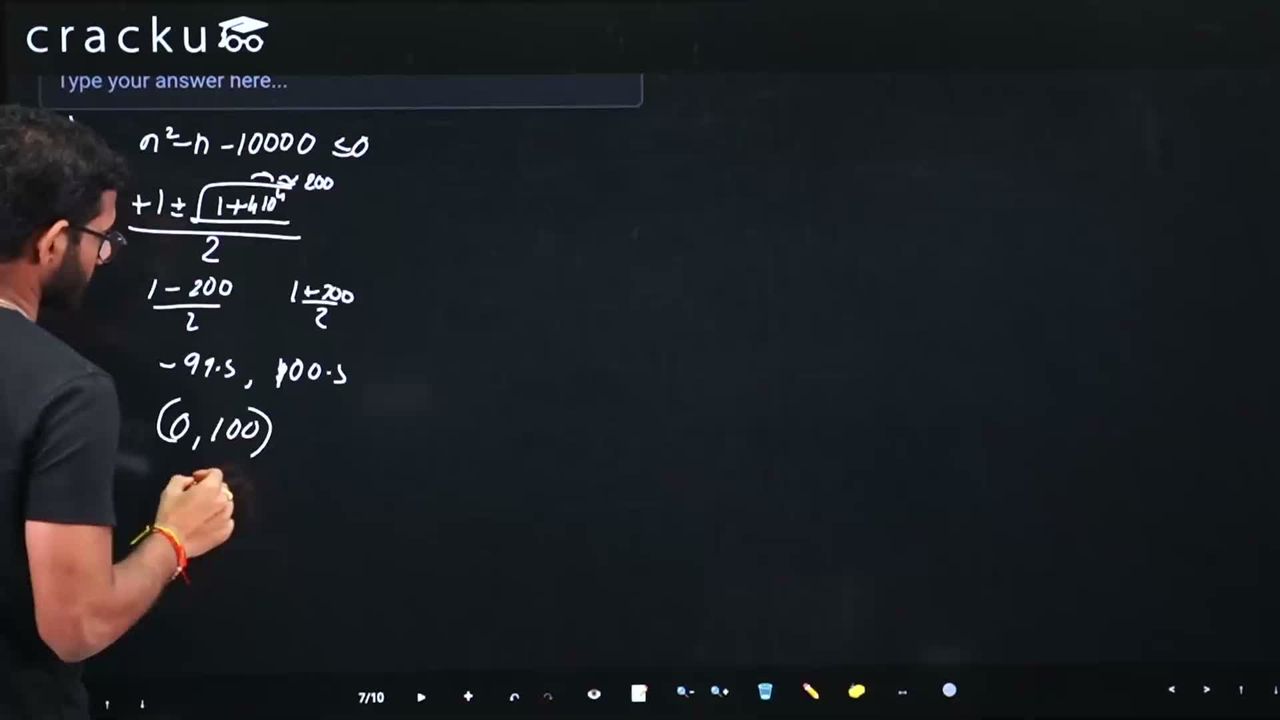
$$n^{2}\le n+10000 \;\Longrightarrow\; n^{2}-n-10000\le 0.$$
We apply the quadratic-formula roots of $$n^{2}-n-10000=0$$. The formula is stated first:
If $$ax^{2}+bx+c=0,\text{ then }x=\dfrac{-b\pm\sqrt{b^{2}-4ac}}{2a}.$$
For the present quadratic $$a=1,\;b=-1,\;c=-10000$$, so
$$n=\dfrac{-(-1)\pm\sqrt{(-1)^{2}-4(1)(-10000)}}{2(1)} =\dfrac{1\pm\sqrt{1+40000}}{2} =\dfrac{1\pm\sqrt{40001}}{2}.$$
The discriminant $$40001$$ lies between $$200^{2}=40000$$ and $$201^{2}=40401$$, therefore
$$200<\sqrt{40001}<201.$$
Consequently
$$\dfrac{1-\sqrt{40001}}{2}\approx -99.5 \quad\text{and}\quad \dfrac{1+\sqrt{40001}}{2}\approx 100.5.$$
Because $$n$$ must be a positive integer, the inequality $$n^{2}-n-10000\le 0$$ restricts $$n$$ to
$$1\le n\le 100.$$
Hence
$$A=\{1,2,3,\ldots,100\}.$$
Next we examine the set $$B$$:
$$B=\{\,3k+1\mid k\in N\}=\{\,4,7,10,13,\ldots\}.$$
The set $$C$$ is
$$C=\{\,2k\mid k\in N\}=\{\,2,4,6,8,\ldots\},$$
the collection of all positive even integers.
The expression $$B-C$$ means “all elements of $$B$$ that are not in $$C$$.” Because every element of $$C$$ is even, an element $$3k+1$$ is removed whenever it is even. Let us determine the parity of $$3k+1$$:
Parity $$(3k) = \text{Parity}(k)\;(\text{since }3\text{ is odd}).$$
Therefore
$$3k+1$$ is odd $$\Longleftrightarrow k$$ is even $$.$$
Only those $$k$$ that are even survive the subtraction $$B-C$$. Write $$k=2m$$ with $$m\in N$$; then
$$3k+1=3(2m)+1=6m+1.$$
Thus
$$B-C=\{\,6m+1\mid m\in N\,\}=\{\,7,13,19,25,\ldots\}.$$
Now we intersect with $$A$$. We need all numbers of the form $$6m+1$$ that do not exceed $$100$$:
$$6m+1\le100 \;\Longrightarrow\; 6m\le99 \;\Longrightarrow\; m\le16.5.$$
Because $$m$$ is a positive integer, $$m$$ ranges from $$1$$ to $$16$$ inclusive. For each $$m$$ we obtain
$$\begin{aligned} m=1&\;:\;6(1)+1=7,\\ m=2&\;:\;6(2)+1=13,\\ m=3&\;:\;6(3)+1=19,\\ &\;\;\vdots\\ m=16&:;;6(16)+1=97. \end{aligned}$$
Collecting every value we have the set
$$A\cap(B-C)=\{7,13,19,25,31,37,43,49,55,61,67,73,79,85,91,97\}.$$
This is an arithmetic progression whose first term is $$a_{1}=7$$, common difference is $$d=6$$, and the number of terms is $$n=16$$.
The sum $$S_{n}$$ of the first $$n$$ terms of an arithmetic progression is given by the formula
$$S_{n}=\dfrac{n}{2}\bigl(2a_{1}+(n-1)d\bigr).$$
Substituting $$n=16,\;a_{1}=7,\;d=6$$ we obtain
$$S_{16}=\dfrac{16}{2}\bigl(2\cdot7+(16-1)\cdot6\bigr) =8\bigl(14+15\cdot6\bigr) =8\bigl(14+90\bigr) =8\times104 =832.$$
Hence, the correct answer is Option 832.
Was this solution helpful?
Click on the Email ☝️ to Watch the Video Solution
Create a FREE account and get:
_1.webp)

Educational materials for JEE preparation

Ask our AI anything

AI can make mistakes. Please verify important information.
AI can make mistakes. Please verify important information.
