
Join Our JEE Preparation Group
Prep with like-minded aspirants; Get access to free daily tests and study material.
Sign in
Please select an account to continue using cracku.in
↓ →
Join Our JEE Preparation Group
Prep with like-minded aspirants; Get access to free daily tests and study material.
Let $$n$$ be a non-negative integer. Then the number of divisors of the form $$4n + 1$$ of the number $$(10)^{10} \cdot (11)^{11} \cdot (13)^{13}$$ is equal to _________.
Correct Answer: 924
We have to count those positive divisors that can be written in the form $$4n+1$$ for the number $$ (10)^{10}\,(11)^{11}\,(13)^{13}. $$ First we write every factor in terms of its prime constituents:
$$10 = 2\cdot5,$$ so $$ (10)^{10}=2^{10}\,5^{10}.$$ Hence the complete prime‐factorisation of the given number is
$$ N \;=\;2^{10}\,5^{10}\,11^{11}\,13^{13}. $$
Any divisor $$d$$ of $$N$$ therefore has the general form
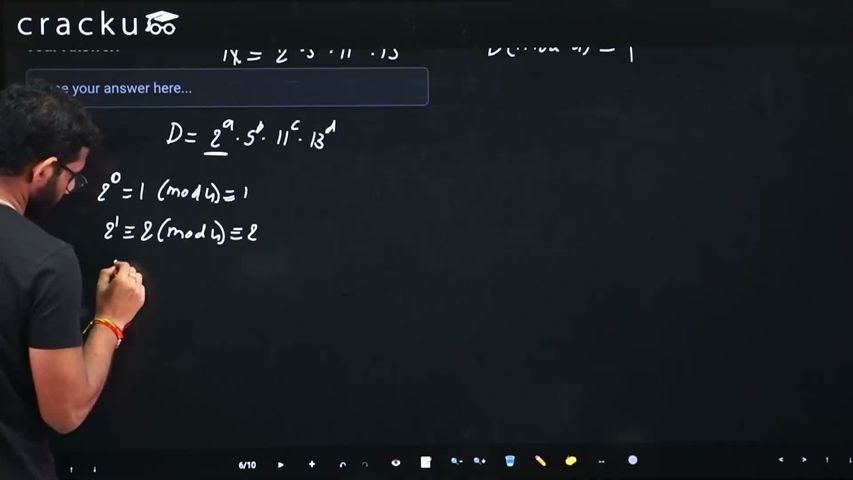
$$ d \;=\;2^{a}\,5^{b}\,11^{c}\,13^{d_1}, $$
where the exponents are restricted by the powers present in $$N$$:
$$ 0\le a\le 10,\quad 0\le b\le 10,\quad 0\le c\le 11,\quad 0\le d_1\le 13. $$
To ensure that $$d$$ is of the form $$4n+1$$ we must have $$d\equiv1\pmod4.$$ We therefore study each prime factor modulo $$4$$:
$$ 2\equiv2\pmod4,\qquad5\equiv1\pmod4,\qquad11\equiv3\pmod4,\qquad13\equiv1\pmod4. $$
Because $$5\equiv1\pmod4$$ and $$13\equiv1\pmod4,$$ every power of $$5$$ or $$13$$ is again congruent to $$1$$ modulo $$4$$:
$$ 5^{b}\equiv1\pmod4,\qquad13^{d_1}\equiv1\pmod4\quad\text{for all }b,d_1. $$
Only the powers of $$2$$ and $$11$$ can change the final remainder. We therefore examine them separately.
Behaviour of $$2^{a}\pmod4$$
$$ 2^{0}=1,\quad2^{1}=2,\quad2^{2}=4\equiv0\pmod4, $$ and for any $$a\ge2$$ we still have $$2^{a}\equiv0\pmod4.$$ Hence
$$ 2^{a}\equiv \begin{cases} 1,&a=0,\\ 2,&a=1,\\ 0,&a\ge2. \end{cases} $$
If $$a\ge2$$ the factor $$2^{a}$$ already forces the whole product to be $$0\pmod4,$$ so such divisors can never be congruent to $$1\pmod4.$$ Therefore we must restrict ourselves to
$$ a=0\quad\text{or}\quad a=1. $$
Behaviour of $$11^{c}\pmod4$$
Since $$11\equiv3\pmod4,$$ we use the basic property $$3^{2}\equiv9\equiv1\pmod4.$$ Thus
$$ 11^{c}\equiv3^{c}\equiv \begin{cases} 1,&c\text{ even},\\ 3,&c\text{ odd}. \end{cases} $$
Combining the two factors
The total remainder contributed by $$2^{a}11^{c}$$ is
$$ (2^{a}\bmod4)\times(3^{c}\bmod4)\pmod4. $$
We now test the only possible values of $$a$$(namely $$0$$ and $$1$$):
• If $$a=0,$$ then $$2^{a}\equiv1,$$ so we need $$ 1\times3^{c}\equiv1\pmod4, $$ which is true exactly when $$3^{c}\equiv1,$$ i.e. when $$c$$ is even.
• If $$a=1,$$ then $$2^{a}\equiv2,$$ giving $$ 2\times3^{c}\pmod4\in\{2,\,2\}\quad(\text{because }3^{c}\equiv1\text{ or }3), $$ both of which are $$2\pmod4,$$ never $$1.$$ Hence no divisor with $$a=1$$ can satisfy the condition.
Consequently the required divisors must have
$$ a=0,\qquad c\text{ even}. $$
Counting the allowable choices
• For $$a$$ there is only one choice: $$a=0.$$
• For $$c$$ (ranging from $$0$$ to $$11$$) the even values are
$$0,2,4,6,8,10,$$ a total of $$6$$ choices.
• For $$b$$ any value from $$0$$ to $$10$$ is permitted, giving $$10-0+1=11$$ choices.
• For $$d_1$$ any value from $$0$$ to $$13$$ is allowed, giving $$13-0+1=14$$ choices.
Multiplying the independent counts we obtain the total number of divisors congruent to $$1\pmod4$$:
$$ 1\times6\times11\times14 \;=\; 6\times154 \;=\; 924. $$
So, the answer is $$924$$.
Was this solution helpful?
Click on the Email ☝️ to Watch the Video Solution
Create a FREE account and get:
_1.webp)

Educational materials for JEE preparation

Ask our AI anything

AI can make mistakes. Please verify important information.
AI can make mistakes. Please verify important information.
