
Join Our JEE Preparation Group
Prep with like-minded aspirants; Get access to free daily tests and study material.
Sign in
Please select an account to continue using cracku.in
↓ →
Join Our JEE Preparation Group
Prep with like-minded aspirants; Get access to free daily tests and study material.
If the real part of the complex number $$z = \frac{3 + 2i\cos\theta}{1 - 3i\cos\theta}$$, $$\theta \in \left(0, \frac{\pi}{2}\right)$$ is zero, then the value of $$\sin^2 3\theta + \cos^2 \theta$$ is equal to _________
Correct Answer: 1
We are given the complex number $$z=\dfrac{3+2i\cos\theta}{1-3i\cos\theta}$$ with $$\theta\in\left(0,\dfrac{\pi}{2}\right)$$ and the information that the real part of $$z$$ is zero. Our goal is to find the value of $$\sin^2 3\theta+\cos^2\theta$$.
First, we rewrite $$z$$ in the standard (a + ib) form so that its real part becomes evident. To do this, we multiply the numerator and the denominator by the complex conjugate of the denominator:
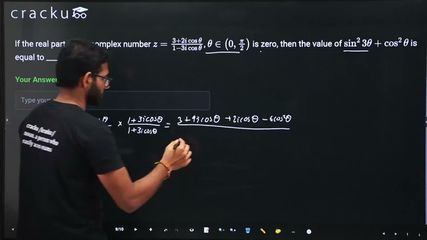
$$z=\dfrac{3+2i\cos\theta}{1-3i\cos\theta}\cdot\dfrac{1+3i\cos\theta}{1+3i\cos\theta} =\dfrac{(3+2i\cos\theta)(1+3i\cos\theta)}{(1)^2-(3i\cos\theta)^2}.$$
We now simplify the denominator. Using $$i^2=-1$$, we have
$$ (1)^2-(3i\cos\theta)^2 =1-\bigl(9i^2\cos^2\theta\bigr) =1-9(-1)\cos^2\theta =1+9\cos^2\theta. $$
Next we expand the numerator term by term:
$$ (3+2i\cos\theta)(1+3i\cos\theta) =3(1)+3(3i\cos\theta)+2i\cos\theta(1)+2i\cos\theta(3i\cos\theta). $$
Evaluating each product:
$$\begin{aligned} 3(1) &= 3,\\ 3(3i\cos\theta) &= 9i\cos\theta,\\ 2i\cos\theta(1) &= 2i\cos\theta,\\ 2i\cos\theta(3i\cos\theta) &= 6i^2\cos^2\theta =6(-1)\cos^2\theta =-6\cos^2\theta. \end{aligned}$$
Adding the real parts and the imaginary parts separately, we obtain
$$ (3-6\cos^2\theta) \;+\; i(9\cos\theta+2\cos\theta) =(3-6\cos^2\theta)\;+\;11i\cos\theta. $$
Therefore,
$$ z=\dfrac{(3-6\cos^2\theta)+11i\cos\theta}{1+9\cos^2\theta}. $$
In this form the real part of $$z$$ is clearly
$$\operatorname{Re}(z)=\dfrac{3-6\cos^2\theta}{1+9\cos^2\theta}.$$
Because the real part is zero, its numerator must be zero:
$$3-6\cos^2\theta=0.$$ Dividing by 3, we get $$1-2\cos^2\theta=0,$$ so $$\cos^2\theta=\dfrac{1}{2}.$$
Given that $$\theta\in\left(0,\dfrac{\pi}{2}\right)$$ (the first quadrant), we take the positive root:
$$\cos\theta=\dfrac{1}{\sqrt2}\quad\Longrightarrow\quad\theta=\dfrac{\pi}{4}.$$
Now we turn to the required expression $$\sin^2 3\theta+\cos^2\theta$$. We already know $$\cos^2\theta=\dfrac12$$. We must compute $$\sin 3\theta$$.
We recall the triple‐angle identity for sine: $$\sin 3A = 3\sin A - 4\sin^3 A.$$
Putting $$A=\theta=\dfrac{\pi}{4}$$, we first note $$\sin\theta=\sin\dfrac{\pi}{4}=\dfrac{1}{\sqrt2}.$$
Applying the formula,
$$ \begin{aligned} \sin 3\theta &=3\sin\theta-4\sin^3\theta\\ &=3\left(\dfrac{1}{\sqrt2}\right)-4\left(\dfrac{1}{\sqrt2}\right)^3\\ &=\dfrac{3}{\sqrt2}-4\cdot\dfrac{1}{2\sqrt2}\\ &=\dfrac{3}{\sqrt2}-\dfrac{2}{\sqrt2}\\ &=\dfrac{1}{\sqrt2}. \end{aligned} $$
Consequently,
$$\sin^2 3\theta=\left(\dfrac{1}{\sqrt2}\right)^2=\dfrac12.$$
Finally, we add the two squares:
$$ \sin^2 3\theta+\cos^2\theta =\dfrac12+\dfrac12 =1. $$
Hence, the correct answer is Option 1.
Was this solution helpful?
Click on the Email ☝️ to Watch the Video Solution
Create a FREE account and get:
_1.webp)

Educational materials for JEE preparation

Ask our AI anything

AI can make mistakes. Please verify important information.
AI can make mistakes. Please verify important information.
