
Join Our JEE Preparation Group
Prep with like-minded aspirants; Get access to free daily tests and study material.
Sign in
Please select an account to continue using cracku.in
↓ →
Join Our JEE Preparation Group
Prep with like-minded aspirants; Get access to free daily tests and study material.
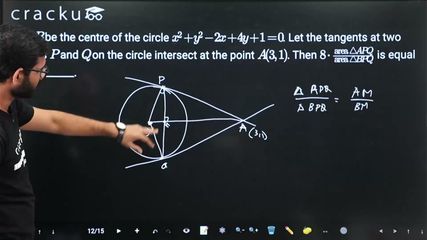
Let $$B$$ be the centre of the circle $$x^2 + y^2 - 2x + 4y + 1 = 0$$. Let the tangents at two points $$P$$ and $$Q$$ on the circle intersect at the point $$A(3, 1)$$. Then $$8 \cdot \frac{\text{area } \triangle APQ}{\text{area } \triangle BPQ}$$ is equal to _________.
Correct Answer: 18
We have the circle
$$x^{2}+y^{2}-2x+4y+1=0.$$
The general form of a circle is written as
$$x^{2}+y^{2}+2gx+2fy+c=0,$$
so by comparing we see
$$2g=-2 \;\;\Longrightarrow\;\; g=-1,$$
$$2f=4 \;\;\Longrightarrow\;\; f=2,$$
$$c=1.$$
Hence the centre of the circle is
$$B(-g,\,-f)=(1,\,-2).$$
The two tangents drawn from the external point
$$A(3,\,1)$$
touch the circle at the points $$P$$ and $$Q$$. The line $$PQ$$ is therefore the chord of contact of $$A$$ with respect to the given circle.
The formula for the chord of contact from an external point $$(x_{1},y_{1})$$ to the circle $$x^{2}+y^{2}+2gx+2fy+c=0$$ is obtained by replacing $$x^{2}$$ by $$xx_{1}$$ and $$y^{2}$$ by $$yy_{1}$$ in the equation of the circle. Symbolically,
$$T=0:\; xx_{1}+yy_{1}+g(x+x_{1})+f(y+y_{1})+c=0.$$
Here $$(x_{1},y_{1})=(3,\,1)$$. Substituting $$g=-1,\;f=2,\;c=1$$ we get
$$xx_{1}+yy_{1}+g(x+x_{1})+f(y+y_{1})+c=0,$$
$$x\cdot3+y\cdot1+(-1)(x+3)+2(y+1)+1=0.$$
Simplifying term by term:
$$3x+y-x-3+2y+2+1=0,$$
$$(3x-x)=2x,\quad (y+2y)=3y,\quad (-3+2+1)=0,$$
so the chord of contact is
$$2x+3y=0.$$
Thus the straight line joining $$P$$ and $$Q$$ is
$$PQ:\;2x+3y=0.$$
Both triangles $$\triangle APQ$$ and $$\triangle BPQ$$ have the same base $$PQ$$. Therefore the ratio of their areas equals the ratio of the perpendicular distances of the vertices $$A$$ and $$B$$ from the line $$PQ$$. That is,
$$\frac{\text{area }\triangle APQ}{\text{area }\triangle BPQ} =\frac{\text{distance of }A\text{ from }PQ} {\text{distance of }B\text{ from }PQ}.$$
The distance of a point $$(x_{0},y_{0})$$ from the line $$2x+3y=0$$ is given by the point-to-line distance formula:
$$d=\frac{|2x_{0}+3y_{0}|}{\sqrt{2^{2}+3^{2}}} =\frac{|2x_{0}+3y_{0}|}{\sqrt{13}}.$$
Distance of $$A(3,1)$$ from $$PQ$$
$$d_{A}=\frac{|2\cdot3+3\cdot1|}{\sqrt{13}} =\frac{|6+3|}{\sqrt{13}} =\frac{9}{\sqrt{13}}.$$
Distance of $$B(1,-2)$$ from $$PQ$$
$$d_{B}=\frac{|2\cdot1+3\cdot(-2)|}{\sqrt{13}} =\frac{|2-6|}{\sqrt{13}} =\frac{4}{\sqrt{13}}.$$
Hence
$$\frac{\text{area }\triangle APQ}{\text{area }\triangle BPQ} =\frac{d_{A}}{d_{B}} =\frac{9/\sqrt{13}}{4/\sqrt{13}} =\frac{9}{4}.$$
We are asked to find
$$8\cdot\frac{\text{area }\triangle APQ}{\text{area }\triangle BPQ} =8\cdot\frac{9}{4} =\frac{8\times9}{4} =2\times9 =18.$$
So, the answer is $$18$$.
Click on the Email ☝️ to Watch the Video Solution
Create a FREE account and get:
_1.webp)

Educational materials for JEE preparation

Ask our AI anything

AI can make mistakes. Please verify important information.
AI can make mistakes. Please verify important information.


