
Join Our JEE Preparation Group
Prep with like-minded aspirants; Get access to free daily tests and study material.
Sign in
Please select an account to continue using cracku.in
↓ →
Join Our JEE Preparation Group
Prep with like-minded aspirants; Get access to free daily tests and study material.
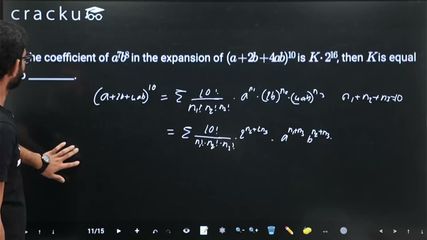
If the coefficient of $$a^7 b^8$$ in the expansion of $$(a + 2b + 4ab)^{10}$$ is $$K \cdot 2^{16}$$, then $$K$$ is equal to _________.
Correct Answer: 315
We have to find the coefficient of the term containing $$a^{7} b^{8}$$ in the expansion of $$(a + 2b + 4ab)^{10}$$.
First recall the multinomial theorem. For any three terms $$x_{1}, x_{2}, x_{3}$$,
$$ (x_{1} + x_{2} + x_{3})^{10} = \sum_{n_{1}+n_{2}+n_{3}=10} \dfrac{10!}{n_{1}! \, n_{2}! \, n_{3}!}\; x_{1}^{\,n_{1}} x_{2}^{\,n_{2}} x_{3}^{\,n_{3}}. $$
In our question we identify
$$x_{1}=a, \qquad x_{2}=2b, \qquad x_{3}=4ab.$$
Let $$n_{1}, n_{2}, n_{3}$$ be the number of times these three terms are chosen, so
$$n_{1}+n_{2}+n_{3}=10.$$
The powers of $$a$$ and $$b$$ contributed by one choice of each term are
$$x_{1}=a \;\; \longrightarrow \;\; a^{1} b^{0},$$ $$x_{2}=2b \;\; \longrightarrow \;\; a^{0} b^{1},$$ $$x_{3}=4ab \;\;\longrightarrow \;\; a^{1} b^{1}.$
Hence after making $$n_{1}, n_{2}, n_{3}$$ selections, the total exponents of $$a$$ and $$b$$ become
$$\text{Power of } a : \; n_{1} + n_{3},$$ $$\text{Power of } b : \; n_{2} + n_{3}.$$
We need these powers to be $$7$$ and $$8$$ respectively, so we write the two equations
$$n_{1} + n_{3} = 7, \qquad n_{2} + n_{3} = 8.$$
Together with $$n_{1}+n_{2}+n_{3}=10,$$ we now solve for $$n_{1}, n_{2}, n_{3}.$
Adding the first two equations gives
$$n_{1}+n_{2}+2n_{3}=15.$$
But $$n_{1}+n_{2}=10-n_{3},$$ so substituting,
$$(10-n_{3}) + 2n_{3} = 15 \;\; \Longrightarrow \;\; 10 + n_{3} = 15 \;\; \Longrightarrow \;\; n_{3} = 5.$$
Now we back-substitute:
$$n_{1} = 7 - n_{3} = 7 - 5 = 2,$$ $$n_{2} = 8 - n_{3} = 8 - 5 = 3.$$
Thus the required term arises from $$n_{1}=2,\, n_{2}=3,\, n_{3}=5.$
According to the multinomial theorem, the coefficient of this term is
$$\dfrac{10!}{n_{1}! \, n_{2}! \, n_{3}!}\; (2)^{n_{2}}\;(4)^{n_{3}}.$$
Writing out the factorials,
$$10! = 3628800,$$ $$n_{1}! = 2! = 2,$$ $$n_{2}! = 3! = 6,$$ $$n_{3}! = 5! = 120.$$
So
$$\dfrac{10!}{2!\,3!\,5!} = \dfrac{3628800}{2 \times 6 \times 120} = \dfrac{3628800}{1440} = 2520.$$
Next incorporate the numerical factors from the bases:
$$(2)^{n_{2}} = 2^{3} = 8,$$ $$(4)^{n_{3}} = (2^{2})^{5} = 2^{10} = 1024.$$
Multiplying these powers of $$2$$,
$$8 \times 1024 = 2^{3} \times 2^{10} = 2^{13} = 8192.$$
Hence the full numerical coefficient of the term $$a^{7} b^{8}$$ is
$$2520 \times 8192 = 20643840.$$
We are told in the question that this coefficient can be written as $$K \cdot 2^{16}.$$ Since $$2^{16}=65536,$$ we set up the equation
$$K \times 65536 = 20643840.$$
Dividing to isolate $$K,$$
$$K = \dfrac{20643840}{65536}.$$
Compute the division step by step:
$$65536 \times 300 = 19660800,$$
Subtracting, $$20643840 - 19660800 = 983040,$$
$$65536 \times 10 = 655360,$$
Subtracting, $$983040 - 655360 = 327680,$$
$$65536 \times 5 = 327680,$$
Subtracting, the remainder is $$0.$$
Adding the multipliers, $$300 + 10 + 5 = 315.$$ Therefore,
$$K = 315.$$
So, the answer is $$315$$.
Click on the Email ☝️ to Watch the Video Solution
Create a FREE account and get:
_1.webp)

Educational materials for JEE preparation

Ask our AI anything

AI can make mistakes. Please verify important information.
AI can make mistakes. Please verify important information.


