
Join Our JEE Preparation Group
Prep with like-minded aspirants; Get access to free daily tests and study material.
Sign in
Please select an account to continue using cracku.in
↓ →
Join Our JEE Preparation Group
Prep with like-minded aspirants; Get access to free daily tests and study material.
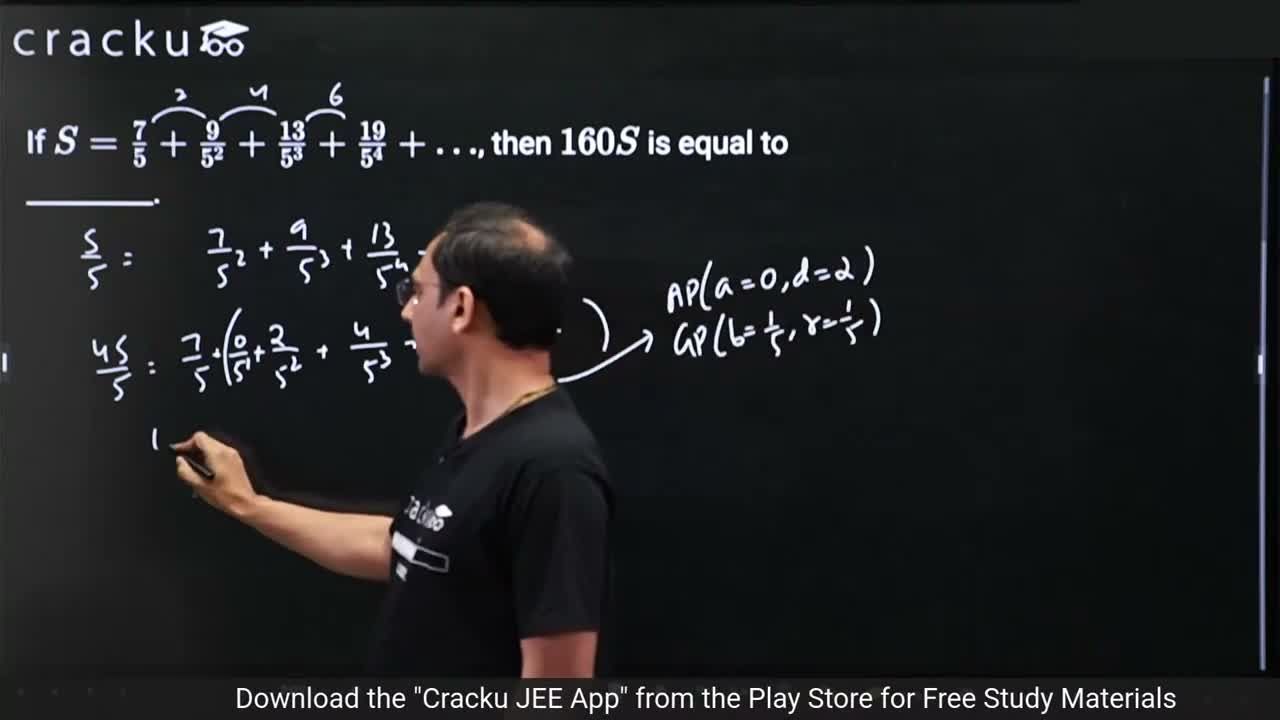
If $$S = \frac{7}{5} + \frac{9}{5^2} + \frac{13}{5^3} + \frac{19}{5^4} + \ldots$$, then $$160 S$$ is equal to _________.
Correct Answer: 305
We begin by writing the series in a compact sigma form. Observing the pattern of the numerators, we have
$$S=\frac{7}{5}+\frac{9}{5^{2}}+\frac{13}{5^{3}}+\frac{19}{5^{4}}+\ldots =\sum_{n=1}^{\infty}\frac{a_n}{5^{\,n}},$$ where the numerators are $$a_1=7,\;a_2=9,\;a_3=13,\;a_4=19,\ldots$$
To find the general formula for $$a_n$$, we assume a quadratic form $$a_n=An^{2}+Bn+C$$ and use the first three terms:
$$\begin{aligned} A(1)^2+B(1)+C&=7,\\ A(2)^2+B(2)+C&=9,\\ A(3)^2+B(3)+C&=13. \end{aligned}$$
Simplifying each line gives
$$\begin{aligned} A+B+C&=7,\\ 4A+2B+C&=9,\\ 9A+3B+C&=13. \end{aligned}$$
Subtracting the first equation from the second yields $$3A+B=2,$$ and subtracting the second from the third gives $$5A+B=4.$$ Subtracting these two new relations gives $$2A=2\Rightarrow A=1.$$ Putting $$A=1$$ in $$3A+B=2$$ leads to $$B=-1,$$ and finally $$C=7-(A+B)=7-(1-1)=7.$$ Hence
$$a_n=n^{2}-n+7.$$
Thus the series can be written as
$$S=\sum_{n=1}^{\infty}\left(n^{2}-n+7\right)\left(\frac{1}{5}\right)^{n}.$$
We separate the sum term-wise:
$$S=\sum_{n=1}^{\infty}n^{2}\left(\frac15\right)^{n}-\sum_{n=1}^{\infty}n\left(\frac15\right)^{n} +7\sum_{n=1}^{\infty}\left(\frac15\right)^{n}.$$
We now recall the standard power-series formulae valid for |x|<1:
$$\sum_{n=1}^{\infty}x^{n}=\frac{x}{1-x},\qquad \sum_{n=1}^{\infty}nx^{n}=\frac{x}{(1-x)^{2}},\qquad \sum_{n=1}^{\infty}n^{2}x^{n}=\frac{x(1+x)}{(1-x)^{3}}.$$
Here $$x=\dfrac15,$$ so we compute each required sum.
For the geometric progression:
$$\sum_{n=1}^{\infty}\left(\frac15\right)^{n} =\frac{\frac15}{1-\frac15} =\frac{\frac15}{\frac45} =\frac14.$$
For the arithmetico-geometric progression:
$$\sum_{n=1}^{\infty}n\left(\frac15\right)^{n} =\frac{\frac15}{\left(1-\frac15\right)^{2}} =\frac{\frac15}{\left(\frac45\right)^{2}} =\frac{\frac15}{\frac{16}{25}} =\frac{25}{80} =\frac5{16}.$$
For the quadratic arithmetico-geometric progression:
$$\sum_{n=1}^{\infty}n^{2}\left(\frac15\right)^{n} =\frac{\frac15\!\left(1+\frac15\right)}{\left(1-\frac15\right)^{3}} =\frac{\frac15\cdot\frac65}{\left(\frac45\right)^{3}} =\frac{\frac65}{25}\cdot\frac{125}{64} =\frac{6\cdot125}{25\cdot64} =\frac{750}{1600} =\frac{75}{160} =\frac{15}{32}.$$
Substituting these results back into the expression for $$S$$ gives
$$\begin{aligned} S&=\left(\frac{15}{32}\right)-\left(\frac{5}{16}\right)+7\left(\frac14\right)\\[4pt] &=\frac{15}{32}-\frac{10}{32}+\frac{56}{32}\\[4pt] &=\frac{61}{32}. \end{aligned}$$
Finally, we multiply by 160 as required:
$$160\,S=160\left(\frac{61}{32}\right)=\frac{160}{32}\times61=5\times61=305.$$
Hence, the correct answer is Option 305.
Click on the Email ☝️ to Watch the Video Solution
Create a FREE account and get:
_1.webp)

Educational materials for JEE preparation

Ask our AI anything

AI can make mistakes. Please verify important information.
AI can make mistakes. Please verify important information.


